Fine-grained Two-factor Access Control for
Web-based Cloud Computing Services
ABSTRACT
 A new fine-grained two-factor authentication (2FA)
access control system for web-based cloud computing
services has been proposed.
 In our proposed 2FA access control system, an attribute-
based access control mechanism is implemented with the
necessity of both user secret key and a lightweight
security device.
 As a user cannot access the system if s/he does not hold
both, the mechanism can enhance the security of the
system, especially in those scenarios where many users
share the same computer for web-based cloud services.
LITERATURE SURVEY
InterCloud: Utility-Oriented Federation of Cloud
Computing Environments for Scaling of
Application Services
• Cloud computing providers have setup several data
centers at different geographical locations over the
Internet in order to optimally serve needs of their
customers around the world
• The Cloud computing providers are unable to predict
geographic distribution of users consuming their
services, hence the load coordination must happen
automatically,
 The overall goal is to create a computing
environment that supports dynamic expansion or
contraction of capabilities
 using the CloudSim toolkit The results demonstrate
that federated Cloud computing model has immense
potential as it offers significant performance gains as
regards to response time and cost saving under
dynamic workload scenarios.
ADVANTAGES & DISADVANATGES
ADVANTAGES:
 Scalable architecture and frequent data accessibility.
 Fast access of data.
 Data can be accessed from anywhere in the world.
DISADVANATGES:
 Complexity occurs for large number of data to
maintain.
 Too much load can crash the whole system and
flow of data
(2) Characterizing Task Usage Shapes in Google’s
Compute Clusters:
 The increase in scale and complexity of large compute clusters
motivates a need for representative workload benchmarks to
evaluate the performance impact of system changes
 The goal is to find an accurate characterization that can
faithfully reproduce the performance of historical workload
traces in terms of key performance metrics
 Through experiments using workload traces from Google
production clusters, we find that simply using the mean of
task usage can generate synthetic work-load traces that
accurately reproduce resource utilizations and task waiting
time
ADVANATAGES & DISADVANATAGES
ADVANATGES:
 Advance security measiures like 2-step verification
was introduced.
 Less chances of system failure or data loss.
 High security measures.
DISADVANATGES:
 Hard for users to use this system because of its
complexity
 Time Consuming process.
(3) An Analysis of Traces from a Production
MapReduce Cluster:
 MapReduce is a programming paradigm for parallel
processing that is increasingly being used for data-
intensive applications in cloud computing environments
 The service provider can use this knowledge to make
better scheduling decisions
 We use an instance-based learning technique that
exploits temporal locality to predict job completion times
from historical data and identify potential performance
problems in our dataset.
ADVANATAGES & DISADAVANATGES
ADVANTAGES:
 Step by step verifications required for users to prove
their identity and Cluster based data maintenance
 High security measures
DISADVANATAGES:
 Hard to clear the authentication process
 Time consuming
(4) Characterization of Hadoop Jobs Using
Unsupervised Learning:
 Apache Hadoop, is increasingly being used for data-
intensive applications in cloud computing
environments.
 MapReduce environments benefits both the cloud
service providers and their users.
 metrics and job configuration features such as
format of the input/output files, type of compression
used etc to find similarity among Hadoop jobs
ADVANATGES & DISADVANTAGES
ADVANTAGES:
 Random Key methodology is implemented for
signature verification
 Handling of huge amount of data is possible
 Ease of use
DISADVANATGES:
 Possibility of guessing the key structure is high.
 Less secure when compared to other methods
(5) An approach for characterizing workloads
in Google cloud to derive Realistic resource
utilization models:
 Analyzing behavioral patterns of workloads is critical
to understanding Cloud computing environments.
 the first large-scale analysis of real-world Cloud data,
using a recently released dataset that features traces
from over 12,000 servers over the period of a month.
 The derived model assists in understanding the
relationship between users and tasks within
workload, and enables further work
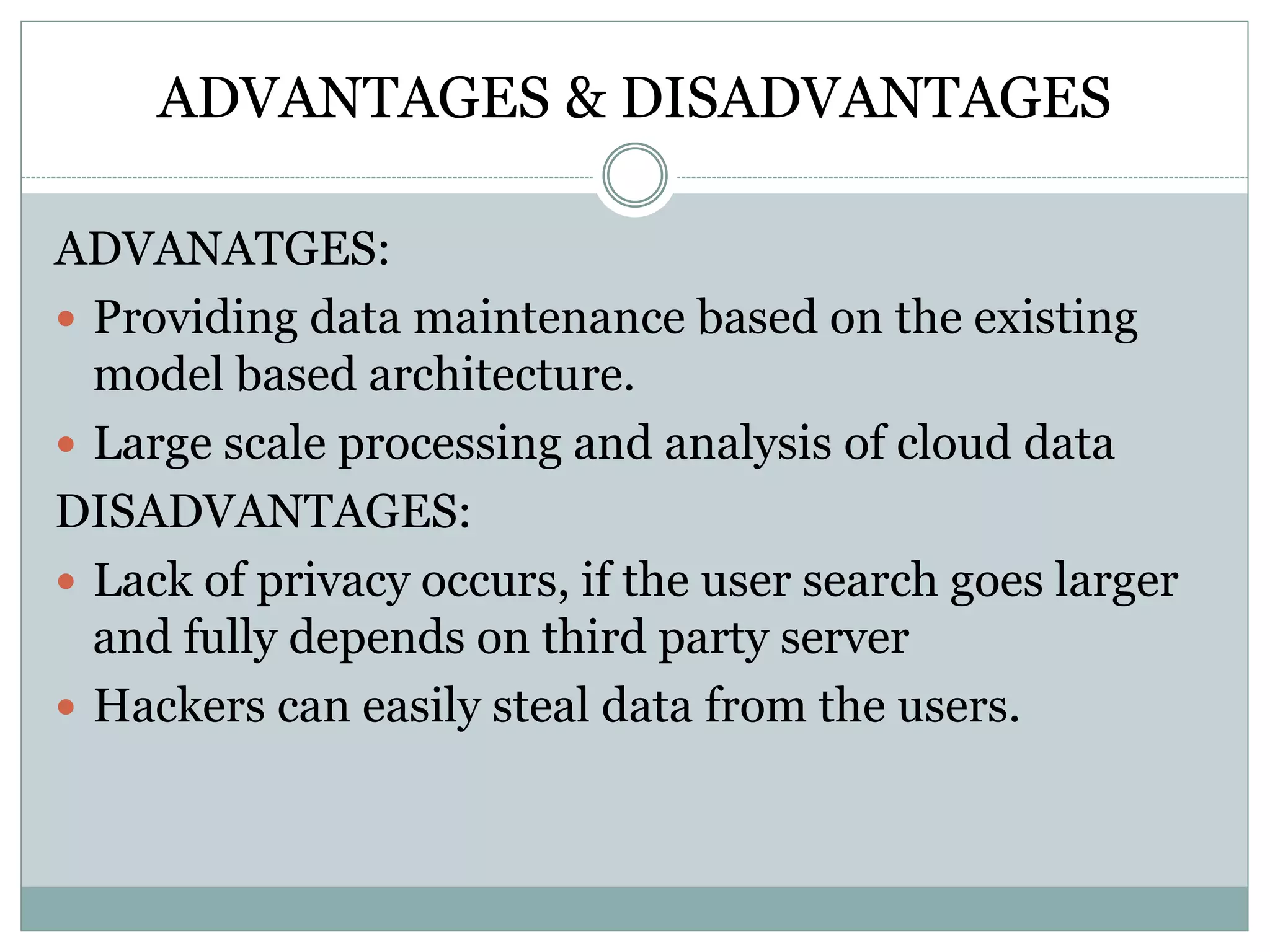
ADVANTAGES & DISADVANTAGES
ADVANATGES:
 Providing data maintenance based on the existing
model based architecture.
 Large scale processing and analysis of cloud data
DISADVANTAGES:
 Lack of privacy occurs, if the user search goes larger
and fully depends on third party server
 Hackers can easily steal data from the users.
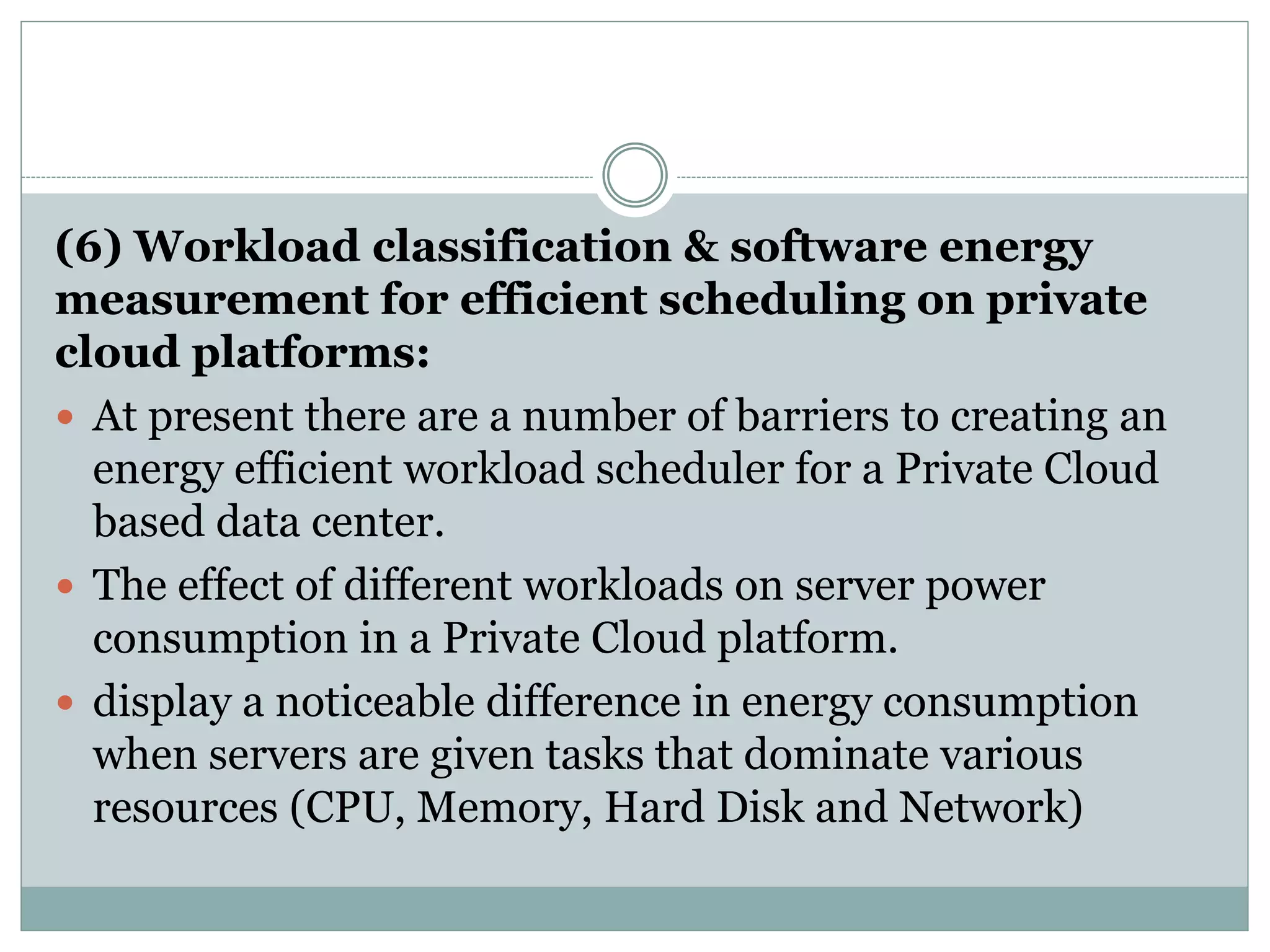
(6) Workload classification & software energy
measurement for efficient scheduling on private
cloud platforms:
 At present there are a number of barriers to creating an
energy efficient workload scheduler for a Private Cloud
based data center.
 The effect of different workloads on server power
consumption in a Private Cloud platform.
 display a noticeable difference in energy consumption
when servers are given tasks that dominate various
resources (CPU, Memory, Hard Disk and Network)
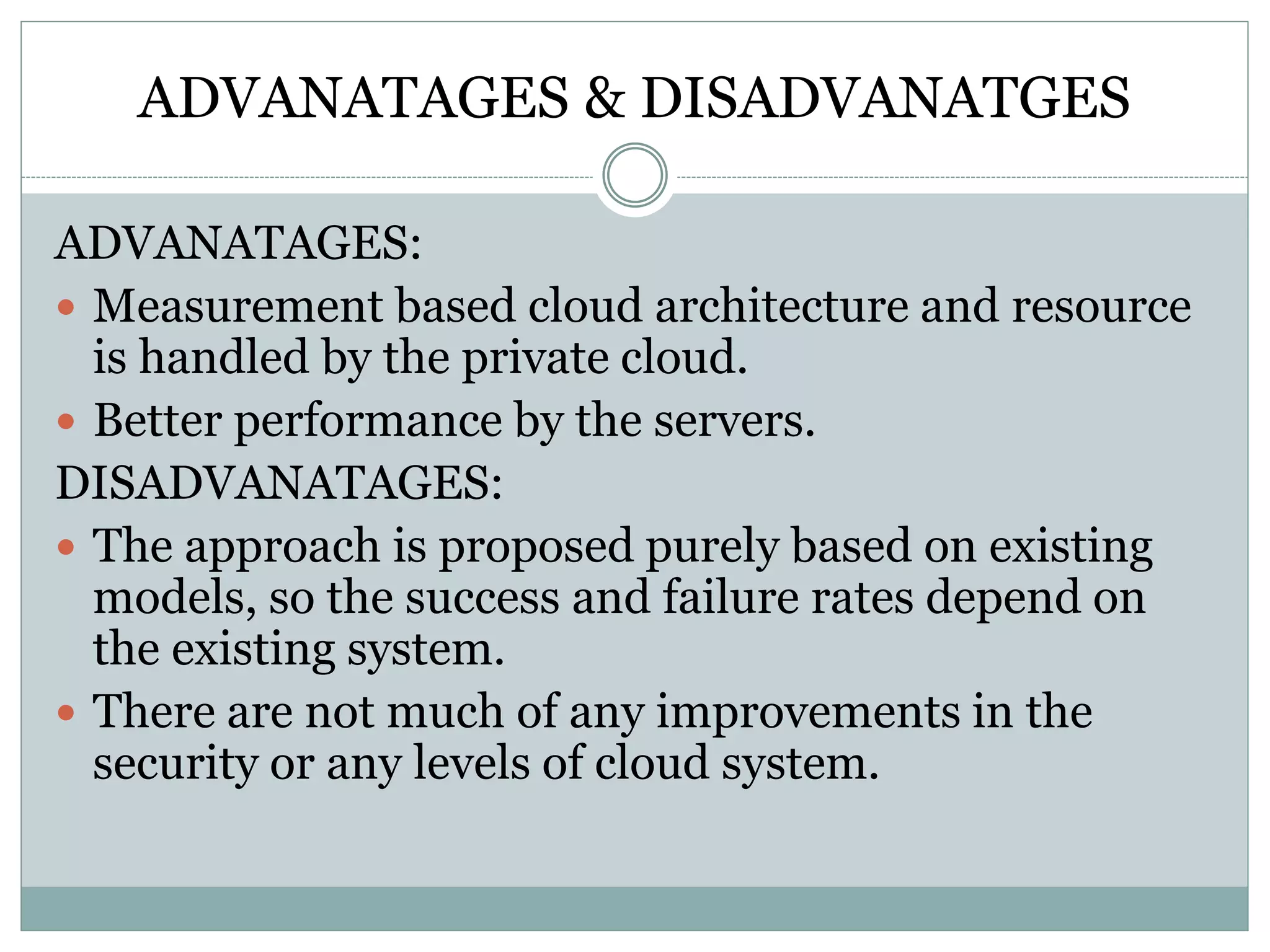
ADVANATAGES & DISADVANATGES
ADVANATAGES:
 Measurement based cloud architecture and resource
is handled by the private cloud.
 Better performance by the servers.
DISADVANATAGES:
 The approach is proposed purely based on existing
models, so the success and failure rates depend on
the existing system.
 There are not much of any improvements in the
security or any levels of cloud system.
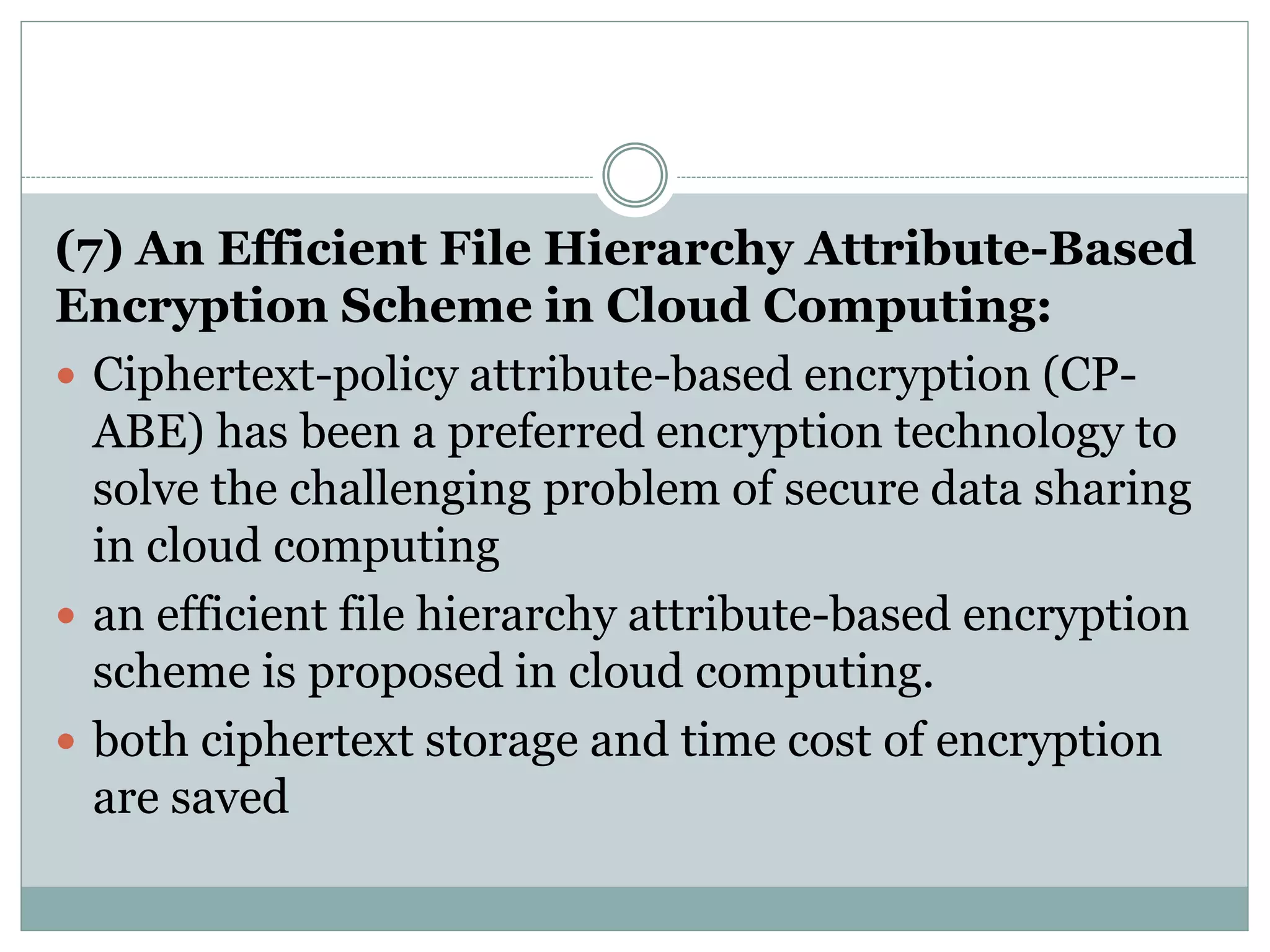
(7) An Efficient File Hierarchy Attribute-Based
Encryption Scheme in Cloud Computing:
 Ciphertext-policy attribute-based encryption (CP-
ABE) has been a preferred encryption technology to
solve the challenging problem of secure data sharing
in cloud computing
 an efficient file hierarchy attribute-based encryption
scheme is proposed in cloud computing.
 both ciphertext storage and time cost of encryption
are saved
ADVANATAGES & DISADVANATAGES
ADAVANATGES:
 Layered access structures are integrated into a single
structure in CP-ABE.
 Very high level of encryption and security of data
DISADVANATAGES:
 The shared data files generally have the
characteristic of multilevel hierarchy.
 It can cause errors in data processing.
(8) Intrusion-Resilience via the Bounded-Storage
Model:
 New methords are used to preserve the protocols from
the malicious program
 The security of our protocols relies on the assumption
that the amount of data that the adversary can transfer
from the infected machine is limited
 This method is based on the results from the
BoundedStorage Model
 This type of software can be secretly attached to
seemingly harmless programs, or can be installed by
worms or viruses.
ADVANATAGES & DISADVANATAGES
ADVANATAGES:
 Intrusion-resilience in the cryptographic protocols
by session-key generation and entity authentication.
 High level of security for protection of data.
DISADAVANATAGES:
 The main drawback of our protocols is that during
the intrusion the virus can impersonate the user
 The user might be annoyed by the whole setup
process
(9) SMS-based One-Time Passwords: Attacks
and Defence:
 SMS-based One-Time Passwords (SMS OTP) were
introduced to online bank transaction prevent from
theft
 analyze the security architecture of SMS OTP
systems and study attacks that pose a threat to
Internet-based authentication and authorization
services
 Mechanisms to secure SMS OTPs against common
attacks and specifically against smartphone Trojans
ADVANATAGES & DISADVANTAGES
ADVANTAGES:
 The OTP will only be received in the registered number
of the User which no other have access.
 The OTP’s will only be valid for limited amount of time.
 The randomly generated OTP will not be guessable.
DISADVANATAGES:
 Delay in receiving OTP when there are any network
problems
 The main drawback of this method is OTP can stolen by
a person with whom one work in a profession.
(10) Securing online bank transaction from phishing
attacks using MFA And secure session key:
 Phishing is an online criminal activity using the collection of
social engineering methods such as messages and emails
 The strong techniques are required to avoid phishing attacks
 Multi Factor Authentication (MFA) and secure session key
generation using Gaussian distribution to reduce the attacks
 Authentication technique authenticates the users using user's
signature image recognition and secret question answer.
 session key generated using Gaussian distribution is sent to
user's mobile phone
ADVANATAGES & DISADAVANTAGES
ADVANATAGES:
 Multi Factor Authentication (MFA) and secure session
key generation using Gaussian distribution to reduce the
attacks caused by the phishers
 Multiple levels of security measures available for
protection of data from hackers.
DISADVANATAGES:
 Deceptive phishing attacks, false emails are sent to the
user’s inbox are still threat
 Users are prone to fraud activities by hackers and data
can be stolen by such fraudulent measures.

Fine grained two-factor access control for cloud

  • 1.
    Fine-grained Two-factor AccessControl for Web-based Cloud Computing Services
  • 2.
    ABSTRACT  A newfine-grained two-factor authentication (2FA) access control system for web-based cloud computing services has been proposed.  In our proposed 2FA access control system, an attribute- based access control mechanism is implemented with the necessity of both user secret key and a lightweight security device.  As a user cannot access the system if s/he does not hold both, the mechanism can enhance the security of the system, especially in those scenarios where many users share the same computer for web-based cloud services.
  • 3.
    LITERATURE SURVEY InterCloud: Utility-OrientedFederation of Cloud Computing Environments for Scaling of Application Services • Cloud computing providers have setup several data centers at different geographical locations over the Internet in order to optimally serve needs of their customers around the world • The Cloud computing providers are unable to predict geographic distribution of users consuming their services, hence the load coordination must happen automatically,
  • 4.
     The overallgoal is to create a computing environment that supports dynamic expansion or contraction of capabilities  using the CloudSim toolkit The results demonstrate that federated Cloud computing model has immense potential as it offers significant performance gains as regards to response time and cost saving under dynamic workload scenarios.
  • 5.
    ADVANTAGES & DISADVANATGES ADVANTAGES: Scalable architecture and frequent data accessibility.  Fast access of data.  Data can be accessed from anywhere in the world. DISADVANATGES:  Complexity occurs for large number of data to maintain.  Too much load can crash the whole system and flow of data
  • 6.
    (2) Characterizing TaskUsage Shapes in Google’s Compute Clusters:  The increase in scale and complexity of large compute clusters motivates a need for representative workload benchmarks to evaluate the performance impact of system changes  The goal is to find an accurate characterization that can faithfully reproduce the performance of historical workload traces in terms of key performance metrics  Through experiments using workload traces from Google production clusters, we find that simply using the mean of task usage can generate synthetic work-load traces that accurately reproduce resource utilizations and task waiting time
  • 7.
    ADVANATAGES & DISADVANATAGES ADVANATGES: Advance security measiures like 2-step verification was introduced.  Less chances of system failure or data loss.  High security measures. DISADVANATGES:  Hard for users to use this system because of its complexity  Time Consuming process.
  • 8.
    (3) An Analysisof Traces from a Production MapReduce Cluster:  MapReduce is a programming paradigm for parallel processing that is increasingly being used for data- intensive applications in cloud computing environments  The service provider can use this knowledge to make better scheduling decisions  We use an instance-based learning technique that exploits temporal locality to predict job completion times from historical data and identify potential performance problems in our dataset.
  • 9.
    ADVANATAGES & DISADAVANATGES ADVANTAGES: Step by step verifications required for users to prove their identity and Cluster based data maintenance  High security measures DISADVANATAGES:  Hard to clear the authentication process  Time consuming
  • 10.
    (4) Characterization ofHadoop Jobs Using Unsupervised Learning:  Apache Hadoop, is increasingly being used for data- intensive applications in cloud computing environments.  MapReduce environments benefits both the cloud service providers and their users.  metrics and job configuration features such as format of the input/output files, type of compression used etc to find similarity among Hadoop jobs
  • 11.
    ADVANATGES & DISADVANTAGES ADVANTAGES: Random Key methodology is implemented for signature verification  Handling of huge amount of data is possible  Ease of use DISADVANATGES:  Possibility of guessing the key structure is high.  Less secure when compared to other methods
  • 12.
    (5) An approachfor characterizing workloads in Google cloud to derive Realistic resource utilization models:  Analyzing behavioral patterns of workloads is critical to understanding Cloud computing environments.  the first large-scale analysis of real-world Cloud data, using a recently released dataset that features traces from over 12,000 servers over the period of a month.  The derived model assists in understanding the relationship between users and tasks within workload, and enables further work
  • 13.
    ADVANTAGES & DISADVANTAGES ADVANATGES: Providing data maintenance based on the existing model based architecture.  Large scale processing and analysis of cloud data DISADVANTAGES:  Lack of privacy occurs, if the user search goes larger and fully depends on third party server  Hackers can easily steal data from the users.
  • 14.
    (6) Workload classification& software energy measurement for efficient scheduling on private cloud platforms:  At present there are a number of barriers to creating an energy efficient workload scheduler for a Private Cloud based data center.  The effect of different workloads on server power consumption in a Private Cloud platform.  display a noticeable difference in energy consumption when servers are given tasks that dominate various resources (CPU, Memory, Hard Disk and Network)
  • 15.
    ADVANATAGES & DISADVANATGES ADVANATAGES: Measurement based cloud architecture and resource is handled by the private cloud.  Better performance by the servers. DISADVANATAGES:  The approach is proposed purely based on existing models, so the success and failure rates depend on the existing system.  There are not much of any improvements in the security or any levels of cloud system.
  • 16.
    (7) An EfficientFile Hierarchy Attribute-Based Encryption Scheme in Cloud Computing:  Ciphertext-policy attribute-based encryption (CP- ABE) has been a preferred encryption technology to solve the challenging problem of secure data sharing in cloud computing  an efficient file hierarchy attribute-based encryption scheme is proposed in cloud computing.  both ciphertext storage and time cost of encryption are saved
  • 17.
    ADVANATAGES & DISADVANATAGES ADAVANATGES: Layered access structures are integrated into a single structure in CP-ABE.  Very high level of encryption and security of data DISADVANATAGES:  The shared data files generally have the characteristic of multilevel hierarchy.  It can cause errors in data processing.
  • 18.
    (8) Intrusion-Resilience viathe Bounded-Storage Model:  New methords are used to preserve the protocols from the malicious program  The security of our protocols relies on the assumption that the amount of data that the adversary can transfer from the infected machine is limited  This method is based on the results from the BoundedStorage Model  This type of software can be secretly attached to seemingly harmless programs, or can be installed by worms or viruses.
  • 19.
    ADVANATAGES & DISADVANATAGES ADVANATAGES: Intrusion-resilience in the cryptographic protocols by session-key generation and entity authentication.  High level of security for protection of data. DISADAVANATAGES:  The main drawback of our protocols is that during the intrusion the virus can impersonate the user  The user might be annoyed by the whole setup process
  • 20.
    (9) SMS-based One-TimePasswords: Attacks and Defence:  SMS-based One-Time Passwords (SMS OTP) were introduced to online bank transaction prevent from theft  analyze the security architecture of SMS OTP systems and study attacks that pose a threat to Internet-based authentication and authorization services  Mechanisms to secure SMS OTPs against common attacks and specifically against smartphone Trojans
  • 21.
    ADVANATAGES & DISADVANTAGES ADVANTAGES: The OTP will only be received in the registered number of the User which no other have access.  The OTP’s will only be valid for limited amount of time.  The randomly generated OTP will not be guessable. DISADVANATAGES:  Delay in receiving OTP when there are any network problems  The main drawback of this method is OTP can stolen by a person with whom one work in a profession.
  • 22.
    (10) Securing onlinebank transaction from phishing attacks using MFA And secure session key:  Phishing is an online criminal activity using the collection of social engineering methods such as messages and emails  The strong techniques are required to avoid phishing attacks  Multi Factor Authentication (MFA) and secure session key generation using Gaussian distribution to reduce the attacks  Authentication technique authenticates the users using user's signature image recognition and secret question answer.  session key generated using Gaussian distribution is sent to user's mobile phone
  • 23.
    ADVANATAGES & DISADAVANTAGES ADVANATAGES: Multi Factor Authentication (MFA) and secure session key generation using Gaussian distribution to reduce the attacks caused by the phishers  Multiple levels of security measures available for protection of data from hackers. DISADVANATAGES:  Deceptive phishing attacks, false emails are sent to the user’s inbox are still threat  Users are prone to fraud activities by hackers and data can be stolen by such fraudulent measures.