Download to read offline
![International Research Journal of Engineering and Technology (IRJET) e-ISSN: 2395 -0056
Volume: 04 Issue: 03 | Mar -2017 www.irjet.net p-ISSN: 2395-0072
© 2017, IRJET | Impact Factor value: 5.181 | ISO 9001:2008 Certified Journal | Page 2186
An Anti-phishing Framework Based on Visual Cryptography
Bushra Siddique1, Upendra Malekar2, Mohini Kashyap3
1Student, Dept. of CSE, Ballarpur Institute of Technology, MS, India
2Assistant Professor, Dept. of CSE, Ballarpur Institute of Technology, MS, India
3Student, Dept. of CSE, Ballarpur Institute of Technology, MS, India
---------------------------------------------------------------------***---------------------------------------------------------------------
Abstract - Due to immense use of internet, onlineattackhas
increased. Among that, phishing attack is the most common
one. Phishing is an act carried by an individual or a group to
access personal information such as credit card details,
passwords etc for financial gain and other fraudulent
activities. Thus, a new method is proposed named as "An
Antipishing framework based on visualcryptography"tosolve
phishing issues. In this paper, an image based authentication
using visual cryptography (VC) is used. The use of visual
cryptography is to preserve the privacy of an image captcha
by decomposing the original image captcha into two sheets
that are stored in separate database servers. The original
image captcha can be revealed only when both are
simultaneously available. Once the original image captcha is
revealed to its user, it can be used as the password. Using this,
websites can cross verify it and proves its identity.
Key Words: Image captcha, shares, visual cryptography,
security, phishing.
1. INTRODUCTION
In today’s world, online transactions are very common and
some leads to various online attacks. In this, the major
security threat is the phishing attack and thus innovative
ideas are coming with this every second. So, for this the
preventive measurement should also be developed in a very
effective manner. Therefore, the security for this should not
be traceable easily.
Now-a-days, majority of the applications is as secure as
underlying system. As a result, it is not possible to be
confident that the computer that is connected with the
internet is a secure one or not. Phishing attack is also
creating problems for e-commerceandonlinebankingusers.
So, how to tackle with the application that needs high
security.
The main goal of the phished is to hack information such as
credit card information, passwords etc from the users.
Phishing is a form of fraud in which the attacker tries to
learn information such as login or account information by
masquerading as a reputable entity, IM or other
communication channels. Another definition of phishing is
given as the criminal activity done using social engineering.
The phishing done on the website is sameasthefishingdone
in a lake, but in this phishing instead of stealing the fish the
phisher steals the personal information of the users to
commit crime. Thus, to overcome all this factors we are
giving a technique to prevent phishing using visual
cryptography.
In this technique, a concept called image processing is used.
Here, the image is given as an input and it is been processed
in image processing thus generating the output as the
improved or of the same characteristics of the original
image. The concept of image processing is that an image can
be spitted into any number of shares such that to get the
original image, a particular number of shared must be
combined.
2. RELATED WORK
Phishing web pages are fake web pages that are created by
phishers to imitate Web pages of real web site. This kind of
web page has visual similarities to do fraud with their
victims. Email is the most common way for doing this due to
its easiness and simplicity. Phishers can send crafted emails
to majority of the legitimate and can fool the users using the
flaws in SMTP.
To overcome all this, researchers have given different
methods such as-
1) Automated challenge Response method [1] is a
methodwhichprovidesauthenticationmechanisms.
This method provides two way authentication and
simplicity. This method also prevents man-in-
middle attacks.
2) There are also a DNS-based anti-phishing approach
[2] technique that contains heuristic detection,
blacklists and page similarity assessment.Butthese
techniques to have some cons.](https://image.slidesharecdn.com/irjet-v4i3572-180106055543/85/An-Anti-Phishing-Framework-Based-on-Visual-Cryptography-1-320.jpg)
![International Research Journal of Engineering and Technology (IRJET) e-ISSN: 2395 -0056
Volume: 04 Issue: 03 | Mar -2017 www.irjet.net p-ISSN: 2395-0072
© 2017, IRJET | Impact Factor value: 5.181 | ISO 9001:2008 Certified Journal | Page 2186
An Anti-phishing Framework Based on Visual Cryptography
Bushra Siddique1, Upendra Malekar2, Mohini Kashyap3
1Student, Dept. of CSE, Ballarpur Institute of Technology, MS, India
2Assistant Professor, Dept. of CSE, Ballarpur Institute of Technology, MS, India
3Student, Dept. of CSE, Ballarpur Institute of Technology, MS, India
---------------------------------------------------------------------***---------------------------------------------------------------------
Abstract - Due to immense use of internet, onlineattackhas
increased. Among that, phishing attack is the most common
one. Phishing is an act carried by an individual or a group to
access personal information such as credit card details,
passwords etc for financial gain and other fraudulent
activities. Thus, a new method is proposed named as "An
Antipishing framework based on visualcryptography"tosolve
phishing issues. In this paper, an image based authentication
using visual cryptography (VC) is used. The use of visual
cryptography is to preserve the privacy of an image captcha
by decomposing the original image captcha into two sheets
that are stored in separate database servers. The original
image captcha can be revealed only when both are
simultaneously available. Once the original image captcha is
revealed to its user, it can be used as the password. Using this,
websites can cross verify it and proves its identity.
Key Words: Image captcha, shares, visual cryptography,
security, phishing.
1. INTRODUCTION
In today’s world, online transactions are very common and
some leads to various online attacks. In this, the major
security threat is the phishing attack and thus innovative
ideas are coming with this every second. So, for this the
preventive measurement should also be developed in a very
effective manner. Therefore, the security for this should not
be traceable easily.
Now-a-days, majority of the applications is as secure as
underlying system. As a result, it is not possible to be
confident that the computer that is connected with the
internet is a secure one or not. Phishing attack is also
creating problems for e-commerceandonlinebankingusers.
So, how to tackle with the application that needs high
security.
The main goal of the phished is to hack information such as
credit card information, passwords etc from the users.
Phishing is a form of fraud in which the attacker tries to
learn information such as login or account information by
masquerading as a reputable entity, IM or other
communication channels. Another definition of phishing is
given as the criminal activity done using social engineering.
The phishing done on the website is sameasthefishingdone
in a lake, but in this phishing instead of stealing the fish the
phisher steals the personal information of the users to
commit crime. Thus, to overcome all this factors we are
giving a technique to prevent phishing using visual
cryptography.
In this technique, a concept called image processing is used.
Here, the image is given as an input and it is been processed
in image processing thus generating the output as the
improved or of the same characteristics of the original
image. The concept of image processing is that an image can
be spitted into any number of shares such that to get the
original image, a particular number of shared must be
combined.
2. RELATED WORK
Phishing web pages are fake web pages that are created by
phishers to imitate Web pages of real web site. This kind of
web page has visual similarities to do fraud with their
victims. Email is the most common way for doing this due to
its easiness and simplicity. Phishers can send crafted emails
to majority of the legitimate and can fool the users using the
flaws in SMTP.
To overcome all this, researchers have given different
methods such as-
1) Automated challenge Response method [1] is a
methodwhichprovidesauthenticationmechanisms.
This method provides two way authentication and
simplicity. This method also prevents man-in-
middle attacks.
2) There are also a DNS-based anti-phishing approach
[2] technique that contains heuristic detection,
blacklists and page similarity assessment.Butthese
techniques to have some cons.](https://image.slidesharecdn.com/irjet-v4i3572-180106055543/75/An-Anti-Phishing-Framework-Based-on-Visual-Cryptography-1-2048.jpg)
![International Research Journal of Engineering and Technology (IRJET) e-ISSN: 2395 -0056
Volume: 04 Issue: 03 | Mar -2017 www.irjet.net p-ISSN: 2395-0072
© 2017, IRJET | Impact Factor value: 5.181 | ISO 9001:2008 Certified Journal | Page 2187
a) In Heuristic based anti phishing technique, it is
easy for the hacker to avoid the heuristic
characteristics detection.
b) In Blacklist-based technique, we cannot detect
the website that are not available in the
database of the blacklist
c) In Similarity assessment based technique, it
requires much time to calculatethepages.Thus,
this is not suitable for detecting the phishing
sites.
3) Ren-junn Hwang has proposed a technique which
makes use of watermark method [3] to save digital
image copyright ownership using visual
cryptography. But here, there is the difficulty of
finding the pixels having the watermark pattern.
4) Divya James [4] and Mintu Philip [4] have given an
anti-phishing framework which uses visual
cryptography [5] for detecting the phishing
websites. In this, Image captcha validation scheme
is used. There are two phases in this paper. One is
for registration while other is for login.
3. EXISTING METHODOLOGY
In the existing methodology, from the below diagram we can
see that whenever an end user entersthedatainthewebsites
then if the site is an actual site then the data is safe otherwise
if the site is a phishing site then in this situation the
information can be easily captured by the attackers using
phishing technique.
Fig1: Existing Scenario
4. PROPOSED METHODOLOGY
In our proposed work, we are giving the methodology used
for detecting the phishing websites. Our methodology is
based on anti-phishing image captcha validation scheme
using visual cryptography. The use of visual cryptographyis
to preserve the image captcha privacy. This is done by
decomposing the image captcha into two shares such that
one is with the user and the other with the server. The
original image captcha can be generated only when both the
shares are simultaneously present. The individual share
cannot reveal the image captcha. Once we get the image
captcha we can use it as a password.
This system protects confidential information of users by
proving 3 layers of security.
1) First layer verifies whether the website is phishing
website or secure website. If the site is phished one then it
will not display the image captcha to the users because the
image is generated by the stacking of both the shares,
present with the user and the server.
2) Second layer checksvalidationoftheimagecaptcha in
response to the user. The image captcha is human readable
and not to machine users. Thus, by using image captcha
mechanism no machine basedusercanhack thepasswordor
other information.
3) As a third layer of security, it prevents intruders
attack.
5. MODULES
The modules in our project are: -
1) Registration phase
2) Login phase
A) Registration phase:-
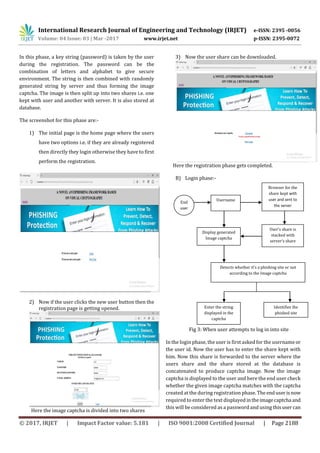
Figure: When user performs registration process for the
website
User enter the key Server enter the key
Image captcha is
generated
Share 2 kept with serverShare 1 kept with user
Stored data gathered by
end user
End
user
Actual
Website
Phishing
Website
Database
Username,
password, Credit
card information and
other confidential
information](https://image.slidesharecdn.com/irjet-v4i3572-180106055543/85/An-Anti-Phishing-Framework-Based-on-Visual-Cryptography-2-320.jpg)
![International Research Journal of Engineering and Technology (IRJET) e-ISSN: 2395 -0056
Volume: 04 Issue: 03 | Mar -2017 www.irjet.net p-ISSN: 2395-0072
© 2017, IRJET | Impact Factor value: 5.181 | ISO 9001:2008 Certified Journal | Page 2190
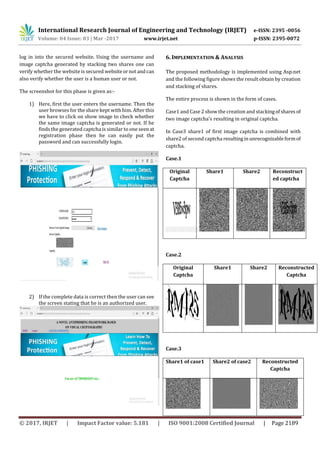
It is seen that both original and reconstructed image
captcha's are related with high degree of correlation.
7. CONCLUSION
Phishing attacks are very common in day-to-day life
because it is done globally and very easily it can store the
user’s confidential information. This data can be used by
attackers. . Phishing websites as well as human users can be
easily identified using our proposed “An Anti-phishing
framework based on Visual Cryptography". The proposed
methodology protects confidential information of users
using 3 layers of security.The proposed methodology can be
used to prevent the attacks of phishing websites onfinancial
web portal, banking portal, online shopping market etc.
REFERENCES
[1]. Thiyagarajan, P.; Venkatesan, V.P.; Aghila, G.;
"Anti-Phishing Technique using Automated
Challenge Response Method'", in Proceedings of
IEEE- International ConferenceonCommunications
and Computational Intelligience, 2010.
[2]. Sun Bin.; Wen Qiaoyan.; Liang Xiaoying.; "A DNS
based Anti-Phishing Approach," in Proceedings of
IEEE- SecondInternational ConferenceonNetworks
Security, Wireless Communications and Trusted
Computing, 2010.
[3]. Ren-Junn Hwang,”A digital image copyright
protection scheme based on visual cryptography”,
Tamkang Journal of science and engineering, Vol.3,
No. 2, pp. 97-106(2000).
[4]. Divya James, Mintu Philip, ”A novel Anti-phishing
framework based on visual cryptography”, IEEE
2012.
[5]. M.Naor andA.Shamir,”Visual cryptography”,inProc.
EUROCRYPT, 1994, pp.1-12. IJDPSVol.3,No.1,2012.](https://image.slidesharecdn.com/irjet-v4i3572-180106055543/85/An-Anti-Phishing-Framework-Based-on-Visual-Cryptography-5-320.jpg)

This document proposes an anti-phishing framework based on visual cryptography to address the growing issue of phishing attacks. It involves splitting an image captcha into two shares stored separately so that only when combined can the original captcha be revealed, preventing phishing sites from accessing it. During registration, a user and server each contribute keys to generate the captcha image, then split into shares. For login, the user share is combined with the stored server share to reconstruct and display the captcha for password verification. The framework aims to provide three layers of security to protect user information and detect phishing sites through image captcha validation.


![[IJET V2I5P15] Authors: V.Preethi, G.Velmayil](https://cdn.slidesharecdn.com/ss_thumbnails/ijet-v2i5p15-161107143444-thumbnail.jpg?width=640&height=640&fit=bounds)


