Jr.’s Source & Load Pull Imran Bashir, David Seymour (Grand Pa),  Chris Kamilar, David Mize
Objective For the given NE721 GaAs MESFET Characterize output power, PAE as a function of S22 (output match) @ 3-dB compression point Characterize noise figure as a function of S11 (input match) Determine  Г opt  at output for power & PAE Determine  Г opt  at input for noise figure Given bias conditions VDD = 3V, V gs  = -0.97V, I dd  = 10mA
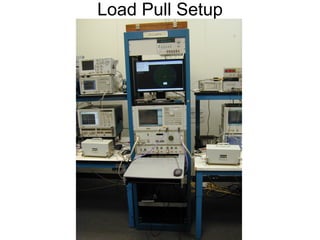
Load Pull Setup
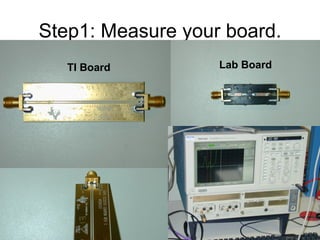
Step1: Measure your board. Lab Board TI Board
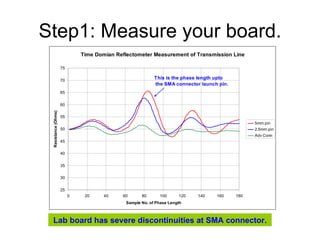
Step1: Measure your board. Lab board has severe discontinuities at SMA connector.
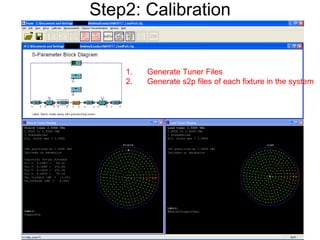
Step2: Calibration Generate Tuner Files Generate s2p files of each fixture in the system
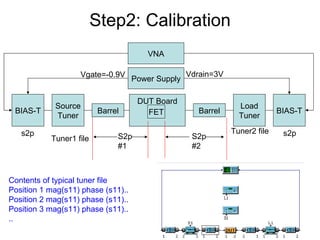
Step2: Calibration Source Tuner Load Tuner Barrel Barrel DUT Board FET BIAS-T BIAS-T VNA Power Supply Vdrain=3V Vgate=-0.9V Tuner1 file Tuner2 file Contents of typical tuner file Position 1 mag(s11) phase (s11).. Position 2 mag(s11) phase (s11).. Position 3 mag(s11) phase (s11).. .. s2p S2p #1 S2p #2 s2p
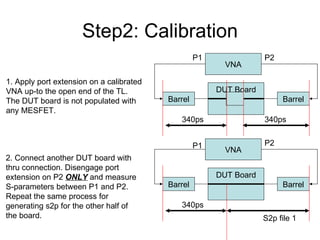
Step2: Calibration DUT Board Barrel Barrel VNA 1. Apply port extension on a calibrated  VNA up-to the open end of the TL. The DUT board is not populated with any MESFET. 340ps 340ps DUT Board Barrel Barrel VNA 340ps S2p file 1 2. Connect another DUT board with thru connection. Disengage port extension on P2  ONLY  and measure S-parameters between P1 and P2. Repeat the same process for generating s2p for the other half of the board. P1 P2 P1 P2
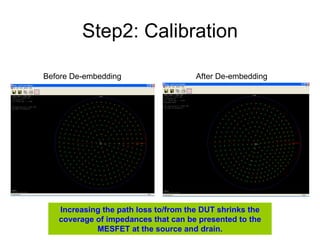
Step2: Calibration Before De-embedding After De-embedding Increasing the path loss to/from the DUT shrinks the coverage of impedances that can be presented to the MESFET at the source and drain.
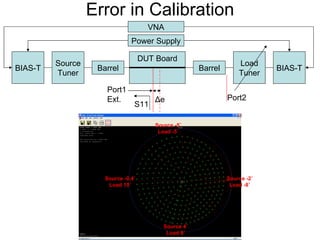
Error in Calibration Source Tuner Load Tuner Barrel Barrel DUT Board BIAS-T BIAS-T VNA Power Supply Port1 Ext. Port2 S11 Δ e Source -0.4 ˚ Load 10˚ Source -5 ˚ Load -5˚ Source -2 ˚ Load -8˚ Source 4 ˚ Load 9˚
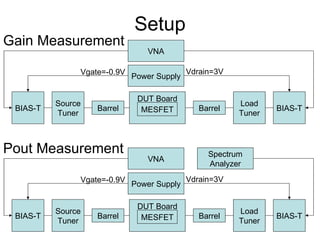
Setup Gain Measurement Source Tuner Load Tuner Barrel Barrel DUT Board MESFET BIAS-T BIAS-T VNA Power Supply Vdrain=3V Vgate=-0.9V Pout Measurement Source Tuner Load Tuner Barrel Barrel DUT Board MESFET BIAS-T BIAS-T VNA Power Supply Vdrain=3V Vgate=-0.9V Spectrum Analyzer
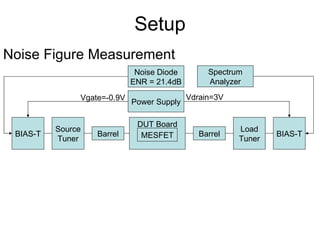
Setup Noise Figure Measurement Source Tuner Load Tuner Barrel Barrel DUT Board MESFET BIAS-T BIAS-T Noise Diode ENR = 21.4dB Power Supply Vdrain=3V Vgate=-0.9V Spectrum Analyzer
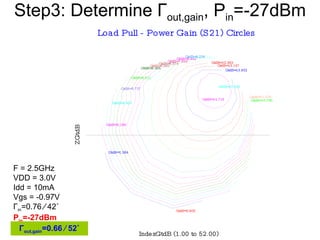
Step3: Determine  Γ out,gain , P in =-27dBm F = 2.5GHz VDD = 3.0V Idd = 10mA Vgs = -0.97V Γ in =0.76 ∕ 42˚ P in =-27dBm Γ out,gain =0.66 ∕ 52˚
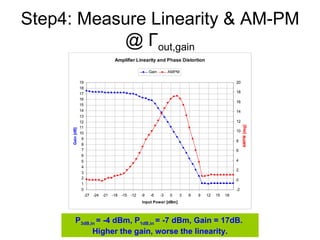
Step4: Measure Linearity & AM-PM @  Γ out,gain P 3dB,in  = -4 dBm, P 1dB,in  = -7 dBm, Gain = 17dB.  Higher the gain, worse the linearity.
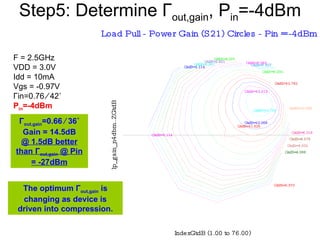
Step5: Determine  Γ out,gain , P in =-4dBm F = 2.5GHz VDD = 3.0V Idd = 10mA Vgs = -0.97V Γ in=0.76 ∕ 42˚ P in =-4dBm Γ out,gain =0.66 ∕ 36˚ Gain = 14.5dB @ 1.5dB better than Γ out,gain  @ Pin = -27dBm The optimum Γ out,gain  is changing as device is driven into compression.
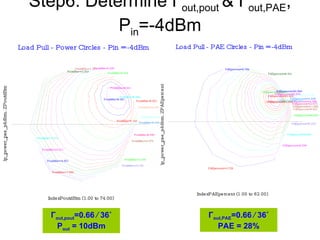
Step6: Determine  Γ out,pout  &  Γ out,PAE , P in =-4dBm Γ out,pout =0.66 ∕ 36˚ P out  = 10dBm Γ out,PAE =0.66 ∕ 36˚ PAE = 28%
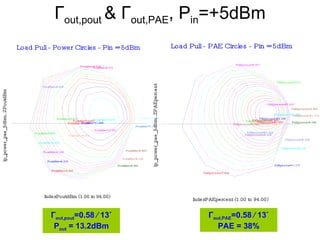
Γ out,pout  &  Γ out,PAE , P in =+5dBm Γ out,pout =0.58 ∕ 13˚ P out  = 13.2dBm Γ out,PAE =0.58 ∕ 13˚ PAE = 38%
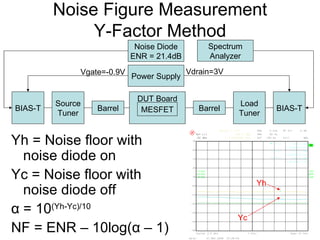
Noise Figure Measurement Y-Factor Method Yh = Noise floor with noise diode on Yc = Noise floor with noise diode off α  = 10 (Yh-Yc)/10 NF = ENR – 10log( α  – 1) Source Tuner Load Tuner Barrel Barrel DUT Board MESFET BIAS-T BIAS-T Noise Diode ENR = 21.4dB Power Supply Vdrain=3V Vgate=-0.9V Spectrum Analyzer Yc Yh
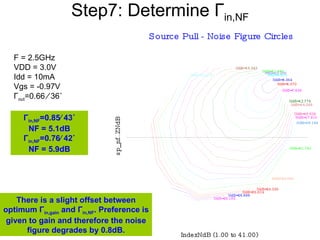
Step7: Determine  Γ in,NF F = 2.5GHz VDD = 3.0V Idd = 10mA Vgs = -0.97V Γ out =0.66 ∕ 36˚ Γ in,NF =0.85∕ 43˚ NF = 5.1dB Γ in,NF =0.76∕ 42˚ NF = 5.9dB There is a slight offset between optimum Γ in,gain  and Γ in,NF . Preference is given to gain and therefore the noise figure degrades by 0.8dB.
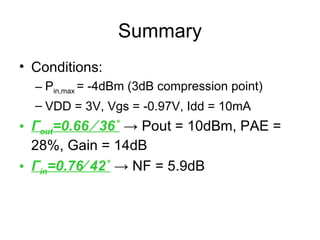
Summary Conditions: P in,max  = -4dBm (3dB compression point) VDD = 3V, Vgs = -0.97V, Idd = 10mA Γ out =0.66 ∕ 36˚   ->  Pout = 10dBm, PAE = 28%, Gain = 14dB Γ in =0.76∕ 42˚   ->  NF = 5.9dB

Amplifier Design

  • 1.
    Jr.’s Source &Load Pull Imran Bashir, David Seymour (Grand Pa), Chris Kamilar, David Mize
  • 2.
    Objective For thegiven NE721 GaAs MESFET Characterize output power, PAE as a function of S22 (output match) @ 3-dB compression point Characterize noise figure as a function of S11 (input match) Determine Г opt at output for power & PAE Determine Г opt at input for noise figure Given bias conditions VDD = 3V, V gs = -0.97V, I dd = 10mA
  • 3.
  • 4.
    Step1: Measure yourboard. Lab Board TI Board
  • 5.
    Step1: Measure yourboard. Lab board has severe discontinuities at SMA connector.
  • 6.
    Step2: Calibration GenerateTuner Files Generate s2p files of each fixture in the system
  • 7.
    Step2: Calibration SourceTuner Load Tuner Barrel Barrel DUT Board FET BIAS-T BIAS-T VNA Power Supply Vdrain=3V Vgate=-0.9V Tuner1 file Tuner2 file Contents of typical tuner file Position 1 mag(s11) phase (s11).. Position 2 mag(s11) phase (s11).. Position 3 mag(s11) phase (s11).. .. s2p S2p #1 S2p #2 s2p
  • 8.
    Step2: Calibration DUTBoard Barrel Barrel VNA 1. Apply port extension on a calibrated VNA up-to the open end of the TL. The DUT board is not populated with any MESFET. 340ps 340ps DUT Board Barrel Barrel VNA 340ps S2p file 1 2. Connect another DUT board with thru connection. Disengage port extension on P2 ONLY and measure S-parameters between P1 and P2. Repeat the same process for generating s2p for the other half of the board. P1 P2 P1 P2
  • 9.
    Step2: Calibration BeforeDe-embedding After De-embedding Increasing the path loss to/from the DUT shrinks the coverage of impedances that can be presented to the MESFET at the source and drain.
  • 10.
    Error in CalibrationSource Tuner Load Tuner Barrel Barrel DUT Board BIAS-T BIAS-T VNA Power Supply Port1 Ext. Port2 S11 Δ e Source -0.4 ˚ Load 10˚ Source -5 ˚ Load -5˚ Source -2 ˚ Load -8˚ Source 4 ˚ Load 9˚
  • 11.
    Setup Gain MeasurementSource Tuner Load Tuner Barrel Barrel DUT Board MESFET BIAS-T BIAS-T VNA Power Supply Vdrain=3V Vgate=-0.9V Pout Measurement Source Tuner Load Tuner Barrel Barrel DUT Board MESFET BIAS-T BIAS-T VNA Power Supply Vdrain=3V Vgate=-0.9V Spectrum Analyzer
  • 12.
    Setup Noise FigureMeasurement Source Tuner Load Tuner Barrel Barrel DUT Board MESFET BIAS-T BIAS-T Noise Diode ENR = 21.4dB Power Supply Vdrain=3V Vgate=-0.9V Spectrum Analyzer
  • 13.
    Step3: Determine Γ out,gain , P in =-27dBm F = 2.5GHz VDD = 3.0V Idd = 10mA Vgs = -0.97V Γ in =0.76 ∕ 42˚ P in =-27dBm Γ out,gain =0.66 ∕ 52˚
  • 14.
    Step4: Measure Linearity& AM-PM @ Γ out,gain P 3dB,in = -4 dBm, P 1dB,in = -7 dBm, Gain = 17dB. Higher the gain, worse the linearity.
  • 15.
    Step5: Determine Γ out,gain , P in =-4dBm F = 2.5GHz VDD = 3.0V Idd = 10mA Vgs = -0.97V Γ in=0.76 ∕ 42˚ P in =-4dBm Γ out,gain =0.66 ∕ 36˚ Gain = 14.5dB @ 1.5dB better than Γ out,gain @ Pin = -27dBm The optimum Γ out,gain is changing as device is driven into compression.
  • 16.
    Step6: Determine Γ out,pout & Γ out,PAE , P in =-4dBm Γ out,pout =0.66 ∕ 36˚ P out = 10dBm Γ out,PAE =0.66 ∕ 36˚ PAE = 28%
  • 17.
    Γ out,pout & Γ out,PAE , P in =+5dBm Γ out,pout =0.58 ∕ 13˚ P out = 13.2dBm Γ out,PAE =0.58 ∕ 13˚ PAE = 38%
  • 18.
    Noise Figure MeasurementY-Factor Method Yh = Noise floor with noise diode on Yc = Noise floor with noise diode off α = 10 (Yh-Yc)/10 NF = ENR – 10log( α – 1) Source Tuner Load Tuner Barrel Barrel DUT Board MESFET BIAS-T BIAS-T Noise Diode ENR = 21.4dB Power Supply Vdrain=3V Vgate=-0.9V Spectrum Analyzer Yc Yh
  • 19.
    Step7: Determine Γ in,NF F = 2.5GHz VDD = 3.0V Idd = 10mA Vgs = -0.97V Γ out =0.66 ∕ 36˚ Γ in,NF =0.85∕ 43˚ NF = 5.1dB Γ in,NF =0.76∕ 42˚ NF = 5.9dB There is a slight offset between optimum Γ in,gain and Γ in,NF . Preference is given to gain and therefore the noise figure degrades by 0.8dB.
  • 20.
    Summary Conditions: Pin,max = -4dBm (3dB compression point) VDD = 3V, Vgs = -0.97V, Idd = 10mA Γ out =0.66 ∕ 36˚ -> Pout = 10dBm, PAE = 28%, Gain = 14dB Γ in =0.76∕ 42˚ -> NF = 5.9dB