Polyhydramnios
and
Oligohydramnios
Professor Umar Model of Integrated Lecture
60%
CORE SUBJECT
20%
HORIZONTAL
INTEGRATION
Physiology
biochemistry
8%
VERTICAL
INTEGRATION
Pathology
pharmacology
7%
VERTICAL
INTEGRATION
Clinical integration
5%
VERTICAL
INTEGRATION
Research,
professionalism
Ethics
Digital library
Wisdom
Truth
Motto Vision; The
Dream/Tomorrow
 To impart evidence based
research oriented medical
education
 To provide best possible
patient care
 To inculcate the values of
mutual respect and ethical
practice of medicine
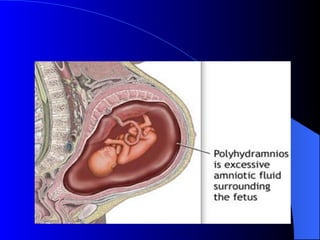
Polyhydramnios
and
Oligohydramnios
Learning Objectives
 to enable students understand importance
of amniotic fluid for fetal well being
Causes of liquor abnormalities
Complications associated with
oligohydramnios and polyhydramnios
Management of liquor abnormalities

Amniotic fluid
Early pregnancy: Amnion
10th
week: Transudate of the fetal serum
via skin & umbilical cord
 From 16th
week: Fetal skin becomes
impermeable to water
Contribution of fluid through
the kidneys & lungs and
removal by fetal swallowing
Composition
Growth factors
Multipotent stem cells
Amniotic fluid volume
Progressive increase from 10-38th
week
10 weeks: 30 ml
20 weeks: 300 ml
30 weeks: 600 ml
38 weeks: 1000ml
From 38th
week onwards: rapid fall
40 weeks: 800 ml
42 weeks: 350 ml
Measurement
Two ways
1. The maximum vertical pool (MVP)
2. Amniotic fluid index (AFI)
MVP : After a general survey
Less than 2 cm
Greater than 8cm
Amniotic fluid index
Uterus is divided in four quadrants
A vertical measurement is taken of the
deepest pool of fluid that is free of
umbilical cord in all the four quadrants of
the uterus and is summated
Third trimester: 10-25 cm
Below 5 cm. (less)
Above 25 cm (more)
The function of the amniotic
fluid
Protect the fetus from mechanical injury
Permit movement of the fetus while
preventing limb contracture
Prevent adhesions between fetus & amnion
Permit fetal lung development in which
there is two-way movement of fluid into
fetal bronchioles
Absence of AF: pulmonary hypoplasia
Polyhydramnios
Amniotic Fluid Index : > 25 cm
pockets in 4 quadrants
Deepest vertical pool: >8cm
Incidence:
1-1.5% of pregnancies
Association with underlying pathology
Mild polyhydramnios:
Single deepest pool : 8-11cm: 17 %
Severe: > 15cm : 91%
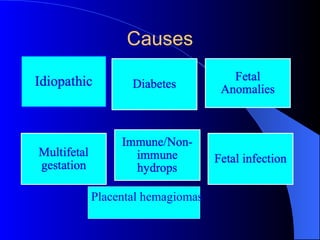
Causes
Placental hemagiomas
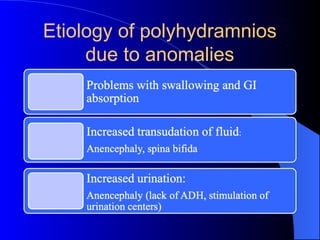
Etiology of polyhydramnios
due to anomalies
Symptoms
 Dyspnea/discomfort
 Abdominal pain
 Preterm labor
 Pressure symptoms of venous stasis
 Decreased perception of movements
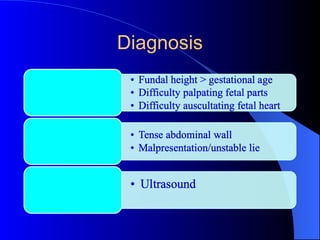
Diagnosis
Complications
Fetal:
Prognosis : directly proportional with
severity of polyhydramnios
• Congenital anomaly
• Preterm delivery
• Cord prolapse and fetal demise
Complications
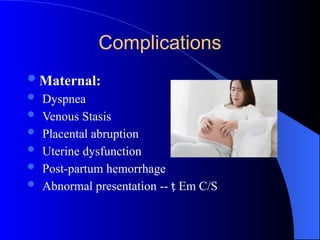
Maternal:
 Dyspnea
 Venous Stasis
 Placental abruption
 Uterine dysfunction
 Post-partum hemorrhage
 Abnormal presentation --  Em C/S
Treatment
Mild to Moderate :Rarely requires treatment
 Blood sugar control
 Feto-maternal surveillance
Severe : Needs hospitalization
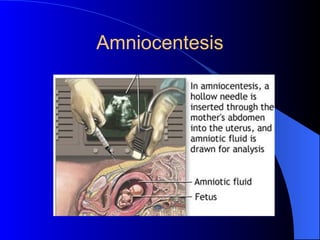
 Amniocentesis
 NSADIS: Non-steroidal anti-inflammatory
 Analgesia
 Feto-maternal surveillance
Amniocentesis
Oligohydramnios
Definition
 AFI 5
 DVP<2cm
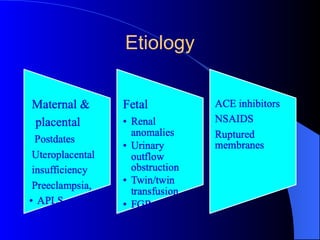
Etiology
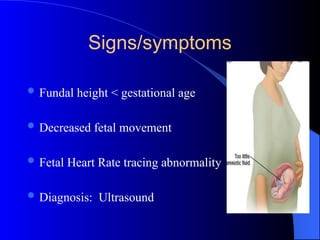
Signs/symptoms
 Fundal height < gestational age
 Decreased fetal movement
 Fetal Heart Rate tracing abnormality
 Diagnosis: Ultrasound
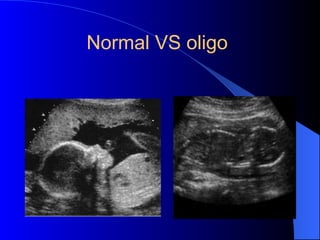
Normal VS oligo
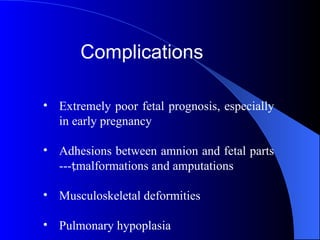
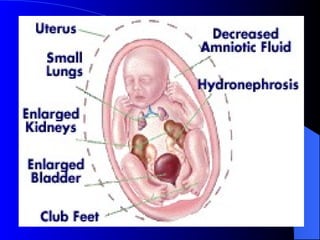
Complications
• Extremely poor fetal prognosis, especially
in early pregnancy
• Adhesions between amnion and fetal parts
---malformations and amputations
• Musculoskeletal deformities
• Pulmonary hypoplasia
 Cord Compression -- >fetal hypoxia
 Passage of meconium into low AF volume:
thick particulate suspension -->respiratory
compromise
Fetal demise
Iatrogenic preterm delivery/cesarean
Treatment
Underlying maternal disease (preeclampsia)
Corticosteriod : lung maturity
In utero transfer
Timely delivery
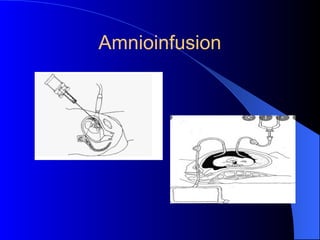
Amnio-infusion?
Clexane/heparin??
Time and mode of delivery :
 important to have safe outcome
Amnioinfusion
Vertical
integration
Beneficence
• TAKE
HOME
MESSAGE
The principle of beneficence is the obligation of physician to act for
the benefit of the patient and supports a number of moral rules to
protect and defend the right of others, prevent harm, remove
conditions that will cause harm, help persons with disabilities, and
rescue persons in danger.
It is worth emphasizing that, the language here is one of positive
requirements. The principle calls for not just avoiding harm, but
also to benefit patients and to promote their welfare.
Ethical Consideration
Councelling ( anomaly,fetal prematurity,
still birth ,pregnancy outcome)
 Termination of pregnancy ( fetamaternal
indication)
Mode and time of delivery
Implications on future pregnancy
References
1. Obsterics by ten teachers. Louise C. Kenny, Jenny E. Myers. 20th
ed
ISBN 9781498744393. Published June 1, 2017 by CRC Press
2. Polyhydramnios: Causes, Diagnosis and Therapy
A. Hamza,1
D. Herr,1
E. F. Solomayer,2
and G. Meyberg-Solomayer1
Geburtshilfe Frauenheilkd. 2013 Dec; 73(12): 1241–1246.
doi: 10.1055/s-0033-1360163
3. Amnioreduction procedure for singleton pregnancies complicated by
polyhydramnios causing maternal discomfort
B.S. Albaqawi, A.S. Alghamdi, M.M. Abuzaid, W.Y. Alaali, B.I. Sallout
First published: 08 September 2016
https://doi.org/10.1002/uog.17097
mcqs
 1. a 24year old primigravida obeses BMI 35Kg/m2presents for first
antenatal booking .she is 26 weeks, her SFH is 36cm and tense
abdomen.what is ur next best step in management?
 a. admit for blood sugar monitoring
 b. Inquire about LMP
 c. ultrasound anomaly +liq,and blood sugar monitoring
 d. expectant management
 e. induce labor
 1. a 24year old primigravida obeses BMI 35Kg/m2presents for first
antenatal booking .she is 26 weeks, her SFH is 36cm and tense
abdomen.what is ur next best step in management?
 a. admit for blood sugar monitoring
 b. Inquire about LMP
 c. ultrasound for anomaly+liq and blood sugar monitoring
 d. expectant management
 e. induce labor
 2. a G2P1 at 37 weeks presents for checkup.She is known
hypertensive since 4 years.Her SFH IS 32cm,long cephalic with good
fetal heart beats,EFW is 3.1kg.Ultrasound shows almost nil
liquor.bishop score is 9.How will you manage her?
a. b.p monitoring,dopplersultrasound.
 b. Amnioinfusion
 c. steriod cover and induce labor
 d. emergency cesarean section
 e. Expectant managment
 2. a G2P1 at 37 weeks presents for checkup.She is known
hypertensive since 4 years.Her SFH IS 32cm,long cephalic with good
fetal heart beats,EFW is 3.1kg.Ultrasound shows almost nil
liquor.bishop score is 9.How will you manage her?
a. b.p monitoring,dopplersultrasound.
 b. Amnioinfusion
 c. steriod cover and induce labor
 d. emergency cesarean section
 e. Expectant managment
-POLYHYDRAMNIOS AND OLIGOHYDRAMNIOS.pptx

  • 1.
  • 2.
    Professor Umar Modelof Integrated Lecture 60% CORE SUBJECT 20% HORIZONTAL INTEGRATION Physiology biochemistry 8% VERTICAL INTEGRATION Pathology pharmacology 7% VERTICAL INTEGRATION Clinical integration 5% VERTICAL INTEGRATION Research, professionalism Ethics Digital library
  • 3.
    Wisdom Truth Motto Vision; The Dream/Tomorrow To impart evidence based research oriented medical education  To provide best possible patient care  To inculcate the values of mutual respect and ethical practice of medicine
  • 4.
  • 5.
    Learning Objectives  toenable students understand importance of amniotic fluid for fetal well being Causes of liquor abnormalities Complications associated with oligohydramnios and polyhydramnios Management of liquor abnormalities 
  • 6.
    Amniotic fluid Early pregnancy:Amnion 10th week: Transudate of the fetal serum via skin & umbilical cord  From 16th week: Fetal skin becomes impermeable to water Contribution of fluid through the kidneys & lungs and removal by fetal swallowing
  • 7.
  • 8.
    Amniotic fluid volume Progressiveincrease from 10-38th week 10 weeks: 30 ml 20 weeks: 300 ml 30 weeks: 600 ml 38 weeks: 1000ml From 38th week onwards: rapid fall 40 weeks: 800 ml 42 weeks: 350 ml
  • 9.
    Measurement Two ways 1. Themaximum vertical pool (MVP) 2. Amniotic fluid index (AFI) MVP : After a general survey Less than 2 cm Greater than 8cm
  • 10.
    Amniotic fluid index Uterusis divided in four quadrants A vertical measurement is taken of the deepest pool of fluid that is free of umbilical cord in all the four quadrants of the uterus and is summated Third trimester: 10-25 cm Below 5 cm. (less) Above 25 cm (more)
  • 11.
    The function ofthe amniotic fluid Protect the fetus from mechanical injury Permit movement of the fetus while preventing limb contracture Prevent adhesions between fetus & amnion Permit fetal lung development in which there is two-way movement of fluid into fetal bronchioles Absence of AF: pulmonary hypoplasia
  • 12.
    Polyhydramnios Amniotic Fluid Index: > 25 cm pockets in 4 quadrants Deepest vertical pool: >8cm
  • 14.
    Incidence: 1-1.5% of pregnancies Associationwith underlying pathology Mild polyhydramnios: Single deepest pool : 8-11cm: 17 % Severe: > 15cm : 91%
  • 15.
  • 16.
  • 17.
    Symptoms  Dyspnea/discomfort  Abdominalpain  Preterm labor  Pressure symptoms of venous stasis  Decreased perception of movements
  • 18.
  • 19.
    Complications Fetal: Prognosis : directlyproportional with severity of polyhydramnios • Congenital anomaly • Preterm delivery • Cord prolapse and fetal demise
  • 20.
    Complications Maternal:  Dyspnea  VenousStasis  Placental abruption  Uterine dysfunction  Post-partum hemorrhage  Abnormal presentation --  Em C/S
  • 21.
    Treatment Mild to Moderate:Rarely requires treatment  Blood sugar control  Feto-maternal surveillance Severe : Needs hospitalization  Amniocentesis  NSADIS: Non-steroidal anti-inflammatory  Analgesia  Feto-maternal surveillance
  • 22.
  • 23.
  • 24.
  • 25.
  • 26.
    Signs/symptoms  Fundal height< gestational age  Decreased fetal movement  Fetal Heart Rate tracing abnormality  Diagnosis: Ultrasound
  • 27.
  • 28.
    Complications • Extremely poorfetal prognosis, especially in early pregnancy • Adhesions between amnion and fetal parts ---malformations and amputations • Musculoskeletal deformities • Pulmonary hypoplasia
  • 29.
     Cord Compression-- >fetal hypoxia  Passage of meconium into low AF volume: thick particulate suspension -->respiratory compromise Fetal demise Iatrogenic preterm delivery/cesarean
  • 31.
    Treatment Underlying maternal disease(preeclampsia) Corticosteriod : lung maturity In utero transfer Timely delivery Amnio-infusion? Clexane/heparin??
  • 32.
    Time and modeof delivery :  important to have safe outcome
  • 33.
  • 34.
    Vertical integration Beneficence • TAKE HOME MESSAGE The principleof beneficence is the obligation of physician to act for the benefit of the patient and supports a number of moral rules to protect and defend the right of others, prevent harm, remove conditions that will cause harm, help persons with disabilities, and rescue persons in danger. It is worth emphasizing that, the language here is one of positive requirements. The principle calls for not just avoiding harm, but also to benefit patients and to promote their welfare.
  • 35.
    Ethical Consideration Councelling (anomaly,fetal prematurity, still birth ,pregnancy outcome)  Termination of pregnancy ( fetamaternal indication) Mode and time of delivery Implications on future pregnancy
  • 36.
    References 1. Obsterics byten teachers. Louise C. Kenny, Jenny E. Myers. 20th ed ISBN 9781498744393. Published June 1, 2017 by CRC Press 2. Polyhydramnios: Causes, Diagnosis and Therapy A. Hamza,1 D. Herr,1 E. F. Solomayer,2 and G. Meyberg-Solomayer1 Geburtshilfe Frauenheilkd. 2013 Dec; 73(12): 1241–1246. doi: 10.1055/s-0033-1360163 3. Amnioreduction procedure for singleton pregnancies complicated by polyhydramnios causing maternal discomfort B.S. Albaqawi, A.S. Alghamdi, M.M. Abuzaid, W.Y. Alaali, B.I. Sallout First published: 08 September 2016 https://doi.org/10.1002/uog.17097
  • 38.
    mcqs  1. a24year old primigravida obeses BMI 35Kg/m2presents for first antenatal booking .she is 26 weeks, her SFH is 36cm and tense abdomen.what is ur next best step in management?  a. admit for blood sugar monitoring  b. Inquire about LMP  c. ultrasound anomaly +liq,and blood sugar monitoring  d. expectant management  e. induce labor
  • 39.
     1. a24year old primigravida obeses BMI 35Kg/m2presents for first antenatal booking .she is 26 weeks, her SFH is 36cm and tense abdomen.what is ur next best step in management?  a. admit for blood sugar monitoring  b. Inquire about LMP  c. ultrasound for anomaly+liq and blood sugar monitoring  d. expectant management  e. induce labor
  • 40.
     2. aG2P1 at 37 weeks presents for checkup.She is known hypertensive since 4 years.Her SFH IS 32cm,long cephalic with good fetal heart beats,EFW is 3.1kg.Ultrasound shows almost nil liquor.bishop score is 9.How will you manage her? a. b.p monitoring,dopplersultrasound.  b. Amnioinfusion  c. steriod cover and induce labor  d. emergency cesarean section  e. Expectant managment
  • 41.
     2. aG2P1 at 37 weeks presents for checkup.She is known hypertensive since 4 years.Her SFH IS 32cm,long cephalic with good fetal heart beats,EFW is 3.1kg.Ultrasound shows almost nil liquor.bishop score is 9.How will you manage her? a. b.p monitoring,dopplersultrasound.  b. Amnioinfusion  c. steriod cover and induce labor  d. emergency cesarean section  e. Expectant managment