Presented by
BARKHA SINGH
DEPARTMENT OF PHARMACOGNOSY
2015-2016
PES College Of Pharmacy
Bangalore.
BarkhaS12@gmail.com
 Introduction of Amla
 Climate requirements
 Soil requirements
 Planting materials and inputs
 Propagation in Amla
 Planting
 Irrigation
 Training and pruning
 Mulching and intercropping
 Pest and diseases
 Harvesting
 Yield
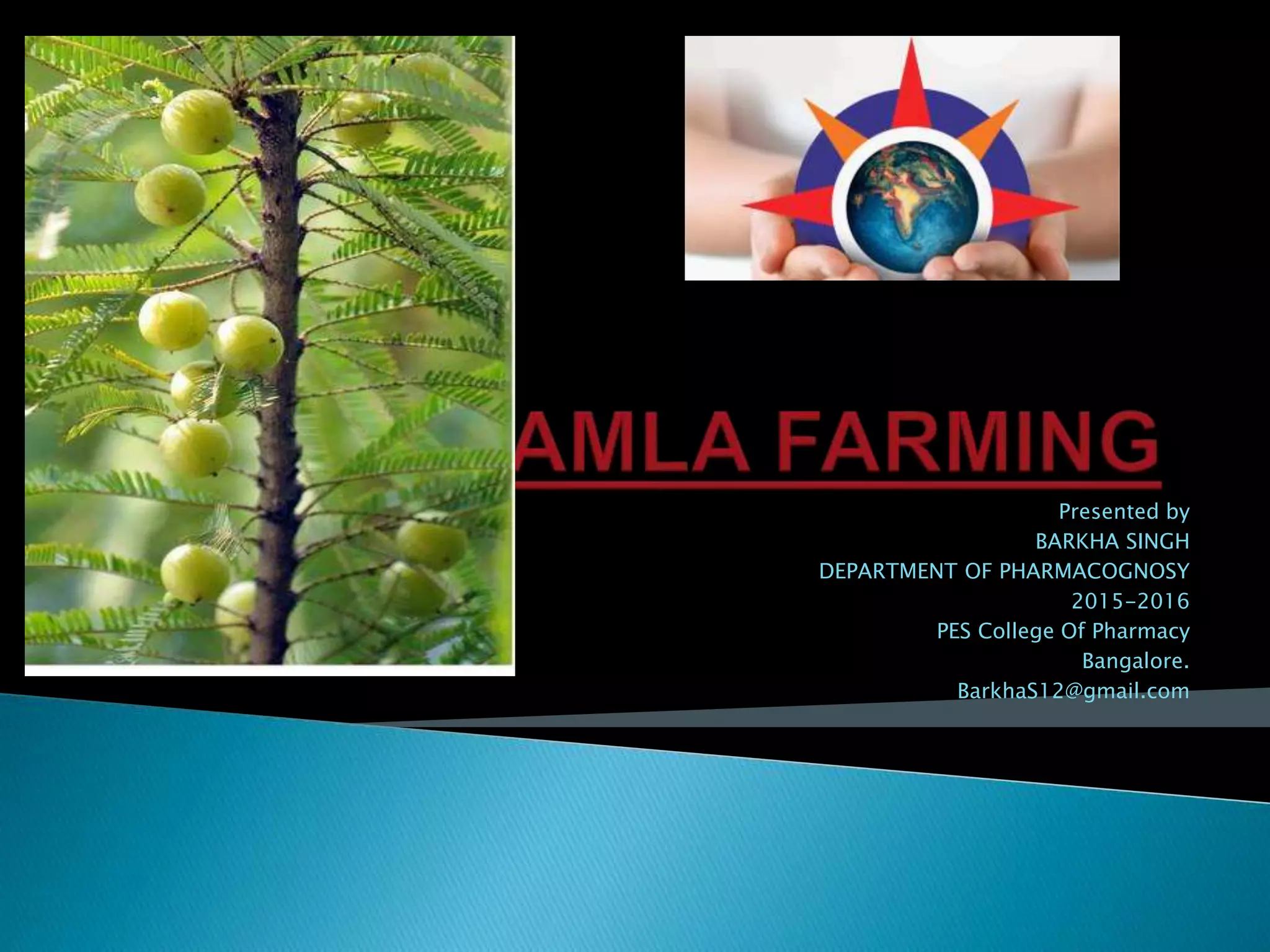
Embellica officinalis also known as AMLA or Indian
goose berry is an important crop in India known for its
medicinal value. The fruits have high content of vitamin C i.e. [
8.75 mg of natural vitamin C complex is equivalent to 100mg
of the most commonly synthetic vitamin C ]. It is also
considered as a good liver tonic.
The fruits is valued as Antiscorbatic, diuretic, laxative and
antibiotic, other uses such as in the treatment of leucorrhoea,
menorrhagia, diarrhoea, toothache, sores, fever, anaemia etc.
It has a good demand from industries for the preparation of
hair oil, shampoo, dye, face cream. In India, pickles of Amla
are made.
Phyllemblin obtained from the fruit pulp has bee found to have
a mild depressant action on the central nervous system.
INTRODUCTION
 Amla is a tropical plant and it requires 620-800 mm of annual rainfall. The
young plants up to the age of 3 years should be protected from hot winds in
summer and from frost in winter.
 Light medium heavy soils except purely sandy soils are ideal for its
cultivation.
 The tree is well adopted to dry region and can withstand moderate
climate also.
 Different varieties of amla are Banarasi, chakaiya, NA-4, NA-5.
 15kg FYM (Farm yard manure) and 0.5 kg phosphorus should be
applied to each pits before planting.
 Application of 30 g of nitrogen each year during sept-oct up to 10
years for each tree is recommended.
 Amla is generally propagated through sheild budding. It is done on
one year old seedling with buds collected from best varieties
yielding big sized fruits.
 One year old seedling can be transplanted to polythene bags and
one year old seeding can be planted in the main field with the onset
of the monsoon.
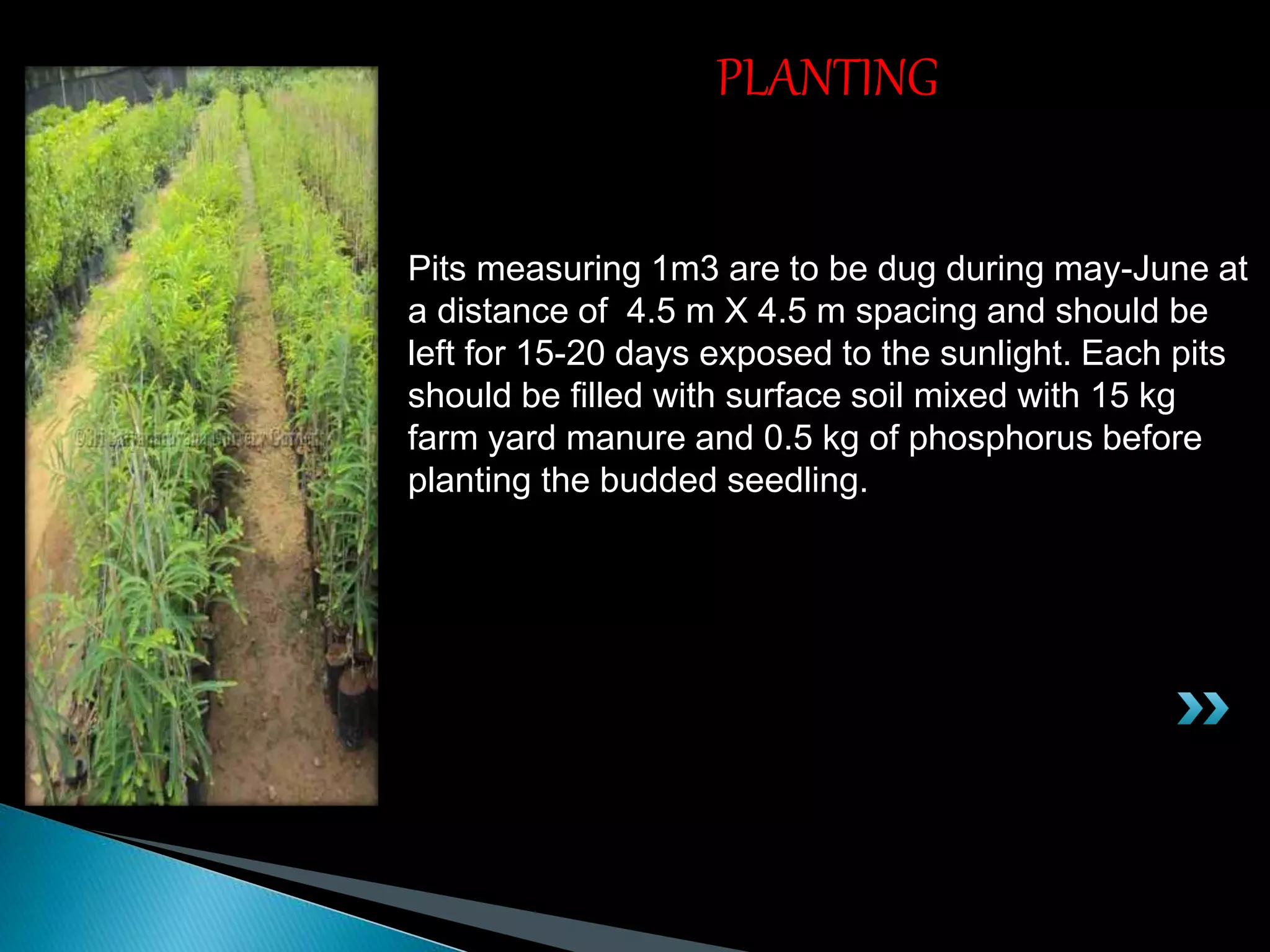
Pits measuring 1m3 are to be dug during may-June at
a distance of 4.5 m X 4.5 m spacing and should be
left for 15-20 days exposed to the sunlight. Each pits
should be filled with surface soil mixed with 15 kg
farm yard manure and 0.5 kg of phosphorus before
planting the budded seedling.
PLANTING
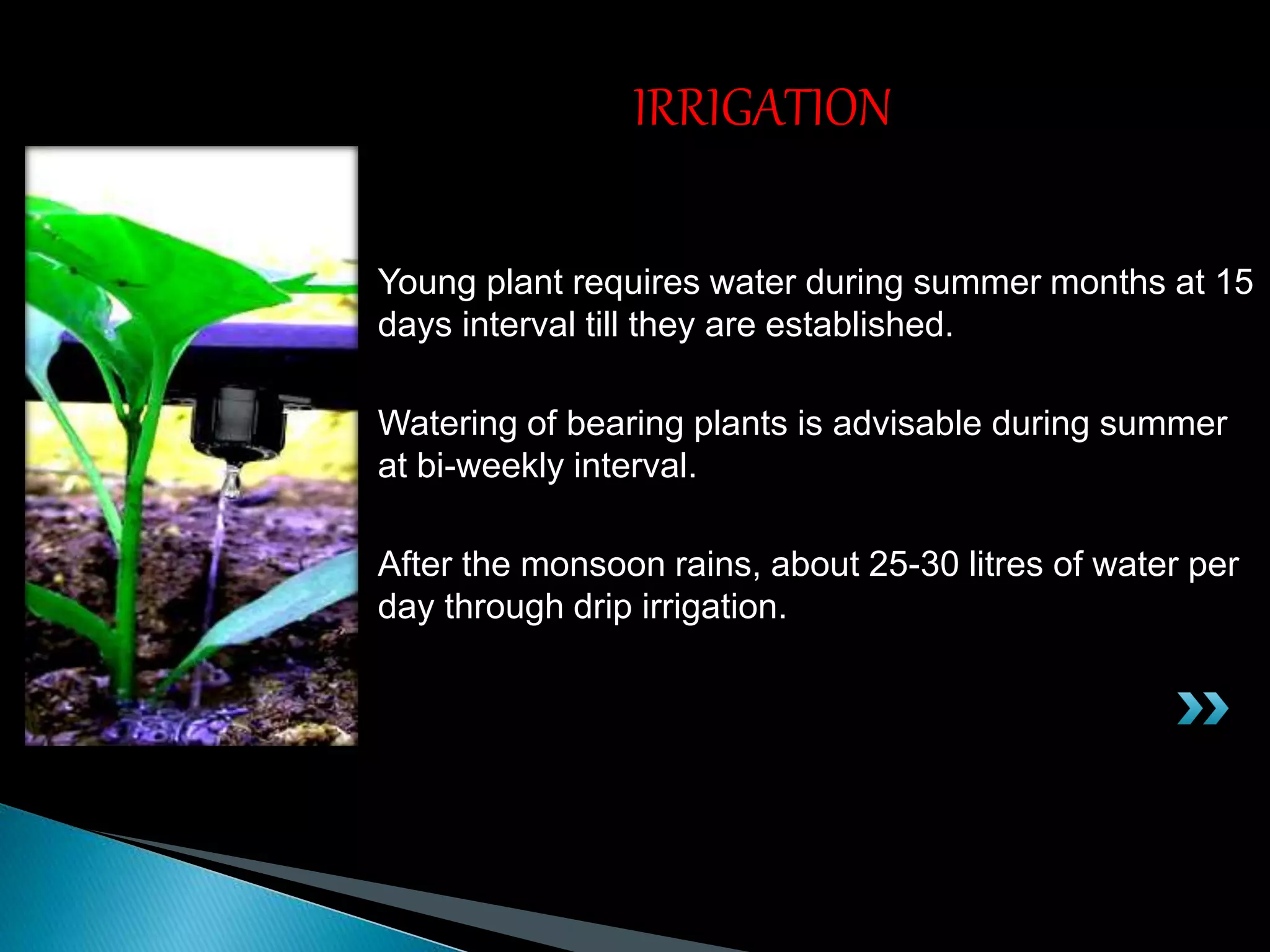
Young plant requires water during summer months at 15
days interval till they are established.
Watering of bearing plants is advisable during summer
at bi-weekly interval.
After the monsoon rains, about 25-30 litres of water per
day through drip irrigation.
IRRIGATION
 leaving only 4-5 well shaped branches, other dead diseased, weak
criss crossing branches and suckers should be pruned off at the end
of December.
 During summer, the crop should be mulched with paddy straw or
wheat straw at the base of the tree to prevent evaporation of
moisture.
 Intercrops like green gram, black gram, cow pea and horse gram
can be grown up to 8 years in amla farming.
 Major insect in amla farming is: Bark eating caterpillar and major
disease is Rust.
 Control measures:
 Injection of Endosulphon 0.05% or Monocrotophos 0.03% in holes
and plugging with mud is effective in protecting the tree against bark
eating caterpillar.
 Spraying of Indofil N-45 @ 0.3% twice first in early September and
second 15 days after first application controls the spread of rust.
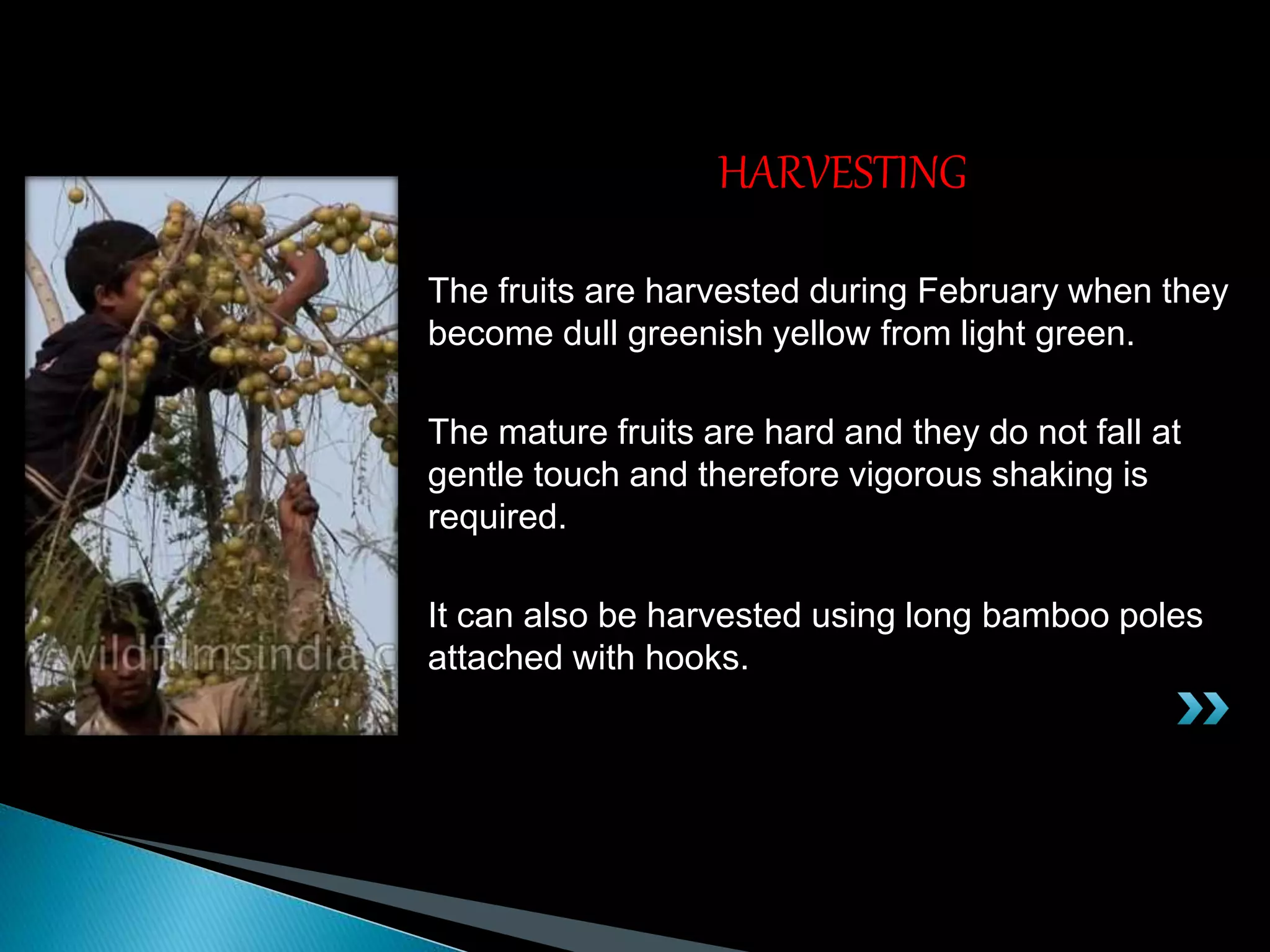
The fruits are harvested during February when they
become dull greenish yellow from light green.
The mature fruits are hard and they do not fall at
gentle touch and therefore vigorous shaking is
required.
It can also be harvested using long bamboo poles
attached with hooks.
HARVESTING
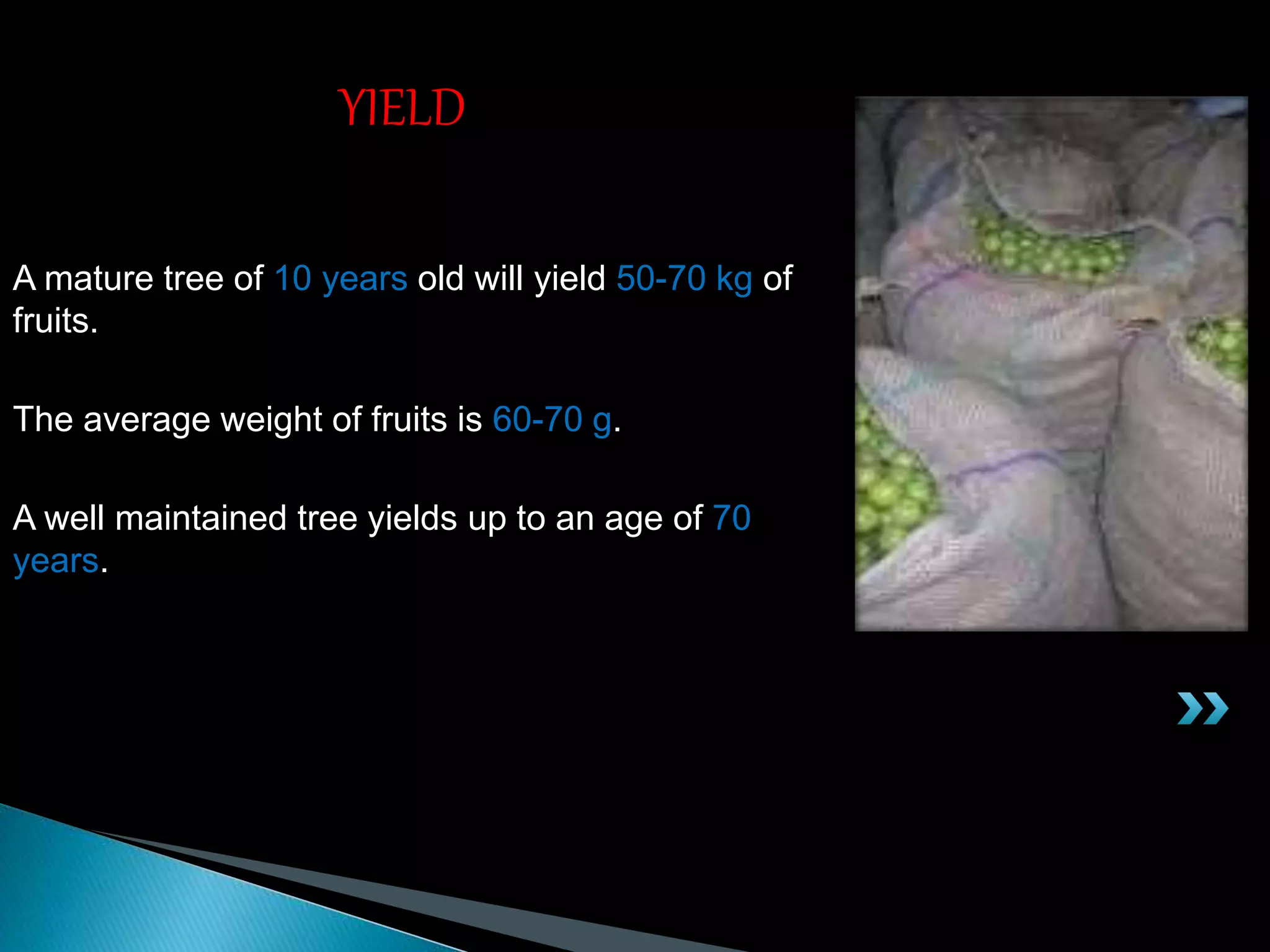
A mature tree of 10 years old will yield 50-70 kg of
fruits.
The average weight of fruits is 60-70 g.
A well maintained tree yields up to an age of 70
years.
YIELD
Thank you

Amla farming

  • 1.
    Presented by BARKHA SINGH DEPARTMENTOF PHARMACOGNOSY 2015-2016 PES College Of Pharmacy Bangalore. BarkhaS12@gmail.com
  • 2.
     Introduction ofAmla  Climate requirements  Soil requirements  Planting materials and inputs  Propagation in Amla  Planting  Irrigation  Training and pruning  Mulching and intercropping  Pest and diseases  Harvesting  Yield
  • 3.
    Embellica officinalis alsoknown as AMLA or Indian goose berry is an important crop in India known for its medicinal value. The fruits have high content of vitamin C i.e. [ 8.75 mg of natural vitamin C complex is equivalent to 100mg of the most commonly synthetic vitamin C ]. It is also considered as a good liver tonic. The fruits is valued as Antiscorbatic, diuretic, laxative and antibiotic, other uses such as in the treatment of leucorrhoea, menorrhagia, diarrhoea, toothache, sores, fever, anaemia etc. It has a good demand from industries for the preparation of hair oil, shampoo, dye, face cream. In India, pickles of Amla are made. Phyllemblin obtained from the fruit pulp has bee found to have a mild depressant action on the central nervous system. INTRODUCTION
  • 4.
     Amla isa tropical plant and it requires 620-800 mm of annual rainfall. The young plants up to the age of 3 years should be protected from hot winds in summer and from frost in winter.
  • 5.
     Light mediumheavy soils except purely sandy soils are ideal for its cultivation.  The tree is well adopted to dry region and can withstand moderate climate also.  Different varieties of amla are Banarasi, chakaiya, NA-4, NA-5.
  • 6.
     15kg FYM(Farm yard manure) and 0.5 kg phosphorus should be applied to each pits before planting.  Application of 30 g of nitrogen each year during sept-oct up to 10 years for each tree is recommended.
  • 7.
     Amla isgenerally propagated through sheild budding. It is done on one year old seedling with buds collected from best varieties yielding big sized fruits.  One year old seedling can be transplanted to polythene bags and one year old seeding can be planted in the main field with the onset of the monsoon.
  • 8.
    Pits measuring 1m3are to be dug during may-June at a distance of 4.5 m X 4.5 m spacing and should be left for 15-20 days exposed to the sunlight. Each pits should be filled with surface soil mixed with 15 kg farm yard manure and 0.5 kg of phosphorus before planting the budded seedling. PLANTING
  • 9.
    Young plant requireswater during summer months at 15 days interval till they are established. Watering of bearing plants is advisable during summer at bi-weekly interval. After the monsoon rains, about 25-30 litres of water per day through drip irrigation. IRRIGATION
  • 10.
     leaving only4-5 well shaped branches, other dead diseased, weak criss crossing branches and suckers should be pruned off at the end of December.
  • 11.
     During summer,the crop should be mulched with paddy straw or wheat straw at the base of the tree to prevent evaporation of moisture.  Intercrops like green gram, black gram, cow pea and horse gram can be grown up to 8 years in amla farming.
  • 12.
     Major insectin amla farming is: Bark eating caterpillar and major disease is Rust.  Control measures:  Injection of Endosulphon 0.05% or Monocrotophos 0.03% in holes and plugging with mud is effective in protecting the tree against bark eating caterpillar.  Spraying of Indofil N-45 @ 0.3% twice first in early September and second 15 days after first application controls the spread of rust.
  • 13.
    The fruits areharvested during February when they become dull greenish yellow from light green. The mature fruits are hard and they do not fall at gentle touch and therefore vigorous shaking is required. It can also be harvested using long bamboo poles attached with hooks. HARVESTING
  • 14.
    A mature treeof 10 years old will yield 50-70 kg of fruits. The average weight of fruits is 60-70 g. A well maintained tree yields up to an age of 70 years. YIELD
  • 15.