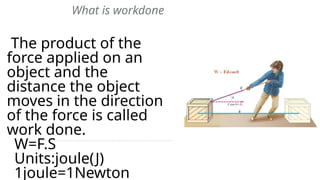
The product ofthe
force applied on an
object and the
distance the object
moves in the direction
of the force is called
work done.
W=F.S
Units:joule(J)
1joule=1Newton
What is workdone
3.
Examples of workdone
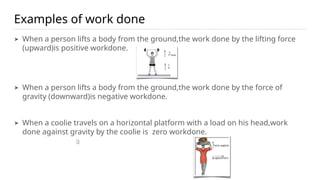
➤ When a person lifts a body from the ground,the work done by the lifting force
(upward)is positive workdone.
➤ When a person lifts a body from the ground,the work done by the force of
gravity (downward)is negative workdone.
➤ When a coolie travels on a horizontal platform with a load on his head,work
done against gravity by the coolie is zero workdone.
4.
Cases of workdone
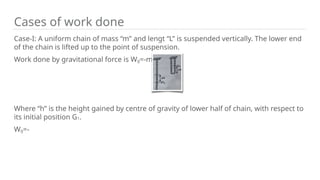
Case-I: A uniform chain of mass “m” and lengt “L” is suspended vertically. The lower end
of the chain is lifted up to the point of suspension.
Work done by gravitational force is Wg=-mgh.
Where “h” is the height gained by centre of gravity of lower half of chain, with respect to
its initial position G1.
Wg=-
5.
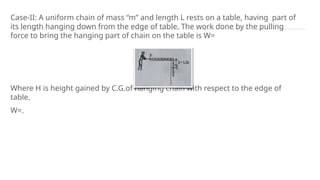
Case-II: A uniformchain of mass “m” and length L rests on a table, having part of
its length hanging down from the edge of table. The work done by the pulling
force to bring the hanging part of chain on the table is W=
Where H is height gained by C.G.of hanging chain with respect to the edge of
table.
W=.
6.
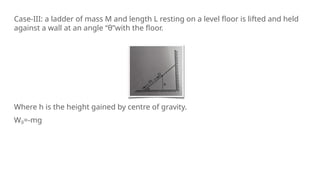
Case-III: a ladderof mass M and length L resting on a level floor is lifted and held
against a wall at an angle “θ”with the floor.
Where h is the height gained by centre of gravity.
Wg=-mg
7.
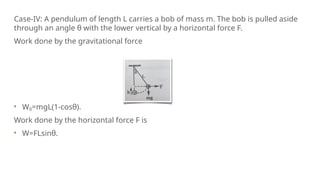
Case-IV: A pendulumof length L carries a bob of mass m. The bob is pulled aside
through an angle θ with the lower vertical by a horizontal force F.
Work done by the gravitational force
Wg=mgL(1-cosθ).
Work done by the horizontal force F is
W=FLsinθ.
8.
Conservative Field
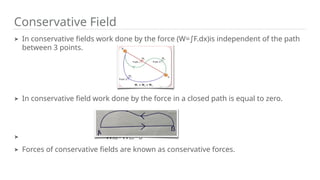
➤ Inconservative fields work done by the force (W= F.dx)is independent of the path
∫
between 3 points.
➤ In conservative field work done by the force in a closed path is equal to zero.
➤ WAB+WBA=0
➤ Forces of conservative fields are known as conservative forces.
9.
Examples of conservativefields: Electrostatic force,Magnetic force,Gravitational force
etc.
➤ These all are central forces.
➤ Central force: A force that acts on an object along the line that connects the object to
a fixed point called the centre of force or central force.
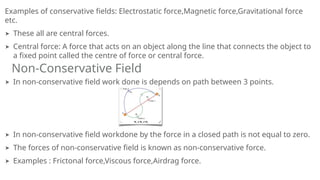
➤ In non-conservative field work done is depends on path between 3 points.
➤ In non-conservative field workdone by the force in a closed path is not equal to zero.
➤ The forces of non-conservative field is known as non-conservative force.
➤ Examples : Frictonal force,Viscous force,Airdrag force.
Non-Conservative Field
10.
Energy(Kinetic Energy)
➤ Energyis capacity to do work.
➤ Energy and work are same.
➤ Energy is measured in Joule or Erg
➤ 1Joule=107
erg.
➤ Dimension: [ML2
T-2
] it is same as that of work or torque.
➤ 1eV=1.6x10⁻¹⁹
Joules (eV-electron volt)
➤ 1kWh=3.6x10⁶
Joules (kWh-Kilowatt hor)
➤ 1cal=4.18 Joules (cal-calories)
➤ Einstein propose every particle has its mass and energy the relation between mass of the particle and its
equivalent energy is given by E=mc2
➤ E-energy
➤ M-mass
➤ C-speed of light=3x10⁸
m/s
12.
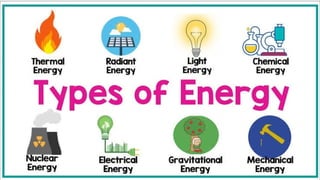
Various forms ofenergy
(i)Mechanical energy:Energy stored in an object due to its position or motion.Mechanical
energy is the sum of an object’s potential and kinetic energy.
(ii)Chemical energy:Energy stored in bonds of atoms and molecules. This energy is released
when the bonds break,often as heat.
(iii)Electrical energy:Energy created by the movement of charged particles in
atoms.Alternators an batteries are systems that produce electricity.
(iv)Nuclear energy: Energy stored in the nucleus of an atom.Nuclear energy is released when
atoms split or join together.
(v)Magnetic energy:A form of energy that is associated with magnetic fields.
(vi)Sound energy:A type of energy that is produced by vibrations in objects and is perceived
by the human ear.
(vii)Gravitational energy:Energy stored in an object due to its height
13.
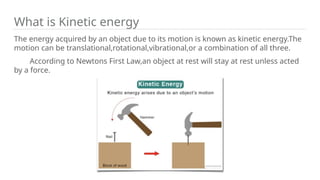
What is Kineticenergy
The energy acquired by an object due to its motion is known as kinetic energy.The
motion can be translational,rotational,vibrational,or a combination of all three.
According to Newtons First Law,an object at rest will stay at rest unless acted
by a force.
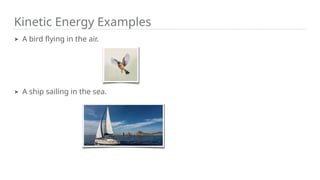
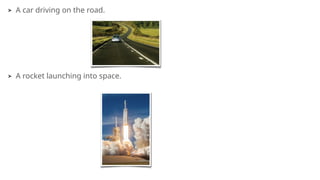
➤ A cardriving on the road.
➤ A rocket launching into space.
16.
Change in KineticEnergy
An object can start from rest and acquire velocity.An object can also
change its velocity during its motion.Suppose the object moves with a
velocity vi,the initial velocity.A force alters its motion such that its velocity
changes to vf ,which is the final velocity.Then, the change in kinetic energy
is,
ΔK.E. = ½ mvf
2
— ½ mvi
2
Now, work is being done on the object to change its motion. The change
of kinetic energy is equal to the work done W. Therefore
W = ΔК.Е.
This equation is known as the work done.
17.
Potential Energy
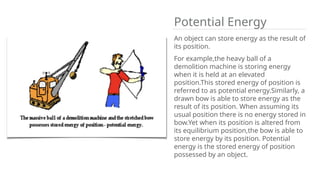
An objectcan store energy as the result of
its position.
For example,the heavy ball of a
demolition machine is storing energy
when it is held at an elevated
position.This stored energy of position is
referred to as potential energy.Similarly, a
drawn bow is able to store energy as the
result of its position. When assuming its
usual position there is no energy stored in
bow.Yet when its position is altered from
its equilibrium position,the bow is able to
store energy by its position. Potential
energy is the stored energy of position
possessed by an object.
18.
Potential energy isone of the two main forms of energy. There are two main types
of potential energy, and they are:
Gravitational potential Energy
Elastic potential Energy
Gravitational Potential Energy:
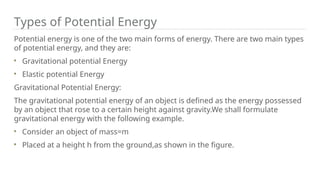
The gravitational potential energy of an object is defined as the energy possessed
by an object that rose to a certain height against gravity.We shall formulate
gravitational energy with the following example.
Consider an object of mass=m
Placed at a height h from the ground,as shown in the figure.
Types of Potential Energy
19.
Potential Energy Examples
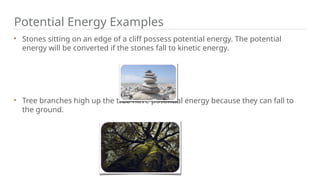
Stonessitting on an edge of a cliff possess potential energy. The potential
energy will be converted if the stones fall to kinetic energy.
Tree branches high up the tree have potential energy because they can fall to
the ground.
20.
Work-Energy Theorem
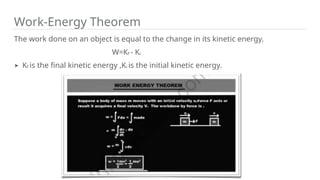
The workdone on an object is equal to the change in its kinetic energy.
W=Kf - Ki
➤ Kf is the final kinetic energy ,Ki is the initial kinetic energy.
21.
Examples of work-energytheorem:
If a person slows down a car from high speed to low speed,the work done on
the car is negative because the kinetic energy of the car decreases.
It can be defined as the state of an object in which two or more counter-
influences,whether internal,external,or a combination of both,act on the
body,nullifying each other to keep the object in the same state as it was. The word
equilibrium has a root in Latin word libra,Which means weight or balance.
A few examples of equilibrium are:
A book kept on a table at rest.
A car moving with a constant velocity.
A chemical reaction where the rates of forward reaction and backward reaction
are the same.
EQUILIBRIUM
22.
Calculating equilibrium
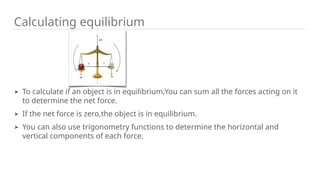
➤ Tocalculate if an object is in equilibrium,You can sum all the forces acting on it
to determine the net force.
➤ If the net force is zero,the object is in equilibrium.
➤ You can also use trigonometry functions to determine the horizontal and
vertical components of each force.
23.
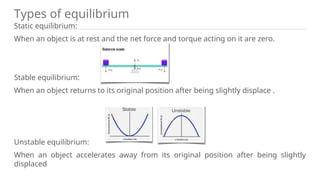
Types of equilibrium
Staticequilibrium:
When an object is at rest and the net force and torque acting on it are zero.
Stable equilibrium:
When an object returns to its original position after being slightly displace .
Unstable equilibrium:
When an object accelerates away from its original position after being slightly
displaced
24.
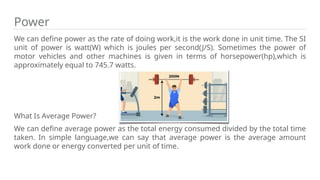
Power
We can definepower as the rate of doing work,it is the work done in unit time. The SI
unit of power is watt(W) which is joules per second(J/S). Sometimes the power of
motor vehicles and other machines is given in terms of horsepower(hp),which is
approximately equal to 745.7 watts.
What Is Average Power?
We can define average power as the total energy consumed divided by the total time
taken. In simple language,we can say that average power is the average amount
work done or energy converted per unit of time.
25.
Power Formula
Power isdefined as the rate at which work is done upon an object. Power is a time
based quantity. Which is related to how fast a job is done. The formula for power is
mentioned below.
Power=work/time
P=w/t
Unit of power is Watt(W).
1watt=1joule/1second
26.
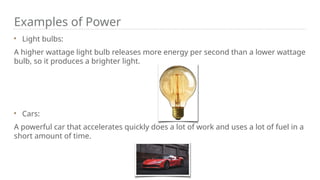
Examples of Power
Lightbulbs:
A higher wattage light bulb releases more energy per second than a lower wattage
bulb, so it produces a brighter light.
Cars:
A powerful car that accelerates quickly does a lot of work and uses a lot of fuel in a
short amount of time.
27.
People:
A person whoruns or picks up boxes quickly has a higher power rating than
someone who does the same task more slowly.
Stars:
The sun and other stars radiate energy at a very high rate, which is an example of
power.
28.
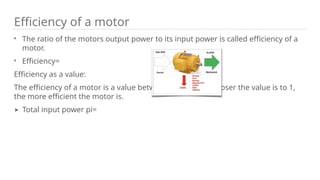
Efficiency of amotor
The ratio of the motors output power to its input power is called efficiency of a
motor.
Efficiency=
Efficiency as a value:
The efficiency of a motor is a value between 0 and 1. The closer the value is to 1,
the more efficient the motor is.
➤ Total input power pi=
29.
Measuring a motor’sefficiency
➤ You can measure a motor’s efficiency by comparing its
output power to its input power. You can also measure a
motor’s temperature to determine if it’s operating
efficiently. A motor that’s heating up too much might be
overloaded, while a motor that’s not warming up all might
be too big or too heavy for its load.

![Energy(Kinetic Energy)
➤ Energy is capacity to do work.
➤ Energy and work are same.
➤ Energy is measured in Joule or Erg
➤ 1Joule=107
erg.
➤ Dimension: [ML2
T-2
] it is same as that of work or torque.
➤ 1eV=1.6x10⁻¹⁹
Joules (eV-electron volt)
➤ 1kWh=3.6x10⁶
Joules (kWh-Kilowatt hor)
➤ 1cal=4.18 Joules (cal-calories)
➤ Einstein propose every particle has its mass and energy the relation between mass of the particle and its
equivalent energy is given by E=mc2
➤ E-energy
➤ M-mass
➤ C-speed of light=3x10⁸
m/s](https://image.slidesharecdn.com/physics-sathwickgroup5-250926050711-eacd4e2a/85/Physics-sathwick-group-5-pptx-for-lesson-work-energy-power-10-320.jpg)