Dr. Mukunda Bharat Bargade,
JR1, Dept. of Pharmacology,
IGGMC, Nagpur.
9 April 2015 1Dr.M. B. Bargade
 Introduction
 Purpose of experiments in pharmacology
 Bioassay
 Experiments on isolated skeletal muscle
preparations
 Conclusion
9 April 2015 2Dr.M. B. Bargade
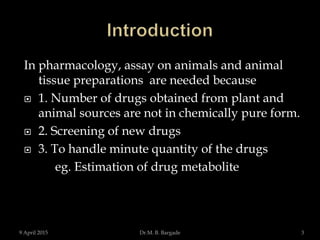
In pharmacology, assay on animals and animal
tissue preparations are needed because
 1. Number of drugs obtained from plant and
animal sources are not in chemically pure form.
 2. Screening of new drugs
 3. To handle minute quantity of the drugs
eg. Estimation of drug metabolite
9 April 2015 3Dr.M. B. Bargade
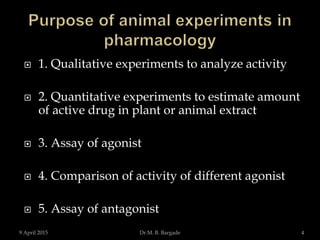
 1. Qualitative experiments to analyze activity
 2. Quantitative experiments to estimate amount
of active drug in plant or animal extract
 3. Assay of agonist
 4. Comparison of activity of different agonist
 5. Assay of antagonist
9 April 2015 4Dr.M. B. Bargade
•Based on physical
characteristicsPhysical
•Estimation of concentration
of active principleChemical
•Using various biological
methodsBiological
9 April 2015 5Dr.M. B. Bargade
 Definition- Bioassay is the estimation of the
potency of an active principle in the given
quantity of the given preparation using
biological method.
 Specific bioassays-
A. Bioassay on whole animal
B. Bioassay on isolated tissue
C. Bioassay on cells
D. Bioassay on microorganism9 April 2015 6Dr.M. B. Bargade
A. The phrenic nerve-diaphragm preparation of rat
B. The rectus abdominis muscle of frog
C. The dorsal muscle of leech
D. The chick biventer cervicis preparation
9 April 2015 7Dr.M. B. Bargade
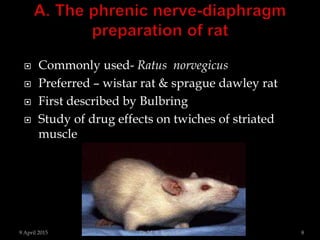
 Commonly used- Ratus norvegicus
 Preferred – wistar rat & sprague dawley rat
 First described by Bulbring
 Study of drug effects on twiches of striated
muscle
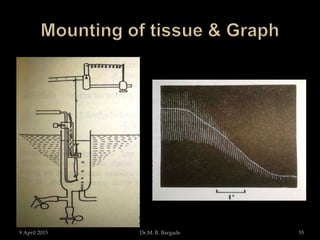
9 April 2015 8Dr.M. B. Bargade
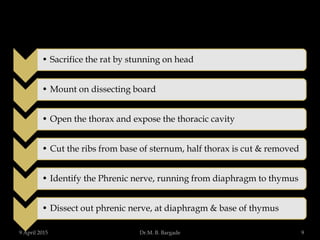
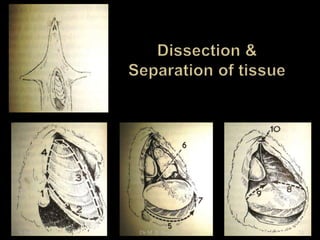
• Sacrifice the rat by stunning on head
• Mount on dissecting board
• Open the thorax and expose the thoracic cavity
• Cut the ribs from base of sternum, half thorax is cut & removed
• Identify the Phrenic nerve, running from diaphragm to thymus
• Dissect out phrenic nerve, at diaphragm & base of thymus
9 April 2015 9Dr.M. B. Bargade
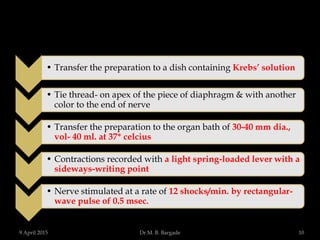
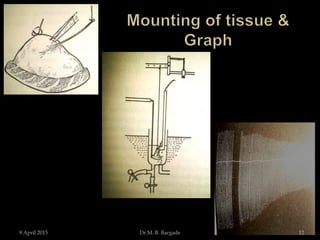
• Transfer the preparation to a dish containing Krebs’ solution
• Tie thread- on apex of the piece of diaphragm & with another
color to the end of nerve
• Transfer the preparation to the organ bath of 30-40 mm dia.,
vol- 40 ml. at 37* celcius
• Contractions recorded with a light spring-loaded lever with a
sideways-writing point
• Nerve stimulated at a rate of 12 shocks/min. by rectangular-
wave pulse of 0.5 msec.
9 April 2015 10Dr.M. B. Bargade
9 April 2015 11Dr.M. B. Bargade
9 April 2015 12Dr.M. B. Bargade
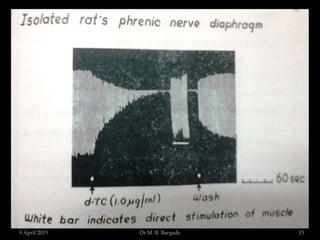
 Tubocurarine-
 Estimation of the concentration of unknown
solution
 Standard solution- 2*10-4 M
 Doses of standard & unknown which produce
roughly 30% & 50% inhibition of contraction
 Perform four-point assay of Latin square
design
9 April 2015 13Dr.M. B. Bargade
 Solution required –
 Krebs’ solution- minimum 5 lit.
 Tubocurarine chloride- standard 2*10-4 M
unknown- stronger than 5*10-5 M
Stock- 10-3 M
 Time required-
 For full 16 dose assay- 4 hours or more
 Cycle-
0 min- Start kymoghraph
1 min.- Add drug
6 min.- Stop kymoghraph & wash preparation
8 min.- wash preparation
10 min.- start kymoghraph9 April 2015 14Dr.M. B. Bargade
9 April 2015 15Dr.M. B. Bargade
 Effect of following drugs on preparations-
1] Ach 10-2 M
2]Decamethonium
6*10-3 M or
suxamethonium 2*10-
3 M
3] Hexamethonium
2*10-2 M
4] Tubocurarine 2*10-4 M or
Gallamine triethiodide 5*10-3
M
5] Tubocurarine or Gallamine
(as in 4) f/b 3 min after without
wash, 0.2 ml Physostigmine 10-4
M or neostigmine 10-4 M
9 April 2015 16Dr.M. B. Bargade
6] Decamethonium 6*10-3
M or suxamethonium
2*10-3 M f/b 3 min after
without wash, 0.2 ml
Physostigmine 10-4 M or
neostigmine 10-4 M
7] 0.2 ml Physostigmine
10-4 M or neostigmine 10-4
M f/b 1min after without
wash O.2 ml Ach 10-2 M
8] 0.2 ml Lignocaine 3*10-2
M
9 April 2015 17Dr.M. B. Bargade
 Convinient to arrange the experiments in pairs-
 One preparation for Decamethonium,
tubocurarine chloride, Physostigmine
 Other for Suxamethonium, Gallamine
triethiodide, Neostigmine
9 April 2015 18Dr.M. B. Bargade
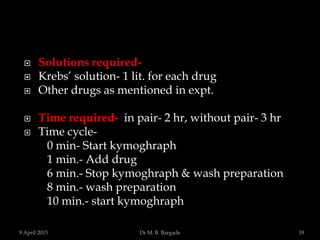
 Solutions required-
 Krebs’ solution- 1 lit. for each drug
 Other drugs as mentioned in expt.
 Time required- in pair- 2 hr, without pair- 3 hr
 Time cycle-
0 min- Start kymoghraph
1 min.- Add drug
6 min.- Stop kymoghraph & wash preparation
8 min.- wash preparation
10 min.- start kymoghraph
9 April 2015 19Dr.M. B. Bargade
9 April 2015 20Dr.M. B. Bargade
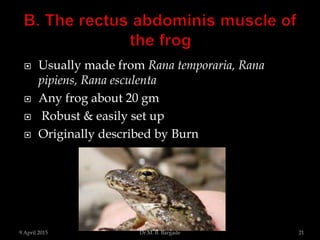
 Usually made from Rana temporaria, Rana
pipiens, Rana esculenta
 Any frog about 20 gm
 Robust & easily set up
 Originally described by Burn
9 April 2015 21Dr.M. B. Bargade
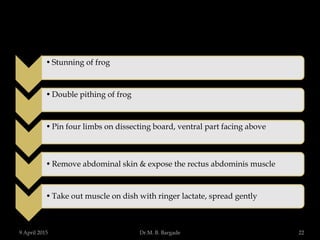
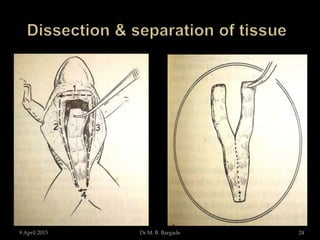
•Stunning of frog
•Double pithing of frog
•Pin four limbs on dissecting board, ventral part facing above
•Remove abdominal skin & expose the rectus abdominis muscle
•Take out muscle on dish with ringer lactate, spread gently
9 April 2015 22Dr.M. B. Bargade
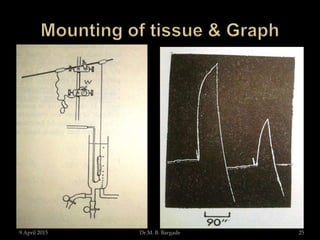
• Cut into two longitudinaly & transfer to Frog ringer solution.
• Thread is attached at each end of preparation
• Preparation is mounted in organ-bath of capacity 5-10 ml at
room temperature
• Contractions are recorded with a simple sideways-writing
lever
• Contractions are obtained by administrating drugs to the
organ bath
9 April 2015 23Dr.M. B. Bargade
9 April 2015 24Dr.M. B. Bargade
9 April 2015 25Dr.M. B. Bargade
 6 min cycle to test responses to ACh
 Log dose response curve
 Dose for 30% of maximum response
 Doubling the conc. will give about 50-60 %
response
 Test doses for unknown solution
 Select 2 suitable conc. & perfom four-point
assay with Latin square method
9 April 2015 26Dr.M. B. Bargade
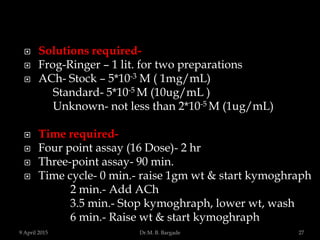
 Solutions required-
 Frog-Ringer – 1 lit. for two preparations
 ACh- Stock – 5*10-3 M ( 1mg/mL)
Standard- 5*10-5 M (10ug/mL )
Unknown- not less than 2*10-5 M (1ug/mL)
 Time required-
 Four point assay (16 Dose)- 2 hr
 Three-point assay- 90 min.
 Time cycle- 0 min.- raise 1gm wt & start kymoghraph
2 min.- Add ACh
3.5 min.- Stop kymoghraph, lower wt, wash
6 min.- Raise wt & start kymoghraph
9 April 2015 27Dr.M. B. Bargade
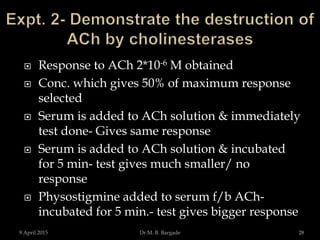
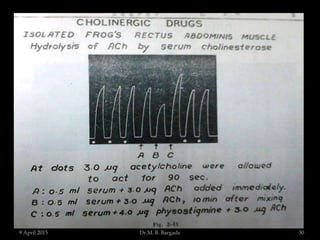
 Response to ACh 2*10-6 M obtained
 Conc. which gives 50% of maximum response
selected
 Serum is added to ACh solution & immediately
test done- Gives same response
 Serum is added to ACh solution & incubated
for 5 min- test gives much smaller/ no
response
 Physostigmine added to serum f/b ACh-
incubated for 5 min.- test gives bigger response
9 April 2015 28Dr.M. B. Bargade
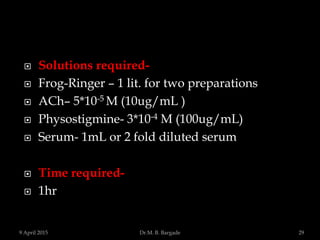
 Solutions required-
 Frog-Ringer – 1 lit. for two preparations
 ACh– 5*10-5 M (10ug/mL )
 Physostigmine- 3*10-4 M (100ug/mL)
 Serum- 1mL or 2 fold diluted serum
 Time required-
 1hr
9 April 2015 29Dr.M. B. Bargade
9 April 2015 30Dr.M. B. Bargade
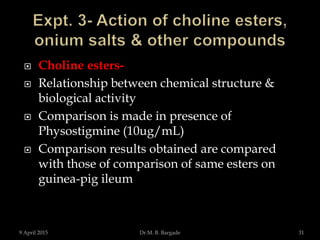
 Choline esters-
 Relationship between chemical structure &
biological activity
 Comparison is made in presence of
Physostigmine (10ug/mL)
 Comparison results obtained are compared
with those of comparison of same esters on
guinea-pig ileum
9 April 2015 31Dr.M. B. Bargade
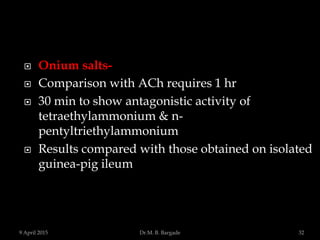
 Onium salts-
 Comparison with ACh requires 1 hr
 30 min to show antagonistic activity of
tetraethylammonium & n-
pentyltriethylammonium
 Results compared with those obtained on isolated
guinea-pig ileum
9 April 2015 32Dr.M. B. Bargade
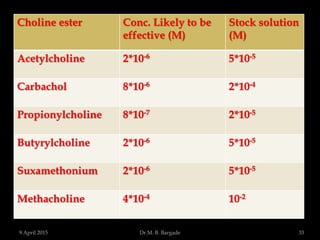
Choline ester Conc. Likely to be
effective (M)
Stock solution
(M)
Acetylcholine 2*10-6 5*10-5
Carbachol 8*10-6 2*10-4
Propionylcholine 8*10-7 2*10-5
Butyrylcholine 2*10-6 5*10-5
Suxamethonium 2*10-6 5*10-5
Methacholine 4*10-4 10-2
9 April 2015 33Dr.M. B. Bargade
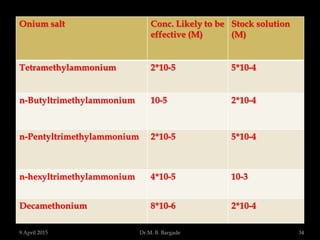
Onium salt Conc. Likely to be
effective (M)
Stock solution
(M)
Tetramethylammonium 2*10-5 5*10-4
n-Butyltrimethylammonium 10-5 2*10-4
n-Pentyltrimethylammonium 2*10-5 5*10-4
n-hexyltrimethylammonium 4*10-5 10-3
Decamethonium 8*10-6 2*10-4
9 April 2015 34Dr.M. B. Bargade
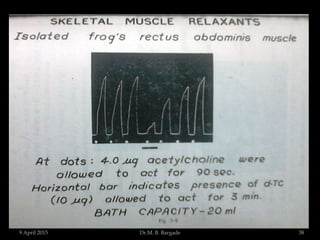
 Agonist conc. giving 30% & 60% of maximum
responses are obtained
 Ringer then replaced by Frog-Ringer solution
with tubocurarine chloride 10-6 M
 Agonist now gives much smaller response
9 April 2015 35Dr.M. B. Bargade
 Again repeated with tubocurarine 10-5 M and
10-4 M
 Dose-ratios of agonist for corresponding conc.
of antagonist calculated
 Graph of dose-ratio minus one versus conc. of
antagonist is ploted
9 April 2015 36Dr.M. B. Bargade
 Solution require-
 Frog- ringer- 1 lit. for each preparation
 ACh- 5*10-3 M, 5*10-4 M, 5*10-5 M
 Tubocurarine chloride- 10-3 M, 10-4 M, 10-5 M
diluted 1 in 10 in frog-ringer
 Time required-
 About 2 hr
9 April 2015 37Dr.M. B. Bargade
9 April 2015 38Dr.M. B. Bargade
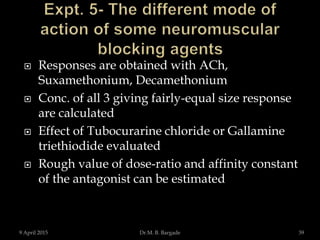
 Responses are obtained with ACh,
Suxamethonium, Decamethonium
 Conc. of all 3 giving fairly-equal size response
are calculated
 Effect of Tubocurarine chloride or Gallamine
triethiodide evaluated
 Rough value of dose-ratio and affinity constant
of the antagonist can be estimated
9 April 2015 39Dr.M. B. Bargade
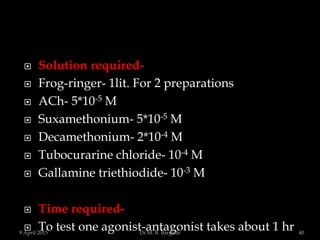
 Solution required-
 Frog-ringer- 1lit. For 2 preparations
 ACh- 5*10-5 M
 Suxamethonium- 5*10-5 M
 Decamethonium- 2*10-4 M
 Tubocurarine chloride- 10-4 M
 Gallamine triethiodide- 10-3 M
 Time required-
 To test one agonist-antagonist takes about 1 hr9 April 2015 40Dr.M. B. Bargade
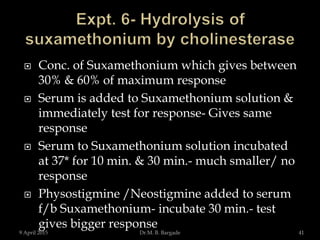
 Conc. of Suxamethonium which gives between
30% & 60% of maximum response
 Serum is added to Suxamethonium solution &
immediately test for response- Gives same
response
 Serum to Suxamethonium solution incubated
at 37* for 10 min. & 30 min.- much smaller/ no
response
 Physostigmine /Neostigmine added to serum
f/b Suxamethonium- incubate 30 min.- test
gives bigger response
9 April 2015 41Dr.M. B. Bargade
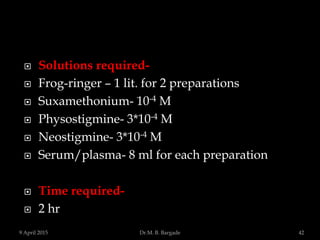
 Solutions required-
 Frog-ringer – 1 lit. for 2 preparations
 Suxamethonium- 10-4 M
 Physostigmine- 3*10-4 M
 Neostigmine- 3*10-4 M
 Serum/plasma- 8 ml for each preparation
 Time required-
 2 hr
9 April 2015 42Dr.M. B. Bargade
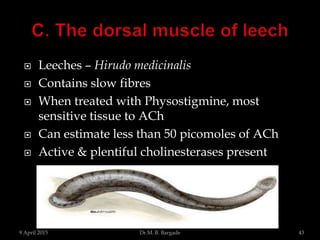
 Leeches – Hirudo medicinalis
 Contains slow fibres
 When treated with Physostigmine, most
sensitive tissue to ACh
 Can estimate less than 50 picomoles of ACh
 Active & plentiful cholinesterases present
9 April 2015 43Dr.M. B. Bargade
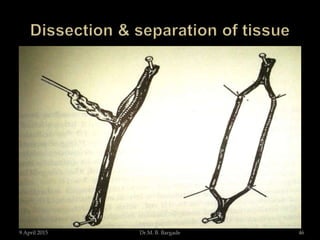
• Leech is pined on two end over cork board
• Cut- along 2 pale lateral line from mouth to tail
• Remove internal organs
• Dorsal muscle pinned out & divided longitudinally
• Thread is attached on both ends
9 April 2015 44Dr.M. B. Bargade
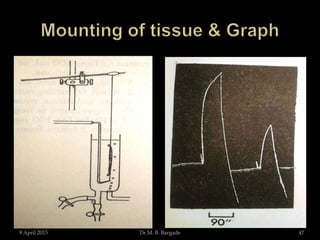
•Tissue is mounted in organ bath of 5-10 ml capacity at room
temp.
•Frog-ringer or Locke’s solution used
•Contraction are recorded with Simple sideways-writing lever
•Drugs are tested by administrating into organ bath
9 April 2015 45Dr.M. B. Bargade
9 April 2015 46Dr.M. B. Bargade
9 April 2015 47Dr.M. B. Bargade
 Dose-response curve with ACh using Frog-
ringer
 Physostigmine 25 mL 3*10-4 M in 250 mL of
Frog-ringer
 Frog-ringer containing Physostigmine is added
to organ bah & incubate for 20 min.
9 April 2015 48Dr.M. B. Bargade
 Dose-response curve with ACh obtained again
 Degree of potentiation for Physostigmine
calculated from comparison of above 2 dose-
response curves
 Unknown solution of ACh in frog-ringer
containing Physiostigmine is tested
 A simple bracketing assay
9 April 2015 49Dr.M. B. Bargade
 Solution required-
 Frog-ringer or Locke’s solution- 5 lit. for 2
preparations
 ACh- 10-4 M, 10-6 M & unknow ( stronger than
3*10-7 M)
 Physostigmine- 3*10-4 M
 Time required-
 About 2 hr
 Time cycle- 0 min.- start kymograph
2 min.- add ACh
3.5 min.- stop kymograph & wash
10 min.- wash
15 min.- start kymoghraph9 April 2015 50Dr.M. B. Bargade
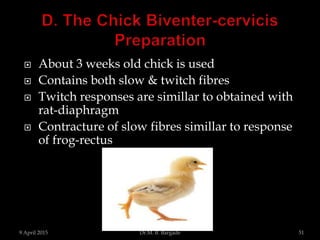
 About 3 weeks old chick is used
 Contains both slow & twitch fibres
 Twitch responses are simillar to obtained with
rat-diaphragm
 Contracture of slow fibres simillar to response
of frog-rectus
9 April 2015 51Dr.M. B. Bargade
•Chick is euthanized with Phenobarbitone or Chloroform
•Clear the feathers
•Midline incision on back from skull to base of neck
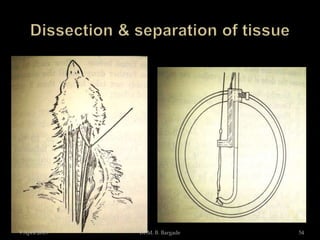
•Biventer cervicis muscle is identified on either side of midline of neck
just below the surface
•Thread is attached to upper end & muscle is cut from bottom, and
then from other end
9 April 2015 52Dr.M. B. Bargade
• Transfer the preparation to a dish containing Krebs’ solution
• Lower end tied with thread & upper end attached to fix pin at
the bottom of electrode holder
• Transfer the preparation to the organ bath of 30-40 mm dia.,
vol- 40 ml. at 37* celcius
• Contractions recorded with a light sprung lever
• Nerve stimulated at a rate of 12 shocks/min. by rectangular-
wave pulse of 0.5 msec.
9 April 2015 53Dr.M. B. Bargade
9 April 2015 54Dr.M. B. Bargade
9 April 2015 55Dr.M. B. Bargade
 Effect of following drugs on preparations-
1] Ach 10-2 M
2]Decamethonium
10-4 M or
suxamethonium 10-4
M
3] Hexamethonium
10-2 M
4] Tubocurarine 2*10-3 M or
Gallamine triethiodide 10-3
M
5] Tubocurarine or Gallamine
(as in 4) f/b 3 min after without
wash, 0.2 ml Physostigmine 10-4
M or neostigmine 10-4 M
9 April 2015 56Dr.M. B. Bargade
6] Decamethonium 10-4 M
or suxamethonium 10-4 M,
f/b 3 min after without
wash, 0.2 ml
Physostigmine 10-4 M or
neostigmine 10-4 M
7] 0.2 ml Physostigmine
10-4 M or neostigmine 10-4
M f/b 1 min after without
wash O.2 ml Ach 10-2 M
8] 0.2 ml Lignocaine 3*10-2
M
9 April 2015 57Dr.M. B. Bargade
 Convinient to arrange the experiments in pairs-
 One preparation for Decamethonium,
tubocurarine chloride, Physostigmine
 Other for Suxamethonium, Gallamine
triethiodide, Neostigmine
9 April 2015 58Dr.M. B. Bargade
 Solutions required-
 Krebs’ solution- 1 lit. for each drug
 Other drugs as mentioned in expt.
 Time required- in pair- 2 hr, without pair- 3 hr
 Time cycle-
0 min- Start kymoghraph
1 min.- Add drug
6 min.- Stop kymoghraph & wash preparation
8 min.- wash preparation
10 min.- start kymoghraph
9 April 2015 59Dr.M. B. Bargade
 “In the era of sophisticated physical and
chemical assay techniques, isolated
preparations of skeletal muscles are still the
important available methods to assay various
agents acting at neuromuscular junctions.”
9 April 2015 60Dr.M. B. Bargade
 Dept. of pharmacology University of Edinburgh.
Pharmacological expt. on isolated preparations:
skeletal muscle preparations. 2nd ed. Churchill
Livingstone, Edinburgh, Great Britain. 1976. pp.
30-57.
 Ghosh MN. Fundamentals of experimental
pharmacology: study on isolated muscle
preparations. 3rd ed. Bose printing house, Kolkata,
India. 2005. pp. 106-9.
 Medhi B, Prakash A. practical manual of
experimental & clinical pharmacology:commonly
used expt. Animals, Identification & collection of
tissue/muscle. 1st ed. Jaypee brothers medical
publishers (p) ltd. 2010. pp. 6-15, 140-9.
9 April 2015 61Dr.M. B. Bargade
 Satoskar RS, Rege NN, Bhandarkar SD.
Pharmacology and pharmacotherapeutics: drug
invention; new drug development; and drug assay.
23th ed. Popular prakashan pvt. Ltd., Mumbai.
2013. pp. 77-80.
 Vogel HG. Drug discovery & evaluation:
Pharmacological assay; Effect on peripheral nerve
function. 3rd ed. Springer, Berlin, Germany. 2008.
pp.973-81.
 Sheth UK, Dadkar NK, Kamat UG. Selected topics
in experimental pharmacology; Autonomic
pharmacology. 1st ed. The Kothari book depot,
Mumbai, India. 1972. pp. 40-77.
9 April 2015 62Dr.M. B. Bargade
 Sharma HL, Sharma KK. Principles of
Pharmacology: Bioassay of drugs. 2nd ed. Paras
publications, Hyderabad. 2011. pp. 920-6.
 Rang HP, Dale MM, Ritter JM, Flower RJ,
Henderson G. Rang and Dale’s Pharmacology:
Method & measurment in pharmacology. 7th ed.
Elsevier Churchill Livingstone, Spain. 2012. pp.89-
91.
 Satoskar RS, Rege NN, Bhandarkar SD.
Pharmacology and pharmacotherapeutics: drug
invention; new drug development; and drug assay.
23th ed. Popular prakashan pvt. Ltd., Mumbai.
2013. pp. 77-80.
9 April 2015 63Dr.M. B. Bargade
9 April 2015 64Dr.M. B. Bargade
9 April 2015 65Dr.M. B. Bargade

Experiments on isolated skeletal muscles mukunda

  • 1.
    Dr. Mukunda BharatBargade, JR1, Dept. of Pharmacology, IGGMC, Nagpur. 9 April 2015 1Dr.M. B. Bargade
  • 2.
     Introduction  Purposeof experiments in pharmacology  Bioassay  Experiments on isolated skeletal muscle preparations  Conclusion 9 April 2015 2Dr.M. B. Bargade
  • 3.
    In pharmacology, assayon animals and animal tissue preparations are needed because  1. Number of drugs obtained from plant and animal sources are not in chemically pure form.  2. Screening of new drugs  3. To handle minute quantity of the drugs eg. Estimation of drug metabolite 9 April 2015 3Dr.M. B. Bargade
  • 4.
     1. Qualitativeexperiments to analyze activity  2. Quantitative experiments to estimate amount of active drug in plant or animal extract  3. Assay of agonist  4. Comparison of activity of different agonist  5. Assay of antagonist 9 April 2015 4Dr.M. B. Bargade
  • 5.
    •Based on physical characteristicsPhysical •Estimationof concentration of active principleChemical •Using various biological methodsBiological 9 April 2015 5Dr.M. B. Bargade
  • 6.
     Definition- Bioassayis the estimation of the potency of an active principle in the given quantity of the given preparation using biological method.  Specific bioassays- A. Bioassay on whole animal B. Bioassay on isolated tissue C. Bioassay on cells D. Bioassay on microorganism9 April 2015 6Dr.M. B. Bargade
  • 7.
    A. The phrenicnerve-diaphragm preparation of rat B. The rectus abdominis muscle of frog C. The dorsal muscle of leech D. The chick biventer cervicis preparation 9 April 2015 7Dr.M. B. Bargade
  • 8.
     Commonly used-Ratus norvegicus  Preferred – wistar rat & sprague dawley rat  First described by Bulbring  Study of drug effects on twiches of striated muscle 9 April 2015 8Dr.M. B. Bargade
  • 9.
    • Sacrifice therat by stunning on head • Mount on dissecting board • Open the thorax and expose the thoracic cavity • Cut the ribs from base of sternum, half thorax is cut & removed • Identify the Phrenic nerve, running from diaphragm to thymus • Dissect out phrenic nerve, at diaphragm & base of thymus 9 April 2015 9Dr.M. B. Bargade
  • 10.
    • Transfer thepreparation to a dish containing Krebs’ solution • Tie thread- on apex of the piece of diaphragm & with another color to the end of nerve • Transfer the preparation to the organ bath of 30-40 mm dia., vol- 40 ml. at 37* celcius • Contractions recorded with a light spring-loaded lever with a sideways-writing point • Nerve stimulated at a rate of 12 shocks/min. by rectangular- wave pulse of 0.5 msec. 9 April 2015 10Dr.M. B. Bargade
  • 11.
    9 April 201511Dr.M. B. Bargade
  • 12.
    9 April 201512Dr.M. B. Bargade
  • 13.
     Tubocurarine-  Estimationof the concentration of unknown solution  Standard solution- 2*10-4 M  Doses of standard & unknown which produce roughly 30% & 50% inhibition of contraction  Perform four-point assay of Latin square design 9 April 2015 13Dr.M. B. Bargade
  • 14.
     Solution required–  Krebs’ solution- minimum 5 lit.  Tubocurarine chloride- standard 2*10-4 M unknown- stronger than 5*10-5 M Stock- 10-3 M  Time required-  For full 16 dose assay- 4 hours or more  Cycle- 0 min- Start kymoghraph 1 min.- Add drug 6 min.- Stop kymoghraph & wash preparation 8 min.- wash preparation 10 min.- start kymoghraph9 April 2015 14Dr.M. B. Bargade
  • 15.
    9 April 201515Dr.M. B. Bargade
  • 16.
     Effect offollowing drugs on preparations- 1] Ach 10-2 M 2]Decamethonium 6*10-3 M or suxamethonium 2*10- 3 M 3] Hexamethonium 2*10-2 M 4] Tubocurarine 2*10-4 M or Gallamine triethiodide 5*10-3 M 5] Tubocurarine or Gallamine (as in 4) f/b 3 min after without wash, 0.2 ml Physostigmine 10-4 M or neostigmine 10-4 M 9 April 2015 16Dr.M. B. Bargade
  • 17.
    6] Decamethonium 6*10-3 Mor suxamethonium 2*10-3 M f/b 3 min after without wash, 0.2 ml Physostigmine 10-4 M or neostigmine 10-4 M 7] 0.2 ml Physostigmine 10-4 M or neostigmine 10-4 M f/b 1min after without wash O.2 ml Ach 10-2 M 8] 0.2 ml Lignocaine 3*10-2 M 9 April 2015 17Dr.M. B. Bargade
  • 18.
     Convinient toarrange the experiments in pairs-  One preparation for Decamethonium, tubocurarine chloride, Physostigmine  Other for Suxamethonium, Gallamine triethiodide, Neostigmine 9 April 2015 18Dr.M. B. Bargade
  • 19.
     Solutions required- Krebs’ solution- 1 lit. for each drug  Other drugs as mentioned in expt.  Time required- in pair- 2 hr, without pair- 3 hr  Time cycle- 0 min- Start kymoghraph 1 min.- Add drug 6 min.- Stop kymoghraph & wash preparation 8 min.- wash preparation 10 min.- start kymoghraph 9 April 2015 19Dr.M. B. Bargade
  • 20.
    9 April 201520Dr.M. B. Bargade
  • 21.
     Usually madefrom Rana temporaria, Rana pipiens, Rana esculenta  Any frog about 20 gm  Robust & easily set up  Originally described by Burn 9 April 2015 21Dr.M. B. Bargade
  • 22.
    •Stunning of frog •Doublepithing of frog •Pin four limbs on dissecting board, ventral part facing above •Remove abdominal skin & expose the rectus abdominis muscle •Take out muscle on dish with ringer lactate, spread gently 9 April 2015 22Dr.M. B. Bargade
  • 23.
    • Cut intotwo longitudinaly & transfer to Frog ringer solution. • Thread is attached at each end of preparation • Preparation is mounted in organ-bath of capacity 5-10 ml at room temperature • Contractions are recorded with a simple sideways-writing lever • Contractions are obtained by administrating drugs to the organ bath 9 April 2015 23Dr.M. B. Bargade
  • 24.
    9 April 201524Dr.M. B. Bargade
  • 25.
    9 April 201525Dr.M. B. Bargade
  • 26.
     6 mincycle to test responses to ACh  Log dose response curve  Dose for 30% of maximum response  Doubling the conc. will give about 50-60 % response  Test doses for unknown solution  Select 2 suitable conc. & perfom four-point assay with Latin square method 9 April 2015 26Dr.M. B. Bargade
  • 27.
     Solutions required- Frog-Ringer – 1 lit. for two preparations  ACh- Stock – 5*10-3 M ( 1mg/mL) Standard- 5*10-5 M (10ug/mL ) Unknown- not less than 2*10-5 M (1ug/mL)  Time required-  Four point assay (16 Dose)- 2 hr  Three-point assay- 90 min.  Time cycle- 0 min.- raise 1gm wt & start kymoghraph 2 min.- Add ACh 3.5 min.- Stop kymoghraph, lower wt, wash 6 min.- Raise wt & start kymoghraph 9 April 2015 27Dr.M. B. Bargade
  • 28.
     Response toACh 2*10-6 M obtained  Conc. which gives 50% of maximum response selected  Serum is added to ACh solution & immediately test done- Gives same response  Serum is added to ACh solution & incubated for 5 min- test gives much smaller/ no response  Physostigmine added to serum f/b ACh- incubated for 5 min.- test gives bigger response 9 April 2015 28Dr.M. B. Bargade
  • 29.
     Solutions required- Frog-Ringer – 1 lit. for two preparations  ACh– 5*10-5 M (10ug/mL )  Physostigmine- 3*10-4 M (100ug/mL)  Serum- 1mL or 2 fold diluted serum  Time required-  1hr 9 April 2015 29Dr.M. B. Bargade
  • 30.
    9 April 201530Dr.M. B. Bargade
  • 31.
     Choline esters- Relationship between chemical structure & biological activity  Comparison is made in presence of Physostigmine (10ug/mL)  Comparison results obtained are compared with those of comparison of same esters on guinea-pig ileum 9 April 2015 31Dr.M. B. Bargade
  • 32.
     Onium salts- Comparison with ACh requires 1 hr  30 min to show antagonistic activity of tetraethylammonium & n- pentyltriethylammonium  Results compared with those obtained on isolated guinea-pig ileum 9 April 2015 32Dr.M. B. Bargade
  • 33.
    Choline ester Conc.Likely to be effective (M) Stock solution (M) Acetylcholine 2*10-6 5*10-5 Carbachol 8*10-6 2*10-4 Propionylcholine 8*10-7 2*10-5 Butyrylcholine 2*10-6 5*10-5 Suxamethonium 2*10-6 5*10-5 Methacholine 4*10-4 10-2 9 April 2015 33Dr.M. B. Bargade
  • 34.
    Onium salt Conc.Likely to be effective (M) Stock solution (M) Tetramethylammonium 2*10-5 5*10-4 n-Butyltrimethylammonium 10-5 2*10-4 n-Pentyltrimethylammonium 2*10-5 5*10-4 n-hexyltrimethylammonium 4*10-5 10-3 Decamethonium 8*10-6 2*10-4 9 April 2015 34Dr.M. B. Bargade
  • 35.
     Agonist conc.giving 30% & 60% of maximum responses are obtained  Ringer then replaced by Frog-Ringer solution with tubocurarine chloride 10-6 M  Agonist now gives much smaller response 9 April 2015 35Dr.M. B. Bargade
  • 36.
     Again repeatedwith tubocurarine 10-5 M and 10-4 M  Dose-ratios of agonist for corresponding conc. of antagonist calculated  Graph of dose-ratio minus one versus conc. of antagonist is ploted 9 April 2015 36Dr.M. B. Bargade
  • 37.
     Solution require- Frog- ringer- 1 lit. for each preparation  ACh- 5*10-3 M, 5*10-4 M, 5*10-5 M  Tubocurarine chloride- 10-3 M, 10-4 M, 10-5 M diluted 1 in 10 in frog-ringer  Time required-  About 2 hr 9 April 2015 37Dr.M. B. Bargade
  • 38.
    9 April 201538Dr.M. B. Bargade
  • 39.
     Responses areobtained with ACh, Suxamethonium, Decamethonium  Conc. of all 3 giving fairly-equal size response are calculated  Effect of Tubocurarine chloride or Gallamine triethiodide evaluated  Rough value of dose-ratio and affinity constant of the antagonist can be estimated 9 April 2015 39Dr.M. B. Bargade
  • 40.
     Solution required- Frog-ringer- 1lit. For 2 preparations  ACh- 5*10-5 M  Suxamethonium- 5*10-5 M  Decamethonium- 2*10-4 M  Tubocurarine chloride- 10-4 M  Gallamine triethiodide- 10-3 M  Time required-  To test one agonist-antagonist takes about 1 hr9 April 2015 40Dr.M. B. Bargade
  • 41.
     Conc. ofSuxamethonium which gives between 30% & 60% of maximum response  Serum is added to Suxamethonium solution & immediately test for response- Gives same response  Serum to Suxamethonium solution incubated at 37* for 10 min. & 30 min.- much smaller/ no response  Physostigmine /Neostigmine added to serum f/b Suxamethonium- incubate 30 min.- test gives bigger response 9 April 2015 41Dr.M. B. Bargade
  • 42.
     Solutions required- Frog-ringer – 1 lit. for 2 preparations  Suxamethonium- 10-4 M  Physostigmine- 3*10-4 M  Neostigmine- 3*10-4 M  Serum/plasma- 8 ml for each preparation  Time required-  2 hr 9 April 2015 42Dr.M. B. Bargade
  • 43.
     Leeches –Hirudo medicinalis  Contains slow fibres  When treated with Physostigmine, most sensitive tissue to ACh  Can estimate less than 50 picomoles of ACh  Active & plentiful cholinesterases present 9 April 2015 43Dr.M. B. Bargade
  • 44.
    • Leech ispined on two end over cork board • Cut- along 2 pale lateral line from mouth to tail • Remove internal organs • Dorsal muscle pinned out & divided longitudinally • Thread is attached on both ends 9 April 2015 44Dr.M. B. Bargade
  • 45.
    •Tissue is mountedin organ bath of 5-10 ml capacity at room temp. •Frog-ringer or Locke’s solution used •Contraction are recorded with Simple sideways-writing lever •Drugs are tested by administrating into organ bath 9 April 2015 45Dr.M. B. Bargade
  • 46.
    9 April 201546Dr.M. B. Bargade
  • 47.
    9 April 201547Dr.M. B. Bargade
  • 48.
     Dose-response curvewith ACh using Frog- ringer  Physostigmine 25 mL 3*10-4 M in 250 mL of Frog-ringer  Frog-ringer containing Physostigmine is added to organ bah & incubate for 20 min. 9 April 2015 48Dr.M. B. Bargade
  • 49.
     Dose-response curvewith ACh obtained again  Degree of potentiation for Physostigmine calculated from comparison of above 2 dose- response curves  Unknown solution of ACh in frog-ringer containing Physiostigmine is tested  A simple bracketing assay 9 April 2015 49Dr.M. B. Bargade
  • 50.
     Solution required- Frog-ringer or Locke’s solution- 5 lit. for 2 preparations  ACh- 10-4 M, 10-6 M & unknow ( stronger than 3*10-7 M)  Physostigmine- 3*10-4 M  Time required-  About 2 hr  Time cycle- 0 min.- start kymograph 2 min.- add ACh 3.5 min.- stop kymograph & wash 10 min.- wash 15 min.- start kymoghraph9 April 2015 50Dr.M. B. Bargade
  • 51.
     About 3weeks old chick is used  Contains both slow & twitch fibres  Twitch responses are simillar to obtained with rat-diaphragm  Contracture of slow fibres simillar to response of frog-rectus 9 April 2015 51Dr.M. B. Bargade
  • 52.
    •Chick is euthanizedwith Phenobarbitone or Chloroform •Clear the feathers •Midline incision on back from skull to base of neck •Biventer cervicis muscle is identified on either side of midline of neck just below the surface •Thread is attached to upper end & muscle is cut from bottom, and then from other end 9 April 2015 52Dr.M. B. Bargade
  • 53.
    • Transfer thepreparation to a dish containing Krebs’ solution • Lower end tied with thread & upper end attached to fix pin at the bottom of electrode holder • Transfer the preparation to the organ bath of 30-40 mm dia., vol- 40 ml. at 37* celcius • Contractions recorded with a light sprung lever • Nerve stimulated at a rate of 12 shocks/min. by rectangular- wave pulse of 0.5 msec. 9 April 2015 53Dr.M. B. Bargade
  • 54.
    9 April 201554Dr.M. B. Bargade
  • 55.
    9 April 201555Dr.M. B. Bargade
  • 56.
     Effect offollowing drugs on preparations- 1] Ach 10-2 M 2]Decamethonium 10-4 M or suxamethonium 10-4 M 3] Hexamethonium 10-2 M 4] Tubocurarine 2*10-3 M or Gallamine triethiodide 10-3 M 5] Tubocurarine or Gallamine (as in 4) f/b 3 min after without wash, 0.2 ml Physostigmine 10-4 M or neostigmine 10-4 M 9 April 2015 56Dr.M. B. Bargade
  • 57.
    6] Decamethonium 10-4M or suxamethonium 10-4 M, f/b 3 min after without wash, 0.2 ml Physostigmine 10-4 M or neostigmine 10-4 M 7] 0.2 ml Physostigmine 10-4 M or neostigmine 10-4 M f/b 1 min after without wash O.2 ml Ach 10-2 M 8] 0.2 ml Lignocaine 3*10-2 M 9 April 2015 57Dr.M. B. Bargade
  • 58.
     Convinient toarrange the experiments in pairs-  One preparation for Decamethonium, tubocurarine chloride, Physostigmine  Other for Suxamethonium, Gallamine triethiodide, Neostigmine 9 April 2015 58Dr.M. B. Bargade
  • 59.
     Solutions required- Krebs’ solution- 1 lit. for each drug  Other drugs as mentioned in expt.  Time required- in pair- 2 hr, without pair- 3 hr  Time cycle- 0 min- Start kymoghraph 1 min.- Add drug 6 min.- Stop kymoghraph & wash preparation 8 min.- wash preparation 10 min.- start kymoghraph 9 April 2015 59Dr.M. B. Bargade
  • 60.
     “In theera of sophisticated physical and chemical assay techniques, isolated preparations of skeletal muscles are still the important available methods to assay various agents acting at neuromuscular junctions.” 9 April 2015 60Dr.M. B. Bargade
  • 61.
     Dept. ofpharmacology University of Edinburgh. Pharmacological expt. on isolated preparations: skeletal muscle preparations. 2nd ed. Churchill Livingstone, Edinburgh, Great Britain. 1976. pp. 30-57.  Ghosh MN. Fundamentals of experimental pharmacology: study on isolated muscle preparations. 3rd ed. Bose printing house, Kolkata, India. 2005. pp. 106-9.  Medhi B, Prakash A. practical manual of experimental & clinical pharmacology:commonly used expt. Animals, Identification & collection of tissue/muscle. 1st ed. Jaypee brothers medical publishers (p) ltd. 2010. pp. 6-15, 140-9. 9 April 2015 61Dr.M. B. Bargade
  • 62.
     Satoskar RS,Rege NN, Bhandarkar SD. Pharmacology and pharmacotherapeutics: drug invention; new drug development; and drug assay. 23th ed. Popular prakashan pvt. Ltd., Mumbai. 2013. pp. 77-80.  Vogel HG. Drug discovery & evaluation: Pharmacological assay; Effect on peripheral nerve function. 3rd ed. Springer, Berlin, Germany. 2008. pp.973-81.  Sheth UK, Dadkar NK, Kamat UG. Selected topics in experimental pharmacology; Autonomic pharmacology. 1st ed. The Kothari book depot, Mumbai, India. 1972. pp. 40-77. 9 April 2015 62Dr.M. B. Bargade
  • 63.
     Sharma HL,Sharma KK. Principles of Pharmacology: Bioassay of drugs. 2nd ed. Paras publications, Hyderabad. 2011. pp. 920-6.  Rang HP, Dale MM, Ritter JM, Flower RJ, Henderson G. Rang and Dale’s Pharmacology: Method & measurment in pharmacology. 7th ed. Elsevier Churchill Livingstone, Spain. 2012. pp.89- 91.  Satoskar RS, Rege NN, Bhandarkar SD. Pharmacology and pharmacotherapeutics: drug invention; new drug development; and drug assay. 23th ed. Popular prakashan pvt. Ltd., Mumbai. 2013. pp. 77-80. 9 April 2015 63Dr.M. B. Bargade
  • 64.
    9 April 201564Dr.M. B. Bargade
  • 65.
    9 April 201565Dr.M. B. Bargade