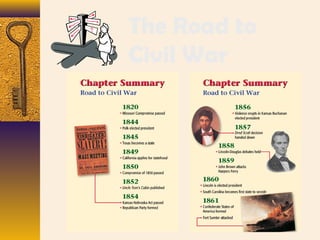
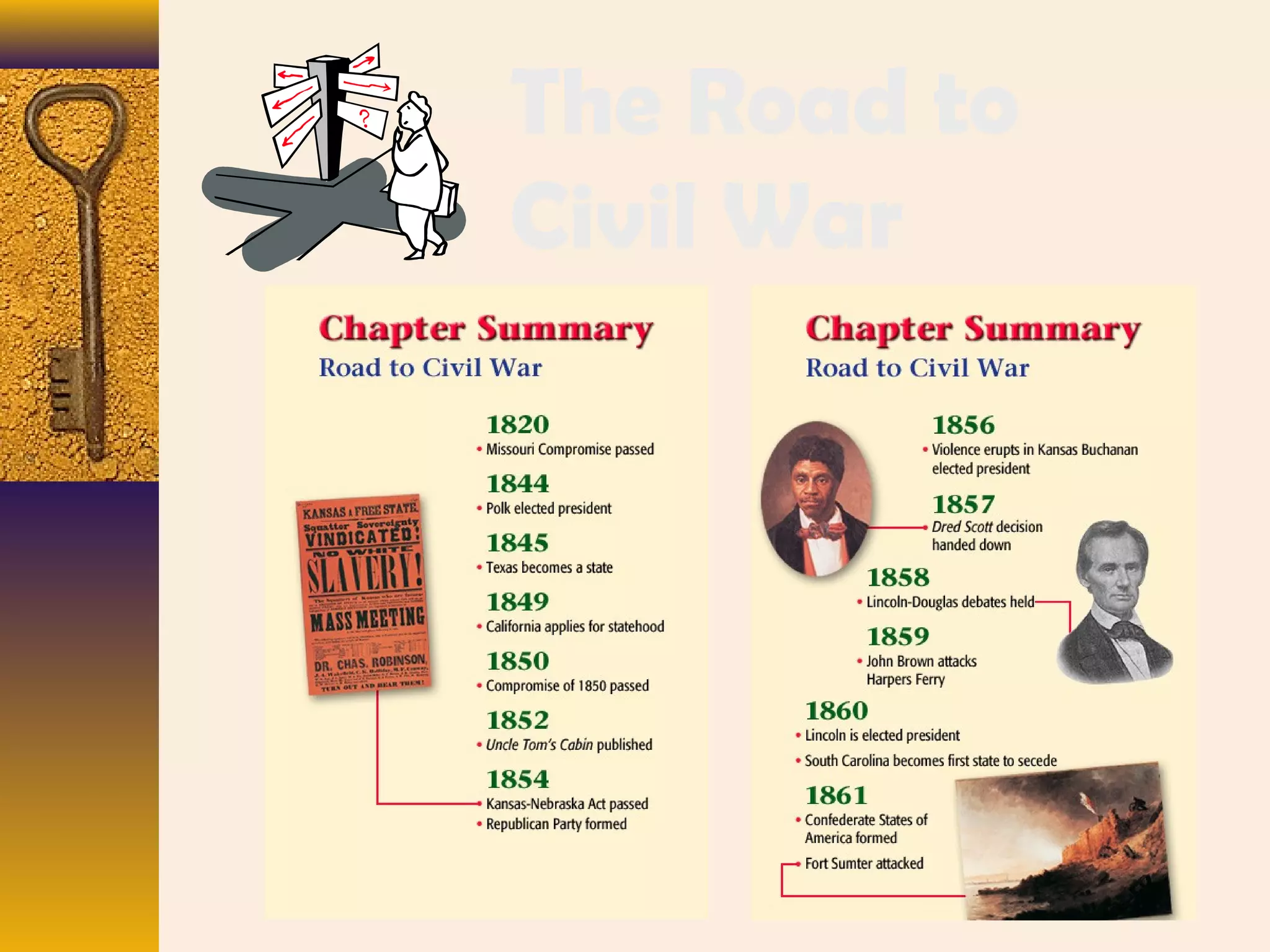
The Road to
Civil War
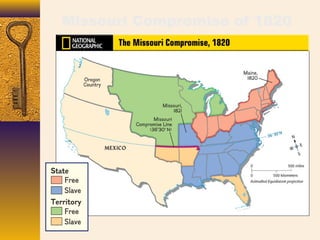
Missouri Compromise of 1820
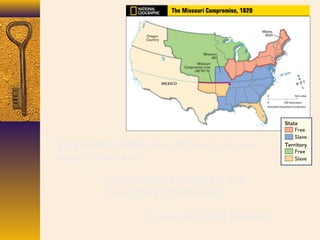
Supposed to settle issue of slavery in new
western territories
Compromise favored the Anti-
Slave folks (Abolitionists)
It was not strictly followed
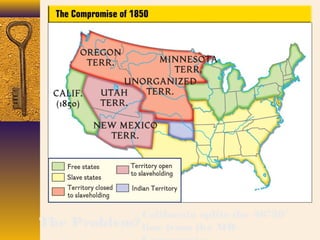
The Problem?
California splits the 36º30’
line from the MO
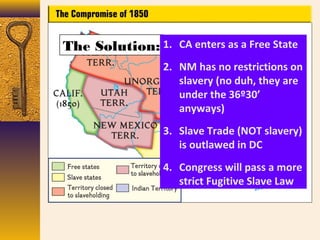
The Solution: 1. CA enters as a Free State
2. NM has no restrictions on
slavery (no duh, they are
under the 36º30’
anyways)
3. Slave Trade (NOT slavery)
is outlawed in DC
4. Congress will pass a more
strict Fugitive Slave Law
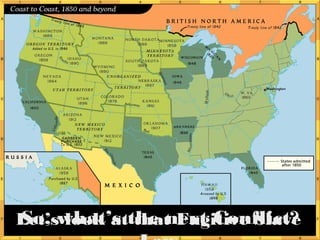
So, what’s the next Conflict?Let’s look at that Fugitive Slave
The Fugitive Slave Act of 1850
•It required ALL citizens to help
catch runaway slaves
•The Act actually convinced more
Northerners to oppose slavery
•Northern juries refused to convict
those who broke the law
•But, the law did have influential
supporters in the North like
Franklin Pierce (President)
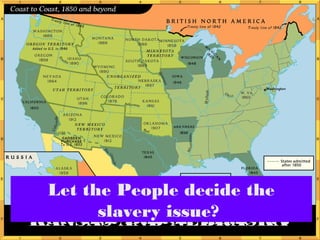
Next Hot Button Issue . . .KANSAS AND NEBRASKA
Let the People decide the
slavery issue?
The Kansas-Nebraska
Act
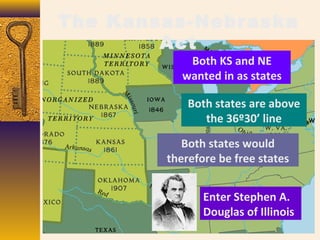
Enter Stephen A.
Douglas of Illinois
Both KS and NE
wanted in as states
Both states are above
the 36º30’ line
Both states would
therefore be free states
The Kansas-Nebraska Act
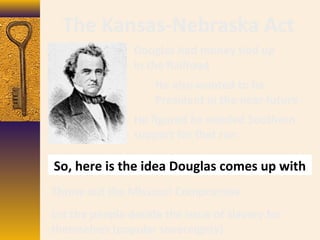
Douglas had money tied up
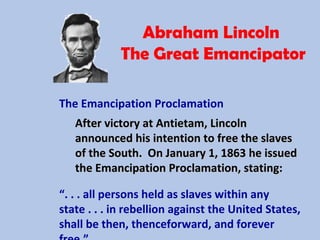
in the Railroad
He also wanted to be
President in the near future
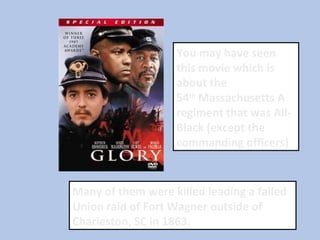
He figured he needed Southern
support for that run
So, here is the idea Douglas comes up with
Throw out the Missouri Compromise
Let the people decide the issue of slavery for
themselves (popular sovereignty)
The Kansas-Nebraska Act
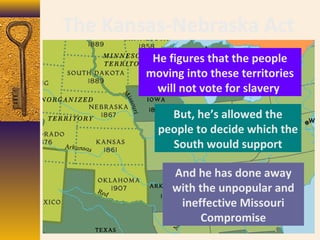
He figures that the people
moving into these territories
will not vote for slavery
But, he’s allowed the
people to decide which the
South would support
And he has done away
with the unpopular and
ineffective Missouri
Compromise
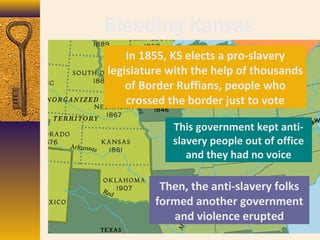
Bleeding Kansas
In 1855, KS elects a pro-slavery
legislature with the help of thousands
of Border Ruffians, people who
crossed the border just to vote
This government kept anti-
slavery people out of office
and they had no voice
Then, the anti-slavery folks
formed another government
and violence erupted
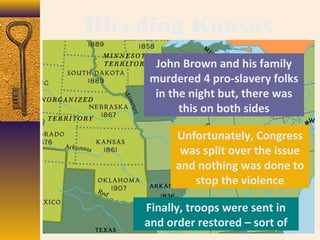
Bleeding Kansas
Unfortunately, Congress
was split over the issue
and nothing was done to
stop the violence
Finally, troops were sent in
and order restored – sort of
John Brown and his family
murdered 4 pro-slavery folks
in the night but, there was
this on both sides
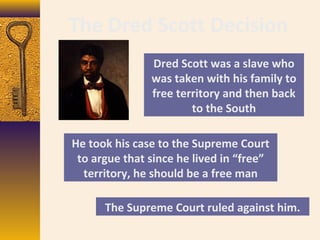
The Dred Scott Decision
Dred Scott was a slave who
was taken with his family to
free territory and then back
to the South
He took his case to the Supreme Court
to argue that since he lived in “free”
territory, he should be a free man
The Supreme Court ruled against him.
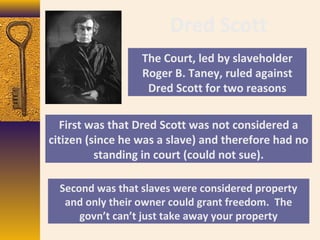
Dred Scott
The Court, led by slaveholder
Roger B. Taney, ruled against
Dred Scott for two reasons
First was that Dred Scott was not considered a
citizen (since he was a slave) and therefore had no
standing in court (could not sue).
Second was that slaves were considered property
and only their owner could grant freedom. The
govn’t can’t just take away your property
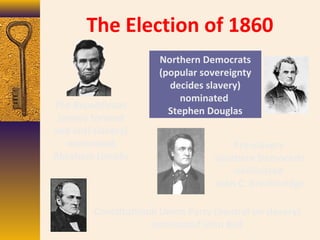
The Election of 1860
The Republicans
(newly formed
and anti-slavery)
nominated
Abraham Lincoln
Northern Democrats
(popular sovereignty
decides slavery)
nominated
Stephen Douglas
Pro-slavery
Southern Democrats
nominated
John C. Breckinridge
Constitutional Union Party (neutral on slavery)
nominated John Bell
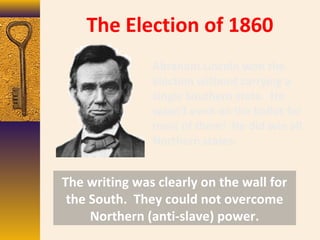
The Election of 1860
Abraham Lincoln won the
election without carrying a
single Southern state. He
wasn’t even on the ballot for
most of them! He did win all
Northern states.
The writing was clearly on the wall for
the South. They could not overcome
Northern (anti-slave) power.
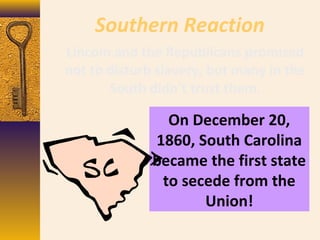
Southern Reaction
On December 20,
1860, South Carolina
became the first state
to secede from the
Union!
Lincoln and the Republicans promised
not to disturb slavery, but many in the
South didn’t trust them.
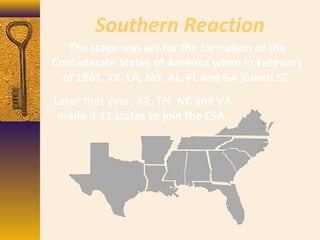
Southern Reaction
The stage was set for the formation of the
Confederate States of America when in February
of 1861, TX, LA, MS, AL, FL and GA joined SC.
Later that year, AR, TN, NC and VA
made it 11 states to join the CSA.
The Confederate States of America
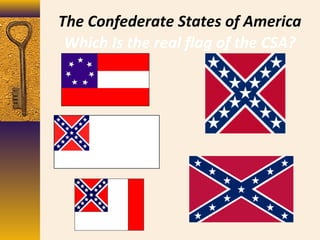
Which Is the real flag of the CSA?
The Confederate States of America
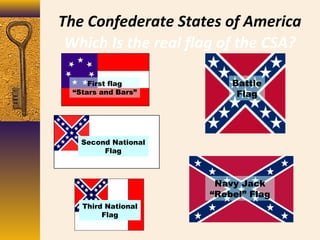
Which Is the real flag of the CSA?
First flag
“Stars and Bars”
Second National
Flag
Third National
Flag
Battle
Flag
Navy Jack
“Rebel” Flag
The Confederate States of America
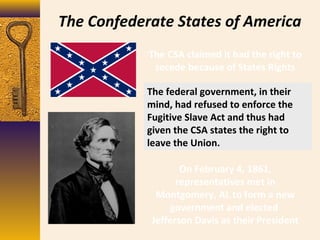
The CSA claimed it had the right to
secede because of States Rights
The federal government, in their
mind, had refused to enforce the
Fugitive Slave Act and thus had
given the CSA states the right to
leave the Union.
On February 4, 1861,
representatives met in
Montgomery, AL to form a new
government and elected
Jefferson Davis as their President
The Civil War Begins
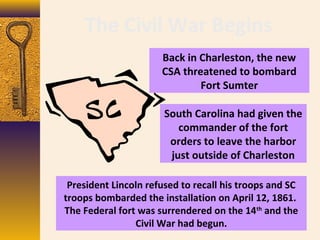
Back in Charleston, the new
CSA threatened to bombard
Fort Sumter
South Carolina had given the
commander of the fort
orders to leave the harbor
just outside of Charleston
President Lincoln refused to recall his troops and SC
troops bombarded the installation on April 12, 1861.
The Federal fort was surrendered on the 14th
and the
Civil War had begun.
The Civil War (1861-1865)
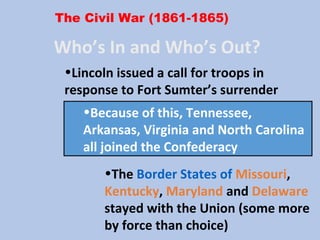
Who’s In and Who’s Out?
•The Border States of Missouri,
Kentucky, Maryland and Delaware
stayed with the Union (some more
by force than choice)
•Because of this, Tennessee,
Arkansas, Virginia and North Carolina
all joined the Confederacy
•Lincoln issued a call for troops in
response to Fort Sumter’s surrender
The Civil War (1861-1865)
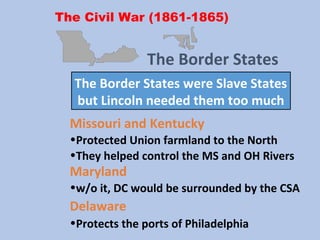
Missouri and Kentucky
•Protected Union farmland to the North
•They helped control the MS and OH Rivers
The Border States
The Border States were Slave States
but Lincoln needed them too much
Maryland
•w/o it, DC would be surrounded by the CSA
Delaware
•Protects the ports of Philadelphia
The Civil War (1861-1865)
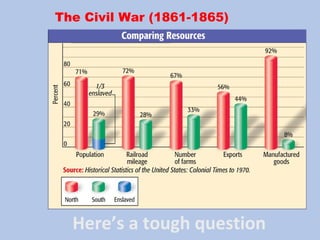
Here’s a tough question
The Civil War (1861-1865)
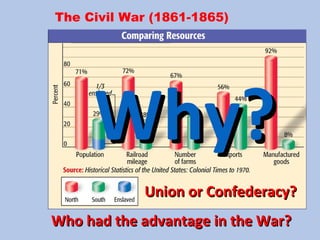
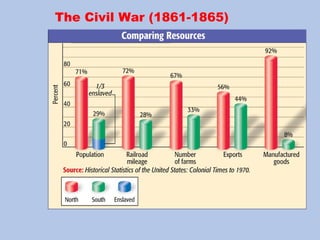
Who had the advantage in the War?Who had the advantage in the War?
Union or Confederacy?Union or Confederacy?
Why?Why?
The Civil War (1861-1865)
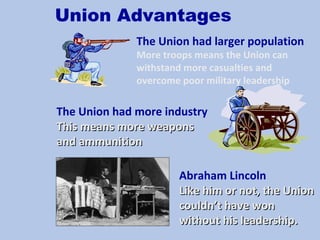
Union Advantages
The Union had larger population
More troops means the Union can
withstand more casualties and
overcome poor military leadership
The Union had more industry
This means more weaponsThis means more weapons
and ammunitionand ammunition
Abraham Lincoln
Like him or not, the UnionLike him or not, the Union
couldn’t have woncouldn’t have won
without his leadership.without his leadership.
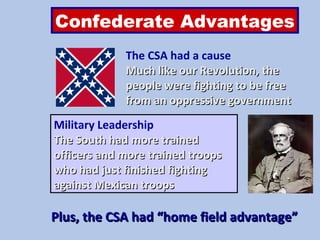
Confederate Advantages
The CSA had a cause
Much like our Revolution, theMuch like our Revolution, the
people were fighting to be freepeople were fighting to be free
from an oppressive governmentfrom an oppressive government
Military Leadership
The South had more trainedThe South had more trained
officers and more trained troopsofficers and more trained troops
who had just finished fightingwho had just finished fighting
against Mexican troopsagainst Mexican troops
Plus, the CSA had “home field advantage”Plus, the CSA had “home field advantage”
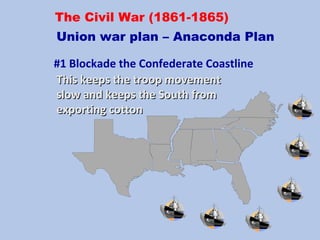
#1 Blockade the Confederate Coastline
This keeps the troop movementThis keeps the troop movement
slow and keeps the South fromslow and keeps the South from
exporting cottonexporting cotton
The Civil War (1861-1865)
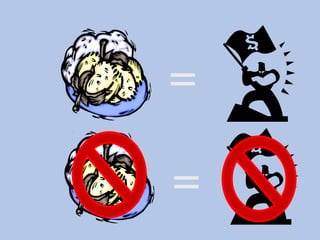
Union war plan – Anaconda Plan
=
=
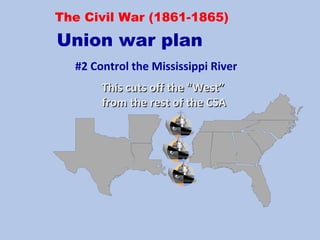
#2 Control the Mississippi River
This cuts off the “West”This cuts off the “West”
from the rest of the CSAfrom the rest of the CSA
The Civil War (1861-1865)
Union war plan
It was a simple one-part plan
Fight a “defensive” war. Make it difficultFight a “defensive” war. Make it difficult
enough for the Union to take them back, theenough for the Union to take them back, the
Union would simply get tired of fighting andUnion would simply get tired of fighting and
recognize the CSA as a new nation.recognize the CSA as a new nation.
The Civil War (1861-1865)
Confederate war plan
Besides, they didn’t have the troopBesides, they didn’t have the troop
numbers to go on the “offensive.”numbers to go on the “offensive.”
The Civil War (1861-1865)
Who were these two sides?
The Confederates were broken into two major
Armies
The Army of Tennessee
•This was the combination of the Armies of
Kentucky, Mississippi and Tennessee
•was headed by a few different Generals
•Fought mostly in the Western Campaigns
The Army of Northern Virginia
•Eventually was headed by Robert E. Lee
•Fought mostly in the Eastern Campaigns
The Civil War (1861-1865)
Who were these two sides?
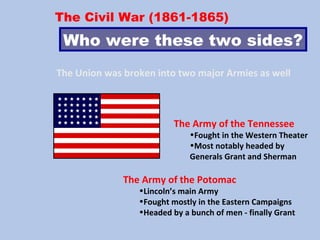
The Union was broken into two major Armies as well
The Army of the Tennessee
•Fought in the Western Theater
•Most notably headed by
Generals Grant and Sherman
The Army of the Potomac
•Lincoln’s main Army
•Fought mostly in the Eastern Campaigns
•Headed by a bunch of men - finally Grant
The Civil War (1861-1865)
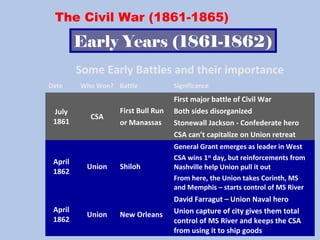
Early Years (1861-1862)
Some Early Battles and their importance
Date Who Won? Battle Significance
July
1861
CSA
First Bull Run
or Manassas
First major battle of Civil War
Both sides disorganized
Stonewall Jackson - Confederate hero
CSA can’t capitalize on Union retreat
April
1862
Union Shiloh
General Grant emerges as leader in West
CSA wins 1st
day, but reinforcements from
Nashville help Union pull it out
From here, the Union takes Corinth, MS
and Memphis – starts control of MS River
April
1862
Union New Orleans
David Farragut – Union Naval hero
Union capture of city gives them total
control of MS River and keeps the CSA
from using it to ship goods
The Civil War (1861-1865)
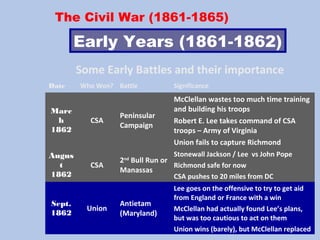
Early Years (1861-1862)
Some Early Battles and their importance
Date Who Won? Battle Significance
Marc
h
1862
CSA
Peninsular
Campaign
McClellan wastes too much time training
and building his troops
Robert E. Lee takes command of CSA
troops – Army of Virginia
Union fails to capture Richmond
Augus
t
1862
CSA
2nd
Bull Run or
Manassas
Stonewall Jackson / Lee vs John Pope
Richmond safe for now
CSA pushes to 20 miles from DC
Sept.
1862
Union
Antietam
(Maryland)
Lee goes on the offensive to try to get aid
from England or France with a win
McClellan had actually found Lee’s plans,
but was too cautious to act on them
Union wins (barely), but McClellan replaced
Death
Tolls
Death
Tolls
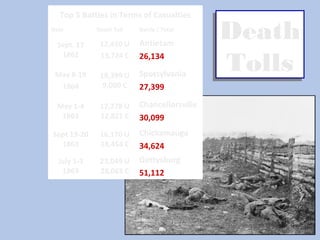
Top 5 Battles in Terms of Casualties
Date Death Toll Battle / Total
Sept. 17
1862
12,410 U
13,724 C
Antietam
26,134
May 8-19
1864
18,399 U
9,000 C
Spotsylvania
27,399
May 1-4
1863
17,278 U
12,821 C
Chancellorsville
30,099
Sept 19-20
1863
16,170 U
18,454 C
Chickamauga
34,624
July 1-3
1863
23,049 U
28,063 C
Gettysburg
51,112
Did You Know?Did You Know?
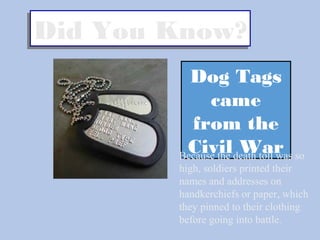
Dog Tags
came
from the
Civil WarBecause the death toll was so
high, soldiers printed their
names and addresses on
handkerchiefs or paper, which
they pinned to their clothing
before going into battle.
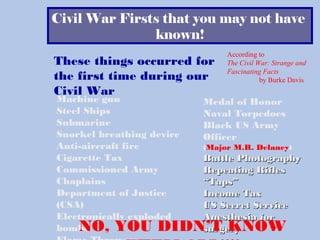
Civil War Firsts that you may not have
known!
These things occurred for
the first time during our
Civil War
Machine gun
Steel Ships
Submarine
Snorkel breathing device
Anti-aircraft fire
Cigarette Tax
Commissioned Army
Chaplains
Department of Justice
(CSA)
Electronically exploded
bombs
Medal of Honor
Naval Torpedoes
Black US Army
Officer
(Major M.R. Delaney)
Battle PhotographyBattle Photography
Repeating RiflesRepeating Rifles
““Taps”Taps”
Income TaxIncome Tax
US Secret ServiceUS Secret Service
Anesthesia forAnesthesia for
surgerysurgeryNO, YOU DIDN’T KNOW
According to
The Civil War: Strange and
Fascinating Facts
by Burke Davis
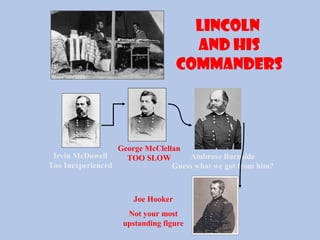
Lincoln
and his
commanders
Irvin McDowell
Too Inexperienced
George McClellan
TOO SLOW Ambrose Burnside
Guess what we got from him?
Joe Hooker
Not your most
upstanding figure
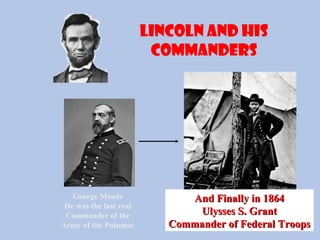
Lincoln and his
commanders
George Meade
He was the last real
Commander of the
Army of the Potomac
And Finally in 1864And Finally in 1864
Ulysses S. GrantUlysses S. Grant
Commander of Federal TroopsCommander of Federal Troops
Abraham Lincoln
The Great Emancipator
Early Views on Slavery
Remember that Lincoln and most RepublicansRemember that Lincoln and most Republicans
were for a gradual end to slavery.were for a gradual end to slavery.
His main concern was with the BorderHis main concern was with the Border
States who still owned slaves.States who still owned slaves.
As the war moved on, the North sawAs the war moved on, the North saw
slavery as helping the Confederate cause.slavery as helping the Confederate cause.
Abraham Lincoln
The Great Emancipator
The Times They are a Changin’
There was growing pressure from FreeThere was growing pressure from Free
Blacks and Abolitionists in the North.Blacks and Abolitionists in the North.
Lincoln also needs a way to keep EnglandLincoln also needs a way to keep England
and France out of this war.and France out of this war.
He also wanted the President to make aHe also wanted the President to make a
stand on slavery, not the Congress.stand on slavery, not the Congress.
Abraham Lincoln
The Great Emancipator
The Emancipation Proclamation
After victory at Antietam, LincolnAfter victory at Antietam, Lincoln
announced his intention to free the slavesannounced his intention to free the slaves
of the South. On January 1, 1863 he issuedof the South. On January 1, 1863 he issued
the Emancipation Proclamation, stating:the Emancipation Proclamation, stating:
“. . . all persons held as slaves within any
state . . . in rebellion against the United States,
shall be then, thenceforward, and forever
Emancipation Proclamation
What did it do?
DID IT FREE THE SLAVES IN THE UNION?
NO! The Border States kept their slaves
because they weren’t “in rebellion.”
DID IT FREE THE SLAVES IN THE SOUTH?
NOT REALLY Remember, the CSA isn’t
listening to Lincoln because they are “in
rebellion” DUH
Emancipation Proclamation
What did it do?
DID IT GIVE BLACKS AND SLAVES HOPE?
YES, any slave who made it to Union
controlled territory was set free and over
100,000 did just that.
Furthermore, there were about 200,000
African Americans who served in the
Union Armies and Navies.
You may have seen
this movie which is
about the
54th
Massachusetts A
regiment that was All-
Black (except the
commanding officers)
Many of them were killed leading a failed
Union raid of Fort Wagner outside of
Charleston, SC in 1863.
Emancipation Proclamation
What did it do?
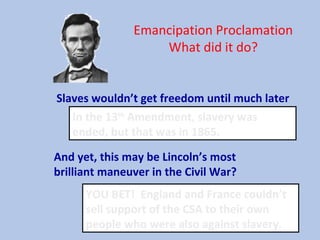
Slaves wouldn’t get freedom until much later
In the 13th
Amendment, slavery was
ended, but that was in 1865.
And yet, this may be Lincoln’s most
brilliant maneuver in the Civil War?
YOU BET! England and France couldn’t
sell support of the CSA to their own
people who were also against slavery.
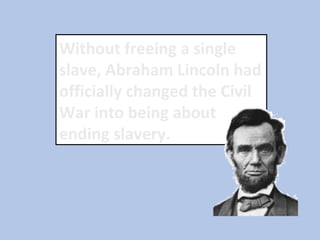
Without freeing a single
slave, Abraham Lincoln had
officially changed the Civil
War into being about
ending slavery.
The Civil War (1861-1865)
Things are going good for the
Confederates, or are they?
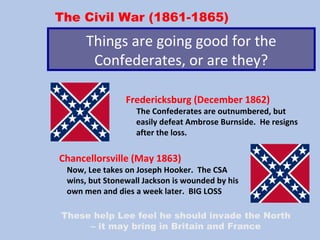
Fredericksburg (December 1862)
The Confederates are outnumbered, but
easily defeat Ambrose Burnside. He resigns
after the loss.
Chancellorsville (May 1863)
Now, Lee takes on Joseph Hooker. The CSA
wins, but Stonewall Jackson is wounded by his
own men and dies a week later. BIG LOSS
These help Lee feel he should invade the North
– it may bring in Britain and France
The Civil War (1861-1865)
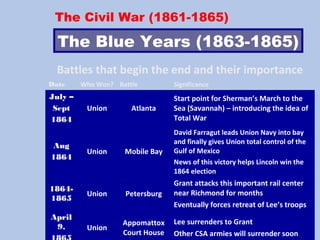
The Blue Years (1863-1865)
Battles that begin the end and their importance
Date Who Won? Battle Significance
July
1863
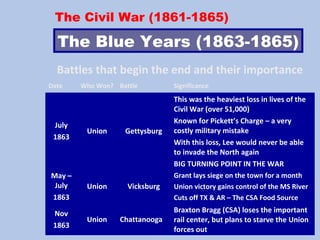
Union Gettysburg
This was the heaviest loss in lives of the
Civil War (over 51,000)
Known for Pickett’s Charge – a very
costly military mistake
With this loss, Lee would never be able
to invade the North again
BIG TURNING POINT IN THE WAR
May –
July
1863
Union Vicksburg
Grant lays siege on the town for a month
Union victory gains control of the MS River
Cuts off TX & AR – The CSA Food Source
Nov
1863
Union Chattanooga
Braxton Bragg (CSA) loses the important
rail center, but plans to starve the Union
forces out
The Civil War (1861-1865)
The Blue Years (1863-1865)
Battles that begin the end and their importance
Date Who Won? Battle Significance
July –
Sept
1864
Union Atlanta
Start point for Sherman’s March to the
Sea (Savannah) – introducing the idea of
Total War
Aug
1864
Union Mobile Bay
David Farragut leads Union Navy into bay
and finally gives Union total control of the
Gulf of Mexico
News of this victory helps Lincoln win the
1864 election
1864-
1865
Union Petersburg
Grant attacks this important rail center
near Richmond for months
Eventually forces retreat of Lee’s troops
April
9, Union
Appomattox
Court House
Lee surrenders to Grant
Other CSA armies will surrender soon

Civil war in a nutshell

  • 1.
  • 2.
  • 3.
    Supposed to settleissue of slavery in new western territories Compromise favored the Anti- Slave folks (Abolitionists) It was not strictly followed
  • 4.
    The Problem? California splitsthe 36º30’ line from the MO
  • 5.
    The Solution: 1.CA enters as a Free State 2. NM has no restrictions on slavery (no duh, they are under the 36º30’ anyways) 3. Slave Trade (NOT slavery) is outlawed in DC 4. Congress will pass a more strict Fugitive Slave Law
  • 6.
    So, what’s thenext Conflict?Let’s look at that Fugitive Slave
  • 7.
    The Fugitive SlaveAct of 1850 •It required ALL citizens to help catch runaway slaves •The Act actually convinced more Northerners to oppose slavery •Northern juries refused to convict those who broke the law •But, the law did have influential supporters in the North like Franklin Pierce (President)
  • 8.
    Next Hot ButtonIssue . . .KANSAS AND NEBRASKA Let the People decide the slavery issue?
  • 9.
    The Kansas-Nebraska Act Enter StephenA. Douglas of Illinois Both KS and NE wanted in as states Both states are above the 36º30’ line Both states would therefore be free states
  • 10.
    The Kansas-Nebraska Act Douglashad money tied up in the Railroad He also wanted to be President in the near future He figured he needed Southern support for that run So, here is the idea Douglas comes up with Throw out the Missouri Compromise Let the people decide the issue of slavery for themselves (popular sovereignty)
  • 11.
    The Kansas-Nebraska Act Hefigures that the people moving into these territories will not vote for slavery But, he’s allowed the people to decide which the South would support And he has done away with the unpopular and ineffective Missouri Compromise
  • 12.
    Bleeding Kansas In 1855,KS elects a pro-slavery legislature with the help of thousands of Border Ruffians, people who crossed the border just to vote This government kept anti- slavery people out of office and they had no voice Then, the anti-slavery folks formed another government and violence erupted
  • 13.
    Bleeding Kansas Unfortunately, Congress wassplit over the issue and nothing was done to stop the violence Finally, troops were sent in and order restored – sort of John Brown and his family murdered 4 pro-slavery folks in the night but, there was this on both sides
  • 14.
    The Dred ScottDecision Dred Scott was a slave who was taken with his family to free territory and then back to the South He took his case to the Supreme Court to argue that since he lived in “free” territory, he should be a free man The Supreme Court ruled against him.
  • 15.
    Dred Scott The Court,led by slaveholder Roger B. Taney, ruled against Dred Scott for two reasons First was that Dred Scott was not considered a citizen (since he was a slave) and therefore had no standing in court (could not sue). Second was that slaves were considered property and only their owner could grant freedom. The govn’t can’t just take away your property
  • 16.
    The Election of1860 The Republicans (newly formed and anti-slavery) nominated Abraham Lincoln Northern Democrats (popular sovereignty decides slavery) nominated Stephen Douglas Pro-slavery Southern Democrats nominated John C. Breckinridge Constitutional Union Party (neutral on slavery) nominated John Bell
  • 17.
    The Election of1860 Abraham Lincoln won the election without carrying a single Southern state. He wasn’t even on the ballot for most of them! He did win all Northern states. The writing was clearly on the wall for the South. They could not overcome Northern (anti-slave) power.
  • 18.
    Southern Reaction On December20, 1860, South Carolina became the first state to secede from the Union! Lincoln and the Republicans promised not to disturb slavery, but many in the South didn’t trust them.
  • 19.
    Southern Reaction The stagewas set for the formation of the Confederate States of America when in February of 1861, TX, LA, MS, AL, FL and GA joined SC. Later that year, AR, TN, NC and VA made it 11 states to join the CSA.
  • 20.
    The Confederate Statesof America Which Is the real flag of the CSA?
  • 21.
    The Confederate Statesof America Which Is the real flag of the CSA? First flag “Stars and Bars” Second National Flag Third National Flag Battle Flag Navy Jack “Rebel” Flag
  • 22.
    The Confederate Statesof America The CSA claimed it had the right to secede because of States Rights The federal government, in their mind, had refused to enforce the Fugitive Slave Act and thus had given the CSA states the right to leave the Union. On February 4, 1861, representatives met in Montgomery, AL to form a new government and elected Jefferson Davis as their President
  • 23.
    The Civil WarBegins Back in Charleston, the new CSA threatened to bombard Fort Sumter South Carolina had given the commander of the fort orders to leave the harbor just outside of Charleston President Lincoln refused to recall his troops and SC troops bombarded the installation on April 12, 1861. The Federal fort was surrendered on the 14th and the Civil War had begun.
  • 24.
    The Civil War(1861-1865) Who’s In and Who’s Out? •The Border States of Missouri, Kentucky, Maryland and Delaware stayed with the Union (some more by force than choice) •Because of this, Tennessee, Arkansas, Virginia and North Carolina all joined the Confederacy •Lincoln issued a call for troops in response to Fort Sumter’s surrender
  • 25.
    The Civil War(1861-1865) Missouri and Kentucky •Protected Union farmland to the North •They helped control the MS and OH Rivers The Border States The Border States were Slave States but Lincoln needed them too much Maryland •w/o it, DC would be surrounded by the CSA Delaware •Protects the ports of Philadelphia
  • 26.
    The Civil War(1861-1865) Here’s a tough question
  • 27.
    The Civil War(1861-1865) Who had the advantage in the War?Who had the advantage in the War? Union or Confederacy?Union or Confederacy? Why?Why?
  • 28.
    The Civil War(1861-1865)
  • 29.
    Union Advantages The Unionhad larger population More troops means the Union can withstand more casualties and overcome poor military leadership The Union had more industry This means more weaponsThis means more weapons and ammunitionand ammunition Abraham Lincoln Like him or not, the UnionLike him or not, the Union couldn’t have woncouldn’t have won without his leadership.without his leadership.
  • 30.
    Confederate Advantages The CSAhad a cause Much like our Revolution, theMuch like our Revolution, the people were fighting to be freepeople were fighting to be free from an oppressive governmentfrom an oppressive government Military Leadership The South had more trainedThe South had more trained officers and more trained troopsofficers and more trained troops who had just finished fightingwho had just finished fighting against Mexican troopsagainst Mexican troops Plus, the CSA had “home field advantage”Plus, the CSA had “home field advantage”
  • 31.
    #1 Blockade theConfederate Coastline This keeps the troop movementThis keeps the troop movement slow and keeps the South fromslow and keeps the South from exporting cottonexporting cotton The Civil War (1861-1865) Union war plan – Anaconda Plan
  • 32.
  • 33.
    #2 Control theMississippi River This cuts off the “West”This cuts off the “West” from the rest of the CSAfrom the rest of the CSA The Civil War (1861-1865) Union war plan
  • 34.
    It was asimple one-part plan Fight a “defensive” war. Make it difficultFight a “defensive” war. Make it difficult enough for the Union to take them back, theenough for the Union to take them back, the Union would simply get tired of fighting andUnion would simply get tired of fighting and recognize the CSA as a new nation.recognize the CSA as a new nation. The Civil War (1861-1865) Confederate war plan Besides, they didn’t have the troopBesides, they didn’t have the troop numbers to go on the “offensive.”numbers to go on the “offensive.”
  • 35.
    The Civil War(1861-1865) Who were these two sides? The Confederates were broken into two major Armies The Army of Tennessee •This was the combination of the Armies of Kentucky, Mississippi and Tennessee •was headed by a few different Generals •Fought mostly in the Western Campaigns The Army of Northern Virginia •Eventually was headed by Robert E. Lee •Fought mostly in the Eastern Campaigns
  • 36.
    The Civil War(1861-1865) Who were these two sides? The Union was broken into two major Armies as well The Army of the Tennessee •Fought in the Western Theater •Most notably headed by Generals Grant and Sherman The Army of the Potomac •Lincoln’s main Army •Fought mostly in the Eastern Campaigns •Headed by a bunch of men - finally Grant
  • 37.
    The Civil War(1861-1865) Early Years (1861-1862) Some Early Battles and their importance Date Who Won? Battle Significance July 1861 CSA First Bull Run or Manassas First major battle of Civil War Both sides disorganized Stonewall Jackson - Confederate hero CSA can’t capitalize on Union retreat April 1862 Union Shiloh General Grant emerges as leader in West CSA wins 1st day, but reinforcements from Nashville help Union pull it out From here, the Union takes Corinth, MS and Memphis – starts control of MS River April 1862 Union New Orleans David Farragut – Union Naval hero Union capture of city gives them total control of MS River and keeps the CSA from using it to ship goods
  • 38.
    The Civil War(1861-1865) Early Years (1861-1862) Some Early Battles and their importance Date Who Won? Battle Significance Marc h 1862 CSA Peninsular Campaign McClellan wastes too much time training and building his troops Robert E. Lee takes command of CSA troops – Army of Virginia Union fails to capture Richmond Augus t 1862 CSA 2nd Bull Run or Manassas Stonewall Jackson / Lee vs John Pope Richmond safe for now CSA pushes to 20 miles from DC Sept. 1862 Union Antietam (Maryland) Lee goes on the offensive to try to get aid from England or France with a win McClellan had actually found Lee’s plans, but was too cautious to act on them Union wins (barely), but McClellan replaced
  • 39.
    Death Tolls Death Tolls Top 5 Battlesin Terms of Casualties Date Death Toll Battle / Total Sept. 17 1862 12,410 U 13,724 C Antietam 26,134 May 8-19 1864 18,399 U 9,000 C Spotsylvania 27,399 May 1-4 1863 17,278 U 12,821 C Chancellorsville 30,099 Sept 19-20 1863 16,170 U 18,454 C Chickamauga 34,624 July 1-3 1863 23,049 U 28,063 C Gettysburg 51,112
  • 40.
    Did You Know?DidYou Know? Dog Tags came from the Civil WarBecause the death toll was so high, soldiers printed their names and addresses on handkerchiefs or paper, which they pinned to their clothing before going into battle.
  • 41.
    Civil War Firststhat you may not have known! These things occurred for the first time during our Civil War Machine gun Steel Ships Submarine Snorkel breathing device Anti-aircraft fire Cigarette Tax Commissioned Army Chaplains Department of Justice (CSA) Electronically exploded bombs Medal of Honor Naval Torpedoes Black US Army Officer (Major M.R. Delaney) Battle PhotographyBattle Photography Repeating RiflesRepeating Rifles ““Taps”Taps” Income TaxIncome Tax US Secret ServiceUS Secret Service Anesthesia forAnesthesia for surgerysurgeryNO, YOU DIDN’T KNOW According to The Civil War: Strange and Fascinating Facts by Burke Davis
  • 42.
    Lincoln and his commanders Irvin McDowell TooInexperienced George McClellan TOO SLOW Ambrose Burnside Guess what we got from him? Joe Hooker Not your most upstanding figure
  • 43.
    Lincoln and his commanders GeorgeMeade He was the last real Commander of the Army of the Potomac And Finally in 1864And Finally in 1864 Ulysses S. GrantUlysses S. Grant Commander of Federal TroopsCommander of Federal Troops
  • 44.
    Abraham Lincoln The GreatEmancipator Early Views on Slavery Remember that Lincoln and most RepublicansRemember that Lincoln and most Republicans were for a gradual end to slavery.were for a gradual end to slavery. His main concern was with the BorderHis main concern was with the Border States who still owned slaves.States who still owned slaves. As the war moved on, the North sawAs the war moved on, the North saw slavery as helping the Confederate cause.slavery as helping the Confederate cause.
  • 45.
    Abraham Lincoln The GreatEmancipator The Times They are a Changin’ There was growing pressure from FreeThere was growing pressure from Free Blacks and Abolitionists in the North.Blacks and Abolitionists in the North. Lincoln also needs a way to keep EnglandLincoln also needs a way to keep England and France out of this war.and France out of this war. He also wanted the President to make aHe also wanted the President to make a stand on slavery, not the Congress.stand on slavery, not the Congress.
  • 46.
    Abraham Lincoln The GreatEmancipator The Emancipation Proclamation After victory at Antietam, LincolnAfter victory at Antietam, Lincoln announced his intention to free the slavesannounced his intention to free the slaves of the South. On January 1, 1863 he issuedof the South. On January 1, 1863 he issued the Emancipation Proclamation, stating:the Emancipation Proclamation, stating: “. . . all persons held as slaves within any state . . . in rebellion against the United States, shall be then, thenceforward, and forever
  • 47.
    Emancipation Proclamation What didit do? DID IT FREE THE SLAVES IN THE UNION? NO! The Border States kept their slaves because they weren’t “in rebellion.” DID IT FREE THE SLAVES IN THE SOUTH? NOT REALLY Remember, the CSA isn’t listening to Lincoln because they are “in rebellion” DUH
  • 48.
    Emancipation Proclamation What didit do? DID IT GIVE BLACKS AND SLAVES HOPE? YES, any slave who made it to Union controlled territory was set free and over 100,000 did just that. Furthermore, there were about 200,000 African Americans who served in the Union Armies and Navies.
  • 49.
    You may haveseen this movie which is about the 54th Massachusetts A regiment that was All- Black (except the commanding officers) Many of them were killed leading a failed Union raid of Fort Wagner outside of Charleston, SC in 1863.
  • 50.
    Emancipation Proclamation What didit do? Slaves wouldn’t get freedom until much later In the 13th Amendment, slavery was ended, but that was in 1865. And yet, this may be Lincoln’s most brilliant maneuver in the Civil War? YOU BET! England and France couldn’t sell support of the CSA to their own people who were also against slavery.
  • 51.
    Without freeing asingle slave, Abraham Lincoln had officially changed the Civil War into being about ending slavery.
  • 52.
    The Civil War(1861-1865) Things are going good for the Confederates, or are they? Fredericksburg (December 1862) The Confederates are outnumbered, but easily defeat Ambrose Burnside. He resigns after the loss. Chancellorsville (May 1863) Now, Lee takes on Joseph Hooker. The CSA wins, but Stonewall Jackson is wounded by his own men and dies a week later. BIG LOSS These help Lee feel he should invade the North – it may bring in Britain and France
  • 53.
    The Civil War(1861-1865) The Blue Years (1863-1865) Battles that begin the end and their importance Date Who Won? Battle Significance July 1863 Union Gettysburg This was the heaviest loss in lives of the Civil War (over 51,000) Known for Pickett’s Charge – a very costly military mistake With this loss, Lee would never be able to invade the North again BIG TURNING POINT IN THE WAR May – July 1863 Union Vicksburg Grant lays siege on the town for a month Union victory gains control of the MS River Cuts off TX & AR – The CSA Food Source Nov 1863 Union Chattanooga Braxton Bragg (CSA) loses the important rail center, but plans to starve the Union forces out
  • 54.
    The Civil War(1861-1865) The Blue Years (1863-1865) Battles that begin the end and their importance Date Who Won? Battle Significance July – Sept 1864 Union Atlanta Start point for Sherman’s March to the Sea (Savannah) – introducing the idea of Total War Aug 1864 Union Mobile Bay David Farragut leads Union Navy into bay and finally gives Union total control of the Gulf of Mexico News of this victory helps Lincoln win the 1864 election 1864- 1865 Union Petersburg Grant attacks this important rail center near Richmond for months Eventually forces retreat of Lee’s troops April 9, Union Appomattox Court House Lee surrenders to Grant Other CSA armies will surrender soon