Effects of Exercise the respiratory system
Homework We all need our homework out for the first 2 tasks.
Lesson Objectives Understand the  short term  and  long term  effects exercise has on respiratory system Be able to explain what  oxygen debt  is and why it occurs Understand the terms  vital capacity, tidal volume, residual volume  and  lung capacity
Recap http://www.youtube.com/watch?v=HiT621PrrO0&feature=related   http://www.youtube.com/watch?v=HiT621PrrO0&NR=1
Short term effects Increased breathing rate  Increased depth of breathing Increased demand for oxygen Inreased rate of CO2 removal Gaseous exchange Oxygen debt
Effects of training & Competition At rest, quiet breathing is sufficient to supply the body with oxygen (O2) & remove carbon dioxide CO2 During exercise the  demand  for O2 is  increased  by the muscles Therefore  more CO2  is  produced  & needs removing As a result the  depth and rate of breathing increases  to take in more O2 & remove the extra CO2
Effects of training & Competition Effects of exercise Anaerobic exercise can cause the body to build up an  oxygen debt. This is due to the body not taking in enough O2 for the work the muscles are doing e.g. 400m sprint  This O2 debt must be paid back as it is needed to remove the levels of CO2 and lactic acid built up through exercise
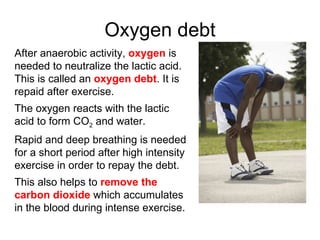
Oxygen debt After anaerobic activity,  oxygen  is needed to neutralize the lactic acid. This is called an  oxygen debt . It is repaid after exercise. The oxygen reacts with the lactic acid to form CO 2  and water. Rapid and deep breathing is needed for a short period after high intensity exercise in order to repay the debt. This also helps to  remove the carbon dioxide  which accumulates in the blood during intense exercise.
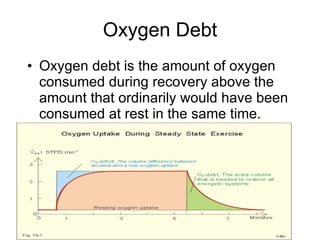
Oxygen Debt Oxygen debt is the amount of oxygen consumed during recovery above the amount that ordinarily would have been consumed at rest in the same time.
Task 1  Complete booklets
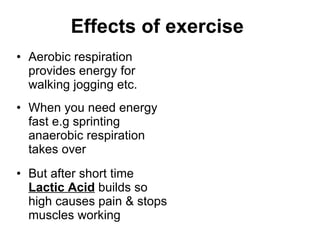
Effects of exercise   Aerobic respiration provides energy for walking jogging etc. When you need energy fast e.g sprinting anaerobic respiration takes over But after short time  Lactic Acid  builds so high causes pain & stops muscles working
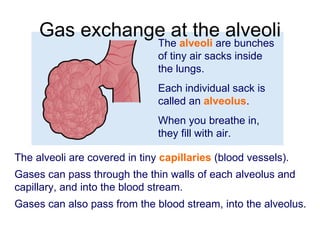
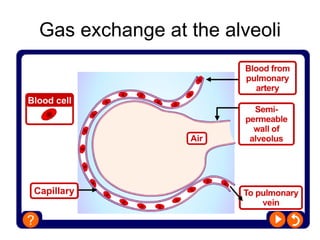
Gas exchange at the alveoli The  alveoli  are bunches of tiny air sacks inside the lungs.  Each individual sack is called an  alveolus . When you breathe in, they fill with air. The alveoli are covered in tiny  capillaries  (blood vessels). Gases can pass through the thin walls of each alveolus and capillary, and into the blood stream.  Gases can also pass from the blood stream,   into the alveolus.
Gas exchange at the alveoli
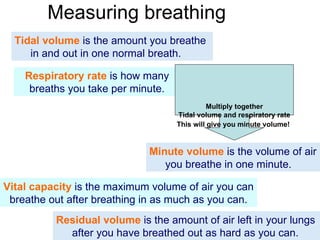
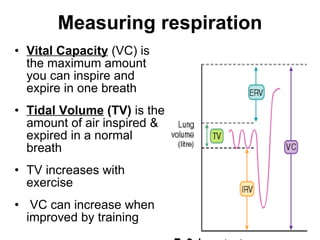
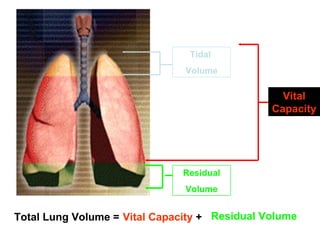
Measuring breathing Tidal volume  is the amount you breathe in and out in one normal breath. Residual volume  is the amount of air left in your lungs after you have breathed out as hard as you can. Minute volume  is the volume of air you breathe in one minute. Respiratory rate  is how many breaths you take per minute. Vital capacity  is the maximum volume of air you can breathe out after breathing in as much as you can. Multiply together Tidal volume and respiratory rate This will give you minute volume!
Measuring respiration Vital Capacity  (VC) is the maximum amount you can inspire and expire in one breath Tidal Volume  (TV)  is the amount of air inspired & expired in a normal breath TV increases with exercise VC can increase when improved by training
Tidal  Volume Residual Volume Vital Capacity Total Lung Volume = Vital Capacity  + Residual Volume
Task 3  We are going to measure our tidal volume and vital capacity. In pairs follow the instructions on the sheet.  We will be feeding back our results to the rest of the class.
Long term effects Stronger diaphragm Stronger inter costal muscles Increased amount of capillaries  Increased lung capacity Increased lung volume Increased vital capacity
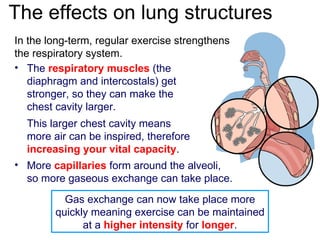
The effects on lung structures The  respiratory muscles  (the diaphragm and intercostals) get stronger, so they can make the chest cavity larger. This larger chest cavity means more air can be inspired, therefore  increasing your vital capacity . More  capillaries   form around the alveoli,  so more gaseous exchange can take place. In the long-term, regular exercise strengthens the respiratory system. Gas exchange can now take place more quickly meaning exercise can be maintained at a  higher intensity  for  longer .
Task 2 Complete booklets
Summary   Write down a summary of three thing you have learned in today’s lesson  Write down 1 thing you didn’t quite understand
Homework Complete two pages in the booklet The components of the respiratory system Mechanics of breathing

ScienceShare.co.uk Shared Resource

  • 1.
    Effects of Exercisethe respiratory system
  • 2.
    Homework We allneed our homework out for the first 2 tasks.
  • 3.
    Lesson Objectives Understandthe short term and long term effects exercise has on respiratory system Be able to explain what oxygen debt is and why it occurs Understand the terms vital capacity, tidal volume, residual volume and lung capacity
  • 4.
    Recap http://www.youtube.com/watch?v=HiT621PrrO0&feature=related http://www.youtube.com/watch?v=HiT621PrrO0&NR=1
  • 5.
    Short term effectsIncreased breathing rate Increased depth of breathing Increased demand for oxygen Inreased rate of CO2 removal Gaseous exchange Oxygen debt
  • 6.
    Effects of training& Competition At rest, quiet breathing is sufficient to supply the body with oxygen (O2) & remove carbon dioxide CO2 During exercise the demand for O2 is increased by the muscles Therefore more CO2 is produced & needs removing As a result the depth and rate of breathing increases to take in more O2 & remove the extra CO2
  • 7.
    Effects of training& Competition Effects of exercise Anaerobic exercise can cause the body to build up an oxygen debt. This is due to the body not taking in enough O2 for the work the muscles are doing e.g. 400m sprint This O2 debt must be paid back as it is needed to remove the levels of CO2 and lactic acid built up through exercise
  • 8.
    Oxygen debt Afteranaerobic activity, oxygen is needed to neutralize the lactic acid. This is called an oxygen debt . It is repaid after exercise. The oxygen reacts with the lactic acid to form CO 2 and water. Rapid and deep breathing is needed for a short period after high intensity exercise in order to repay the debt. This also helps to remove the carbon dioxide which accumulates in the blood during intense exercise.
  • 9.
    Oxygen Debt Oxygendebt is the amount of oxygen consumed during recovery above the amount that ordinarily would have been consumed at rest in the same time.
  • 10.
    Task 1 Complete booklets
  • 11.
    Effects of exercise Aerobic respiration provides energy for walking jogging etc. When you need energy fast e.g sprinting anaerobic respiration takes over But after short time Lactic Acid builds so high causes pain & stops muscles working
  • 12.
    Gas exchange atthe alveoli The alveoli are bunches of tiny air sacks inside the lungs. Each individual sack is called an alveolus . When you breathe in, they fill with air. The alveoli are covered in tiny capillaries (blood vessels). Gases can pass through the thin walls of each alveolus and capillary, and into the blood stream. Gases can also pass from the blood stream, into the alveolus.
  • 13.
    Gas exchange atthe alveoli
  • 14.
    Measuring breathing Tidalvolume is the amount you breathe in and out in one normal breath. Residual volume is the amount of air left in your lungs after you have breathed out as hard as you can. Minute volume is the volume of air you breathe in one minute. Respiratory rate is how many breaths you take per minute. Vital capacity is the maximum volume of air you can breathe out after breathing in as much as you can. Multiply together Tidal volume and respiratory rate This will give you minute volume!
  • 15.
    Measuring respiration VitalCapacity (VC) is the maximum amount you can inspire and expire in one breath Tidal Volume (TV) is the amount of air inspired & expired in a normal breath TV increases with exercise VC can increase when improved by training
  • 16.
    Tidal VolumeResidual Volume Vital Capacity Total Lung Volume = Vital Capacity + Residual Volume
  • 17.
    Task 3 We are going to measure our tidal volume and vital capacity. In pairs follow the instructions on the sheet. We will be feeding back our results to the rest of the class.
  • 18.
    Long term effectsStronger diaphragm Stronger inter costal muscles Increased amount of capillaries Increased lung capacity Increased lung volume Increased vital capacity
  • 19.
    The effects onlung structures The respiratory muscles (the diaphragm and intercostals) get stronger, so they can make the chest cavity larger. This larger chest cavity means more air can be inspired, therefore increasing your vital capacity . More capillaries form around the alveoli, so more gaseous exchange can take place. In the long-term, regular exercise strengthens the respiratory system. Gas exchange can now take place more quickly meaning exercise can be maintained at a higher intensity for longer .
  • 20.
  • 21.
    Summary Write down a summary of three thing you have learned in today’s lesson Write down 1 thing you didn’t quite understand
  • 22.
    Homework Complete twopages in the booklet The components of the respiratory system Mechanics of breathing

Editor's Notes

  • #9 Image © 2006 Jupiterimages Corporation
  • #15 Clarify and expand on the definitions with the students
  • #20 Relate these facts to improvements in performance. Emphasise that lungs are NOT muscles and therefore do not increase in size – they function more efficiently.