Predicting House Price on
Ames Dataset
Evaluating Linear and Bayesian Regression
Supervisor :
Anirban Basu
Prepared By:-
Archit Vora (2015HT12480)
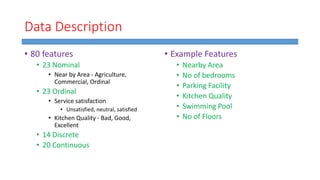
Data Description
• 80 features
• 23 Nominal
• Near by Area - Agriculture,
Commercial, Ordinal
• 23 Ordinal
• Service satisfaction
• Unsatisfied, neutral, satisfied
• Kitchen Quality - Bad, Good,
Excellent
• 14 Discrete
• 20 Continuous
• Example Features
• Nearby Area
• No of bedrooms
• Parking Facility
• Kitchen Quality
• Swimming Pool
• No of Floors
Filling Up Missing Values
• Common
• Encoding for Ordinal variables
• Leveling for nominal variables
• Specific
• Replace with most frequent value for discrete and nominal
• When no of missing values are less
• Mostly the case with our data
• Sometimes null value implies feature is not available
• Basement area null gets replaced with zero
• Inferring from related variables
• When garage year is null, we say house is without garage
• Allows us to infer garage area, no of cars, garage condition
• Linear Regression : Predict Lot Frontage from lot area (after sqrt)
• Improvements:
• Creating Levels blindly : 288 features, 0.157122 rmse
• After logically filling missing values : 263 features, 0.155965
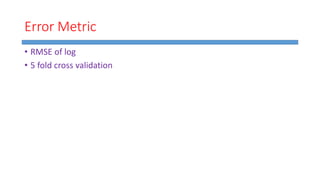
Error Metric
• RMSE of log
• 5 fold cross validation
Linear Regression
Linear Least Squares
• P is Project matrix
• Instead of solving for Y we solve for
𝑌∗
• A = (𝑋 𝑇 𝑋) is the matrix of interest
• In our case it is not invertible
• We find Pseudo inverse with SVD
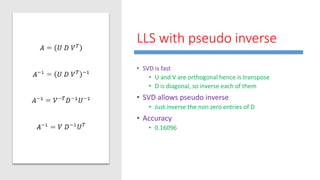
LLS with pseudo inverse
• SVD is fast
• U and V are orthogonal hence is transpose
• D is diagonal, so inverse each of them
• SVD allows pseudo inverse
• Just inverse the non zero entries of D
• Accuracy
• 0.16096
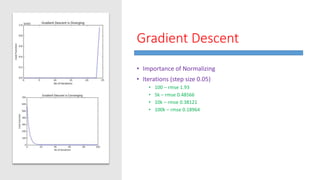
Gradient Descent
• Importance of Normalizing
• Iterations (step size 0.05)
• 100 – rmse 1.93
• 5k – rmse 0.48566
• 10k – rmse 0.38121
• 100k – rmse 0.18964
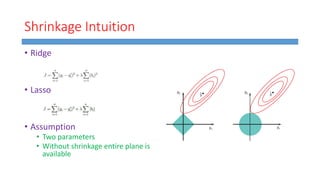
Shrinkage Intuition
• Ridge
• Lasso
• Assumption
• Two parameters
• Without shrinkage entire plane is
available
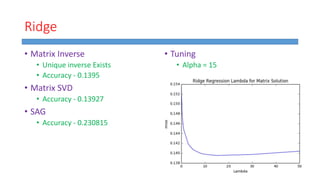
Ridge
• Matrix Inverse
• Unique inverse Exists
• Accuracy - 0.1395
• Matrix SVD
• Accuracy - 0.13927
• SAG
• Accuracy - 0.230815
• Tuning
• Alpha = 15
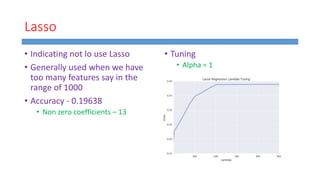
Lasso
• Indicating not lo use Lasso
• Generally used when we have
too many features say in the
range of 1000
• Accuracy - 0.19638
• Non zero coefficients – 13
• Tuning
• Alpha = 1
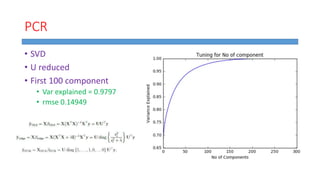
PCR
• SVD
• U reduced
• First 100 component
• Var explained = 0.9797
• rmse 0.14949
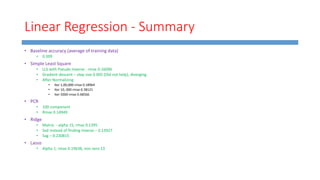
Linear Regression - Summary
• Baseline accuracy (average of training data)
• 0.399
• Simple Least Square
• LLS with Pseudo Inverse - rmse 0.16096
• Gradient descent – step size 0.005 (Did not help), diverging
• After Normalizing
• Iter 1,00,000 rmse 0.18964
• Iter 10, 000 rmse 0.38121
• Iter 5000 rmse 0.48566
• PCR
• 100 component
• Rmse 0.14949
• Ridge
• Matrix - alpha 15, rmse 0.1395
• Svd instead of finding inverse – 0.13927
• Sag – 0.230815
• Lasso
• Alpha 1, rmse 0.19638, non zero 13
Bayesian Regression
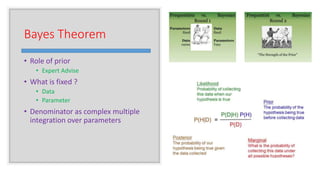
Bayes Theorem
• Role of prior
• Expert Advise
• What is fixed ?
• Data
• Parameter
• Denominator as complex multiple
integration over parameters
Markov Chain Monte Carlo
• Markov Chain
• Next state depends only on
current steps
• Application
• Hidden Markov models in speech
recognition
• Allows to draw independent samples
• Monte Carlo
• Simulation when simple
mathematical equation is simple
• Application
• Uncertainty in market is random,
predict sales
• Solving complex Integration
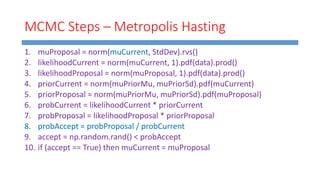
MCMC Steps – Metropolis Hasting
1. muProposal = norm(muCurrent, StdDev).rvs()
2. likelihoodCurrent = norm(muCurrent, 1).pdf(data).prod()
3. likelihoodProposal = norm(muProposal, 1).pdf(data).prod()
4. priorCurrent = norm(muPriorMu, muPriorSd).pdf(muCurrent)
5. priorProposal = norm(muPriorMu, muPriorSd).pdf(muProposal)
6. probCurrent = likelihoodCurrent * priorCurrent
7. probProposal = likelihoodProposal * priorProposal
8. probAccept = probProposal / probCurrent
9. accept = np.random.rand() < probAccept
10. if (accept == True) then muCurrent = muProposal
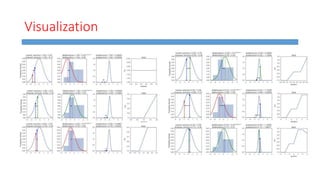
Visualization
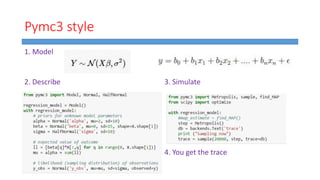
Pymc3 style
1. Model
2. Describe 3. Simulate
4. You get the trace
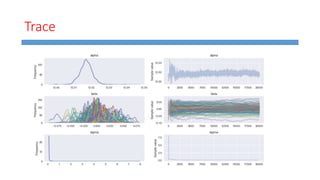
Trace
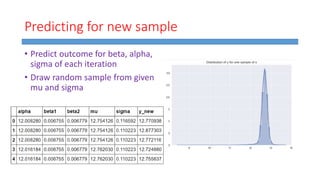
Predicting for new sample
• Predict outcome for beta, alpha,
sigma of each iteration
• Draw random sample from given
mu and sigma
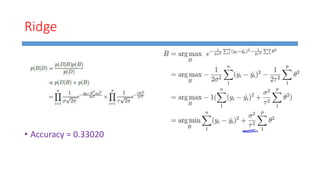
Ridge
• Accuracy = 0.33020
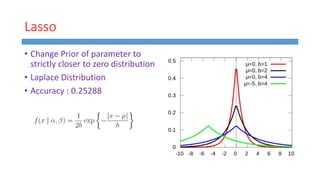
Lasso
• Change Prior of parameter to
strictly closer to zero distribution
• Laplace Distribution
• Accuracy : 0.25288
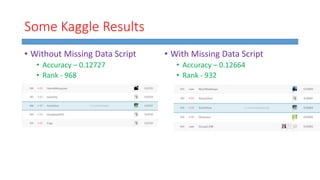
Some Kaggle Results
• Without Missing Data Script
• Accuracy – 0.12727
• Rank - 968
• With Missing Data Script
• Accuracy – 0.12664
• Rank - 932
Thank you !
• BITS Wilp
• Two years of amazing learning
• Adobe for work life balance
• My mentor Anirban Basu
• Mathematics will carry along, subjective knowledge will not
• Teachers, professors and seniors
• I think I am luck enough
• Parents and sisters
• I think I am blessed
Questions and Suggestions !

Ames housing

  • 1.
    Predicting House Priceon Ames Dataset Evaluating Linear and Bayesian Regression Supervisor : Anirban Basu Prepared By:- Archit Vora (2015HT12480)
  • 2.
    Data Description • 80features • 23 Nominal • Near by Area - Agriculture, Commercial, Ordinal • 23 Ordinal • Service satisfaction • Unsatisfied, neutral, satisfied • Kitchen Quality - Bad, Good, Excellent • 14 Discrete • 20 Continuous • Example Features • Nearby Area • No of bedrooms • Parking Facility • Kitchen Quality • Swimming Pool • No of Floors
  • 3.
    Filling Up MissingValues • Common • Encoding for Ordinal variables • Leveling for nominal variables • Specific • Replace with most frequent value for discrete and nominal • When no of missing values are less • Mostly the case with our data • Sometimes null value implies feature is not available • Basement area null gets replaced with zero • Inferring from related variables • When garage year is null, we say house is without garage • Allows us to infer garage area, no of cars, garage condition • Linear Regression : Predict Lot Frontage from lot area (after sqrt) • Improvements: • Creating Levels blindly : 288 features, 0.157122 rmse • After logically filling missing values : 263 features, 0.155965
  • 4.
    Error Metric • RMSEof log • 5 fold cross validation
  • 5.
  • 6.
    Linear Least Squares •P is Project matrix • Instead of solving for Y we solve for 𝑌∗ • A = (𝑋 𝑇 𝑋) is the matrix of interest • In our case it is not invertible • We find Pseudo inverse with SVD
  • 7.
    LLS with pseudoinverse • SVD is fast • U and V are orthogonal hence is transpose • D is diagonal, so inverse each of them • SVD allows pseudo inverse • Just inverse the non zero entries of D • Accuracy • 0.16096
  • 8.
    Gradient Descent • Importanceof Normalizing • Iterations (step size 0.05) • 100 – rmse 1.93 • 5k – rmse 0.48566 • 10k – rmse 0.38121 • 100k – rmse 0.18964
  • 9.
    Shrinkage Intuition • Ridge •Lasso • Assumption • Two parameters • Without shrinkage entire plane is available
  • 10.
    Ridge • Matrix Inverse •Unique inverse Exists • Accuracy - 0.1395 • Matrix SVD • Accuracy - 0.13927 • SAG • Accuracy - 0.230815 • Tuning • Alpha = 15
  • 11.
    Lasso • Indicating notlo use Lasso • Generally used when we have too many features say in the range of 1000 • Accuracy - 0.19638 • Non zero coefficients – 13 • Tuning • Alpha = 1
  • 12.
    PCR • SVD • Ureduced • First 100 component • Var explained = 0.9797 • rmse 0.14949
  • 13.
    Linear Regression -Summary • Baseline accuracy (average of training data) • 0.399 • Simple Least Square • LLS with Pseudo Inverse - rmse 0.16096 • Gradient descent – step size 0.005 (Did not help), diverging • After Normalizing • Iter 1,00,000 rmse 0.18964 • Iter 10, 000 rmse 0.38121 • Iter 5000 rmse 0.48566 • PCR • 100 component • Rmse 0.14949 • Ridge • Matrix - alpha 15, rmse 0.1395 • Svd instead of finding inverse – 0.13927 • Sag – 0.230815 • Lasso • Alpha 1, rmse 0.19638, non zero 13
  • 14.
  • 15.
    Bayes Theorem • Roleof prior • Expert Advise • What is fixed ? • Data • Parameter • Denominator as complex multiple integration over parameters
  • 16.
    Markov Chain MonteCarlo • Markov Chain • Next state depends only on current steps • Application • Hidden Markov models in speech recognition • Allows to draw independent samples • Monte Carlo • Simulation when simple mathematical equation is simple • Application • Uncertainty in market is random, predict sales • Solving complex Integration
  • 17.
    MCMC Steps –Metropolis Hasting 1. muProposal = norm(muCurrent, StdDev).rvs() 2. likelihoodCurrent = norm(muCurrent, 1).pdf(data).prod() 3. likelihoodProposal = norm(muProposal, 1).pdf(data).prod() 4. priorCurrent = norm(muPriorMu, muPriorSd).pdf(muCurrent) 5. priorProposal = norm(muPriorMu, muPriorSd).pdf(muProposal) 6. probCurrent = likelihoodCurrent * priorCurrent 7. probProposal = likelihoodProposal * priorProposal 8. probAccept = probProposal / probCurrent 9. accept = np.random.rand() < probAccept 10. if (accept == True) then muCurrent = muProposal
  • 18.
  • 19.
    Pymc3 style 1. Model 2.Describe 3. Simulate 4. You get the trace
  • 20.
  • 21.
    Predicting for newsample • Predict outcome for beta, alpha, sigma of each iteration • Draw random sample from given mu and sigma
  • 22.
  • 23.
    Lasso • Change Priorof parameter to strictly closer to zero distribution • Laplace Distribution • Accuracy : 0.25288
  • 24.
    Some Kaggle Results •Without Missing Data Script • Accuracy – 0.12727 • Rank - 968 • With Missing Data Script • Accuracy – 0.12664 • Rank - 932
  • 25.
    Thank you ! •BITS Wilp • Two years of amazing learning • Adobe for work life balance • My mentor Anirban Basu • Mathematics will carry along, subjective knowledge will not • Teachers, professors and seniors • I think I am luck enough • Parents and sisters • I think I am blessed
  • 26.