2
1. Introduction
2. Ameloblast
3. Amelogenesis
4. Ameloblast secretory products
5. Mineral pathway and mineralization
6. Regulation of PH
7. Age changes
8. Clinical consideration
3
AMELOGENESIS is a process of enamel formation
Enamel is the hardest calcified matrix of the body
 It is translucent and varies in color from light yellow to grey white.
It also varies in thickness, from a maximum of approximately 2.5 mm
 Enamel consists of approximately 96% mineral and 4% organic
material and water
Enamel formation begins in the bell stage
The cells responsible for formation of enamel is Ameloblast
Introduction
4
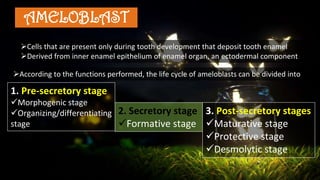
AMELOBLAST
Cells that are present only during tooth development that deposit tooth enamel
Derived from inner enamel epithelium of enamel organ, an ectodermal component
According to the functions performed, the life cycle of ameloblasts can be divided into
1. Pre-secretory stage
Morphogenic stage
Organizing/differentiating
stage
2. Secretory stage
Formative stage
3. Post-secretory stages
Maturative stage
Protective stage
Desmolytic stage
“
5
Morphogenic stage
This stage determines the shape of tooth
Cells are low columnar with central nucleus
Cytoplasmic organelles not abundant
Centrioles and golgi complex located at
apical part
Mitochondria evenly distributed
“
6
Organizing/differentiation stage
Inner enamel epithelium cells undergo differentition
to ameloblast
Ameloblast exert organinzing influence on dental
papilla and differntiate to odontoblast
Cells increase in length to 40 microns and abundant
cytoplasmic organelles
Reversal polarity
Interdependance between ameloblast and
odontoblast referred as reciprocal induction
7
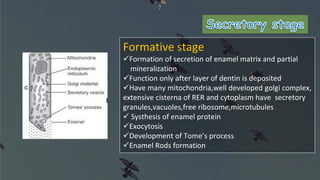
Formative stage
Formation of secretion of enamel matrix and partial
mineralization
Function only after layer of dentin is deposited
Have many mitochondria,well developed golgi complex,
extensive cisterna of RER and cytoplasm have secretory
granules,vacuoles,free ribosome,microtubules
 Systhesis of enamel protein
Exocytosis
Development of Tome’s process
Enamel Rods formation
8
Maturative stage
 Mineralization and
maturation of enamel
Ameloblast modulation
Slight reduction in height &
decrease organelles content
 excess synthetic organelle
are removed & remaining are
shifted to distal ends
Protective stage
Ameloblast with enamel organ
perform protective function
Secrete protein on newly
formed enamel
Reduced enamel epithelum(REE)
REE protects enamel till tooth
erupts
Desmolytic stage
REE secretes collagenous
enzyme
Solid plug of epithelial
cells
Tooth eruption
9
10
•Secretion of enamel
protein
•Produces a partially
mineralized (30%) enamel
•Deposition of hydroxyapatite
Crystal
•Organic mineral and water are
lost and mineral is added to
attain >96% mineral content
•Two step process
11
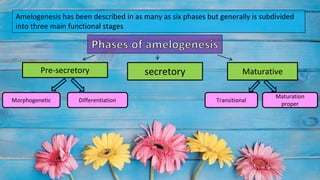
Amelogenesis has been described in as many as six phases but generally is subdivided
into three main functional stages
Pre-secretory secretory Maturative
Morphogenetic Differentiation Transitional
Maturation
proper
12
Differentiating ameloblast require their
phenotype
Change polarity
Develope an extensive protein synthetic
apparatus
Prepare to secrete the organic matrix of enamel
13
Shape of crown is determined is bell stage
Inner enamel epithelium still undergo mitotic division
limited to cervical portion
Cells are cuboidal or low columnar with large central
nucleus, poor golgi elements in proximal position
Mitochondria & cytoplasmic components scattered
throughout the cell
14
 Cells of inner enamel epithelim differentiate into ameloblast
 Basal lamina is fragmented by cytoplasmic projections and
disintegrates during mantle predentin formation
 Cells elongate and nuclei shift proximally
 Golgi increases and migrates distally
 Rough endoplasmic recticulum increases
 Second junctional complex is developed at distal proximity
dividing the ameloblast into body and and distal extension
called tomes process ,against enamel
15
Fine actin containing filaments radiate from junctional
complexes forming proximal and distal terminal webs
16
Cells acquire intense synthetic and secretory activity
 Enamel proteins are translated by REE modified by golgi
apparatus packed into secretory granules
 These granules migrate to distal extremity of the cell ,into tomes
process
When enamel formation beings ,tomes process comprises of only
a proximal portion
Contents of secretory granules is released against newly formed
dentin the along the surface of tomes process
Initial layer of enamel does not contain rods
17
Ameloblast migrate away from the dentin surface and develop distal portion of
tomes process as an outgrowth of proximal portion
Secretion of enamel protein becomes unstable and confined to two sites
Secretion from 1st site (proximal portion) results in formation of interrod enamel
that delimits a pit in which distal portion of tomes process resides
Secretion from 2nd site (distal part) provides matrix that result in formation of rod
enamel which fills the pit
Proximal
part
distal part
18
Tome’s process decrease in size as rod grows in diameter
Narrow space is formed along the circumference between rods and interrods
which is filled by organic material ,forming rod sheath
Rods and interod enamel differ only in the orientation of crystallites
Enamel layer composed of rod/interrod-prismatic layer sandwitched between
thin and rodless aprismatic layer initial &final layer
Interrod (IR) enamel surrounds the forming rod (R) and the distal portion of Tomes' process (dpTP)
(A) first (initial) and (B) last (final) enamel layers are aprismatic; that
is, they do not contain rods
19
Before eruption of teeth into the oral cavity ,enamel
hardens
This change results from growth in width and
thickness of pre-existing crystal
Amelogenesis is a slow process that it take as long as 5
years to complete ,upto 2/3rd time is take by maturation
stage
20
Ameloblast undergo significant morphological changes
Height of the cell reduces
Cell volume and organelles decreases
Ameloblast undergo programmed cell death
25% cells die during transitional stage another 25% as
enamel maturation proceeds
21
22
Removal of water and organic material from enamel and
introduction of inorganic material
 Dramatic activity of ameloblast is modulation , cyclic creation,
loss and recreation of highly invaginated ruffle-ended apical surface
(alternate between ruffle and smooth ended)
Modulation occur rapidly once in every 8 hrs
23
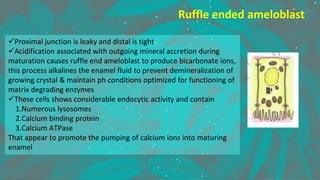
Proximal junction is leaky and distal is tight
Acidification associated with outgoing mineral accretion during
maturation causes ruffle end ameloblast to produce bicarbonate ions,
this process alkalines the enamel fluid to prevent demineralization of
growing crystal & maintain ph conditions optimized for functioning of
matrix degrading enzymes
These cells shows considerable endocytic activity and contain
1.Numerous lysosomes
2.Calcium binding protein
3.Calcium ATPase
That appear to promote the pumping of calcium ions into maturing
enamel
Ruffle ended ameloblast
24
Proximal junction is tight and distal is leaky
Bulky-degrading enzyme act extracellularly to digest various
matrix proteins into fragments small enough to leave enamel
Polypeptide fragments leave the enamel through distal
junctions of smooth ended ameloblast & diffuse laterally amoung
the ameloblast to be taken up along their basolateral surface
Smooth ended ameloblast
25
Ameloblast complete transitional phase &begins the cycle they
deposit an atypical basal lamina at their flattend apex
This layer adheres to enamel surface and ameloblast by the
means of hemidesmosomes
It contains LAMININ 332 , heterotrimer molecule essential for
formation of hemidesmosomes
Its deficiency leads to focal enamel hypoplasia
26
Amelogenins
90% of enamel proteins are hetergenous group
of low molecular weight
These are hydrophobic proteins rich in
prolins,histidine & glutamine
Molecular weight ranges 5-45kDA
These accumulate during secretory stage
Undego minor short term & major longterm
extracellular processing by proteolytic enzyme
into low molecular fragments
Loss of function causes deposition of thin
hypoplastic enamel layer which lack rods &
interrods
Non-amelogenins
Consist of remaining 10% of enamel
proteins of amelogenesis such as
enamelin ,ameloblastin, tuftlin
27
Calcium moves from the blood vessels through the enamel organ to
reach enamel likely implicates intercellular and transcellular routes
The stratum intermedium may also participate in the translocation
of calcium, since calcium-ATPase activity has been localized at the
cell membrane of the stratum intermedium.
No matrix vesicles are associated with the mineralization of enamel
Mineral pathway and mineralization
28
Regulation of ph during enamel formation
pH values of forming enamel are maintained near neutral
during secretion
Considerable variation during maturation, shifting from
acidic to near-neutral values and then rising to higher pH
levels in more mature enamel
Carbonic anhydrases (mainly CA2 and CA6) to generate
local bicarbonate; chloride ion exchangers,bicarbonate co
transporters,NA+/H+ exchangers
29
Age changes
Enamel is non vital organ , incapable of regeneration
Masticatory attrition
Discolouration
Reduced permiability
Modification in surface layer
Increase incidence of caries
30
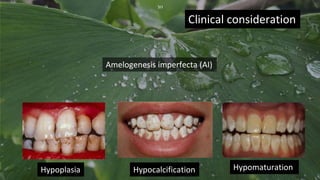
Clinical consideration
Amelogenesis imperfecta (AI)
Hypoplasia Hypocalcification Hypomaturation
31
1. Ten cate’s oral histology – Antonio nanci 9th edition
2. Orbans ‘s oral histology & embryology -g.s kumar 14th edition
3. Essentials of oral biology - maji jose 2nd edition
4. Shafer’s textbook of pathology – 7th edition
References
32

Amelogenesis by dr.suriya visithiriyan

  • 2.
    2 1. Introduction 2. Ameloblast 3.Amelogenesis 4. Ameloblast secretory products 5. Mineral pathway and mineralization 6. Regulation of PH 7. Age changes 8. Clinical consideration
  • 3.
    3 AMELOGENESIS is aprocess of enamel formation Enamel is the hardest calcified matrix of the body  It is translucent and varies in color from light yellow to grey white. It also varies in thickness, from a maximum of approximately 2.5 mm  Enamel consists of approximately 96% mineral and 4% organic material and water Enamel formation begins in the bell stage The cells responsible for formation of enamel is Ameloblast Introduction
  • 4.
    4 AMELOBLAST Cells that arepresent only during tooth development that deposit tooth enamel Derived from inner enamel epithelium of enamel organ, an ectodermal component According to the functions performed, the life cycle of ameloblasts can be divided into 1. Pre-secretory stage Morphogenic stage Organizing/differentiating stage 2. Secretory stage Formative stage 3. Post-secretory stages Maturative stage Protective stage Desmolytic stage
  • 5.
    “ 5 Morphogenic stage This stagedetermines the shape of tooth Cells are low columnar with central nucleus Cytoplasmic organelles not abundant Centrioles and golgi complex located at apical part Mitochondria evenly distributed
  • 6.
    “ 6 Organizing/differentiation stage Inner enamelepithelium cells undergo differentition to ameloblast Ameloblast exert organinzing influence on dental papilla and differntiate to odontoblast Cells increase in length to 40 microns and abundant cytoplasmic organelles Reversal polarity Interdependance between ameloblast and odontoblast referred as reciprocal induction
  • 7.
    7 Formative stage Formation ofsecretion of enamel matrix and partial mineralization Function only after layer of dentin is deposited Have many mitochondria,well developed golgi complex, extensive cisterna of RER and cytoplasm have secretory granules,vacuoles,free ribosome,microtubules  Systhesis of enamel protein Exocytosis Development of Tome’s process Enamel Rods formation
  • 8.
    8 Maturative stage  Mineralizationand maturation of enamel Ameloblast modulation Slight reduction in height & decrease organelles content  excess synthetic organelle are removed & remaining are shifted to distal ends Protective stage Ameloblast with enamel organ perform protective function Secrete protein on newly formed enamel Reduced enamel epithelum(REE) REE protects enamel till tooth erupts Desmolytic stage REE secretes collagenous enzyme Solid plug of epithelial cells Tooth eruption
  • 9.
  • 10.
    10 •Secretion of enamel protein •Producesa partially mineralized (30%) enamel •Deposition of hydroxyapatite Crystal •Organic mineral and water are lost and mineral is added to attain >96% mineral content •Two step process
  • 11.
    11 Amelogenesis has beendescribed in as many as six phases but generally is subdivided into three main functional stages Pre-secretory secretory Maturative Morphogenetic Differentiation Transitional Maturation proper
  • 12.
    12 Differentiating ameloblast requiretheir phenotype Change polarity Develope an extensive protein synthetic apparatus Prepare to secrete the organic matrix of enamel
  • 13.
    13 Shape of crownis determined is bell stage Inner enamel epithelium still undergo mitotic division limited to cervical portion Cells are cuboidal or low columnar with large central nucleus, poor golgi elements in proximal position Mitochondria & cytoplasmic components scattered throughout the cell
  • 14.
    14  Cells ofinner enamel epithelim differentiate into ameloblast  Basal lamina is fragmented by cytoplasmic projections and disintegrates during mantle predentin formation  Cells elongate and nuclei shift proximally  Golgi increases and migrates distally  Rough endoplasmic recticulum increases  Second junctional complex is developed at distal proximity dividing the ameloblast into body and and distal extension called tomes process ,against enamel
  • 15.
    15 Fine actin containingfilaments radiate from junctional complexes forming proximal and distal terminal webs
  • 16.
    16 Cells acquire intensesynthetic and secretory activity  Enamel proteins are translated by REE modified by golgi apparatus packed into secretory granules  These granules migrate to distal extremity of the cell ,into tomes process When enamel formation beings ,tomes process comprises of only a proximal portion Contents of secretory granules is released against newly formed dentin the along the surface of tomes process Initial layer of enamel does not contain rods
  • 17.
    17 Ameloblast migrate awayfrom the dentin surface and develop distal portion of tomes process as an outgrowth of proximal portion Secretion of enamel protein becomes unstable and confined to two sites Secretion from 1st site (proximal portion) results in formation of interrod enamel that delimits a pit in which distal portion of tomes process resides Secretion from 2nd site (distal part) provides matrix that result in formation of rod enamel which fills the pit Proximal part distal part
  • 18.
    18 Tome’s process decreasein size as rod grows in diameter Narrow space is formed along the circumference between rods and interrods which is filled by organic material ,forming rod sheath Rods and interod enamel differ only in the orientation of crystallites Enamel layer composed of rod/interrod-prismatic layer sandwitched between thin and rodless aprismatic layer initial &final layer Interrod (IR) enamel surrounds the forming rod (R) and the distal portion of Tomes' process (dpTP) (A) first (initial) and (B) last (final) enamel layers are aprismatic; that is, they do not contain rods
  • 19.
    19 Before eruption ofteeth into the oral cavity ,enamel hardens This change results from growth in width and thickness of pre-existing crystal Amelogenesis is a slow process that it take as long as 5 years to complete ,upto 2/3rd time is take by maturation stage
  • 20.
    20 Ameloblast undergo significantmorphological changes Height of the cell reduces Cell volume and organelles decreases Ameloblast undergo programmed cell death 25% cells die during transitional stage another 25% as enamel maturation proceeds
  • 21.
  • 22.
    22 Removal of waterand organic material from enamel and introduction of inorganic material  Dramatic activity of ameloblast is modulation , cyclic creation, loss and recreation of highly invaginated ruffle-ended apical surface (alternate between ruffle and smooth ended) Modulation occur rapidly once in every 8 hrs
  • 23.
    23 Proximal junction isleaky and distal is tight Acidification associated with outgoing mineral accretion during maturation causes ruffle end ameloblast to produce bicarbonate ions, this process alkalines the enamel fluid to prevent demineralization of growing crystal & maintain ph conditions optimized for functioning of matrix degrading enzymes These cells shows considerable endocytic activity and contain 1.Numerous lysosomes 2.Calcium binding protein 3.Calcium ATPase That appear to promote the pumping of calcium ions into maturing enamel Ruffle ended ameloblast
  • 24.
    24 Proximal junction istight and distal is leaky Bulky-degrading enzyme act extracellularly to digest various matrix proteins into fragments small enough to leave enamel Polypeptide fragments leave the enamel through distal junctions of smooth ended ameloblast & diffuse laterally amoung the ameloblast to be taken up along their basolateral surface Smooth ended ameloblast
  • 25.
    25 Ameloblast complete transitionalphase &begins the cycle they deposit an atypical basal lamina at their flattend apex This layer adheres to enamel surface and ameloblast by the means of hemidesmosomes It contains LAMININ 332 , heterotrimer molecule essential for formation of hemidesmosomes Its deficiency leads to focal enamel hypoplasia
  • 26.
    26 Amelogenins 90% of enamelproteins are hetergenous group of low molecular weight These are hydrophobic proteins rich in prolins,histidine & glutamine Molecular weight ranges 5-45kDA These accumulate during secretory stage Undego minor short term & major longterm extracellular processing by proteolytic enzyme into low molecular fragments Loss of function causes deposition of thin hypoplastic enamel layer which lack rods & interrods Non-amelogenins Consist of remaining 10% of enamel proteins of amelogenesis such as enamelin ,ameloblastin, tuftlin
  • 27.
    27 Calcium moves fromthe blood vessels through the enamel organ to reach enamel likely implicates intercellular and transcellular routes The stratum intermedium may also participate in the translocation of calcium, since calcium-ATPase activity has been localized at the cell membrane of the stratum intermedium. No matrix vesicles are associated with the mineralization of enamel Mineral pathway and mineralization
  • 28.
    28 Regulation of phduring enamel formation pH values of forming enamel are maintained near neutral during secretion Considerable variation during maturation, shifting from acidic to near-neutral values and then rising to higher pH levels in more mature enamel Carbonic anhydrases (mainly CA2 and CA6) to generate local bicarbonate; chloride ion exchangers,bicarbonate co transporters,NA+/H+ exchangers
  • 29.
    29 Age changes Enamel isnon vital organ , incapable of regeneration Masticatory attrition Discolouration Reduced permiability Modification in surface layer Increase incidence of caries
  • 30.
    30 Clinical consideration Amelogenesis imperfecta(AI) Hypoplasia Hypocalcification Hypomaturation
  • 31.
    31 1. Ten cate’soral histology – Antonio nanci 9th edition 2. Orbans ‘s oral histology & embryology -g.s kumar 14th edition 3. Essentials of oral biology - maji jose 2nd edition 4. Shafer’s textbook of pathology – 7th edition References
  • 32.