AN APPROACH TO AMBIGUOUS GENITALIA
.....IT CAN BE COMPLICATED!
Dr Jeanne Wong Sze Lyn
Paediatric Endocrinologist
Putrajaya Hospital
Postgraduate Paediatric Endocrine Course 30.6.2021
Learning objectives
1. Identify and describe ambiguous genitalia
correctly
2. Know who to investigate
3. Evaluate and initiate early management
4. Be aware of life-threatening conditions (adrenal
deficiency)
Lecture outline
Introduction
Determinants of sex
Approach to ambiguous genitalia
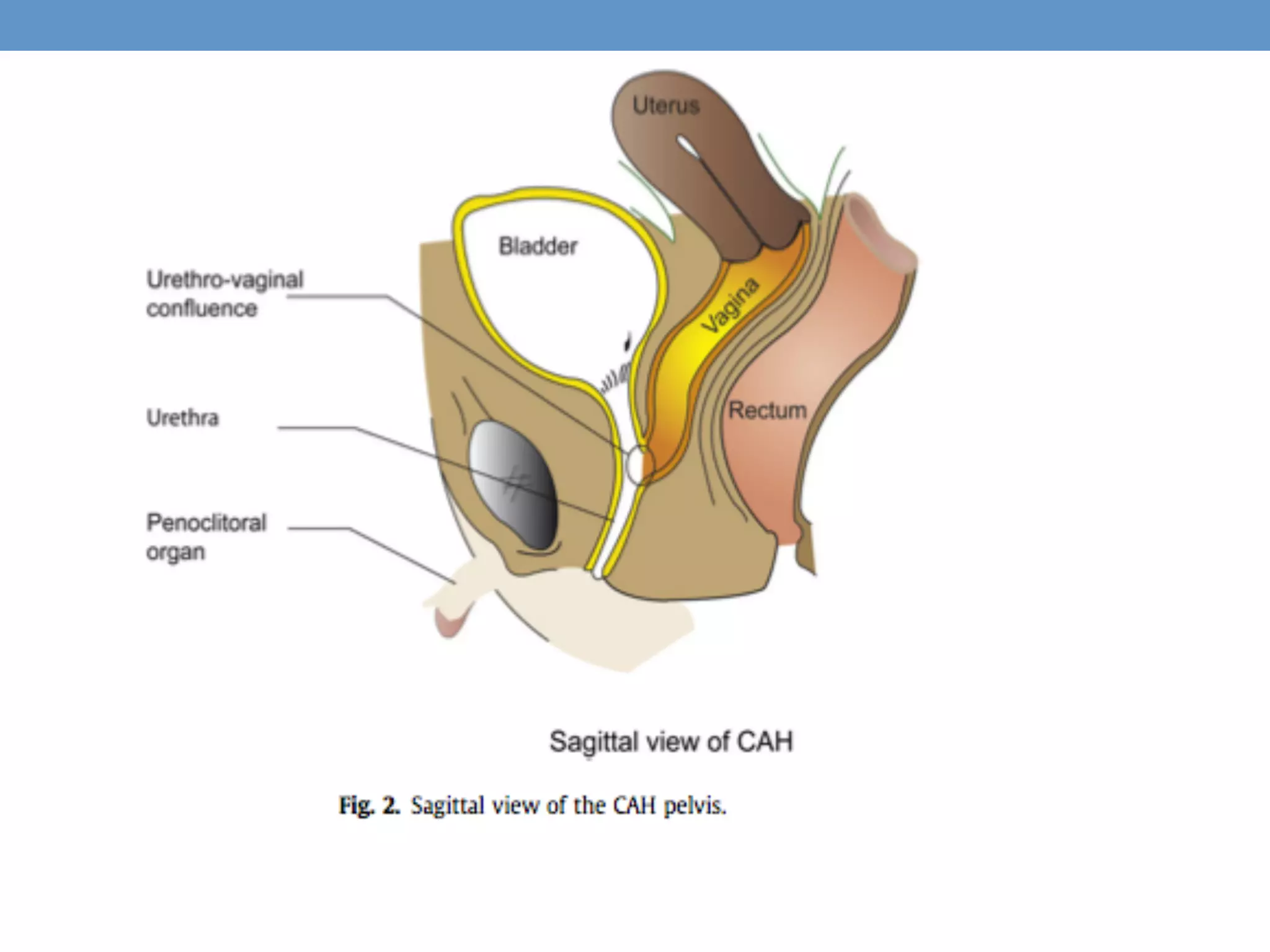
• Causes
• History
• Examination
• Investigation
• Management
• Case presentations
Definition of ambiguous genitalia
• Appearance of external genitalia that is not “typical” male
or female
• Usually noted at birth but may also be diagnosed only at
childhood or adolescence
• Causes of ambiguous genitalia usually falls under
Disorders/Differences of Sex Development (DSD)
• DSD are conditions where there is atypical development
of chromosomal, gonadal or anatomic sex. Not all DSDs
have ambiguous genitalia
Incidences of some form of DSD
Determinants of sex
Genetic make-up
(sex chromosome & other genes)
ê
Gonads differentiation
ê
Phenotype differentiation
• Male development requires the presence of
• Y chromosome (sex determining gene on SRY )à cascade of events mediated by various
other genes
• Testes
• Androgen production and its action
• In the absence of any of these, the default position is female (simplified theory)
• SRY on the Y chromosome is a critical regulator of male gonadal differentiation.
Other important genes WT1 (gonadogenesis & nephrogenesis) , SF1/NR5A1
(gonadal & adrenal development), SOX 9
5-alpha reductase
Causes
Undervirilised male (46 XY DSD)
• Abnormal testes determination (gonadal dysgenesis - Partial (XY) or mixed (XY, XO), if
complete à female external genitalia
• Androgen biosynthetic defects (5 alpha-reductase deficiency, rare forms of CAH, LH
receptor inactivating mutations )
• Resistance to androgen actions (Androgen Insensitivity Syndromes-partial, complete)
Virilised female (46 XX DSD)
Usually androgen excess
• Fetal : congenital adrenal hyperplasia (CAH) –most common
• Maternal (virilising tumors, exogenous)
• Fetoplacental (aromatase deficiency)
Ovotesticular DSD
• Presence of both testicular and ovarian tissue (karyotype usually XX)
Approach to a baby with ambiguous genitalia
Initial assessment
1. Determine who needs to be investigated
2. Rule out life threatening conditions eg CAH
3. Gender determination
• History , physical examination
• First line investigations
History
Details of the pregnancy
• Maternal virilisation
• Maternal drugs, creams, endocrine disruptors
Family history (3-generation)
• consaingunity
• neonatal deaths - adrenal crisis
• ambiguous genitalia
• unexpected changes at puberty
• primary amenorrhea
• infertility
General examination
• Dysmorphic features – genetic/chromosomal disorder,
syndromes
• Midline defects – cryptoorchidism & micropenis à
(hypopituitarism is a differential diagnosis)
• Skin hyperpigmentation à underlying primary adrenal
insufficiency eg CAH
• Blood pressure – 11-beta hydroxylase, 17 alpha
hydroxylase forms of CAH may be hypertensive.
Genitalia
1. Phallus / clitoris size (phallic/cliterophallic structure/genital tubercle)
Ø Measure stretched length and diameter
Ø Micropenis term neonate stretched length less than 2.5cm (varies with ethnicity), for any
gestation < 2cm is usually abnormal
Ø Cliteromegaly – >1cm
2. Orifices
Ø single or two
Ø site
3. Gonads
Ø Palpable ? Labioscrotal, inguinal
4. Labioscrotal folds
Ø pigmentation and rugosity
Ø Unfused, posterior fusion, fused (folds may be separated, or might be fused in the midline)
5. Anogenital distance
Degree of virilisation in a female – Prader staging
I. Prader Staging for CAH (1954)
Stage 1 Stage 2 Stage 3 Stage 4 Stage 5
Slightly
enlarged
clitoris
Mild enlarged
clitoris
Clitoromegaly Clitoromegaly
appear as
male phallus
Male phallus
Slightly
reduced
vaginal
opening
Small vaginal
opening
Single
urogenital
sinus
Urogenital
sinus opens
near the base
clitoris
Urethra
opening at or
near tip
Posterior
labial fusion
Nearly
complete
labia fusion
Complete
fusion labia
minora
Complete
labial fusion
Prader A. Der genitalbefund beim pseudohermaproditus feminus des kongenitalen adrenogenitalen
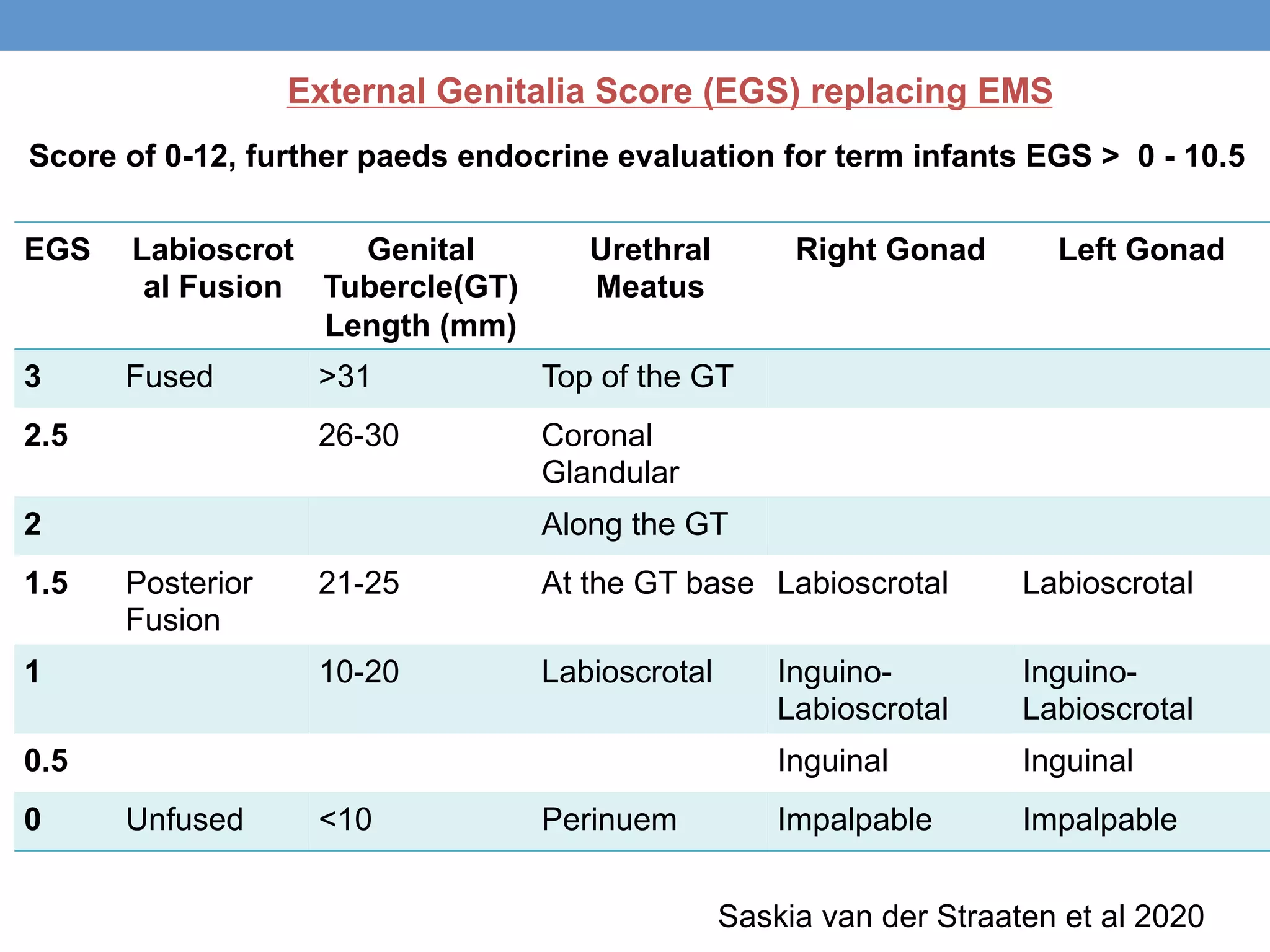
EMS score (undervirilised male)
EGS Labioscrot
al Fusion
Genital
Tubercle(GT)
Length (mm)
Urethral
Meatus
Right Gonad Left Gonad
3 Fused >31 Top of the GT
2.5 26-30 Coronal
Glandular
2 Along the GT
1.5 Posterior
Fusion
21-25 At the GT base Labioscrotal Labioscrotal
1 10-20 Labioscrotal Inguino-
Labioscrotal
Inguino-
Labioscrotal
0.5 Inguinal Inguinal
0 Unfused <10 Perinuem Impalpable Impalpable
External Genitalia Score (EGS) replacing EMS
Score of 0-12, further paeds endocrine evaluation for term infants EGS > 0 - 10.5
Saskia van der Straaten et al 2020
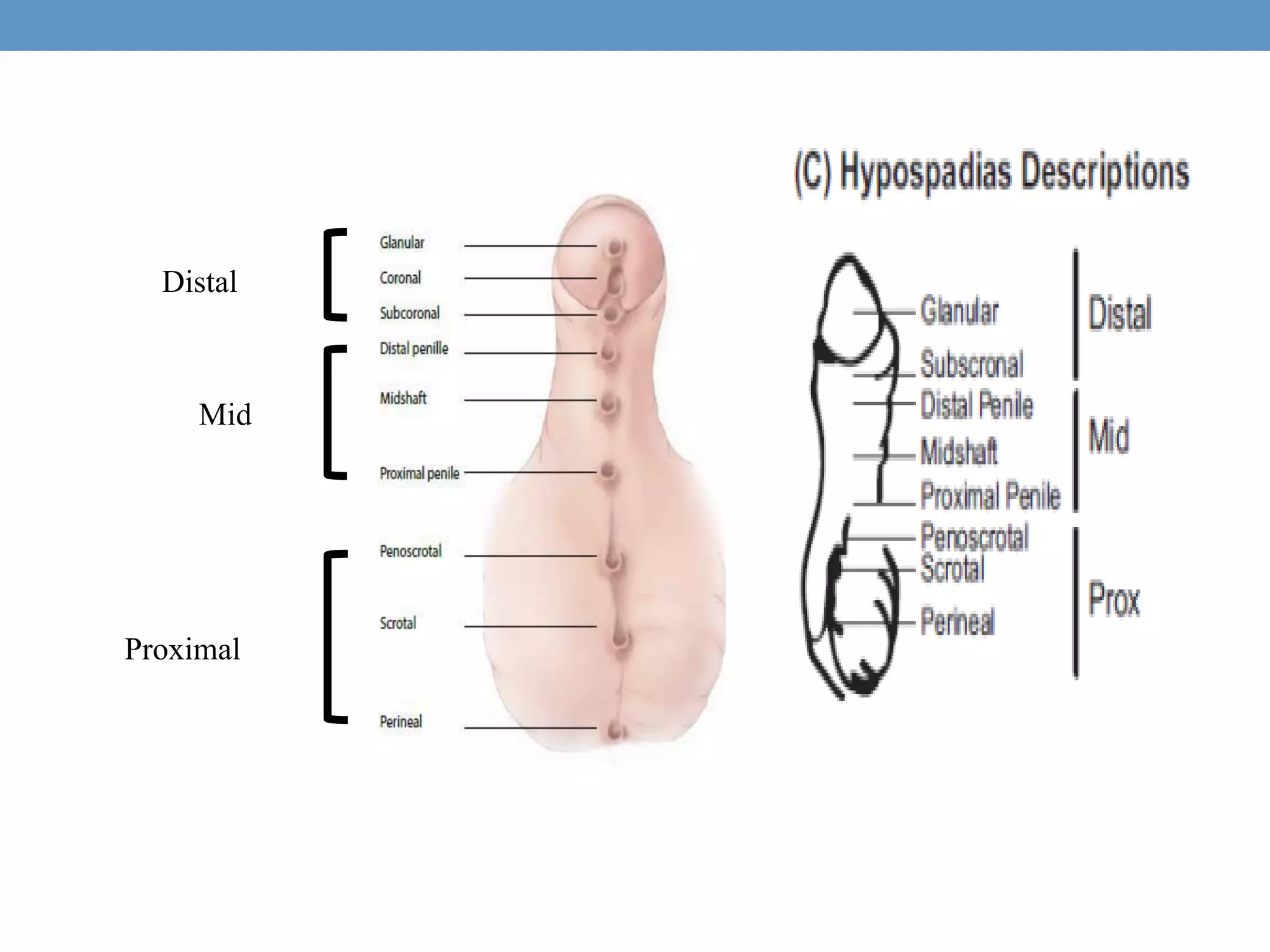
Distal
Mid
Proximal
1. “Cliterophallic structure” (Genital tubercle) – stretched length 2.2cm, diameter 1cm
2. Single opening at labioscrotal fold
3. Left gonad palpable within labioscrotal fold – good size 1ml, right not palpable
(remember to palpate also at inguinal!)
4. Labioscrotal fold – posterior fusion, minimal rugae & pigmentation
External Genitalia Score (EGS) 5.5 à need paeds endo consult for further workout
Description of genitalia – key features
Who should be investigated
1. Apparent female genitalia
• Enlarged clitoris
• Posterior labial fusion
• Inguinal/labial mass / “hernia”
2. Apparent male genitalia
• Bilateral gonads are not palpable
• Microphallus
3. Hypospadias with
• Unilateral or bilateral undescended testes
• Proximal (penoscrotal, perineal)
• Familial
4. EGS score >0 - 10.5 (previously EMS score < 11)
Investigations
Aims
1. Exclude life-threatening condition –eg adrenal
insufficiency most commonly salt losing CAH in a
virilised female
2. Determine gender & cause
3. Assess gonadal +/- adrenal function
Investigations
Karyotype
Request sufficient cells to be analysed so as not to miss mosaicism
eg mixed gonadal dygenesis (XY/X0, XX/XY)
FISH for SRY gene
Bld glucose, urea and electrolytes (if suspect CAH à
urgent referral to paeds endocrine )
Investigation
• LH, FSH, testosterone (optimal time to measure is around 2 weeks to 4
mths during the “mini puberty” )
• Anti-mullerian hormone (AMH) (values in male range indicates
presence of testicular Sertoli cell)
• 17-OHP (elevated in classical CAH usually >300nmol/L, take > 72 hours of
life)
• Cortisol, ACTH (if suspect adrenal deficiency, may need stimulation test if
depending on clinical suspicion. A low morning cortisol in an otherwise-well
neonate does not mean adrenal deficiency, young infants do not have
established circadian rhythm)
• Renin, aldosterone (if abnormal electrolytes, suspect adrenal deficiency,
CAH)
Imaging
US abdomen / pelvis / inguinal
• Gonads
• Mullerian structures
• +/- Kidneys
MRI to locate gonads – (ultrasound is the most appropriate
modality initially)
Further investigations – gonadal & adrenal axis
Short synacthen (ACTH stimulation) test
• cases of suspected adrenal deficiency, eg CAH –
stimulated cortisol/17-OHP levels.
hCG stimulation test
• Assess presence & function of testicular tissue -
Leydig cells - pre and post-hCG testosterone levels
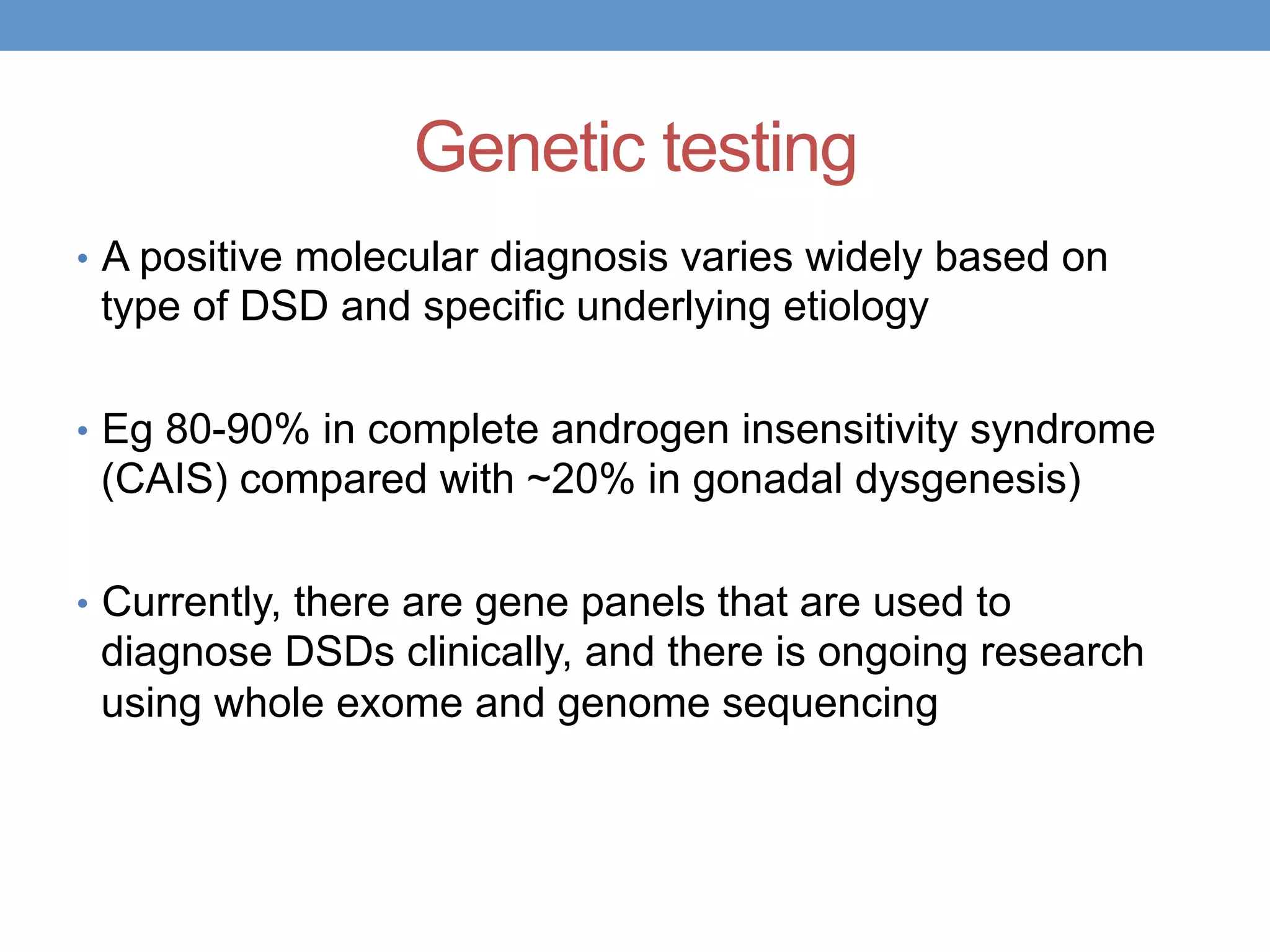
Genetic testing
• A positive molecular diagnosis varies widely based on
type of DSD and specific underlying etiology
• Eg 80-90% in complete androgen insensitivity syndrome
(CAIS) compared with ~20% in gonadal dysgenesis)
• Currently, there are gene panels that are used to
diagnose DSDs clinically, and there is ongoing research
using whole exome and genome sequencing
Others
• For some cases - genitourethrogram or genitocystoscopy
to determine internal anatomy
• Usually not done for weeks/months if thought necessary
• Laparoscopy to locate internal gonads
Management principles
1. Rule out life-threatening condition
2. Determination of gender and cause
3. Specific medical & surgical management
• Multidisplinary – paediatric endocrinologist,
surgeon, psychologist, geneticist
• Be sensitive and respectful - Psychosocial support
for child and family
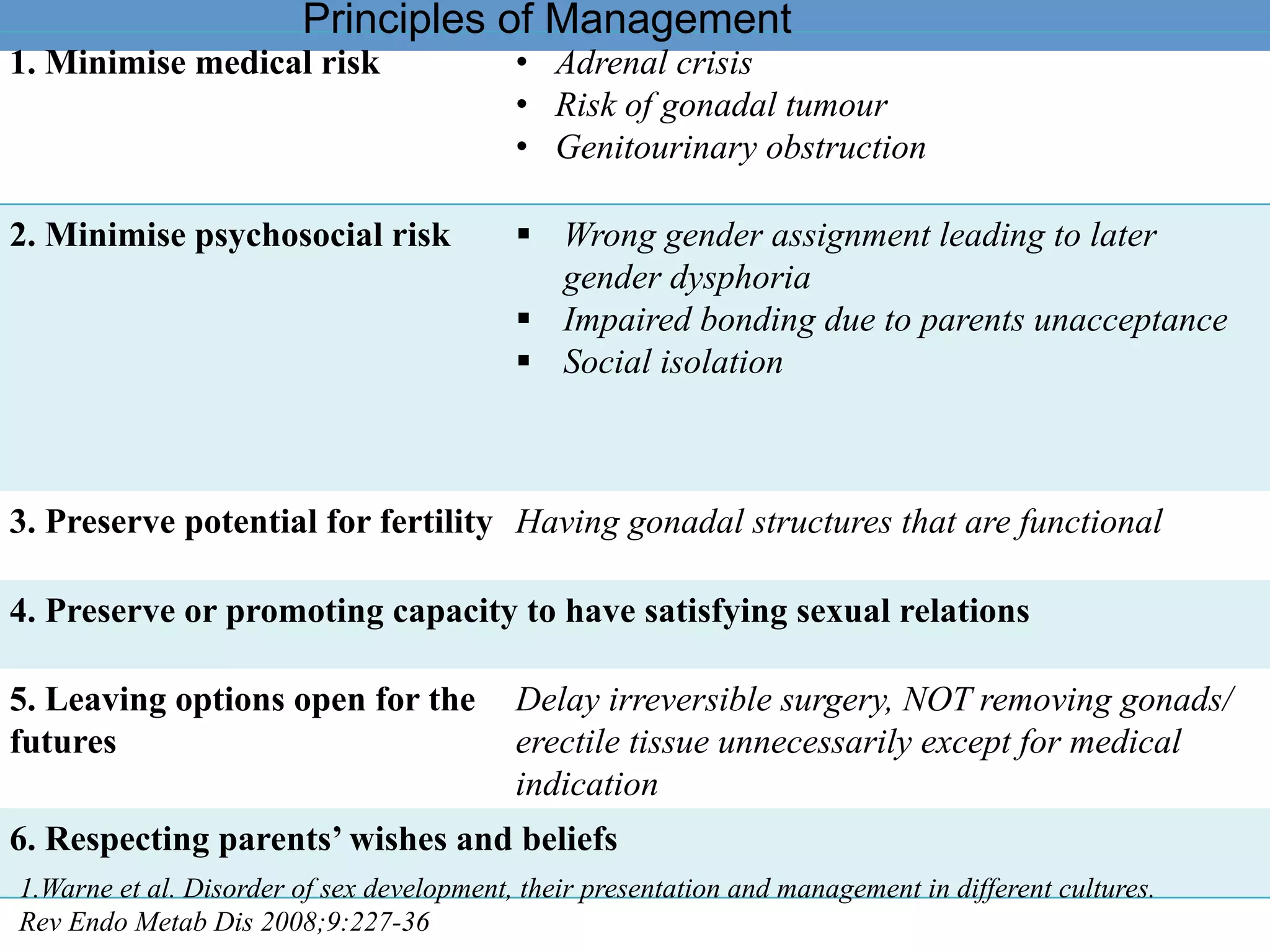
1. Minimise medical risk • Adrenal crisis
• Risk of gonadal tumour
• Genitourinary obstruction
2. Minimise psychosocial risk § Wrong gender assignment leading to later
gender dysphoria
§ Impaired bonding due to parents unacceptance
§ Social isolation
3. Preserve potential for fertility Having gonadal structures that are functional
4. Preserve or promoting capacity to have satisfying sexual relations
5. Leaving options open for the
futures
Delay irreversible surgery, NOT removing gonads/
erectile tissue unnecessarily except for medical
indication
6. Respecting parents’ wishes and beliefs
1.Warne et al. Disorder of sex development, their presentation and management in different cultures.
Rev Endo Metab Dis 2008;9:227-36
Principles of Management
Gender assignment
• Serious psychosocial dynamics to be considered
• Assigned sex at birth and biological sex are different from
gender identity
• Gender identity is based on how the person perceives and
understands themselves. Complex à social and
biological factors (prenatal hormones, genes or
neuroanatomy (structural & functional aspects of the
brain)
Factors influencing gender assignment
• The diagnosis
Ø CAH traditionally raised as girls, debate for Prader stage 4 & 5
Ø Complete gonadal dysgenesis, CAIS raised as girls
Ø 5-alpha reductase deficiency and milder forms of PAIS usually boys
• Genitalia appearance
• Functional status
Ø Potential for fertility, sexual function, life-long replacement therapy
• Surgical options
• Views of the family
Can be very difficult in some conditions eg partial or mixed gonadal dysgenesis,
severe PAIS
Karyotype itself should not be the primary determinant
Most importantly, the child preferred gender identity is not known yet
Surgery
• Ethically complex
• Experienced surgeon in DSD, multidisciplinary team discussion
• Includes genitoplasty (i.e., clitoroplasty, vaginoplasty, and
phalloplasty), urogenital sinus mobilization, hypospadias repair,
and gonadectomy (need to consider risk of malignancy for
those with Y chromosome).
• Trend now to
ØNot to perform surgery solely for cosmetic appearance, and toward
preserving function and innervation
ØDelay irreversible surgery if there is no medical indication until gender
identity is affirmed and the individual is able to participate in decision-
making
Case presentations
Presented with neonatal hypoglycemia
Micropenis, urethra at tip, hypoplastic scrotum, bilateral orchidopexy scars
Diagnosis
• Hypopituitarism - can present with “ambiguous genitalia” (micropenis)
• Monitor other pituitary deficiencies à consult paeds endo early
Case 1
6 year old boy referred for micropenis
Embedded penis – phimosis
Not micropenis, not ambiguous genitalia
Case 1
Case 2
Referred at 4 months old. Raised as girl.
Undervirilised male? Virilised female? Uncertain?
Case 3
• Karyotype 46 XY
• Baseline FSH, LH, testosterone at 5 mths not elevated
• hCG stimulation à rise in testosterone
• US pelvis – right gonad visualised in the pelvis, left not
seen, presence of uterus
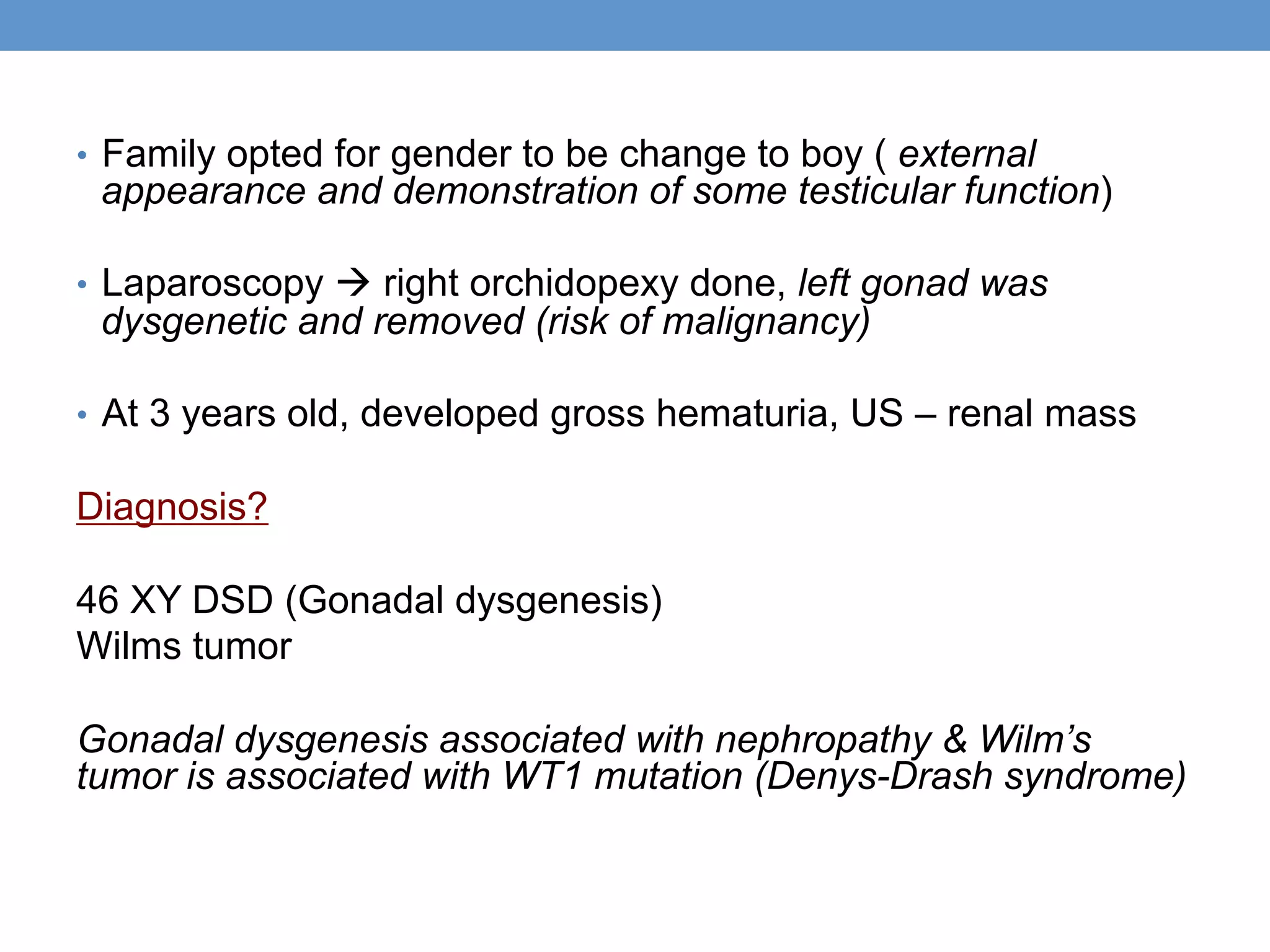
• Family opted for gender to be change to boy ( external
appearance and demonstration of some testicular function)
• Laparoscopy à right orchidopexy done, left gonad was
dysgenetic and removed (risk of malignancy)
• At 3 years old, developed gross hematuria, US – renal mass
Diagnosis?
46 XY DSD (Gonadal dysgenesis)
Wilms tumor
Gonadal dysgenesis associated with nephropathy & Wilm’s
tumor is associated with WT1 mutation (Denys-Drash syndrome)
• 1.5yr old girl seen at a medical centre for bilateral swelling at
inguinal region. Normal female external genitalia
• Bilateral herniotomy was done for inguinal “hernia”. Intra-op
noted gonads, biopsy suggestive of testicular tissue
• Karyotype 46 XY, mutation at the androgen receptor (AR) gene
Diagnosis : Complete androgen insensitvity syndrome (CAIS)
Gender : Remains girl
Further issues : Timing of gonadectomy (childhood vs after
puberty), risk malignancy , long-term hormonal replacement,
sexual functions, fertility in adulthood
Learning point : Apparent female genitalia with inguinal
“swellings” must be evaluated for an underlying DSD. CAIS can
also present later with amenorrhea.
Case 4
Case 5
Newborn referred for ambiguous genitalia.
“Phallus” 3.5 cm, gonads not palpable, single perineal opening
Undervirilised male ? Virilised female ? Uncertain ?
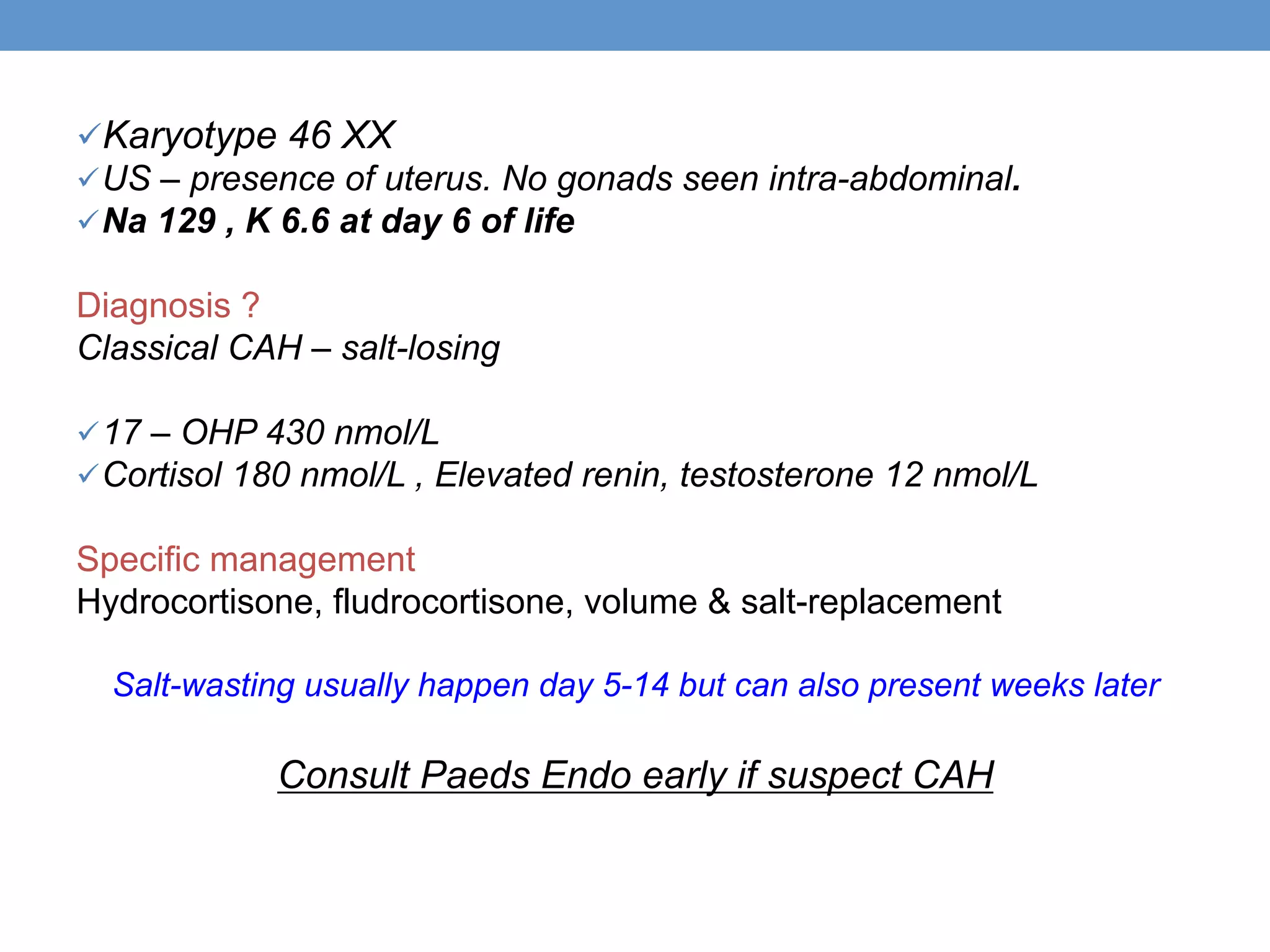
üKaryotype 46 XX
üUS – presence of uterus. No gonads seen intra-abdominal.
üNa 129 , K 6.6 at day 6 of life
Diagnosis ?
Classical CAH – salt-losing
ü17 – OHP 430 nmol/L
üCortisol 180 nmol/L , Elevated renin, testosterone 12 nmol/L
Specific management
Hydrocortisone, fludrocortisone, volume & salt-replacement
Salt-wasting usually happen day 5-14 but can also present weeks later
Consult Paeds Endo early if suspect CAH
Take home messages
1. Know who needs to be referred & investigated
2. Recognise life-threatening conditions eg CAH
3. Principles of initial management
4. Gender determination can be complex
5. Be holistic, sensitive & respectful
References
• dsdfamilies.org (website, useful resources for families)
• Peter A Lee. et al. Global Disorders of Sex development. Update
since 2006: Perceptions, Approach and Care. Horm Res Paediatr
2016
• Mehul T Dattani, Charles GD Brook. Brook’s Clinical Pediatric
Endocrinology 7th edition 2020
• Tafadzwa Makaya et al. Sex determination it can get difficult! Infant
2010.
• S Faisal Ahmed et al. Investigation and initial management of
ambiguous genitalia. Best Pract & Research Clinical Endocrinology
Met 2010
• Isabelle Vida. Surgical options in disorders of sex development (dsd)
with ambiguous genitalia. Best Pract & Research Clinical
Endocrinology Met 2010
• Saskia van der Straaten et al. The external genitalia score (EGS). A
European Multicentre Validation Study 2020 .

ambiguous genitalia

  • 1.
    AN APPROACH TOAMBIGUOUS GENITALIA .....IT CAN BE COMPLICATED! Dr Jeanne Wong Sze Lyn Paediatric Endocrinologist Putrajaya Hospital Postgraduate Paediatric Endocrine Course 30.6.2021
  • 2.
    Learning objectives 1. Identifyand describe ambiguous genitalia correctly 2. Know who to investigate 3. Evaluate and initiate early management 4. Be aware of life-threatening conditions (adrenal deficiency)
  • 3.
    Lecture outline Introduction Determinants ofsex Approach to ambiguous genitalia • Causes • History • Examination • Investigation • Management • Case presentations
  • 4.
    Definition of ambiguousgenitalia • Appearance of external genitalia that is not “typical” male or female • Usually noted at birth but may also be diagnosed only at childhood or adolescence • Causes of ambiguous genitalia usually falls under Disorders/Differences of Sex Development (DSD) • DSD are conditions where there is atypical development of chromosomal, gonadal or anatomic sex. Not all DSDs have ambiguous genitalia
  • 5.
    Incidences of someform of DSD
  • 6.
    Determinants of sex Geneticmake-up (sex chromosome & other genes) ê Gonads differentiation ê Phenotype differentiation • Male development requires the presence of • Y chromosome (sex determining gene on SRY )à cascade of events mediated by various other genes • Testes • Androgen production and its action • In the absence of any of these, the default position is female (simplified theory) • SRY on the Y chromosome is a critical regulator of male gonadal differentiation. Other important genes WT1 (gonadogenesis & nephrogenesis) , SF1/NR5A1 (gonadal & adrenal development), SOX 9
  • 9.
  • 10.
    Causes Undervirilised male (46XY DSD) • Abnormal testes determination (gonadal dysgenesis - Partial (XY) or mixed (XY, XO), if complete à female external genitalia • Androgen biosynthetic defects (5 alpha-reductase deficiency, rare forms of CAH, LH receptor inactivating mutations ) • Resistance to androgen actions (Androgen Insensitivity Syndromes-partial, complete) Virilised female (46 XX DSD) Usually androgen excess • Fetal : congenital adrenal hyperplasia (CAH) –most common • Maternal (virilising tumors, exogenous) • Fetoplacental (aromatase deficiency) Ovotesticular DSD • Presence of both testicular and ovarian tissue (karyotype usually XX)
  • 12.
    Approach to ababy with ambiguous genitalia Initial assessment 1. Determine who needs to be investigated 2. Rule out life threatening conditions eg CAH 3. Gender determination • History , physical examination • First line investigations
  • 13.
    History Details of thepregnancy • Maternal virilisation • Maternal drugs, creams, endocrine disruptors Family history (3-generation) • consaingunity • neonatal deaths - adrenal crisis • ambiguous genitalia • unexpected changes at puberty • primary amenorrhea • infertility
  • 14.
    General examination • Dysmorphicfeatures – genetic/chromosomal disorder, syndromes • Midline defects – cryptoorchidism & micropenis à (hypopituitarism is a differential diagnosis) • Skin hyperpigmentation à underlying primary adrenal insufficiency eg CAH • Blood pressure – 11-beta hydroxylase, 17 alpha hydroxylase forms of CAH may be hypertensive.
  • 15.
    Genitalia 1. Phallus /clitoris size (phallic/cliterophallic structure/genital tubercle) Ø Measure stretched length and diameter Ø Micropenis term neonate stretched length less than 2.5cm (varies with ethnicity), for any gestation < 2cm is usually abnormal Ø Cliteromegaly – >1cm 2. Orifices Ø single or two Ø site 3. Gonads Ø Palpable ? Labioscrotal, inguinal 4. Labioscrotal folds Ø pigmentation and rugosity Ø Unfused, posterior fusion, fused (folds may be separated, or might be fused in the midline) 5. Anogenital distance
  • 16.
    Degree of virilisationin a female – Prader staging
  • 17.
    I. Prader Stagingfor CAH (1954) Stage 1 Stage 2 Stage 3 Stage 4 Stage 5 Slightly enlarged clitoris Mild enlarged clitoris Clitoromegaly Clitoromegaly appear as male phallus Male phallus Slightly reduced vaginal opening Small vaginal opening Single urogenital sinus Urogenital sinus opens near the base clitoris Urethra opening at or near tip Posterior labial fusion Nearly complete labia fusion Complete fusion labia minora Complete labial fusion Prader A. Der genitalbefund beim pseudohermaproditus feminus des kongenitalen adrenogenitalen
  • 20.
  • 21.
    EGS Labioscrot al Fusion Genital Tubercle(GT) Length(mm) Urethral Meatus Right Gonad Left Gonad 3 Fused >31 Top of the GT 2.5 26-30 Coronal Glandular 2 Along the GT 1.5 Posterior Fusion 21-25 At the GT base Labioscrotal Labioscrotal 1 10-20 Labioscrotal Inguino- Labioscrotal Inguino- Labioscrotal 0.5 Inguinal Inguinal 0 Unfused <10 Perinuem Impalpable Impalpable External Genitalia Score (EGS) replacing EMS Score of 0-12, further paeds endocrine evaluation for term infants EGS > 0 - 10.5 Saskia van der Straaten et al 2020
  • 22.
  • 23.
    1. “Cliterophallic structure”(Genital tubercle) – stretched length 2.2cm, diameter 1cm 2. Single opening at labioscrotal fold 3. Left gonad palpable within labioscrotal fold – good size 1ml, right not palpable (remember to palpate also at inguinal!) 4. Labioscrotal fold – posterior fusion, minimal rugae & pigmentation External Genitalia Score (EGS) 5.5 à need paeds endo consult for further workout Description of genitalia – key features
  • 24.
    Who should beinvestigated 1. Apparent female genitalia • Enlarged clitoris • Posterior labial fusion • Inguinal/labial mass / “hernia” 2. Apparent male genitalia • Bilateral gonads are not palpable • Microphallus 3. Hypospadias with • Unilateral or bilateral undescended testes • Proximal (penoscrotal, perineal) • Familial 4. EGS score >0 - 10.5 (previously EMS score < 11)
  • 25.
    Investigations Aims 1. Exclude life-threateningcondition –eg adrenal insufficiency most commonly salt losing CAH in a virilised female 2. Determine gender & cause 3. Assess gonadal +/- adrenal function
  • 26.
    Investigations Karyotype Request sufficient cellsto be analysed so as not to miss mosaicism eg mixed gonadal dygenesis (XY/X0, XX/XY) FISH for SRY gene Bld glucose, urea and electrolytes (if suspect CAH à urgent referral to paeds endocrine )
  • 27.
    Investigation • LH, FSH,testosterone (optimal time to measure is around 2 weeks to 4 mths during the “mini puberty” ) • Anti-mullerian hormone (AMH) (values in male range indicates presence of testicular Sertoli cell) • 17-OHP (elevated in classical CAH usually >300nmol/L, take > 72 hours of life) • Cortisol, ACTH (if suspect adrenal deficiency, may need stimulation test if depending on clinical suspicion. A low morning cortisol in an otherwise-well neonate does not mean adrenal deficiency, young infants do not have established circadian rhythm) • Renin, aldosterone (if abnormal electrolytes, suspect adrenal deficiency, CAH)
  • 28.
    Imaging US abdomen /pelvis / inguinal • Gonads • Mullerian structures • +/- Kidneys MRI to locate gonads – (ultrasound is the most appropriate modality initially)
  • 29.
    Further investigations –gonadal & adrenal axis Short synacthen (ACTH stimulation) test • cases of suspected adrenal deficiency, eg CAH – stimulated cortisol/17-OHP levels. hCG stimulation test • Assess presence & function of testicular tissue - Leydig cells - pre and post-hCG testosterone levels
  • 30.
    Genetic testing • Apositive molecular diagnosis varies widely based on type of DSD and specific underlying etiology • Eg 80-90% in complete androgen insensitivity syndrome (CAIS) compared with ~20% in gonadal dysgenesis) • Currently, there are gene panels that are used to diagnose DSDs clinically, and there is ongoing research using whole exome and genome sequencing
  • 31.
    Others • For somecases - genitourethrogram or genitocystoscopy to determine internal anatomy • Usually not done for weeks/months if thought necessary • Laparoscopy to locate internal gonads
  • 32.
    Management principles 1. Ruleout life-threatening condition 2. Determination of gender and cause 3. Specific medical & surgical management • Multidisplinary – paediatric endocrinologist, surgeon, psychologist, geneticist • Be sensitive and respectful - Psychosocial support for child and family
  • 33.
    1. Minimise medicalrisk • Adrenal crisis • Risk of gonadal tumour • Genitourinary obstruction 2. Minimise psychosocial risk § Wrong gender assignment leading to later gender dysphoria § Impaired bonding due to parents unacceptance § Social isolation 3. Preserve potential for fertility Having gonadal structures that are functional 4. Preserve or promoting capacity to have satisfying sexual relations 5. Leaving options open for the futures Delay irreversible surgery, NOT removing gonads/ erectile tissue unnecessarily except for medical indication 6. Respecting parents’ wishes and beliefs 1.Warne et al. Disorder of sex development, their presentation and management in different cultures. Rev Endo Metab Dis 2008;9:227-36 Principles of Management
  • 34.
    Gender assignment • Seriouspsychosocial dynamics to be considered • Assigned sex at birth and biological sex are different from gender identity • Gender identity is based on how the person perceives and understands themselves. Complex à social and biological factors (prenatal hormones, genes or neuroanatomy (structural & functional aspects of the brain)
  • 35.
    Factors influencing genderassignment • The diagnosis Ø CAH traditionally raised as girls, debate for Prader stage 4 & 5 Ø Complete gonadal dysgenesis, CAIS raised as girls Ø 5-alpha reductase deficiency and milder forms of PAIS usually boys • Genitalia appearance • Functional status Ø Potential for fertility, sexual function, life-long replacement therapy • Surgical options • Views of the family Can be very difficult in some conditions eg partial or mixed gonadal dysgenesis, severe PAIS Karyotype itself should not be the primary determinant Most importantly, the child preferred gender identity is not known yet
  • 36.
    Surgery • Ethically complex •Experienced surgeon in DSD, multidisciplinary team discussion • Includes genitoplasty (i.e., clitoroplasty, vaginoplasty, and phalloplasty), urogenital sinus mobilization, hypospadias repair, and gonadectomy (need to consider risk of malignancy for those with Y chromosome). • Trend now to ØNot to perform surgery solely for cosmetic appearance, and toward preserving function and innervation ØDelay irreversible surgery if there is no medical indication until gender identity is affirmed and the individual is able to participate in decision- making
  • 37.
  • 38.
    Presented with neonatalhypoglycemia Micropenis, urethra at tip, hypoplastic scrotum, bilateral orchidopexy scars Diagnosis • Hypopituitarism - can present with “ambiguous genitalia” (micropenis) • Monitor other pituitary deficiencies à consult paeds endo early Case 1
  • 39.
    6 year oldboy referred for micropenis Embedded penis – phimosis Not micropenis, not ambiguous genitalia Case 1 Case 2
  • 40.
    Referred at 4months old. Raised as girl. Undervirilised male? Virilised female? Uncertain? Case 3
  • 41.
    • Karyotype 46XY • Baseline FSH, LH, testosterone at 5 mths not elevated • hCG stimulation à rise in testosterone • US pelvis – right gonad visualised in the pelvis, left not seen, presence of uterus
  • 42.
    • Family optedfor gender to be change to boy ( external appearance and demonstration of some testicular function) • Laparoscopy à right orchidopexy done, left gonad was dysgenetic and removed (risk of malignancy) • At 3 years old, developed gross hematuria, US – renal mass Diagnosis? 46 XY DSD (Gonadal dysgenesis) Wilms tumor Gonadal dysgenesis associated with nephropathy & Wilm’s tumor is associated with WT1 mutation (Denys-Drash syndrome)
  • 43.
    • 1.5yr oldgirl seen at a medical centre for bilateral swelling at inguinal region. Normal female external genitalia • Bilateral herniotomy was done for inguinal “hernia”. Intra-op noted gonads, biopsy suggestive of testicular tissue • Karyotype 46 XY, mutation at the androgen receptor (AR) gene Diagnosis : Complete androgen insensitvity syndrome (CAIS) Gender : Remains girl Further issues : Timing of gonadectomy (childhood vs after puberty), risk malignancy , long-term hormonal replacement, sexual functions, fertility in adulthood Learning point : Apparent female genitalia with inguinal “swellings” must be evaluated for an underlying DSD. CAIS can also present later with amenorrhea. Case 4
  • 44.
    Case 5 Newborn referredfor ambiguous genitalia. “Phallus” 3.5 cm, gonads not palpable, single perineal opening Undervirilised male ? Virilised female ? Uncertain ?
  • 45.
    üKaryotype 46 XX üUS– presence of uterus. No gonads seen intra-abdominal. üNa 129 , K 6.6 at day 6 of life Diagnosis ? Classical CAH – salt-losing ü17 – OHP 430 nmol/L üCortisol 180 nmol/L , Elevated renin, testosterone 12 nmol/L Specific management Hydrocortisone, fludrocortisone, volume & salt-replacement Salt-wasting usually happen day 5-14 but can also present weeks later Consult Paeds Endo early if suspect CAH
  • 46.
    Take home messages 1.Know who needs to be referred & investigated 2. Recognise life-threatening conditions eg CAH 3. Principles of initial management 4. Gender determination can be complex 5. Be holistic, sensitive & respectful
  • 47.
    References • dsdfamilies.org (website,useful resources for families) • Peter A Lee. et al. Global Disorders of Sex development. Update since 2006: Perceptions, Approach and Care. Horm Res Paediatr 2016 • Mehul T Dattani, Charles GD Brook. Brook’s Clinical Pediatric Endocrinology 7th edition 2020 • Tafadzwa Makaya et al. Sex determination it can get difficult! Infant 2010. • S Faisal Ahmed et al. Investigation and initial management of ambiguous genitalia. Best Pract & Research Clinical Endocrinology Met 2010 • Isabelle Vida. Surgical options in disorders of sex development (dsd) with ambiguous genitalia. Best Pract & Research Clinical Endocrinology Met 2010 • Saskia van der Straaten et al. The external genitalia score (EGS). A European Multicentre Validation Study 2020 .