APPROACH TO DISORDERS OF
SEXUAL DIFFERENTIATION
Dr.Lakshit Bhalala
First Year Resident
Department of Paediatrics
Guide by : Dr. Hardik Shah
Assistant Professor
INTRODUCTION
• The newborn infant with ambiguous external
genitalia often comes as a surprise for the
doctors as well as the parents and is
sometimes described as an endocrine
emergency situation presenting a problem of
sex assignment.
• The nomenclature such as ‘intersex’,
‘hermaphrodite’, and ‘pseudohermaphrodite’
is out of date as well as confusing.
The Chicago Consensus held in 2005
recommended new terminology based on the
umbrella term disorders of sex differentiation
(DSDs).
The evaluation and management of DSDs is
complex, and a multidisciplinary team approach
 including a pediatric urologist, a psychiatrist, and
a pediatric endocrinologist is required for optimal
management.
DEFINITION
DSDs are defined as congenital conditions
associated with atypical development of
chromosomal, gonadal, or anatomical sex.
INCIDENCE
• overall incidence of DSDs is one in 5,500
• The incidence of CAH: 1:15,000
• The most common causes of ambiguous
genitalia :Congenital adrenal hyperplasia (CAH)
• Constituting approximately over 50% of all
cases of genital ambiguity in the newborn
period .
ESSENTIAL FEATURES OF NORMAL FEMALE
GENITALIA IN A NEWBORN
 Vaginal opening Fully Visible 3 to 4 mm Slit OR
Stellate Orifice With Heaped Up Mucosa.
 Clitoris Width 2 to 6mm
 Absence Of Gonads in Labia Majora Or Inguinal
Region
ESSENTIAL FEATURES OF NORMAL
MALE GENITALIA IN A NEWBORN
Urethra at the tip of glans
Penis of normal stretched length(2.5-5cm) and
Diameter (0.9-1.3 cm).
Bilateral testes of normal size(8-14mm) in
scrotal sac
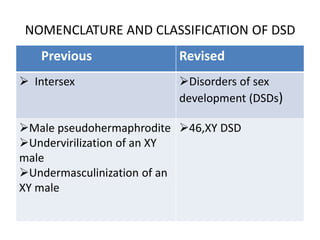
NOMENCLATURE AND CLASSIFICATION OF DSD
Previous Revised
 Intersex Disorders of sex
development (DSDs)
Male pseudohermaphrodite
Undervirilization of an XY
male
Undermasculinization of an
XY male
46,XY DSD
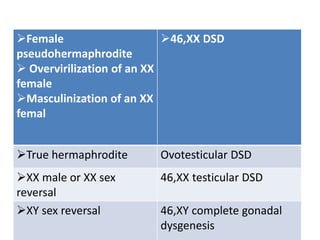
Female
pseudohermaphrodite
 Overvirilization of an XX
female
Masculinization of an XX
femal
46,XX DSD
True hermaphrodite Ovotesticular DSD
XX male or XX sex
reversal
46,XX testicular DSD
XY sex reversal 46,XY complete gonadal
dysgenesis
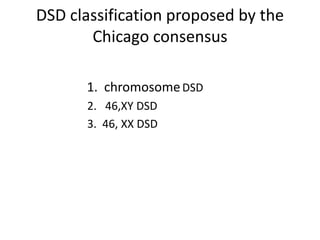
DSD classification proposed by the
Chicago consensus
1. chromosomeDSD
2. 46,XY DSD
3. 46, XX DSD
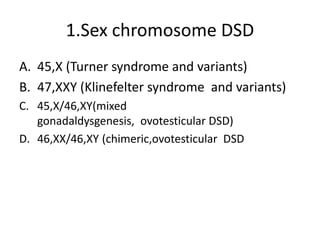
1.Sex chromosome DSD
A. 45,X (Turner syndrome and variants)
B. 47,XXY (Klinefelter syndrome and variants)
C. 45,X/46,XY(mixed
gonadaldysgenesis, ovotesticular DSD)
D. 46,XX/46,XY (chimeric,ovotesticular DSD
2.46,XY DSD
1. Disorders of gonadal development
2. Disorders in androgen synthesis or action
3. OTHER (A)severe hypospadias
(B)cloacalextrophy
Disorders of gonadal (testicular)
development
• Complete gonadal dysgenesis (Swyer
syndrome)
• Partial gonadal dysgenesis
• Gonadal regression
• Ovotesticular DSD
Disorders in androgen synthesis or
action
A) Androgen biosynthesis defect:
1)17-hydroxysteroid dehydrogenase deficiency
2) 5α-reductase deficiency
B) Defect in androgen action
1)complete androgen insensitivity syndrome
2)partial androgen insensitivity syndrome
C) LH receptor defect(leydig cell hypoplasia)
D)Disorder of AMH and AMH receptor
3.46,XX DSD
• Disorders of gonadal (ovarian) development
• Androgen excess
• OTHER :1) cloacalextrophy
2)Mullerian duct aplasia,renal aplasia
and cervicothoracic somite dysplasia
Disorders of gonadal (ovarian)
development
• Ovotesticular DSD
• Testicular DSD (SRY+, dup SOX9
• Gonadal dysgenesis
Androgen excess
• Fetal (21- or 11-hydroxylase deficiency)
• Fetoplacental :
1) Aromatase deficiency
2)Cytochrome P450 oxidoreductase(POR)
• Maternal
1)luteoma
2) exogenous)
APPROACH TO THE DIAGNOSIS
• HISTORY
• PHYSICAL EXAMINATION
• PROBABLE POINT TOWARDS DSD
HISTORY
• A detailed history from the parents is needed that
is especially focused on the following
• Ambiguity
• Hirsutism
• Precocious puberty
• Consanguinity
• Amenorrhea
• Infertility
• Exogenous hormones
PHYSICAL EXAMINATION
• History taking should be combined with a
general physical examination with special
attention to the genital anatomy .
• Any abnormal virilized or cushingoid
appearance of the mother should be checked.
• It is important to examine the groin and
scrotal or labial folds to determine the
presence of palpable gonads For differential
diagnosis and treatment purposes.
• A palpable gonad is highly suggestive of a
testis or rarely an ovotestis, because the
ovaries and streak gonad do not descend.
• An abnormal phallic size should be noted by
width and stretched length measurements.
• Historically considered, phallus size was
considered first in the 1960s when any child
with a stretched penile length <2.5 cm was
likely to be assigned as female regardless of
the underlying diagnosis .
• Through a rectal exam, we can confirm the presence of
a uterus and cervix.
• Physical examination should be done in a warm room
and the patient should be placed supine in the frog leg
position.
• It is important to note the size, location, and texture of
both gonads, if palpable.
• The undescended testis could be located in the
inguinalcanal, the superficial inguinal pouch, at the
upper scrotum, or rarely in the femoral, perineal, or
contralateral scrotal regions.
• The undescended testis could be located in the
inguinalcanal, the superficial inguinal pouch, at
the upper scrotum, or rarely in the femoral,
perineal, or contralateral scrotal regions.
• All examinations should be done in the presence
of the parents, who should be informed exactly
what will be done and why.
• Medical photography requires sensitivity and
consent.
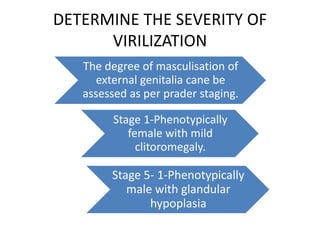
DETERMINE THE SEVERITY OF
VIRILIZATION
The degree of masculisation of
external genitalia cane be
assessed as per prader staging.
Stage 1-Phenotypically
female with mild
clitoromegaly.
Stage 5- 1-Phenotypically
male with glandular
hypoplasia
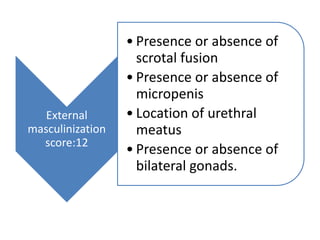
External
masculinization
score:12
• Presence or absence of
scrotal fusion
• Presence or absence of
micropenis
• Location of urethral
meatus
• Presence or absence of
bilateral gonads.
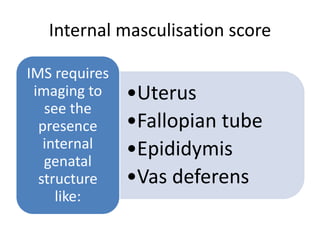
Internal masculisation score
•Uterus
•Fallopian tube
•Epididymis
•Vas deferens
IMS requires
imaging to
see the
presence
internal
genatal
structure
like:
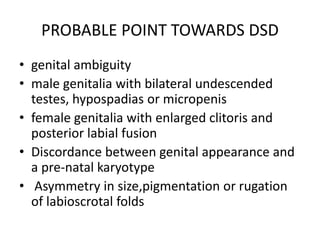
PROBABLE POINT TOWARDS DSD
• genital ambiguity
• male genitalia with bilateral undescended
testes, hypospadias or micropenis
• female genitalia with enlarged clitoris and
posterior labial fusion
• Discordance between genital appearance and
a pre-natal karyotype
• Asymmetry in size,pigmentation or rugation
of labioscrotal folds
First line investigation
1. Serum electrolytes
2. Random blood sugar
3. Karyotyping/fish/pcr
4. Ultrasound for look for mullerian structures
and gonad
5. Serum 17-hydroxyprogesterone(17-OHP)
Interpretation of 17 OHP
1. Unaffected neonatal concentration:<15
nmol/L
2. In 21 hydroxylase deficiency:>300-800 nmo/L
3. Non-classical CAH:15-51 nmol/L
4. In 11-beta hydroxylase and 3 beta
hydroxysteroid dehydrogenase
deficiency:modest increase (15-100nmol/L)
SECOND LINE INVESTIGATION
1. Serum testosterone,dihydrotestosterone,
FSH,LH
2. Serum 11 deoxycortisol
3. Antimullerian hormone
4. HCG stimulation test
5. Genitogram and laproscopy
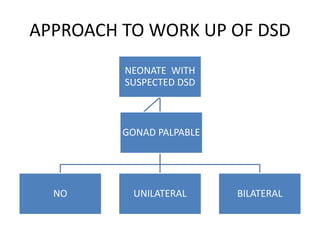
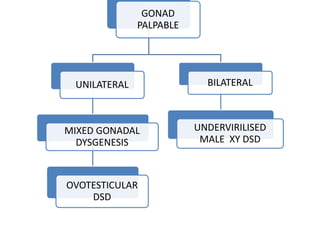
APPROACH TO WORK UP OF DSD
NEONATE WITH
SUSPECTED DSD
NO UNILATERAL BILATERAL
GONAD PALPABLE
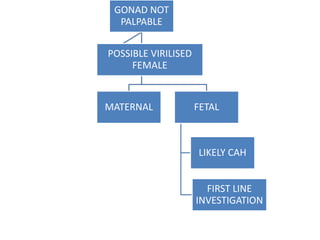
GONAD NOT
PALPABLE
MATERNAL FETAL
LIKELY CAH
FIRST LINE
INVESTIGATION
POSSIBLE VIRILISED
FEMALE
GONAD
PALPABLE
UNILATERAL
MIXED GONADAL
DYSGENESIS
OVOTESTICULAR
DSD
BILATERAL
UNDERVIRILISED
MALE XY DSD
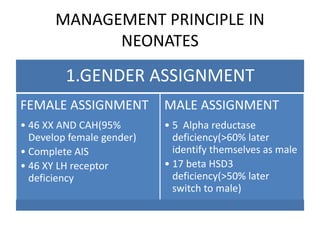
MANAGEMENT PRINCIPLE IN
NEONATES
1.GENDER ASSIGNMENT
FEMALE ASSIGNMENT
• 46 XX AND CAH(95%
Develop female gender)
• Complete AIS
• 46 XY LH receptor
deficiency
MALE ASSIGNMENT
• 5 Alpha reductase
deficiency(>60% later
identify themselves as male
• 17 beta HSD3
deficiency(>50% later
switch to male)
2.MEDICAL MANAGEMENT
• Neonate with CAH as a cause of DSD need
rouitine and emergency medical management
to be a stable.
• Neonate present as medical emergency either
whithin first week of life, its also precipitated
by intercurrent illness like sepsis,diarrhea,
vomiting.
Management of adrenal crisis
• Features of adrenal or salt crisis
1. Shock
2. Hypoglycemia
3. Hyponatremia
4. Hyperkalemia
5. Metabolic acidosis
Shock and dyselectrolytemia
• Normal saline bolus should be administered
• Salt loss replaced initially with intravenous
normal saline with glucose
• Sodium requirement 8 meq/kg/day
• Fluid are continued till the neonate is stable
Steroid supplementation
• Hydrocortisone at 50 -100 mg/m/day at 8
hourly till 48- 72 hours,when neonate become
stable.
• Maintenance dose of Hydrocortisone 10-15
mg/m/day and fludrocortisone 0.1 to 0.2 mg
per day.
• Fludrocortisone is not needed when
Hydrocortisone dose >50 mg/m/day
Definitive treatment
1. Hormonal treatment
Testosterone in case of microphallus
Pubertal estrogen and progestin in female
gender
2. Surgical option
Surgical correction may be required for
chordee,orchidopexy and hypospadias.
REFERENCES

dsd 1.pptx

  • 1.
    APPROACH TO DISORDERSOF SEXUAL DIFFERENTIATION Dr.Lakshit Bhalala First Year Resident Department of Paediatrics Guide by : Dr. Hardik Shah Assistant Professor
  • 2.
    INTRODUCTION • The newborninfant with ambiguous external genitalia often comes as a surprise for the doctors as well as the parents and is sometimes described as an endocrine emergency situation presenting a problem of sex assignment. • The nomenclature such as ‘intersex’, ‘hermaphrodite’, and ‘pseudohermaphrodite’ is out of date as well as confusing.
  • 3.
    The Chicago Consensusheld in 2005 recommended new terminology based on the umbrella term disorders of sex differentiation (DSDs). The evaluation and management of DSDs is complex, and a multidisciplinary team approach  including a pediatric urologist, a psychiatrist, and a pediatric endocrinologist is required for optimal management.
  • 4.
    DEFINITION DSDs are definedas congenital conditions associated with atypical development of chromosomal, gonadal, or anatomical sex.
  • 5.
    INCIDENCE • overall incidenceof DSDs is one in 5,500 • The incidence of CAH: 1:15,000
  • 6.
    • The mostcommon causes of ambiguous genitalia :Congenital adrenal hyperplasia (CAH) • Constituting approximately over 50% of all cases of genital ambiguity in the newborn period .
  • 7.
    ESSENTIAL FEATURES OFNORMAL FEMALE GENITALIA IN A NEWBORN  Vaginal opening Fully Visible 3 to 4 mm Slit OR Stellate Orifice With Heaped Up Mucosa.  Clitoris Width 2 to 6mm  Absence Of Gonads in Labia Majora Or Inguinal Region
  • 8.
    ESSENTIAL FEATURES OFNORMAL MALE GENITALIA IN A NEWBORN Urethra at the tip of glans Penis of normal stretched length(2.5-5cm) and Diameter (0.9-1.3 cm). Bilateral testes of normal size(8-14mm) in scrotal sac
  • 9.
    NOMENCLATURE AND CLASSIFICATIONOF DSD Previous Revised  Intersex Disorders of sex development (DSDs) Male pseudohermaphrodite Undervirilization of an XY male Undermasculinization of an XY male 46,XY DSD
  • 10.
    Female pseudohermaphrodite  Overvirilization ofan XX female Masculinization of an XX femal 46,XX DSD True hermaphrodite Ovotesticular DSD XX male or XX sex reversal 46,XX testicular DSD XY sex reversal 46,XY complete gonadal dysgenesis
  • 11.
    DSD classification proposedby the Chicago consensus 1. chromosomeDSD 2. 46,XY DSD 3. 46, XX DSD
  • 12.
    1.Sex chromosome DSD A.45,X (Turner syndrome and variants) B. 47,XXY (Klinefelter syndrome and variants) C. 45,X/46,XY(mixed gonadaldysgenesis, ovotesticular DSD) D. 46,XX/46,XY (chimeric,ovotesticular DSD
  • 13.
    2.46,XY DSD 1. Disordersof gonadal development 2. Disorders in androgen synthesis or action 3. OTHER (A)severe hypospadias (B)cloacalextrophy
  • 14.
    Disorders of gonadal(testicular) development • Complete gonadal dysgenesis (Swyer syndrome) • Partial gonadal dysgenesis • Gonadal regression • Ovotesticular DSD
  • 15.
    Disorders in androgensynthesis or action A) Androgen biosynthesis defect: 1)17-hydroxysteroid dehydrogenase deficiency 2) 5α-reductase deficiency B) Defect in androgen action 1)complete androgen insensitivity syndrome 2)partial androgen insensitivity syndrome C) LH receptor defect(leydig cell hypoplasia) D)Disorder of AMH and AMH receptor
  • 16.
    3.46,XX DSD • Disordersof gonadal (ovarian) development • Androgen excess • OTHER :1) cloacalextrophy 2)Mullerian duct aplasia,renal aplasia and cervicothoracic somite dysplasia
  • 17.
    Disorders of gonadal(ovarian) development • Ovotesticular DSD • Testicular DSD (SRY+, dup SOX9 • Gonadal dysgenesis
  • 18.
    Androgen excess • Fetal(21- or 11-hydroxylase deficiency) • Fetoplacental : 1) Aromatase deficiency 2)Cytochrome P450 oxidoreductase(POR) • Maternal 1)luteoma 2) exogenous)
  • 19.
    APPROACH TO THEDIAGNOSIS • HISTORY • PHYSICAL EXAMINATION • PROBABLE POINT TOWARDS DSD
  • 20.
    HISTORY • A detailedhistory from the parents is needed that is especially focused on the following • Ambiguity • Hirsutism • Precocious puberty • Consanguinity • Amenorrhea • Infertility • Exogenous hormones
  • 21.
    PHYSICAL EXAMINATION • Historytaking should be combined with a general physical examination with special attention to the genital anatomy . • Any abnormal virilized or cushingoid appearance of the mother should be checked. • It is important to examine the groin and scrotal or labial folds to determine the presence of palpable gonads For differential diagnosis and treatment purposes.
  • 22.
    • A palpablegonad is highly suggestive of a testis or rarely an ovotestis, because the ovaries and streak gonad do not descend. • An abnormal phallic size should be noted by width and stretched length measurements. • Historically considered, phallus size was considered first in the 1960s when any child with a stretched penile length <2.5 cm was likely to be assigned as female regardless of the underlying diagnosis .
  • 23.
    • Through arectal exam, we can confirm the presence of a uterus and cervix. • Physical examination should be done in a warm room and the patient should be placed supine in the frog leg position. • It is important to note the size, location, and texture of both gonads, if palpable. • The undescended testis could be located in the inguinalcanal, the superficial inguinal pouch, at the upper scrotum, or rarely in the femoral, perineal, or contralateral scrotal regions.
  • 24.
    • The undescendedtestis could be located in the inguinalcanal, the superficial inguinal pouch, at the upper scrotum, or rarely in the femoral, perineal, or contralateral scrotal regions. • All examinations should be done in the presence of the parents, who should be informed exactly what will be done and why. • Medical photography requires sensitivity and consent.
  • 25.
    DETERMINE THE SEVERITYOF VIRILIZATION The degree of masculisation of external genitalia cane be assessed as per prader staging. Stage 1-Phenotypically female with mild clitoromegaly. Stage 5- 1-Phenotypically male with glandular hypoplasia
  • 26.
    External masculinization score:12 • Presence orabsence of scrotal fusion • Presence or absence of micropenis • Location of urethral meatus • Presence or absence of bilateral gonads.
  • 27.
    Internal masculisation score •Uterus •Fallopiantube •Epididymis •Vas deferens IMS requires imaging to see the presence internal genatal structure like:
  • 28.
    PROBABLE POINT TOWARDSDSD • genital ambiguity • male genitalia with bilateral undescended testes, hypospadias or micropenis • female genitalia with enlarged clitoris and posterior labial fusion • Discordance between genital appearance and a pre-natal karyotype • Asymmetry in size,pigmentation or rugation of labioscrotal folds
  • 29.
    First line investigation 1.Serum electrolytes 2. Random blood sugar 3. Karyotyping/fish/pcr 4. Ultrasound for look for mullerian structures and gonad 5. Serum 17-hydroxyprogesterone(17-OHP)
  • 30.
    Interpretation of 17OHP 1. Unaffected neonatal concentration:<15 nmol/L 2. In 21 hydroxylase deficiency:>300-800 nmo/L 3. Non-classical CAH:15-51 nmol/L 4. In 11-beta hydroxylase and 3 beta hydroxysteroid dehydrogenase deficiency:modest increase (15-100nmol/L)
  • 31.
    SECOND LINE INVESTIGATION 1.Serum testosterone,dihydrotestosterone, FSH,LH 2. Serum 11 deoxycortisol 3. Antimullerian hormone 4. HCG stimulation test 5. Genitogram and laproscopy
  • 32.
    APPROACH TO WORKUP OF DSD NEONATE WITH SUSPECTED DSD NO UNILATERAL BILATERAL GONAD PALPABLE
  • 33.
    GONAD NOT PALPABLE MATERNAL FETAL LIKELYCAH FIRST LINE INVESTIGATION POSSIBLE VIRILISED FEMALE
  • 34.
  • 35.
    MANAGEMENT PRINCIPLE IN NEONATES 1.GENDERASSIGNMENT FEMALE ASSIGNMENT • 46 XX AND CAH(95% Develop female gender) • Complete AIS • 46 XY LH receptor deficiency MALE ASSIGNMENT • 5 Alpha reductase deficiency(>60% later identify themselves as male • 17 beta HSD3 deficiency(>50% later switch to male)
  • 36.
    2.MEDICAL MANAGEMENT • Neonatewith CAH as a cause of DSD need rouitine and emergency medical management to be a stable. • Neonate present as medical emergency either whithin first week of life, its also precipitated by intercurrent illness like sepsis,diarrhea, vomiting.
  • 37.
    Management of adrenalcrisis • Features of adrenal or salt crisis 1. Shock 2. Hypoglycemia 3. Hyponatremia 4. Hyperkalemia 5. Metabolic acidosis
  • 38.
    Shock and dyselectrolytemia •Normal saline bolus should be administered • Salt loss replaced initially with intravenous normal saline with glucose • Sodium requirement 8 meq/kg/day • Fluid are continued till the neonate is stable
  • 39.
    Steroid supplementation • Hydrocortisoneat 50 -100 mg/m/day at 8 hourly till 48- 72 hours,when neonate become stable. • Maintenance dose of Hydrocortisone 10-15 mg/m/day and fludrocortisone 0.1 to 0.2 mg per day. • Fludrocortisone is not needed when Hydrocortisone dose >50 mg/m/day
  • 40.
    Definitive treatment 1. Hormonaltreatment Testosterone in case of microphallus Pubertal estrogen and progestin in female gender 2. Surgical option Surgical correction may be required for chordee,orchidopexy and hypospadias.
  • 41.