Approximating Context-Free Grammar Ambiguity Claus Brabrand [email_address] BRICS, Department of Computer Science University of Aarhus, Denmark
// Abstract “ Approximating Context-Free Grammar Ambiguity” Context-free grammar ambiguity is undecidable. However, just because it’s undecidable, doesn’t mean there aren’t (good) approximations!  Indeed, the whole area of static analysis works on  “side-stepping   undecidability” . We exhibit a characterization of context-free ambiguity which induces a whole framework for approximating the problem. In particular, we give an approximation, A MN , based on the [Mohri-Nederhof, 2000] regular approximation of context-free grammars and show how to boost the precision even further.
// Outline Introduction Vertical / Horizontal Ambiguity Characterization of Ambiguity (Over-)Approximation Framework Approximation (A MN ) Assessment Related Work Conclusion
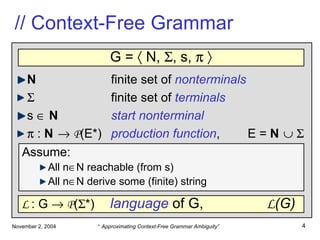
// Context-Free Grammar N finite set of  nonterminals    finite set of  terminals s     N start nonterminal    :  N      P (E*) production function ,  E =  N         G =    N,   , s,      Assume : All n  N reachable (from s) All n  N derive some (finite) string L  : G     P (  *)   language  of G,  L (G)
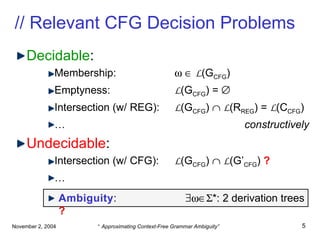
// Relevant CFG Decision Problems Decidable : Membership:       L (G CFG ) Emptyness: L (G CFG ) =   Intersection (w/ REG): L (G CFG )     L (R REG )  =  L (C CFG )   …   constructively Undecidable : Intersection (w/ CFG): L (G CFG )     L (G’ CFG )  ? … Ambiguity :     *: 2 derivation trees   ?
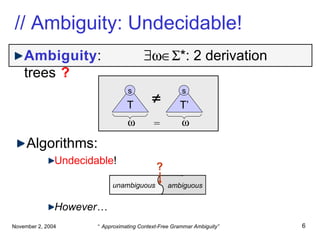
// Ambiguity: Undecidable! Algorithms: Undecidable ! However…  T s  T’ s  = unambiguous  ambiguous Ambiguity :    *: 2 derivation trees   ? ?
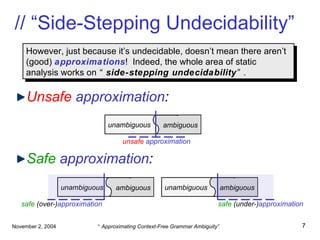
// “Side-Stepping Undecidability” Unsafe   approximation : Safe   approximation : However, just because it’s undecidable, doesn’t mean there aren’t (good)  approximations !  Indeed, the whole area of static analysis works on  “ side-stepping   undecidability ” . unambiguous  ambiguous safe   (over-) approximation unambiguous  ambiguous safe   (under-) approximation unambiguous  ambiguous unsafe  approximation
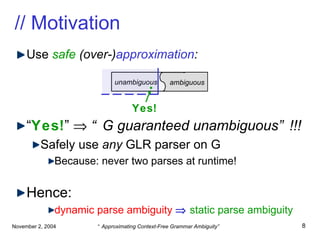
// Motivation Use  safe   (over-) approximation : “ Yes! ”     “G guaranteed unambiguous”!!! Safely use  any  GLR parser on G Because: never two parses at runtime! Hence: dynamic parse ambiguity      static parse ambiguity unambiguous  ambiguous Yes! .
// Motivation (cont’d) Undecidability means:  “there’ll always be a  slack ”: However, still useful! Possible  interpretations  of “ No? ”: Treat as  error  (reject grammar): “ Please redesign your grammar”  (as in [LA]LR(k)) Treat as  warning : “ Here are some potential problems” unambiguous  ambiguous No? . .
// Vertical Ambiguity “ Vertical ambiguity” : Example:  n     N  :   ,   ’      (n) :         ’     L (  )     L (  ’) =   x a y Z  :  x  A  y :  x  B  y  A  :  a B  :  a Ambiguous string: ~ “ reduce/reduce conflict ”  in [Yacc]  G
// Horizontal Ambiguity “ Horizontal ambiguity” : where: Example:  n     N :         (n):   i    [1..|  |-1]:  L (  0  ..   i-1 )  L (  i  ..   |  |-1  ) =   :  P (  *)     P (  *)     P (  *)  X  Y  =  { x a y | x,y  *     a  +    x,x a  L (X)    y, a y  L (Y) } x a y Z  :  A B  A  :  x  a :  x B  :  a  y :  y Ambiguous string: ~ “ shift/reduce conflict ”  in [Yacc]  G      
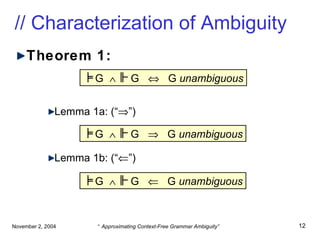
// Characterization of Ambiguity Theorem 1: Lemma 1a: (“  ”) Lemma 1b: (“  ”) G     G     G  unambiguous G     G     G  unambiguous G     G     G  unambiguous
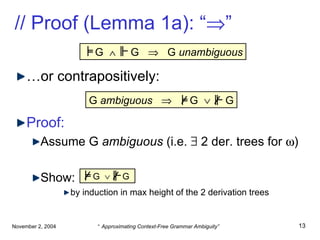
// Proof (Lemma 1a): “  ” … or contrapositively: Proof: Assume G  ambiguous  (i.e.    2 der. trees for   ) Show:  by induction in max height of the 2 derivation trees G     G     G  unambiguous G  ambiguous     G     G G     G
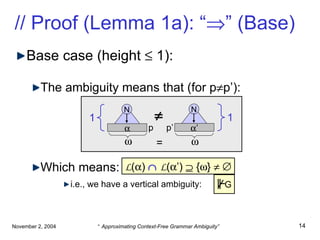
// Proof (Lemma 1a): “  ” (Base) Base case (height    1): The ambiguity means that  (for p  p’) : Which means: i.e., we have a vertical ambiguity: N  ’ 1  N  1   L (  )     L (  ’)    {  }      p p’ = G
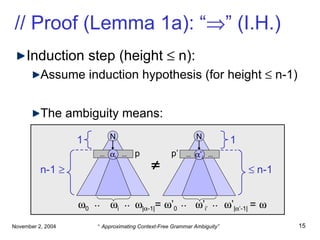
// Proof (Lemma 1a): “  ” (I.H.) Induction step (height    n): Assume induction hypothesis (for height    n-1) The ambiguity means: N n-1     N    n-1  i  ’ i’ …  …  i …  …  ’ i’ p p’ 1 1  |  -1| =   ’ 0  ’ |  ’-1|  0 .. .. .. ..  =  
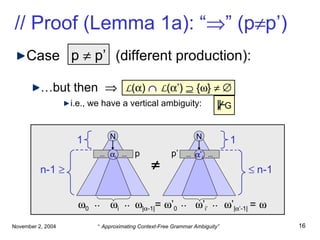
// Proof (Lemma 1a): “  ” (p  p’) Case  p = q  (different production): … but then   i.e., we have a vertical ambiguity: L (  )     L (  ’)    {  }      p    p’ G N n-1     N    n-1  i  ’ i’ …  …  i …  …  ’ i’ p p’ 1 1  |  -1| =   ’ 0  ’ |  ’-1|  0 .. .. .. ..  =  
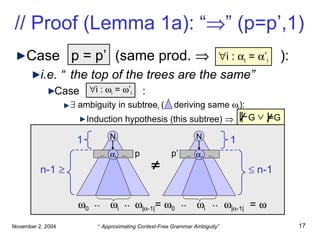
// Proof (Lemma 1a): “  ” (p=p’,1) Case  p    q  (same prod.     ): i.e. “the top of the trees are the same” Case :     ambiguity in subtree i  (  deriving same   i ): Induction hypothesis (this subtree)    i :   i  =   ’ i p = p’  i :   i  =   ’ i  N n-1     N    n-1  i  i …  …  i …  …  i’ p p’ 1 1  |  -1| =   0  |  -1|  0 .. .. .. ..  =   G G
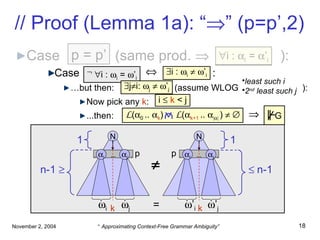
// Proof (Lemma 1a): “  ” (p=p’,2) Case  p    q  (same prod.     ): Case    : … but then: (assume WLOG  ): Now pick any  k : ...then: N n-1     N    n-1  i .   …  .  i p  i :   i       ’ i p = p’ p 1 1  i :   i  =   ’ i     i :   i  =   ’ i   j  i:   j       ’ j =   j  j  ’ i .   …  .  i  j  ’ j i     k  < j L (  0  ..   k )  L (  k+1  ..   |  |  )       k k least such i 2 nd  least such j G  
// Proof (Lemma 1b): “  ” Contrapositively: Assume “  ”  (vertical conflict) : Then for some N  N : But then derive  (using reachability + derivability of N) : s   * x N       x         * x  a       * x  a  y s   * x N       x   ’       * x  a       * x  a  y N         *  a , N      ’   *  a ,  L (  )     L (  ’ )    { a }      G     G     G  unambiguous G  ambiguous     G     G
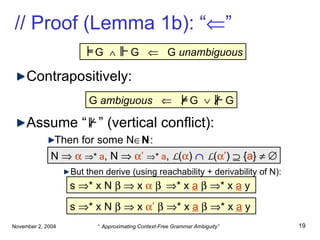
// Proof (Lemma 1b): “  ” (cont’d) Assume “  ”  (horizontal conflict) : Then for some N  N : But then derive  (using reachability + derivability of N) : s   * v N       v            * v x         * v x  a   y       * v x  a   y  w s   * v N       v            * v  x   a          * v  x   a  y      * v  x   a  y w N          ,  L (  )  L (  )       x,y      * :   a       +  : x,x a      L (  )    y, a y     L (  ) i.e.  
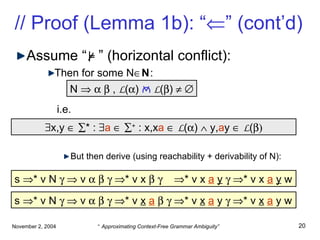
// (Over-)Approximation (A) (Over-)Approximation   A  : E*     P (  *) A   decidable     “  ” and “  ” decidable on co-dom( A ) Approximated  vertical ambiguity: Approximated  horizontal ambiguity:       E* :   L (  )     A (  )   n    N :   ,   ’      (n) :  A (  )     A (  ’) =   A A  n    N:         (n):   i    [1..|  |-1]:  A (  0  ..   i-1 )  A (  i  ..   |  |-1 ) =    G G    
// Ambiguity Approximation Theorem 2: Proof : “ Conflicts w/ smaller sets    conflicts w/ larger sets”:       G  unambiguous A (  )     A (  ) =        L (  )     L (  ) =   A (  )  A (  ) =        L (  )  L (  ) =   A A          A A G G G G G G    
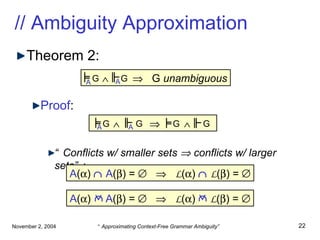
// Compositionality (of A’s) Colloary 3: Proof: Follows from definition [omited…] i.e. “Approximations are  compositional ”!: A ,  A’   decidable  (over-)approximations     A    A’ decidable  (over-)approximation unambiguous  ambiguous unambiguous  ambiguous unambiguous  ambiguous A A’ A      A’ 
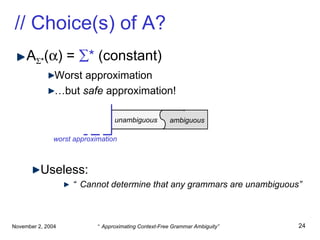
// Choice(s) of A? A  * (  ) =   *  (constant) Worst approximation … but  safe  approximation! Useless: “ Cannot determine that any grammars are unambiguous” unambiguous  ambiguous worst approximation
// Choice(s) of A? (cont’d) A MN (  ) =  [Mohri-Nederhof](  ) CFG    DFA (NFA) Approximation Properties of this “  Black-box  ”: Good (over-)approximation! Works on  language ,  L (G); not  on  grammatical structure , G Approximation  parameterizable : E.g. unfold nonterminals “n” times “ Regular Approximation of Context-Free Grammars through Transformation” [Mohri-Nederhof, 2000] Black-box
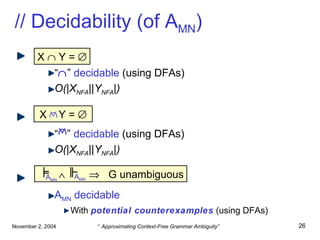
// Decidability (of A MN ) “  ”   decidable  (using DFAs) O(|X NFA ||Y NFA |) “   ”   decidable  (using DFAs) O(|X NFA ||Y NFA |) A MN  decidable With  potential counterexamples  (using DFAs) X    Y =   X  Y =         G unambiguous A MN A MN    
For X,Y regular languages: All  overlappings,   “x a y”,   as DFAs;  variant of  “  ”  construction! // Decision Algorithm for (X  Y)  X NFA Y NFA [X;Y] NFA     a     path :  X NFA Y NFA [X;Y] NFA a a x y x a y a a X Y Y X X    Y   
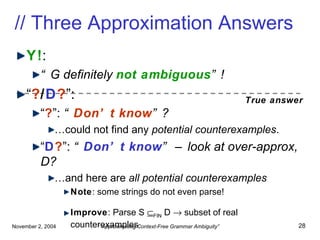
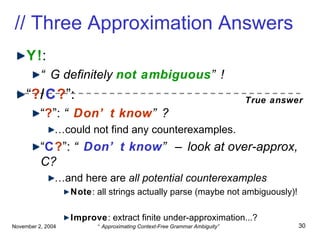
// Three Approximation Answers Y! : “ G definitely  not ambiguous ”! “ ? / D ? ”: “ ? ”:  “ Don’t know ”? … could not find any  potential counterexamples . “ D ? ”:  “ Don’t know ” – look at over-approx, D? … and here are  all potential   counterexamples Note : some strings do not even parse! Improve : Parse S   FIN  D    subset of real counterexamples True answer
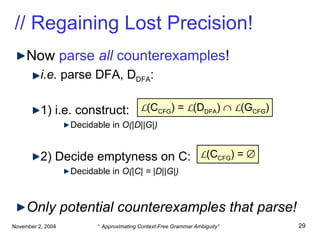
// Regaining Lost Precision! Now  parse  all  counterexamples !   i.e.  parse DFA, D DFA : 1) i.e. construct: Decidable in  O(|D||G|) 2) Decide emptyness on C: Decidable in  O(|C| = |D||G|) Only potential counterexamples that parse! L (C CFG ) =  L (D DFA )     L (G CFG ) L (C CFG ) =  
// Three Approximation Answers Y! : “ G definitely  not ambiguous ”! “ ? / C ? ”: “ ? ”:  “ Don’t know ”? … could not find any counterexamples. “ C ? ”:  “ Don’t know ” – look at over-approx, C? … and here are  all potential   counterexamples Note : all strings actually parse (maybe not ambiguously)! Improve : extract finite under-approximation...? True answer
[Mohri-Nederhof]:   O(n 2 vh) Vertical Amb:   O(n 3 v 4 h 4 ) Horizontal Amb:   O(n 3 v 3 h 5 ) Total:   O(n 3 v 3 h 4 (v+h))    O(g 5 ) // Asymptotic (Time) Complexity N 1   : e 1,1  … e a,1 : … : e 1,p  … e a,p h n v n  = | N | v  = max{|  (N)|, N  N } h  = max{|  |,   (N), N  N } g  =  nvh  = |G|
// Related Work (Dynamic) Dynamic disambiguation : “ Disambiguation-by-convention”: Longest match, most specific match, … Customizable: [Bison v. 1.5+]:  %dprec ,  %merge [ASF+SDF]: “disambiguation filters” Dynamic ambiguity interception : GLR ([Tomita], [Early], [Bison], [ASF+SDF], …)
// Related Work (Static) Static disambiguation : “ Disambiguation-by-convention”: First match, most specific match, … Customizable: [Yacc]:  %left ,  %right ,  %nonassoc ,  %prec Static ambiguity interception : LL(k), [LA-]LR(k), … Our work goes here (but for GLR)!
// Implementation disamb  (Java) In progress…!
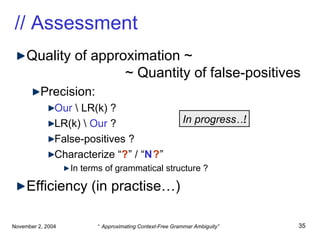
// Assessment Quality of approximation ~   ~ Quantity of false-positives  Precision: Our  \ LR(k) ? LR(k) \  Our  ? False-positives ? Characterize “ ? ” / “ N ? ” In terms of grammatical structure ? Efficiency (in practise…) In progress…!
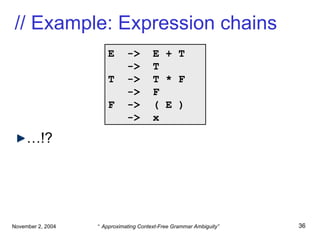
// Example: Expression chains … !? E  ->  E + T ->  T T  ->  T * F ->  F F  ->  ( E ) ->  x
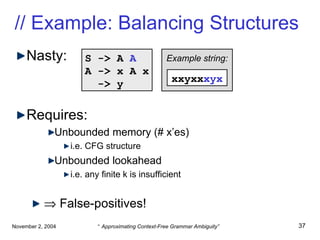
// Example: Balancing Structures Nasty: Requires: Unbounded memory (# x’es) i.e. CFG structure Unbounded lookahead i.e. any finite k is insufficient    False-positives! S -> A  A A -> x A x -> y xxyxx xyx Example string:
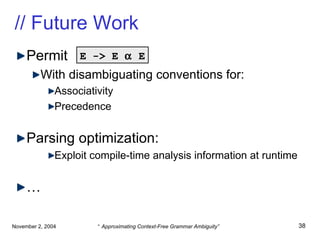
// Future Work Permit With disambiguating conventions for: Associativity Precedence Parsing optimization: Exploit compile-time analysis information at runtime … E -> E    E
// Conclusion But wait, there’s more… “ Approximating Context-Free Grammar Ambiguity” Context-free grammar ambiguity is undecidable. However, just because it’s undecidable, doesn’t mean there aren’t (good) approximations!  Indeed, the whole area of static analysis works on  “side-stepping   undecidability” . We exhibit a characterization of context-free ambiguity which induces a whole framework for (over-)approximation. In particular, we give an approximation based on the [Mohri-Nederhof, 2000] regular approximation of context-free grammars and show how to boost the precision even further.
// Lessons Learned Framework: Plug in your favorite (over-)approximation of  L (  ) Even take intersection of them: A =   i  A i Approximation closed under intersection Methodology: Just because it’s undecidable doesn’t mean there aren’t (good) approximations Quantity of false-positives (practically motivated) What to do with false-positives (pratically motivated) Don’t be scared of undecidability
[bonus slides]
// Membership: Decidable! Membership (aka.  “parsing” ): Given         * : “ Is the string,   , in the language of G”: Algorithms: LL(k) O(|  |) [LA-]LR(k) O(|  |) GLR  O(|  | 3 ) …       L (G)
The ambiguity problem for [X;Y]... In fact, already a problem if x’ “goes too far”: Thus, we only have a problem if  (“X eats into Y”): Essentially disambiguation by picking longest match // Parsing Greedily Left-to-Right x   y   x’   y’   x   y   - (“too little”):  Not possible (due to greediness) ... may occur in 2 cases: - (“too much”): Only this is a problem!    X     X;( prefix(Y) \ {  } )         X  Y   x’   y’

Ambiguity Pilambda

  • 1.
    Approximating Context-Free GrammarAmbiguity Claus Brabrand [email_address] BRICS, Department of Computer Science University of Aarhus, Denmark
  • 2.
    // Abstract “Approximating Context-Free Grammar Ambiguity” Context-free grammar ambiguity is undecidable. However, just because it’s undecidable, doesn’t mean there aren’t (good) approximations! Indeed, the whole area of static analysis works on “side-stepping undecidability” . We exhibit a characterization of context-free ambiguity which induces a whole framework for approximating the problem. In particular, we give an approximation, A MN , based on the [Mohri-Nederhof, 2000] regular approximation of context-free grammars and show how to boost the precision even further.
  • 3.
    // Outline IntroductionVertical / Horizontal Ambiguity Characterization of Ambiguity (Over-)Approximation Framework Approximation (A MN ) Assessment Related Work Conclusion
  • 4.
    // Context-Free GrammarN finite set of nonterminals  finite set of terminals s  N start nonterminal  : N  P (E*) production function , E = N   G =  N,  , s,   Assume : All n  N reachable (from s) All n  N derive some (finite) string L : G  P (  *) language of G, L (G)
  • 5.
    // Relevant CFGDecision Problems Decidable : Membership:   L (G CFG ) Emptyness: L (G CFG ) =  Intersection (w/ REG): L (G CFG )  L (R REG ) = L (C CFG ) … constructively Undecidable : Intersection (w/ CFG): L (G CFG )  L (G’ CFG ) ? … Ambiguity :  *: 2 derivation trees ?
  • 6.
    // Ambiguity: Undecidable!Algorithms: Undecidable ! However…  T s  T’ s  = unambiguous ambiguous Ambiguity :  *: 2 derivation trees ? ?
  • 7.
    // “Side-Stepping Undecidability”Unsafe approximation : Safe approximation : However, just because it’s undecidable, doesn’t mean there aren’t (good) approximations ! Indeed, the whole area of static analysis works on “ side-stepping undecidability ” . unambiguous ambiguous safe (over-) approximation unambiguous ambiguous safe (under-) approximation unambiguous ambiguous unsafe approximation
  • 8.
    // Motivation Use safe (over-) approximation : “ Yes! ”  “G guaranteed unambiguous”!!! Safely use any GLR parser on G Because: never two parses at runtime! Hence: dynamic parse ambiguity  static parse ambiguity unambiguous ambiguous Yes! .
  • 9.
    // Motivation (cont’d)Undecidability means: “there’ll always be a slack ”: However, still useful! Possible interpretations of “ No? ”: Treat as error (reject grammar): “ Please redesign your grammar” (as in [LA]LR(k)) Treat as warning : “ Here are some potential problems” unambiguous ambiguous No? . .
  • 10.
    // Vertical Ambiguity“ Vertical ambiguity” : Example:  n  N :  ,  ’   (n) :    ’  L (  )  L (  ’) =  x a y Z : x A y : x B y A : a B : a Ambiguous string: ~ “ reduce/reduce conflict ” in [Yacc]  G
  • 11.
    // Horizontal Ambiguity“ Horizontal ambiguity” : where: Example:  n  N :    (n):  i  [1..|  |-1]: L (  0 ..  i-1 ) L (  i ..  |  |-1 ) =  : P (  *)  P (  *)  P (  *) X Y = { x a y | x,y  *  a  +  x,x a  L (X)  y, a y  L (Y) } x a y Z : A B A : x a : x B : a y : y Ambiguous string: ~ “ shift/reduce conflict ” in [Yacc]  G      
  • 12.
    // Characterization ofAmbiguity Theorem 1: Lemma 1a: (“  ”) Lemma 1b: (“  ”) G  G  G unambiguous G  G  G unambiguous G  G  G unambiguous
  • 13.
    // Proof (Lemma1a): “  ” … or contrapositively: Proof: Assume G ambiguous (i.e.  2 der. trees for  ) Show: by induction in max height of the 2 derivation trees G  G  G unambiguous G ambiguous  G  G G  G
  • 14.
    // Proof (Lemma1a): “  ” (Base) Base case (height  1): The ambiguity means that (for p  p’) : Which means: i.e., we have a vertical ambiguity: N  ’ 1  N  1   L (  )  L (  ’)  {  }   p p’ = G
  • 15.
    // Proof (Lemma1a): “  ” (I.H.) Induction step (height  n): Assume induction hypothesis (for height  n-1) The ambiguity means: N n-1  N  n-1  i  ’ i’ … …  i … …  ’ i’ p p’ 1 1  |  -1| =  ’ 0  ’ |  ’-1|  0 .. .. .. ..  = 
  • 16.
    // Proof (Lemma1a): “  ” (p  p’) Case p = q (different production): … but then  i.e., we have a vertical ambiguity: L (  )  L (  ’)  {  }   p  p’ G N n-1  N  n-1  i  ’ i’ … …  i … …  ’ i’ p p’ 1 1  |  -1| =  ’ 0  ’ |  ’-1|  0 .. .. .. ..  = 
  • 17.
    // Proof (Lemma1a): “  ” (p=p’,1) Case p  q (same prod.  ): i.e. “the top of the trees are the same” Case :  ambiguity in subtree i ( deriving same  i ): Induction hypothesis (this subtree)   i :  i =  ’ i p = p’  i :  i =  ’ i  N n-1  N  n-1  i  i … …  i … …  i’ p p’ 1 1  |  -1| =  0  |  -1|  0 .. .. .. ..  =  G G
  • 18.
    // Proof (Lemma1a): “  ” (p=p’,2) Case p  q (same prod.  ): Case : … but then: (assume WLOG ): Now pick any k : ...then: N n-1  N  n-1  i . … .  i p  i :  i   ’ i p = p’ p 1 1  i :  i =  ’ i   i :  i =  ’ i   j  i:  j   ’ j =   j  j  ’ i . … .  i  j  ’ j i  k < j L (  0 ..  k ) L (  k+1 ..  |  | )    k k least such i 2 nd least such j G  
  • 19.
    // Proof (Lemma1b): “  ” Contrapositively: Assume “ ” (vertical conflict) : Then for some N  N : But then derive (using reachability + derivability of N) : s  * x N   x    * x a   * x a y s  * x N   x  ’   * x a   * x a y N    * a , N   ’  * a , L (  )  L (  ’ )  { a }   G  G  G unambiguous G ambiguous  G  G
  • 20.
    // Proof (Lemma1b): “  ” (cont’d) Assume “ ” (horizontal conflict) : Then for some N  N : But then derive (using reachability + derivability of N) : s  * v N   v     * v x    * v x a y   * v x a y w s  * v N   v     * v x a    * v x a y   * v x a y w N    , L (  ) L (  )    x,y   * :  a   + : x,x a  L (  )  y, a y  L (  ) i.e.  
  • 21.
    // (Over-)Approximation (A)(Over-)Approximation A : E*  P (  *) A decidable  “ ” and “ ” decidable on co-dom( A ) Approximated vertical ambiguity: Approximated horizontal ambiguity:   E* : L (  )  A (  )  n  N :  ,  ’   (n) : A (  )  A (  ’) =  A A  n  N:    (n):  i  [1..|  |-1]: A (  0 ..  i-1 ) A (  i ..  |  |-1 ) =   G G    
  • 22.
    // Ambiguity ApproximationTheorem 2: Proof : “ Conflicts w/ smaller sets  conflicts w/ larger sets”:   G unambiguous A (  )  A (  ) =   L (  )  L (  ) =  A (  ) A (  ) =   L (  ) L (  ) =  A A    A A G G G G G G    
  • 23.
    // Compositionality (ofA’s) Colloary 3: Proof: Follows from definition [omited…] i.e. “Approximations are compositional ”!: A , A’ decidable (over-)approximations  A  A’ decidable (over-)approximation unambiguous ambiguous unambiguous ambiguous unambiguous ambiguous A A’ A  A’ 
  • 24.
    // Choice(s) ofA? A  * (  ) =  * (constant) Worst approximation … but safe approximation! Useless: “ Cannot determine that any grammars are unambiguous” unambiguous ambiguous worst approximation
  • 25.
    // Choice(s) ofA? (cont’d) A MN (  ) = [Mohri-Nederhof](  ) CFG  DFA (NFA) Approximation Properties of this “ Black-box ”: Good (over-)approximation! Works on language , L (G); not on grammatical structure , G Approximation parameterizable : E.g. unfold nonterminals “n” times “ Regular Approximation of Context-Free Grammars through Transformation” [Mohri-Nederhof, 2000] Black-box
  • 26.
    // Decidability (ofA MN ) “  ” decidable (using DFAs) O(|X NFA ||Y NFA |) “ ” decidable (using DFAs) O(|X NFA ||Y NFA |) A MN decidable With potential counterexamples (using DFAs) X  Y =  X Y =    G unambiguous A MN A MN    
  • 27.
    For X,Y regularlanguages: All overlappings, “x a y”, as DFAs; variant of “  ” construction! // Decision Algorithm for (X Y)  X NFA Y NFA [X;Y] NFA   a  path : X NFA Y NFA [X;Y] NFA a a x y x a y a a X Y Y X X  Y   
  • 28.
    // Three ApproximationAnswers Y! : “ G definitely not ambiguous ”! “ ? / D ? ”: “ ? ”: “ Don’t know ”? … could not find any potential counterexamples . “ D ? ”: “ Don’t know ” – look at over-approx, D? … and here are all potential counterexamples Note : some strings do not even parse! Improve : Parse S  FIN D  subset of real counterexamples True answer
  • 29.
    // Regaining LostPrecision! Now parse all counterexamples ! i.e. parse DFA, D DFA : 1) i.e. construct: Decidable in O(|D||G|) 2) Decide emptyness on C: Decidable in O(|C| = |D||G|) Only potential counterexamples that parse! L (C CFG ) = L (D DFA )  L (G CFG ) L (C CFG ) = 
  • 30.
    // Three ApproximationAnswers Y! : “ G definitely not ambiguous ”! “ ? / C ? ”: “ ? ”: “ Don’t know ”? … could not find any counterexamples. “ C ? ”: “ Don’t know ” – look at over-approx, C? … and here are all potential counterexamples Note : all strings actually parse (maybe not ambiguously)! Improve : extract finite under-approximation...? True answer
  • 31.
    [Mohri-Nederhof]: O(n 2 vh) Vertical Amb: O(n 3 v 4 h 4 ) Horizontal Amb: O(n 3 v 3 h 5 ) Total: O(n 3 v 3 h 4 (v+h))  O(g 5 ) // Asymptotic (Time) Complexity N 1 : e 1,1 … e a,1 : … : e 1,p … e a,p h n v n = | N | v = max{|  (N)|, N  N } h = max{|  |,  (N), N  N } g = nvh = |G|
  • 32.
    // Related Work(Dynamic) Dynamic disambiguation : “ Disambiguation-by-convention”: Longest match, most specific match, … Customizable: [Bison v. 1.5+]: %dprec , %merge [ASF+SDF]: “disambiguation filters” Dynamic ambiguity interception : GLR ([Tomita], [Early], [Bison], [ASF+SDF], …)
  • 33.
    // Related Work(Static) Static disambiguation : “ Disambiguation-by-convention”: First match, most specific match, … Customizable: [Yacc]: %left , %right , %nonassoc , %prec Static ambiguity interception : LL(k), [LA-]LR(k), … Our work goes here (but for GLR)!
  • 34.
    // Implementation disamb (Java) In progress…!
  • 35.
    // Assessment Qualityof approximation ~ ~ Quantity of false-positives Precision: Our \ LR(k) ? LR(k) \ Our ? False-positives ? Characterize “ ? ” / “ N ? ” In terms of grammatical structure ? Efficiency (in practise…) In progress…!
  • 36.
    // Example: Expressionchains … !? E -> E + T -> T T -> T * F -> F F -> ( E ) -> x
  • 37.
    // Example: BalancingStructures Nasty: Requires: Unbounded memory (# x’es) i.e. CFG structure Unbounded lookahead i.e. any finite k is insufficient  False-positives! S -> A A A -> x A x -> y xxyxx xyx Example string:
  • 38.
    // Future WorkPermit With disambiguating conventions for: Associativity Precedence Parsing optimization: Exploit compile-time analysis information at runtime … E -> E  E
  • 39.
    // Conclusion Butwait, there’s more… “ Approximating Context-Free Grammar Ambiguity” Context-free grammar ambiguity is undecidable. However, just because it’s undecidable, doesn’t mean there aren’t (good) approximations! Indeed, the whole area of static analysis works on “side-stepping undecidability” . We exhibit a characterization of context-free ambiguity which induces a whole framework for (over-)approximation. In particular, we give an approximation based on the [Mohri-Nederhof, 2000] regular approximation of context-free grammars and show how to boost the precision even further.
  • 40.
    // Lessons LearnedFramework: Plug in your favorite (over-)approximation of L (  ) Even take intersection of them: A =  i A i Approximation closed under intersection Methodology: Just because it’s undecidable doesn’t mean there aren’t (good) approximations Quantity of false-positives (practically motivated) What to do with false-positives (pratically motivated) Don’t be scared of undecidability
  • 41.
  • 42.
    // Membership: Decidable!Membership (aka. “parsing” ): Given    * : “ Is the string,  , in the language of G”: Algorithms: LL(k) O(|  |) [LA-]LR(k) O(|  |) GLR O(|  | 3 ) …   L (G)
  • 43.
    The ambiguity problemfor [X;Y]... In fact, already a problem if x’ “goes too far”: Thus, we only have a problem if (“X eats into Y”): Essentially disambiguation by picking longest match // Parsing Greedily Left-to-Right x y x’ y’ x y - (“too little”): Not possible (due to greediness) ... may occur in 2 cases: - (“too much”): Only this is a problem!  X  X;( prefix(Y) \ {  } )    X Y  x’ y’