STATE OF TEXAS ASSESSMENTS
   OF ACADEMIC READINESS
          (STAARTM)

        English I, II, and III
        Reading and Writing
Victoria Young
Director of Reading, Writing, and
Social Studies Assessments
Texas Education Agency
English I, II, and III Writing
2


    Revision and editing assessed in separate
    sections of the test and equally
    emphasized—each section worth 24% of
    total test score
      Broader measure of writing for each
      course by requiring students to write
      two compositions addressing different
      purposes
      English I−literary and expository
      English II−expository and persuasive
      English III−persuasive and analytical
English I, II, and III Writing
3


    Essays weighted equally—each 26% of
    total writing score
    One page—a maximum of 26 lines for
    each composition (25 “light lines” plus
    the heavy “border line” at the bottom of
    the writing space); no “double-lining”
    allowed
    No “gatekeeper” (no automatic fail of the
    writing test for receiving a score of 1 on
    a composition)
English I, II, and III Writing
4


    Make-up testing allowed
    Dictionary policy expanded
      students may use dictionaries on the
      entire test (multiple-choice section and
      compositions)
      types of allowable dictionaries now
      include bilingual and handheld non-
      internet-capable electronic dictionaries
    Field test: one prompt and either a
    revising or editing passage and 6 items
    embedded in test
English I, II, and III Reading
5


    Two short answer reading questions and 38
    multiple choice on each assessment
    A total of 56 points on reading test: multiple
    choice worth 38 points (68% of total score)
    and short answer questions worth 18 points
    (32% of total score)
    Each short answer reading question based on
    a 0−3 rubric and weighted by 3, for a total of 9
    points
    Students have 10 lines to answer each
    question: 9 “light lines” plus the heavy
    “border line” at the bottom of the box
English I, II, and III Reading
6


    Make-up testing allowed
    Allowable dictionaries now include bilingual
    and handheld non-internet-capable
    electronic dictionaries
    One field-test reading selection and 8 items
    embedded in test
STAAR Writing Performance
7


     Score Point 1—VERY LIMITED
     Score Point 2—BASIC
     Score Point 3—SATISFACTORY
     Score Point 4—ACCOMPLISHED
STAAR Writing Prompts
8


    Expository, persuasive, and analytical
    prompts contain a stimulus and are
    scaffolded:


         Read, Think, Write, Be Sure to−

    Purpose: to help students “build” a concept of
    what they might write about and to provide
    students with important reminders that will
    help them be successful on the writing task
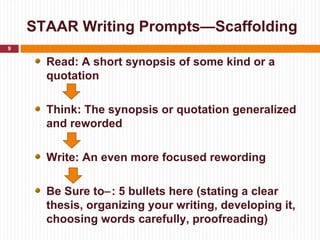
STAAR Writing Prompts—Scaffolding
9

      Read: A short synopsis of some kind or a
      quotation

      Think: The synopsis or quotation generalized
      and reworded

      Write: An even more focused rewording

      Be Sure to−: 5 bullets here (stating a clear
      thesis, organizing your writing, developing it,
      choosing words carefully, proofreading)
Expository and Persuasive Writing
10

      Prompts focus on issues/questions that don’t
      require students to bring particular
      background knowledge or facts to the table in
      order to write a good essay
      The expository task requires students to
      clearly explain what they think about
      something
      The persuasive task requires students to take
      a position and present a consistent,
      sustained argument that supports it
     Clear Explanation vs. Compelling Argument
Expository and Persuasive Writing
11

      Audience awareness
        Expository—the student is NOT TRYING to
        convince the reader to think a certain way or
        to accept a single viewpoint as valid
        Persuasive—the student is TRYING to
        convince the reader to think a certain way or
        to accept a single viewpoint as valid
      Students may use 1st or 3rd person (though
      better to stay away from “one”); remember that
      prompts are written to elicit an explanatory or
      persuasive response that reflects students’ own
      thinking about their lives and the world
Analytical Writing
12


     A combination of expository writing and
     interpretation of one aspect of a literary or
     expository text (really a hybrid of writing
     and reading)
     Analytical prompts contain a literary or
     informational text (approximately 350−450
     words), which students must analyze
     Score based on the student’s ability to
     interpret the text and support it with
     relevant textual evidence (15C) AND quality
     of the writing (criteria under expository
     writing in 15A)
STAAR English I Expository
13

     Read the information in the box below.

     In 1955 medical researcher Jonas Salk introduced an
     effective polio vaccine. At the time polio was
     considered the biggest threat to public health, yet
     Salk refused to profit by patenting the vaccine
     because he was more concerned with preventing
     disease than with personal gain.

     Although many people work to benefit themselves,
     some people choose to put others first. Think
     carefully about this statement.
STAAR English I Expository
14


     Write an essay explaining whether people should be
     more concerned about others than about
     themselves.

     Be sure to—
         clearly state your thesis
         organize and develop your ideas effectively
         choose your words carefully
         edit your writing for grammar, mechanics, and
         sentences
How Not to Begin an Essay
15

   People view things differently and see it in their own
way. They also have different opinions, and each person
thinks no one is right but themselves. Quotations are
thought through very differently from everyone else. It all
depends on the way you think and how you view things in
life.


        This introduction takes up the first 5 of the 26 lines.
STAAR English I Expository
16


     Score Point 2
     Thinking about others before you is a nice thing
     to think of, but if you think of yourself first it
     makes you feel isolated. Caring about others
     before you isn’t a bad thing, but thinking about
     yourself isn’t bad either. To me I think of others
     before me. Some people have the good life,
     others don’t. I’ll rather put myself in danger
     than others being in danger as well. I’m only
     one person but risking myself could save more
     than one life. When your in a room where there
     seems to be a fire some people will think of
STAAR English I Expository
17


     themselves while others think of the rest. The
     doctor could risk himself of getting polio but he
     could save hundreds of lifes that currently have
     polio. To me people that think of themselves
     before others are selfish and maybe greedy, but
     others that think of others are kind people.

              Handwritten version is 25 lines.
STAAR English I Expository
18


     Score Point 4
     Humanity has a funny way of contradicting itself
     sometimes. All children are taught to share and
     put others’ needs before our own. Somewhere
     down the line we realize that the very people who
     preach these things to us don’t follow their own
     rules. It is very important in society today to
     remember the bigger picture, which often
     includes doing things to help others with no
     benefit to yourself.
     People use each other for personal gain all the
     time. A glorified outlook on this way of life is all
     around us. In media people are more concerned
STAAR English I Expository
19


     with which Hollywood star is going out with which
     millionaire rather than the thousands of people
     dying of hunger in third world countries. As
     consumers we see this life and wish to be like
     that.
     Doing something for monitary gain is just like
     money itself: easily expendable and transient. But
     doing something to help others leads to
     emotional or moral gain. The memmories and
     feelings you get from helping others won’t ever
     go away. It’s worth something to you. Worth more
     than money ever could be.
                Handwritten version is 22 lines.
STAAR English I Literary
20


     Literary prompts (English I) also contain a
     stimulus and are scaffolded.
     English I Knowledge and Skill Statement:
     Students write literary texts to express their ideas
     and feelings about real or imagined people,
     events, and ideas.
     STAAR based on SE 14(A): write an engaging
     story with a well-developed conflict and
     resolution, interesting and believable characters,
     and a range of literary strategies (e.g., dialogue,
     suspense) and devices to enhance the plot
     Literary responses can be real or fictional.
STAAR English I Literary
21

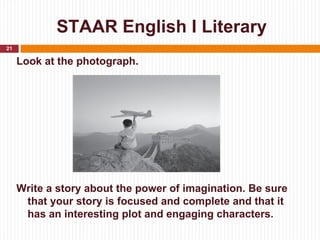
     Look at the photograph.


                    PHOTOGRAPH


     Write a story about the power of imagination. Be sure
      that your story is focused and complete and that it
      has an interesting plot and engaging characters.
STAAR English I Literary
22


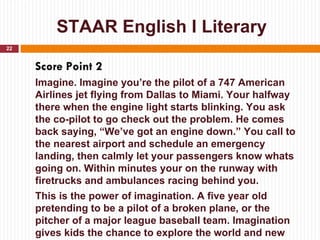
     Score Point 2
     Imagine. Imagine you’re the pilot of a 747 American
     Airlines jet flying from Dallas to Miami. Your halfway
     there when the engine light starts blinking. You ask
     the co-pilot to go check out the problem. He comes
     back saying, “We’ve got an engine down.” You call to
     the nearest airport and schedule an emergency
     landing, then calmly let your passengers know whats
     going on. Within minutes your on the runway with
     firetrucks and ambulances racing behind you.
     This is the power of imagination. A five year old
     pretending to be a pilot of a broken plane, or the
     pitcher of a major league baseball team. Imagination
     gives kids the chance to explore the world and new
STAAR English I Literary
23


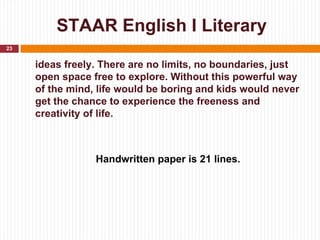
     ideas freely. There are no limits, no boundaries, just
     open space free to explore. Without this powerful way
     of the mind, life would be boring and kids would never
     get the chance to experience the freeness and
     creativity of life.


                 Handwritten paper is 21 lines.
STAAR English I Literary
24


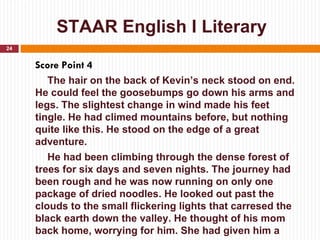
     Score Point 4
        The hair on the back of Kevin’s neck stood on end.
     He could feel the goosebumps go down his arms and
     legs. The slightest change in wind made his feet
     tingle. He had climed mountains before, but nothing
     quite like this. He stood on the edge of a great
     adventure.
        He had been climbing through the dense forest of
     trees for six days and seven nights. The journey had
     been rough and he was now running on only one
     package of dried noodles. He looked out past the
     clouds to the small flickering lights that carresed the
     black earth down the valley. He thought of his mom
     back home, worrying for him. She had given him a
STAAR English I Literary
25


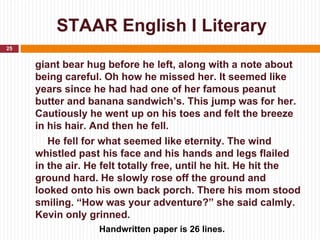
     giant bear hug before he left, along with a note about
     being careful. Oh how he missed her. It seemed like
     years since he had had one of her famous peanut
     butter and banana sandwich’s. This jump was for her.
     Cautiously he went up on his toes and felt the breeze
     in his hair. And then he fell.
        He fell for what seemed like eternity. The wind
     whistled past his face and his hands and legs flailed
     in the air. He felt totally free, until he hit. He hit the
     ground hard. He slowly rose off the ground and
     looked onto his own back porch. There his mom stood
     smiling. “How was your adventure?” she said calmly.
     Kevin only grinned.
                  Handwritten paper is 26 lines.
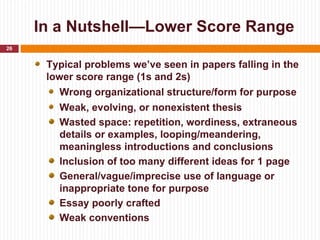
In a Nutshell—Lower Score Range
26


      Typical problems we’ve seen in papers falling in the
      lower score range (1s and 2s)
         Wrong organizational structure/form for purpose
        Weak, evolving, or nonexistent thesis
        Wasted space: repetition, wordiness, extraneous
        details or examples, looping/meandering,
        meaningless introductions and conclusions
        Inclusion of too many different ideas for 1 page
        General/vague/imprecise use of language or
        inappropriate tone for purpose
        Essay poorly crafted
        Weak conventions
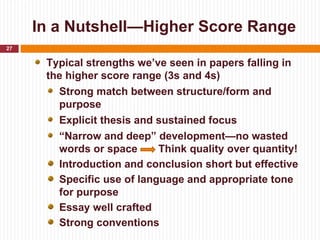
In a Nutshell—Higher Score Range
27

      Typical strengths we’ve seen in papers falling in
      the higher score range (3s and 4s)
        Strong match between structure/form and
        purpose
        Explicit thesis and sustained focus
        “Narrow and deep” development—no wasted
        words or space      Think quality over quantity!
        Introduction and conclusion short but effective
        Specific use of language and appropriate tone
        for purpose
        Essay well crafted
        Strong conventions
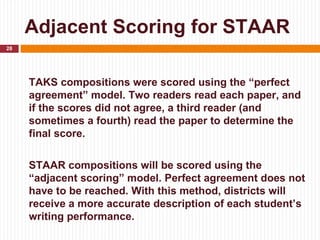
Adjacent Scoring for STAAR
28


     TAKS compositions were scored using the “perfect
     agreement” model. Two readers read each paper, and
     if the scores did not agree, a third reader (and
     sometimes a fourth) read the paper to determine the
     final score.

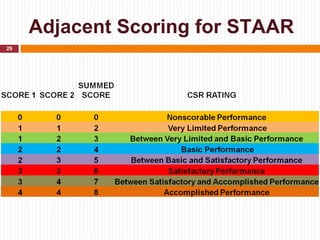
     STAAR compositions will be scored using the
     “adjacent scoring” model. Perfect agreement does not
     have to be reached. With this method, districts will
     receive a more accurate description of each student’s
     writing performance.
Adjacent Scoring for STAAR
29
STAAR Reading Design
30


     STAAR reading assessments will emphasize
     students’ ability
       to make connections within and across
       texts
       to think critically/inferentially about
       different types of texts (almost all test
       questions go beyond literal understanding)
       to understand how writer’s craft affects
       meaning
       to understand how to use text evidence to
       confirm the validity of their ideas
STAAR Reading Performance
31


      Score Point 0—INSUFFICIENT
      Score Point 1—PARTIALLY SUFFICIENT
      Score Point 2—SUFFICIENT
      Score Point 3—EXEMPLARY
STAAR Short Answer Questions
                Text Evidence
32

        Students must know that text evidence is
         always flawed when it is
          only a general reference to the text

          too partial to support the idea

          weakly linked to the idea

          used inappropriately because it wrongly
           manipulates the meaning of the text
        Students must know that to score a 2 or 3 on
         short answer reading, text evidence must be
         considered accurate and relevant (SP 2) or
         specific and well chosen (SP 3)
STAAR Short Answer Questions
33

        English I short answer question for single
         selection: drama

         In this excerpt from Anne of Green Gables,
         do you think the stage directions enhance
         your understanding of the scene? Explain
         your answer and support it with evidence
         from the selection.
STAAR Short Answer Questions
34

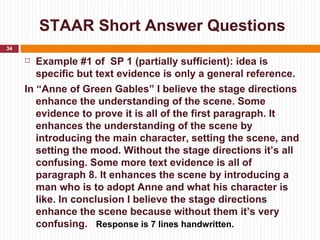
       Example #1 of SP 1 (partially sufficient): idea is
        specific but text evidence is only a general reference.
     In “Anne of Green Gables” I believe the stage directions
        enhance the understanding of the scene. Some
        evidence to prove it is all of the first paragraph. It
        enhances the understanding of the scene by
        introducing the main character, setting the scene, and
        setting the mood. Without the stage directions it’s all
        confusing. Some more text evidence is all of
        paragraph 8. It enhances the scene by introducing a
        man who is to adopt Anne and what his character is
        like. In conclusion I believe the stage directions
        enhance the scene because without them it’s very
        confusing. Response is 7 lines handwritten.
STAAR Short Answer Questions
35

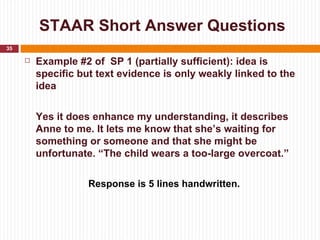
        Example #2 of SP 1 (partially sufficient): idea is
         specific but text evidence is only weakly linked to the
         idea


         Yes it does enhance my understanding, it describes
         Anne to me. It lets me know that she’s waiting for
         something or someone and that she might be
         unfortunate. “The child wears a too-large overcoat.”

                    Response is 5 lines handwritten.
STAAR Short Answer Questions
36

        Example of SP 2 (sufficient): idea is specific and text
         evidence is relevant and accurate


         The stage directions help a lot because you can create
         better pictures in your head about what is going on.
         When the story says “[Anne clutches her bag. She is
         terrified]” shows Anne is scared without Anne having
         to say it.

                     Response is 5 lines handwritten.
STAAR Short Answer Questions
37

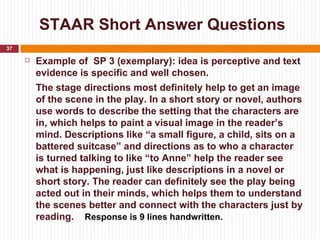
        Example of SP 3 (exemplary): idea is perceptive and text
         evidence is specific and well chosen.
         The stage directions most definitely help to get an image
         of the scene in the play. In a short story or novel, authors
         use words to describe the setting that the characters are
         in, which helps to paint a visual image in the reader’s
         mind. Descriptions like “a small figure, a child, sits on a
         battered suitcase” and directions as to who a character
         is turned talking to like “to Anne” help the reader see
         what is happening, just like descriptions in a novel or
         short story. The reader can definitely see the play being
         acted out in their minds, which helps them to understand
         the scenes better and connect with the characters just by
         reading. Response is 9 lines handwritten.
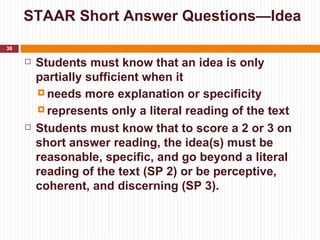
STAAR Short Answer Questions—Idea
38

        Students must know that an idea is only
         partially sufficient when it
          needs more explanation or specificity

          represents only a literal reading of the text

        Students must know that to score a 2 or 3 on
         short answer reading, the idea(s) must be
         reasonable, specific, and go beyond a literal
         reading of the text (SP 2) or be perceptive,
         coherent, and discerning (SP 3).
STAAR Short Answer Questions
39

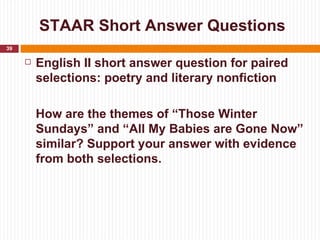
        English II short answer question for paired
         selections: poetry and literary nonfiction

         How are the themes of “Those Winter
         Sundays” and “All My Babies are Gone Now”
         similar? Support your answer with evidence
         from both selections.
STAAR Short Answer Questions
40

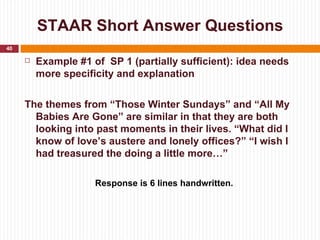
        Example #1 of SP 1 (partially sufficient): idea needs
         more specificity and explanation


     The themes from “Those Winter Sundays” and “All My
       Babies Are Gone” are similar in that they are both
       looking into past moments in their lives. “What did I
       know of love’s austere and lonely offices?” “I wish I
       had treasured the doing a little more…”

                     Response is 6 lines handwritten.
STAAR Short Answer Questions
41

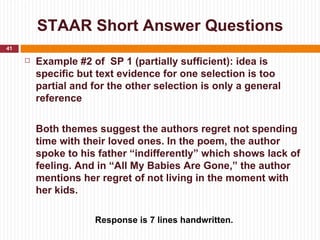
        Example #2 of SP 1 (partially sufficient): idea is
         specific but text evidence for one selection is too
         partial and for the other selection is only a general
         reference


         Both themes suggest the authors regret not spending
         time with their loved ones. In the poem, the author
         spoke to his father “indifferently” which shows lack of
         feeling. And in “All My Babies Are Gone,” the author
         mentions her regret of not living in the moment with
         her kids.

                     Response is 7 lines handwritten.
STAAR Short Answer Questions
42

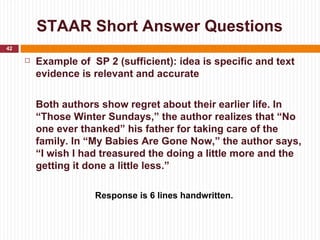
        Example of SP 2 (sufficient): idea is specific and text
         evidence is relevant and accurate


         Both authors show regret about their earlier life. In
         “Those Winter Sundays,” the author realizes that “No
         one ever thanked” his father for taking care of the
         family. In “My Babies Are Gone Now,” the author says,
         “I wish I had treasured the doing a little more and the
         getting it done a little less.”

                     Response is 6 lines handwritten.
STAAR Short Answer Questions
43

        Example of SP 3 (exemplary): idea is perceptive and text
         evidence is specific and well chosen.
         Both themes are similar in the sense that both the child
         and mother in the selections have a feeling of remorse of
         not being able to appreciate who they have in front of
         them and not being able to take advantage of time. “No
         one ever thanked him.” The child acknowledges the fact
         that his father “with cracked hands that ached from
         labor” would wake up “in the blueblack cold” to provide
         warmth for his family, yet no one seems to be grateful for
         it. Time flew by for this mother; she didn’t get to cherish
         her three treasures as she wanted because in the blink of
         an eye they turned into “three almost adults”.
                      Response is 8 lines handwritten.
44
      CONTACT INFORMATION

                  Victoria Young
     Director of Reading, Writing, and Social
               Studies Assessments
            Texas Education Agency
                   512-463-9536
         victoria.young@tea.state.tx.us

Tctela2012 staar english

  • 1.
    STATE OF TEXASASSESSMENTS OF ACADEMIC READINESS (STAARTM) English I, II, and III Reading and Writing Victoria Young Director of Reading, Writing, and Social Studies Assessments Texas Education Agency
  • 2.
    English I, II,and III Writing 2 Revision and editing assessed in separate sections of the test and equally emphasized—each section worth 24% of total test score Broader measure of writing for each course by requiring students to write two compositions addressing different purposes English I−literary and expository English II−expository and persuasive English III−persuasive and analytical
  • 3.
    English I, II,and III Writing 3 Essays weighted equally—each 26% of total writing score One page—a maximum of 26 lines for each composition (25 “light lines” plus the heavy “border line” at the bottom of the writing space); no “double-lining” allowed No “gatekeeper” (no automatic fail of the writing test for receiving a score of 1 on a composition)
  • 4.
    English I, II,and III Writing 4 Make-up testing allowed Dictionary policy expanded students may use dictionaries on the entire test (multiple-choice section and compositions) types of allowable dictionaries now include bilingual and handheld non- internet-capable electronic dictionaries Field test: one prompt and either a revising or editing passage and 6 items embedded in test
  • 5.
    English I, II,and III Reading 5 Two short answer reading questions and 38 multiple choice on each assessment A total of 56 points on reading test: multiple choice worth 38 points (68% of total score) and short answer questions worth 18 points (32% of total score) Each short answer reading question based on a 0−3 rubric and weighted by 3, for a total of 9 points Students have 10 lines to answer each question: 9 “light lines” plus the heavy “border line” at the bottom of the box
  • 6.
    English I, II,and III Reading 6 Make-up testing allowed Allowable dictionaries now include bilingual and handheld non-internet-capable electronic dictionaries One field-test reading selection and 8 items embedded in test
  • 7.
    STAAR Writing Performance 7 Score Point 1—VERY LIMITED Score Point 2—BASIC Score Point 3—SATISFACTORY Score Point 4—ACCOMPLISHED
  • 8.
    STAAR Writing Prompts 8 Expository, persuasive, and analytical prompts contain a stimulus and are scaffolded: Read, Think, Write, Be Sure to− Purpose: to help students “build” a concept of what they might write about and to provide students with important reminders that will help them be successful on the writing task
  • 9.
    STAAR Writing Prompts—Scaffolding 9 Read: A short synopsis of some kind or a quotation Think: The synopsis or quotation generalized and reworded Write: An even more focused rewording Be Sure to−: 5 bullets here (stating a clear thesis, organizing your writing, developing it, choosing words carefully, proofreading)
  • 10.
    Expository and PersuasiveWriting 10 Prompts focus on issues/questions that don’t require students to bring particular background knowledge or facts to the table in order to write a good essay The expository task requires students to clearly explain what they think about something The persuasive task requires students to take a position and present a consistent, sustained argument that supports it Clear Explanation vs. Compelling Argument
  • 11.
    Expository and PersuasiveWriting 11 Audience awareness Expository—the student is NOT TRYING to convince the reader to think a certain way or to accept a single viewpoint as valid Persuasive—the student is TRYING to convince the reader to think a certain way or to accept a single viewpoint as valid Students may use 1st or 3rd person (though better to stay away from “one”); remember that prompts are written to elicit an explanatory or persuasive response that reflects students’ own thinking about their lives and the world
  • 12.
    Analytical Writing 12 A combination of expository writing and interpretation of one aspect of a literary or expository text (really a hybrid of writing and reading) Analytical prompts contain a literary or informational text (approximately 350−450 words), which students must analyze Score based on the student’s ability to interpret the text and support it with relevant textual evidence (15C) AND quality of the writing (criteria under expository writing in 15A)
  • 13.
    STAAR English IExpository 13 Read the information in the box below. In 1955 medical researcher Jonas Salk introduced an effective polio vaccine. At the time polio was considered the biggest threat to public health, yet Salk refused to profit by patenting the vaccine because he was more concerned with preventing disease than with personal gain. Although many people work to benefit themselves, some people choose to put others first. Think carefully about this statement.
  • 14.
    STAAR English IExpository 14 Write an essay explaining whether people should be more concerned about others than about themselves. Be sure to— clearly state your thesis organize and develop your ideas effectively choose your words carefully edit your writing for grammar, mechanics, and sentences
  • 15.
    How Not toBegin an Essay 15 People view things differently and see it in their own way. They also have different opinions, and each person thinks no one is right but themselves. Quotations are thought through very differently from everyone else. It all depends on the way you think and how you view things in life. This introduction takes up the first 5 of the 26 lines.
  • 16.
    STAAR English IExpository 16 Score Point 2 Thinking about others before you is a nice thing to think of, but if you think of yourself first it makes you feel isolated. Caring about others before you isn’t a bad thing, but thinking about yourself isn’t bad either. To me I think of others before me. Some people have the good life, others don’t. I’ll rather put myself in danger than others being in danger as well. I’m only one person but risking myself could save more than one life. When your in a room where there seems to be a fire some people will think of
  • 17.
    STAAR English IExpository 17 themselves while others think of the rest. The doctor could risk himself of getting polio but he could save hundreds of lifes that currently have polio. To me people that think of themselves before others are selfish and maybe greedy, but others that think of others are kind people. Handwritten version is 25 lines.
  • 18.
    STAAR English IExpository 18 Score Point 4 Humanity has a funny way of contradicting itself sometimes. All children are taught to share and put others’ needs before our own. Somewhere down the line we realize that the very people who preach these things to us don’t follow their own rules. It is very important in society today to remember the bigger picture, which often includes doing things to help others with no benefit to yourself. People use each other for personal gain all the time. A glorified outlook on this way of life is all around us. In media people are more concerned
  • 19.
    STAAR English IExpository 19 with which Hollywood star is going out with which millionaire rather than the thousands of people dying of hunger in third world countries. As consumers we see this life and wish to be like that. Doing something for monitary gain is just like money itself: easily expendable and transient. But doing something to help others leads to emotional or moral gain. The memmories and feelings you get from helping others won’t ever go away. It’s worth something to you. Worth more than money ever could be. Handwritten version is 22 lines.
  • 20.
    STAAR English ILiterary 20 Literary prompts (English I) also contain a stimulus and are scaffolded. English I Knowledge and Skill Statement: Students write literary texts to express their ideas and feelings about real or imagined people, events, and ideas. STAAR based on SE 14(A): write an engaging story with a well-developed conflict and resolution, interesting and believable characters, and a range of literary strategies (e.g., dialogue, suspense) and devices to enhance the plot Literary responses can be real or fictional.
  • 21.
    STAAR English ILiterary 21 Look at the photograph. PHOTOGRAPH Write a story about the power of imagination. Be sure that your story is focused and complete and that it has an interesting plot and engaging characters.
  • 22.
    STAAR English ILiterary 22 Score Point 2 Imagine. Imagine you’re the pilot of a 747 American Airlines jet flying from Dallas to Miami. Your halfway there when the engine light starts blinking. You ask the co-pilot to go check out the problem. He comes back saying, “We’ve got an engine down.” You call to the nearest airport and schedule an emergency landing, then calmly let your passengers know whats going on. Within minutes your on the runway with firetrucks and ambulances racing behind you. This is the power of imagination. A five year old pretending to be a pilot of a broken plane, or the pitcher of a major league baseball team. Imagination gives kids the chance to explore the world and new
  • 23.
    STAAR English ILiterary 23 ideas freely. There are no limits, no boundaries, just open space free to explore. Without this powerful way of the mind, life would be boring and kids would never get the chance to experience the freeness and creativity of life. Handwritten paper is 21 lines.
  • 24.
    STAAR English ILiterary 24 Score Point 4 The hair on the back of Kevin’s neck stood on end. He could feel the goosebumps go down his arms and legs. The slightest change in wind made his feet tingle. He had climed mountains before, but nothing quite like this. He stood on the edge of a great adventure. He had been climbing through the dense forest of trees for six days and seven nights. The journey had been rough and he was now running on only one package of dried noodles. He looked out past the clouds to the small flickering lights that carresed the black earth down the valley. He thought of his mom back home, worrying for him. She had given him a
  • 25.
    STAAR English ILiterary 25 giant bear hug before he left, along with a note about being careful. Oh how he missed her. It seemed like years since he had had one of her famous peanut butter and banana sandwich’s. This jump was for her. Cautiously he went up on his toes and felt the breeze in his hair. And then he fell. He fell for what seemed like eternity. The wind whistled past his face and his hands and legs flailed in the air. He felt totally free, until he hit. He hit the ground hard. He slowly rose off the ground and looked onto his own back porch. There his mom stood smiling. “How was your adventure?” she said calmly. Kevin only grinned. Handwritten paper is 26 lines.
  • 26.
    In a Nutshell—LowerScore Range 26 Typical problems we’ve seen in papers falling in the lower score range (1s and 2s) Wrong organizational structure/form for purpose Weak, evolving, or nonexistent thesis Wasted space: repetition, wordiness, extraneous details or examples, looping/meandering, meaningless introductions and conclusions Inclusion of too many different ideas for 1 page General/vague/imprecise use of language or inappropriate tone for purpose Essay poorly crafted Weak conventions
  • 27.
    In a Nutshell—HigherScore Range 27 Typical strengths we’ve seen in papers falling in the higher score range (3s and 4s) Strong match between structure/form and purpose Explicit thesis and sustained focus “Narrow and deep” development—no wasted words or space Think quality over quantity! Introduction and conclusion short but effective Specific use of language and appropriate tone for purpose Essay well crafted Strong conventions
  • 28.
    Adjacent Scoring forSTAAR 28 TAKS compositions were scored using the “perfect agreement” model. Two readers read each paper, and if the scores did not agree, a third reader (and sometimes a fourth) read the paper to determine the final score. STAAR compositions will be scored using the “adjacent scoring” model. Perfect agreement does not have to be reached. With this method, districts will receive a more accurate description of each student’s writing performance.
  • 29.
  • 30.
    STAAR Reading Design 30 STAAR reading assessments will emphasize students’ ability to make connections within and across texts to think critically/inferentially about different types of texts (almost all test questions go beyond literal understanding) to understand how writer’s craft affects meaning to understand how to use text evidence to confirm the validity of their ideas
  • 31.
    STAAR Reading Performance 31 Score Point 0—INSUFFICIENT Score Point 1—PARTIALLY SUFFICIENT Score Point 2—SUFFICIENT Score Point 3—EXEMPLARY
  • 32.
    STAAR Short AnswerQuestions Text Evidence 32  Students must know that text evidence is always flawed when it is  only a general reference to the text  too partial to support the idea  weakly linked to the idea  used inappropriately because it wrongly manipulates the meaning of the text  Students must know that to score a 2 or 3 on short answer reading, text evidence must be considered accurate and relevant (SP 2) or specific and well chosen (SP 3)
  • 33.
    STAAR Short AnswerQuestions 33  English I short answer question for single selection: drama In this excerpt from Anne of Green Gables, do you think the stage directions enhance your understanding of the scene? Explain your answer and support it with evidence from the selection.
  • 34.
    STAAR Short AnswerQuestions 34  Example #1 of SP 1 (partially sufficient): idea is specific but text evidence is only a general reference. In “Anne of Green Gables” I believe the stage directions enhance the understanding of the scene. Some evidence to prove it is all of the first paragraph. It enhances the understanding of the scene by introducing the main character, setting the scene, and setting the mood. Without the stage directions it’s all confusing. Some more text evidence is all of paragraph 8. It enhances the scene by introducing a man who is to adopt Anne and what his character is like. In conclusion I believe the stage directions enhance the scene because without them it’s very confusing. Response is 7 lines handwritten.
  • 35.
    STAAR Short AnswerQuestions 35  Example #2 of SP 1 (partially sufficient): idea is specific but text evidence is only weakly linked to the idea Yes it does enhance my understanding, it describes Anne to me. It lets me know that she’s waiting for something or someone and that she might be unfortunate. “The child wears a too-large overcoat.” Response is 5 lines handwritten.
  • 36.
    STAAR Short AnswerQuestions 36  Example of SP 2 (sufficient): idea is specific and text evidence is relevant and accurate The stage directions help a lot because you can create better pictures in your head about what is going on. When the story says “[Anne clutches her bag. She is terrified]” shows Anne is scared without Anne having to say it. Response is 5 lines handwritten.
  • 37.
    STAAR Short AnswerQuestions 37  Example of SP 3 (exemplary): idea is perceptive and text evidence is specific and well chosen. The stage directions most definitely help to get an image of the scene in the play. In a short story or novel, authors use words to describe the setting that the characters are in, which helps to paint a visual image in the reader’s mind. Descriptions like “a small figure, a child, sits on a battered suitcase” and directions as to who a character is turned talking to like “to Anne” help the reader see what is happening, just like descriptions in a novel or short story. The reader can definitely see the play being acted out in their minds, which helps them to understand the scenes better and connect with the characters just by reading. Response is 9 lines handwritten.
  • 38.
    STAAR Short AnswerQuestions—Idea 38  Students must know that an idea is only partially sufficient when it  needs more explanation or specificity  represents only a literal reading of the text  Students must know that to score a 2 or 3 on short answer reading, the idea(s) must be reasonable, specific, and go beyond a literal reading of the text (SP 2) or be perceptive, coherent, and discerning (SP 3).
  • 39.
    STAAR Short AnswerQuestions 39  English II short answer question for paired selections: poetry and literary nonfiction How are the themes of “Those Winter Sundays” and “All My Babies are Gone Now” similar? Support your answer with evidence from both selections.
  • 40.
    STAAR Short AnswerQuestions 40  Example #1 of SP 1 (partially sufficient): idea needs more specificity and explanation The themes from “Those Winter Sundays” and “All My Babies Are Gone” are similar in that they are both looking into past moments in their lives. “What did I know of love’s austere and lonely offices?” “I wish I had treasured the doing a little more…” Response is 6 lines handwritten.
  • 41.
    STAAR Short AnswerQuestions 41  Example #2 of SP 1 (partially sufficient): idea is specific but text evidence for one selection is too partial and for the other selection is only a general reference Both themes suggest the authors regret not spending time with their loved ones. In the poem, the author spoke to his father “indifferently” which shows lack of feeling. And in “All My Babies Are Gone,” the author mentions her regret of not living in the moment with her kids. Response is 7 lines handwritten.
  • 42.
    STAAR Short AnswerQuestions 42  Example of SP 2 (sufficient): idea is specific and text evidence is relevant and accurate Both authors show regret about their earlier life. In “Those Winter Sundays,” the author realizes that “No one ever thanked” his father for taking care of the family. In “My Babies Are Gone Now,” the author says, “I wish I had treasured the doing a little more and the getting it done a little less.” Response is 6 lines handwritten.
  • 43.
    STAAR Short AnswerQuestions 43  Example of SP 3 (exemplary): idea is perceptive and text evidence is specific and well chosen. Both themes are similar in the sense that both the child and mother in the selections have a feeling of remorse of not being able to appreciate who they have in front of them and not being able to take advantage of time. “No one ever thanked him.” The child acknowledges the fact that his father “with cracked hands that ached from labor” would wake up “in the blueblack cold” to provide warmth for his family, yet no one seems to be grateful for it. Time flew by for this mother; she didn’t get to cherish her three treasures as she wanted because in the blink of an eye they turned into “three almost adults”. Response is 8 lines handwritten.
  • 44.
    44 CONTACT INFORMATION Victoria Young Director of Reading, Writing, and Social Studies Assessments Texas Education Agency 512-463-9536 victoria.young@tea.state.tx.us