Convex hull algorithms in 3D
Slides by: Roger Hernando
Introduction Complexity Gift wrapping Divide and conquer Incremental algorithm References
Outline
1 Introduction
2 Complexity
3 Gift wrapping
4 Divide and conquer
5 Incremental algorithm
6 References
Slides by: Roger Hernando Convex hull algorithms in 3D
Introduction Complexity Gift wrapping Divide and conquer Incremental algorithm References
Problem statement
Given P: set of n points in 3D.
Convex hull of P: CH(P), the
smallest polyhedron s.t. all
elements of P on or in the interior
of CH(P).
Slides by: Roger Hernando Convex hull algorithms in 3D
Introduction Complexity Gift wrapping Divide and conquer Incremental algorithm References
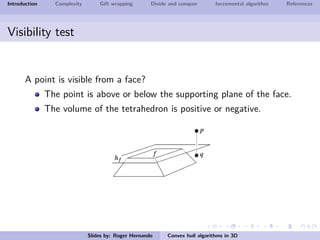
Visibility test
A point is visible from a face?
The point is above or below the supporting plane of the face.
The volume of the tetrahedron is positive or negative.
Slides by: Roger Hernando Convex hull algorithms in 3D
Introduction Complexity Gift wrapping Divide and conquer Incremental algorithm References
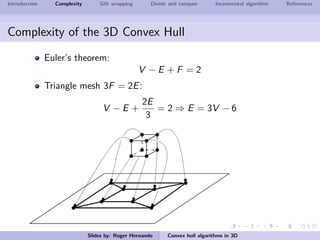
Complexity of the 3D Convex Hull
Euler’s theorem:
V − E + F = 2
Triangle mesh 3F = 2E:
V − E +
2E
3
= 2 ⇒ E = 3V − 6
Slides by: Roger Hernando Convex hull algorithms in 3D
Introduction Complexity Gift wrapping Divide and conquer Incremental algorithm References
Complexity of the Convex Hull
Given a set S of n points in Rn what is maximum #edges on
CH(S)?
Bernard Chazelle [1990]: CH of n points in Rd in optimal
worst-case is O n log n + n
d
2 . Bound by Seidel[1981].
Slides by: Roger Hernando Convex hull algorithms in 3D
Introduction Complexity Gift wrapping Divide and conquer Incremental algorithm References
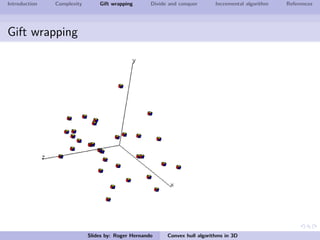
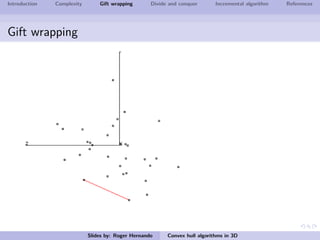
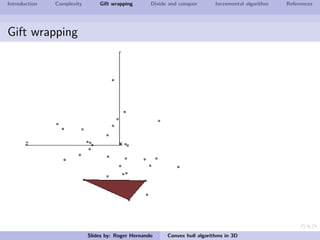
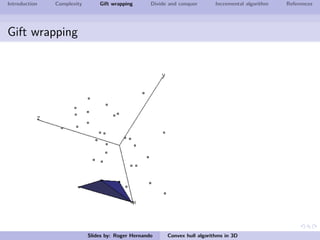
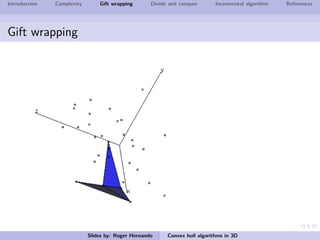
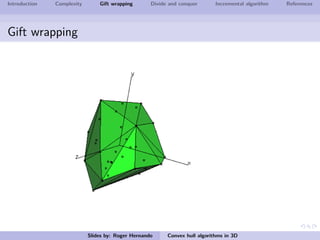
Gift wrapping
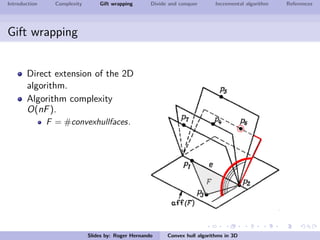
Direct extension of the 2D
algorithm.
Algorithm complexity
O(nF).
F = #convexhullfaces.
Slides by: Roger Hernando Convex hull algorithms in 3D
Introduction Complexity Gift wrapping Divide and conquer Incremental algorithm References
Gift wrapping
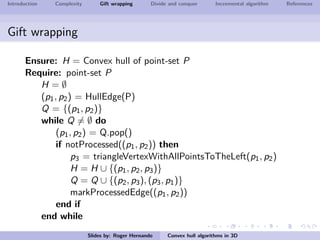
Ensure: H = Convex hull of point-set P
Require: point-set P
H = ∅
(p1, p2) = HullEdge(P)
Q = {(p1, p2)}
while Q = ∅ do
(p1, p2) = Q.pop()
if notProcessed((p1, p2)) then
p3 = triangleVertexWithAllPointsToTheLeft(p1, p2)
H = H ∪ {(p1, p2, p3)}
Q = Q ∪ {(p2, p3), (p3, p1)}
markProcessedEdge((p1, p2))
end if
end while
Slides by: Roger Hernando Convex hull algorithms in 3D
Introduction Complexity Gift wrapping Divide and conquer Incremental algorithm References
Gift wrapping
Slides by: Roger Hernando Convex hull algorithms in 3D
Introduction Complexity Gift wrapping Divide and conquer Incremental algorithm References
Gift wrapping
Slides by: Roger Hernando Convex hull algorithms in 3D
Introduction Complexity Gift wrapping Divide and conquer Incremental algorithm References
Gift wrapping
Slides by: Roger Hernando Convex hull algorithms in 3D
Introduction Complexity Gift wrapping Divide and conquer Incremental algorithm References
Gift wrapping
Slides by: Roger Hernando Convex hull algorithms in 3D
Introduction Complexity Gift wrapping Divide and conquer Incremental algorithm References
Gift wrapping
Slides by: Roger Hernando Convex hull algorithms in 3D
Introduction Complexity Gift wrapping Divide and conquer Incremental algorithm References
Gift wrapping
Slides by: Roger Hernando Convex hull algorithms in 3D
Introduction Complexity Gift wrapping Divide and conquer Incremental algorithm References
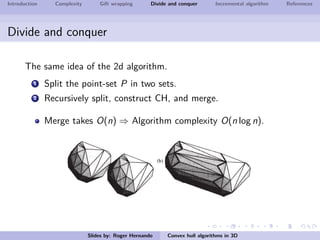
Divide and conquer
The same idea of the 2d algorithm.
1 Split the point-set P in two sets.
2 Recursively split, construct CH, and merge.
Merge takes O(n) ⇒ Algorithm complexity O(n log n).
Slides by: Roger Hernando Convex hull algorithms in 3D
Introduction Complexity Gift wrapping Divide and conquer Incremental algorithm References
Divide and conquer
Ensure: Convex hull of point-set P
Require: point-set P(sorted by certain coord)
function divideAndConquer(P)
if |P| ≤ x then
return incremental(P)
end if
(P1, P2) = split(P)
H1 = divideAndConquer(P1)
H2 = divideAndConquer(P2)
return merge(H1, H2)
end function
Slides by: Roger Hernando Convex hull algorithms in 3D
Introduction Complexity Gift wrapping Divide and conquer Incremental algorithm References
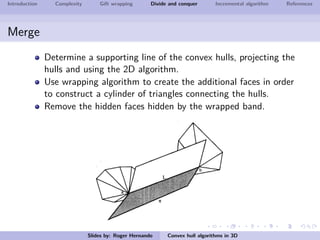
Merge
Determine a supporting line of the convex hulls, projecting the
hulls and using the 2D algorithm.
Use wrapping algorithm to create the additional faces in order
to construct a cylinder of triangles connecting the hulls.
Remove the hidden faces hidden by the wrapped band.
Slides by: Roger Hernando Convex hull algorithms in 3D
Introduction Complexity Gift wrapping Divide and conquer Incremental algorithm References
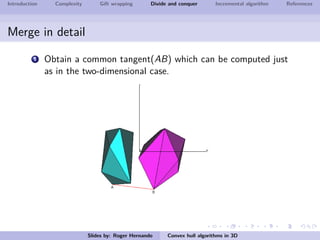
Merge in detail
1 Obtain a common tangent(AB) which can be computed just
as in the two-dimensional case.
Slides by: Roger Hernando Convex hull algorithms in 3D
Introduction Complexity Gift wrapping Divide and conquer Incremental algorithm References
Merge in detail
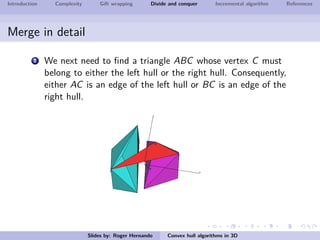
2 We next need to find a triangle ABC whose vertex C must
belong to either the left hull or the right hull. Consequently,
either AC is an edge of the left hull or BC is an edge of the
right hull.
Slides by: Roger Hernando Convex hull algorithms in 3D
Introduction Complexity Gift wrapping Divide and conquer Incremental algorithm References
Merge in detail
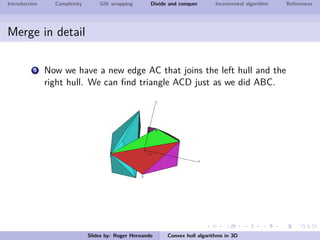
3 Now we have a new edge AC that joins the left hull and the
right hull. We can find triangle ACD just as we did ABC.
Slides by: Roger Hernando Convex hull algorithms in 3D
Introduction Complexity Gift wrapping Divide and conquer Incremental algorithm References
Merge in detail
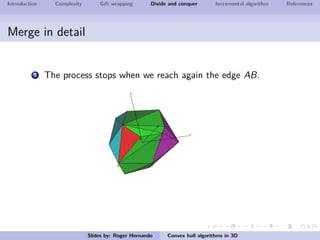
3 The process stops when we reach again the edge AB.
Slides by: Roger Hernando Convex hull algorithms in 3D
Introduction Complexity Gift wrapping Divide and conquer Incremental algorithm References
Merge in detail
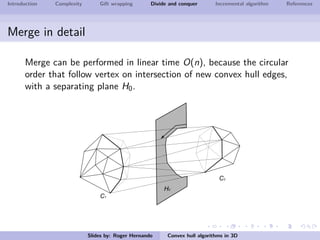
Merge can be performed in linear time O(n), because the circular
order that follow vertex on intersection of new convex hull edges,
with a separating plane H0.
Slides by: Roger Hernando Convex hull algorithms in 3D
Introduction Complexity Gift wrapping Divide and conquer Incremental algorithm References
Merge
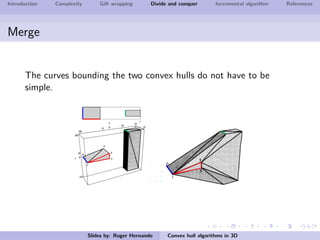
The curves bounding the two convex hulls do not have to be
simple.
Slides by: Roger Hernando Convex hull algorithms in 3D
Introduction Complexity Gift wrapping Divide and conquer Incremental algorithm References
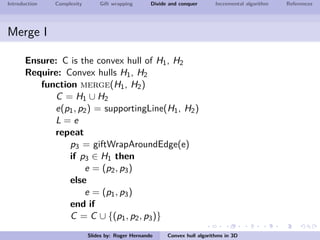
Merge I
Ensure: C is the convex hull of H1, H2
Require: Convex hulls H1, H2
function merge(H1, H2)
C = H1 ∪ H2
e(p1, p2) = supportingLine(H1, H2)
L = e
repeat
p3 = giftWrapAroundEdge(e)
if p3 ∈ H1 then
e = (p2, p3)
else
e = (p1, p3)
end if
C = C ∪ {(p1, p2, p3)}
Slides by: Roger Hernando Convex hull algorithms in 3D
Introduction Complexity Gift wrapping Divide and conquer Incremental algorithm References
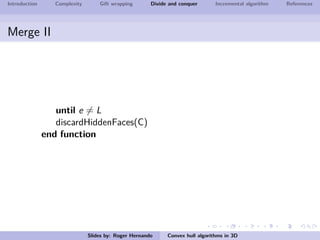
Merge II
until e = L
discardHiddenFaces(C)
end function
Slides by: Roger Hernando Convex hull algorithms in 3D
Introduction Complexity Gift wrapping Divide and conquer Incremental algorithm References
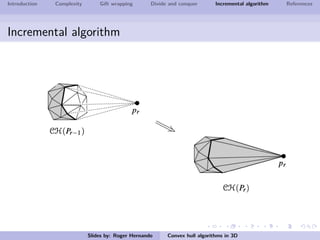
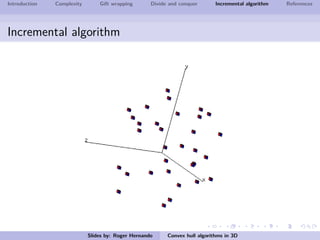
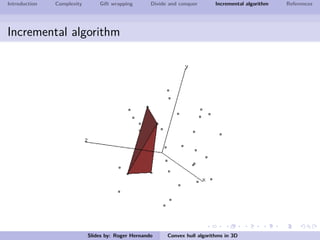
Incremental algorithm
Slides by: Roger Hernando Convex hull algorithms in 3D
Introduction Complexity Gift wrapping Divide and conquer Incremental algorithm References
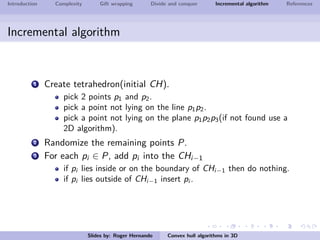
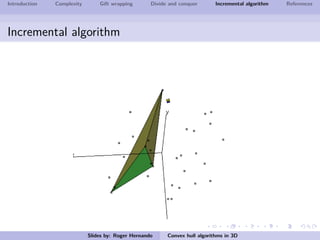
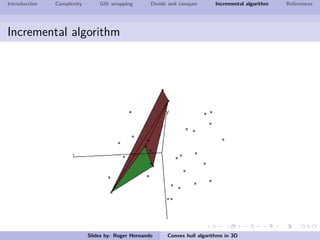
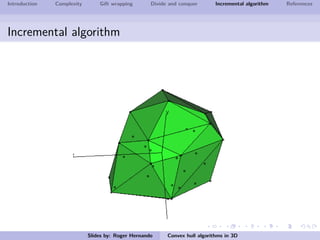
Incremental algorithm
1 Create tetrahedron(initial CH).
pick 2 points p1 and p2.
pick a point not lying on the line p1p2.
pick a point not lying on the plane p1p2p3(if not found use a
2D algorithm).
2 Randomize the remaining points P.
3 For each pi ∈ P, add pi into the CHi−1
if pi lies inside or on the boundary of CHi−1 then do nothing.
if pi lies outside of CHi−1 insert pi .
Slides by: Roger Hernando Convex hull algorithms in 3D
Introduction Complexity Gift wrapping Divide and conquer Incremental algorithm References
Incremental algorithm
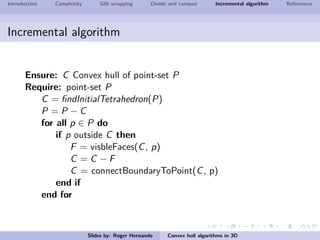
Ensure: C Convex hull of point-set P
Require: point-set P
C = findInitialTetrahedron(P)
P = P − C
for all p ∈ P do
if p outside C then
F = visbleFaces(C, p)
C = C − F
C = connectBoundaryToPoint(C, p)
end if
end for
Slides by: Roger Hernando Convex hull algorithms in 3D
Introduction Complexity Gift wrapping Divide and conquer Incremental algorithm References
Find visible region
Naive:
Test every face for each point O(n2
).
Conflict graph:
Maintain information to aid in determining visible facets from
a point.
Slides by: Roger Hernando Convex hull algorithms in 3D
Introduction Complexity Gift wrapping Divide and conquer Incremental algorithm References
Conflict graph
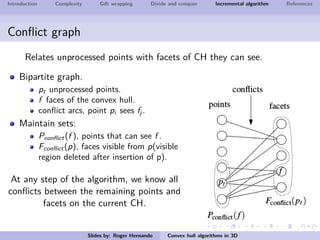
Relates unprocessed points with facets of CH they can see.
Bipartite graph.
pt unprocessed points.
f faces of the convex hull.
conflict arcs, point pi sees fj .
Maintain sets:
Pconflict(f ), points that can see f .
Fconflict(p), faces visible from p(visible
region deleted after insertion of p).
At any step of the algorithm, we know all
conflicts between the remaining points and
facets on the current CH.
Slides by: Roger Hernando Convex hull algorithms in 3D
Introduction Complexity Gift wrapping Divide and conquer Incremental algorithm References
Initialize Conflict graph
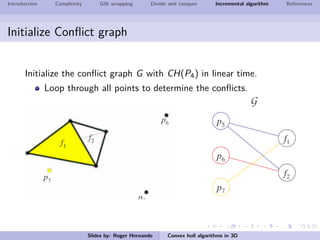
Initialize the conflict graph G with CH(P4) in linear time.
Loop through all points to determine the conflicts.
Slides by: Roger Hernando Convex hull algorithms in 3D
Introduction Complexity Gift wrapping Divide and conquer Incremental algorithm References
Update Conflict graph
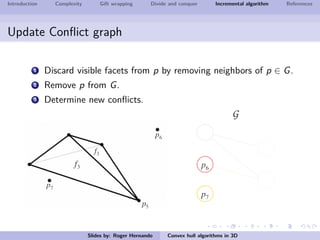
1 Discard visible facets from p by removing neighbors of p ∈ G.
2 Remove p from G.
3 Determine new conflicts.
Slides by: Roger Hernando Convex hull algorithms in 3D
Introduction Complexity Gift wrapping Divide and conquer Incremental algorithm References
Determine new conflicts
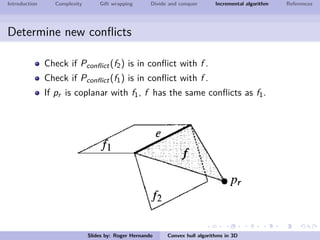
Check if Pconflict(f2) is in conflict with f .
Check if Pconflict(f1) is in conflict with f .
If pr is coplanar with f1, f has the same conflicts as f1.
Slides by: Roger Hernando Convex hull algorithms in 3D
Introduction Complexity Gift wrapping Divide and conquer Incremental algorithm References
Incremental algorithm I
Ensure: C Convex hull of point-set P
Require: point-set P
C = findInitialTetrahedron(P)
initializeConflictGraph(P, C)
P = P − C
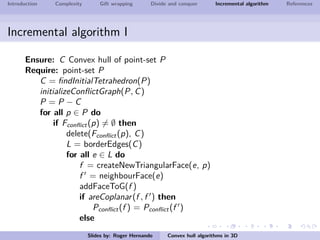
for all p ∈ P do
if Fconflict(p) = ∅ then
delete(Fconflict(p), C)
L = borderEdges(C)
for all e ∈ L do
f = createNewTriangularFace(e, p)
f = neighbourFace(e)
addFaceToG(f )
if areCoplanar(f , f ) then
Pconflict(f ) = Pconflict(f )
else
Slides by: Roger Hernando Convex hull algorithms in 3D
Introduction Complexity Gift wrapping Divide and conquer Incremental algorithm References
Incremental algorithm II
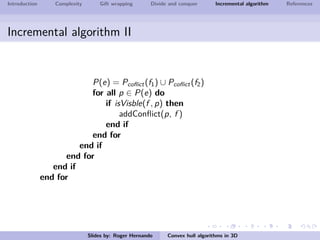
P(e) = Pcoflict(f1) ∪ Pcoflict(f2)
for all p ∈ P(e) do
if isVisble(f , p) then
addConflict(p, f )
end if
end for
end if
end for
end if
end for
Slides by: Roger Hernando Convex hull algorithms in 3D
Introduction Complexity Gift wrapping Divide and conquer Incremental algorithm References
Analysis
We want to bound the total number of facets created/deleted by
the algorithm.
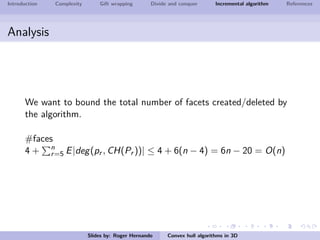
#faces
4 + n
r=5 E|deg(pr , CH(Pr ))| ≤ 4 + 6(n − 4) = 6n − 20 = O(n)
Slides by: Roger Hernando Convex hull algorithms in 3D
Introduction Complexity Gift wrapping Divide and conquer Incremental algorithm References
Analysis
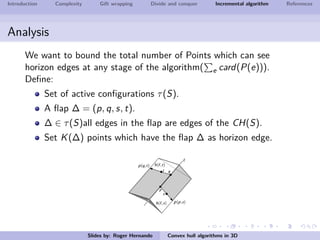
We want to bound the total number of Points which can see
horizon edges at any stage of the algorithm( e card(P(e))).
Define:
Set of active configurations τ(S).
A flap ∆ = (p, q, s, t).
∆ ∈ τ(S)all edges in the flap are edges of the CH(S).
Set K(∆) points which have the flap ∆ as horizon edge.
Slides by: Roger Hernando Convex hull algorithms in 3D
Introduction Complexity Gift wrapping Divide and conquer Incremental algorithm References
Analysis
We want to bound the total number of Points which can see
horizon edges at any stage of the algorithm( e card(P(e))).
e card(P(e)) ≤ ∆ card(K(∆)) ≤ n
r=1 16 n−r
r
6r−12
r ≤
≤ 96n ln n = O(n log n)
Slides by: Roger Hernando Convex hull algorithms in 3D
Introduction Complexity Gift wrapping Divide and conquer Incremental algorithm References
Incremental algorithm
Slides by: Roger Hernando Convex hull algorithms in 3D
Introduction Complexity Gift wrapping Divide and conquer Incremental algorithm References
Incremental algorithm
Slides by: Roger Hernando Convex hull algorithms in 3D
Introduction Complexity Gift wrapping Divide and conquer Incremental algorithm References
Incremental algorithm
Slides by: Roger Hernando Convex hull algorithms in 3D
Introduction Complexity Gift wrapping Divide and conquer Incremental algorithm References
Incremental algorithm
Slides by: Roger Hernando Convex hull algorithms in 3D
Introduction Complexity Gift wrapping Divide and conquer Incremental algorithm References
Incremental algorithm
Slides by: Roger Hernando Convex hull algorithms in 3D
Introduction Complexity Gift wrapping Divide and conquer Incremental algorithm References
References I
Applet:
http://www.cse.unsw.edu.au/ lambert/java/3d/hull.htm
M. de Berg, O. Cheong, M. van Kreveld, M. Overmars,
Computational Geometry Algorithms and Applications
J. O’Rourke,Computational Geometry in C
Partha P. Goswami, Introduction to Computational Geometry
David M. Mount, Lecture notes.
Bernard Chazelle, An optimal convex hull algorith in any fixed
dimension
Alexander Wolf, Slides
Jason C. Yang, Slides
Peter Felkel, Slides
Slides by: Roger Hernando Convex hull algorithms in 3D

Convex hull in 3D

  • 1.
    Convex hull algorithmsin 3D Slides by: Roger Hernando
  • 2.
    Introduction Complexity Giftwrapping Divide and conquer Incremental algorithm References Outline 1 Introduction 2 Complexity 3 Gift wrapping 4 Divide and conquer 5 Incremental algorithm 6 References Slides by: Roger Hernando Convex hull algorithms in 3D
  • 3.
    Introduction Complexity Giftwrapping Divide and conquer Incremental algorithm References Problem statement Given P: set of n points in 3D. Convex hull of P: CH(P), the smallest polyhedron s.t. all elements of P on or in the interior of CH(P). Slides by: Roger Hernando Convex hull algorithms in 3D
  • 4.
    Introduction Complexity Giftwrapping Divide and conquer Incremental algorithm References Visibility test A point is visible from a face? The point is above or below the supporting plane of the face. The volume of the tetrahedron is positive or negative. Slides by: Roger Hernando Convex hull algorithms in 3D
  • 5.
    Introduction Complexity Giftwrapping Divide and conquer Incremental algorithm References Complexity of the 3D Convex Hull Euler’s theorem: V − E + F = 2 Triangle mesh 3F = 2E: V − E + 2E 3 = 2 ⇒ E = 3V − 6 Slides by: Roger Hernando Convex hull algorithms in 3D
  • 6.
    Introduction Complexity Giftwrapping Divide and conquer Incremental algorithm References Complexity of the Convex Hull Given a set S of n points in Rn what is maximum #edges on CH(S)? Bernard Chazelle [1990]: CH of n points in Rd in optimal worst-case is O n log n + n d 2 . Bound by Seidel[1981]. Slides by: Roger Hernando Convex hull algorithms in 3D
  • 7.
    Introduction Complexity Giftwrapping Divide and conquer Incremental algorithm References Gift wrapping Direct extension of the 2D algorithm. Algorithm complexity O(nF). F = #convexhullfaces. Slides by: Roger Hernando Convex hull algorithms in 3D
  • 8.
    Introduction Complexity Giftwrapping Divide and conquer Incremental algorithm References Gift wrapping Ensure: H = Convex hull of point-set P Require: point-set P H = ∅ (p1, p2) = HullEdge(P) Q = {(p1, p2)} while Q = ∅ do (p1, p2) = Q.pop() if notProcessed((p1, p2)) then p3 = triangleVertexWithAllPointsToTheLeft(p1, p2) H = H ∪ {(p1, p2, p3)} Q = Q ∪ {(p2, p3), (p3, p1)} markProcessedEdge((p1, p2)) end if end while Slides by: Roger Hernando Convex hull algorithms in 3D
  • 9.
    Introduction Complexity Giftwrapping Divide and conquer Incremental algorithm References Gift wrapping Slides by: Roger Hernando Convex hull algorithms in 3D
  • 10.
    Introduction Complexity Giftwrapping Divide and conquer Incremental algorithm References Gift wrapping Slides by: Roger Hernando Convex hull algorithms in 3D
  • 11.
    Introduction Complexity Giftwrapping Divide and conquer Incremental algorithm References Gift wrapping Slides by: Roger Hernando Convex hull algorithms in 3D
  • 12.
    Introduction Complexity Giftwrapping Divide and conquer Incremental algorithm References Gift wrapping Slides by: Roger Hernando Convex hull algorithms in 3D
  • 13.
    Introduction Complexity Giftwrapping Divide and conquer Incremental algorithm References Gift wrapping Slides by: Roger Hernando Convex hull algorithms in 3D
  • 14.
    Introduction Complexity Giftwrapping Divide and conquer Incremental algorithm References Gift wrapping Slides by: Roger Hernando Convex hull algorithms in 3D
  • 15.
    Introduction Complexity Giftwrapping Divide and conquer Incremental algorithm References Divide and conquer The same idea of the 2d algorithm. 1 Split the point-set P in two sets. 2 Recursively split, construct CH, and merge. Merge takes O(n) ⇒ Algorithm complexity O(n log n). Slides by: Roger Hernando Convex hull algorithms in 3D
  • 16.
    Introduction Complexity Giftwrapping Divide and conquer Incremental algorithm References Divide and conquer Ensure: Convex hull of point-set P Require: point-set P(sorted by certain coord) function divideAndConquer(P) if |P| ≤ x then return incremental(P) end if (P1, P2) = split(P) H1 = divideAndConquer(P1) H2 = divideAndConquer(P2) return merge(H1, H2) end function Slides by: Roger Hernando Convex hull algorithms in 3D
  • 17.
    Introduction Complexity Giftwrapping Divide and conquer Incremental algorithm References Merge Determine a supporting line of the convex hulls, projecting the hulls and using the 2D algorithm. Use wrapping algorithm to create the additional faces in order to construct a cylinder of triangles connecting the hulls. Remove the hidden faces hidden by the wrapped band. Slides by: Roger Hernando Convex hull algorithms in 3D
  • 18.
    Introduction Complexity Giftwrapping Divide and conquer Incremental algorithm References Merge in detail 1 Obtain a common tangent(AB) which can be computed just as in the two-dimensional case. Slides by: Roger Hernando Convex hull algorithms in 3D
  • 19.
    Introduction Complexity Giftwrapping Divide and conquer Incremental algorithm References Merge in detail 2 We next need to find a triangle ABC whose vertex C must belong to either the left hull or the right hull. Consequently, either AC is an edge of the left hull or BC is an edge of the right hull. Slides by: Roger Hernando Convex hull algorithms in 3D
  • 20.
    Introduction Complexity Giftwrapping Divide and conquer Incremental algorithm References Merge in detail 3 Now we have a new edge AC that joins the left hull and the right hull. We can find triangle ACD just as we did ABC. Slides by: Roger Hernando Convex hull algorithms in 3D
  • 21.
    Introduction Complexity Giftwrapping Divide and conquer Incremental algorithm References Merge in detail 3 The process stops when we reach again the edge AB. Slides by: Roger Hernando Convex hull algorithms in 3D
  • 22.
    Introduction Complexity Giftwrapping Divide and conquer Incremental algorithm References Merge in detail Merge can be performed in linear time O(n), because the circular order that follow vertex on intersection of new convex hull edges, with a separating plane H0. Slides by: Roger Hernando Convex hull algorithms in 3D
  • 23.
    Introduction Complexity Giftwrapping Divide and conquer Incremental algorithm References Merge The curves bounding the two convex hulls do not have to be simple. Slides by: Roger Hernando Convex hull algorithms in 3D
  • 24.
    Introduction Complexity Giftwrapping Divide and conquer Incremental algorithm References Merge I Ensure: C is the convex hull of H1, H2 Require: Convex hulls H1, H2 function merge(H1, H2) C = H1 ∪ H2 e(p1, p2) = supportingLine(H1, H2) L = e repeat p3 = giftWrapAroundEdge(e) if p3 ∈ H1 then e = (p2, p3) else e = (p1, p3) end if C = C ∪ {(p1, p2, p3)} Slides by: Roger Hernando Convex hull algorithms in 3D
  • 25.
    Introduction Complexity Giftwrapping Divide and conquer Incremental algorithm References Merge II until e = L discardHiddenFaces(C) end function Slides by: Roger Hernando Convex hull algorithms in 3D
  • 26.
    Introduction Complexity Giftwrapping Divide and conquer Incremental algorithm References Incremental algorithm Slides by: Roger Hernando Convex hull algorithms in 3D
  • 27.
    Introduction Complexity Giftwrapping Divide and conquer Incremental algorithm References Incremental algorithm 1 Create tetrahedron(initial CH). pick 2 points p1 and p2. pick a point not lying on the line p1p2. pick a point not lying on the plane p1p2p3(if not found use a 2D algorithm). 2 Randomize the remaining points P. 3 For each pi ∈ P, add pi into the CHi−1 if pi lies inside or on the boundary of CHi−1 then do nothing. if pi lies outside of CHi−1 insert pi . Slides by: Roger Hernando Convex hull algorithms in 3D
  • 28.
    Introduction Complexity Giftwrapping Divide and conquer Incremental algorithm References Incremental algorithm Ensure: C Convex hull of point-set P Require: point-set P C = findInitialTetrahedron(P) P = P − C for all p ∈ P do if p outside C then F = visbleFaces(C, p) C = C − F C = connectBoundaryToPoint(C, p) end if end for Slides by: Roger Hernando Convex hull algorithms in 3D
  • 29.
    Introduction Complexity Giftwrapping Divide and conquer Incremental algorithm References Find visible region Naive: Test every face for each point O(n2 ). Conflict graph: Maintain information to aid in determining visible facets from a point. Slides by: Roger Hernando Convex hull algorithms in 3D
  • 30.
    Introduction Complexity Giftwrapping Divide and conquer Incremental algorithm References Conflict graph Relates unprocessed points with facets of CH they can see. Bipartite graph. pt unprocessed points. f faces of the convex hull. conflict arcs, point pi sees fj . Maintain sets: Pconflict(f ), points that can see f . Fconflict(p), faces visible from p(visible region deleted after insertion of p). At any step of the algorithm, we know all conflicts between the remaining points and facets on the current CH. Slides by: Roger Hernando Convex hull algorithms in 3D
  • 31.
    Introduction Complexity Giftwrapping Divide and conquer Incremental algorithm References Initialize Conflict graph Initialize the conflict graph G with CH(P4) in linear time. Loop through all points to determine the conflicts. Slides by: Roger Hernando Convex hull algorithms in 3D
  • 32.
    Introduction Complexity Giftwrapping Divide and conquer Incremental algorithm References Update Conflict graph 1 Discard visible facets from p by removing neighbors of p ∈ G. 2 Remove p from G. 3 Determine new conflicts. Slides by: Roger Hernando Convex hull algorithms in 3D
  • 33.
    Introduction Complexity Giftwrapping Divide and conquer Incremental algorithm References Determine new conflicts Check if Pconflict(f2) is in conflict with f . Check if Pconflict(f1) is in conflict with f . If pr is coplanar with f1, f has the same conflicts as f1. Slides by: Roger Hernando Convex hull algorithms in 3D
  • 34.
    Introduction Complexity Giftwrapping Divide and conquer Incremental algorithm References Incremental algorithm I Ensure: C Convex hull of point-set P Require: point-set P C = findInitialTetrahedron(P) initializeConflictGraph(P, C) P = P − C for all p ∈ P do if Fconflict(p) = ∅ then delete(Fconflict(p), C) L = borderEdges(C) for all e ∈ L do f = createNewTriangularFace(e, p) f = neighbourFace(e) addFaceToG(f ) if areCoplanar(f , f ) then Pconflict(f ) = Pconflict(f ) else Slides by: Roger Hernando Convex hull algorithms in 3D
  • 35.
    Introduction Complexity Giftwrapping Divide and conquer Incremental algorithm References Incremental algorithm II P(e) = Pcoflict(f1) ∪ Pcoflict(f2) for all p ∈ P(e) do if isVisble(f , p) then addConflict(p, f ) end if end for end if end for end if end for Slides by: Roger Hernando Convex hull algorithms in 3D
  • 36.
    Introduction Complexity Giftwrapping Divide and conquer Incremental algorithm References Analysis We want to bound the total number of facets created/deleted by the algorithm. #faces 4 + n r=5 E|deg(pr , CH(Pr ))| ≤ 4 + 6(n − 4) = 6n − 20 = O(n) Slides by: Roger Hernando Convex hull algorithms in 3D
  • 37.
    Introduction Complexity Giftwrapping Divide and conquer Incremental algorithm References Analysis We want to bound the total number of Points which can see horizon edges at any stage of the algorithm( e card(P(e))). Define: Set of active configurations τ(S). A flap ∆ = (p, q, s, t). ∆ ∈ τ(S)all edges in the flap are edges of the CH(S). Set K(∆) points which have the flap ∆ as horizon edge. Slides by: Roger Hernando Convex hull algorithms in 3D
  • 38.
    Introduction Complexity Giftwrapping Divide and conquer Incremental algorithm References Analysis We want to bound the total number of Points which can see horizon edges at any stage of the algorithm( e card(P(e))). e card(P(e)) ≤ ∆ card(K(∆)) ≤ n r=1 16 n−r r 6r−12 r ≤ ≤ 96n ln n = O(n log n) Slides by: Roger Hernando Convex hull algorithms in 3D
  • 39.
    Introduction Complexity Giftwrapping Divide and conquer Incremental algorithm References Incremental algorithm Slides by: Roger Hernando Convex hull algorithms in 3D
  • 40.
    Introduction Complexity Giftwrapping Divide and conquer Incremental algorithm References Incremental algorithm Slides by: Roger Hernando Convex hull algorithms in 3D
  • 41.
    Introduction Complexity Giftwrapping Divide and conquer Incremental algorithm References Incremental algorithm Slides by: Roger Hernando Convex hull algorithms in 3D
  • 42.
    Introduction Complexity Giftwrapping Divide and conquer Incremental algorithm References Incremental algorithm Slides by: Roger Hernando Convex hull algorithms in 3D
  • 43.
    Introduction Complexity Giftwrapping Divide and conquer Incremental algorithm References Incremental algorithm Slides by: Roger Hernando Convex hull algorithms in 3D
  • 44.
    Introduction Complexity Giftwrapping Divide and conquer Incremental algorithm References References I Applet: http://www.cse.unsw.edu.au/ lambert/java/3d/hull.htm M. de Berg, O. Cheong, M. van Kreveld, M. Overmars, Computational Geometry Algorithms and Applications J. O’Rourke,Computational Geometry in C Partha P. Goswami, Introduction to Computational Geometry David M. Mount, Lecture notes. Bernard Chazelle, An optimal convex hull algorith in any fixed dimension Alexander Wolf, Slides Jason C. Yang, Slides Peter Felkel, Slides Slides by: Roger Hernando Convex hull algorithms in 3D