LR Parsing
2
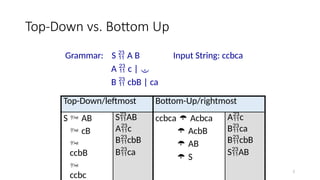
Top-Down vs. Bottom Up
Grammar: S  A B
A  c | 
B  cbB | ca
Input String: ccbca
Top-Down/leftmost Bottom-Up/rightmost
S  AB
 cB

ccbB

ccbc
SAB
Ac
BcbB
Bca
ccbca  Acbca
 AcbB
 AB
 S
Ac
Bca
BcbB
SAB
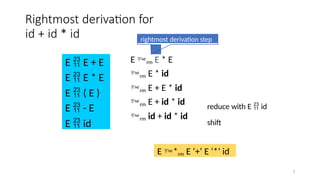
Rightmost derivation for
id + id * id
E rm E * E
rm E * id
rm E + E * id
rm E + id * id
rm id + id * id
reduce with E  id
shift
E  E + E
E  E * E
E  ( E )
E  - E
E  id
E *rm E ‘+’ E ‘*’ id
rightmost derivation step
3
4
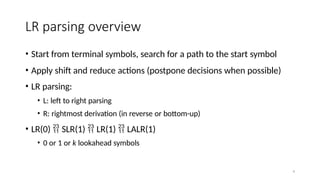
LR parsing overview
• Start from terminal symbols, search for a path to the start symbol
• Apply shift and reduce actions (postpone decisions when possible)
• LR parsing:
• L: left to right parsing
• R: rightmost derivation (in reverse or bottom-up)
• LR(0)  SLR(1)  LR(1)  LALR(1)
• 0 or 1 or k lookahead symbols
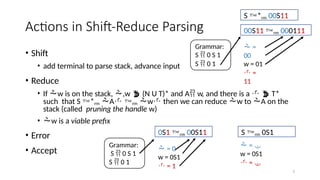
Actions in Shift-Reduce Parsing
• Shift
• add terminal to parse stack, advance input
• Reduce
• If w is on the stack, ,w  (N U T)* and A w, and there is a   T*
such that S *rm A rm w then we can reduce w to A on the
stack (called pruning the handle w)
• w is a viable prefix
• Error
• Accept
Grammar:
S  0 S 1
S  0 1
S *rm 00S11
 =
00
w = 01
 =
11
00S11 rm 000111
 = 0
w = 0S1
 = 1
0S1 rm 00S11
Grammar:
S  0 S 1
S  0 1
S rm 0S1
5
 = 
w = 0S1
 = 
6
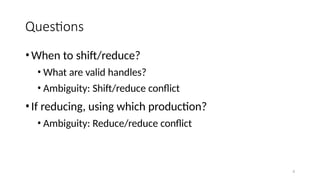
Questions
•When to shift/reduce?
• What are valid handles?
• Ambiguity: Shift/reduce conflict
•If reducing, using which production?
• Ambiguity: Reduce/reduce conflict
Table-based Shift Reduce Parsing
8
LR Parsing
• Table-based parser
• Creates rightmost derivation (in reverse)
• Works with left- and right- recursive context-free grammars
• Data structures:
• Stack of states/symbols {s}
• Action table: action[s, a]; a  T
• Goto table: goto[s, X]; X  N
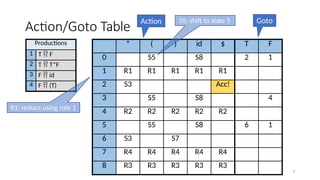
Action/Goto Table
* ( ) id $ T F
0 S5 S8 2 1
1 R1 R1 R1 R1 R1
2 S3 Acc!
3 S5 S8 4
4 R2 R2 R2 R2 R2
5 S5 S8 6 1
6 S3 S7
7 R4 R4 R4 R4 R4
8 R3 R3 R3 R3 R3
Productions
1 T  F
2 T  T*F
3 F  id
4 F  (T)
Action Goto
S5: shift to state 5
R1: reduce using rule 1
9
Trace “(id)*id”
Stack Input Action/Goto
0 ( id ) * id $ Shift S5
0 5 id ) * id $ Shift S8
0 5 8 ) * id $ Reduce 3 Fid,
pop 8, goto [5,F]=1
0 5 1 ) * id $ Reduce 1 T F
,
pop 1, goto [5,T]=6
0 5 6 ) * id $ Shift S7
0 5 6 7 * id $ Reduce 4 F (T),
pop 7 6 5, goto [0,F]=1
0 1 * id $ Reduce 1 T  F
pop 1, goto [0,T]=2
* ( ) id $ T F
0 S5 S8 2 1
1 R1 R1 R1 R1 R1
2 S3 A
3 S5 S8 4
4 R2 R2 R2 R2 R2
5 S5 S8 6 1
6 S3 S7
7 R4 R4 R4 R4 R4
8 R3 R3 R3 R3 R3
Productions
1 T  F
2 T  T*F
3 F  id
4 F  (T)
0 is the
start state
10
11
Trace “(id)*id”
Stack Input Action/Goto
0 1 * id $ Reduce 1 TF,
pop 1, goto [0,T]=2
0 2 * id $ Shift S3
0 2 3 id $ Shift S8
0 2 3 8 $ Reduce 3 Fid,
pop 8, goto [3,F]=4
0 2 3 4 $ Reduce 2 TT * F
pop 4 3 2, goto [0,T]=2
0 2 $ Accept
Productions
1 T  F
2 T  T*F
3 F  id
4 F  (T)
* ( ) id $ T F
0 S5 S8 2 1
1 R1 R1 R1 R1 R1
2 S3 A
3 S5 S8 4
4 R2 R2 R2 R2 R2
5 S5 S8 6 1
6 S3 S7
7 R4 R4 R4 R4 R4
8 R3 R3 R3 R3 R3
12
Tracing LR: action[s, a]
• case shift u:
• push state u
• read new a
• case reduce r:
• lookup production r: X  Y1..Yk;
• pop k states, find state u
• push goto[u, X]
• case accept: done
• no entry in action table: error
Algorithm to build the Action/Goto table
14
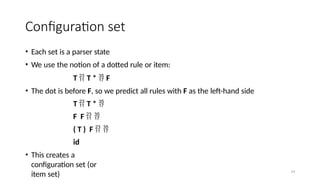
Configuration set
• Each set is a parser state
• We use the notion of a dotted rule or item:
T  T *  F
• The dot is before F, so we predict all rules with F as the left-hand side
T  T * 
F F  
( T ) F  
id
• This creates a
configuration set (or
item set)
15
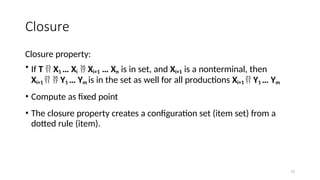
Closure
Closure property:
• If T  X1 … Xi  Xi+1 … Xn is in set, and Xi+1 is a nonterminal, then
Xi+1   Y1 … Ym is in the set as well for all productions Xi+1  Y1 … Ym
• Compute as fixed point
• The closure property creates a configuration set (item set) from a
dotted rule (item).
16
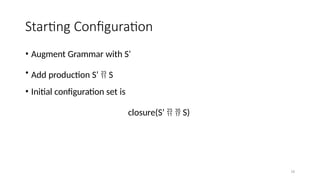
Starting Configuration
• Augment Grammar with S’
• Add production S’  S
• Initial configuration set is
closure(S’   S)
17
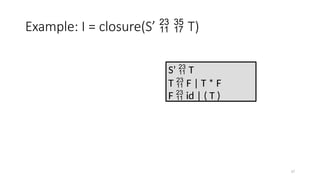
Example: I = closure(S’   T)
S’  T
T  F | T * F
F  id | ( T )
18
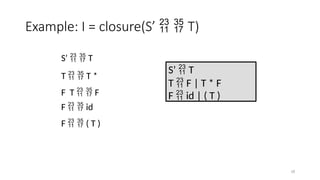
Example: I = closure(S’   T)
S’   T
T   T *
F T   F
F   id
F   ( T )
S’  T
T  F | T * F
F  id | ( T )
19
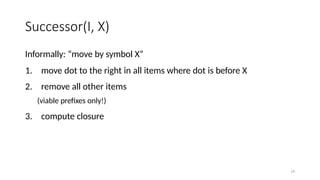
Successor(I, X)
Informally: “move by symbol X”
1. move dot to the right in all items where dot is before X
2. remove all other items
(viable prefixes only!)
3. compute closure
20
Successor Example
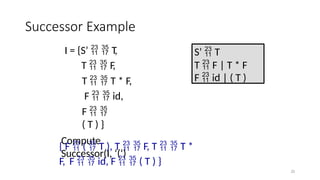
S’  T
T  F | T * F
F  id | ( T )
I = {S’   T
,
T   F
,
T   T * F,
F   id,
F  
( T ) }
Compute
Successor(I, ‘(‘)
{ F  (  T ), T   F, T   T *
F, F   id, F   ( T ) }
21
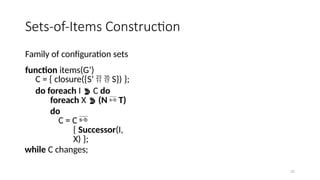
Sets-of-Items Construction
Family of configuration sets
function items(G’)
C = { closure({S’   S}) };
do foreach I  C do
foreach X  (N  T)
do
C = C 
{ Successor(I,
X) };
while C changes;
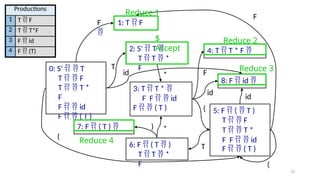
0: S’   T
T   F
T   T *
F
F   id
F   ( T )
Productions
1 T  F
2 T  T*F
3 F  id
4 F  (T)
F 1: T  F

2: S’  T 
T  T  *
F
T
3: T  T * 
F F   id
F   ( T )
*
4: T  T * F 
F
5: F  (  T )
T   F
T   T *
F F   id
F   ( T )
(
6: F  ( T  )
T  T  *
F
T
7: F  ( T )  )
8: F  id 
id
*
(
F
id
id
(
$
Accept
Reduce 1
Reduce 2
22
Reduce 3
Reduce 4
T 

T * F
F 

id
F 

( T )
Productions
1 T  F
2 T  T*F
3 F  id
4 F  (T)
F 1: T  F

2: S’  T 
T  T  *
F
T
3: T  T * 
F F   id
F   ( T )
*
4: T  T * F 
F
5: F  (  T )
T   F
T   T *
F F   id
F   ( T )
(
6: F  ( T  )
T  T  *
F
T
7: F  ( T )  )
8: F  id 
id
*
(
F
id
id
(
$
Accept
Reduce 1
Reduce 2
Reduce 3
Redu
c
e 4
*
23
(
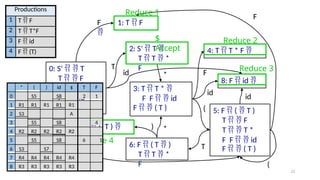
0: S’   T
T   F
) id $ T F
0 S5 S8 2 1
1 R1 R1 R1 R1 R1
2 S3 A
3 S5 S8 4
4 R2 R2 R2 R2 R2
5 S5 S8 6 1
6 S3 S7
7 R4 R4 R4 R4 R4
8 R3 R3 R3 R3 R3
24
LR(0) Construction
1. Construct F = {I0, I1, …In}
2. a) if {A  }  Ii and A != S’
then action[i, _] := reduce A  
b) if {S’  S}  Ii
then action[i,$] := accept
c) if {A  a}  Ii and Successor(Ii,a)
= Ij then action[i,a] := shift j
3. if Successor(Ii,A) = Ij then goto[i,A] := j
25
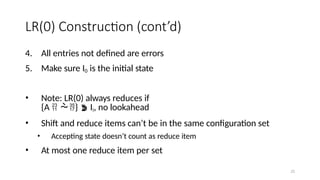
LR(0) Construction (cont’d)
4. All entries not defined are errors
5. Make sure I0 is the initial state
• Note: LR(0) always reduces if
{A  }  Ii, no lookahead
• Shift and reduce items can’t be in the same configuration set
• Accepting state doesn’t count as reduce item
• At most one reduce item per set
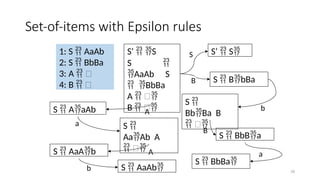
Set-of-items with Epsilon rules
S’  S
S 
AaAb S
 BbBa
A  
B  
S 
AaAb A
 
S  AaAb
1: S  AaAb
2: S  BbBa
3: A  
4: B  
S  BbBa
S 
BbBa B
 
S  AaAb
S  AaAb
S  BbBa
S  BbBa
S’  S
S
B
b
B
a
A
a
A
b 26
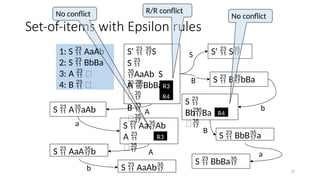
Set-of-items with Epsilon rules
S’  S
S 
AaAb S
 BbBa
A 

B 

S  AaAb
A 

S  AaAb
1: S  AaAb
2: S  BbBa
3: A  
4: B  
S  BbBa
S 
BbBa
B 

S  AaAb
S  AaAb
S  BbBa
S  BbBa
S’  S
S
B
b
B
a
A
a
A
b
R3
R4
R4
R3
R/R conflict
No conflict
No conflict
27
28
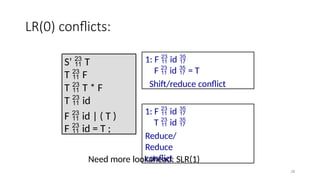
LR(0) conflicts:
Need more lookahead: SLR(1)
S’  T
T  F
T  T * F
T  id
F  id | ( T )
F  id = T ;
1: F  id 
F  id  = T
Shift/reduce conflict
1: F  id 
T  id 
Reduce/
Reduce
conflict
Viable Prefixes
• γ is a viable prefix if there is some ω such that γ|ω is a state of a shift-reduce parser
• Important fact: A viable prefix is a prefix of a handle
• An LR(0) item [X   ] says that
•  is on top of the stack ( is a suffix of γ)
• The parser is looking for an X
• Expects to find input string derived from 
• We can recognize viable prefixes via a NFA (DFA)
• States of NFA are LR(0) items
• States of DFA are sets of LR(0) items
γ | ω
stack rest of input
29
30
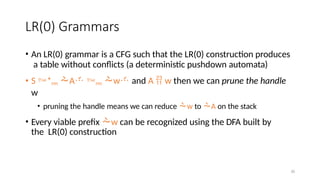
LR(0) Grammars
• An LR(0) grammar is a CFG such that the LR(0) construction produces
a table without conflicts (a deterministic pushdown automata)
• S *rm A rm w and A  w then we can prune the handle
w
• pruning the handle means we can reduce w to A on the stack
• Every viable prefix w can be recognized using the DFA built by
the LR(0) construction
31
LR(0) Grammars
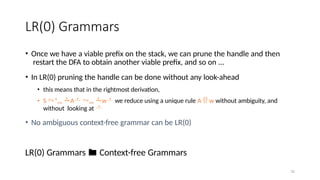
• Once we have a viable prefix on the stack, we can prune the handle and then
restart the DFA to obtain another viable prefix, and so on ...
• In LR(0) pruning the handle can be done without any look-ahead
• this means that in the rightmost derivation,
• S *rm A rm w we reduce using a unique rule A  w without ambiguity, and
without looking at 
• No ambiguous context-free grammar can be LR(0)
LR(0) Grammars  Context-free Grammars
32
Parsing - Roadmap
• Parser:
• decision procedure: builds a parse tree
• Top-down vs. bottom-up
• LL(1) – Deterministic Parsing
• recursive-descent
• table-driven
• LR(k) – Deterministic Parsing
• LR(0), SLR(1), LR(1), LALR(1)
• Parsing arbitrary CFGs – Polynomial time parsing

This is a presentation on the parsing.pptx

  • 1.
  • 2.
    2 Top-Down vs. BottomUp Grammar: S  A B A  c |  B  cbB | ca Input String: ccbca Top-Down/leftmost Bottom-Up/rightmost S  AB  cB  ccbB  ccbc SAB Ac BcbB Bca ccbca  Acbca  AcbB  AB  S Ac Bca BcbB SAB
  • 3.
    Rightmost derivation for id+ id * id E rm E * E rm E * id rm E + E * id rm E + id * id rm id + id * id reduce with E  id shift E  E + E E  E * E E  ( E ) E  - E E  id E *rm E ‘+’ E ‘*’ id rightmost derivation step 3
  • 4.
    4 LR parsing overview •Start from terminal symbols, search for a path to the start symbol • Apply shift and reduce actions (postpone decisions when possible) • LR parsing: • L: left to right parsing • R: rightmost derivation (in reverse or bottom-up) • LR(0)  SLR(1)  LR(1)  LALR(1) • 0 or 1 or k lookahead symbols
  • 5.
    Actions in Shift-ReduceParsing • Shift • add terminal to parse stack, advance input • Reduce • If w is on the stack, ,w  (N U T)* and A w, and there is a   T* such that S *rm A rm w then we can reduce w to A on the stack (called pruning the handle w) • w is a viable prefix • Error • Accept Grammar: S  0 S 1 S  0 1 S *rm 00S11  = 00 w = 01  = 11 00S11 rm 000111  = 0 w = 0S1  = 1 0S1 rm 00S11 Grammar: S  0 S 1 S  0 1 S rm 0S1 5  =  w = 0S1  = 
  • 6.
    6 Questions •When to shift/reduce? •What are valid handles? • Ambiguity: Shift/reduce conflict •If reducing, using which production? • Ambiguity: Reduce/reduce conflict
  • 7.
  • 8.
    8 LR Parsing • Table-basedparser • Creates rightmost derivation (in reverse) • Works with left- and right- recursive context-free grammars • Data structures: • Stack of states/symbols {s} • Action table: action[s, a]; a  T • Goto table: goto[s, X]; X  N
  • 9.
    Action/Goto Table * () id $ T F 0 S5 S8 2 1 1 R1 R1 R1 R1 R1 2 S3 Acc! 3 S5 S8 4 4 R2 R2 R2 R2 R2 5 S5 S8 6 1 6 S3 S7 7 R4 R4 R4 R4 R4 8 R3 R3 R3 R3 R3 Productions 1 T  F 2 T  T*F 3 F  id 4 F  (T) Action Goto S5: shift to state 5 R1: reduce using rule 1 9
  • 10.
    Trace “(id)*id” Stack InputAction/Goto 0 ( id ) * id $ Shift S5 0 5 id ) * id $ Shift S8 0 5 8 ) * id $ Reduce 3 Fid, pop 8, goto [5,F]=1 0 5 1 ) * id $ Reduce 1 T F , pop 1, goto [5,T]=6 0 5 6 ) * id $ Shift S7 0 5 6 7 * id $ Reduce 4 F (T), pop 7 6 5, goto [0,F]=1 0 1 * id $ Reduce 1 T  F pop 1, goto [0,T]=2 * ( ) id $ T F 0 S5 S8 2 1 1 R1 R1 R1 R1 R1 2 S3 A 3 S5 S8 4 4 R2 R2 R2 R2 R2 5 S5 S8 6 1 6 S3 S7 7 R4 R4 R4 R4 R4 8 R3 R3 R3 R3 R3 Productions 1 T  F 2 T  T*F 3 F  id 4 F  (T) 0 is the start state 10
  • 11.
    11 Trace “(id)*id” Stack InputAction/Goto 0 1 * id $ Reduce 1 TF, pop 1, goto [0,T]=2 0 2 * id $ Shift S3 0 2 3 id $ Shift S8 0 2 3 8 $ Reduce 3 Fid, pop 8, goto [3,F]=4 0 2 3 4 $ Reduce 2 TT * F pop 4 3 2, goto [0,T]=2 0 2 $ Accept Productions 1 T  F 2 T  T*F 3 F  id 4 F  (T) * ( ) id $ T F 0 S5 S8 2 1 1 R1 R1 R1 R1 R1 2 S3 A 3 S5 S8 4 4 R2 R2 R2 R2 R2 5 S5 S8 6 1 6 S3 S7 7 R4 R4 R4 R4 R4 8 R3 R3 R3 R3 R3
  • 12.
    12 Tracing LR: action[s,a] • case shift u: • push state u • read new a • case reduce r: • lookup production r: X  Y1..Yk; • pop k states, find state u • push goto[u, X] • case accept: done • no entry in action table: error
  • 13.
    Algorithm to buildthe Action/Goto table
  • 14.
    14 Configuration set • Eachset is a parser state • We use the notion of a dotted rule or item: T  T *  F • The dot is before F, so we predict all rules with F as the left-hand side T  T *  F F   ( T ) F   id • This creates a configuration set (or item set)
  • 15.
    15 Closure Closure property: • IfT  X1 … Xi  Xi+1 … Xn is in set, and Xi+1 is a nonterminal, then Xi+1   Y1 … Ym is in the set as well for all productions Xi+1  Y1 … Ym • Compute as fixed point • The closure property creates a configuration set (item set) from a dotted rule (item).
  • 16.
    16 Starting Configuration • AugmentGrammar with S’ • Add production S’  S • Initial configuration set is closure(S’   S)
  • 17.
    17 Example: I =closure(S’   T) S’  T T  F | T * F F  id | ( T )
  • 18.
    18 Example: I =closure(S’   T) S’   T T   T * F T   F F   id F   ( T ) S’  T T  F | T * F F  id | ( T )
  • 19.
    19 Successor(I, X) Informally: “moveby symbol X” 1. move dot to the right in all items where dot is before X 2. remove all other items (viable prefixes only!) 3. compute closure
  • 20.
    20 Successor Example S’ T T  F | T * F F  id | ( T ) I = {S’   T , T   F , T   T * F, F   id, F   ( T ) } Compute Successor(I, ‘(‘) { F  (  T ), T   F, T   T * F, F   id, F   ( T ) }
  • 21.
    21 Sets-of-Items Construction Family ofconfiguration sets function items(G’) C = { closure({S’   S}) }; do foreach I  C do foreach X  (N  T) do C = C  { Successor(I, X) }; while C changes;
  • 22.
    0: S’  T T   F T   T * F F   id F   ( T ) Productions 1 T  F 2 T  T*F 3 F  id 4 F  (T) F 1: T  F  2: S’  T  T  T  * F T 3: T  T *  F F   id F   ( T ) * 4: T  T * F  F 5: F  (  T ) T   F T   T * F F   id F   ( T ) ( 6: F  ( T  ) T  T  * F T 7: F  ( T )  ) 8: F  id  id * ( F id id ( $ Accept Reduce 1 Reduce 2 22 Reduce 3 Reduce 4
  • 23.
    T   T *F F   id F   ( T ) Productions 1 T  F 2 T  T*F 3 F  id 4 F  (T) F 1: T  F  2: S’  T  T  T  * F T 3: T  T *  F F   id F   ( T ) * 4: T  T * F  F 5: F  (  T ) T   F T   T * F F   id F   ( T ) ( 6: F  ( T  ) T  T  * F T 7: F  ( T )  ) 8: F  id  id * ( F id id ( $ Accept Reduce 1 Reduce 2 Reduce 3 Redu c e 4 * 23 ( 0: S’   T T   F ) id $ T F 0 S5 S8 2 1 1 R1 R1 R1 R1 R1 2 S3 A 3 S5 S8 4 4 R2 R2 R2 R2 R2 5 S5 S8 6 1 6 S3 S7 7 R4 R4 R4 R4 R4 8 R3 R3 R3 R3 R3
  • 24.
    24 LR(0) Construction 1. ConstructF = {I0, I1, …In} 2. a) if {A  }  Ii and A != S’ then action[i, _] := reduce A   b) if {S’  S}  Ii then action[i,$] := accept c) if {A  a}  Ii and Successor(Ii,a) = Ij then action[i,a] := shift j 3. if Successor(Ii,A) = Ij then goto[i,A] := j
  • 25.
    25 LR(0) Construction (cont’d) 4.All entries not defined are errors 5. Make sure I0 is the initial state • Note: LR(0) always reduces if {A  }  Ii, no lookahead • Shift and reduce items can’t be in the same configuration set • Accepting state doesn’t count as reduce item • At most one reduce item per set
  • 26.
    Set-of-items with Epsilonrules S’  S S  AaAb S  BbBa A   B   S  AaAb A   S  AaAb 1: S  AaAb 2: S  BbBa 3: A   4: B   S  BbBa S  BbBa B   S  AaAb S  AaAb S  BbBa S  BbBa S’  S S B b B a A a A b 26
  • 27.
    Set-of-items with Epsilonrules S’  S S  AaAb S  BbBa A   B   S  AaAb A   S  AaAb 1: S  AaAb 2: S  BbBa 3: A   4: B   S  BbBa S  BbBa B   S  AaAb S  AaAb S  BbBa S  BbBa S’  S S B b B a A a A b R3 R4 R4 R3 R/R conflict No conflict No conflict 27
  • 28.
    28 LR(0) conflicts: Need morelookahead: SLR(1) S’  T T  F T  T * F T  id F  id | ( T ) F  id = T ; 1: F  id  F  id  = T Shift/reduce conflict 1: F  id  T  id  Reduce/ Reduce conflict
  • 29.
    Viable Prefixes • γis a viable prefix if there is some ω such that γ|ω is a state of a shift-reduce parser • Important fact: A viable prefix is a prefix of a handle • An LR(0) item [X   ] says that •  is on top of the stack ( is a suffix of γ) • The parser is looking for an X • Expects to find input string derived from  • We can recognize viable prefixes via a NFA (DFA) • States of NFA are LR(0) items • States of DFA are sets of LR(0) items γ | ω stack rest of input 29
  • 30.
    30 LR(0) Grammars • AnLR(0) grammar is a CFG such that the LR(0) construction produces a table without conflicts (a deterministic pushdown automata) • S *rm A rm w and A  w then we can prune the handle w • pruning the handle means we can reduce w to A on the stack • Every viable prefix w can be recognized using the DFA built by the LR(0) construction
  • 31.
    31 LR(0) Grammars • Oncewe have a viable prefix on the stack, we can prune the handle and then restart the DFA to obtain another viable prefix, and so on ... • In LR(0) pruning the handle can be done without any look-ahead • this means that in the rightmost derivation, • S *rm A rm w we reduce using a unique rule A  w without ambiguity, and without looking at  • No ambiguous context-free grammar can be LR(0) LR(0) Grammars  Context-free Grammars
  • 32.
    32 Parsing - Roadmap •Parser: • decision procedure: builds a parse tree • Top-down vs. bottom-up • LL(1) – Deterministic Parsing • recursive-descent • table-driven • LR(k) – Deterministic Parsing • LR(0), SLR(1), LR(1), LALR(1) • Parsing arbitrary CFGs – Polynomial time parsing