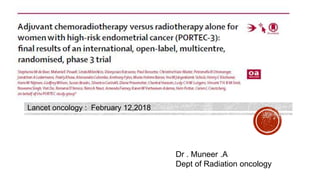
Lancet oncology : February 12,2018
Dr . Muneer .A
Dept of Radiation oncology
 What is
 PORTEC 1?
 PORTEC 2?
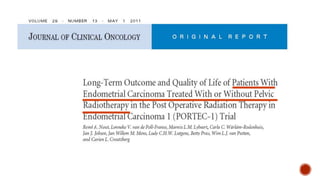
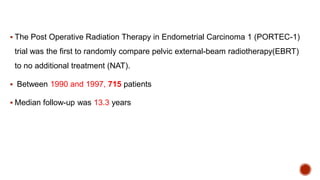
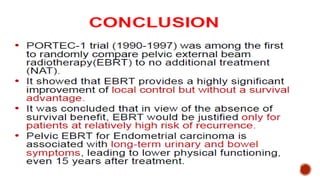
 The Post Operative Radiation Therapy in Endometrial Carcinoma 1 (PORTEC-1)
trial was the first to randomly compare pelvic external-beam radiotherapy(EBRT)
to no additional treatment (NAT).
 Between 1990 and 1997, 715 patients
 Median follow-up was 13.3 years
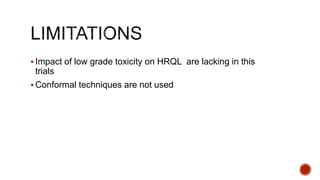
 Impact of low grade toxicity on HRQL are lacking in this
trials
 Conformal techniques are not used
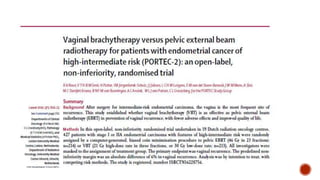
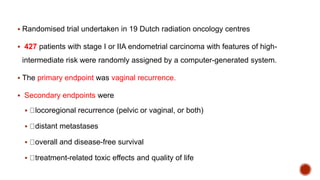
 Randomised trial undertaken in 19 Dutch radiation oncology centres
 427 patients with stage I or IIA endometrial carcinoma with features of high-
intermediate risk were randomly assigned by a computer-generated system.
 The primary endpoint was vaginal recurrence.
 Secondary endpoints were
 locoregional recurrence (pelvic or vaginal, or both)
 distant metastases
 overall and disease-free survival
 treatment-related toxic effects and quality of life
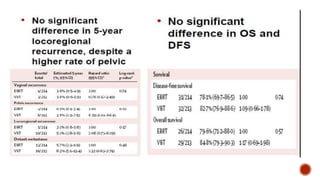
 VBT is very effective in ensuring local control keeping to a minimum risk of vaginal
recurrence.
 VBT achieves excellent vaginal control and rates of locoregional recurrence.
 Overall survival, and disease-free survival that are similar to EBRT
 Quality of life and gastrointestinal toxic effects are significantly better with VBT.
 VBT should be the adjuvant treatment of choice for patients with uterine confined-
endometrial carcinoma of high intermediate risk
 Number of patients is low that under powers the study
 Change in grade I and grade II diseases in central pathological review.
 44% to 79% in grade I
 44% to 9% in grade II
 13% In Retrospect were ineligible for trial
 It did not consider LVSI in risk factors
 It underscored the role of pathologists in the diagnosis of carcinoma endometrium
Lancet oncology : February 12,2018
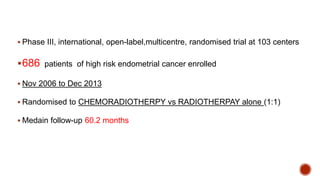
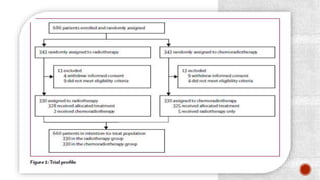
 Phase III, international, open-label,multicentre, randomised trial at 103 centers
686 patients of high risk endometrial cancer enrolled
 Nov 2006 to Dec 2013
 Randomised to CHEMORADIOTHERPY vs RADIOTHERPAY alone (1:1)
 Medain follow-up 60.2 months
 Pelvic external beam radiotherapy has been the standard adjuvant treatment for women with
high-risk endometrial cancer for many decades, although there is a paucity of evidence on
improvement of survival.
 Randomised trials( lissoni et al ,susumu et al) have compared adjuvant chemotherapy with
external beam radiotherapy.
 Radiotherapy was shown to delay pelvic recurrence and chemotherapy was shown to delay
distant metastases, but no differences in survival were found.
 Retrospective studies reported substantial rates of pelvic recurrence if high-risk
patients were treated without radiotherapy, supporting the combined use of
pelvic radiotherapy with adjuvant chemotherapy, as first explored in the RTOG
9708 phase 2 trial
 Because the combination of radiotherapy and chemotherapy
(chemoradiotherapy) seemed more effective than either treatment alone, and
because data for toxicity and quality of life were lacking,
 the randomised PORTEC-3 trial was initiated to evaluate the benefit of
chemoradiotherapy versus radiotherapy alone for women with high-risk
endometrial cancer
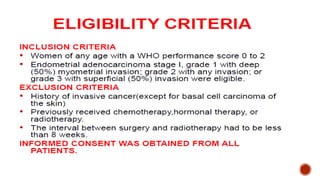
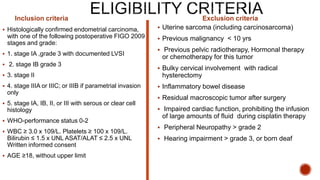
Inclusion criteria
 Histologically confirmed endometrial carcinoma,
with one of the following postoperative FIGO 2009
stages and grade:
 1. stage IA ,grade 3 with documented LVSI
 2. stage IB grade 3
 3. stage II
 4. stage IIIA or IIIC; or IIIB if parametrial invasion
only
 5. stage IA, IB, II, or III with serous or clear cell
histology
 WHO-performance status 0-2
 WBC ≥ 3.0 x 10⁹/L. Platelets ≥ 100 x 109/L.
Bilirubin ≤ 1.5 x UNL ASAT/ALAT ≤ 2.5 x UNL
Written informed consent
 AGE ≥18, without upper limit
Exclusion criteria
 Uterine sarcoma (including carcinosarcoma)
 Previous malignancy < 10 yrs
 Previous pelvic radiotherapy, Hormonal therapy
or chemotherapy for this tumor
 Bulky cervical involvement with radical
hysterectomy
 Inflammatory bowel disease
 Residual macroscopic tumor after surgery
 Impaired cardiac function, prohibiting the infusion
of large amounts of fluid during cisplatin therapy
 Peripheral Neuropathy > grade 2
 Hearing impairment > grade 3, or born deaf
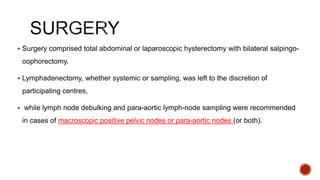
 Surgery comprised total abdominal or laparoscopic hysterectomy with bilateral salpingo-
oophorectomy.
 Lymphadenectomy, whether systemic or sampling, was left to the discretion of
participating centres,
 while lymph node debulking and para-aortic lymph-node sampling were recommended
in cases of macroscopic positive pelvic nodes or para-aortic nodes (or both).
 Given in both treatment group
 Total dose 48.6 Gy 1.8 Gy fractions , 5 days a week
 Proximal vagina,Parametrial tissue
 Internal, external, and common iliac node upto L5- S1(with a margin of ≥2 cm above the highest
involved lymph node).
 In case of cervical involvement (glandular, stromal, or both), a brachytherapy boost was given to
the vaginal vault.
 Brachytherapy dose was equivalent to 14 Gy in 2 Gy fractions (with recommended scheme of 10
Gy high-dose rate [HDR] in fractions of 5 Gy), specified at 5 mm from the vaginal vault surface.
 start within 4–6 weeks of surgery, but no later than 8 weeks.
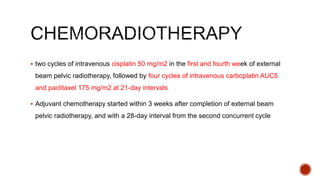
 two cycles of intravenous cisplatin 50 mg/m2 in the first and fourth week of external
beam pelvic radiotherapy, followed by four cycles of intravenous carboplatin AUC5
and paclitaxel 175 mg/m2 at 21-day intervals
 Adjuvant chemotherapy started within 3 weeks after completion of external beam
pelvic radiotherapy, and with a 28-day interval from the second concurrent cycle
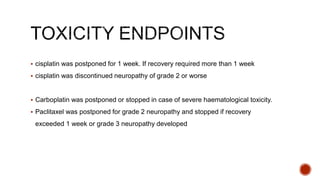
 cisplatin was postponed for 1 week. If recovery required more than 1 week
 cisplatin was discontinued neuropathy of grade 2 or worse
 Carboplatin was postponed or stopped in case of severe haematological toxicity.
 Paclitaxel was postponed for grade 2 neuropathy and stopped if recovery
exceeded 1 week or grade 3 neuropathy developed
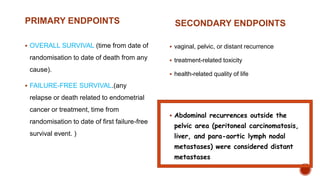
PRIMARY ENDPOINTS
 OVERALL SURVIVAL (time from date of
randomisation to date of death from any
cause).
 FAILURE-FREE SURVIVAL.(any
relapse or death related to endometrial
cancer or treatment, time from
randomisation to date of first failure-free
survival event. )
SECONDARY ENDPOINTS
 vaginal, pelvic, or distant recurrence
 treatment-related toxicity
 health-related quality of life
 Abdominal recurrences outside the
pelvic area (peritoneal carcinomatosis,
liver, and para-aortic lymph nodal
metastases) were considered distant
metastases
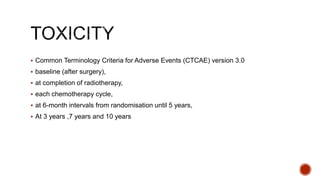
 Common Terminology Criteria for Adverse Events (CTCAE) version 3.0
 baseline (after surgery),
 at completion of radiotherapy,
 each chemotherapy cycle,
 at 6-month intervals from randomisation until 5 years,
 At 3 years ,7 years and 10 years
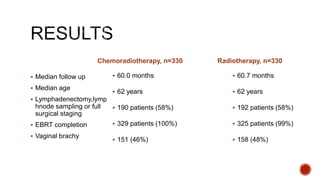
Chemoradiotherapy, n=330
 Median follow up
 Median age
 Lymphadenectomy,lymp
hnode sampling or full
surgical staging
 EBRT completion
 Vaginal brachy
Radiotherapy, n=330
 60.0 months
 62 years
 190 patients (58%)
 329 patients (100%)
 151 (46%)
 60.7 months
 62 years
 192 patients (58%)
 325 patients (99%)
 158 (48%)
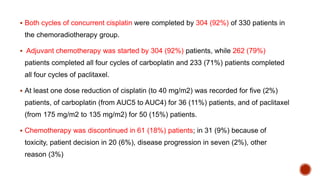
 Both cycles of concurrent cisplatin were completed by 304 (92%) of 330 patients in
the chemoradiotherapy group.
 Adjuvant chemotherapy was started by 304 (92%) patients, while 262 (79%)
patients completed all four cycles of carboplatin and 233 (71%) patients completed
all four cycles of paclitaxel.
 At least one dose reduction of cisplatin (to 40 mg/m2) was recorded for five (2%)
patients, of carboplatin (from AUC5 to AUC4) for 36 (11%) patients, and of paclitaxel
(from 175 mg/m2 to 135 mg/m2) for 50 (15%) patients.
 Chemotherapy was discontinued in 61 (18%) patients; in 31 (9%) because of
toxicity, patient decision in 20 (6%), disease progression in seven (2%), other
reason (3%)
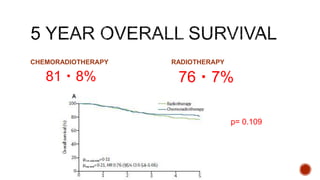
CHEMORADIOTHERAPY
81・8%
RADIOTHERAPY
76・7%
p= 0.109
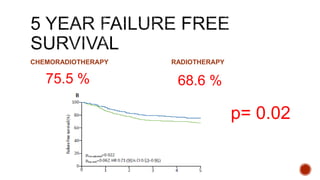
CHEMORADIOTHERAPY
75.5 %
RADIOTHERAPY
68.6 %
p= 0.02
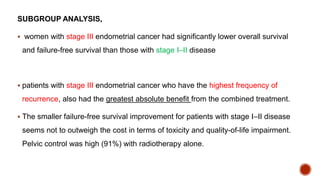
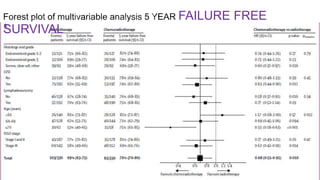
SUBGROUP ANALYSIS,
 women with stage III endometrial cancer had significantly lower overall survival
and failure-free survival than those with stage I–II disease
 patients with stage III endometrial cancer who have the highest frequency of
recurrence, also had the greatest absolute benefit from the combined treatment.
 The smaller failure-free survival improvement for patients with stage I–II disease
seems not to outweigh the cost in terms of toxicity and quality-of-life impairment.
Pelvic control was high (91%) with radiotherapy alone.
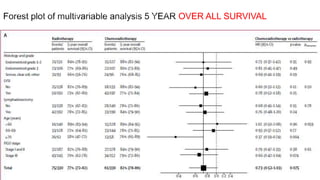
OVER ALL SURVIVAL
FAILURE FREE
SURVIVAL
 In multivariable analysis for failure-free survival, only age group was found to be
predictive of treatment effect, with a strong treatment-by-age effect (p=0・012)
 Women aged 70 years or older had the greatest benefit from chemoradiotherapy
than younger women.
 Age is a well-known risk factor for endometrial cancer and a greater benefit of
chemotherapy in older women has been reported previously.( susumu et al,
colombo et al)
 (although selection of fitter older women in this randomised trial might have
occurred )
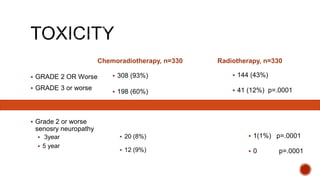
Chemoradiotherapy, n=330
 GRADE 2 OR Worse
 GRADE 3 or worse
 Grade 2 or worse
senosry neuropathy
 3year
 5 year
Radiotherapy, n=330
 308 (93%)
 198 (60%)
 20 (8%)
 12 (9%)
 144 (43%)
 41 (12%) p=.0001
 1(1%) p=.0001
 0 p=.0001
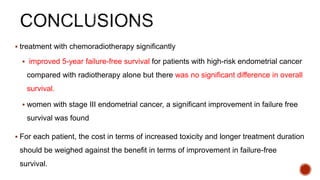
 treatment with chemoradiotherapy significantly
 improved 5-year failure-free survival for patients with high-risk endometrial cancer
compared with radiotherapy alone but there was no significant difference in overall
survival.
 women with stage III endometrial cancer, a significant improvement in failure free
survival was found
 For each patient, the cost in terms of increased toxicity and longer treatment duration
should be weighed against the benefit in terms of improvement in failure-free
survival.
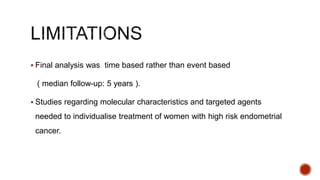
 Final analysis was time based rather than event based
( median follow-up: 5 years ).
 Studies regarding molecular characteristics and targeted agents
needed to individualise treatment of women with high risk endometrial
cancer.
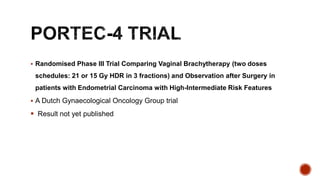
 Randomised Phase III Trial Comparing Vaginal Brachytherapy (two doses
schedules: 21 or 15 Gy HDR in 3 fractions) and Observation after Surgery in
patients with Endometrial Carcinoma with High-Intermediate Risk Features
 A Dutch Gynaecological Oncology Group trial
 Result not yet published
Portec 3
Portec 3

Portec 3

  • 1.
    Lancet oncology :February 12,2018 Dr . Muneer .A Dept of Radiation oncology
  • 2.
     What is PORTEC 1?  PORTEC 2?
  • 4.
     The PostOperative Radiation Therapy in Endometrial Carcinoma 1 (PORTEC-1) trial was the first to randomly compare pelvic external-beam radiotherapy(EBRT) to no additional treatment (NAT).  Between 1990 and 1997, 715 patients  Median follow-up was 13.3 years
  • 7.
     Impact oflow grade toxicity on HRQL are lacking in this trials  Conformal techniques are not used
  • 9.
     Randomised trialundertaken in 19 Dutch radiation oncology centres  427 patients with stage I or IIA endometrial carcinoma with features of high- intermediate risk were randomly assigned by a computer-generated system.  The primary endpoint was vaginal recurrence.  Secondary endpoints were  locoregional recurrence (pelvic or vaginal, or both)  distant metastases  overall and disease-free survival  treatment-related toxic effects and quality of life
  • 11.
     VBT isvery effective in ensuring local control keeping to a minimum risk of vaginal recurrence.  VBT achieves excellent vaginal control and rates of locoregional recurrence.  Overall survival, and disease-free survival that are similar to EBRT  Quality of life and gastrointestinal toxic effects are significantly better with VBT.  VBT should be the adjuvant treatment of choice for patients with uterine confined- endometrial carcinoma of high intermediate risk
  • 12.
     Number ofpatients is low that under powers the study  Change in grade I and grade II diseases in central pathological review.  44% to 79% in grade I  44% to 9% in grade II  13% In Retrospect were ineligible for trial  It did not consider LVSI in risk factors  It underscored the role of pathologists in the diagnosis of carcinoma endometrium
  • 13.
    Lancet oncology :February 12,2018
  • 14.
     Phase III,international, open-label,multicentre, randomised trial at 103 centers 686 patients of high risk endometrial cancer enrolled  Nov 2006 to Dec 2013  Randomised to CHEMORADIOTHERPY vs RADIOTHERPAY alone (1:1)  Medain follow-up 60.2 months
  • 15.
     Pelvic externalbeam radiotherapy has been the standard adjuvant treatment for women with high-risk endometrial cancer for many decades, although there is a paucity of evidence on improvement of survival.  Randomised trials( lissoni et al ,susumu et al) have compared adjuvant chemotherapy with external beam radiotherapy.  Radiotherapy was shown to delay pelvic recurrence and chemotherapy was shown to delay distant metastases, but no differences in survival were found.
  • 16.
     Retrospective studiesreported substantial rates of pelvic recurrence if high-risk patients were treated without radiotherapy, supporting the combined use of pelvic radiotherapy with adjuvant chemotherapy, as first explored in the RTOG 9708 phase 2 trial  Because the combination of radiotherapy and chemotherapy (chemoradiotherapy) seemed more effective than either treatment alone, and because data for toxicity and quality of life were lacking,  the randomised PORTEC-3 trial was initiated to evaluate the benefit of chemoradiotherapy versus radiotherapy alone for women with high-risk endometrial cancer
  • 17.
    Inclusion criteria  Histologicallyconfirmed endometrial carcinoma, with one of the following postoperative FIGO 2009 stages and grade:  1. stage IA ,grade 3 with documented LVSI  2. stage IB grade 3  3. stage II  4. stage IIIA or IIIC; or IIIB if parametrial invasion only  5. stage IA, IB, II, or III with serous or clear cell histology  WHO-performance status 0-2  WBC ≥ 3.0 x 10⁹/L. Platelets ≥ 100 x 109/L. Bilirubin ≤ 1.5 x UNL ASAT/ALAT ≤ 2.5 x UNL Written informed consent  AGE ≥18, without upper limit Exclusion criteria  Uterine sarcoma (including carcinosarcoma)  Previous malignancy < 10 yrs  Previous pelvic radiotherapy, Hormonal therapy or chemotherapy for this tumor  Bulky cervical involvement with radical hysterectomy  Inflammatory bowel disease  Residual macroscopic tumor after surgery  Impaired cardiac function, prohibiting the infusion of large amounts of fluid during cisplatin therapy  Peripheral Neuropathy > grade 2  Hearing impairment > grade 3, or born deaf
  • 19.
     Surgery comprisedtotal abdominal or laparoscopic hysterectomy with bilateral salpingo- oophorectomy.  Lymphadenectomy, whether systemic or sampling, was left to the discretion of participating centres,  while lymph node debulking and para-aortic lymph-node sampling were recommended in cases of macroscopic positive pelvic nodes or para-aortic nodes (or both).
  • 20.
     Given inboth treatment group  Total dose 48.6 Gy 1.8 Gy fractions , 5 days a week  Proximal vagina,Parametrial tissue  Internal, external, and common iliac node upto L5- S1(with a margin of ≥2 cm above the highest involved lymph node).  In case of cervical involvement (glandular, stromal, or both), a brachytherapy boost was given to the vaginal vault.  Brachytherapy dose was equivalent to 14 Gy in 2 Gy fractions (with recommended scheme of 10 Gy high-dose rate [HDR] in fractions of 5 Gy), specified at 5 mm from the vaginal vault surface.  start within 4–6 weeks of surgery, but no later than 8 weeks.
  • 21.
     two cyclesof intravenous cisplatin 50 mg/m2 in the first and fourth week of external beam pelvic radiotherapy, followed by four cycles of intravenous carboplatin AUC5 and paclitaxel 175 mg/m2 at 21-day intervals  Adjuvant chemotherapy started within 3 weeks after completion of external beam pelvic radiotherapy, and with a 28-day interval from the second concurrent cycle
  • 22.
     cisplatin waspostponed for 1 week. If recovery required more than 1 week  cisplatin was discontinued neuropathy of grade 2 or worse  Carboplatin was postponed or stopped in case of severe haematological toxicity.  Paclitaxel was postponed for grade 2 neuropathy and stopped if recovery exceeded 1 week or grade 3 neuropathy developed
  • 23.
    PRIMARY ENDPOINTS  OVERALLSURVIVAL (time from date of randomisation to date of death from any cause).  FAILURE-FREE SURVIVAL.(any relapse or death related to endometrial cancer or treatment, time from randomisation to date of first failure-free survival event. ) SECONDARY ENDPOINTS  vaginal, pelvic, or distant recurrence  treatment-related toxicity  health-related quality of life  Abdominal recurrences outside the pelvic area (peritoneal carcinomatosis, liver, and para-aortic lymph nodal metastases) were considered distant metastases
  • 24.
     Common TerminologyCriteria for Adverse Events (CTCAE) version 3.0  baseline (after surgery),  at completion of radiotherapy,  each chemotherapy cycle,  at 6-month intervals from randomisation until 5 years,  At 3 years ,7 years and 10 years
  • 25.
    Chemoradiotherapy, n=330  Medianfollow up  Median age  Lymphadenectomy,lymp hnode sampling or full surgical staging  EBRT completion  Vaginal brachy Radiotherapy, n=330  60.0 months  62 years  190 patients (58%)  329 patients (100%)  151 (46%)  60.7 months  62 years  192 patients (58%)  325 patients (99%)  158 (48%)
  • 26.
     Both cyclesof concurrent cisplatin were completed by 304 (92%) of 330 patients in the chemoradiotherapy group.  Adjuvant chemotherapy was started by 304 (92%) patients, while 262 (79%) patients completed all four cycles of carboplatin and 233 (71%) patients completed all four cycles of paclitaxel.  At least one dose reduction of cisplatin (to 40 mg/m2) was recorded for five (2%) patients, of carboplatin (from AUC5 to AUC4) for 36 (11%) patients, and of paclitaxel (from 175 mg/m2 to 135 mg/m2) for 50 (15%) patients.  Chemotherapy was discontinued in 61 (18%) patients; in 31 (9%) because of toxicity, patient decision in 20 (6%), disease progression in seven (2%), other reason (3%)
  • 27.
  • 28.
  • 29.
    SUBGROUP ANALYSIS,  womenwith stage III endometrial cancer had significantly lower overall survival and failure-free survival than those with stage I–II disease  patients with stage III endometrial cancer who have the highest frequency of recurrence, also had the greatest absolute benefit from the combined treatment.  The smaller failure-free survival improvement for patients with stage I–II disease seems not to outweigh the cost in terms of toxicity and quality-of-life impairment. Pelvic control was high (91%) with radiotherapy alone.
  • 30.
  • 31.
  • 32.
     In multivariableanalysis for failure-free survival, only age group was found to be predictive of treatment effect, with a strong treatment-by-age effect (p=0・012)  Women aged 70 years or older had the greatest benefit from chemoradiotherapy than younger women.  Age is a well-known risk factor for endometrial cancer and a greater benefit of chemotherapy in older women has been reported previously.( susumu et al, colombo et al)  (although selection of fitter older women in this randomised trial might have occurred )
  • 34.
    Chemoradiotherapy, n=330  GRADE2 OR Worse  GRADE 3 or worse  Grade 2 or worse senosry neuropathy  3year  5 year Radiotherapy, n=330  308 (93%)  198 (60%)  20 (8%)  12 (9%)  144 (43%)  41 (12%) p=.0001  1(1%) p=.0001  0 p=.0001
  • 35.
     treatment withchemoradiotherapy significantly  improved 5-year failure-free survival for patients with high-risk endometrial cancer compared with radiotherapy alone but there was no significant difference in overall survival.  women with stage III endometrial cancer, a significant improvement in failure free survival was found  For each patient, the cost in terms of increased toxicity and longer treatment duration should be weighed against the benefit in terms of improvement in failure-free survival.
  • 36.
     Final analysiswas time based rather than event based ( median follow-up: 5 years ).  Studies regarding molecular characteristics and targeted agents needed to individualise treatment of women with high risk endometrial cancer.
  • 37.
     Randomised PhaseIII Trial Comparing Vaginal Brachytherapy (two doses schedules: 21 or 15 Gy HDR in 3 fractions) and Observation after Surgery in patients with Endometrial Carcinoma with High-Intermediate Risk Features  A Dutch Gynaecological Oncology Group trial  Result not yet published