Can we go forward with FAST Forward?
The Journal club
FAST Forward study
Dr Kanhu Charan Patro
5/5/2020 1DR KANHU
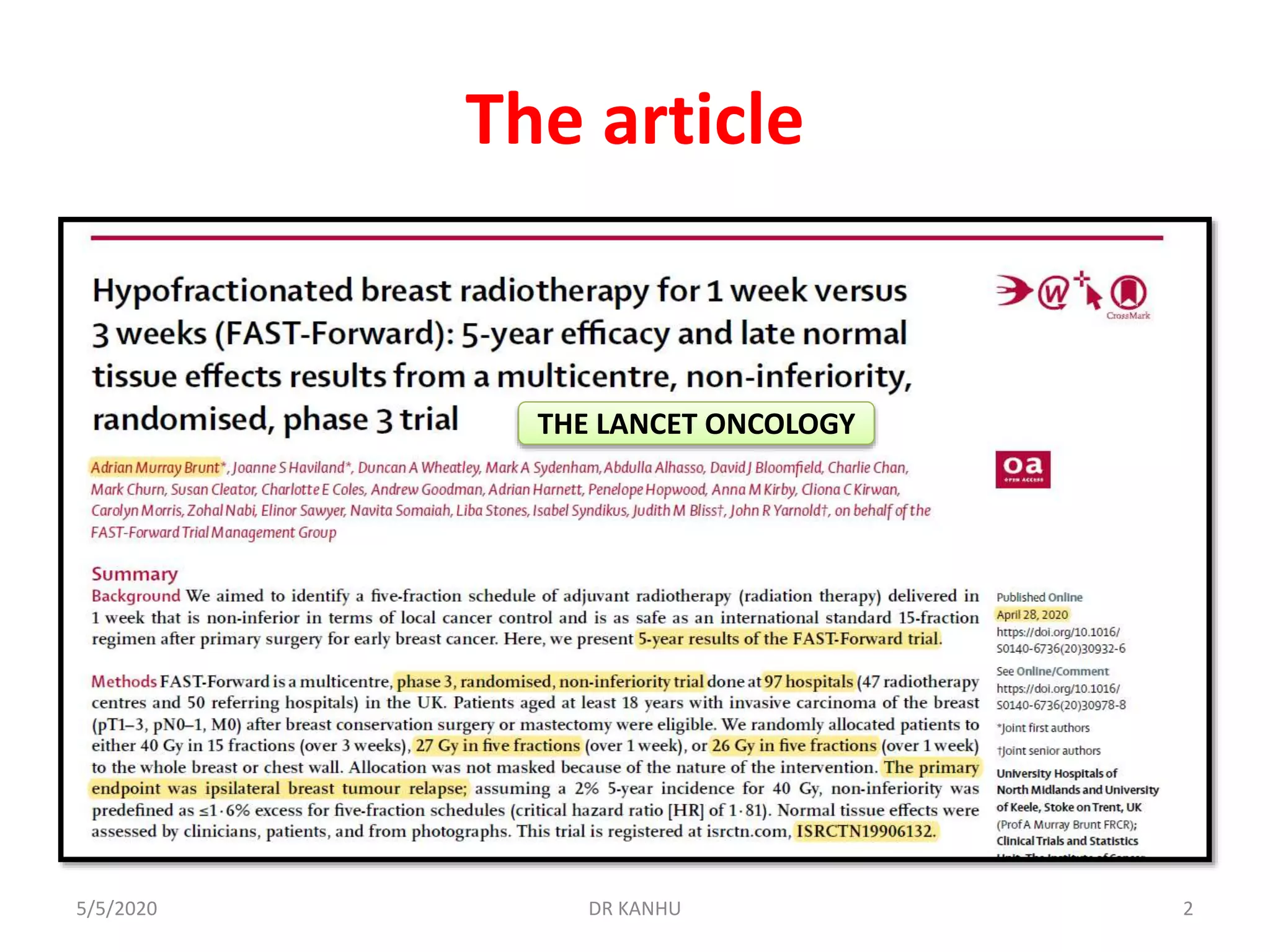
The article
25/5/2020 DR KANHU
THE LANCET ONCOLOGY
It is all about
35/5/2020 DR KANHU
Adrian Murray Brunt
• Royal Stoke University
Hospital
• Current position
– Professor of Clinical
Oncology
45/5/2020 DR KANHU
The background
• Adjuvant radiotherapy for breast cancer is the
standard after BCS and mastectomy if indicated.
• 25 # of 2 Gy over 5 weeks-standard
– Early Breast Cancer Trialists’ Collaborative Group
• A 3-wk schedule of 15 # has been the UK
standard of care since 2009 and is now an
international standard for adjuvant local
radiotherapy
– START trials
55/5/2020 DR KANHU
α⁄β= SENSITIVITY TO FRACTION SIZE
• If α ⁄β ratio of tumor is high (often 10 or
greater) and α⁄β ratio of normal tissue is low
(often < 5), lower dose per fraction (hyper
fractionation) is preferred
– e.g., HNSCC, Ca lung
• If α⁄β ratio of tumor is less than normal tissue
then a larger dose per fraction
(hypofractionation) is preferred
– e.g., prostate cancer, breast cancer
65/5/2020 DR KANHU
α/β ratio breast
• Breast cancer is an exception in showing low
α/β ratio.
• Hence it should be sensitive to high dose per
fraction.
• Adjusted α/β value for tumor control was
estimated to be 3.5 Gy
75/5/2020 DR KANHU
Why hypofraction?
• Results were consistent with hypothesis that
the breast cancer cells were sensitive to high
dose per fraction since they have low α/β
ratio
85/5/2020 DR KANHU
The evolution
95/5/2020 DR KANHU
The metaanalysis-START trials
105/5/2020 DR KANHU
UK FAST TRIAL
115/5/2020 DR KANHU
Weekly regimen
UK IMPORT LOW-IMRT
125/5/2020 DR KANHU
Reduced breast Partial breast
UK IMPORT HIGH-IMRT SIB
135/5/2020 DR KANHU
Results are awaited
The trial introduction
• Phase lll, randomized, non-inferiority trial
• Multicentre-97 hospitals
• UK
• Trial registration-ISRCTN19906132
• Nov 24, 2011 to June 19, 2014
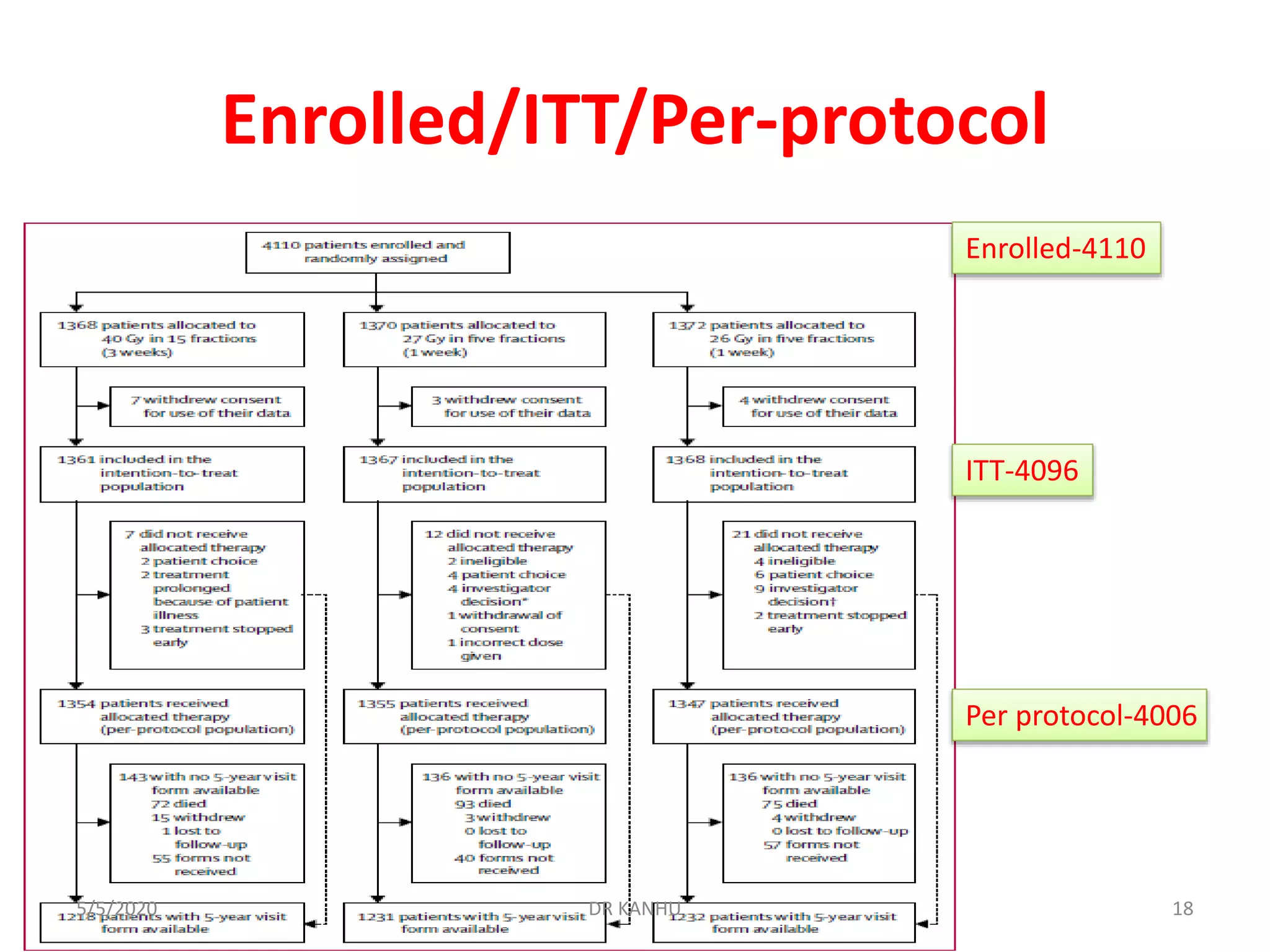
• 4096 patients of breast cancer
• 5-year results
145/5/2020 DR KANHU
Inclusions
• 18 years
• With invasive carcinoma of the breast
• (pT1–3, pN0–1, M0)
• Breast conservation surgery or mastectomy
• Reconstruction allowed
155/5/2020 DR KANHU
Exclusions
• Aged ≥65 years, pT1, grade 1 or 2, [ER] pos.,
HER2 negative, pN0, M0
• Amendment on Feb 15, 2013
165/5/2020 DR KANHU
Allowed and not allowed
Allowed
• Concurrent endocrine
therapy or trastuzumab, or
both
• Axillary surgery (sentinel
node biopsy or axillary
dissection
Not allowed
• Concurrent chemotherapy
• Nodal radiotherapy
175/5/2020 DR KANHU
Enrolled/ITT/Per-protocol
Enrolled-4110
ITT-4096
Per protocol-4006
185/5/2020 DR KANHU
Patient demography
5/5/2020 DR KANHU 19
Patient demography
5/5/2020 DR KANHU 20
Patient demography
215/5/2020 DR KANHU
Patient demography
225/5/2020 DR KANHU
Radiation details- Target
• Whole breast clinical target volume, including the soft
tissues from 5 mm below the skin surface to the deep
fascia.
• Postmastectomy chest wall clinical target volume
encompassed post-surgical skin flaps and underlying soft
tissues to the deep fascia.
• Both excluded underlying muscle and rib cage
• Surgeons were strongly encouraged to mark the tumour
cavity walls with titanium clips or gold seeds at the time of
breast conservation surgery in order to aid placement of
tangential fields and delineation of tumour bed.
• PTV-1cm
235/5/2020 DR KANHU
Radiation details-Plan
• The treatment plan was optimized with 3D
dose compensation to achieve the
• X-ray beam energies for treatment were 6 MV
or 10 MV, but a mixture of energies—eg, 6 MV
and 10–15 MV—was allowed for larger
patients, assessed on a case-by-case basis
• Tumour bed boost was delivered via electrons
or photons.
245/5/2020 DR KANHU
Radiation details- Prescription
• A tangential opposing pair beam arrangement
encompassed the whole breast or chest wall PTV
• Minimizing the ipsilateral lung and heart
exposure.
• Following PTV dose distribution:
– > 95% of PTV received 95% of prescribed dose
– < 5% of PTV received 105% or more,
– <2% of PTV received 107% or more
– Global maximum of < 110%.
255/5/2020 DR KANHU
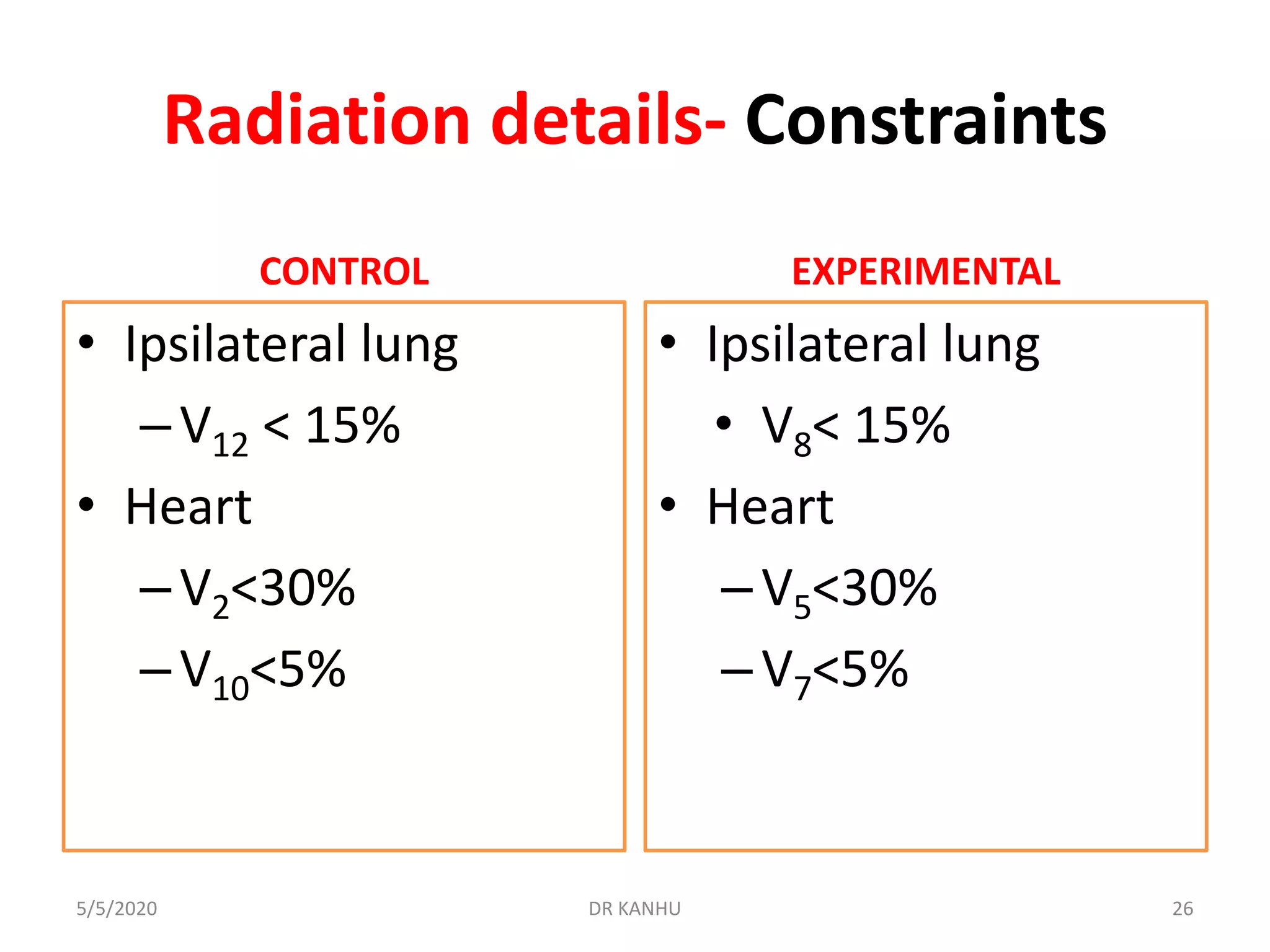
Radiation details- Constraints
CONTROL
• Ipsilateral lung
–V12 < 15%
• Heart
–V2<30%
–V10<5%
EXPERIMENTAL
• Ipsilateral lung
• V8< 15%
• Heart
–V5<30%
–V7<5%
265/5/2020 DR KANHU
Radiation details- Verification
CONTROL
• Treatment verification
was required for at least
– Three fractions in the first
week with correction for any
systematic error
– Then once weekly with a
tolerance of 5 mm
EXPERIMENTAL
• Verification imaging for
each fraction with
recommendations to
correct all measured
displacements.
275/5/2020 DR KANHU
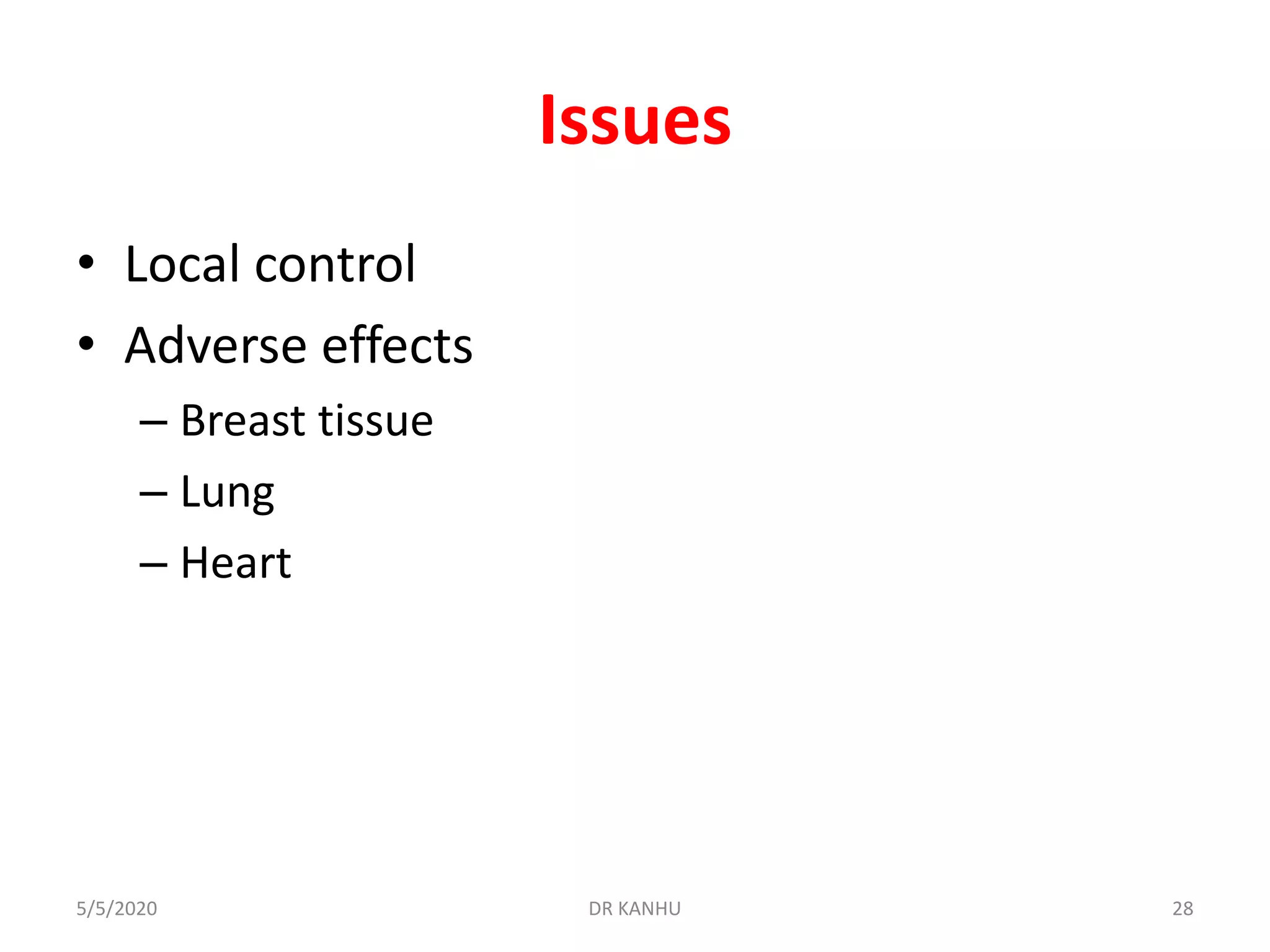
Issues
• Local control
• Adverse effects
– Breast tissue
– Lung
– Heart
285/5/2020 DR KANHU
OUTCOME end points
• Primary endpoint was ipsilateral breast tumor relapse
– Defined as invasive carcinoma or ductal carcinoma in situ
presenting anywhere in the ipsilateral breast parenchyma
or overlying skin or post-mastectomy chest wall, whether
considered local recurrence or new primary tumour.
• Secondary endpoints
– late normal tissue effects assessed by [PPP] physicians,
patients, and from photographs,
– Other disease-related and survival outcomes (loco regional
relapse, distant relapse, disease free survival, and overall
survival
295/5/2020 DR KANHU
Statistical analysis
• Patients were randomly assigned (1:1:1)
• Computer-generated random permuted blocks were used
• The target sample size was 4000 patients (balanced allocation
between groups).
• This provided 80% power
• One-sided α of 0・025 allowing for non-inferiority for relapse
• Because of multiple testing, a significance level of 0・005 was used
for the clinician and patient normal tissue effects assessments.
• All hypotheses for the normal tissue effects endpoints were two-
sided
• Kaplan-Meier estimates (with 95% CIs) of 5-year ipsilateral Breast
tumour relapse incidence
305/5/2020 DR KANHU
Statistical analysis
• Death from any cause as a competing event in a
Fine–Gray competing risks regression model
• Cross-sectional 5-year analyses compared
prevalence of moderate or marked effects versus
none or mild effects between groups using risk
ratios and risk differences and Fisher’s exact test
• Longitudinal analyses of moderate or marked
effects (vs none or mild) using generalized
estimating equations including all assessments,
comparing groups across the whole follow-up
period using odds ratios (ORs) and the Wald test
315/5/2020 DR KANHU
Statistical analysis
• No formal interim analyses were done
• All analyses were performed on an ITT basis
that included all patients
• Because the main hypothesis was non-
inferiority, the primary endpoint was also
tested in the per-protocol population,
325/5/2020 DR KANHU
Statistical analysis
• The primary endpoint was ipsilateral breast tumour
relapse; assuming a 2% 5-year incidence for 40 Gy,
non-inferiority was predefined as ≤1・6% excess for
5# schedules (critical hazard ratio [HR] of 1・81)
• Normal tissue effects were assessed by[PPP]
physicians, patients, and from photographs
• The database snapshot was taken on Nov 22, 2019;
Stata, version 15 (StataCorp)
335/5/2020 DR KANHU
Statistical analysis
• Estimates of fractionation sensitivity (α/β values) in FAST-
Forward were obtained for the primary endpoint of ipsilateral
breast tumour relapse and late normal tissue effects as per
methods in the START and FAST trials.
• The α/β estimate for breast cancer was obtained from a Cox
proportional hazards regression model basing on time to first
ipsilateral breast tumor relapse, and for late normal tissue
effects from generalized estimating equations models
including all follow-up assessments (separate models for
photographic and clinician assessments).
345/5/2020 DR KANHU
Assessment- PPP mode
• PPP mode
– Physician
– Patient
– Photography
355/5/2020 DR KANHU
Assessment- Physician mode
• Assessed by physicians for ipsilateral breast
tumour relapse and late normal tissue effects
at annual follow-up visits. Starting 12 months
after trial entry.
365/5/2020 DR KANHU
Late-onset normal tissue effects in
ipsilateral breast
• Late-onset normal tissue effects in ipsilateral
breast or chest wall
– Breast distortion,
– Shrinkage,
– Induration
– Telangiectasia
– Breast or chest wall oedema
– Discomfort
375/5/2020 DR KANHU
Assessment-Graded by physician
• Four-point scale
– None
– A little,
– Quite a bit,
– Very much
• Interpreted
– None,
– Mild,
– Moderate,
– Marked
385/5/2020 DR KANHU
Assessment- Patient mode
• EORTC of Cancer QLQ-BR23 breast cancer
module
• Before randomization at 3, 6, 12, 24, and 60
months
395/5/2020 DR KANHU
Assessment - Scale
• Patient assessments used a four point scale (not
at all, a little, quite a bit, and very much)
• Protocol-specific questions relating to changes to
the affected breast after treatment (including
breast appearance changed, smaller, harder or
firmer, and skin appearance changed).
• Breast size and surgical deficit were assessed
from the baseline photographs on a three-point
scale (small, medium, and large)
405/5/2020 DR KANHU
Assessment – Photographic mode
• In the photographic sub study, photographs were taken at
baseline and at 2 and 5 years after radiotherapy.
• Change in photographic breast appearance compared with
baseline (after surgery and before radiotherapy) was scored on a
three-point scale (none, mild, or marked) based on changes in
breast size and shape relative to the contralateral breast
• Patients were ineligible for further photographic assessments
after breast reconstruction surgery and further ipsilateral
disease.
• Digital photographs were scored by three observers who were
masked to patient identity and treatment allocation following
scoring procedures established in the START trials.
415/5/2020 DR KANHU
Result –Ipsilateral tumor recurrence
• Median follow-up of 71・5 months
• 79 patients
– 31 in the 40 Gy group
– 27 in the 27 Gy group-
• HRs versus 40 Gy is 0・86 (95% CI 0・51 to 1・44)
– 21 in the 26 Gy group-
• HRs versus 40 Gy is 0・67 (95% CI 0・38 to 1・16)
425/5/2020 DR KANHU
Ipsilateral breast tumor relapse
435/5/2020 DR KANHU
Relapse : time-to-event analysis
445/5/2020 DR KANHU
Mortality : time-to-event analysis
455/5/2020 DR KANHU
Relapses, second primary cancers,
and deaths by fractionation schedule
465/5/2020 DR KANHU
Normal tissue effects- Clinical
• At 5 years moderate or marked breast or chest wall
was reported for
– 98 of 986 (9・9%) 40 Gy patients,
– 155 (15・4%) of 1005 27 Gy patients, and
– 121 of 1020 (11・9%)26 Gy patients.
• OR Across all clinician assessments from 1–5 years
– 1・55 (95% CI 1・32 to 1・83, p<0・0001) for 27 Gy/ 5#
– 1・12 (95% CI 0・94 to 1・34, p=0・20) for 26 Gy / 5#
• Patient and photographic assessments showed higher
normal tissue effect risk for 27 Gy not for 26 Gy.
475/5/2020 DR KANHU
Normal tissue effects
Photographic assessment
• 1737 patients
• At 2 years, mild or marked change in photographic breast appearance was
reported in
– 35/411 (8・5%) 40 Gy,
– 67/429 (15・6%) for 27 Gy
– 46/427 (10・8%) for 26 Gy;
• At 5 years were
– 34 (12・0%) of 283 for 40 Gy,
– 83 (26・9%) of 308 for 27 Gy
– 37 (13・0%) of 284 for 26 Gy Modeling
• 2-year and 5-year together
– 27Gy vs 40 Gy (OR 2・29 [95% CI 1・60 to 3・27], p<0・0001),
– 26Gy vs 40 Gy (OR 1・26 [0・85 to 1・86], p=0・24
– 26 Gy had a significantly lower risk of change in photographic breast
appearance than 27 Gy (p=0・0006).
– 27 Gy had a significantly increased risk of mild or marked change in breast
appearance
485/5/2020 DR KANHU
Longitudinal analysis of moderate or marked clinician-
assessed late normal tissue effects for patients with at
least one annual clinical assessment
495/5/2020 DR KANHU
Longitudinal analysis of moderate or marked clinician-
assessed late normal tissue effects for patients with at
least one annual clinical assessment
505/5/2020 DR KANHU
Longitudinal analysis of moderate or marked patient-assessed
late normal tissue effects from baseline to 5 years
515/5/2020 DR KANHU
Longitudinal analysis of moderate or marked patient-assessed
late normal tissue effects from baseline to 5 years
525/5/2020 DR KANHU
Longitudinal analysis of moderate or marked patient-assessed
late normal tissue effects from baseline to 5 years
535/5/2020 DR KANHU
α/β estimate- relapse
The a/ß value of 3·7 Gy (95% CI
0·3–7·1) for tumour control in FAST-
Forward is similar to the 3·5 Gy (1·2–
5·7) estimated from the START pilot
and START-A trials
5/5/2020 DR KANHU 54
α/β estimate- Normal Tissue
• Unadjusted α/β estimate for any moderate or
marked clinician-assessed normal tissue effects in
the breast or chest wall was 1・7 Gy
• EQD2 estimates
– 47・1 Gy for 40 Gy in 15 fractions
– 51・6 Gy for 27 Gy in 5 fractions
– 48・3 Gy for 26 Gy in 5 fractions
• Adjusting for prognostic factors age, boost, and
whole-breast planning treatment volume as a
proxy for breast size
555/5/2020 DR KANHU
α/β estimate- Photographic
• Unadjusted α/β estimate for any moderate or
marked clinician-assessed normal tissue
effects in the breast or chest wall was 1・8 Gy
• EQD2 estimates
– 46・1 Gy for 40 Gy in 15 fractions
– 48・2 Gy for 27 Gy in 5 fractions
– 45・2 Gy for 26 Gy in 5 fractions
• Adjusting for breast size and surgical deficit
assessed from the baseline photographs
565/5/2020 DR KANHU
Worries
• BCS VS MRM
• Age
• Chemo used
• Dose distribution
• Boost
• Left vs Right
• Stage
• Nodal irradiation
• Brachial plexus
575/5/2020 DR KANHU
Strength of the study
• Well randomized
• Late tissue reaction assessment
• ITT analysis
• Well matched pair analysis
• PPP mode assessment
• α/β estimation
585/5/2020 DR KANHU
Pit falls of the study
• No subgroup analysis- on going
• No longer follow up
• Following recruitment into the main trial a further sub
study opened, testing the same fractionation schedules
for patients requiring radiotherapy to the axilla or
supraclavicular fossa lymph nodes after sentinel node
biopsy or supraclavicular fossa only (levels 3–4) after
axillary dissection with a primary endpoint focusing on
safety.
• Patients and results from this sub study are not
reported here because follow-up is not yet mature.
595/5/2020 DR KANHU
Summary
• 5-yr ipsilateral breast tumor relapse incidence after a
1-wk course of adj. breast radiotherapy delivered in
5# is non-inferior to the standard 3-wk schedule
according to the predefined inferiority threshold.
• The 26 Gy dose level is similar to 40 Gy in 15
fractions in terms of patient-assessed normal tissue
effects, clinician-assessed normal tissue effects, and
photographic change in breast appearance, and is
similar to normal tissue effects expected after 46–48
Gy in 2 Gy #
605/5/2020 DR KANHU
Take home message
1. The consistency of FAST-Forward results with
earlier hypofractionation trials supports the
adoption of 26 Gy in 5 daily # as a new standard
for women with operable breast cancer requiring
adjuvant to partial and whole breast
2. The 1-week schedule has major benefits over the
3-week or 5-week regimens in terms of
convenience and cost for patients and for health
services globally
615/5/2020 DR KANHU
In this corona situation
Think of hypofractionation
Go forward
With FAST Forward
IF YOU
5/5/2020 DR KANHU 62
5/5/2020 DR KANHU 63

FAST Forward Trial breast cancer

  • 1.
    Can we goforward with FAST Forward? The Journal club FAST Forward study Dr Kanhu Charan Patro 5/5/2020 1DR KANHU
  • 2.
    The article 25/5/2020 DRKANHU THE LANCET ONCOLOGY
  • 3.
    It is allabout 35/5/2020 DR KANHU
  • 4.
    Adrian Murray Brunt •Royal Stoke University Hospital • Current position – Professor of Clinical Oncology 45/5/2020 DR KANHU
  • 5.
    The background • Adjuvantradiotherapy for breast cancer is the standard after BCS and mastectomy if indicated. • 25 # of 2 Gy over 5 weeks-standard – Early Breast Cancer Trialists’ Collaborative Group • A 3-wk schedule of 15 # has been the UK standard of care since 2009 and is now an international standard for adjuvant local radiotherapy – START trials 55/5/2020 DR KANHU
  • 6.
    α⁄β= SENSITIVITY TOFRACTION SIZE • If α ⁄β ratio of tumor is high (often 10 or greater) and α⁄β ratio of normal tissue is low (often < 5), lower dose per fraction (hyper fractionation) is preferred – e.g., HNSCC, Ca lung • If α⁄β ratio of tumor is less than normal tissue then a larger dose per fraction (hypofractionation) is preferred – e.g., prostate cancer, breast cancer 65/5/2020 DR KANHU
  • 7.
    α/β ratio breast •Breast cancer is an exception in showing low α/β ratio. • Hence it should be sensitive to high dose per fraction. • Adjusted α/β value for tumor control was estimated to be 3.5 Gy 75/5/2020 DR KANHU
  • 8.
    Why hypofraction? • Resultswere consistent with hypothesis that the breast cancer cells were sensitive to high dose per fraction since they have low α/β ratio 85/5/2020 DR KANHU
  • 9.
  • 10.
  • 11.
    UK FAST TRIAL 115/5/2020DR KANHU Weekly regimen
  • 12.
    UK IMPORT LOW-IMRT 125/5/2020DR KANHU Reduced breast Partial breast
  • 13.
    UK IMPORT HIGH-IMRTSIB 135/5/2020 DR KANHU Results are awaited
  • 14.
    The trial introduction •Phase lll, randomized, non-inferiority trial • Multicentre-97 hospitals • UK • Trial registration-ISRCTN19906132 • Nov 24, 2011 to June 19, 2014 • 4096 patients of breast cancer • 5-year results 145/5/2020 DR KANHU
  • 15.
    Inclusions • 18 years •With invasive carcinoma of the breast • (pT1–3, pN0–1, M0) • Breast conservation surgery or mastectomy • Reconstruction allowed 155/5/2020 DR KANHU
  • 16.
    Exclusions • Aged ≥65years, pT1, grade 1 or 2, [ER] pos., HER2 negative, pN0, M0 • Amendment on Feb 15, 2013 165/5/2020 DR KANHU
  • 17.
    Allowed and notallowed Allowed • Concurrent endocrine therapy or trastuzumab, or both • Axillary surgery (sentinel node biopsy or axillary dissection Not allowed • Concurrent chemotherapy • Nodal radiotherapy 175/5/2020 DR KANHU
  • 18.
  • 19.
  • 20.
  • 21.
  • 22.
  • 23.
    Radiation details- Target •Whole breast clinical target volume, including the soft tissues from 5 mm below the skin surface to the deep fascia. • Postmastectomy chest wall clinical target volume encompassed post-surgical skin flaps and underlying soft tissues to the deep fascia. • Both excluded underlying muscle and rib cage • Surgeons were strongly encouraged to mark the tumour cavity walls with titanium clips or gold seeds at the time of breast conservation surgery in order to aid placement of tangential fields and delineation of tumour bed. • PTV-1cm 235/5/2020 DR KANHU
  • 24.
    Radiation details-Plan • Thetreatment plan was optimized with 3D dose compensation to achieve the • X-ray beam energies for treatment were 6 MV or 10 MV, but a mixture of energies—eg, 6 MV and 10–15 MV—was allowed for larger patients, assessed on a case-by-case basis • Tumour bed boost was delivered via electrons or photons. 245/5/2020 DR KANHU
  • 25.
    Radiation details- Prescription •A tangential opposing pair beam arrangement encompassed the whole breast or chest wall PTV • Minimizing the ipsilateral lung and heart exposure. • Following PTV dose distribution: – > 95% of PTV received 95% of prescribed dose – < 5% of PTV received 105% or more, – <2% of PTV received 107% or more – Global maximum of < 110%. 255/5/2020 DR KANHU
  • 26.
    Radiation details- Constraints CONTROL •Ipsilateral lung –V12 < 15% • Heart –V2<30% –V10<5% EXPERIMENTAL • Ipsilateral lung • V8< 15% • Heart –V5<30% –V7<5% 265/5/2020 DR KANHU
  • 27.
    Radiation details- Verification CONTROL •Treatment verification was required for at least – Three fractions in the first week with correction for any systematic error – Then once weekly with a tolerance of 5 mm EXPERIMENTAL • Verification imaging for each fraction with recommendations to correct all measured displacements. 275/5/2020 DR KANHU
  • 28.
    Issues • Local control •Adverse effects – Breast tissue – Lung – Heart 285/5/2020 DR KANHU
  • 29.
    OUTCOME end points •Primary endpoint was ipsilateral breast tumor relapse – Defined as invasive carcinoma or ductal carcinoma in situ presenting anywhere in the ipsilateral breast parenchyma or overlying skin or post-mastectomy chest wall, whether considered local recurrence or new primary tumour. • Secondary endpoints – late normal tissue effects assessed by [PPP] physicians, patients, and from photographs, – Other disease-related and survival outcomes (loco regional relapse, distant relapse, disease free survival, and overall survival 295/5/2020 DR KANHU
  • 30.
    Statistical analysis • Patientswere randomly assigned (1:1:1) • Computer-generated random permuted blocks were used • The target sample size was 4000 patients (balanced allocation between groups). • This provided 80% power • One-sided α of 0・025 allowing for non-inferiority for relapse • Because of multiple testing, a significance level of 0・005 was used for the clinician and patient normal tissue effects assessments. • All hypotheses for the normal tissue effects endpoints were two- sided • Kaplan-Meier estimates (with 95% CIs) of 5-year ipsilateral Breast tumour relapse incidence 305/5/2020 DR KANHU
  • 31.
    Statistical analysis • Deathfrom any cause as a competing event in a Fine–Gray competing risks regression model • Cross-sectional 5-year analyses compared prevalence of moderate or marked effects versus none or mild effects between groups using risk ratios and risk differences and Fisher’s exact test • Longitudinal analyses of moderate or marked effects (vs none or mild) using generalized estimating equations including all assessments, comparing groups across the whole follow-up period using odds ratios (ORs) and the Wald test 315/5/2020 DR KANHU
  • 32.
    Statistical analysis • Noformal interim analyses were done • All analyses were performed on an ITT basis that included all patients • Because the main hypothesis was non- inferiority, the primary endpoint was also tested in the per-protocol population, 325/5/2020 DR KANHU
  • 33.
    Statistical analysis • Theprimary endpoint was ipsilateral breast tumour relapse; assuming a 2% 5-year incidence for 40 Gy, non-inferiority was predefined as ≤1・6% excess for 5# schedules (critical hazard ratio [HR] of 1・81) • Normal tissue effects were assessed by[PPP] physicians, patients, and from photographs • The database snapshot was taken on Nov 22, 2019; Stata, version 15 (StataCorp) 335/5/2020 DR KANHU
  • 34.
    Statistical analysis • Estimatesof fractionation sensitivity (α/β values) in FAST- Forward were obtained for the primary endpoint of ipsilateral breast tumour relapse and late normal tissue effects as per methods in the START and FAST trials. • The α/β estimate for breast cancer was obtained from a Cox proportional hazards regression model basing on time to first ipsilateral breast tumor relapse, and for late normal tissue effects from generalized estimating equations models including all follow-up assessments (separate models for photographic and clinician assessments). 345/5/2020 DR KANHU
  • 35.
    Assessment- PPP mode •PPP mode – Physician – Patient – Photography 355/5/2020 DR KANHU
  • 36.
    Assessment- Physician mode •Assessed by physicians for ipsilateral breast tumour relapse and late normal tissue effects at annual follow-up visits. Starting 12 months after trial entry. 365/5/2020 DR KANHU
  • 37.
    Late-onset normal tissueeffects in ipsilateral breast • Late-onset normal tissue effects in ipsilateral breast or chest wall – Breast distortion, – Shrinkage, – Induration – Telangiectasia – Breast or chest wall oedema – Discomfort 375/5/2020 DR KANHU
  • 38.
    Assessment-Graded by physician •Four-point scale – None – A little, – Quite a bit, – Very much • Interpreted – None, – Mild, – Moderate, – Marked 385/5/2020 DR KANHU
  • 39.
    Assessment- Patient mode •EORTC of Cancer QLQ-BR23 breast cancer module • Before randomization at 3, 6, 12, 24, and 60 months 395/5/2020 DR KANHU
  • 40.
    Assessment - Scale •Patient assessments used a four point scale (not at all, a little, quite a bit, and very much) • Protocol-specific questions relating to changes to the affected breast after treatment (including breast appearance changed, smaller, harder or firmer, and skin appearance changed). • Breast size and surgical deficit were assessed from the baseline photographs on a three-point scale (small, medium, and large) 405/5/2020 DR KANHU
  • 41.
    Assessment – Photographicmode • In the photographic sub study, photographs were taken at baseline and at 2 and 5 years after radiotherapy. • Change in photographic breast appearance compared with baseline (after surgery and before radiotherapy) was scored on a three-point scale (none, mild, or marked) based on changes in breast size and shape relative to the contralateral breast • Patients were ineligible for further photographic assessments after breast reconstruction surgery and further ipsilateral disease. • Digital photographs were scored by three observers who were masked to patient identity and treatment allocation following scoring procedures established in the START trials. 415/5/2020 DR KANHU
  • 42.
    Result –Ipsilateral tumorrecurrence • Median follow-up of 71・5 months • 79 patients – 31 in the 40 Gy group – 27 in the 27 Gy group- • HRs versus 40 Gy is 0・86 (95% CI 0・51 to 1・44) – 21 in the 26 Gy group- • HRs versus 40 Gy is 0・67 (95% CI 0・38 to 1・16) 425/5/2020 DR KANHU
  • 43.
    Ipsilateral breast tumorrelapse 435/5/2020 DR KANHU
  • 44.
    Relapse : time-to-eventanalysis 445/5/2020 DR KANHU
  • 45.
    Mortality : time-to-eventanalysis 455/5/2020 DR KANHU
  • 46.
    Relapses, second primarycancers, and deaths by fractionation schedule 465/5/2020 DR KANHU
  • 47.
    Normal tissue effects-Clinical • At 5 years moderate or marked breast or chest wall was reported for – 98 of 986 (9・9%) 40 Gy patients, – 155 (15・4%) of 1005 27 Gy patients, and – 121 of 1020 (11・9%)26 Gy patients. • OR Across all clinician assessments from 1–5 years – 1・55 (95% CI 1・32 to 1・83, p<0・0001) for 27 Gy/ 5# – 1・12 (95% CI 0・94 to 1・34, p=0・20) for 26 Gy / 5# • Patient and photographic assessments showed higher normal tissue effect risk for 27 Gy not for 26 Gy. 475/5/2020 DR KANHU
  • 48.
    Normal tissue effects Photographicassessment • 1737 patients • At 2 years, mild or marked change in photographic breast appearance was reported in – 35/411 (8・5%) 40 Gy, – 67/429 (15・6%) for 27 Gy – 46/427 (10・8%) for 26 Gy; • At 5 years were – 34 (12・0%) of 283 for 40 Gy, – 83 (26・9%) of 308 for 27 Gy – 37 (13・0%) of 284 for 26 Gy Modeling • 2-year and 5-year together – 27Gy vs 40 Gy (OR 2・29 [95% CI 1・60 to 3・27], p<0・0001), – 26Gy vs 40 Gy (OR 1・26 [0・85 to 1・86], p=0・24 – 26 Gy had a significantly lower risk of change in photographic breast appearance than 27 Gy (p=0・0006). – 27 Gy had a significantly increased risk of mild or marked change in breast appearance 485/5/2020 DR KANHU
  • 49.
    Longitudinal analysis ofmoderate or marked clinician- assessed late normal tissue effects for patients with at least one annual clinical assessment 495/5/2020 DR KANHU
  • 50.
    Longitudinal analysis ofmoderate or marked clinician- assessed late normal tissue effects for patients with at least one annual clinical assessment 505/5/2020 DR KANHU
  • 51.
    Longitudinal analysis ofmoderate or marked patient-assessed late normal tissue effects from baseline to 5 years 515/5/2020 DR KANHU
  • 52.
    Longitudinal analysis ofmoderate or marked patient-assessed late normal tissue effects from baseline to 5 years 525/5/2020 DR KANHU
  • 53.
    Longitudinal analysis ofmoderate or marked patient-assessed late normal tissue effects from baseline to 5 years 535/5/2020 DR KANHU
  • 54.
    α/β estimate- relapse Thea/ß value of 3·7 Gy (95% CI 0·3–7·1) for tumour control in FAST- Forward is similar to the 3·5 Gy (1·2– 5·7) estimated from the START pilot and START-A trials 5/5/2020 DR KANHU 54
  • 55.
    α/β estimate- NormalTissue • Unadjusted α/β estimate for any moderate or marked clinician-assessed normal tissue effects in the breast or chest wall was 1・7 Gy • EQD2 estimates – 47・1 Gy for 40 Gy in 15 fractions – 51・6 Gy for 27 Gy in 5 fractions – 48・3 Gy for 26 Gy in 5 fractions • Adjusting for prognostic factors age, boost, and whole-breast planning treatment volume as a proxy for breast size 555/5/2020 DR KANHU
  • 56.
    α/β estimate- Photographic •Unadjusted α/β estimate for any moderate or marked clinician-assessed normal tissue effects in the breast or chest wall was 1・8 Gy • EQD2 estimates – 46・1 Gy for 40 Gy in 15 fractions – 48・2 Gy for 27 Gy in 5 fractions – 45・2 Gy for 26 Gy in 5 fractions • Adjusting for breast size and surgical deficit assessed from the baseline photographs 565/5/2020 DR KANHU
  • 57.
    Worries • BCS VSMRM • Age • Chemo used • Dose distribution • Boost • Left vs Right • Stage • Nodal irradiation • Brachial plexus 575/5/2020 DR KANHU
  • 58.
    Strength of thestudy • Well randomized • Late tissue reaction assessment • ITT analysis • Well matched pair analysis • PPP mode assessment • α/β estimation 585/5/2020 DR KANHU
  • 59.
    Pit falls ofthe study • No subgroup analysis- on going • No longer follow up • Following recruitment into the main trial a further sub study opened, testing the same fractionation schedules for patients requiring radiotherapy to the axilla or supraclavicular fossa lymph nodes after sentinel node biopsy or supraclavicular fossa only (levels 3–4) after axillary dissection with a primary endpoint focusing on safety. • Patients and results from this sub study are not reported here because follow-up is not yet mature. 595/5/2020 DR KANHU
  • 60.
    Summary • 5-yr ipsilateralbreast tumor relapse incidence after a 1-wk course of adj. breast radiotherapy delivered in 5# is non-inferior to the standard 3-wk schedule according to the predefined inferiority threshold. • The 26 Gy dose level is similar to 40 Gy in 15 fractions in terms of patient-assessed normal tissue effects, clinician-assessed normal tissue effects, and photographic change in breast appearance, and is similar to normal tissue effects expected after 46–48 Gy in 2 Gy # 605/5/2020 DR KANHU
  • 61.
    Take home message 1.The consistency of FAST-Forward results with earlier hypofractionation trials supports the adoption of 26 Gy in 5 daily # as a new standard for women with operable breast cancer requiring adjuvant to partial and whole breast 2. The 1-week schedule has major benefits over the 3-week or 5-week regimens in terms of convenience and cost for patients and for health services globally 615/5/2020 DR KANHU In this corona situation Think of hypofractionation Go forward With FAST Forward
  • 62.
  • 63.