Contents
 Introduction
 Choosing Forging operation
 Main Project Part (Connecting Rod)
 Part Material
 Manufacturing Operation
 Die material
 Conclusion
Introduction
 Aluminium has since been identified as the most
common metal on earth, forming about eight percent
of the earth's crust. It is the third most plentiful element
known to man.
 A number of unique and attractive properties
account for engineering significance of aluminium
.These include its workability ,light weight ,corrosion
resistance and good electrical and thermal
conductivity.
 Aluminium has a specific gravity 2.7 compared to 7.85
for steel , making aluminium about one -third the
weight of steel for an equivalent.
Forging operation
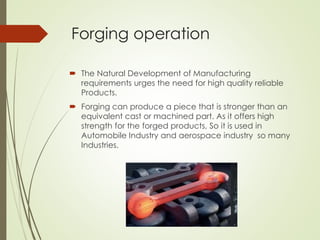
 The Natural Development of Manufacturing
requirements urges the need for high quality reliable
Products.
 Forging can produce a piece that is stronger than an
equivalent cast or machined part. As it offers high
strength for the forged products, So it is used in
Automobile Industry and aerospace industry so many
Industries.
Connecting Rod
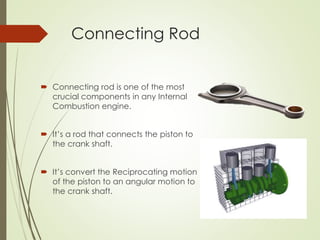
 Connecting rod is one of the most
crucial components in any Internal
Combustion engine.
 It’s a rod that connects the piston to
the crank shaft.
 It’s convert the Reciprocating motion
of the piston to an angular motion to
the crank shaft.
Stresses on Connecting Rod
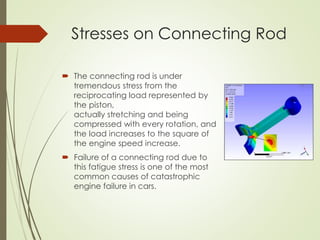
 The connecting rod is under
tremendous stress from the
reciprocating load represented by
the piston,
actually stretching and being
compressed with every rotation, and
the load increases to the square of
the engine speed increase.
 Failure of a connecting rod due to
this fatigue stress is one of the most
common causes of catastrophic
engine failure in cars.
Connecting Rod Material
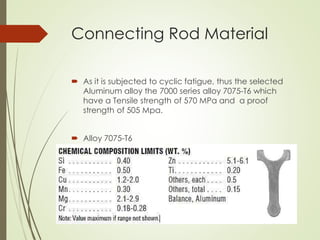
 As it is subjected to cyclic fatigue, thus the selected
Aluminum alloy the 7000 series alloy 7075-T6 which
have a Tensile strength of 570 MPa and a proof
strength of 505 Mpa.
 Alloy 7075-T6
Manufacturing Operation
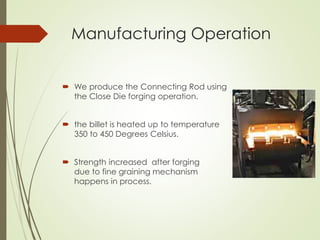
 We produce the Connecting Rod using
the Close Die forging operation.
 the billet is heated up to temperature
350 to 450 Degrees Celsius.
 Strength increased after forging
due to fine graining mechanism
happens in process.
Die design
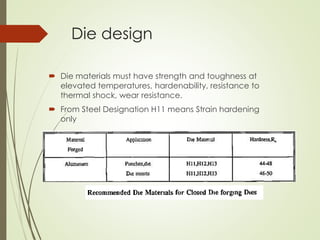
 Die materials must have strength and toughness at
elevated temperatures, hardenability, resistance to
thermal shock, wear resistance.
 From Steel Designation H11 means Strain hardening
only
Die design
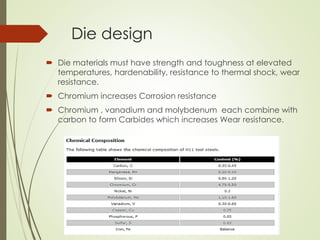
 Die materials must have strength and toughness at elevated
temperatures, hardenability, resistance to thermal shock, wear
resistance.
 Chromium increases Corrosion resistance
 Chromium , vanadium and molybdenum each combine with
carbon to form Carbides which increases Wear resistance.
Conclusion
 Presence of aluminum in earth crust , importance and
applications
 Importance of Forging process and its applications in
industry
 Connecting rod working principle and stresses applied
in
 Aluminum alloy 7075 T6 , its chemical composition and
effect of major alloying element (Zinc) in it
 Manufacturing operation
 Manufacturing considerations as Die Material
 Chemical composition of Die Material
Thank you
Mahmoud
Khairy
Toka
Mohamed
Mohamed
Samir
Mohamed
Ibrahim
Khulod
Amer

Aluminum forging presentation

  • 2.
    Contents  Introduction  ChoosingForging operation  Main Project Part (Connecting Rod)  Part Material  Manufacturing Operation  Die material  Conclusion
  • 3.
    Introduction  Aluminium hassince been identified as the most common metal on earth, forming about eight percent of the earth's crust. It is the third most plentiful element known to man.  A number of unique and attractive properties account for engineering significance of aluminium .These include its workability ,light weight ,corrosion resistance and good electrical and thermal conductivity.  Aluminium has a specific gravity 2.7 compared to 7.85 for steel , making aluminium about one -third the weight of steel for an equivalent.
  • 4.
    Forging operation  TheNatural Development of Manufacturing requirements urges the need for high quality reliable Products.  Forging can produce a piece that is stronger than an equivalent cast or machined part. As it offers high strength for the forged products, So it is used in Automobile Industry and aerospace industry so many Industries.
  • 5.
    Connecting Rod  Connectingrod is one of the most crucial components in any Internal Combustion engine.  It’s a rod that connects the piston to the crank shaft.  It’s convert the Reciprocating motion of the piston to an angular motion to the crank shaft.
  • 6.
    Stresses on ConnectingRod  The connecting rod is under tremendous stress from the reciprocating load represented by the piston, actually stretching and being compressed with every rotation, and the load increases to the square of the engine speed increase.  Failure of a connecting rod due to this fatigue stress is one of the most common causes of catastrophic engine failure in cars.
  • 7.
    Connecting Rod Material As it is subjected to cyclic fatigue, thus the selected Aluminum alloy the 7000 series alloy 7075-T6 which have a Tensile strength of 570 MPa and a proof strength of 505 Mpa.  Alloy 7075-T6
  • 8.
    Manufacturing Operation  Weproduce the Connecting Rod using the Close Die forging operation.  the billet is heated up to temperature 350 to 450 Degrees Celsius.  Strength increased after forging due to fine graining mechanism happens in process.
  • 9.
    Die design  Diematerials must have strength and toughness at elevated temperatures, hardenability, resistance to thermal shock, wear resistance.  From Steel Designation H11 means Strain hardening only
  • 10.
    Die design  Diematerials must have strength and toughness at elevated temperatures, hardenability, resistance to thermal shock, wear resistance.  Chromium increases Corrosion resistance  Chromium , vanadium and molybdenum each combine with carbon to form Carbides which increases Wear resistance.
  • 11.
    Conclusion  Presence ofaluminum in earth crust , importance and applications  Importance of Forging process and its applications in industry  Connecting rod working principle and stresses applied in  Aluminum alloy 7075 T6 , its chemical composition and effect of major alloying element (Zinc) in it  Manufacturing operation  Manufacturing considerations as Die Material  Chemical composition of Die Material
  • 12.