International Research Journal of Engineering and Technology (IRJET) e-ISSN: 2395-0056
Volume: 07 Issue: 03 | Mar 2020 www.irjet.net p-ISSN: 2395-0072
© 2020, IRJET | Impact Factor value: 7.34 | ISO 9001:2008 Certified Journal | Page 1011
Design and Analysis of Connecting Rod using Different Materials
Mr. H D. Nitturkar1, Mr. S M. Kalshetti2, Mr. A R. Nadaf3
1Mr. H D. Nitturkar: Student, Dept. of Mechanical Engineering, BSIET College, Kolhapur, Maharashtra, India
2Mr. S M. Kalshetti: Student, Dept. of Mechanical Engineering, BSIET College, Kolhapur, Maharashtra, India
3Mr.A R. Nadaf: Professor, Dept. of Mechanical Engineering, BSIET College, Kolhapur, Maharashtra, India
---------------------------------------------------------------------***---------------------------------------------------------------------
Abstract - The connecting rod is the intermediate member
between the piston and the Crankshaft. Its primary function is
to transmit the push and pull from the piston pin to the crank
pin, thus converting the reciprocating motion of the piston
into rotary motion of the crank. Thisthesisdescribesdesigning
and Analysis of connecting rod. Currently, existing connecting
rod is manufactured by using Forged steel. In this, drawing is
drafted from the calculations. A parametric model of
Connecting rod is modeled using NX 10 software and to that
model, analysis is carried out by using ANSYS Workbench
Software. Finite element analysis of connecting rod is done by
considering the materials, such as Titanium Alloy, Beryllium
Alloy – 25, Magnesium Alloy and Aluminum 360. The best
combination of parameters like Von misses Stress and strain,
Deformation, Factor of safety and weight reduction for two
wheeler piston were done in ANSYS software. AluminiumAlloy
has more factor of safety, reduce the weight, reduce the stress
and stiffer than other material like Forged Steel. With Fatigue
analysis we can determine the lifetime of the connecting rod.
Key Words: Connecting Rod, Aluminium Alloy,
Forged Steel, Ansys Workbench, etc.
1. INTRODUCTION
Internal Combustion engine has many parts like cylinder,
piston, connecting rod, crank and crank shaft. The
connecting rod is very important part of an engine. Working
of the connecting rod is to transmit power of piston to crank
pin. Connecting rod has two ends one is pin end and other is
crank end. Pin end is attached with piston. The big end
(crank end) is attached to the crank pin by a crankshaft. The
function of crank shaft is to transmit the reciprocating
motion of piston into rotary motion. The connecting rod
should be such that it can sustain the maximumloadwithout
any failure during high cycle fatigue. The connecting rodhas
generally three parts; pin end, crank end, and long shank.
Design of shank can be different type like rectangular,
tubular, circular, I-section and H-section. Circular section is
generally used for low speed engines. I-section is used for
high speed engines.
2. LITERATURE REVIEW
This section includes the literaturesurveyof earlierresearch
work made by various researchers on connecting rod.
Various researchers presented the different techniques in
the development of connecting rod and their optimization.
This section presents the summary of these research works.
1. Pai (1996) presented an approach to optimize
shape of connecting rod subjected to a load cycle,
consisting of the inertia loaddeductedfromgasload
as one extreme and peak inertia load exerted bythe
piston assembly mass as the other extreme, with
fatigue life constraint. Fatigue life defined as the
sum of the crack initiation and crack growth lives,
was obtained using fracture mechanics principles.
The approach used finite element routine to first
calculate the displacements and stresses in the rod;
these were then used in a separate routine to
calculate the total life. The stressesandthelife were
used in an optimization routine to evaluate the
objective function and constraints.
2. Kuldeep B “Analysis and optimizationofconnecting
rod using ALFASiC composites”. Generally
connecting rods are manufactured using carbon
steel and in recent days Aluminium alloys are
finding its application in connecting rod. In this
work connecting rod is replaced by Aluminium
based composite material reinforced with silicon
carbide and fly ash. And it also describes the
modelling and analysis of connecting rod. FEA
analysis was carried out by considering two
materials. The parameterlikevonmissesstress,von
misses strain and displacements were obtained
from ANSYS software.
3. Prof. N.p.doshi “analysis of connecting rod using
analytical and finite element method”. The most
International Research Journal of Engineering and Technology (IRJET) e-ISSN: 2395-0056
Volume: 07 Issue: 03 | Mar 2020 www.irjet.net p-ISSN: 2395-0072
© 2020, IRJET | Impact Factor value: 7.34 | ISO 9001:2008 Certified Journal | Page 1012
common types of materials used for connecting
rods are steel and aluminium. Connecting rods are
widely used in variety of engines such as, in-line
engines, v-engines, opposed cylinder engines,radial
engines and oppose-piston engines. For the project
work we have selected connecting rod used in light
commercial vehicleoftata motorshadrecentlybeen
launched in the market. We found out the stresses
developed in connecting rod under static loading
with different loading conditions of compression
and tension at crank end and pin end of connecting
rod.
3. PROBLEM DEFINATION
The connecting rods are most usually made of steel for
production engines, but can be made of aluminum (for
lightness and the ability to absorbhighimpactattheexpense
of durability) or titanium (for a combination of strength and
lightness at the expense of affordability) for high
performance engines, or of cast iron for applications such as
motor scooters.
4. OBJECTIVES
1. To design the connecting rod for a petrol engine so
as to determine the section thickness of connecting
rod.
2. To geometrically model the connecting rod as per
the dimensions generated from the process of
design procedure followed.
3. To analyze the buckling load which is equivalent
stress due to inertia forces acting on each material
of connecting rod.
4. To analyze the stresses using FEA approachoneach
material selected for study.
5. DESIGN OF CONNECTING ROD
In an internal combustion engine, most stressed part is
connecting rod. There are different typesofstressesinduced
in connecting rod. One of them is force of gaspressurewhich
is induced by combustion of fuel in the cylinder so that a
high compressive force is acted on the piston pin. And the
other one is inertial force which is causedbyreciprocatingof
piston. Connecting rod can be made of different type of
materials. In modern era it is generally made of steel, but it
can be made of aluminium (reducing the weight and the
ability of absorbing high impact) or titanium alloy (for high
performance engines) or cast iron for two wheeler like
scooters, mopeds, etc. In this project study three materials
Aluminium-360, Forged Steel, & Titanium Alloy are
considered for Ansys.
Engine Specification:-
1) Engine Type – S.I, 4 Stroke, Air Cooled Engine
2) Displacement – 149.5 cc
3) Bore × Stroke – 57 mm × 58.6 mm
4) Maximum Power – 13.8 bhp @8500 rpm
5) Maximum Torque – 13.4 Nm @6000 rpm
6) Fuel Used – Petrol (C8H18)
 Calculation for Gas Pressure
Mass of Fuel (Mf) = density of fuel × Volume of
cylinder
Mf = 0.11 Kg
Temperature = T (60oC = 288.85oK)
Specific Gas Constant (RSpecific) = RAir / MP
⸫RSpecific = 72.786 J K-1 Mol-1
Therefore by using Ideal Gas Law,
PV = MRT
⸫ P = 15.5 Mpa
 Calculating Load Acting on Connecting Rod by
Gases
F1 = (Π/4) × (bore)2 × Gas Pressure (P)
⸫F1 = 39.552 × 10 3 N
 Calculation for Buckling Load
WB = Load acting of connecting rod (F1) × F.O.S
⸫WB = 37663N
 Calculation for Moment of Inertia around both
the axis of I-Section
Ixx = 34.91 t4
IYY = 10.91 t4
Area of Section (A) = 11 t2
Height of Section (H) = 5t
Width of Section (B) = 4t
Therefore, by using Rankine’s Formula
by solving the Rankine’s Formula, we get the value
of ‘t’ as 3.2 mm.
 Design of Small End
Fg = d1(inner dia.) × l 1 × P bp
⸫ d1 = 17.94 mm
l1 = 1.5 × d 1 = 26.94 mm
Outer Diameter (d2) = d1 + 2 tb + 2 tm
⸫ d2 = 31.94 mm
 Design of Big End
Fg = d3(inner dia.) × l 2 × P bp
WB = σc × A
1 + α (L / Kxx)2
International Research Journal of Engineering and Technology (IRJET) e-ISSN: 2395-0056
Volume: 07 Issue: 03 | Mar 2020 www.irjet.net p-ISSN: 2395-0072
© 2020, IRJET | Impact Factor value: 7.34 | ISO 9001:2008 Certified Journal | Page 1013
⸫ d3 = 23.88 mm
⸫ l1 = 1.0× d 3 = 23.88 mm
Outer Diameter (d4) = d3 + 2 tb + 2 tm + 2 bd
⸫ d4 = 47.72 mm
From above calculations following values of Connecting Rod
were obtained;
Table 1- Specifications of Connecting rod.
Sr. No. Parameters (mm)
1. Thickness of the connecting rod (t) = 3.2
2. Width of the section (B = 4t) = 12.8
3. Height of the section(H = 5t) = 16
4. Height at the big end = (1.1 to 1.125)H = 17.6
5. Height at the small end = 0.9H to 0.75H = 14.4
6. Inner diameter of the small end = 17.94
7. Outer diameter of the small end = 31.94
8. Inner diameter of the big end = 23.88
9. Outer diameter of the big end = 47.72
6. SPECIFICATIONS OF CONNECTING ROD
In this project, study three materials i.e Aluminium-
360, Forged Steel, & Titanium Alloy are considered for
Ansys.
Table 2- Material Properties
7. MODELING AND ANALYSIS OF CONNECTING ROD
Modeling of Connecting Rod (NX10):-
Step 1:- Opened NX10 Software.
Step 2:- Selected MODEL option.
Step 3:- Gave the software the location to save the file.
Step 4:- Selected the SKETCH option.
Step 5:- Selected the suitable plane for sketching the
connecting rod. (YZ Plane).
Step 6:- Selected the CIRCLE option and drew a circle(Circle
1). (Inner dia. Of big end - 23.88).
Step 7:- Again selected the CIRCLE option and drew a circle
(Circle 2) for the same centre as that of previous circle
(Outer dia. Of big end - 47.72)
Step 8:- Selected the LINE option and drew a line (Center
line) from center or the circle.
Step 9:- Again selected the CIRCLE option and drew a circle
(Circle 3) at the other end of the previously drawn line.
(Inner dia. Of small end – 17.94).
Step 10:- Drew another circle (Circle 4) on the center of
(Circle 3). (Outer dia. Of small end – 31.94).
Step 11:- Selected the LINE option and drew two parallel
lines on both sides of the previously drawn line. (Distance
between center line and parallel lines - 8 each).
Step 12:- Followed the same steps and drew a rectangular
slot between the upper circles and lower circles. (Thickness
– 8, Height – 40).
Step 13:- Selected the TRIM option and trimmed the
unwanted lines.
Step 14:- Clicked on the FINISH SKETCH option.
Step 15:- Selected the EXTRUDE option and selected the
lower circle and extruded it symmetrically. (Height of big
end – 17.6).
Step 16:- Similarly extruded all the components of the
connecting rod symmetrically. (Height of small end – 14.4,
Height of the section – 16, Height of the slot – 3.2).
Step 17:- United every component with each other.
Step 18:- Selected the SHOW AND HIDE option and hide the
sketches, datum planes, co-ordinate system, etc.
Step 19:- Saved the Model using SAVE option.
Step 20:- Again selected the SAVE option and saved the
model in IGES format for further analysis on ANSYS
Software.
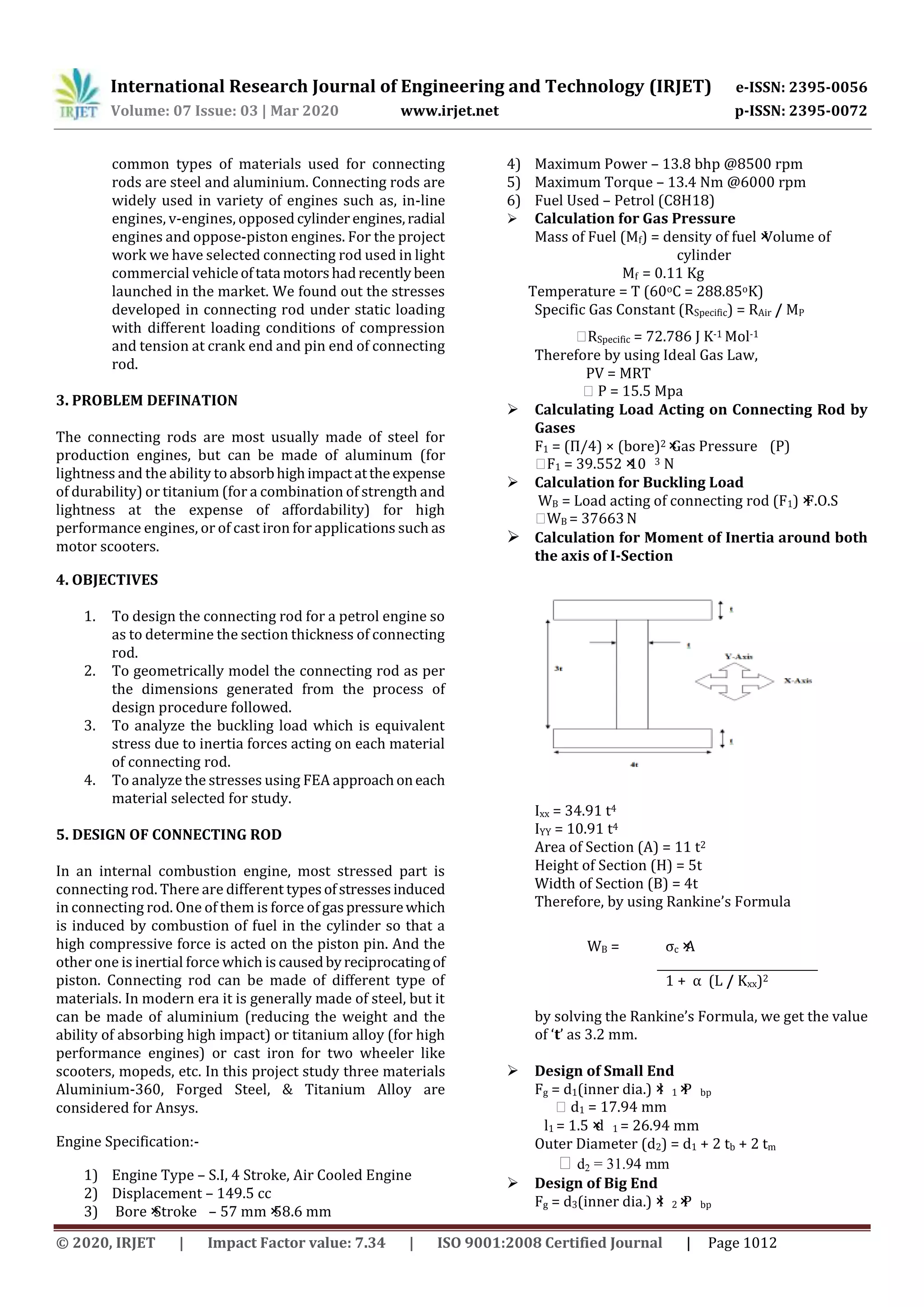
Figure 1 – Connecting Rod designed in NX 10 software
 Static Analysis
Static analysis deals with the conditionsofequilibriumofthe
bodies acted upon by forces. A static analysis can be either
linear or non-linear. All types of non-linearities are allowed
such as large deformations,plasticity,creep,stressstiffening,
Material Tensile
yield
strength
(MPa)
Ultimate
tensile
strength
(MPa)
Density
(kg/m3)
Aluminum
360
170 317 2680
Forged steel 415 625 7900
Titanium
alloy
1207 1276 4840
International Research Journal of Engineering and Technology (IRJET) e-ISSN: 2395-0056
Volume: 07 Issue: 03 | Mar 2020 www.irjet.net p-ISSN: 2395-0072
© 2020, IRJET | Impact Factor value: 7.34 | ISO 9001:2008 Certified Journal | Page 1014
contact elements etc. this chapter focuses on static analysis.
A static analysis calculates the effects of steady loading
conditions on a structure, while ignoring inertia and
damping effects, such as those carried by time varyingloads.
A static analysis is used to determine the displacements,
stresses, strains and forces in structures or components
caused by loads that do not induce significant inertia and
damping effects. A static analysis can however include
steady inertia loads such as gravity, spinning and time
varying loads. In static analysis loading and response
conditions are assumed, that is the loads and the structure
responses are assumed to vary slowly with respect to time.
The kinds of loading that can be applied in static analysis
includes,
a) Externally applied forces, moments and pressures
b) Steady state inertial forces such as gravity and
spinning
c) Imposed non-zero displacements
A static analysis result of structural displacements, stresses
and strains and forces in structures for components caused
by loads will give a clear idea about whether thestructure or
components will withstand for the applied maximumforces.
If the stress values obtained in this analysis crosses the
allowable values it will result in the failureofthestructure in
the static condition itself. To avoid such a failure, this
analysis is necessary. Following is theproceduretocarry out
static structural analysis:
1. Started Ansys Workbench.
2. Double clicked on Static Structural in the toolbox
window to add it to the Project Schematic window.
3. Renamed the Static Structural analysis system as
“Connecting Rod”.
4. In the connecting rod analysis system, we double
clicked the “Geometry” cell; the “Design Modeler”
window along with the ANSYS Workbench dialog
box is displayed.
5. Set the units to Millimeter and imported the
external geometry file of connecting rod which we
designed in NX10 software. (As per the steps
mentioned above)
6. Exit the “Design Modeler” window.
7. Then we defined “Engineering Data”. In this section
material for the current project is assigned. In
ANSYS by default structural steel is selected. To
assign new material we turned on the engineering
data source. Then we generated new library for
connecting rod and made a tick mark on the new
generated library named connecting rod to convert
it into edit mode. After this, we added different five
materials which are kept under study. After giving
all required properties for connecting rod wesaved
them into the Library. In the samewaywesavedthe
information about all consideration andthen added
all the five materials in the content by clicking on
the plus sign.
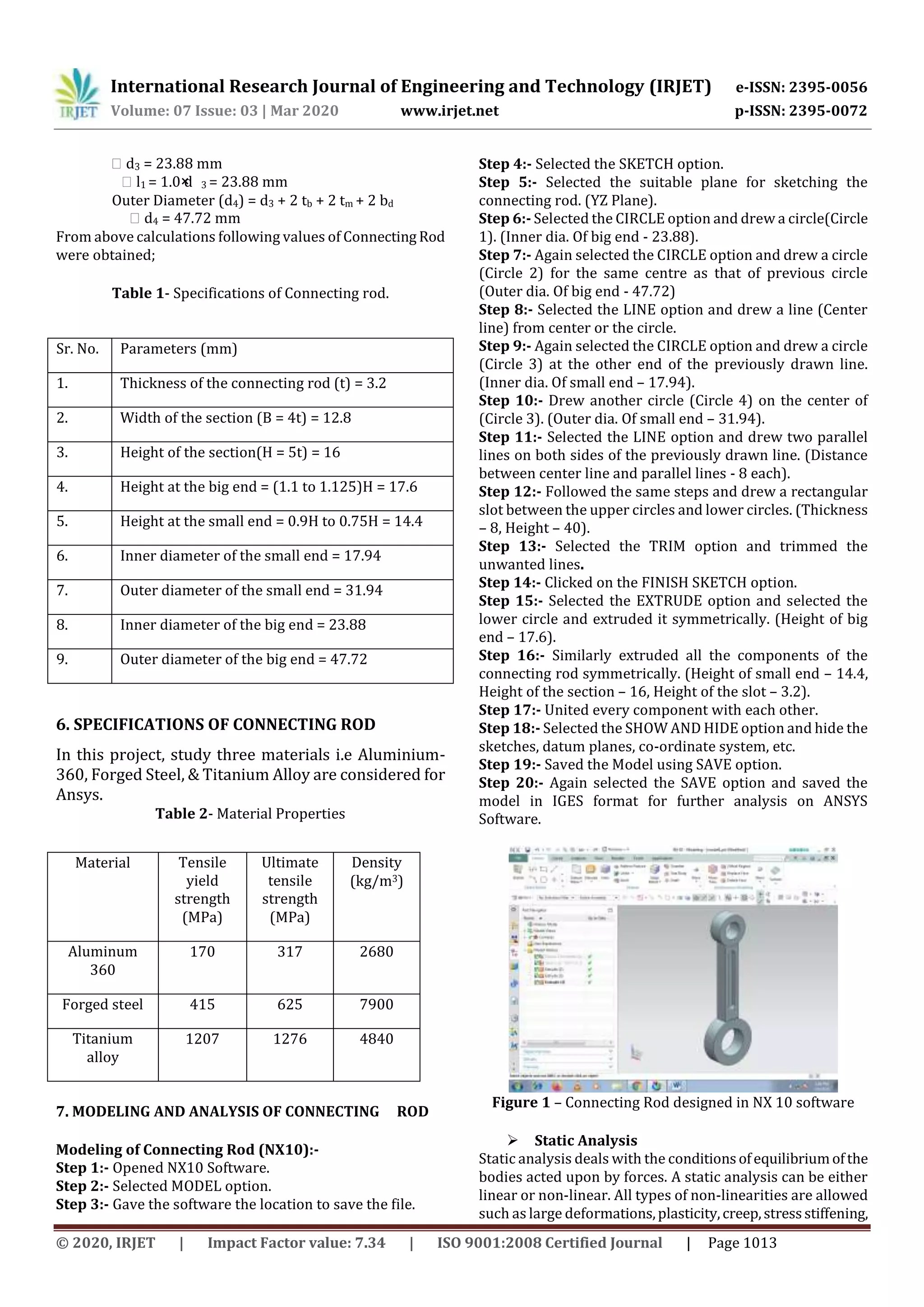
8. After importing the external geometry, we meshed
the connecting rod. Meshing is done for better
accuracy in result.
Figure 2 – Meshing of Connecting Rod in ANSYS
Workbench
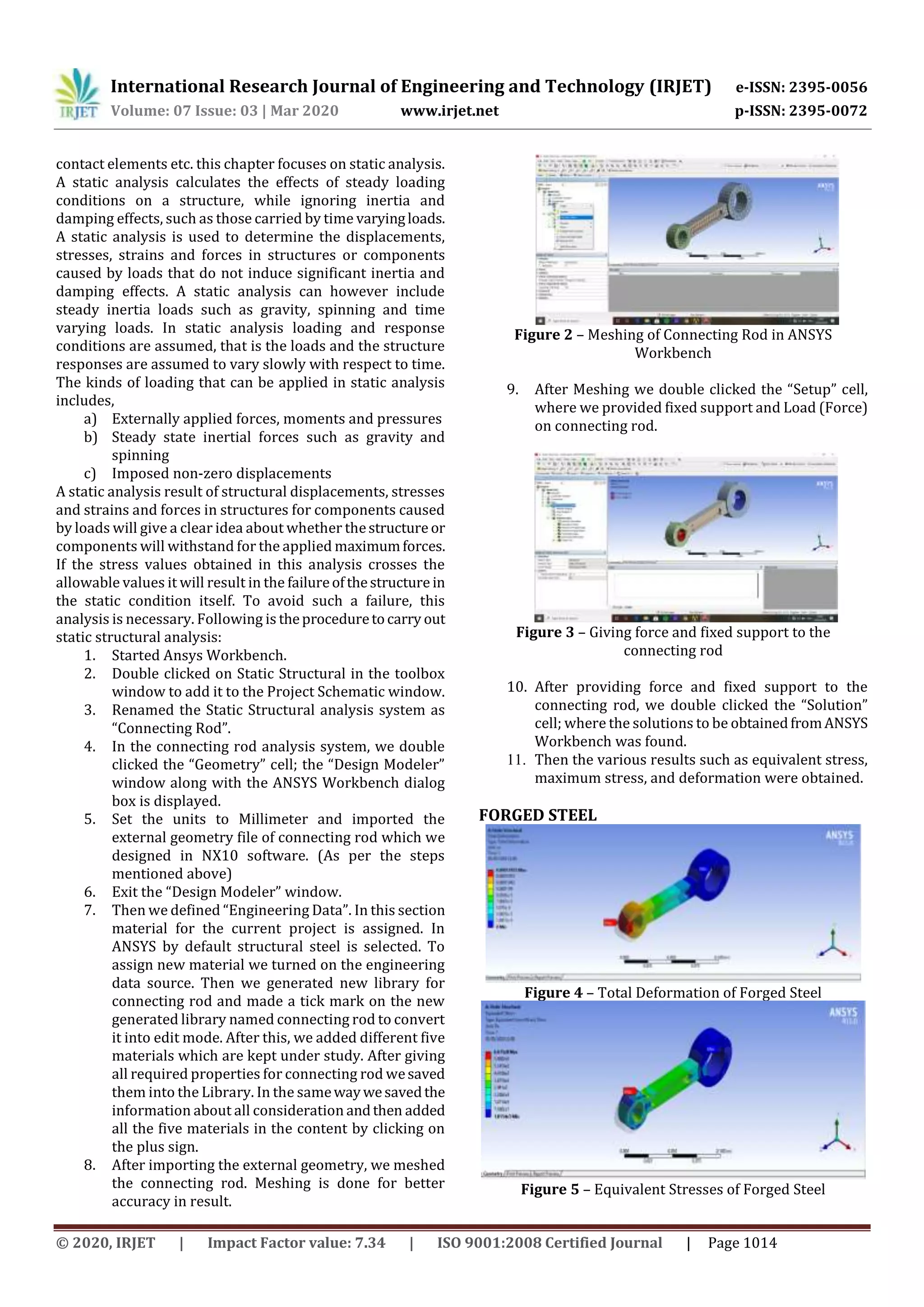
9. After Meshing we double clicked the “Setup” cell,
where we provided fixed support and Load (Force)
on connecting rod.
Figure 3 – Giving force and fixed support to the
connecting rod
10. After providing force and fixed support to the
connecting rod, we double clicked the “Solution”
cell; where the solutions to be obtainedfromANSYS
Workbench was found.
11. Then the various results such as equivalent stress,
maximum stress, and deformation were obtained.
FORGED STEEL
Figure 4 – Total Deformation of Forged Steel
Figure 5 – Equivalent Stresses of Forged Steel
International Research Journal of Engineering and Technology (IRJET) e-ISSN: 2395-0056
Volume: 07 Issue: 03 | Mar 2020 www.irjet.net p-ISSN: 2395-0072
© 2020, IRJET | Impact Factor value: 7.34 | ISO 9001:2008 Certified Journal | Page 1015
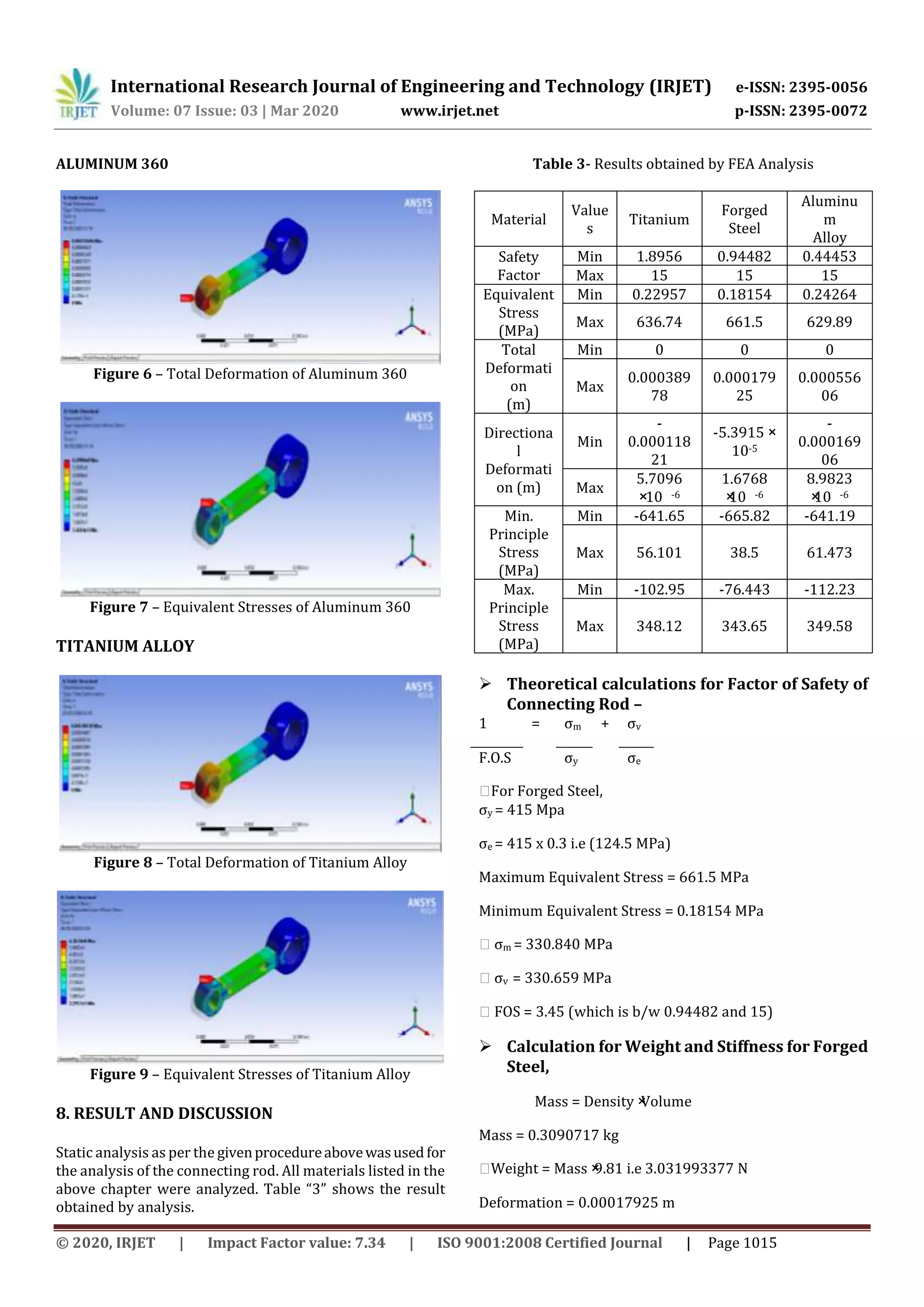
ALUMINUM 360
Figure 6 – Total Deformation of Aluminum 360
Figure 7 – Equivalent Stresses of Aluminum 360
TITANIUM ALLOY
Figure 8 – Total Deformation of Titanium Alloy
Figure 9 – Equivalent Stresses of Titanium Alloy
8. RESULT AND DISCUSSION
Static analysis as per the givenprocedureabovewasused for
the analysis of the connecting rod. All materials listed in the
above chapter were analyzed. Table “3” shows the result
obtained by analysis.
Table 3- Results obtained by FEA Analysis
Material
Value
s
Titanium
Forged
Steel
Aluminu
m
Alloy
Safety
Factor
Min 1.8956 0.94482 0.44453
Max 15 15 15
Equivalent
Stress
(MPa)
Min 0.22957 0.18154 0.24264
Max 636.74 661.5 629.89
Total
Deformati
on
(m)
Min 0 0 0
Max
0.000389
78
0.000179
25
0.000556
06
Directiona
l
Deformati
on (m)
Min
-
0.000118
21
-5.3915 ×
10-5
-
0.000169
06
Max
5.7096
× 10 -6
1.6768
× 10 -6
8.9823
× 10 -6
Min.
Principle
Stress
(MPa)
Min -641.65 -665.82 -641.19
Max 56.101 38.5 61.473
Max.
Principle
Stress
(MPa)
Min -102.95 -76.443 -112.23
Max 348.12 343.65 349.58
 Theoretical calculations for Factor of Safety of
Connecting Rod –
1 = σm + σv
F.O.S σy σe
⸫For Forged Steel,
σy = 415 Mpa
σe = 415 x 0.3 i.e (124.5 MPa)
Maximum Equivalent Stress = 661.5 MPa
Minimum Equivalent Stress = 0.18154 MPa
⸫ σm = 330.840 MPa
⸫ σv = 330.659 MPa
⸫ FOS = 3.45 (which is b/w 0.94482 and 15)
 Calculation for Weight and Stiffness for Forged
Steel,
Mass = Density × Volume
Mass = 0.3090717 kg
⸫Weight = Mass × 9.81 i.e 3.031993377 N
Deformation = 0.00017925 m
International Research Journal of Engineering and Technology (IRJET) e-ISSN: 2395-0056
Volume: 07 Issue: 03 | Mar 2020 www.irjet.net p-ISSN: 2395-0072
© 2020, IRJET | Impact Factor value: 7.34 | ISO 9001:2008 Certified Journal | Page 1016
⸫ Stiffness = Weight / Deformation
= 16914.88634 N/m or 16.91488634 N/mm
By above specified calculations the values for above other
materials were found to be safe for applicationofconnecting
rod and specified in the table given below;
Table 4 - Result obtained by theoretical analysis.
Stresses
Materials
Titanium
Alloy
Forged Steel
Aluminum
360
σm
(Mpa)
318.4847 330.84077 315.06632
σy (Mpa) 1207 415 170
σv (Mpa) 318.2552 330.65923 314.82368
σe (Mpa) 362.1 124.5 51
Stiffness
(N/m)
4765.7029 16914.8863 1849.7553
F.O.S 1.985 3.453 8.026.
9. CONCLUSION AND FUTURE SCOPE
1. Solid modeling of connecting rod was made in NX
10 according to design procedure usedandanalysis
under the effect of tensile and compressive loads in
terms of pressure is done in ANSYS Workbench.
2. From analysis it is observed that the minimum
stresses among all loadingconditions,werefoundat
crank end cap as well as at piston end. So the
material can be reduced from those portions,
thereby reducing material cost.
3. For further optimization of material dynamic
analysis of connecting rod is needed. After
considering dynamic load conditions once again
finite element analysis will have to be performed. It
will give more accurate results than existing.
4. From the static analysis the stress is found
maximum at the small end of the connecting rod.
5. Forged steel as a connecting rod material islessstiff
and having more weight than forged steel andother
material taking in consideration.
6. Forged steel connecting rod is having more weight
than Aluminium, magnesium and beryllium alloys
connecting rod.
7. Aluminium alloy connecting rod is having more
weight and displacement than magnesium and
beryllium alloys. So, aluminum connecting rod
shows more shaky behavior.
8. Maximum von mises stress, Maximum von mises
strain and Maximum displacement are minimum in
connecting rod of Beryllium alloy.
9. Other than conventional materials used the above
studied material can be also used as they show
greater quality than the conventional material.
10. The only thing that is barrier to implement ofabove
materials is costing, availability of material and its
repairing.
 Future Scope
The above work is presented on static analysis of
connecting rod and has many aspects to research
further as follows
1. Torsional analysis can be done due to presence of
small amount of torsional momentatthe endpoints.
2. Design modification can be done to minimize the
weight of connecting rod and the inertia force.
3. Work on the internal coating of hardmaterial inside
the both ends can be done to minimize the wear
failure in connecting rod.
4. Development of connecting rod using different
techniques and above stated materials can be
manufactured and experimental and dynamic
analysis can be carried out.
5. Fatigue analysis can also be carried out on material
having high quality and cost so as to improve and
define life of connecting rod.
REFERENCES
[1] Kuldeep B, Arun L.R, Mohammed Faheem “ANALYSIS
AND OPTIMIZATION OF CONNECTING ROD USING ALFASiC
COMPOSITES”, ISSN: 2319- 875, International Journal of
Innovative ResearchinScience,Engineeringand Technology,
Vol. 2, Issue 6, June 2013
[2] Prof. N.P.Doshi, 1 Prof .N.K.Ingole “ANALYSIS OF
CONNECTING ROD USING ANALYTICAL AND FINITE
ELEMENT METHOD”
INTERNATIONAL JOURNAL OF MODERN ENGINEERING
RESEARCH” (IJMER) www.ijmer.com Vol.3, Issue.1, Jan Feb.
2013, ISSN: 2249-6645.
[3] Yoo et al., M.M. Rahman, M.M. Noor, K. Kadirgama and
A.K. Amirruddin “DESIGN OF CONNECTING ROD OF
INTERNAL COMBUSTION ENGINE: ATOPOLOGY
OPTIMIZATION APPROACHM” National Conference in
Mechanical Engineering Research and Postgraduate Studies
(2nd NCMER 2010) 3-4 December 2010, pp.155166
[4] FOLGAR Analysis of Connecting RodUsingAnalytical and
Finite Element‟ International Journal ofModernEngineering
Research (IJMER), JanFeb. 2013, Vol.3, Issue.1, pp-65-68
BIOGRAPHIES
Mr. Hrishikesh D. Nitturkar
Diploma in Mechanical Engg.
Student, Dept. of Mechanical
Engineering, BSIET College,
Kolhapur, Maharashtra, India.
International Research Journal of Engineering and Technology (IRJET) e-ISSN: 2395-0056
Volume: 07 Issue: 03 | Mar 2020 www.irjet.net p-ISSN: 2395-0072
© 2020, IRJET | Impact Factor value: 7.34 | ISO 9001:2008 Certified Journal | Page 1017
Mr. Shlok M. Kalshetti
Diploma in Mechanical Engg.
Student, Dept. of Mechanical
Engineering, BSIET College,
Kolhapur, Maharashtra, India.
Mr. Anisahmed R. Nadaf
M. E. Design Engg, B. E. Mechanical
Engg. Lecturer at Diploma in
Mechanical Engg.
BSIET College, Kolhapur,
Maharashtra, India.

IRJET - Design and Analysis of Connecting Rod using Different Materials

  • 1.
    International Research Journalof Engineering and Technology (IRJET) e-ISSN: 2395-0056 Volume: 07 Issue: 03 | Mar 2020 www.irjet.net p-ISSN: 2395-0072 © 2020, IRJET | Impact Factor value: 7.34 | ISO 9001:2008 Certified Journal | Page 1011 Design and Analysis of Connecting Rod using Different Materials Mr. H D. Nitturkar1, Mr. S M. Kalshetti2, Mr. A R. Nadaf3 1Mr. H D. Nitturkar: Student, Dept. of Mechanical Engineering, BSIET College, Kolhapur, Maharashtra, India 2Mr. S M. Kalshetti: Student, Dept. of Mechanical Engineering, BSIET College, Kolhapur, Maharashtra, India 3Mr.A R. Nadaf: Professor, Dept. of Mechanical Engineering, BSIET College, Kolhapur, Maharashtra, India ---------------------------------------------------------------------***--------------------------------------------------------------------- Abstract - The connecting rod is the intermediate member between the piston and the Crankshaft. Its primary function is to transmit the push and pull from the piston pin to the crank pin, thus converting the reciprocating motion of the piston into rotary motion of the crank. Thisthesisdescribesdesigning and Analysis of connecting rod. Currently, existing connecting rod is manufactured by using Forged steel. In this, drawing is drafted from the calculations. A parametric model of Connecting rod is modeled using NX 10 software and to that model, analysis is carried out by using ANSYS Workbench Software. Finite element analysis of connecting rod is done by considering the materials, such as Titanium Alloy, Beryllium Alloy – 25, Magnesium Alloy and Aluminum 360. The best combination of parameters like Von misses Stress and strain, Deformation, Factor of safety and weight reduction for two wheeler piston were done in ANSYS software. AluminiumAlloy has more factor of safety, reduce the weight, reduce the stress and stiffer than other material like Forged Steel. With Fatigue analysis we can determine the lifetime of the connecting rod. Key Words: Connecting Rod, Aluminium Alloy, Forged Steel, Ansys Workbench, etc. 1. INTRODUCTION Internal Combustion engine has many parts like cylinder, piston, connecting rod, crank and crank shaft. The connecting rod is very important part of an engine. Working of the connecting rod is to transmit power of piston to crank pin. Connecting rod has two ends one is pin end and other is crank end. Pin end is attached with piston. The big end (crank end) is attached to the crank pin by a crankshaft. The function of crank shaft is to transmit the reciprocating motion of piston into rotary motion. The connecting rod should be such that it can sustain the maximumloadwithout any failure during high cycle fatigue. The connecting rodhas generally three parts; pin end, crank end, and long shank. Design of shank can be different type like rectangular, tubular, circular, I-section and H-section. Circular section is generally used for low speed engines. I-section is used for high speed engines. 2. LITERATURE REVIEW This section includes the literaturesurveyof earlierresearch work made by various researchers on connecting rod. Various researchers presented the different techniques in the development of connecting rod and their optimization. This section presents the summary of these research works. 1. Pai (1996) presented an approach to optimize shape of connecting rod subjected to a load cycle, consisting of the inertia loaddeductedfromgasload as one extreme and peak inertia load exerted bythe piston assembly mass as the other extreme, with fatigue life constraint. Fatigue life defined as the sum of the crack initiation and crack growth lives, was obtained using fracture mechanics principles. The approach used finite element routine to first calculate the displacements and stresses in the rod; these were then used in a separate routine to calculate the total life. The stressesandthelife were used in an optimization routine to evaluate the objective function and constraints. 2. Kuldeep B “Analysis and optimizationofconnecting rod using ALFASiC composites”. Generally connecting rods are manufactured using carbon steel and in recent days Aluminium alloys are finding its application in connecting rod. In this work connecting rod is replaced by Aluminium based composite material reinforced with silicon carbide and fly ash. And it also describes the modelling and analysis of connecting rod. FEA analysis was carried out by considering two materials. The parameterlikevonmissesstress,von misses strain and displacements were obtained from ANSYS software. 3. Prof. N.p.doshi “analysis of connecting rod using analytical and finite element method”. The most
  • 2.
    International Research Journalof Engineering and Technology (IRJET) e-ISSN: 2395-0056 Volume: 07 Issue: 03 | Mar 2020 www.irjet.net p-ISSN: 2395-0072 © 2020, IRJET | Impact Factor value: 7.34 | ISO 9001:2008 Certified Journal | Page 1012 common types of materials used for connecting rods are steel and aluminium. Connecting rods are widely used in variety of engines such as, in-line engines, v-engines, opposed cylinder engines,radial engines and oppose-piston engines. For the project work we have selected connecting rod used in light commercial vehicleoftata motorshadrecentlybeen launched in the market. We found out the stresses developed in connecting rod under static loading with different loading conditions of compression and tension at crank end and pin end of connecting rod. 3. PROBLEM DEFINATION The connecting rods are most usually made of steel for production engines, but can be made of aluminum (for lightness and the ability to absorbhighimpactattheexpense of durability) or titanium (for a combination of strength and lightness at the expense of affordability) for high performance engines, or of cast iron for applications such as motor scooters. 4. OBJECTIVES 1. To design the connecting rod for a petrol engine so as to determine the section thickness of connecting rod. 2. To geometrically model the connecting rod as per the dimensions generated from the process of design procedure followed. 3. To analyze the buckling load which is equivalent stress due to inertia forces acting on each material of connecting rod. 4. To analyze the stresses using FEA approachoneach material selected for study. 5. DESIGN OF CONNECTING ROD In an internal combustion engine, most stressed part is connecting rod. There are different typesofstressesinduced in connecting rod. One of them is force of gaspressurewhich is induced by combustion of fuel in the cylinder so that a high compressive force is acted on the piston pin. And the other one is inertial force which is causedbyreciprocatingof piston. Connecting rod can be made of different type of materials. In modern era it is generally made of steel, but it can be made of aluminium (reducing the weight and the ability of absorbing high impact) or titanium alloy (for high performance engines) or cast iron for two wheeler like scooters, mopeds, etc. In this project study three materials Aluminium-360, Forged Steel, & Titanium Alloy are considered for Ansys. Engine Specification:- 1) Engine Type – S.I, 4 Stroke, Air Cooled Engine 2) Displacement – 149.5 cc 3) Bore × Stroke – 57 mm × 58.6 mm 4) Maximum Power – 13.8 bhp @8500 rpm 5) Maximum Torque – 13.4 Nm @6000 rpm 6) Fuel Used – Petrol (C8H18)  Calculation for Gas Pressure Mass of Fuel (Mf) = density of fuel × Volume of cylinder Mf = 0.11 Kg Temperature = T (60oC = 288.85oK) Specific Gas Constant (RSpecific) = RAir / MP ⸫RSpecific = 72.786 J K-1 Mol-1 Therefore by using Ideal Gas Law, PV = MRT ⸫ P = 15.5 Mpa  Calculating Load Acting on Connecting Rod by Gases F1 = (Π/4) × (bore)2 × Gas Pressure (P) ⸫F1 = 39.552 × 10 3 N  Calculation for Buckling Load WB = Load acting of connecting rod (F1) × F.O.S ⸫WB = 37663N  Calculation for Moment of Inertia around both the axis of I-Section Ixx = 34.91 t4 IYY = 10.91 t4 Area of Section (A) = 11 t2 Height of Section (H) = 5t Width of Section (B) = 4t Therefore, by using Rankine’s Formula by solving the Rankine’s Formula, we get the value of ‘t’ as 3.2 mm.  Design of Small End Fg = d1(inner dia.) × l 1 × P bp ⸫ d1 = 17.94 mm l1 = 1.5 × d 1 = 26.94 mm Outer Diameter (d2) = d1 + 2 tb + 2 tm ⸫ d2 = 31.94 mm  Design of Big End Fg = d3(inner dia.) × l 2 × P bp WB = σc × A 1 + α (L / Kxx)2
  • 3.
    International Research Journalof Engineering and Technology (IRJET) e-ISSN: 2395-0056 Volume: 07 Issue: 03 | Mar 2020 www.irjet.net p-ISSN: 2395-0072 © 2020, IRJET | Impact Factor value: 7.34 | ISO 9001:2008 Certified Journal | Page 1013 ⸫ d3 = 23.88 mm ⸫ l1 = 1.0× d 3 = 23.88 mm Outer Diameter (d4) = d3 + 2 tb + 2 tm + 2 bd ⸫ d4 = 47.72 mm From above calculations following values of Connecting Rod were obtained; Table 1- Specifications of Connecting rod. Sr. No. Parameters (mm) 1. Thickness of the connecting rod (t) = 3.2 2. Width of the section (B = 4t) = 12.8 3. Height of the section(H = 5t) = 16 4. Height at the big end = (1.1 to 1.125)H = 17.6 5. Height at the small end = 0.9H to 0.75H = 14.4 6. Inner diameter of the small end = 17.94 7. Outer diameter of the small end = 31.94 8. Inner diameter of the big end = 23.88 9. Outer diameter of the big end = 47.72 6. SPECIFICATIONS OF CONNECTING ROD In this project, study three materials i.e Aluminium- 360, Forged Steel, & Titanium Alloy are considered for Ansys. Table 2- Material Properties 7. MODELING AND ANALYSIS OF CONNECTING ROD Modeling of Connecting Rod (NX10):- Step 1:- Opened NX10 Software. Step 2:- Selected MODEL option. Step 3:- Gave the software the location to save the file. Step 4:- Selected the SKETCH option. Step 5:- Selected the suitable plane for sketching the connecting rod. (YZ Plane). Step 6:- Selected the CIRCLE option and drew a circle(Circle 1). (Inner dia. Of big end - 23.88). Step 7:- Again selected the CIRCLE option and drew a circle (Circle 2) for the same centre as that of previous circle (Outer dia. Of big end - 47.72) Step 8:- Selected the LINE option and drew a line (Center line) from center or the circle. Step 9:- Again selected the CIRCLE option and drew a circle (Circle 3) at the other end of the previously drawn line. (Inner dia. Of small end – 17.94). Step 10:- Drew another circle (Circle 4) on the center of (Circle 3). (Outer dia. Of small end – 31.94). Step 11:- Selected the LINE option and drew two parallel lines on both sides of the previously drawn line. (Distance between center line and parallel lines - 8 each). Step 12:- Followed the same steps and drew a rectangular slot between the upper circles and lower circles. (Thickness – 8, Height – 40). Step 13:- Selected the TRIM option and trimmed the unwanted lines. Step 14:- Clicked on the FINISH SKETCH option. Step 15:- Selected the EXTRUDE option and selected the lower circle and extruded it symmetrically. (Height of big end – 17.6). Step 16:- Similarly extruded all the components of the connecting rod symmetrically. (Height of small end – 14.4, Height of the section – 16, Height of the slot – 3.2). Step 17:- United every component with each other. Step 18:- Selected the SHOW AND HIDE option and hide the sketches, datum planes, co-ordinate system, etc. Step 19:- Saved the Model using SAVE option. Step 20:- Again selected the SAVE option and saved the model in IGES format for further analysis on ANSYS Software. Figure 1 – Connecting Rod designed in NX 10 software  Static Analysis Static analysis deals with the conditionsofequilibriumofthe bodies acted upon by forces. A static analysis can be either linear or non-linear. All types of non-linearities are allowed such as large deformations,plasticity,creep,stressstiffening, Material Tensile yield strength (MPa) Ultimate tensile strength (MPa) Density (kg/m3) Aluminum 360 170 317 2680 Forged steel 415 625 7900 Titanium alloy 1207 1276 4840
  • 4.
    International Research Journalof Engineering and Technology (IRJET) e-ISSN: 2395-0056 Volume: 07 Issue: 03 | Mar 2020 www.irjet.net p-ISSN: 2395-0072 © 2020, IRJET | Impact Factor value: 7.34 | ISO 9001:2008 Certified Journal | Page 1014 contact elements etc. this chapter focuses on static analysis. A static analysis calculates the effects of steady loading conditions on a structure, while ignoring inertia and damping effects, such as those carried by time varyingloads. A static analysis is used to determine the displacements, stresses, strains and forces in structures or components caused by loads that do not induce significant inertia and damping effects. A static analysis can however include steady inertia loads such as gravity, spinning and time varying loads. In static analysis loading and response conditions are assumed, that is the loads and the structure responses are assumed to vary slowly with respect to time. The kinds of loading that can be applied in static analysis includes, a) Externally applied forces, moments and pressures b) Steady state inertial forces such as gravity and spinning c) Imposed non-zero displacements A static analysis result of structural displacements, stresses and strains and forces in structures for components caused by loads will give a clear idea about whether thestructure or components will withstand for the applied maximumforces. If the stress values obtained in this analysis crosses the allowable values it will result in the failureofthestructure in the static condition itself. To avoid such a failure, this analysis is necessary. Following is theproceduretocarry out static structural analysis: 1. Started Ansys Workbench. 2. Double clicked on Static Structural in the toolbox window to add it to the Project Schematic window. 3. Renamed the Static Structural analysis system as “Connecting Rod”. 4. In the connecting rod analysis system, we double clicked the “Geometry” cell; the “Design Modeler” window along with the ANSYS Workbench dialog box is displayed. 5. Set the units to Millimeter and imported the external geometry file of connecting rod which we designed in NX10 software. (As per the steps mentioned above) 6. Exit the “Design Modeler” window. 7. Then we defined “Engineering Data”. In this section material for the current project is assigned. In ANSYS by default structural steel is selected. To assign new material we turned on the engineering data source. Then we generated new library for connecting rod and made a tick mark on the new generated library named connecting rod to convert it into edit mode. After this, we added different five materials which are kept under study. After giving all required properties for connecting rod wesaved them into the Library. In the samewaywesavedthe information about all consideration andthen added all the five materials in the content by clicking on the plus sign. 8. After importing the external geometry, we meshed the connecting rod. Meshing is done for better accuracy in result. Figure 2 – Meshing of Connecting Rod in ANSYS Workbench 9. After Meshing we double clicked the “Setup” cell, where we provided fixed support and Load (Force) on connecting rod. Figure 3 – Giving force and fixed support to the connecting rod 10. After providing force and fixed support to the connecting rod, we double clicked the “Solution” cell; where the solutions to be obtainedfromANSYS Workbench was found. 11. Then the various results such as equivalent stress, maximum stress, and deformation were obtained. FORGED STEEL Figure 4 – Total Deformation of Forged Steel Figure 5 – Equivalent Stresses of Forged Steel
  • 5.
    International Research Journalof Engineering and Technology (IRJET) e-ISSN: 2395-0056 Volume: 07 Issue: 03 | Mar 2020 www.irjet.net p-ISSN: 2395-0072 © 2020, IRJET | Impact Factor value: 7.34 | ISO 9001:2008 Certified Journal | Page 1015 ALUMINUM 360 Figure 6 – Total Deformation of Aluminum 360 Figure 7 – Equivalent Stresses of Aluminum 360 TITANIUM ALLOY Figure 8 – Total Deformation of Titanium Alloy Figure 9 – Equivalent Stresses of Titanium Alloy 8. RESULT AND DISCUSSION Static analysis as per the givenprocedureabovewasused for the analysis of the connecting rod. All materials listed in the above chapter were analyzed. Table “3” shows the result obtained by analysis. Table 3- Results obtained by FEA Analysis Material Value s Titanium Forged Steel Aluminu m Alloy Safety Factor Min 1.8956 0.94482 0.44453 Max 15 15 15 Equivalent Stress (MPa) Min 0.22957 0.18154 0.24264 Max 636.74 661.5 629.89 Total Deformati on (m) Min 0 0 0 Max 0.000389 78 0.000179 25 0.000556 06 Directiona l Deformati on (m) Min - 0.000118 21 -5.3915 × 10⁻⁵ - 0.000169 06 Max 5.7096 × 10 -6 1.6768 × 10 -6 8.9823 × 10 -6 Min. Principle Stress (MPa) Min -641.65 -665.82 -641.19 Max 56.101 38.5 61.473 Max. Principle Stress (MPa) Min -102.95 -76.443 -112.23 Max 348.12 343.65 349.58  Theoretical calculations for Factor of Safety of Connecting Rod – 1 = σm + σv F.O.S σy σe ⸫For Forged Steel, σy = 415 Mpa σe = 415 x 0.3 i.e (124.5 MPa) Maximum Equivalent Stress = 661.5 MPa Minimum Equivalent Stress = 0.18154 MPa ⸫ σm = 330.840 MPa ⸫ σv = 330.659 MPa ⸫ FOS = 3.45 (which is b/w 0.94482 and 15)  Calculation for Weight and Stiffness for Forged Steel, Mass = Density × Volume Mass = 0.3090717 kg ⸫Weight = Mass × 9.81 i.e 3.031993377 N Deformation = 0.00017925 m
  • 6.
    International Research Journalof Engineering and Technology (IRJET) e-ISSN: 2395-0056 Volume: 07 Issue: 03 | Mar 2020 www.irjet.net p-ISSN: 2395-0072 © 2020, IRJET | Impact Factor value: 7.34 | ISO 9001:2008 Certified Journal | Page 1016 ⸫ Stiffness = Weight / Deformation = 16914.88634 N/m or 16.91488634 N/mm By above specified calculations the values for above other materials were found to be safe for applicationofconnecting rod and specified in the table given below; Table 4 - Result obtained by theoretical analysis. Stresses Materials Titanium Alloy Forged Steel Aluminum 360 σm (Mpa) 318.4847 330.84077 315.06632 σy (Mpa) 1207 415 170 σv (Mpa) 318.2552 330.65923 314.82368 σe (Mpa) 362.1 124.5 51 Stiffness (N/m) 4765.7029 16914.8863 1849.7553 F.O.S 1.985 3.453 8.026. 9. CONCLUSION AND FUTURE SCOPE 1. Solid modeling of connecting rod was made in NX 10 according to design procedure usedandanalysis under the effect of tensile and compressive loads in terms of pressure is done in ANSYS Workbench. 2. From analysis it is observed that the minimum stresses among all loadingconditions,werefoundat crank end cap as well as at piston end. So the material can be reduced from those portions, thereby reducing material cost. 3. For further optimization of material dynamic analysis of connecting rod is needed. After considering dynamic load conditions once again finite element analysis will have to be performed. It will give more accurate results than existing. 4. From the static analysis the stress is found maximum at the small end of the connecting rod. 5. Forged steel as a connecting rod material islessstiff and having more weight than forged steel andother material taking in consideration. 6. Forged steel connecting rod is having more weight than Aluminium, magnesium and beryllium alloys connecting rod. 7. Aluminium alloy connecting rod is having more weight and displacement than magnesium and beryllium alloys. So, aluminum connecting rod shows more shaky behavior. 8. Maximum von mises stress, Maximum von mises strain and Maximum displacement are minimum in connecting rod of Beryllium alloy. 9. Other than conventional materials used the above studied material can be also used as they show greater quality than the conventional material. 10. The only thing that is barrier to implement ofabove materials is costing, availability of material and its repairing.  Future Scope The above work is presented on static analysis of connecting rod and has many aspects to research further as follows 1. Torsional analysis can be done due to presence of small amount of torsional momentatthe endpoints. 2. Design modification can be done to minimize the weight of connecting rod and the inertia force. 3. Work on the internal coating of hardmaterial inside the both ends can be done to minimize the wear failure in connecting rod. 4. Development of connecting rod using different techniques and above stated materials can be manufactured and experimental and dynamic analysis can be carried out. 5. Fatigue analysis can also be carried out on material having high quality and cost so as to improve and define life of connecting rod. REFERENCES [1] Kuldeep B, Arun L.R, Mohammed Faheem “ANALYSIS AND OPTIMIZATION OF CONNECTING ROD USING ALFASiC COMPOSITES”, ISSN: 2319- 875, International Journal of Innovative ResearchinScience,Engineeringand Technology, Vol. 2, Issue 6, June 2013 [2] Prof. N.P.Doshi, 1 Prof .N.K.Ingole “ANALYSIS OF CONNECTING ROD USING ANALYTICAL AND FINITE ELEMENT METHOD” INTERNATIONAL JOURNAL OF MODERN ENGINEERING RESEARCH” (IJMER) www.ijmer.com Vol.3, Issue.1, Jan Feb. 2013, ISSN: 2249-6645. [3] Yoo et al., M.M. Rahman, M.M. Noor, K. Kadirgama and A.K. Amirruddin “DESIGN OF CONNECTING ROD OF INTERNAL COMBUSTION ENGINE: ATOPOLOGY OPTIMIZATION APPROACHM” National Conference in Mechanical Engineering Research and Postgraduate Studies (2nd NCMER 2010) 3-4 December 2010, pp.155166 [4] FOLGAR Analysis of Connecting RodUsingAnalytical and Finite Element‟ International Journal ofModernEngineering Research (IJMER), JanFeb. 2013, Vol.3, Issue.1, pp-65-68 BIOGRAPHIES Mr. Hrishikesh D. Nitturkar Diploma in Mechanical Engg. Student, Dept. of Mechanical Engineering, BSIET College, Kolhapur, Maharashtra, India.
  • 7.
    International Research Journalof Engineering and Technology (IRJET) e-ISSN: 2395-0056 Volume: 07 Issue: 03 | Mar 2020 www.irjet.net p-ISSN: 2395-0072 © 2020, IRJET | Impact Factor value: 7.34 | ISO 9001:2008 Certified Journal | Page 1017 Mr. Shlok M. Kalshetti Diploma in Mechanical Engg. Student, Dept. of Mechanical Engineering, BSIET College, Kolhapur, Maharashtra, India. Mr. Anisahmed R. Nadaf M. E. Design Engg, B. E. Mechanical Engg. Lecturer at Diploma in Mechanical Engg. BSIET College, Kolhapur, Maharashtra, India.