Dr. N.Sundar
Librarian
Thiagarajar College of Preceptors
Library Ethics
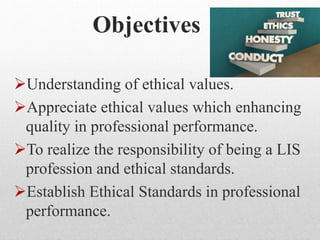
Understanding of ethical values.
Appreciate ethical values which enhancing
quality in professional performance.
To realize the responsibility of being a LIS
profession and ethical standards.
Establish Ethical Standards in professional
performance.
Objectives
Professional performance
conform to ethical
principles to provide user
satisfaction.
 Set of moral Principles.
Introduction
Librarianship/Information services fulfills
prescribed characteristics in order to
achieve quality as a profession.
Introduction
According to Chambers 20th Century
Dictionary, “ethics is a science of moral. It
is that branch of philosophy which is
concerned with the human character and
conduct.”
Introduction
Websters International Dictionary defines Ethics
as
1) Discipline dealing with what is good and bad
or right and wrong with moral duty.
2) theory or system or moral values; the
principles of conduct governing an individual or
a profession; standards of behaviour.
3) principles and practice or a system /philosophy
of conduct and principles practiced by a person
or group.
Ethics in General
Improves self-awareness
Promotes moral behavior by obligating members
to follow the group guidelines
Enhancing institutions reputation
Upholds diverse Perspectives
Highlights values of Professional Groups
Benefits
American Library Association (ALA)established and adopted ethical
code as given below.
 Access
 Confidentiality/Privacy
 Democracy
 Diversity
 Education and Lifelong Learning
 Intellectual Freedom
 Preservation
 The Public Good
 Service Oriented.
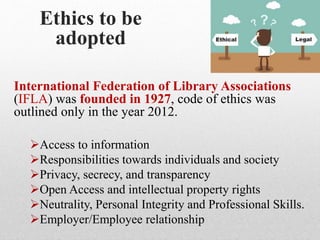
Ethics to be adopted
International Federation of Library Associations
(IFLA) was founded in 1927, code of ethics was
outlined only in the year 2012.
Access to information
Responsibilities towards individuals and society
Privacy, secrecy, and transparency
Open Access and intellectual property rights
Neutrality, Personal Integrity and Professional Skills.
Employer/Employee relationship
Ethics to be
adopted
Code of ethics and professional conduct for LIS
professionals in India
 Five laws of LIS
 Self
 Workplace (Institution and Library)
 Library Staff
 Users/Patrons/Customers
 Other Libraries/Peer and Professional Groups.
 Using Internet, Social Media and Mobile Apps
 Information and sources
 Publishing
 Society
Indian Perspectives
Five laws of Library Science proposed by
S.R.Ranganathan in 1931 were informally accepted as
an ethical code.
1. Books are for Use
2. Every reader his/her book
3. Every book its reader
4. Save the time of the reader
5. A library is a growing organism.
Five Laws of LS
 Foundation of Library and Information Science.
Lovely Professional University.
http://ebooks.lpude.in/library_and_info_science
s/DLIS/Year_1/DLIS001_FOUNDATION_OF_
LIBRARY_AND_INFORMATION_SCIENCE.
pdf
 Library and Information Science. Central Board
of Secondary Education. 2014.
Reference

Library Ethics

  • 1.
    Dr. N.Sundar Librarian Thiagarajar Collegeof Preceptors Library Ethics
  • 2.
    Understanding of ethicalvalues. Appreciate ethical values which enhancing quality in professional performance. To realize the responsibility of being a LIS profession and ethical standards. Establish Ethical Standards in professional performance. Objectives
  • 3.
    Professional performance conform toethical principles to provide user satisfaction.  Set of moral Principles. Introduction
  • 4.
    Librarianship/Information services fulfills prescribedcharacteristics in order to achieve quality as a profession. Introduction
  • 5.
    According to Chambers20th Century Dictionary, “ethics is a science of moral. It is that branch of philosophy which is concerned with the human character and conduct.” Introduction
  • 6.
    Websters International Dictionarydefines Ethics as 1) Discipline dealing with what is good and bad or right and wrong with moral duty. 2) theory or system or moral values; the principles of conduct governing an individual or a profession; standards of behaviour. 3) principles and practice or a system /philosophy of conduct and principles practiced by a person or group. Ethics in General
  • 7.
    Improves self-awareness Promotes moralbehavior by obligating members to follow the group guidelines Enhancing institutions reputation Upholds diverse Perspectives Highlights values of Professional Groups Benefits
  • 8.
    American Library Association(ALA)established and adopted ethical code as given below.  Access  Confidentiality/Privacy  Democracy  Diversity  Education and Lifelong Learning  Intellectual Freedom  Preservation  The Public Good  Service Oriented. Ethics to be adopted
  • 9.
    International Federation ofLibrary Associations (IFLA) was founded in 1927, code of ethics was outlined only in the year 2012. Access to information Responsibilities towards individuals and society Privacy, secrecy, and transparency Open Access and intellectual property rights Neutrality, Personal Integrity and Professional Skills. Employer/Employee relationship Ethics to be adopted
  • 10.
    Code of ethicsand professional conduct for LIS professionals in India  Five laws of LIS  Self  Workplace (Institution and Library)  Library Staff  Users/Patrons/Customers  Other Libraries/Peer and Professional Groups.  Using Internet, Social Media and Mobile Apps  Information and sources  Publishing  Society Indian Perspectives
  • 11.
    Five laws ofLibrary Science proposed by S.R.Ranganathan in 1931 were informally accepted as an ethical code. 1. Books are for Use 2. Every reader his/her book 3. Every book its reader 4. Save the time of the reader 5. A library is a growing organism. Five Laws of LS
  • 12.
     Foundation ofLibrary and Information Science. Lovely Professional University. http://ebooks.lpude.in/library_and_info_science s/DLIS/Year_1/DLIS001_FOUNDATION_OF_ LIBRARY_AND_INFORMATION_SCIENCE. pdf  Library and Information Science. Central Board of Secondary Education. 2014. Reference