From the middle out
Peter Bryant
London School of Economics
@peterbryantHE
http//www.peterbryant.org
Breaking down functional tensions and
resistances between stakeholders to lead
institutional change
Tensions
Affordances v Resistances
Technologies v Pedagogies
Now v Future
Systems v Cloud
Service v Strategy
The use of technology is the exclusive privilege
of the technically adept, the young or the
innovator
Technology is a ‘nice to have’, not
an essential, integrated part of the
action
Learning has been and always will be
the same and new technology simply
enhances and builds on the successes
of the past
The blurry myths of technological change
The ‘harsh’ reality
The agility of society and learners to adapt and innovate their
learning with and through technology often far outstrips the
ability of the educational institution to keep up
Existing practice
and innovation
are pitted
against each
other as a
contest to the
death
Investment is rarely commensurate with
outcome and impact
Learning, teaching and role of the learning
technologist have changed
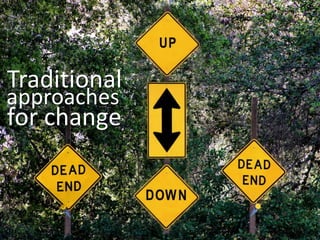
Traditional
approaches
for change
Our experiencesTwo major projects – Greenwich
Connect and Futures
• Tensions between systems
support and innovation
agenda
• Delivering on our previous
promise of ‘solutions in a box’
• Tensions around who owns
‘pedagogy’, ‘technology’ and
‘learning’
• Get the current stuff right
before you start ‘playing’
(Boys/Girls with toys problem)
• Shifting the pioneers to the
business as usual
FROM
the
MIDDLE
OUT
The learning technologist in middle
out
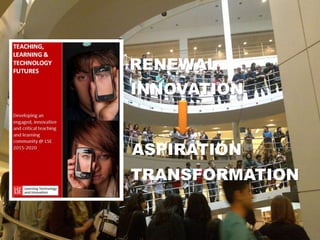
RENEWAL
INNOVATION
ASPIRATION
TRANSFORMATION
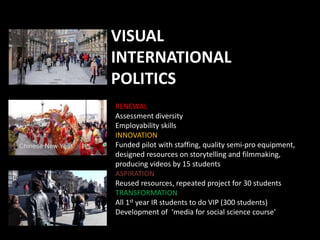
VISUAL
INTERNATIONAL
POLITICS
RENEWAL
Assessment diversity
Employability skills
INNOVATION
Funded pilot with staffing, quality semi-pro equipment,
designed resources on storytelling and filmmaking,
producing videos by 15 students
ASPIRATION
Reused resources, repeated project for 30 students
TRANSFORMATION
All 1st year IR students to do VIP (300 students)
Development of ‘media for social science course’

ALT-C 2015 presentation - From the Middle OUT

  • 1.
    From the middleout Peter Bryant London School of Economics @peterbryantHE http//www.peterbryant.org Breaking down functional tensions and resistances between stakeholders to lead institutional change
  • 2.
    Tensions Affordances v Resistances Technologiesv Pedagogies Now v Future Systems v Cloud Service v Strategy
  • 3.
    The use oftechnology is the exclusive privilege of the technically adept, the young or the innovator Technology is a ‘nice to have’, not an essential, integrated part of the action Learning has been and always will be the same and new technology simply enhances and builds on the successes of the past The blurry myths of technological change
  • 4.
    The ‘harsh’ reality Theagility of society and learners to adapt and innovate their learning with and through technology often far outstrips the ability of the educational institution to keep up Existing practice and innovation are pitted against each other as a contest to the death Investment is rarely commensurate with outcome and impact Learning, teaching and role of the learning technologist have changed
  • 5.
  • 6.
    Our experiencesTwo majorprojects – Greenwich Connect and Futures • Tensions between systems support and innovation agenda • Delivering on our previous promise of ‘solutions in a box’ • Tensions around who owns ‘pedagogy’, ‘technology’ and ‘learning’ • Get the current stuff right before you start ‘playing’ (Boys/Girls with toys problem) • Shifting the pioneers to the business as usual
  • 7.
  • 8.
  • 9.
  • 10.
    VISUAL INTERNATIONAL POLITICS RENEWAL Assessment diversity Employability skills INNOVATION Fundedpilot with staffing, quality semi-pro equipment, designed resources on storytelling and filmmaking, producing videos by 15 students ASPIRATION Reused resources, repeated project for 30 students TRANSFORMATION All 1st year IR students to do VIP (300 students) Development of ‘media for social science course’

Editor's Notes

  • #5 Learning has changed 21st century skills, apps to solve problems (and problems found by apps), media consumption…closed systems,   Teaching has changed Peer led and student co-creation, expanding outside the networks and boundaries of the class, EDx use at MIT, ending of broadcast mode, enhanced role for gaming, DIY coding, social media use   Learning Technology has changed Skills of integration, cloud, UX leading to working with staff to adapt, change, innovate and transform their teaching and learning.   The VLE of 2015 needs to be able to do that, some of the Moodle competitors have moved towards ‘some’ of these
  • #7 We argue that the role of learning technologists as agents and leaders of change at a strategic level is often compromised by tensions and actions arising from implicit internal practices or explicit external relationships. In both cases we found that as teams who led learning technology initiatives we continually found ourselves in untenable positions, arguing for the ongoing support and efficacy of institutional systems that may run counter to engaging the institution in more innovative pedagogical approaches. At the same time, functional tensions arose over who owned ‘pedagogy’, ‘technology’ and ‘learning’ institutionally, and whether there was a role for collaborative stakeholder experimentation and evaluation as opposed to reactive project and systems support.
  • #8 Scaled projects that have institutional impact Connected approaches the cross function, discipline and faculty Activity that is part of a strategic vision The learning technologist and the educational developer working together as advocates of change Alignment of policy to practice
  • #9 This would be a role where the learning technologist argues, lobbies, supports and resources change and where they work to break down functional barriers and siloes between academic and professional services, in order to seek change through the development and celebration of a collective identity. A role which shapes and integrates a shared orientation and argues for the need to challenge the status quo and to address change through practical action (James and van Seters, 2014) and where they flip the support of practice at a local level to one where they advocate and lead change at an institutional level.