Recognition of Short Learning Programmes
(SLPs) and Microcredentials
Clare Dunn
Senior Manager: Recognition of Prior Learning
The Open University, UK
EADTU Summit
17th June 2021
Aims of the presentation
• Provide an introduction to ‘recognition’.
• Highlight the benefits of recognising SLPs and microcredentials.
• Present the approaches to recognition across the partners of the ESLP
project.
• Explore the validation of non-formal and informal learning.
• Make recommendations for the recognition of SLPS and
microcredentials:
• Curriculum design
• Recognition of prior formal, non-formal and informal learning
Introduction to
recognition
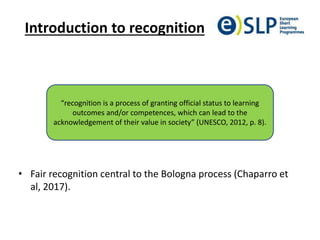
Introduction to recognition
• Fair recognition central to the Bologna process (Chaparro et
al, 2017).
“recognition is a process of granting official status to learning
outcomes and/or competences, which can lead to the
acknowledgement of their value in society” (UNESCO, 2012, p. 8).
Introduction to recognition
• Two forms of market currency in modern higher
education (Marr & Bravenboer, 2017).
• Recognising prior learning provides a mechanism to
“certify existent human capital and foster personal
career development” (Dzelalija & Balkovic, 2014).
• Facilitates learner mobility and lifelong learning.
Benefits of
recognition
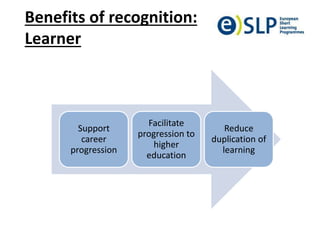
Benefits of recognition:
Learner
Support
career
progression
Facilitate
progression to
higher
education
Reduce
duplication of
learning
Benefits of recognition:
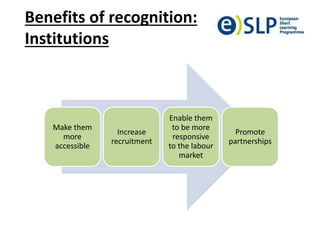
Institutions
Make them
more
accessible
Increase
recruitment
Enable them
to be more
responsive
to the labour
market
Promote
partnerships
Benefits of recognition:
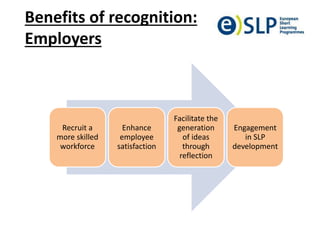
Employers
Recruit a
more skilled
workforce
Enhance
employee
satisfaction
Facilitate the
generation
of ideas
through
reflection
Engagement
in SLP
development
Approaches to
recognition
Data collection
• Short questionnaire to institutions within the
ESLP project.
• Desktop research
Questionnaire responses
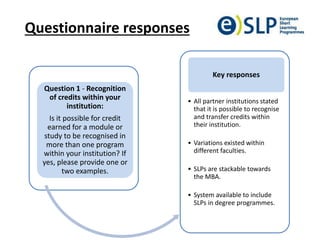
Question 1 - Recognition
of credits within your
institution:
Is it possible for credit
earned for a module or
study to be recognised in
more than one program
within your institution? If
yes, please provide one or
two examples.
• All partner institutions stated
that it is possible to recognise
and transfer credits within
their institution.
• Variations existed within
different faculties.
• SLPs are stackable towards
the MBA.
• System available to include
SLPs in degree programmes.
Key responses
Questionnaire responses
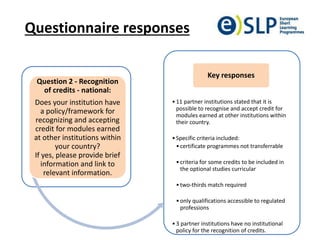
Question 2 - Recognition
of credits - national:
Does your institution have
a policy/framework for
recognizing and accepting
credit for modules earned
at other institutions within
your country?
If yes, please provide brief
information and link to
relevant information.
•11 partner institutions stated that it is
possible to recognise and accept credit for
modules earned at other institutions within
their country.
•Specific criteria included:
•certificate programmes not transferrable
•criteria for some credits to be included in
the optional studies curricular
•two-thirds match required
•only qualifications accessible to regulated
professions
•3 partner institutions have no institutional
policy for the recognition of credits.
Key responses
Questionnaire responses
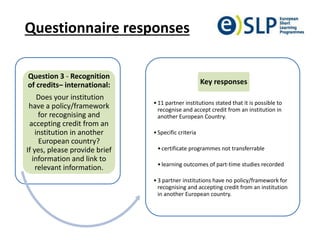
Question 3 - Recognition
of credits– international:
Does your institution
have a policy/framework
for recognising and
accepting credit from an
institution in another
European country?
If yes, please provide brief
information and link to
relevant information.
•11 partner institutions stated that it is possible to
recognise and accept credit from an institution in
another European Country.
•Specific criteria
•certificate programmes not transferrable
•learning outcomes of part-time studies recorded
•3 partner institutions have no policy/framework for
recognising and accepting credit from an institution
in another European country.
Key responses
Questionnaire responses
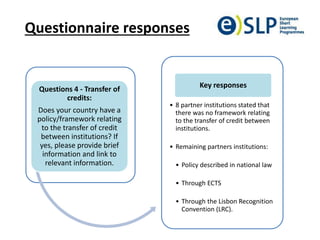
Questions 4 - Transfer of
credits:
Does your country have a
policy/framework relating
to the transfer of credit
between institutions? If
yes, please provide brief
information and link to
relevant information.
• 8 partner institutions stated that
there was no framework relating
to the transfer of credit between
institutions.
• Remaining partners institutions:
• Policy described in national law
• Through ECTS
• Through the Lisbon Recognition
Convention (LRC).
Key responses
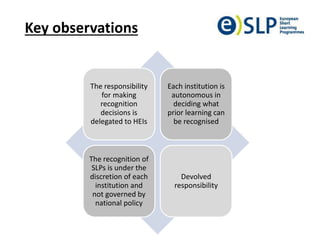
Key observations
The responsibility
for making
recognition
decisions is
delegated to HEIs
Each institution is
autonomous in
deciding what
prior learning can
be recognised
The recognition of
SLPs is under the
discretion of each
institution and
not governed by
national policy
Devolved
responsibility
Validation of non-formal
and informal learning
(VNIFL)
Validation of non-formal and
informal learning
• Fundamental to the EUs approach to lifelong
learning (Laudenbach & Lis 2019).
• Used in response to the ‘economic and labour
market needs’ and for others as a way of widening
access and participation within HE (Duvecot et al,
2014).
• Takes place for one of two purposes in HE.
Data collection
• Baseline research (5 partner countries).
• Validation of the accuracy of information.
• Wider information gathering.
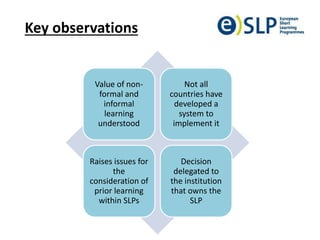
Key observations
Value of non-
formal and
informal
learning
understood
Not all
countries have
developed a
system to
implement it
Raises issues for
the
consideration of
prior learning
within SLPs
Decision
delegated to
the institution
that owns the
SLP
Problems and solutions
• No Single European level framework for the process
of recognising credit enter into reciprocal
recognition arrangements for their SLPs.
• Size variance that might exist – Consistency in the
size of an SLP will aid its recognition.
Recommendations
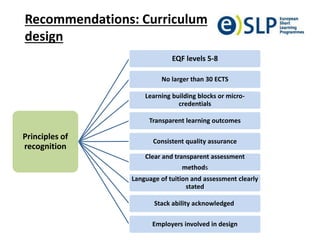
Recommendations: Curriculum
design
Principles of
recognition
EQF levels 5-8
No larger than 30 ECTS
Learning building blocks or micro-
credentials
Transparent learning outcomes
Consistent quality assurance
Clear and transparent assessment
methods
Language of tuition and assessment clearly
stated
Stack ability acknowledged
Employers involved in design
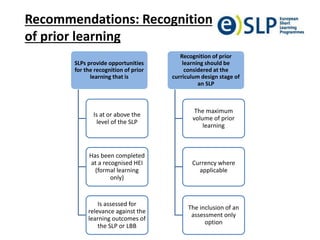
Recommendations: Recognition
of prior learning
SLPs provide opportunities
for the recognition of prior
learning that is
Is at or above the
level of the SLP
Has been completed
at a recognised HEI
(formal learning
only)
Is assessed for
relevance against the
learning outcomes of
the SLP or LBB
Recognition of prior
learning should be
considered at the
curriculum design stage of
an SLP
The maximum
volume of prior
learning
Currency where
applicable
The inclusion of an
assessment only
option
References
• Chaparro, T. S., Ros, C. E., De Labastida, E. F., Goedert, M., Goksoyr, K., Huertas, E., Kelo,
M., Lenehan, N., De Micheo, R. L. & Valeikiene, A. (2017). Current practices on external
quality assurance of academic recognition among QA Agencies. Brussels: ENQA.
• Duvecot, R., Halba, B., Aagaard, K., Gabrscek, S., and Murray, J. (2014). The Power of VPL.
University AS and European Centre for Valuation of Prior Learning: Holland.
• Dzelalija, M., & Balkovic, M. (2014). Recognition of Prior Learning in EU Context and
Globally. Zagreb: Agency for Science and Higher Education.
• Garnett, J., & Cavaye, A. (2015). Recognition of prior learning: opportunities and challenges
for higher education. Journal of Work-Applied Management. Vol 7 (1), pp. 28-37.
• Laudenbach, F., and Lis, A. (2019). Enhancing Mobility – Validation of Prior Non-formal and
Informal Learning and its Impact on Individuals’ Employment Biography: Qualitative
Insights from Germany and Poland. Widening Participation and Lifelong Learning, Vol 21
(1), p. 8-28.
• Marr, L., & Bravenboer, D. (2017). Widening Participation, Lifelong Learning and the Role of
Higher Education Credit. Widening Participation and Lifelong Learning, Vol 19 (3), pp 1-5.
• UNESCO. (2012). UNESCO Guidelines for Recognition, Validation and Accreditation of the
Outcomes of Non-formal and Informal Learning. UNESCO Institute for Lifelong Learning:
Germany.

Clare Dunn - Recognition of short learning programmes and microcredentials

  • 1.
    Recognition of ShortLearning Programmes (SLPs) and Microcredentials Clare Dunn Senior Manager: Recognition of Prior Learning The Open University, UK EADTU Summit 17th June 2021
  • 2.
    Aims of thepresentation • Provide an introduction to ‘recognition’. • Highlight the benefits of recognising SLPs and microcredentials. • Present the approaches to recognition across the partners of the ESLP project. • Explore the validation of non-formal and informal learning. • Make recommendations for the recognition of SLPS and microcredentials: • Curriculum design • Recognition of prior formal, non-formal and informal learning
  • 3.
  • 4.
    Introduction to recognition •Fair recognition central to the Bologna process (Chaparro et al, 2017). “recognition is a process of granting official status to learning outcomes and/or competences, which can lead to the acknowledgement of their value in society” (UNESCO, 2012, p. 8).
  • 5.
    Introduction to recognition •Two forms of market currency in modern higher education (Marr & Bravenboer, 2017). • Recognising prior learning provides a mechanism to “certify existent human capital and foster personal career development” (Dzelalija & Balkovic, 2014). • Facilitates learner mobility and lifelong learning.
  • 6.
  • 7.
  • 8.
    Benefits of recognition: Institutions Makethem more accessible Increase recruitment Enable them to be more responsive to the labour market Promote partnerships
  • 9.
    Benefits of recognition: Employers Recruita more skilled workforce Enhance employee satisfaction Facilitate the generation of ideas through reflection Engagement in SLP development
  • 10.
  • 11.
    Data collection • Shortquestionnaire to institutions within the ESLP project. • Desktop research
  • 12.
    Questionnaire responses Question 1- Recognition of credits within your institution: Is it possible for credit earned for a module or study to be recognised in more than one program within your institution? If yes, please provide one or two examples. • All partner institutions stated that it is possible to recognise and transfer credits within their institution. • Variations existed within different faculties. • SLPs are stackable towards the MBA. • System available to include SLPs in degree programmes. Key responses
  • 13.
    Questionnaire responses Question 2- Recognition of credits - national: Does your institution have a policy/framework for recognizing and accepting credit for modules earned at other institutions within your country? If yes, please provide brief information and link to relevant information. •11 partner institutions stated that it is possible to recognise and accept credit for modules earned at other institutions within their country. •Specific criteria included: •certificate programmes not transferrable •criteria for some credits to be included in the optional studies curricular •two-thirds match required •only qualifications accessible to regulated professions •3 partner institutions have no institutional policy for the recognition of credits. Key responses
  • 14.
    Questionnaire responses Question 3- Recognition of credits– international: Does your institution have a policy/framework for recognising and accepting credit from an institution in another European country? If yes, please provide brief information and link to relevant information. •11 partner institutions stated that it is possible to recognise and accept credit from an institution in another European Country. •Specific criteria •certificate programmes not transferrable •learning outcomes of part-time studies recorded •3 partner institutions have no policy/framework for recognising and accepting credit from an institution in another European country. Key responses
  • 15.
    Questionnaire responses Questions 4- Transfer of credits: Does your country have a policy/framework relating to the transfer of credit between institutions? If yes, please provide brief information and link to relevant information. • 8 partner institutions stated that there was no framework relating to the transfer of credit between institutions. • Remaining partners institutions: • Policy described in national law • Through ECTS • Through the Lisbon Recognition Convention (LRC). Key responses
  • 16.
    Key observations The responsibility formaking recognition decisions is delegated to HEIs Each institution is autonomous in deciding what prior learning can be recognised The recognition of SLPs is under the discretion of each institution and not governed by national policy Devolved responsibility
  • 17.
    Validation of non-formal andinformal learning (VNIFL)
  • 18.
    Validation of non-formaland informal learning • Fundamental to the EUs approach to lifelong learning (Laudenbach & Lis 2019). • Used in response to the ‘economic and labour market needs’ and for others as a way of widening access and participation within HE (Duvecot et al, 2014). • Takes place for one of two purposes in HE.
  • 19.
    Data collection • Baselineresearch (5 partner countries). • Validation of the accuracy of information. • Wider information gathering.
  • 20.
    Key observations Value ofnon- formal and informal learning understood Not all countries have developed a system to implement it Raises issues for the consideration of prior learning within SLPs Decision delegated to the institution that owns the SLP
  • 21.
  • 22.
    Problems and solutions •No Single European level framework for the process of recognising credit enter into reciprocal recognition arrangements for their SLPs. • Size variance that might exist – Consistency in the size of an SLP will aid its recognition.
  • 23.
  • 24.
    Recommendations: Curriculum design Principles of recognition EQFlevels 5-8 No larger than 30 ECTS Learning building blocks or micro- credentials Transparent learning outcomes Consistent quality assurance Clear and transparent assessment methods Language of tuition and assessment clearly stated Stack ability acknowledged Employers involved in design
  • 25.
    Recommendations: Recognition of priorlearning SLPs provide opportunities for the recognition of prior learning that is Is at or above the level of the SLP Has been completed at a recognised HEI (formal learning only) Is assessed for relevance against the learning outcomes of the SLP or LBB Recognition of prior learning should be considered at the curriculum design stage of an SLP The maximum volume of prior learning Currency where applicable The inclusion of an assessment only option
  • 26.
    References • Chaparro, T.S., Ros, C. E., De Labastida, E. F., Goedert, M., Goksoyr, K., Huertas, E., Kelo, M., Lenehan, N., De Micheo, R. L. & Valeikiene, A. (2017). Current practices on external quality assurance of academic recognition among QA Agencies. Brussels: ENQA. • Duvecot, R., Halba, B., Aagaard, K., Gabrscek, S., and Murray, J. (2014). The Power of VPL. University AS and European Centre for Valuation of Prior Learning: Holland. • Dzelalija, M., & Balkovic, M. (2014). Recognition of Prior Learning in EU Context and Globally. Zagreb: Agency for Science and Higher Education. • Garnett, J., & Cavaye, A. (2015). Recognition of prior learning: opportunities and challenges for higher education. Journal of Work-Applied Management. Vol 7 (1), pp. 28-37. • Laudenbach, F., and Lis, A. (2019). Enhancing Mobility – Validation of Prior Non-formal and Informal Learning and its Impact on Individuals’ Employment Biography: Qualitative Insights from Germany and Poland. Widening Participation and Lifelong Learning, Vol 21 (1), p. 8-28. • Marr, L., & Bravenboer, D. (2017). Widening Participation, Lifelong Learning and the Role of Higher Education Credit. Widening Participation and Lifelong Learning, Vol 19 (3), pp 1-5. • UNESCO. (2012). UNESCO Guidelines for Recognition, Validation and Accreditation of the Outcomes of Non-formal and Informal Learning. UNESCO Institute for Lifelong Learning: Germany.