BRIDGE Conference – 38th Edition: 27 March, 2019, Hotel Sheraton Grand, Pune
FOSTERING INDIA FOR INDUSTRY 4.0
Largest Industry-Institute Interaction Event of Asia
Baburaj Nair, Chief Human Resources Officer, The Hindu Group of Publications
Context Setting: Society
1. Digital savvy children/employees
2. Sheconomy
3. Exposure to global trends/culture
4. Shift : Rural to Urban
5. Social Networks will create
participatory economy
6. More localised opportunities
7. Sustainability will become a
competitive requirement
8. Full time to Free Agent employment
9. Data is critical for competitive
advantage
Source: Intuit2020 Report
 Population / Demography
 Technology: Technical change
originates from Research and Development
activities in response to need (labour-saving
and skill-biased)
 Culture
 Collective Behaviour and
Social Movements: social change
involving science and technology; Change
based on rationality; Experimental approach
and validation; Search for truth for sake of
truth itself.
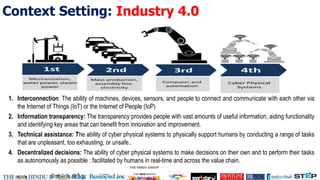
Context Setting: Industry 4.0
1. Interconnection: The ability of machines, devices, sensors, and people to connect and communicate with each other via
the Internet of Things (IoT) or the Internet of People (IoP)
2. Information transparency: The transparency provides people with vast amounts of useful information, aiding functionality
and identifying key areas that can benefit from innovation and improvement.
3. Technical assistance: The ability of cyber physical systems to physically support humans by conducting a range of tasks
that are unpleasant, too exhausting, or unsafe..
4. Decentralized decisions: The ability of cyber physical systems to make decisions on their own and to perform their tasks
as autonomously as possible : facilitated by humans in real-time and across the value chain.
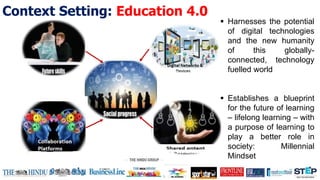
Context Setting: Education 4.0
 Harnesses the potential
of digital technologies
and the new humanity
of this globally-
connected, technology
fuelled world
 Establishes a blueprint
for the future of learning
– lifelong learning – with
a purpose of learning to
play a better role in
society: Millennial
Mindset
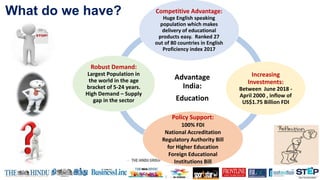
What do we have?
Advantage
India:
Education
Competitive Advantage:
Huge English speaking
population which makes
delivery of educational
products easy. Ranked 27
out of 80 countries in English
Proficiency index 2017
Increasing
Investments:
Between June 2018 -
April 2000 , inflow of
US$1.75 Billion FDI
Policy Support:
100% FDI
National Accreditation
Regulatory Authority Bill
for Higher Education
Foreign Educational
Institutions Bill
Robust Demand:
Largest Population in
the world in the age
bracket of 5-24 years.
High Demand – Supply
gap in the sector
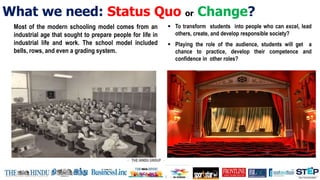
Most of the modern schooling model comes from an
industrial age that sought to prepare people for life in
industrial life and work. The school model included
bells, rows, and even a grading system.
What we need: Status Quo or Change?
 To transform students into people who can excel, lead
others, create, and develop responsible society?
 Playing the role of the audience, students will get a
chance to practice, develop their competence and
confidence in other roles?
©Baburaj Nair, CHRO, THGPPL
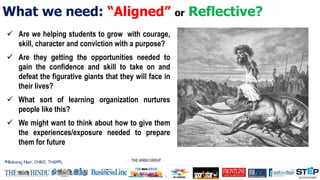
What we need: “Aligned” or Reflective?
 Are we helping students to grow with courage,
skill, character and conviction with a purpose?
 Are they getting the opportunities needed to
gain the confidence and skill to take on and
defeat the figurative giants that they will face in
their lives?
 What sort of learning organization nurtures
people like this?
 We might want to think about how to give them
the experiences/exposure needed to prepare
them for future
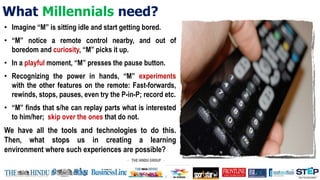
What Millennials need?
• Imagine “M” is sitting idle and start getting bored.
• “M” notice a remote control nearby, and out of
boredom and curiosity, “M” picks it up.
• In a playful moment, “M” presses the pause button.
• Recognizing the power in hands, “M” experiments
with the other features on the remote: Fast-forwards,
rewinds, stops, pauses, even try the P-in-P; record etc.
• “M” finds that s/he can replay parts what is interested
to him/her; skip over the ones that do not.
We have all the tools and technologies to do this.
Then, what stops us in creating a learning
environment where such experiences are possible?
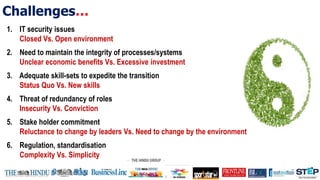
Challenges…
1. IT security issues
Closed Vs. Open environment
2. Need to maintain the integrity of processes/systems
Unclear economic benefits Vs. Excessive investment
3. Adequate skill-sets to expedite the transition
Status Quo Vs. New skills
4. Threat of redundancy of roles
Insecurity Vs. Conviction
5. Stake holder commitment
Reluctance to change by leaders Vs. Need to change by the environment
6. Regulation, standardisation
Complexity Vs. Simplicity
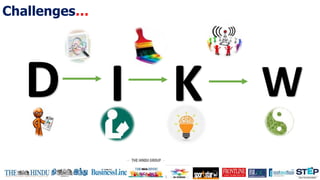
D I K W
Challenges…
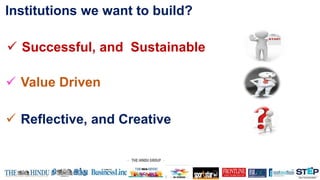
Institutions we want to build?
 Successful, and Sustainable
 Value Driven
 Reflective, and Creative
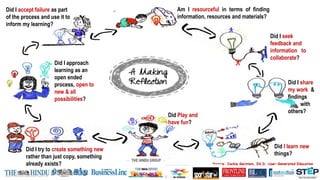
Source: Jackie Gerstein, Ed.D, User-Generated Education
Did Play and
have fun?
Did I accept failure as part
of the process and use it to
inform my learning?
Did I approach
learning as an
open ended
process, open to
new & all
possibilities?
Did I learn new
things?
Am I resourceful in terms of finding
information, resources and materials?
Did I seek
feedback and
information to
collaborate?
Did I share
my work &
findings
with
others?
Did I try to create something new
rather than just copy, something
already exists?
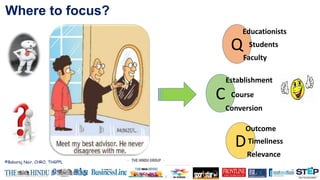
Where to focus?
Q
C
D
Outcome
Timeliness
Relevance
Establishment
Course
Conversion
Students
Faculty
Educationists
©Baburaj Nair, CHRO, THGPPL
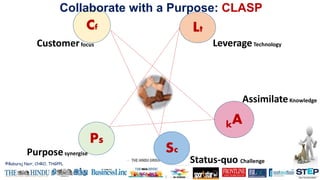
Cf Lt
Ps
Sc
kA
Customerfocus LeverageTechnology
AssimilateKnowledge
Status-quo Challenge
Purposesynergise
Collaborate with a Purpose: CLASP
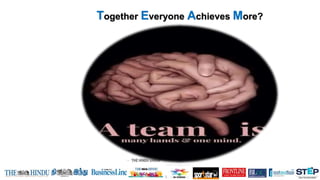
Together Everyone Achieves More?
Baburaj V Nair ,Chief Human Resource Officer, The Hindu Group. www.soulsearchhr.blogspot.in

Bridge hr march 2019

  • 1.
    BRIDGE Conference –38th Edition: 27 March, 2019, Hotel Sheraton Grand, Pune FOSTERING INDIA FOR INDUSTRY 4.0 Largest Industry-Institute Interaction Event of Asia Baburaj Nair, Chief Human Resources Officer, The Hindu Group of Publications
  • 2.
    Context Setting: Society 1.Digital savvy children/employees 2. Sheconomy 3. Exposure to global trends/culture 4. Shift : Rural to Urban 5. Social Networks will create participatory economy 6. More localised opportunities 7. Sustainability will become a competitive requirement 8. Full time to Free Agent employment 9. Data is critical for competitive advantage Source: Intuit2020 Report  Population / Demography  Technology: Technical change originates from Research and Development activities in response to need (labour-saving and skill-biased)  Culture  Collective Behaviour and Social Movements: social change involving science and technology; Change based on rationality; Experimental approach and validation; Search for truth for sake of truth itself.
  • 3.
    Context Setting: Industry4.0 1. Interconnection: The ability of machines, devices, sensors, and people to connect and communicate with each other via the Internet of Things (IoT) or the Internet of People (IoP) 2. Information transparency: The transparency provides people with vast amounts of useful information, aiding functionality and identifying key areas that can benefit from innovation and improvement. 3. Technical assistance: The ability of cyber physical systems to physically support humans by conducting a range of tasks that are unpleasant, too exhausting, or unsafe.. 4. Decentralized decisions: The ability of cyber physical systems to make decisions on their own and to perform their tasks as autonomously as possible : facilitated by humans in real-time and across the value chain.
  • 4.
    Context Setting: Education4.0  Harnesses the potential of digital technologies and the new humanity of this globally- connected, technology fuelled world  Establishes a blueprint for the future of learning – lifelong learning – with a purpose of learning to play a better role in society: Millennial Mindset
  • 5.
    What do wehave? Advantage India: Education Competitive Advantage: Huge English speaking population which makes delivery of educational products easy. Ranked 27 out of 80 countries in English Proficiency index 2017 Increasing Investments: Between June 2018 - April 2000 , inflow of US$1.75 Billion FDI Policy Support: 100% FDI National Accreditation Regulatory Authority Bill for Higher Education Foreign Educational Institutions Bill Robust Demand: Largest Population in the world in the age bracket of 5-24 years. High Demand – Supply gap in the sector
  • 6.
    Most of themodern schooling model comes from an industrial age that sought to prepare people for life in industrial life and work. The school model included bells, rows, and even a grading system. What we need: Status Quo or Change?  To transform students into people who can excel, lead others, create, and develop responsible society?  Playing the role of the audience, students will get a chance to practice, develop their competence and confidence in other roles?
  • 7.
    ©Baburaj Nair, CHRO,THGPPL What we need: “Aligned” or Reflective?  Are we helping students to grow with courage, skill, character and conviction with a purpose?  Are they getting the opportunities needed to gain the confidence and skill to take on and defeat the figurative giants that they will face in their lives?  What sort of learning organization nurtures people like this?  We might want to think about how to give them the experiences/exposure needed to prepare them for future
  • 8.
    What Millennials need? •Imagine “M” is sitting idle and start getting bored. • “M” notice a remote control nearby, and out of boredom and curiosity, “M” picks it up. • In a playful moment, “M” presses the pause button. • Recognizing the power in hands, “M” experiments with the other features on the remote: Fast-forwards, rewinds, stops, pauses, even try the P-in-P; record etc. • “M” finds that s/he can replay parts what is interested to him/her; skip over the ones that do not. We have all the tools and technologies to do this. Then, what stops us in creating a learning environment where such experiences are possible?
  • 9.
    Challenges… 1. IT securityissues Closed Vs. Open environment 2. Need to maintain the integrity of processes/systems Unclear economic benefits Vs. Excessive investment 3. Adequate skill-sets to expedite the transition Status Quo Vs. New skills 4. Threat of redundancy of roles Insecurity Vs. Conviction 5. Stake holder commitment Reluctance to change by leaders Vs. Need to change by the environment 6. Regulation, standardisation Complexity Vs. Simplicity
  • 10.
    D I KW Challenges…
  • 11.
    Institutions we wantto build?  Successful, and Sustainable  Value Driven  Reflective, and Creative
  • 12.
    Source: Jackie Gerstein,Ed.D, User-Generated Education Did Play and have fun? Did I accept failure as part of the process and use it to inform my learning? Did I approach learning as an open ended process, open to new & all possibilities? Did I learn new things? Am I resourceful in terms of finding information, resources and materials? Did I seek feedback and information to collaborate? Did I share my work & findings with others? Did I try to create something new rather than just copy, something already exists?
  • 13.
  • 14.
    ©Baburaj Nair, CHRO,THGPPL Cf Lt Ps Sc kA Customerfocus LeverageTechnology AssimilateKnowledge Status-quo Challenge Purposesynergise Collaborate with a Purpose: CLASP
  • 15.
  • 16.
    Baburaj V Nair,Chief Human Resource Officer, The Hindu Group. www.soulsearchhr.blogspot.in