“Transformative” learning spacesCarlo PerrottaFuturelabApril 2010Friday, May 07, 2010
The expectation is that the proposed changes should not be merely incremental or simply aspirational – they should be innovative and ambitious, and bring about rapid and accelerated change (PfS, 2007).Friday, May 07, 2010
These changes, many of which will be innovative, radical and a significant departure from present and historical practice are intended to bring about step changes in outcomes for children and young people (PfS, 2007).Friday, May 07, 2010
BSF funding will act as a catalyst to enable the changes to be effected and to lever improvement at a faster rate than would otherwise be the case (PfS, 2007).Friday, May 07, 2010
Transformation is...FastAcceleratedRadical AmbitiousNot incrementalSigns of over-promising and under-delivering?Beyond buildings: procuring BSF sustainably, November 2009  - Westminster Sustainable Business ForumFriday, May 07, 2010
BSF is being delivered...During 2008/09, 54 schools were opened under programme, compared with a total of 42 in the first four years of the initiativeMore than 200 schools a year are scheduled to open from 2011 onwards... But is it really going to “transform” education?Friday, May 07, 2010
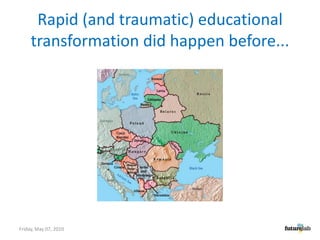
Rapid (and traumatic) educational transformation did happen before...Friday, May 07, 2010
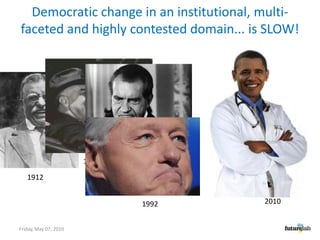
Democratic change in an institutional, multi-faceted and highly contested domain... is SLOW!19741944191219922010Friday, May 07, 2010
Is perhaps pupil involvement the route to transformation?“The relationship between people and their environment is complex, and therefore any outcomes from a change in setting are likely to be produced through an involved chain of events. It is the defining and understanding of these mediating chains that is key and must take account of issues relating to ownership, relevance, purpose and permanence”.   (Woolner et al, cited in PWC, 2007, Technical Report- Appendix E - p19). Friday, May 07, 2010
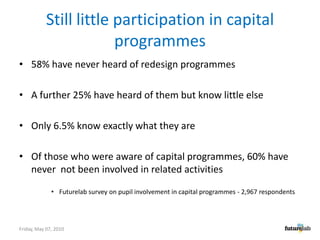
Still little participation in capital programmes58% have never heard of redesign programmesA further 25% have heard of them but know little elseOnly 6.5% know exactly what they areOf those who were aware of capital programmes, 60% have never  not been involved in related activities Futurelab survey on pupil involvement in capital programmes - 2,967 respondentsFriday, May 07, 2010
New methods are being adopted to involve children in research and development activities as partnersUK is leading the way in this areaThere has been an underestimation of the sophistication and ability of young people to talk about design and wider educational issues PP can be tokenistic and restrictedIt does not take a systems approach to educational reformPupil participation in school design (Woodcock et al, 2010 –forthcoming)Friday, May 07, 2010
Who talks about transformation anyway?Politicians: the tyranny of the electoral cycle“governments tend to overestimate what they can achieve in the short term (and therefore become frustrated and disappointed) and underestimate what they can achieve in the longer term (and therefore pay it too little attention)” Geoff MulganConsultants, who can help you deliver your transformation for a fee Friday, May 07, 2010
Back to BSF...Schools still need to state how they are going to “transform”And they are going to be accountable...Is this slightly unfair?What about curricula and assessment regimes?Friday, May 07, 2010
The market place of transformation“...the forces  that conspire to bolster the status quo in the face of transformational intentions. (in such a scenario) We can expect incremental improvement at best”.Friday, May 07, 2010
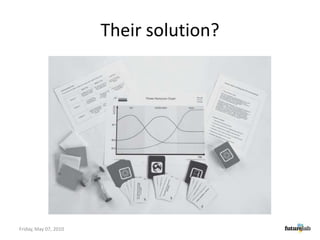
Their solution?Friday, May 07, 2010
Let’s discuss...Are the historical conditions for “transformation” present in the UK?Can transformation, conceived as a rapid, radical change occurring in a short time frame, be achieved in the context of checks and balances of “normal” deliberative democracy?should we be talking instead of old-fashioned, slow CHANGE, perhaps even INCREMENTAL?Friday, May 07, 2010

Transformative learning spaces #FLRI

  • 1.
    “Transformative” learning spacesCarloPerrottaFuturelabApril 2010Friday, May 07, 2010
  • 2.
    The expectation isthat the proposed changes should not be merely incremental or simply aspirational – they should be innovative and ambitious, and bring about rapid and accelerated change (PfS, 2007).Friday, May 07, 2010
  • 3.
    These changes, manyof which will be innovative, radical and a significant departure from present and historical practice are intended to bring about step changes in outcomes for children and young people (PfS, 2007).Friday, May 07, 2010
  • 4.
    BSF funding willact as a catalyst to enable the changes to be effected and to lever improvement at a faster rate than would otherwise be the case (PfS, 2007).Friday, May 07, 2010
  • 5.
    Transformation is...FastAcceleratedRadical AmbitiousNotincrementalSigns of over-promising and under-delivering?Beyond buildings: procuring BSF sustainably, November 2009 - Westminster Sustainable Business ForumFriday, May 07, 2010
  • 6.
    BSF is beingdelivered...During 2008/09, 54 schools were opened under programme, compared with a total of 42 in the first four years of the initiativeMore than 200 schools a year are scheduled to open from 2011 onwards... But is it really going to “transform” education?Friday, May 07, 2010
  • 7.
    Rapid (and traumatic)educational transformation did happen before...Friday, May 07, 2010
  • 8.
    Democratic change inan institutional, multi-faceted and highly contested domain... is SLOW!19741944191219922010Friday, May 07, 2010
  • 9.
    Is perhaps pupilinvolvement the route to transformation?“The relationship between people and their environment is complex, and therefore any outcomes from a change in setting are likely to be produced through an involved chain of events. It is the defining and understanding of these mediating chains that is key and must take account of issues relating to ownership, relevance, purpose and permanence”. (Woolner et al, cited in PWC, 2007, Technical Report- Appendix E - p19). Friday, May 07, 2010
  • 10.
    Still little participationin capital programmes58% have never heard of redesign programmesA further 25% have heard of them but know little elseOnly 6.5% know exactly what they areOf those who were aware of capital programmes, 60% have never not been involved in related activities Futurelab survey on pupil involvement in capital programmes - 2,967 respondentsFriday, May 07, 2010
  • 11.
    New methods arebeing adopted to involve children in research and development activities as partnersUK is leading the way in this areaThere has been an underestimation of the sophistication and ability of young people to talk about design and wider educational issues PP can be tokenistic and restrictedIt does not take a systems approach to educational reformPupil participation in school design (Woodcock et al, 2010 –forthcoming)Friday, May 07, 2010
  • 12.
    Who talks abouttransformation anyway?Politicians: the tyranny of the electoral cycle“governments tend to overestimate what they can achieve in the short term (and therefore become frustrated and disappointed) and underestimate what they can achieve in the longer term (and therefore pay it too little attention)” Geoff MulganConsultants, who can help you deliver your transformation for a fee Friday, May 07, 2010
  • 13.
    Back to BSF...Schoolsstill need to state how they are going to “transform”And they are going to be accountable...Is this slightly unfair?What about curricula and assessment regimes?Friday, May 07, 2010
  • 14.
    The market placeof transformation“...the forces that conspire to bolster the status quo in the face of transformational intentions. (in such a scenario) We can expect incremental improvement at best”.Friday, May 07, 2010
  • 15.
  • 16.
    Let’s discuss...Are thehistorical conditions for “transformation” present in the UK?Can transformation, conceived as a rapid, radical change occurring in a short time frame, be achieved in the context of checks and balances of “normal” deliberative democracy?should we be talking instead of old-fashioned, slow CHANGE, perhaps even INCREMENTAL?Friday, May 07, 2010