Learning Systems A Strategic Guide for the Next Decade
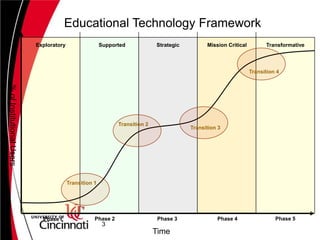
3ExploratorySupportedStrategicTransformativeMission CriticalTransition 4Transition 3Transition 1Transition 2Educational Technology Framework% of Institutional UsersPhase 5Phase 2Phase 3Phase 4Phase ITime
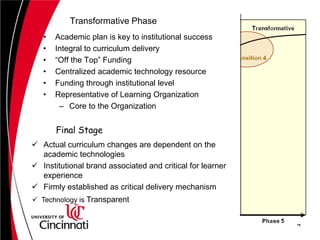
4Final StageActual curriculum changes are dependent on the academic technologies
Institutional brand associated and critical for learner experience
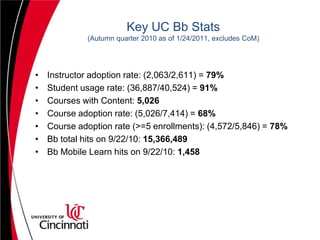
Firmly established as critical delivery mechanismTransformative PhaseAcademic plan is key to institutional successIntegral to curriculum delivery“Off the Top” FundingCentralized academic technology resourceFunding through institutional levelRepresentative of Learning OrganizationCore to the Organization  Technology is TransparentKey UC Bb Stats(Autumn quarter 2010 as of 1/24/2011, excludes CoM)Instructor adoption rate: (2,063/2,611) = 79%Student usage rate: (36,887/40,524) = 91%Courses with Content: 5,026Course adoption rate: (5,026/7,414) = 68%Course adoption rate (>=5 enrollments): (4,572/5,846) = 78%Bb total hits on 9/22/10: 15,366,489Bb Mobile Learn hits on 9/22/10: 1,458
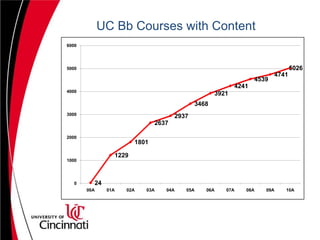
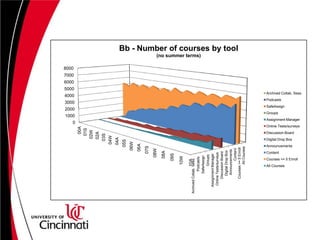
UC Bb Courses with Content
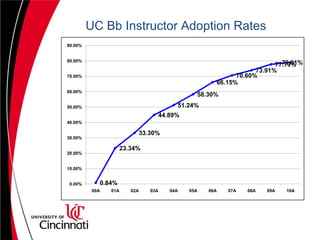
UC Bb Instructor Adoption Rates
Conclusion 1: Learning systems are no longer transformative.
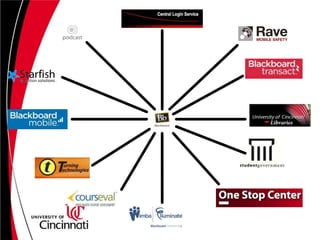
Conclusion 2: Learning Systems are sophisticated delivery platforms that everyone wants to utilize. But every new point of integration further weds you to your current platform.
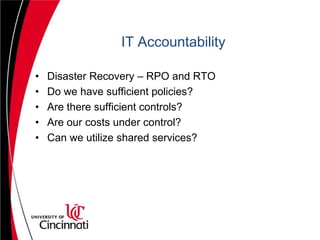
IT AccountabilityDisaster Recovery – RPO and RTODo we have sufficient policies?Are there sufficient controls?Are our costs under control?Can we utilize shared services?
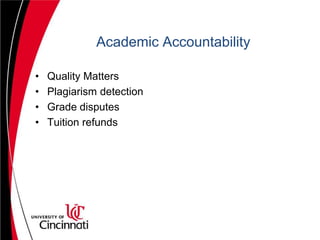
Academic AccountabilityQuality MattersPlagiarism detectionGrade disputesTuition refunds
Conclusion 3: The increased scrutiny and calls for accountability are signs that Learning Systems should be managed in the same manner as a school’s SIS and ERP systems.
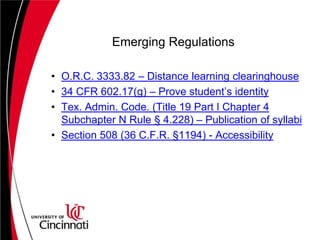
Emerging RegulationsO.R.C. 3333.82 – Distance learning clearinghouse
34 CFR 602.17(g) – Prove student’s identity
Tex. Admin. Code. (Title 19 Part I Chapter 4 Subchapter N Rule § 4.228) – Publication of syllabi
Section 508 (36 C.F.R. §1194) - AccessibilityConclusion 4: Legislatures and administrative agencies at both the state and federal level are going to craft increasingly specific rules that will directly affect the management of Learning Systems.
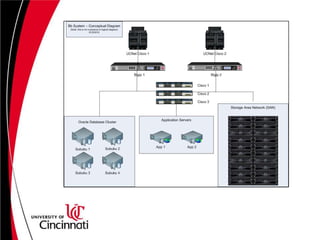
1,133,770,610
Conclusion 5: Learning Systems, despite their current misnomer, will eventually be a key source of data for researchers looking for better teaching methods. In the near term, though, data in Learning Systems will be used for more parochial concerns.
Conclusion 6: Non-learning system vendors are rapidly giving us tools that allow us to better manage our services. Learning System vendors just keep rolling out new features that are difficult to support.
Battle Royale…
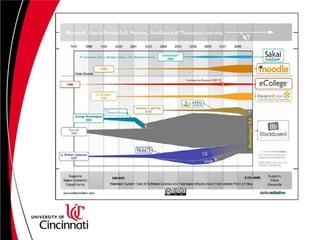
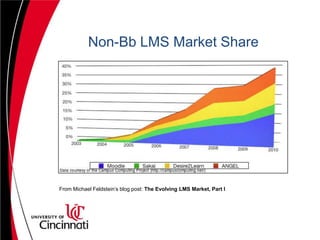
Non-Bb LMS Market ShareFrom Michael Feldstein’s blog post: The Evolving LMS Market, Part I

OHECC Session - Learning Systems -- A Strategic Guide for the next Decade

  • 1.
    Learning Systems AStrategic Guide for the Next Decade
  • 3.
    3ExploratorySupportedStrategicTransformativeMission CriticalTransition 4Transition3Transition 1Transition 2Educational Technology Framework% of Institutional UsersPhase 5Phase 2Phase 3Phase 4Phase ITime
  • 4.
    4Final StageActual curriculumchanges are dependent on the academic technologies
  • 5.
    Institutional brand associatedand critical for learner experience
  • 6.
    Firmly established ascritical delivery mechanismTransformative PhaseAcademic plan is key to institutional successIntegral to curriculum delivery“Off the Top” FundingCentralized academic technology resourceFunding through institutional levelRepresentative of Learning OrganizationCore to the Organization Technology is TransparentKey UC Bb Stats(Autumn quarter 2010 as of 1/24/2011, excludes CoM)Instructor adoption rate: (2,063/2,611) = 79%Student usage rate: (36,887/40,524) = 91%Courses with Content: 5,026Course adoption rate: (5,026/7,414) = 68%Course adoption rate (>=5 enrollments): (4,572/5,846) = 78%Bb total hits on 9/22/10: 15,366,489Bb Mobile Learn hits on 9/22/10: 1,458
  • 7.
    UC Bb Courseswith Content
  • 8.
    UC Bb InstructorAdoption Rates
  • 11.
    Conclusion 1: Learningsystems are no longer transformative.
  • 14.
    Conclusion 2: LearningSystems are sophisticated delivery platforms that everyone wants to utilize. But every new point of integration further weds you to your current platform.
  • 16.
    IT AccountabilityDisaster Recovery– RPO and RTODo we have sufficient policies?Are there sufficient controls?Are our costs under control?Can we utilize shared services?
  • 17.
    Academic AccountabilityQuality MattersPlagiarismdetectionGrade disputesTuition refunds
  • 18.
    Conclusion 3: Theincreased scrutiny and calls for accountability are signs that Learning Systems should be managed in the same manner as a school’s SIS and ERP systems.
  • 19.
    Emerging RegulationsO.R.C. 3333.82– Distance learning clearinghouse
  • 20.
    34 CFR 602.17(g)– Prove student’s identity
  • 21.
    Tex. Admin. Code.(Title 19 Part I Chapter 4 Subchapter N Rule § 4.228) – Publication of syllabi
  • 22.
    Section 508 (36C.F.R. §1194) - AccessibilityConclusion 4: Legislatures and administrative agencies at both the state and federal level are going to craft increasingly specific rules that will directly affect the management of Learning Systems.
  • 25.
  • 26.
    Conclusion 5: LearningSystems, despite their current misnomer, will eventually be a key source of data for researchers looking for better teaching methods. In the near term, though, data in Learning Systems will be used for more parochial concerns.
  • 29.
    Conclusion 6: Non-learningsystem vendors are rapidly giving us tools that allow us to better manage our services. Learning System vendors just keep rolling out new features that are difficult to support.
  • 30.
  • 32.
    Non-Bb LMS MarketShareFrom Michael Feldstein’s blog post: The Evolving LMS Market, Part I

Editor's Notes