eLearning Team
Away Day
16th July 2013
Introduction
9.00-9.30 Coffee and arrivals
9.30-10.50 Session 1
11.00-12.15 Debate, Evaluate, Innovate session round
1
12:15-13.00 LUNCH
13.00-13.45 Debate, Evaluate, Innovate session round
2
13.45-15.15 Session 3
Working afternoon tea
15.15-16.30 Session 3, conclusions
Vice-Chancellor of the University of
Greenwich
Professor David Maguire
Session 1 - Introduction
Introduction
(9.30-10.50am)
Peter Bryant
@peterbryantHE
Simon Walker
@sialker
• Get to know each other
• What is Greenwich Connect?
• Project example
Digital Literacy (Dr. Mark J.P Kerrigan)
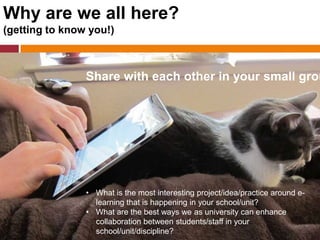
Why are we all here?
(getting to know you!)
9.00-9.30 Coffee and arrivals
9.30-10.50 Session 1
11.00-12.15 Debate, Evaluate, Innovate session
round 1
12:15-13.00 LUNCH
13.00-13.45 Debate, Evaluate, Innovate session
round 2
13.45-15.15 Session 3
Working afternoon tea
• What is the most interesting project/idea/practice around e-
learning that is happening in your school/unit?
• What are the best ways we as university can enhance
collaboration between students/staff in your
school/unit/discipline?
Share with each other in your small grou
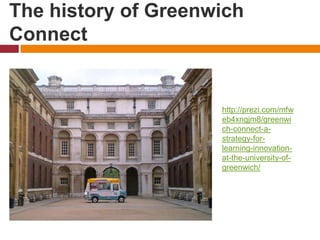
The history of Greenwich
Connect
http://prezi.com/mfw
eb4xngjm8/greenwi
ch-connect-a-
strategy-for-
learning-innovation-
at-the-university-of-
greenwich/
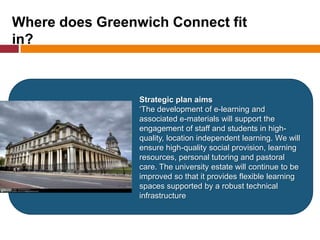
Strategic plan aims
‘The development of e-learning and associated e-materials will support the engagement of staff and students in
high-quality, location independent learning. We will ensure high-quality social provision, learning resources,
personal tutoring and pastoral care. The university estate will continue to be improved so that it provides
flexible learning spaces supported by a robust technical infrastructure’
Where does Greenwich Connect fit
in?
Strategic plan aims
‘The development of e-learning and
associated e-materials will support the
engagement of staff and students in high-
quality, location independent learning. We will
ensure high-quality social provision, learning
resources, personal tutoring and pastoral
care. The university estate will continue to be
improved so that it provides flexible learning
spaces supported by a robust technical
infrastructure
Learning, teaching and assessment
strategy
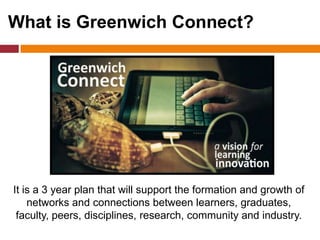
What is Greenwich Connect?
It is a 3 year plan that will support the formation and growth of
networks and connections between learners, graduates,
faculty, peers, disciplines, research, community and industry.
Strategic plan aims
‘The development of e-learning and associated e-materials will support the engagement of staff and students in
high-quality, location independent learning. We will ensure high-quality social provision, learning resources,
personal tutoring and pastoral care. The university estate will continue to be improved so that it provides
flexible learning spaces supported by a robust technical infrastructure’
Where does Greenwich Connect fit
in?
Greenwich Connect will enhance learning, teaching and
assessment by…
• promoting sharing, access, openness and support the formation and
development of networks;
• supporting the learner to excel at work and practice;
• making learning authentic, real and practical;
• encouraging social interaction and social collaboration at all levels of
programme delivery;
• being linked by its devices, platforms, locations, sites and campuses
but not bound by them;
• recognising the power of community and interactivity to enhance
student learning;
• facilitating the development and production of inter and trans-
disciplinary content and knowledge;
• delivering learning that is supportive, interactive, innovative, creative
and engaging;
• valuing pedagogy and its role in shaping the uses of technology;
• supporting learner autonomy, personalisation and the development
and promotion of professional identity;
• making content that is open, shared, collaborative, cutting edge,
media rich, impactful and relevant
• Social interaction
• Social Media
• Collaboration
• Crowdsourcing
• Social construction of knowledge
• Engagement and Networks
Greenwich Connect aims to enhance learning, student
achievement and outcomes at the University of Greenwich by
supporting…
Key Messages
• Many Greenwich students enter the university without
a network, and leave the same way. Greenwich
Connect will support the development and growth of
these networks to enhance employability and student
achievement;
• Greenwich Connect is a vision for learning for the
university in the digital age. It will support learning
with technology into curriculum design and delivery;
• Greenwich Connect is aspirational and achievable. It
outlines project and aims for the next three years;
• It is a vision for all programmes and projects to share,
and is not led by any one school/faculty or office/unit.
Defining Greenwich Connect
Greenwich Graduates would…
• graduate the University with a lasting
network and the skills to maintain and
grow it;
• understand the importance of
connections in career and personal life;
• have the ability to share, collaborate,
evaluate, inquire, play, create, reflect,
personalise and interact;
• use, repurpose and share the
knowledge and skills they have
acquired;
• interact with the next generation of
Greenwich learners through their
networks;
• have acquired and applied the
Greenwich Graduate Attributes;
• continue their association with the
university after graduation.
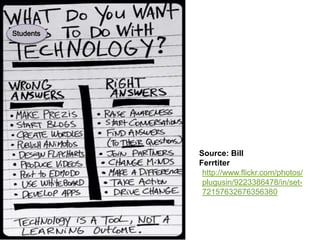
Students
http://www.flickr.com/photos/
plugusin/9223386478/in/set-
72157632676356380
Source: Bill
Ferrtiter
Aims of Greenwich Connect
Greenwich Connect will guide and
lead the uses of e-learning to
support the development and
practices of;
• Social interaction and social
construction of knowledge
• Student employability
• Digital literacy
• Interactive, connected and relevant
curriculum
• Collaborative learning, teaching and
assessment
• Lasting connections and networks that
go beyond the period of enrolment
• Inter and trans-disciplinarity research
and content
• Innovation and creativity
• A sense of autonomy, personalisation
and an enterprise attitude
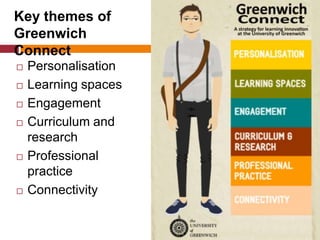
 Personalisation
 Learning spaces
 Engagement
 Curriculum and
research
 Professional
practice
 Connectivity
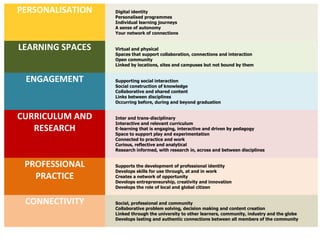
Key themes of
Greenwich
Connect
PERSONALISATION Digital identity
Personalised programmes
Individual learning journeys
A sense of autonomy
Your network of connections
LEARNING SPACES Virtual and physical
Spaces that support collaboration, connections and interaction
Open community
Linked by locations, sites and campuses but not bound by them
ENGAGEMENT Supporting social interaction
Social construction of knowledge
Collaborative and shared content
Links between disciplines
Occurring before, during and beyond graduation
CURRICULUM AND
RESEARCH
Inter and trans-disciplinary
Interactive and relevant curriculum
E-learning that is engaging, interactive and driven by pedagogy
Space to support play and experimentation
Connected to practice and work
Curious, reflective and analytical
Research informed, with research in, across and between disciplines
PROFESSIONAL
PRACTICE
Supports the development of professional identity
Develops skills for use through, at and in work
Creates a network of opportunity
Develops entrepreneurship, creativity and innovation
Develops the role of local and global citizen
CONNECTIVITY Social, professional and community
Collaborative problem solving, decision making and content creation
Linked through the university to other learners, community, industry and the globe
Develops lasting and authentic connections between all members of the community
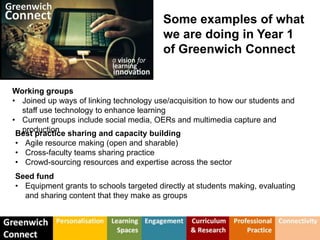
Some examples of what
we are doing in Year 1
of Greenwich Connect
Working groups
• Joined up ways of linking technology use/acquisition to how our students and
staff use technology to enhance learning
• Current groups include social media, OERs and multimedia capture and
productionBest practice sharing and capacity building
• Agile resource making (open and sharable)
• Cross-faculty teams sharing practice
• Crowd-sourcing resources and expertise across the sector
Seed fund
• Equipment grants to schools targeted directly at students making, evaluating
and sharing content that they make as groups
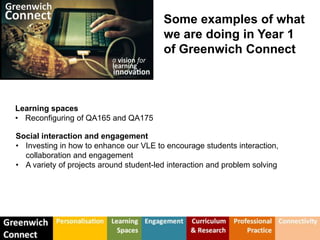
Some examples of what
we are doing in Year 1
of Greenwich Connect
Learning spaces
• Reconfiguring of QA165 and QA175
Social interaction and engagement
• Investing in how to enhance our VLE to encourage students interaction,
collaboration and engagement
• A variety of projects around student-led interaction and problem solving
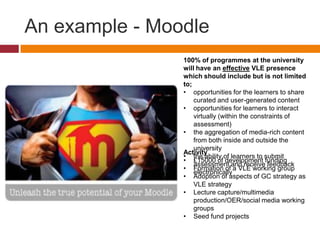
An example - Moodle
100% of programmes at the university
will have an effective VLE presence
which should include but is not limited
to;
• opportunities for the learners to share
curated and user-generated content
• opportunities for learners to interact
virtually (within the constraints of
assessment)
• the aggregation of media-rich content
from both inside and outside the
university
• the ability of learners to submit
assessment and receive feedback
electronically
Activity
• £15000 of development funding
• Formation of a VLE working group
• Adoption of aspects of GC strategy as
VLE strategy
• Lecture capture/multimedia
production/OER/social media working
groups
• Seed fund projects
Page 1
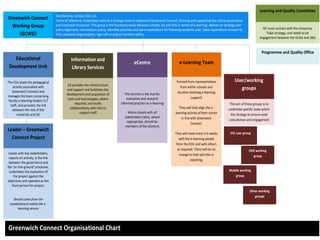
Greenwich Connect
Working Group
(GCWG)
Membership: School, EDU, ILS
Terms of reference: Undertakes work at a strategic level to implement Greenwich Connect, forming and supporting the critical governance
and functional structures. This group is the functional nexus between schools, ILS and EDU in terms of e-learning. Advises on strategy and
policy alignment, commissions policy, identifies priorities and plans expenditure for following academic year, takes expenditure forward to
VCG, evaluates large projects, signs off on policy/ monitors policy.
Meets 4 times a year, Officer for the group is the Manager of the GC project
Educational
Development Unit
Information and
Library Services
The EDU leads the pedagogical
activity associated with
Greenwich Connect and
manages the team comprising
faculty e-learning leaders ELT
staff, and provides the link
between the rest of the
university and GC
ILS provides the infrastructure
and support and facilitates the
development and acquisition of
tools and technologies, where
required, and works
collaboratively with EDU to
support staff
e-Learning Team
Formed from representatives
from within schools and
faculties (existing e-learning
support)
They will help align the e-
learning activity of their school
in line with Greenwich
Connect.
They will meet every 4-6 weeks
with the e-learning people
from the EDU and with others
as required. There will be no
change to their job title or
reporting.
Leader – Greenwich
Connect Project
Liaises with key stakeholders,
reports on activity, is the link
between the governance and
the ‘on-the-ground’ processes,
undertakes the evaluation of
the project against the
objectives and operates as the
front person for project.
Should come from the
establishment within the e-
learning service
User/working
groups
VLE user group
The aim of these groups is to
undertake specific tasks within
the strategy to ensure wide
consultation and engagement
OER working
group
Mobile working
group
Other working
groups
eCentre
The eCentre is the hub for
evaluative and research
informed practice on e-learning
Works closely with all
stakeholders (who, where
appropriate, should be
members of the eCentre)
Greenwich Connect Organisational Chart
Learning and Quality Committee
GC must connect with the University
TL&A strategy, and needs to be
engagement between the GCAG and L&Q
Programme and Quality Office
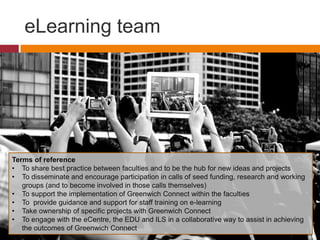
eLearning team
Terms of reference
• To share best practice between faculties and to be the hub for new ideas and projects
• To disseminate and encourage participation in calls of seed funding, research and working
groups (and to become involved in those calls themselves)
• To support the implementation of Greenwich Connect within the faculties
• To provide guidance and support for staff training on e-learning
• Take ownership of specific projects with Greenwich Connect
• To engage with the eCentre, the EDU and ILS in a collaborative way to assist in achieving
the outcomes of Greenwich Connect
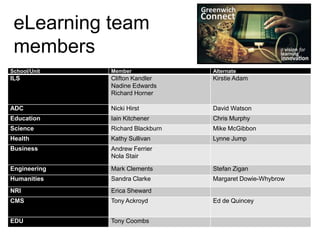
School/Unit Member Alternate
ILS Clifton Kandler
Nadine Edwards
Richard Horner
Kirstie Adam
ADC Nicki Hirst David Watson
Education Iain Kitchener Chris Murphy
Science Richard Blackburn Mike McGibbon
Health Kathy Sullivan Lynne Jump
Business Andrew Ferrier
Nola Stair
Engineering Mark Clements Stefan Zigan
Humanities Sandra Clarke Margaret Dowie-Whybrow
NRI Erica Sheward
CMS Tony Ackroyd Ed de Quincey
EDU Tony Coombs
eLearning team
members
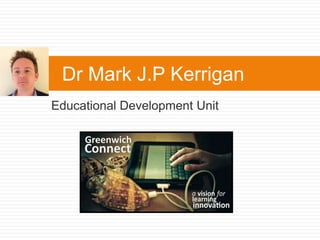
Educational Development Unit
Dr Mark J.P Kerrigan
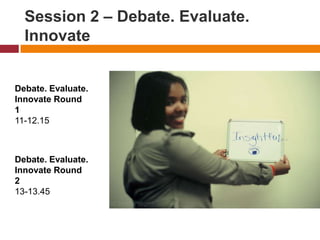
Session 2 – Debate. Evaluate.
Innovate
Debate. Evaluate.
Innovate Round
1
11-12.15
Debate. Evaluate.
Innovate Round
2
13-13.45
Session 2: Debate. Evaluate.
Debate: Is there a unified or
agreed position within the group
around this challenge?
Evaluate: What are the top 3
critical issues/questions for the
university (or Laban) that arise
from this debate?
Innovate: What are the top 3
possibilities/opportunities for the
university (or Laban) that arise
from this debate?
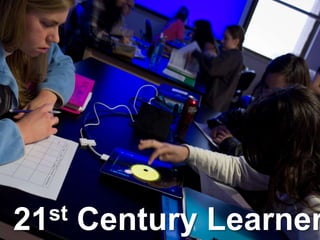
21st Century Learner
Openness
Is there a
need for a
new
pedagogy
Social media and
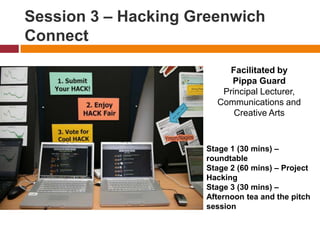
Session 3 – Hacking Greenwich
Connect
Facilitated by
Pippa Guard
Principal Lecturer,
Communications and
Creative Arts
Stage 1 (30 mins) –
roundtable
Stage 2 (60 mins) – Project
Hacking
Stage 3 (30 mins) –
Afternoon tea and the pitch
session
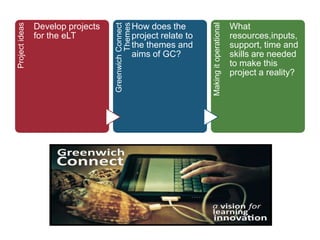
Projectideas
Develop projects
for the eLT
GreenwichConnect
Themes
How does the
project relate to
the themes and
aims of GC?
Makingitoperational
What
resources,inputs,
support, time and
skills are needed
to make this
project a reality?
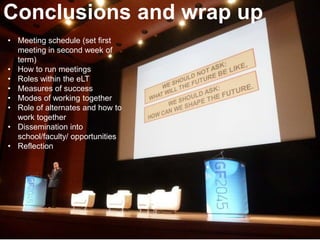
• Meeting schedule (set first
meeting in second week of
term)
• How to run meetings
• Roles within the eLT
• Measures of success
• Modes of working together
• Role of alternates and how to
work together
• Dissemination into
school/faculty/ opportunities
• Reflection
Conclusions and wrap up

Greenwich Connect Away day slides

  • 1.
  • 2.
    Introduction 9.00-9.30 Coffee andarrivals 9.30-10.50 Session 1 11.00-12.15 Debate, Evaluate, Innovate session round 1 12:15-13.00 LUNCH 13.00-13.45 Debate, Evaluate, Innovate session round 2 13.45-15.15 Session 3 Working afternoon tea 15.15-16.30 Session 3, conclusions
  • 3.
    Vice-Chancellor of theUniversity of Greenwich Professor David Maguire
  • 4.
    Session 1 -Introduction Introduction (9.30-10.50am) Peter Bryant @peterbryantHE Simon Walker @sialker • Get to know each other • What is Greenwich Connect? • Project example Digital Literacy (Dr. Mark J.P Kerrigan)
  • 5.
    Why are weall here? (getting to know you!) 9.00-9.30 Coffee and arrivals 9.30-10.50 Session 1 11.00-12.15 Debate, Evaluate, Innovate session round 1 12:15-13.00 LUNCH 13.00-13.45 Debate, Evaluate, Innovate session round 2 13.45-15.15 Session 3 Working afternoon tea • What is the most interesting project/idea/practice around e- learning that is happening in your school/unit? • What are the best ways we as university can enhance collaboration between students/staff in your school/unit/discipline? Share with each other in your small grou
  • 6.
    The history ofGreenwich Connect http://prezi.com/mfw eb4xngjm8/greenwi ch-connect-a- strategy-for- learning-innovation- at-the-university-of- greenwich/
  • 7.
    Strategic plan aims ‘Thedevelopment of e-learning and associated e-materials will support the engagement of staff and students in high-quality, location independent learning. We will ensure high-quality social provision, learning resources, personal tutoring and pastoral care. The university estate will continue to be improved so that it provides flexible learning spaces supported by a robust technical infrastructure’ Where does Greenwich Connect fit in? Strategic plan aims ‘The development of e-learning and associated e-materials will support the engagement of staff and students in high- quality, location independent learning. We will ensure high-quality social provision, learning resources, personal tutoring and pastoral care. The university estate will continue to be improved so that it provides flexible learning spaces supported by a robust technical infrastructure
  • 8.
    Learning, teaching andassessment strategy
  • 9.
    What is GreenwichConnect? It is a 3 year plan that will support the formation and growth of networks and connections between learners, graduates, faculty, peers, disciplines, research, community and industry.
  • 10.
    Strategic plan aims ‘Thedevelopment of e-learning and associated e-materials will support the engagement of staff and students in high-quality, location independent learning. We will ensure high-quality social provision, learning resources, personal tutoring and pastoral care. The university estate will continue to be improved so that it provides flexible learning spaces supported by a robust technical infrastructure’ Where does Greenwich Connect fit in? Greenwich Connect will enhance learning, teaching and assessment by… • promoting sharing, access, openness and support the formation and development of networks; • supporting the learner to excel at work and practice; • making learning authentic, real and practical; • encouraging social interaction and social collaboration at all levels of programme delivery; • being linked by its devices, platforms, locations, sites and campuses but not bound by them; • recognising the power of community and interactivity to enhance student learning; • facilitating the development and production of inter and trans- disciplinary content and knowledge; • delivering learning that is supportive, interactive, innovative, creative and engaging; • valuing pedagogy and its role in shaping the uses of technology; • supporting learner autonomy, personalisation and the development and promotion of professional identity; • making content that is open, shared, collaborative, cutting edge, media rich, impactful and relevant
  • 11.
    • Social interaction •Social Media • Collaboration • Crowdsourcing • Social construction of knowledge • Engagement and Networks Greenwich Connect aims to enhance learning, student achievement and outcomes at the University of Greenwich by supporting…
  • 12.
    Key Messages • ManyGreenwich students enter the university without a network, and leave the same way. Greenwich Connect will support the development and growth of these networks to enhance employability and student achievement; • Greenwich Connect is a vision for learning for the university in the digital age. It will support learning with technology into curriculum design and delivery; • Greenwich Connect is aspirational and achievable. It outlines project and aims for the next three years; • It is a vision for all programmes and projects to share, and is not led by any one school/faculty or office/unit.
  • 13.
    Defining Greenwich Connect GreenwichGraduates would… • graduate the University with a lasting network and the skills to maintain and grow it; • understand the importance of connections in career and personal life; • have the ability to share, collaborate, evaluate, inquire, play, create, reflect, personalise and interact; • use, repurpose and share the knowledge and skills they have acquired; • interact with the next generation of Greenwich learners through their networks; • have acquired and applied the Greenwich Graduate Attributes; • continue their association with the university after graduation.
  • 14.
  • 15.
    Aims of GreenwichConnect Greenwich Connect will guide and lead the uses of e-learning to support the development and practices of; • Social interaction and social construction of knowledge • Student employability • Digital literacy • Interactive, connected and relevant curriculum • Collaborative learning, teaching and assessment • Lasting connections and networks that go beyond the period of enrolment • Inter and trans-disciplinarity research and content • Innovation and creativity • A sense of autonomy, personalisation and an enterprise attitude
  • 16.
     Personalisation  Learningspaces  Engagement  Curriculum and research  Professional practice  Connectivity Key themes of Greenwich Connect
  • 17.
    PERSONALISATION Digital identity Personalisedprogrammes Individual learning journeys A sense of autonomy Your network of connections LEARNING SPACES Virtual and physical Spaces that support collaboration, connections and interaction Open community Linked by locations, sites and campuses but not bound by them ENGAGEMENT Supporting social interaction Social construction of knowledge Collaborative and shared content Links between disciplines Occurring before, during and beyond graduation CURRICULUM AND RESEARCH Inter and trans-disciplinary Interactive and relevant curriculum E-learning that is engaging, interactive and driven by pedagogy Space to support play and experimentation Connected to practice and work Curious, reflective and analytical Research informed, with research in, across and between disciplines PROFESSIONAL PRACTICE Supports the development of professional identity Develops skills for use through, at and in work Creates a network of opportunity Develops entrepreneurship, creativity and innovation Develops the role of local and global citizen CONNECTIVITY Social, professional and community Collaborative problem solving, decision making and content creation Linked through the university to other learners, community, industry and the globe Develops lasting and authentic connections between all members of the community
  • 18.
    Some examples ofwhat we are doing in Year 1 of Greenwich Connect Working groups • Joined up ways of linking technology use/acquisition to how our students and staff use technology to enhance learning • Current groups include social media, OERs and multimedia capture and productionBest practice sharing and capacity building • Agile resource making (open and sharable) • Cross-faculty teams sharing practice • Crowd-sourcing resources and expertise across the sector Seed fund • Equipment grants to schools targeted directly at students making, evaluating and sharing content that they make as groups
  • 19.
    Some examples ofwhat we are doing in Year 1 of Greenwich Connect Learning spaces • Reconfiguring of QA165 and QA175 Social interaction and engagement • Investing in how to enhance our VLE to encourage students interaction, collaboration and engagement • A variety of projects around student-led interaction and problem solving
  • 20.
    An example -Moodle 100% of programmes at the university will have an effective VLE presence which should include but is not limited to; • opportunities for the learners to share curated and user-generated content • opportunities for learners to interact virtually (within the constraints of assessment) • the aggregation of media-rich content from both inside and outside the university • the ability of learners to submit assessment and receive feedback electronically Activity • £15000 of development funding • Formation of a VLE working group • Adoption of aspects of GC strategy as VLE strategy • Lecture capture/multimedia production/OER/social media working groups • Seed fund projects
  • 21.
    Page 1 Greenwich Connect WorkingGroup (GCWG) Membership: School, EDU, ILS Terms of reference: Undertakes work at a strategic level to implement Greenwich Connect, forming and supporting the critical governance and functional structures. This group is the functional nexus between schools, ILS and EDU in terms of e-learning. Advises on strategy and policy alignment, commissions policy, identifies priorities and plans expenditure for following academic year, takes expenditure forward to VCG, evaluates large projects, signs off on policy/ monitors policy. Meets 4 times a year, Officer for the group is the Manager of the GC project Educational Development Unit Information and Library Services The EDU leads the pedagogical activity associated with Greenwich Connect and manages the team comprising faculty e-learning leaders ELT staff, and provides the link between the rest of the university and GC ILS provides the infrastructure and support and facilitates the development and acquisition of tools and technologies, where required, and works collaboratively with EDU to support staff e-Learning Team Formed from representatives from within schools and faculties (existing e-learning support) They will help align the e- learning activity of their school in line with Greenwich Connect. They will meet every 4-6 weeks with the e-learning people from the EDU and with others as required. There will be no change to their job title or reporting. Leader – Greenwich Connect Project Liaises with key stakeholders, reports on activity, is the link between the governance and the ‘on-the-ground’ processes, undertakes the evaluation of the project against the objectives and operates as the front person for project. Should come from the establishment within the e- learning service User/working groups VLE user group The aim of these groups is to undertake specific tasks within the strategy to ensure wide consultation and engagement OER working group Mobile working group Other working groups eCentre The eCentre is the hub for evaluative and research informed practice on e-learning Works closely with all stakeholders (who, where appropriate, should be members of the eCentre) Greenwich Connect Organisational Chart Learning and Quality Committee GC must connect with the University TL&A strategy, and needs to be engagement between the GCAG and L&Q Programme and Quality Office
  • 22.
    eLearning team Terms ofreference • To share best practice between faculties and to be the hub for new ideas and projects • To disseminate and encourage participation in calls of seed funding, research and working groups (and to become involved in those calls themselves) • To support the implementation of Greenwich Connect within the faculties • To provide guidance and support for staff training on e-learning • Take ownership of specific projects with Greenwich Connect • To engage with the eCentre, the EDU and ILS in a collaborative way to assist in achieving the outcomes of Greenwich Connect
  • 23.
    School/Unit Member Alternate ILSClifton Kandler Nadine Edwards Richard Horner Kirstie Adam ADC Nicki Hirst David Watson Education Iain Kitchener Chris Murphy Science Richard Blackburn Mike McGibbon Health Kathy Sullivan Lynne Jump Business Andrew Ferrier Nola Stair Engineering Mark Clements Stefan Zigan Humanities Sandra Clarke Margaret Dowie-Whybrow NRI Erica Sheward CMS Tony Ackroyd Ed de Quincey EDU Tony Coombs eLearning team members
  • 24.
  • 25.
    Session 2 –Debate. Evaluate. Innovate Debate. Evaluate. Innovate Round 1 11-12.15 Debate. Evaluate. Innovate Round 2 13-13.45
  • 26.
    Session 2: Debate.Evaluate. Debate: Is there a unified or agreed position within the group around this challenge? Evaluate: What are the top 3 critical issues/questions for the university (or Laban) that arise from this debate? Innovate: What are the top 3 possibilities/opportunities for the university (or Laban) that arise from this debate?
  • 27.
  • 28.
  • 29.
    Is there a needfor a new pedagogy
  • 30.
  • 31.
    Session 3 –Hacking Greenwich Connect Facilitated by Pippa Guard Principal Lecturer, Communications and Creative Arts Stage 1 (30 mins) – roundtable Stage 2 (60 mins) – Project Hacking Stage 3 (30 mins) – Afternoon tea and the pitch session
  • 32.
    Projectideas Develop projects for theeLT GreenwichConnect Themes How does the project relate to the themes and aims of GC? Makingitoperational What resources,inputs, support, time and skills are needed to make this project a reality?
  • 33.
    • Meeting schedule(set first meeting in second week of term) • How to run meetings • Roles within the eLT • Measures of success • Modes of working together • Role of alternates and how to work together • Dissemination into school/faculty/ opportunities • Reflection Conclusions and wrap up