GRID
May 30th , 2012
PATRICIA GOMEZ
ALSTOM
Network Management
Solutions
Smart Grid Overview
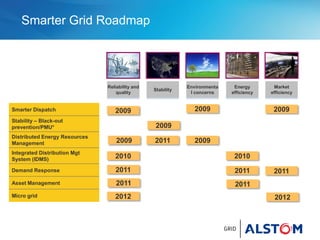
Smarter Grid Roadmap
Reliability and
quality
Environmenta
l concerns
Energy
efficiency
Market
efficiency
Smarter Dispatch
Stability – Black-out
prevention/PMU*
Distributed Energy Resources
Management
Integrated Distribution Mgt
System (IDMS)
Demand Response
Asset Management
Micro grid
2009
Stability
2009
2009
2009
2009
2009
2011
2010
2010
2011
2011
2011
2011
2012
2012
2011
e-terra Architecture
e-terradistribution
e-terraplatform
e-terrascada
Primarily
DMS
Primarily
EMS
Primarily
MMS
Shared
Component
e-terracomm
e-terramarkets
Markets Data Base
Market Clearing
Engine
Markets User
Interface
Markets Operator
Interface
e-terravision e-terrabrowser
Data
Layer
Application
&
Solution
Groupings
UI
Layer
Solution
e-
terraarchive
Services
Layer Infrastructure
Service
Common
Logging
Service
Service
Abstraction
Layer
Alstom
Presentation
Framework
Smart Dispatch
Renewables
Outage
Management
System
Distribution
Operator Training
Simulator
DNAF/DNOM
Sub-Station Editor
On-line Stability
e-terratransmission e-terrageneration
e-terrasimulator
e-terrasource
Security Sub-
systems
PMU Data
Concentrator
e-terrahabitat
Distributed
Generation
Demand Response
Meter Data
Management
e-terracontrol
Orchestration
Scope of Integrated Distribution Management
Distributed
Generation/
Demand
Analysis&
Dispatch
Geo-Spatial
Asset Model
Customer
Model
Network Analysis
Network Outage
Management
Network Optimizer
Power Flow
Load Allocation
Limit Monitor
Power Quality
Short Circuit
Loss Analysis
Load Model &
Forecast
Fault Isolationand Service
Restoration
FeederReconfiguration
PlannedOutage Study
Load & Volt/Var Management
Unplanned/Planned OutageManagement
Trouble Call Mgmt.
Crew Monitor/Assign
Network View
Network Operations User Interface
Topology Analysis Loop Detection
EnergizationStatus Operator NotesAnnotations
Tagging NetworkTracing
Network Operations Model
Call
Center
System
Simulator
DistributionOperator Training
Outage and Restoration
Training
Operations ValidationTool
Switching
Operations
Creation,Validationand
Executionof SwitchingOrders.
Creationand Management of Safety
Documents
Automated
Metering (AMI)
e-terrascada
System
Supports Real-time MaintainsStaticand
Updates DynamicData
DG/Load Models
Equipment,Connectivity, Impedance Models
April 2011 - Strictly Confidential – Do not copy without permission - 5
e-terra : A leader in Smart Grid Network
Management Solutions !
e-terragridcom
products & solution suite for Utility Telecom
e-terramarket
software suite for Market Management System
e-terraplatform
software suite for Energy Management Systems
e-terradistribution
software suite for Distribution Management System
#3
#1
#1
#2
software suite for
Asset Condition Monitoring Systems
software suite for
Distributed Energy Resource Management Systems
PhasorPoint
WAMS & Stability
NEW
!
NEW
! DRBizNet
Demand Response
Smart Grid from Vision to Product
© ALSTOM 2010. All rights reserved. Information contained in this document is provided without liability for information purposes
only and is subject to change without notice. No representation or warranty is given or to be implied as to the completeness of
information or fitness for any particular purpose. Reproduction, use or disclosure to third parties, without express written authority,
is strictly prohibited.
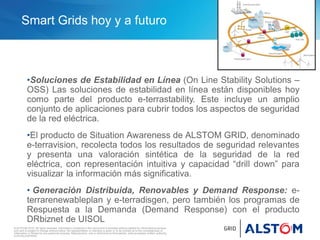
Smart Grids hoy y a futuro
•Soluciones de Estabilidad en Línea (On Line Stability Solutions –
OSS) Las soluciones de estabilidad en línea están disponibles hoy
como parte del producto e-terrastability. Este incluye un amplio
conjunto de aplicaciones para cubrir todos los aspectos de seguridad
de la red eléctrica.
•El producto de Situation Awareness de ALSTOM GRID, denominado
e-terravision, recolecta todos los resultados de seguridad relevantes
y presenta una valoración sintética de la seguridad de la red
eléctrica, con representación intuitiva y capacidad “drill down” para
visualizar la información más significativa.
• Generación Distribuida, Renovables y Demand Response: e-
terrarenewableplan y e-terradisgen, pero también los programas de
Respuesta a la Demanda (Demand Response) con el producto
DRbiznet de UISOL
© ALSTOM 2010. All rights reserved. Information contained in this document is provided without liability for information purposes
only and is subject to change without notice. No representation or warranty is given or to be implied as to the completeness of
information or fitness for any particular purpose. Reproduction, use or disclosure to third parties, without express written authority,
is strictly prohibited.
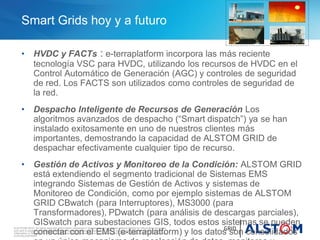
Smart Grids hoy y a futuro
• HVDC y FACTs : e-terraplatform incorpora las más reciente
tecnología VSC para HVDC, utilizando los recursos de HVDC en el
Control Automático de Generación (AGC) y controles de seguridad
de red. Los FACTS son utilizados como controles de seguridad de
la red.
• Despacho Inteligente de Recursos de Generación Los
algoritmos avanzados de despacho (“Smart dispatch”) ya se han
instalado exitosamente en uno de nuestros clientes más
importantes, demostrando la capacidad de ALSTOM GRID de
despachar efectivamente cualquier tipo de recurso.
• Gestión de Activos y Monitoreo de la Condición: ALSTOM GRID
está extendiendo el segmento tradicional de Sistemas EMS
integrando Sistemas de Gestión de Activos y sistemas de
Monitoreo de Condición, como por ejemplo sistemas de ALSTOM
GRID CBwatch (para Interruptores), MS3000 (para
Transformadores), PDwatch (para análisis de descargas parciales),
GISwatch para subestaciones GIS, todos estos sistemas se pueden
conectar con el EMS (e-terraplatform) y los datos son consolidados
Smart Dispatch Market Drivers
Society’s growing dependency on electricity
− Looming risks of major system disturbances
− Focus on reliable demand-supply balance & grid security
Global energy & environmental movement
− Increasing presence of DER - Distributed Energy Resources
(e.g. wind, DR, etc)
− Operational challenges: DER performance uncertainties
Experiences from deregulated system operations
− Established foundation for integrating demand-supply balance
with grid security constraints (e.g. LMP).
− Identified emerging deficiencies in Dispatch Instructions
 Unrelenting complexity in
business & technical
decision process
 Smart devices/resources with
distributed intelligence
 Coordinated decision making
Why Synchrophasors?
- Improve security
- Increase transfer
- System analysis
- Manage renewables
- Indicator of stress on a power
system
- Captures dynamic behaviour
e-terravision
PhasorPoint
Workbench
SCADA
e-terrabrowser
PHASORS
Combined Phasor/SCADA Applications
• Dynamic Constraint Relief
• Voltage Stability (Baseline
validation)
• Transient Stability
• Thermal Monitoring
• Real-time Network Model (SE convergence)
• Oscillatory Sensitivity Analysis
e-terradistribution
Prevent Major Blackouts – Improve Reliability
August 10, 1996 Blackout
Monitor wide-area grid stress.
August 14, 2003 Blackout
Early detection of
dynamic instability.
Dynamic Instability
(Negative Damping)
~ 3% (LOW) Damping
(after Keeler Allston line trips)
Currently 200+
PMUs Installed.
Anticipate to ADD
another 800+ PMUs
by 2013
(Aided by the 2010
DOE Stimulus Projects)
Source: NASPI Website (www.naspi.org)
~200 PMUs: 1990 to 2010..
~1000 PMUs: 2010 to 2013!!
PMU Deployment in North America
Residential
Customers
Demand Response Management System (DRMS)
C&I
Customers
Aggregation
Customers
Email
SMS
VOIP
Open
ADR
e-terraControl
ICCP/DNP3
Building
EMS
Systems
Hot Water AC
Home Gateways
· WiFi
· ZigBee
· DLC
· Other
Home
Area Network
AMI Meter
IHD
EV/PHV
LMS
Systems
AMI
Head
ends
SMTP
Load
Mgmt
Systems
Back Office Systems Integration Layer
Standards Based Integration
Web
UI
&
Web
Services
Wholesale
Markets
Customers
Customer
Service
DR Operations
Aggregators
ISO/RTOs
Exchanges
Capital Markets
Dispatching
Systems
(ADS/AGC)
Balancing
Authority
(EMS/DMS)
Customer
Information
Systems
Metering
Systems
(AMI/MDMS)
Forecasting &
Unit Commitment
(GMS)
User
Access
(Portal/LDAP)
Settlement
Systems
Market
Mgmt Systems
(MMS)
Insert a DRMS
Abstract the technology complexities, integrate, and automate
Single point of
registration for
all DR
programs
Single point of
DR Program
Mgmt &
Operations
Single view of
availability of
DR Resources
Single point of
integration to
back office
systems
Optimization of
the use of DR
Resources
Performance
based
Settlements
DR Management System (DRMS)
Residential
Customers
Device & Load
Management
C&I
Customers
Telemetry
Monitoring
Program
Management
Customer Portal
Customer
Marketing
Enrollment
Processes
Baseline
Calculations
Customer
Notifications
Device
Provisioning
Yield
Forecasting
Event
Management
Web-Services API Enterprise Integration
DRBizNet
DR Business Network
Aggregation
Customers
Email
SMS
VOIP
Settlement
Preparation
Dispatch
Optimization
Open
ADR
Dispatching
Systems
(ADS/AGC)
e-terraControl
ICCP/DNP3
Building
EMS
Systems
Dispatch
Strategies
Meter Data
Aggregation
Hot Water AC
Home Gateways
· WiFi
· ZigBee
· DLC
· Other
Home
Area Network
AMI Meter
IHD
EV/PHV
LMS
Systems
Balancing
Authority
(EMS/DMS)
Customer
Information
Systems
Metering
Systems
(AMI/MDMS)
Forecasting &
Unit Commitment
(GMS)
User
Access
(Portal/LDAP)
Settlement
Systems
Market
Mgmt Systems
(MMS)
AMI
Head
ends
AMI Agent 1
(ex: Sensus)
AMI Agent 2
(ex: SSN)
AMI Agent 3
(ex: Itron)
OpenADR
Agent
SCADA
Agent
LMS Agent 1
(ex: Control4)
Email Agent
New/Custom
Agent
SMTP
LMS Agent 2
(ex: Yukon)
LMS Agent 3
(ex: CCM)
Load
Mgmt
Systems
•15
DRBizNet Enables Demand Side Resources to
Become Virtual Power Plants in the Control Center
 Manage many programs –
energy, capacity, ancillary
services
 Manage entire resource
portfolio and participation
lifecycle
 Manage program and
resource specific
preferences/constraints
 Aggregate capacity into virtual
power plants (VPPs)
 Integrate with MMS, EMS,
Settlements
 Disaggregate
awards/dispatches
 Notify resources over various
communication channels
 Collect and store billing quality
meter data
Substation
Automation
Grid Power
Electronics
Transmission
4. Integrated Distribution Management Systems
Control Room IT
6. Smart Metering Control Rooms
1. On-Line Stability & Defense Plan Management
2. On-Line Asset Management
5. Distributed Energy Ressource (DER) Management
Smart Grid 10 years vision
15 Critical Smart Grids Programs
3. Generation Portfolio Management
9. Smart Digital Substation (SAS)
12. Advanced HVDC Controls (Transverse
GPA)
13. Smart FACTs (Transverse GPA)
14. Medium Size Converter for Industrial,
Solar & Storage (Transverse PEA,
Bouygues, Transport)
15. Meshed DC Grids (Transverse
Grid)
7. Substation Merging Units
10. Wide Area Protection & Control
8. Condition Monitoring IEDs
11. New Substation IEDs (SAS)
SCALABILITY - Florida Power & Light Company
Customers 4.52M
Generation Capacity 19.05GW
Maximum Demand 22.4GW
Transmission lines 64,000 miles
Distribution Zone Substations 550
Distribution Feeders 3,850
Circuit Segments 1,500,000
Distribution Transformers 1,000,000
Distribution Loads 4,000,000
Managed Feeder Capacitors >6,000
User Interface Positions 500
Current Analogs/Points >150K of 400K
The DMS system is deployed and operational throughout FPL.
Control centers have been consolidated. Operator training is
ongoing for network optimization functions (FISR & VVC).
Large Network Model Challenges
− Extremely large models compared to the typical
transmission system – 25 million objects in the FPL case.
− Visualization of the Network Data Model – it is not
reasonable to build/maintain displays specifically for DMS
– leverage the GIS
− The model changes everyday – updates must be
supported which do not impact users, no restarts or
failovers
− There are several data sources from which the online
network model database is created
ALSTOM GRID’s Solution for Power Quality
Problem in India
- Page 19
ALSTOM GRID Solution:
Bus Load Allocation (BLA)
Distribution Power Flow (DPF)
Power Quality Index Evaluation (PQI)
Automated Feeder Reconfiguration (AFR)
Load and Voltage/VAR Management (LVM)
Fault Location (FL)
Economic Dispatch
Billing Schedule and Unit Commitments
Industry:
Bus Load Allocation (BLA)
Distribution Power Flow (DPF)
Power Quality Index Evaluation (PQI)
Economic Dispatch
Billing Schedule and unit commitments
Utility:
Bus Load Allocation (BLA)
Distribution Power Flow (DPF)
Power Quality Index Evaluation (PQI)
Automated Feeder Reconfiguration (AFR)
Load and Voltage/VAR Management (LVM)
Fault Location (FL)
Power Quality Pilot Project Benefits in India
- Page 20
 Breaker tripping without any apparent reasons is drastically reduced.
 Increased operations efficiency
 Improved Voltage profile
 Automated fault location, Isolation and Service Recovery
 Reliable power to customer
 System resists attacks on both the physical infrastructure (substations, poles, transformers, etc.)
and the cyber-structure (markets, systems, software, communications)
 Anticipate and response to system disturbance
 Reduction in equipment failure in field
 Gain efficiency by integrating system
 Premium price for the quality power supply
 Moving data smartly and turn it into action
- Page 21
Peak Load Management Pilot in India– Key
Objectives
Technical Objective Commercial Objective
Establish concept of Demand Response
- Implement Direct Load Curtailment
- Integrate Customer profile in Load Forecast
- Demonstrate improvement in Grid Freq
Implement Load Balancing & Feeder
Reconfiguration
- To reduce losses
- To optimally load feeders
- Visualization of distribution network
Reduced cost of Electricity for Utility
To reduce the technical losses
• Less Investment in Capacity Addition
• Higher Reliability
• Better customer Satisfaction
• Incentive in terms of Tariff to Participating customers
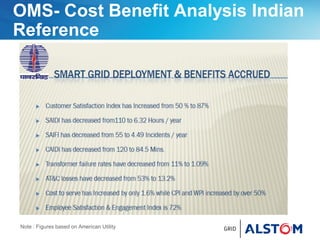
OMS- Cost Benefit Analysis Indian
Reference
Note : Figures based on American Utility
Typical Low-Voltage Microgrid architecture
Microgrid structure includes
− Energy management within and
outside of the distributed power
system
− Interface, control and protection
requirements for each micro
source
− Management of power flow
constraints, voltage and frequency
− Islanding and interconnected
operation philosophy
− Load sharing during islanding
− Protection options for networks of
variable configurations
− Device and interface response and
intelligence requirements
− Next-generation communications
infrastructure
− … PCC: Point of Commom Coupling
MGCC: Micro Grid Central Controller
MC: Micro source Controller
LC: Load Controller
Source: R. Lasseter – University of Wisconsin
MV micro-grid:
Overview of Alstom offering
 Open, multi-purpose SCADA/gateway (ICCP,
104, DNP, 61850, OPC, …)
− Alstom product: e-terracontrol
 Optional Energy Management Applications:
− Topology Analysis
− Network Analysis: product e-terratransmission
− Generation Management: product e-terrageneration
− Historical data with Disturbance Data Recording and Replay
 CIM Modeling tool : e-terrasource
Application to Micro-Grids:
Network Analysis
Look ahead and What-if analysis (Powerflow, Short
Circuit, Contingency Analysis)
− Evaluate viability of islanded operations in specific conditions
− Evaluate consequences of postulated Outages
− Evaluate reconnection after islanding
RT monitoring (State Estimator, CA)
− Calculate and Monitor key electrical characteristics (voltages, flows, angles)
− Evaluate against limits
Volt Var analysis (VVD, VVC)
− Propose Controls to optimize Voltages and Reactive flows, to meet service obligations
− Advisory or Closed Loop
Network Simulation
− Evaluate Black Start scenarios
Application to Micro-Grids:
Generation Management
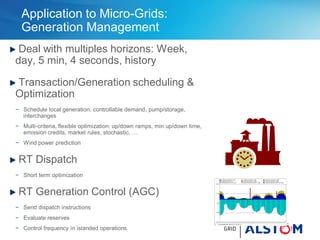
Deal with multiples horizons: Week,
day, 5 min, 4 seconds, history
Transaction/Generation scheduling &
Optimization
− Schedule local generation, controllable demand, pump/storage,
interchanges
− Multi-criteria, flexible optimization: up/down ramps, min up/down time,
emission credits, market rules, stochastic, …
− Wind power prediction
RT Dispatch
− Short term optimization
RT Generation Control (AGC)
− Send dispatch instructions
− Evaluate reserves
− Control frequency in islanded operations
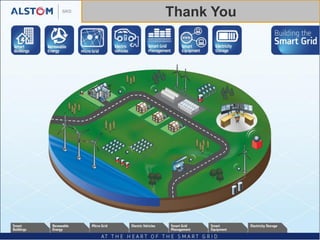
Thank You
Now….
Our specialist: Lawrence E. Jones, Ph.D
Vice President, Regulatory Affairs,
Policy & Industry Relations, Alstom Grid North America
Dr. Lawrence E. Jones has over 20 years of experience in the energy industry with expertise
in Power Systems Engineering, Applications of Information, Communications and Control
Technologies in Power Grid and Electricity Market Operations, Smart Grid Technologies
including HVDC and FACTS, and Renewable Energy Integration. He joined Alstom Grid in
2000.
In September 2010, Dr. Jones was appointed by the United States Department of
Commerce’s National Institute of Standards and Technology (NIST) to a three-year term on
the 15-member Federal Smart Grid Advisory Committee established to carry out duties
authorized by section 1305 of the Energy Independence and Security Act of 2007.

ALSTOM-Network_mgmt_solutions.pdf

  • 1.
    GRID May 30th ,2012 PATRICIA GOMEZ ALSTOM Network Management Solutions Smart Grid Overview
  • 2.
    Smarter Grid Roadmap Reliabilityand quality Environmenta l concerns Energy efficiency Market efficiency Smarter Dispatch Stability – Black-out prevention/PMU* Distributed Energy Resources Management Integrated Distribution Mgt System (IDMS) Demand Response Asset Management Micro grid 2009 Stability 2009 2009 2009 2009 2009 2011 2010 2010 2011 2011 2011 2011 2012 2012 2011
  • 3.
    e-terra Architecture e-terradistribution e-terraplatform e-terrascada Primarily DMS Primarily EMS Primarily MMS Shared Component e-terracomm e-terramarkets Markets DataBase Market Clearing Engine Markets User Interface Markets Operator Interface e-terravision e-terrabrowser Data Layer Application & Solution Groupings UI Layer Solution e- terraarchive Services Layer Infrastructure Service Common Logging Service Service Abstraction Layer Alstom Presentation Framework Smart Dispatch Renewables Outage Management System Distribution Operator Training Simulator DNAF/DNOM Sub-Station Editor On-line Stability e-terratransmission e-terrageneration e-terrasimulator e-terrasource Security Sub- systems PMU Data Concentrator e-terrahabitat Distributed Generation Demand Response Meter Data Management e-terracontrol Orchestration
  • 4.
    Scope of IntegratedDistribution Management Distributed Generation/ Demand Analysis& Dispatch Geo-Spatial Asset Model Customer Model Network Analysis Network Outage Management Network Optimizer Power Flow Load Allocation Limit Monitor Power Quality Short Circuit Loss Analysis Load Model & Forecast Fault Isolationand Service Restoration FeederReconfiguration PlannedOutage Study Load & Volt/Var Management Unplanned/Planned OutageManagement Trouble Call Mgmt. Crew Monitor/Assign Network View Network Operations User Interface Topology Analysis Loop Detection EnergizationStatus Operator NotesAnnotations Tagging NetworkTracing Network Operations Model Call Center System Simulator DistributionOperator Training Outage and Restoration Training Operations ValidationTool Switching Operations Creation,Validationand Executionof SwitchingOrders. Creationand Management of Safety Documents Automated Metering (AMI) e-terrascada System Supports Real-time MaintainsStaticand Updates DynamicData DG/Load Models Equipment,Connectivity, Impedance Models
  • 5.
    April 2011 -Strictly Confidential – Do not copy without permission - 5 e-terra : A leader in Smart Grid Network Management Solutions ! e-terragridcom products & solution suite for Utility Telecom e-terramarket software suite for Market Management System e-terraplatform software suite for Energy Management Systems e-terradistribution software suite for Distribution Management System #3 #1 #1 #2 software suite for Asset Condition Monitoring Systems software suite for Distributed Energy Resource Management Systems PhasorPoint WAMS & Stability NEW ! NEW ! DRBizNet Demand Response
  • 6.
    Smart Grid fromVision to Product
  • 7.
    © ALSTOM 2010.All rights reserved. Information contained in this document is provided without liability for information purposes only and is subject to change without notice. No representation or warranty is given or to be implied as to the completeness of information or fitness for any particular purpose. Reproduction, use or disclosure to third parties, without express written authority, is strictly prohibited. Smart Grids hoy y a futuro •Soluciones de Estabilidad en Línea (On Line Stability Solutions – OSS) Las soluciones de estabilidad en línea están disponibles hoy como parte del producto e-terrastability. Este incluye un amplio conjunto de aplicaciones para cubrir todos los aspectos de seguridad de la red eléctrica. •El producto de Situation Awareness de ALSTOM GRID, denominado e-terravision, recolecta todos los resultados de seguridad relevantes y presenta una valoración sintética de la seguridad de la red eléctrica, con representación intuitiva y capacidad “drill down” para visualizar la información más significativa. • Generación Distribuida, Renovables y Demand Response: e- terrarenewableplan y e-terradisgen, pero también los programas de Respuesta a la Demanda (Demand Response) con el producto DRbiznet de UISOL
  • 8.
    © ALSTOM 2010.All rights reserved. Information contained in this document is provided without liability for information purposes only and is subject to change without notice. No representation or warranty is given or to be implied as to the completeness of information or fitness for any particular purpose. Reproduction, use or disclosure to third parties, without express written authority, is strictly prohibited. Smart Grids hoy y a futuro • HVDC y FACTs : e-terraplatform incorpora las más reciente tecnología VSC para HVDC, utilizando los recursos de HVDC en el Control Automático de Generación (AGC) y controles de seguridad de red. Los FACTS son utilizados como controles de seguridad de la red. • Despacho Inteligente de Recursos de Generación Los algoritmos avanzados de despacho (“Smart dispatch”) ya se han instalado exitosamente en uno de nuestros clientes más importantes, demostrando la capacidad de ALSTOM GRID de despachar efectivamente cualquier tipo de recurso. • Gestión de Activos y Monitoreo de la Condición: ALSTOM GRID está extendiendo el segmento tradicional de Sistemas EMS integrando Sistemas de Gestión de Activos y sistemas de Monitoreo de Condición, como por ejemplo sistemas de ALSTOM GRID CBwatch (para Interruptores), MS3000 (para Transformadores), PDwatch (para análisis de descargas parciales), GISwatch para subestaciones GIS, todos estos sistemas se pueden conectar con el EMS (e-terraplatform) y los datos son consolidados
  • 9.
    Smart Dispatch MarketDrivers Society’s growing dependency on electricity − Looming risks of major system disturbances − Focus on reliable demand-supply balance & grid security Global energy & environmental movement − Increasing presence of DER - Distributed Energy Resources (e.g. wind, DR, etc) − Operational challenges: DER performance uncertainties Experiences from deregulated system operations − Established foundation for integrating demand-supply balance with grid security constraints (e.g. LMP). − Identified emerging deficiencies in Dispatch Instructions  Unrelenting complexity in business & technical decision process  Smart devices/resources with distributed intelligence  Coordinated decision making
  • 10.
    Why Synchrophasors? - Improvesecurity - Increase transfer - System analysis - Manage renewables - Indicator of stress on a power system - Captures dynamic behaviour e-terravision PhasorPoint Workbench SCADA e-terrabrowser PHASORS Combined Phasor/SCADA Applications • Dynamic Constraint Relief • Voltage Stability (Baseline validation) • Transient Stability • Thermal Monitoring • Real-time Network Model (SE convergence) • Oscillatory Sensitivity Analysis e-terradistribution
  • 11.
    Prevent Major Blackouts– Improve Reliability August 10, 1996 Blackout Monitor wide-area grid stress. August 14, 2003 Blackout Early detection of dynamic instability. Dynamic Instability (Negative Damping) ~ 3% (LOW) Damping (after Keeler Allston line trips)
  • 12.
    Currently 200+ PMUs Installed. Anticipateto ADD another 800+ PMUs by 2013 (Aided by the 2010 DOE Stimulus Projects) Source: NASPI Website (www.naspi.org) ~200 PMUs: 1990 to 2010.. ~1000 PMUs: 2010 to 2013!! PMU Deployment in North America
  • 13.
    Residential Customers Demand Response ManagementSystem (DRMS) C&I Customers Aggregation Customers Email SMS VOIP Open ADR e-terraControl ICCP/DNP3 Building EMS Systems Hot Water AC Home Gateways · WiFi · ZigBee · DLC · Other Home Area Network AMI Meter IHD EV/PHV LMS Systems AMI Head ends SMTP Load Mgmt Systems Back Office Systems Integration Layer Standards Based Integration Web UI & Web Services Wholesale Markets Customers Customer Service DR Operations Aggregators ISO/RTOs Exchanges Capital Markets Dispatching Systems (ADS/AGC) Balancing Authority (EMS/DMS) Customer Information Systems Metering Systems (AMI/MDMS) Forecasting & Unit Commitment (GMS) User Access (Portal/LDAP) Settlement Systems Market Mgmt Systems (MMS) Insert a DRMS Abstract the technology complexities, integrate, and automate Single point of registration for all DR programs Single point of DR Program Mgmt & Operations Single view of availability of DR Resources Single point of integration to back office systems Optimization of the use of DR Resources Performance based Settlements
  • 14.
    DR Management System(DRMS) Residential Customers Device & Load Management C&I Customers Telemetry Monitoring Program Management Customer Portal Customer Marketing Enrollment Processes Baseline Calculations Customer Notifications Device Provisioning Yield Forecasting Event Management Web-Services API Enterprise Integration DRBizNet DR Business Network Aggregation Customers Email SMS VOIP Settlement Preparation Dispatch Optimization Open ADR Dispatching Systems (ADS/AGC) e-terraControl ICCP/DNP3 Building EMS Systems Dispatch Strategies Meter Data Aggregation Hot Water AC Home Gateways · WiFi · ZigBee · DLC · Other Home Area Network AMI Meter IHD EV/PHV LMS Systems Balancing Authority (EMS/DMS) Customer Information Systems Metering Systems (AMI/MDMS) Forecasting & Unit Commitment (GMS) User Access (Portal/LDAP) Settlement Systems Market Mgmt Systems (MMS) AMI Head ends AMI Agent 1 (ex: Sensus) AMI Agent 2 (ex: SSN) AMI Agent 3 (ex: Itron) OpenADR Agent SCADA Agent LMS Agent 1 (ex: Control4) Email Agent New/Custom Agent SMTP LMS Agent 2 (ex: Yukon) LMS Agent 3 (ex: CCM) Load Mgmt Systems
  • 15.
    •15 DRBizNet Enables DemandSide Resources to Become Virtual Power Plants in the Control Center  Manage many programs – energy, capacity, ancillary services  Manage entire resource portfolio and participation lifecycle  Manage program and resource specific preferences/constraints  Aggregate capacity into virtual power plants (VPPs)  Integrate with MMS, EMS, Settlements  Disaggregate awards/dispatches  Notify resources over various communication channels  Collect and store billing quality meter data
  • 16.
    Substation Automation Grid Power Electronics Transmission 4. IntegratedDistribution Management Systems Control Room IT 6. Smart Metering Control Rooms 1. On-Line Stability & Defense Plan Management 2. On-Line Asset Management 5. Distributed Energy Ressource (DER) Management Smart Grid 10 years vision 15 Critical Smart Grids Programs 3. Generation Portfolio Management 9. Smart Digital Substation (SAS) 12. Advanced HVDC Controls (Transverse GPA) 13. Smart FACTs (Transverse GPA) 14. Medium Size Converter for Industrial, Solar & Storage (Transverse PEA, Bouygues, Transport) 15. Meshed DC Grids (Transverse Grid) 7. Substation Merging Units 10. Wide Area Protection & Control 8. Condition Monitoring IEDs 11. New Substation IEDs (SAS)
  • 17.
    SCALABILITY - FloridaPower & Light Company Customers 4.52M Generation Capacity 19.05GW Maximum Demand 22.4GW Transmission lines 64,000 miles Distribution Zone Substations 550 Distribution Feeders 3,850 Circuit Segments 1,500,000 Distribution Transformers 1,000,000 Distribution Loads 4,000,000 Managed Feeder Capacitors >6,000 User Interface Positions 500 Current Analogs/Points >150K of 400K The DMS system is deployed and operational throughout FPL. Control centers have been consolidated. Operator training is ongoing for network optimization functions (FISR & VVC).
  • 18.
    Large Network ModelChallenges − Extremely large models compared to the typical transmission system – 25 million objects in the FPL case. − Visualization of the Network Data Model – it is not reasonable to build/maintain displays specifically for DMS – leverage the GIS − The model changes everyday – updates must be supported which do not impact users, no restarts or failovers − There are several data sources from which the online network model database is created
  • 19.
    ALSTOM GRID’s Solutionfor Power Quality Problem in India - Page 19 ALSTOM GRID Solution: Bus Load Allocation (BLA) Distribution Power Flow (DPF) Power Quality Index Evaluation (PQI) Automated Feeder Reconfiguration (AFR) Load and Voltage/VAR Management (LVM) Fault Location (FL) Economic Dispatch Billing Schedule and Unit Commitments Industry: Bus Load Allocation (BLA) Distribution Power Flow (DPF) Power Quality Index Evaluation (PQI) Economic Dispatch Billing Schedule and unit commitments Utility: Bus Load Allocation (BLA) Distribution Power Flow (DPF) Power Quality Index Evaluation (PQI) Automated Feeder Reconfiguration (AFR) Load and Voltage/VAR Management (LVM) Fault Location (FL)
  • 20.
    Power Quality PilotProject Benefits in India - Page 20  Breaker tripping without any apparent reasons is drastically reduced.  Increased operations efficiency  Improved Voltage profile  Automated fault location, Isolation and Service Recovery  Reliable power to customer  System resists attacks on both the physical infrastructure (substations, poles, transformers, etc.) and the cyber-structure (markets, systems, software, communications)  Anticipate and response to system disturbance  Reduction in equipment failure in field  Gain efficiency by integrating system  Premium price for the quality power supply  Moving data smartly and turn it into action
  • 21.
    - Page 21 PeakLoad Management Pilot in India– Key Objectives Technical Objective Commercial Objective Establish concept of Demand Response - Implement Direct Load Curtailment - Integrate Customer profile in Load Forecast - Demonstrate improvement in Grid Freq Implement Load Balancing & Feeder Reconfiguration - To reduce losses - To optimally load feeders - Visualization of distribution network Reduced cost of Electricity for Utility To reduce the technical losses • Less Investment in Capacity Addition • Higher Reliability • Better customer Satisfaction • Incentive in terms of Tariff to Participating customers
  • 22.
    OMS- Cost BenefitAnalysis Indian Reference Note : Figures based on American Utility
  • 23.
    Typical Low-Voltage Microgridarchitecture Microgrid structure includes − Energy management within and outside of the distributed power system − Interface, control and protection requirements for each micro source − Management of power flow constraints, voltage and frequency − Islanding and interconnected operation philosophy − Load sharing during islanding − Protection options for networks of variable configurations − Device and interface response and intelligence requirements − Next-generation communications infrastructure − … PCC: Point of Commom Coupling MGCC: Micro Grid Central Controller MC: Micro source Controller LC: Load Controller Source: R. Lasseter – University of Wisconsin
  • 24.
    MV micro-grid: Overview ofAlstom offering  Open, multi-purpose SCADA/gateway (ICCP, 104, DNP, 61850, OPC, …) − Alstom product: e-terracontrol  Optional Energy Management Applications: − Topology Analysis − Network Analysis: product e-terratransmission − Generation Management: product e-terrageneration − Historical data with Disturbance Data Recording and Replay  CIM Modeling tool : e-terrasource
  • 25.
    Application to Micro-Grids: NetworkAnalysis Look ahead and What-if analysis (Powerflow, Short Circuit, Contingency Analysis) − Evaluate viability of islanded operations in specific conditions − Evaluate consequences of postulated Outages − Evaluate reconnection after islanding RT monitoring (State Estimator, CA) − Calculate and Monitor key electrical characteristics (voltages, flows, angles) − Evaluate against limits Volt Var analysis (VVD, VVC) − Propose Controls to optimize Voltages and Reactive flows, to meet service obligations − Advisory or Closed Loop Network Simulation − Evaluate Black Start scenarios
  • 26.
    Application to Micro-Grids: GenerationManagement Deal with multiples horizons: Week, day, 5 min, 4 seconds, history Transaction/Generation scheduling & Optimization − Schedule local generation, controllable demand, pump/storage, interchanges − Multi-criteria, flexible optimization: up/down ramps, min up/down time, emission credits, market rules, stochastic, … − Wind power prediction RT Dispatch − Short term optimization RT Generation Control (AGC) − Send dispatch instructions − Evaluate reserves − Control frequency in islanded operations
  • 27.
  • 28.
    Now…. Our specialist: LawrenceE. Jones, Ph.D Vice President, Regulatory Affairs, Policy & Industry Relations, Alstom Grid North America Dr. Lawrence E. Jones has over 20 years of experience in the energy industry with expertise in Power Systems Engineering, Applications of Information, Communications and Control Technologies in Power Grid and Electricity Market Operations, Smart Grid Technologies including HVDC and FACTS, and Renewable Energy Integration. He joined Alstom Grid in 2000. In September 2010, Dr. Jones was appointed by the United States Department of Commerce’s National Institute of Standards and Technology (NIST) to a three-year term on the 15-member Federal Smart Grid Advisory Committee established to carry out duties authorized by section 1305 of the Energy Independence and Security Act of 2007.