AUDIO-LINGUAL
METHOD
Presented by:
KHARISSA MAY C. SOSOTER
University of Bohol | MA - English
Overview of ALM
Audio-Lingual Method (ALM) is a style of teaching
used in teaching foreign languages.
It is based on Behaviorism, a theory that sees
learners as passive receivers of information whose
behavior is shaped through positive or negative
reinforcement.
It is also known as Army Method.
1
Overview of ALM
 ALM emphasizes the teaching of listening and
speaking before reading and writing.
 It uses dialogues as the main form of language
presentation and drills as the main training
techniques.
 Native language/ Mother tongue is discouraged in
the classroom.
2
Key Principles of ALM
3
According to Cambridge University, the Audio-
Lingual Method is characterized by several key
principles:
1. Oral Proficiency 4.Structured Activities
2. Repetition and Drills 5. Audio Materials
3. Mimicry 6. Error Correction
Techniques of ALM
4
Takuma Hayashi
President
Mirjam Nilsson
Chief Executive Officer
Flora Berggren
Chief Operations Officer
Rajesh Santoshi
VP Marketing
Here are some key techniques used in ALM:
Dialogue Memorization
Backward Build-up (Expansion) Drill
Repetition Drill
Chain Drill
Complete the Dialogue
Pros and Cons of ALM
5
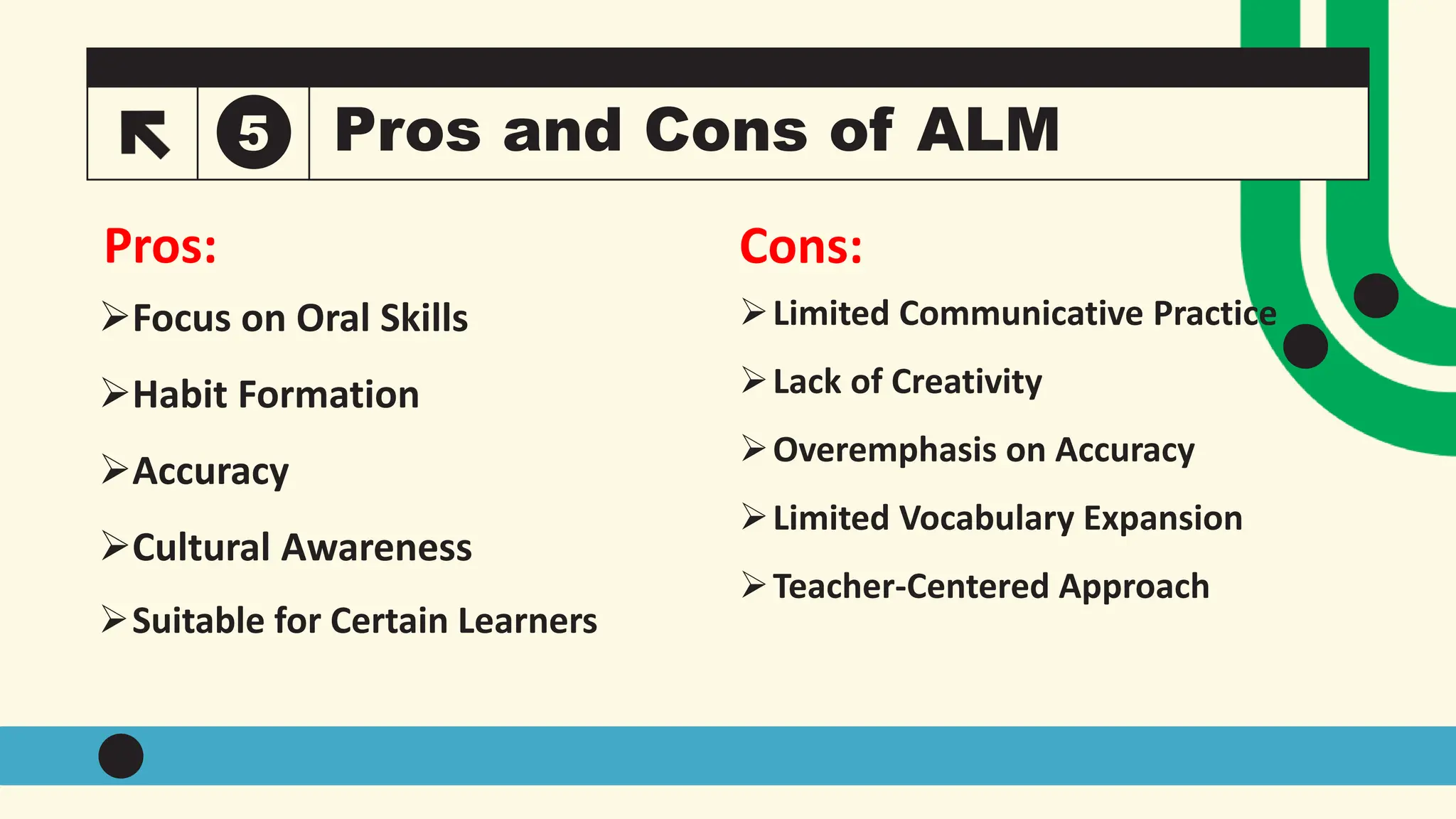
Pros:
Focus on Oral Skills
Habit Formation
Accuracy
Cultural Awareness
Suitable for Certain Learners
Limited Communicative Practice
Lack of Creativity
Overemphasis on Accuracy
Limited Vocabulary Expansion
Teacher-Centered Approach
Cons:
Summary
The Audio-Lingual Method (ALM) remains significant in today's
world for several reasons:
1. ALM laid the foundation for many contemporary language
teaching methodologies.
2. It emphasizes the development of oral proficiency, which is
crucial in today's globalized society.
3. It can be effective for learners who benefit from structured,
repetitive practice.
6
Summary
4. It can be adapted to integrate modern technology,
enhancing its relevance in today's digital age.
5. ALM complements communicative approaches by focusing
on accuracy and habit formation.
6. It fosters cultural sensitivity and awareness among learners.
7. ALM is effective for achieving specific language learning
goals within a limited time frame, making it suitable for
intensive language programs.
7
REFERENCES
8
Takuma Hayashi
President
Mirjam Nilsson
Chief Executive Officer
Flora Berggren
Chief Operations Officer
Rajesh Santoshi
VP Marketing
1. Richards, JC & Rodgers, TS (2014). The audiolingual
method. Approaches and Methods in Language Teaching.
Teaching. Cambridge University Press. pp. 58-80.
2. https://englopedia.com/the-audio-lingual-method/
3. https://www.fluentu.com/blog/educator/audio-lingual-
method/

Modern Technique in Teaching English: Audio-Lingual Method

  • 1.
    AUDIO-LINGUAL METHOD Presented by: KHARISSA MAYC. SOSOTER University of Bohol | MA - English
  • 2.
    Overview of ALM Audio-LingualMethod (ALM) is a style of teaching used in teaching foreign languages. It is based on Behaviorism, a theory that sees learners as passive receivers of information whose behavior is shaped through positive or negative reinforcement. It is also known as Army Method. 1
  • 3.
    Overview of ALM ALM emphasizes the teaching of listening and speaking before reading and writing.  It uses dialogues as the main form of language presentation and drills as the main training techniques.  Native language/ Mother tongue is discouraged in the classroom. 2
  • 4.
    Key Principles ofALM 3 According to Cambridge University, the Audio- Lingual Method is characterized by several key principles: 1. Oral Proficiency 4.Structured Activities 2. Repetition and Drills 5. Audio Materials 3. Mimicry 6. Error Correction
  • 5.
    Techniques of ALM 4 TakumaHayashi President Mirjam Nilsson Chief Executive Officer Flora Berggren Chief Operations Officer Rajesh Santoshi VP Marketing Here are some key techniques used in ALM: Dialogue Memorization Backward Build-up (Expansion) Drill Repetition Drill Chain Drill Complete the Dialogue
  • 6.
    Pros and Consof ALM 5 Pros: Focus on Oral Skills Habit Formation Accuracy Cultural Awareness Suitable for Certain Learners Limited Communicative Practice Lack of Creativity Overemphasis on Accuracy Limited Vocabulary Expansion Teacher-Centered Approach Cons:
  • 7.
    Summary The Audio-Lingual Method(ALM) remains significant in today's world for several reasons: 1. ALM laid the foundation for many contemporary language teaching methodologies. 2. It emphasizes the development of oral proficiency, which is crucial in today's globalized society. 3. It can be effective for learners who benefit from structured, repetitive practice. 6
  • 8.
    Summary 4. It canbe adapted to integrate modern technology, enhancing its relevance in today's digital age. 5. ALM complements communicative approaches by focusing on accuracy and habit formation. 6. It fosters cultural sensitivity and awareness among learners. 7. ALM is effective for achieving specific language learning goals within a limited time frame, making it suitable for intensive language programs. 7
  • 9.
    REFERENCES 8 Takuma Hayashi President Mirjam Nilsson ChiefExecutive Officer Flora Berggren Chief Operations Officer Rajesh Santoshi VP Marketing 1. Richards, JC & Rodgers, TS (2014). The audiolingual method. Approaches and Methods in Language Teaching. Teaching. Cambridge University Press. pp. 58-80. 2. https://englopedia.com/the-audio-lingual-method/ 3. https://www.fluentu.com/blog/educator/audio-lingual- method/