Audio Lingual
Method
By:Fairoz Raopan
1.Background
Audio Lingual Method (ALM) is
the method that was introduced
in the United States in the 1940’s.
Most of the ideas in this section is
adapted from how to teach
foreign languages effectively.
Definition
 TheAudio-lingual Method is a method of
foreign language teaching which
emphasizes the teaching of listening and
speaking before reading and writing.
 It uses dialogues as the main form of
language presentation and drills as the
main training techniques.
 Mother tongue is discouraged in the
classroom.
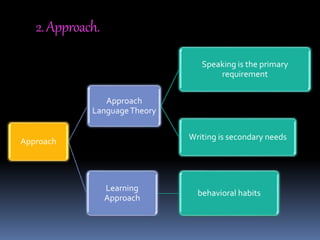
2.Approach.
Approach
Approach
LanguageTheory
Speaking is the primary
requirement
Writing is secondary needs
Learning
Approach
behavioral habits
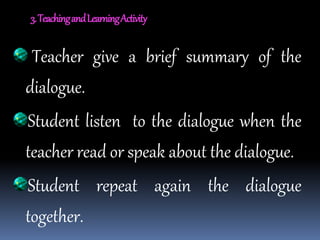
3.TeachingandLearningActivity
Teacher give a brief summary of the
dialogue.
Student listen to the dialogue when the
teacher read or speak about the dialogue.
Student repeat again the dialogue
together.
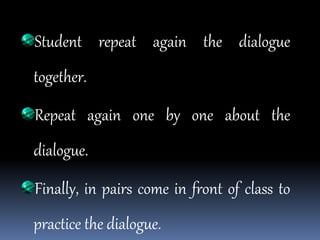
Student repeat again the dialogue
together.
Repeat again one by one about the
dialogue.
Finally, in pairs come in front of class to
practice the dialogue.
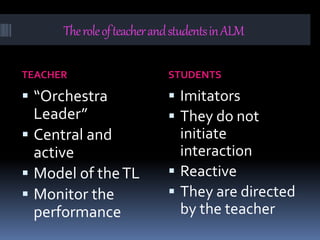
TheroleofteacherandstudentsinALM
TEACHER STUDENTS
 “Orchestra
Leader”
 Central and
active
 Model of theTL
 Monitor the
performance
 Imitators
 They do not
initiate
interaction
 Reactive
 They are directed
by the teacher
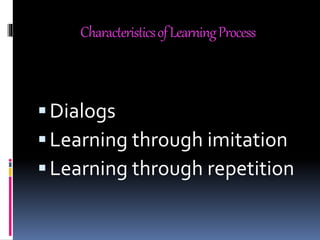
CharacteristicsofLearningProcess
Dialogs
Learning through imitation
Learning through repetition
Variation drills used in the Audio Lingual
Method.
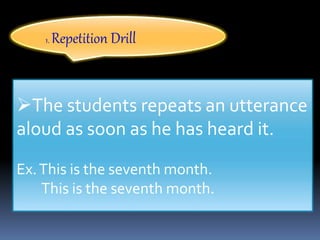
1. Repetition Drill
The students repeats an utterance
aloud as soon as he has heard it.
Ex.This is the seventh month.
This is the seventh month.
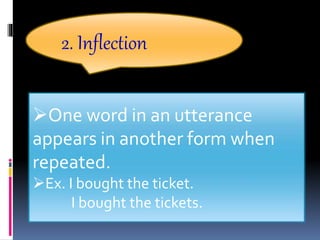
2. Inflection
One word in an utterance
appears in another form when
repeated.
Ex. I bought the ticket.
I bought the tickets.
3. Replacement Drill
One word in an utterance is replaced by
another
Ex. He bought this house cheap
He bought it cheap
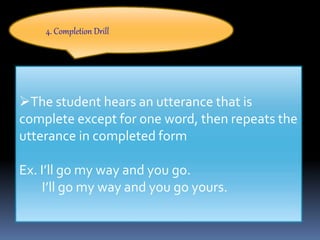
4. Completion Drill
The student hears an utterance that is
complete except for one word, then repeats the
utterance in completed form
Ex. I’ll go my way and you go.
I’ll go my way and you go yours.
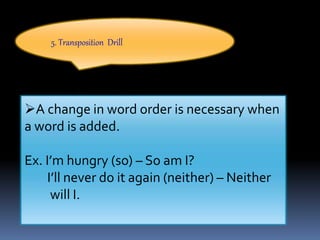
5. Transposition Drill
A change in word order is necessary when
a word is added.
Ex. I’m hungry (so) – So am I?
I’ll never do it again (neither) – Neither
will I.
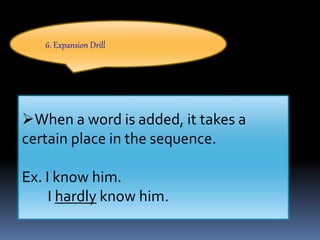
6. Expansion Drill
When a word is added, it takes a
certain place in the sequence.
Ex. I know him.
I hardly know him.
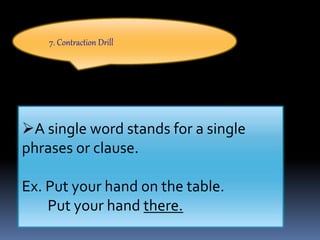
7. Contraction Drill
A single word stands for a single
phrases or clause.
Ex. Put your hand on the table.
Put your hand there.
8. Transformation Drill
A sentence is transformed by being
made negative or interrogative.
Ex. He know my address.
He doesn’t know my address.
Does he know my address?
9. Integration
Two separate utterances are integrated into
one.
Ex.They must be honest.This is important.
-It is important that they must be honest.
10. Rejoinder
The student makes an appropriate
rejoinder to a given utterance. He is told in
advance to respond in one of the following
ways:
Ex.Thank you -You’re welcome
What is your name? - My name is Jax
11. Restoration
The student is given a sequence of words that have
been culled from a sentence but still bear its basic
meaning. He uses these words with a minimum of
changes and additions to restore the sentence to its
original form.
Ex. Students/waiting/bus
The students are waiting for the bus.
5.AdvantagesanddisadvantagesTheAudioLingualMethod.
Advantages
 All students active in the classroom.
Speaking and listening skills are better
trained.
Accessible for large classes
Disadvantages
Teachers are simply not explained in detail.
Bored classes
Learners do not have control on contents
Grammar skill untrained.
It is a teacher-dominated method.
The learner is in a passive role; the
learner has little control over their
learning.
 The behaviorist approach to learning
is now discredited. Many scholars
have proved its weakness
THANKYOU!

audiolingualmethod finality