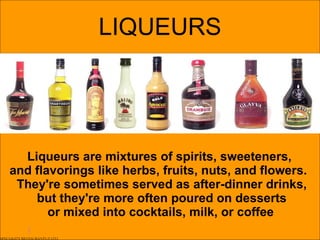
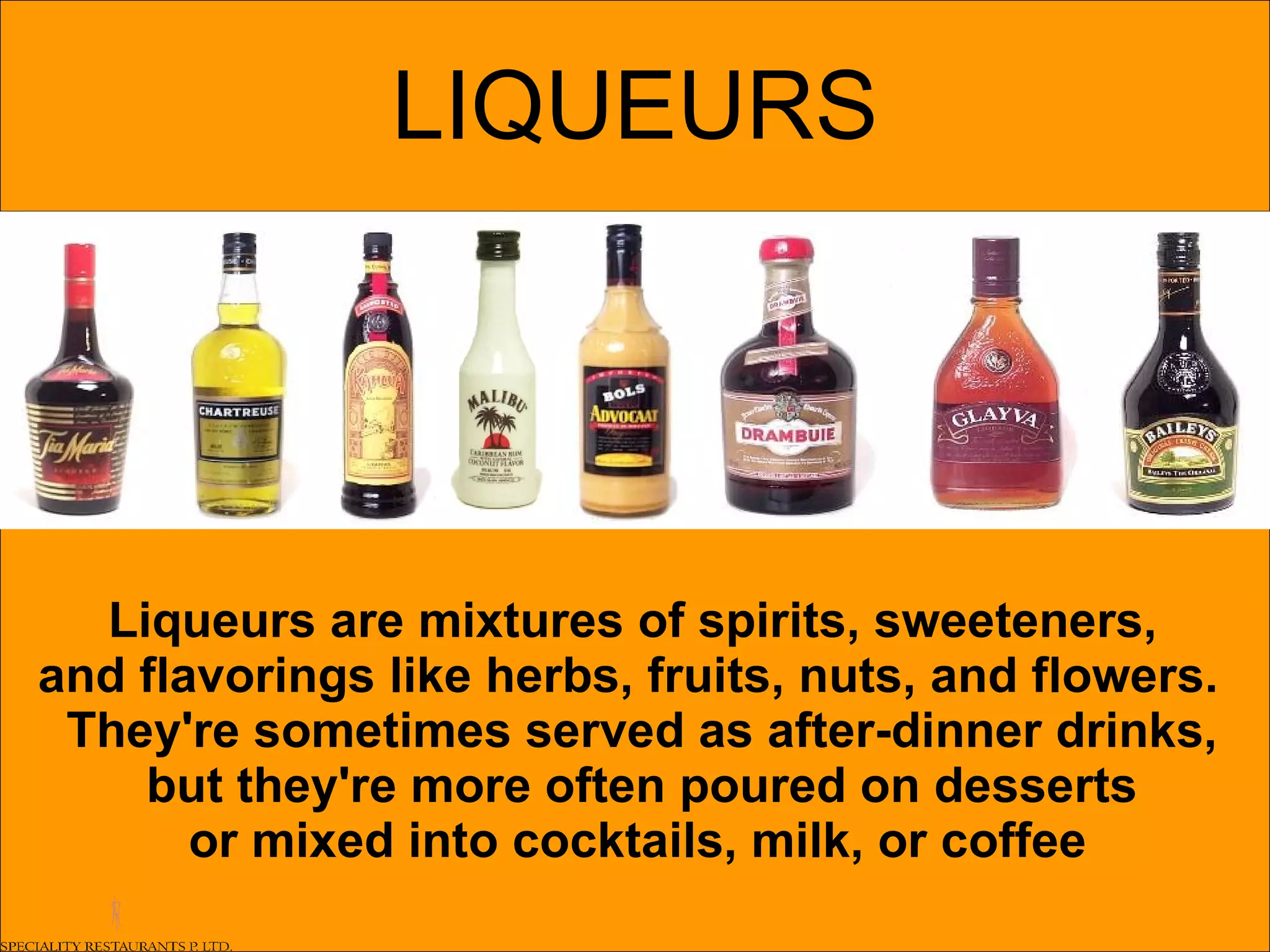
LIQUEURS Liqueurs are mixtures of spirits, sweeteners,  and flavorings like herbs, fruits, nuts, and flowers.  They're sometimes served as after-dinner drinks, but they're more often poured on desserts or mixed into cocktails, milk, or coffee
Production of Liqueurs The production of Liqueurs involves the following steps: ~  Extraction ~ Distillation ~ Compounding ~ Maturing ~ Fining ~ Bottling
Extraction In this process the flavours are extracted from the main ingredient. The methods of extraction are: Pressure   - mechanical presses are used to extract the oil from citrus peel. Maceration  - the flavouring agents are soaked in cold spirit then mashed and squeezed to extract maximum flavour.  Infusion  - maceration in warm spirit which is maintained at a constant temperature for several days.  Percolation  - the spirit is continuously bubbled through the flavouring or the spirit is boiled and the vapours pass up through the flavouring agent and condensed.
Distillation The natural products are steeped in the alcohol until it is well impregnated with flavour, then it is distilled. This liquid is further purified by re-distillation to remove impurities, which would change the flavour.
Compounding The ingredients are then blended in strict sequence to produce the desired flavour. Most liqueurs are made to secret recipes, many of which are centuries old
Maturing Liqueurs must be given time to allow the ingredients to develop flavour and character. The finest liqueurs are matured in oak casks, which aid in mellowing the liquid.
Fining Impurities are still suspended in the liquid and must be removed. For that a substance is added to the liqueur and to which attracts all the impurities. Then a final filtration process is carried out.
Bottling Spirit is added to the liqueur to bring it to the correct alcoholic strength. Sugar syrup may also be added to adjust the sweetness. Harmless organic colours may be added at this point.
Liqueurs They contain at least 2 ½ % sugar by weight Generally preferred as   digestives. Generally served frappe ( on crushed ice) in a cocktail glass or served straight in a liqueur glass/ sherry glass. They are most commonly used in preparations of various cocktails/ mocktails and flavoured coffees.
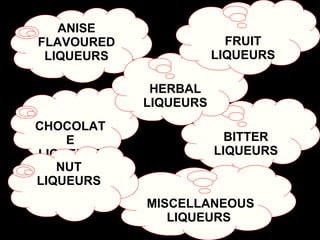
ANISE FLAVOURED  LIQUEURS BITTER LIQUEURS CHOCOLATE LIQUEURS HERBAL LIQUEURS MISCELLANEOUS LIQUEURS   NUT LIQUEURS FRUIT LIQUEURS
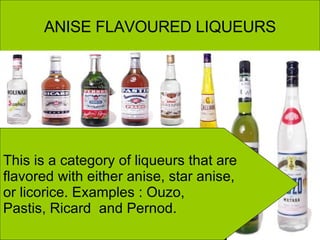
ANISE FLAVOURED LIQUEURS This is a category of liqueurs that are  flavored with either anise, star anise,  or licorice. Examples : Ouzo, Pastis, Ricard  and Pernod.
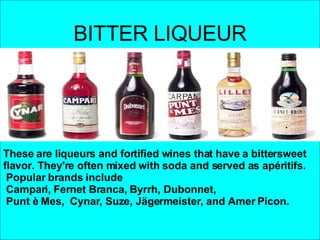
BITTER LIQUEUR These are liqueurs and fortified wines that have a bittersweet flavor. They're often mixed with soda and served as apéritifs.   Popular brands include Campari, Fernet Branca, Byrrh, Dubonnet, Punt è Mes,  Cynar, Suze, Jägermeister, and Amer Picon.
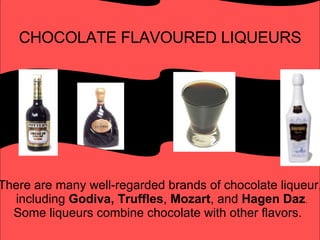
CHOCOLATE FLAVOURED LIQUEURS There are many well-regarded brands of chocolate liqueur, including  Godiva,   Truffles ,  Mozart , and  Hagen Daz . Some liqueurs combine chocolate with other flavors.  
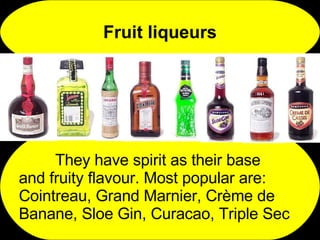
Fruit liqueurs They have spirit as their base  and fruity flavour. Most popular are: Cointreau, Grand Marnier, Crème de Banane, Sloe Gin, Curacao, Triple Sec
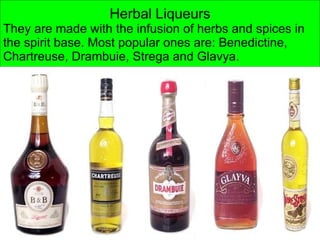
Herbal Liqueurs They are made with the infusion of herbs and spices in the spirit base. Most popular ones are: Benedictine, Chartreuse, Drambuie, Strega and Glavya.
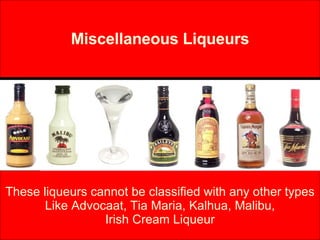
Miscellaneous Liqueurs These liqueurs cannot be classified with any other types Like Advocaat, Tia Maria, Kalhua, Malibu, Irish Cream Liqueur
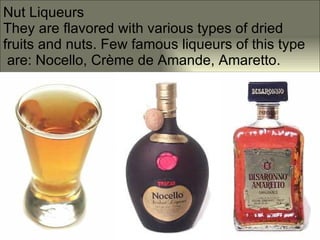
Nut Liqueurs They are flavored with various types of dried fruits and nuts. Few famous liqueurs of this type are: Nocello, Crème de Amande, Amaretto.

Liqueurs

  • 1.
    LIQUEURS Liqueurs aremixtures of spirits, sweeteners, and flavorings like herbs, fruits, nuts, and flowers.  They're sometimes served as after-dinner drinks, but they're more often poured on desserts or mixed into cocktails, milk, or coffee
  • 2.
    Production of LiqueursThe production of Liqueurs involves the following steps: ~ Extraction ~ Distillation ~ Compounding ~ Maturing ~ Fining ~ Bottling
  • 3.
    Extraction In thisprocess the flavours are extracted from the main ingredient. The methods of extraction are: Pressure - mechanical presses are used to extract the oil from citrus peel. Maceration - the flavouring agents are soaked in cold spirit then mashed and squeezed to extract maximum flavour. Infusion - maceration in warm spirit which is maintained at a constant temperature for several days. Percolation - the spirit is continuously bubbled through the flavouring or the spirit is boiled and the vapours pass up through the flavouring agent and condensed.
  • 4.
    Distillation The naturalproducts are steeped in the alcohol until it is well impregnated with flavour, then it is distilled. This liquid is further purified by re-distillation to remove impurities, which would change the flavour.
  • 5.
    Compounding The ingredientsare then blended in strict sequence to produce the desired flavour. Most liqueurs are made to secret recipes, many of which are centuries old
  • 6.
    Maturing Liqueurs mustbe given time to allow the ingredients to develop flavour and character. The finest liqueurs are matured in oak casks, which aid in mellowing the liquid.
  • 7.
    Fining Impurities arestill suspended in the liquid and must be removed. For that a substance is added to the liqueur and to which attracts all the impurities. Then a final filtration process is carried out.
  • 8.
    Bottling Spirit isadded to the liqueur to bring it to the correct alcoholic strength. Sugar syrup may also be added to adjust the sweetness. Harmless organic colours may be added at this point.
  • 9.
    Liqueurs They containat least 2 ½ % sugar by weight Generally preferred as digestives. Generally served frappe ( on crushed ice) in a cocktail glass or served straight in a liqueur glass/ sherry glass. They are most commonly used in preparations of various cocktails/ mocktails and flavoured coffees.
  • 10.
    ANISE FLAVOURED LIQUEURS BITTER LIQUEURS CHOCOLATE LIQUEURS HERBAL LIQUEURS MISCELLANEOUS LIQUEURS NUT LIQUEURS FRUIT LIQUEURS
  • 11.
    ANISE FLAVOURED LIQUEURSThis is a category of liqueurs that are flavored with either anise, star anise, or licorice. Examples : Ouzo, Pastis, Ricard and Pernod.
  • 12.
    BITTER LIQUEUR Theseare liqueurs and fortified wines that have a bittersweet flavor. They're often mixed with soda and served as apéritifs.   Popular brands include Campari, Fernet Branca, Byrrh, Dubonnet, Punt è Mes,  Cynar, Suze, Jägermeister, and Amer Picon.
  • 13.
    CHOCOLATE FLAVOURED LIQUEURSThere are many well-regarded brands of chocolate liqueur, including Godiva, Truffles , Mozart , and Hagen Daz . Some liqueurs combine chocolate with other flavors.  
  • 14.
    Fruit liqueurs Theyhave spirit as their base and fruity flavour. Most popular are: Cointreau, Grand Marnier, Crème de Banane, Sloe Gin, Curacao, Triple Sec
  • 15.
    Herbal Liqueurs Theyare made with the infusion of herbs and spices in the spirit base. Most popular ones are: Benedictine, Chartreuse, Drambuie, Strega and Glavya.
  • 16.
    Miscellaneous Liqueurs Theseliqueurs cannot be classified with any other types Like Advocaat, Tia Maria, Kalhua, Malibu, Irish Cream Liqueur
  • 17.
    Nut Liqueurs Theyare flavored with various types of dried fruits and nuts. Few famous liqueurs of this type are: Nocello, Crème de Amande, Amaretto.