Campus codespaces for networked learners
Siân Bayne
Centre for Research in Digital Education
The University of Edinburgh
@sbayne
from Euclidean space (determined objectively and
measured scientifically)
to relational space (contingent, active and produced
through social relations and material practices)
to more recent ontogentic ideas of space (not about what
space is, but how space becomes)
from Kitchin and Dodge, 2011
The becoming of space
‘Where?’ is no longer a simple question.
Carvalho, Goodyear and de Laat (2017)
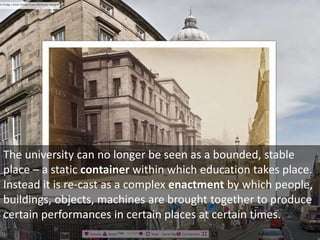
The university can no longer be seen as a bounded, stable
place – a static container within which education takes place.
Instead it is re-cast as a complex enactment by which people,
buildings, objects, machines are brought together to produce
certain performances in certain places at certain times.
The emergent mobilities paradigm ... undermines
sedentarist theories [which] treat as normal stability,
meaning, and place, and treat as abnormal distance,
change, and placelessness.
Sheller and Urry, 2006
putting into question the fundamental ‘territorial’ and
‘sedentary’ precepts of twentieth-century social science.
Hannam et al, 2006
Discursive ‘othering’ of distance education
Material practices of teaching methods
Replication of their metaphors online
Fetishization of the campus in promotional materials
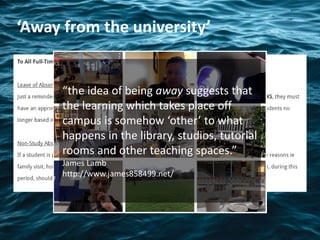
“the idea of being away suggests that
the learning which takes place off
campus is somehow ‘other’ to what
happens in the library, studios, tutorial
rooms and other teaching spaces.”
James Lamb
http://www.james858499.net/
‘Away from the university’
smooth and striated space
networked, fluid and fire space
code/space
Smooth and striated space
Deleuze, G. & Guattari, F. (1988) A Thousand Plateaus: capitalism
and schizophrenia. London: Continuum.
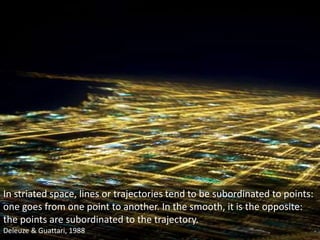
In striated space, lines or trajectories tend to be subordinated to points:
one goes from one point to another. In the smooth, it is the opposite:
the points are subordinated to the trajectory.
Deleuze & Guattari, 1988
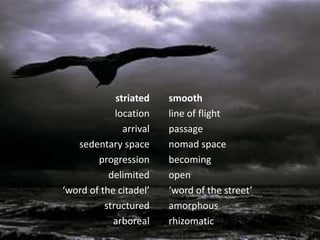
striated
location
arrival
sedentary space
progression
delimited
‘word of the citadel’
structured
arboreal
smooth
line of flight
passage
nomad space
becoming
open
‘word of the street’
amorphous
rhizomatic
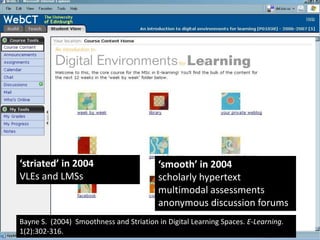
‘striated’ in 2004
VLEs and LMSs
‘smooth’ in 2004
scholarly hypertext
multimodal assessments
anonymous discussion forums
Bayne S. (2004) Smoothness and Striation in Digital Learning Spaces. E-Learning.
1(2):302-316.
[There is] an asymmetrical power relation between
the individuals whose actions generate individual
datums and those who come to own and profit
from the big data they become.
The teleological nature of this understanding is
seen most clearly in the common metaphor of big
data—and the ‘digital’ in general—as new frontiers
to be explored, expanded, and conquered.
Thatcher, O’Sullivan and Mahmoudi, 2016
Rhizo15 http://rhizomatic.net/
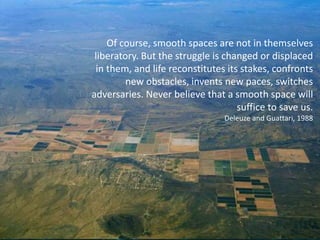
Of course, smooth spaces are not in themselves
liberatory. But the struggle is changed or displaced
in them, and life reconstitutes its stakes, confronts
new obstacles, invents new paces, switches
adversaries. Never believe that a smooth space will
suffice to save us.
Deleuze and Guattari, 1988
Bounded, networked, fluid
and fire space
Law, J. & Mol, A. (2001). Situating technoscience: an inquiry into
spatialities. Environment and Planning D. (19), 609-621.
Mol, A. & Law, J. (1994). Regions, networks and fluids: anaemia
and social topology. Social Studies of Science, 24(4), 641-671.
regional space, defined by stable boundaries
network space, defined by stable relations between elements
fluid space, defined by shifting boundaries and network relations
Mol and Law 1994
fire space, defined by the lambent flickering of presence and
absence
Law and Mol 2001
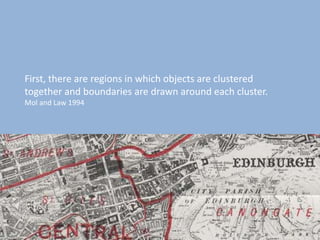
First, there are regions in which objects are clustered
together and boundaries are drawn around each cluster.
Mol and Law 1994
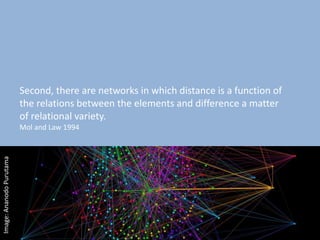
Second, there are networks in which distance is a function of
the relations between the elements and difference a matter
of relational variety.
Mol and Law 1994
Image:AnanodoPurutama
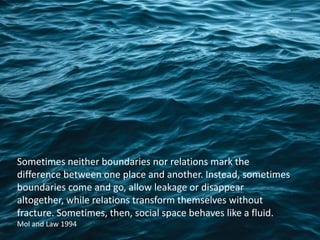
Sometimes neither boundaries nor relations mark the
difference between one place and another. Instead, sometimes
boundaries come and go, allow leakage or disappear
altogether, while relations transform themselves without
fracture. Sometimes, then, social space behaves like a fluid.
Mol and Law 1994
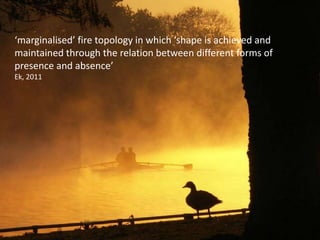
‘marginalised’ fire topology in which ‘shape is achieved and
maintained through the relation between different forms of
presence and absence’
Ek, 2011
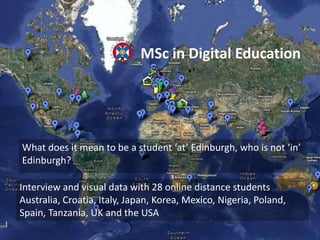
What does it mean to be a student ‘at’ Edinburgh, who is not ‘in’
Edinburgh?
MSc in Digital Education
Interview and visual data with 28 online distance students
Australia, Croatia, Italy, Japan, Korea, Mexico, Nigeria, Poland,
Spain, Tanzania, UK and the USA
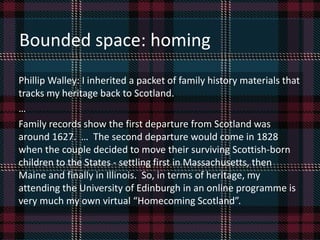
Phillip Walley: I inherited a packet of family history materials that
tracks my heritage back to Scotland.
…
Family records show the first departure from Scotland was
around 1627. … The second departure would come in 1828
when the couple decided to move their surviving Scottish-born
children to the States - settling first in Massachusetts, then
Maine and finally in Illinois. So, in terms of heritage, my
attending the University of Edinburgh in an online programme is
very much my own virtual “Homecoming Scotland”.
Bounded space: homing
Bounded space: ‘campus envy’
What we saw in our interview data was a series of ‘campus
imaginaries’ - imagined qualities of the sociomaterial space of
the university which function as a source of counterfactuals to
troubling or difficult experiences participants had as students
on online distance programmes.
Ross and Sheail, 2016
Max Crary: I seem to remember being a little jealous of those
actually in the city as if proximity would somehow give them an
advantage! …[I] suspected that more of a 'university life' could
be had if one was actually in Edinburgh… but this was a minor
thing compared to my enjoyment with study which far
outweighed any 'Edinburgh envy'.
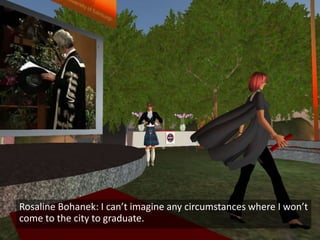
Rosaline Bohanek: I can’t imagine any circumstances where I won’t
come to the city to graduate.
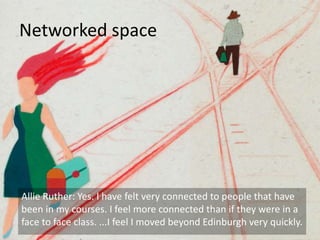
Networked space
Allie Ruther: Yes. I have felt very connected to people that have
been in my courses. I feel more connected than if they were in a
face to face class. ...I feel I moved beyond Edinburgh very quickly.
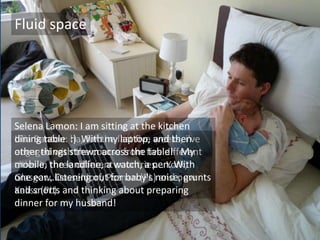
Fluid space
Lilia Banton: ha, for the last five weeks, i've
engaged with the course from five different
cities in three different countries... York,
Glasgow, Dusseldorf, Poznan (PL) and now
Kalisz (PL).
Selena Lamon: I am sitting at the kitchen
dining table :) With my laptop, and then
other things strewn across the table! My
mobile, the landline, a watch, a pen. With
one ear...listening out for baby's noise, grunts
and snorts and thinking about preparing
dinner for my husband!
Lucas Davidson, 'Present Absence' (2010)
Erik Credle: I feel a sense of
belonging to the University, but
at the same time I dont feel that
I am actually part of the
University.
Matthew Gillon: In a
strange way, I didn't feel
that I wasn't in Edinburgh.
Phillip Walley: I may not
be physically on campus,
but … the campus goes
with me - as part of my
cognitive real estate if
you will.
Fire space
Making a case for ‘topological multiplicity rather than uniformity’.
Mol and Law 1994
Bayne, S., Gallagher, M.S. & Lamb, J. (2013). Being ‘at’ university: the social topologies
of distance students. Higher Education 67(5): 569-583.
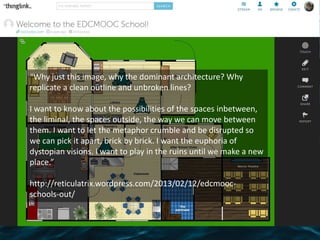
“Why just this image, why the dominant architecture? Why
replicate a clean outline and unbroken lines?
I want to know about the possibilities of the spaces inbetween,
the liminal, the spaces outside, the way we can move between
them. I want to let the metaphor crumble and be disrupted so
we can pick it apart, brick by brick. I want the euphoria of
dystopian visions. I want to play in the ruins until we make a new
place.”
http://reticulatrix.wordpress.com/2013/02/12/edcmooc-
schools-out/
Code/Space
Kitchin, R. and Dodge, M. (2011) Code/Space: Software and
Everyday Life. Cambridge, MA.: MIT Press.
Code/space is where software and the spatiality
of everyday life become mutually constituted,
that is, produced through one another.
Code/space, like all space, is beckoned into
being through various practices and processes.
What makes code/space a unique spatial
formation, however, is that it is profoundly
shaped by software.
Kitchin and Dodge, 2011
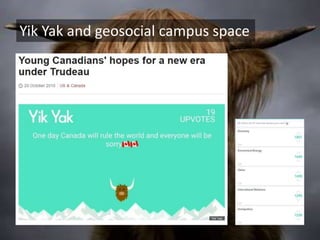
Yik Yak and geosocial campus space
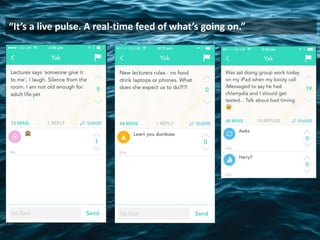
“It’s a live pulse. A real-time feed of what’s going on.”
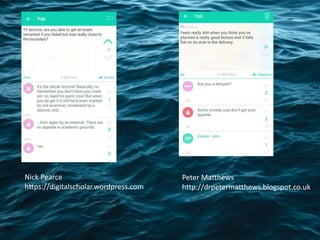
Nick Pearce
https://digitalscholar.wordpress.com
Peter Matthews
http://drpetermatthews.blogspot.co.uk
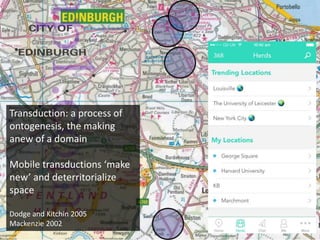
Transduction: a process of
ontogenesis, the making
anew of a domain
Mobile transductions ‘make
new’ and deterritorialize
space
Dodge and Kitchin 2005
Mackenzie 2002
Code/space is a form of transduced space
where the production of space is wholly
dependent on code: if the code ‘fails’, then
the entire transduction ‘fails’.
Coded space is where space is transduced
by code, but the transduction is not
dependent on code; code matters to the
ontogenesis of space, but if the code ‘fails’,
space continues to be transduced.
Dodge and Kitchin 2005
From sedentarism to topological multiplicity:
striated, regulated avenues and smooth lines of flight
bounded regions, networks, spaces of fluid and fire
coded spaces, code/space, transductions and deterritorializations
sian.bayne@ed.ac.uk
@sbayne
sianbayne.net
www.de.ed.ac.uk

Campus codespaces for networked learners

  • 1.
    Campus codespaces fornetworked learners Siân Bayne Centre for Research in Digital Education The University of Edinburgh @sbayne
  • 2.
    from Euclidean space(determined objectively and measured scientifically) to relational space (contingent, active and produced through social relations and material practices) to more recent ontogentic ideas of space (not about what space is, but how space becomes) from Kitchin and Dodge, 2011 The becoming of space ‘Where?’ is no longer a simple question. Carvalho, Goodyear and de Laat (2017)
  • 3.
    The university canno longer be seen as a bounded, stable place – a static container within which education takes place. Instead it is re-cast as a complex enactment by which people, buildings, objects, machines are brought together to produce certain performances in certain places at certain times.
  • 4.
    The emergent mobilitiesparadigm ... undermines sedentarist theories [which] treat as normal stability, meaning, and place, and treat as abnormal distance, change, and placelessness. Sheller and Urry, 2006 putting into question the fundamental ‘territorial’ and ‘sedentary’ precepts of twentieth-century social science. Hannam et al, 2006
  • 5.
    Discursive ‘othering’ ofdistance education Material practices of teaching methods Replication of their metaphors online Fetishization of the campus in promotional materials
  • 6.
    “the idea ofbeing away suggests that the learning which takes place off campus is somehow ‘other’ to what happens in the library, studios, tutorial rooms and other teaching spaces.” James Lamb http://www.james858499.net/ ‘Away from the university’
  • 7.
    smooth and striatedspace networked, fluid and fire space code/space
  • 8.
    Smooth and striatedspace Deleuze, G. & Guattari, F. (1988) A Thousand Plateaus: capitalism and schizophrenia. London: Continuum.
  • 9.
    In striated space,lines or trajectories tend to be subordinated to points: one goes from one point to another. In the smooth, it is the opposite: the points are subordinated to the trajectory. Deleuze & Guattari, 1988
  • 10.
    striated location arrival sedentary space progression delimited ‘word ofthe citadel’ structured arboreal smooth line of flight passage nomad space becoming open ‘word of the street’ amorphous rhizomatic
  • 11.
    ‘striated’ in 2004 VLEsand LMSs ‘smooth’ in 2004 scholarly hypertext multimodal assessments anonymous discussion forums Bayne S. (2004) Smoothness and Striation in Digital Learning Spaces. E-Learning. 1(2):302-316.
  • 12.
    [There is] anasymmetrical power relation between the individuals whose actions generate individual datums and those who come to own and profit from the big data they become. The teleological nature of this understanding is seen most clearly in the common metaphor of big data—and the ‘digital’ in general—as new frontiers to be explored, expanded, and conquered. Thatcher, O’Sullivan and Mahmoudi, 2016 Rhizo15 http://rhizomatic.net/
  • 15.
    Of course, smoothspaces are not in themselves liberatory. But the struggle is changed or displaced in them, and life reconstitutes its stakes, confronts new obstacles, invents new paces, switches adversaries. Never believe that a smooth space will suffice to save us. Deleuze and Guattari, 1988
  • 16.
    Bounded, networked, fluid andfire space Law, J. & Mol, A. (2001). Situating technoscience: an inquiry into spatialities. Environment and Planning D. (19), 609-621. Mol, A. & Law, J. (1994). Regions, networks and fluids: anaemia and social topology. Social Studies of Science, 24(4), 641-671.
  • 17.
    regional space, definedby stable boundaries network space, defined by stable relations between elements fluid space, defined by shifting boundaries and network relations Mol and Law 1994 fire space, defined by the lambent flickering of presence and absence Law and Mol 2001
  • 18.
    First, there areregions in which objects are clustered together and boundaries are drawn around each cluster. Mol and Law 1994
  • 19.
    Second, there arenetworks in which distance is a function of the relations between the elements and difference a matter of relational variety. Mol and Law 1994 Image:AnanodoPurutama
  • 20.
    Sometimes neither boundariesnor relations mark the difference between one place and another. Instead, sometimes boundaries come and go, allow leakage or disappear altogether, while relations transform themselves without fracture. Sometimes, then, social space behaves like a fluid. Mol and Law 1994
  • 21.
    ‘marginalised’ fire topologyin which ‘shape is achieved and maintained through the relation between different forms of presence and absence’ Ek, 2011
  • 22.
    What does itmean to be a student ‘at’ Edinburgh, who is not ‘in’ Edinburgh? MSc in Digital Education Interview and visual data with 28 online distance students Australia, Croatia, Italy, Japan, Korea, Mexico, Nigeria, Poland, Spain, Tanzania, UK and the USA
  • 23.
    Phillip Walley: Iinherited a packet of family history materials that tracks my heritage back to Scotland. … Family records show the first departure from Scotland was around 1627. … The second departure would come in 1828 when the couple decided to move their surviving Scottish-born children to the States - settling first in Massachusetts, then Maine and finally in Illinois. So, in terms of heritage, my attending the University of Edinburgh in an online programme is very much my own virtual “Homecoming Scotland”. Bounded space: homing
  • 24.
    Bounded space: ‘campusenvy’ What we saw in our interview data was a series of ‘campus imaginaries’ - imagined qualities of the sociomaterial space of the university which function as a source of counterfactuals to troubling or difficult experiences participants had as students on online distance programmes. Ross and Sheail, 2016 Max Crary: I seem to remember being a little jealous of those actually in the city as if proximity would somehow give them an advantage! …[I] suspected that more of a 'university life' could be had if one was actually in Edinburgh… but this was a minor thing compared to my enjoyment with study which far outweighed any 'Edinburgh envy'.
  • 25.
    Rosaline Bohanek: Ican’t imagine any circumstances where I won’t come to the city to graduate.
  • 26.
    Networked space Allie Ruther:Yes. I have felt very connected to people that have been in my courses. I feel more connected than if they were in a face to face class. ...I feel I moved beyond Edinburgh very quickly.
  • 27.
    Fluid space Lilia Banton:ha, for the last five weeks, i've engaged with the course from five different cities in three different countries... York, Glasgow, Dusseldorf, Poznan (PL) and now Kalisz (PL). Selena Lamon: I am sitting at the kitchen dining table :) With my laptop, and then other things strewn across the table! My mobile, the landline, a watch, a pen. With one ear...listening out for baby's noise, grunts and snorts and thinking about preparing dinner for my husband!
  • 28.
    Lucas Davidson, 'PresentAbsence' (2010) Erik Credle: I feel a sense of belonging to the University, but at the same time I dont feel that I am actually part of the University. Matthew Gillon: In a strange way, I didn't feel that I wasn't in Edinburgh. Phillip Walley: I may not be physically on campus, but … the campus goes with me - as part of my cognitive real estate if you will. Fire space
  • 29.
    Making a casefor ‘topological multiplicity rather than uniformity’. Mol and Law 1994 Bayne, S., Gallagher, M.S. & Lamb, J. (2013). Being ‘at’ university: the social topologies of distance students. Higher Education 67(5): 569-583.
  • 30.
    “Why just thisimage, why the dominant architecture? Why replicate a clean outline and unbroken lines? I want to know about the possibilities of the spaces inbetween, the liminal, the spaces outside, the way we can move between them. I want to let the metaphor crumble and be disrupted so we can pick it apart, brick by brick. I want the euphoria of dystopian visions. I want to play in the ruins until we make a new place.” http://reticulatrix.wordpress.com/2013/02/12/edcmooc- schools-out/
  • 32.
    Code/Space Kitchin, R. andDodge, M. (2011) Code/Space: Software and Everyday Life. Cambridge, MA.: MIT Press.
  • 33.
    Code/space is wheresoftware and the spatiality of everyday life become mutually constituted, that is, produced through one another. Code/space, like all space, is beckoned into being through various practices and processes. What makes code/space a unique spatial formation, however, is that it is profoundly shaped by software. Kitchin and Dodge, 2011
  • 34.
    Yik Yak andgeosocial campus space
  • 35.
    “It’s a livepulse. A real-time feed of what’s going on.”
  • 37.
  • 38.
    Transduction: a processof ontogenesis, the making anew of a domain Mobile transductions ‘make new’ and deterritorialize space Dodge and Kitchin 2005 Mackenzie 2002
  • 39.
    Code/space is aform of transduced space where the production of space is wholly dependent on code: if the code ‘fails’, then the entire transduction ‘fails’. Coded space is where space is transduced by code, but the transduction is not dependent on code; code matters to the ontogenesis of space, but if the code ‘fails’, space continues to be transduced. Dodge and Kitchin 2005
  • 40.
    From sedentarism totopological multiplicity: striated, regulated avenues and smooth lines of flight bounded regions, networks, spaces of fluid and fire coded spaces, code/space, transductions and deterritorializations
  • 41.