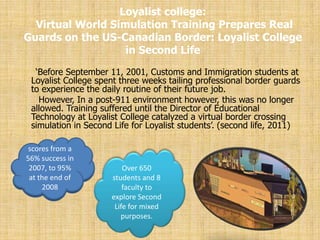
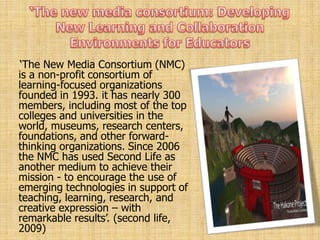
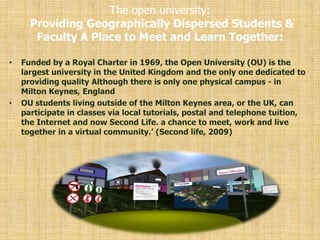
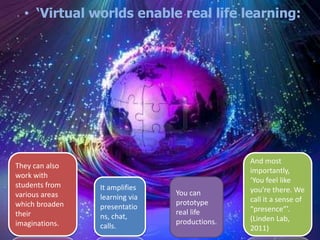
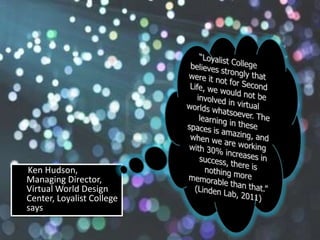
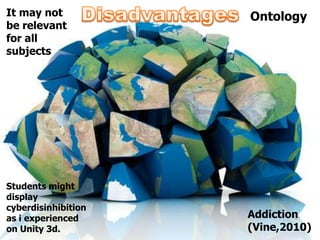
This document discusses the use of virtual worlds like Second Life for educational purposes. It provides several case studies of institutions that have used Second Life for training activities and collaborative learning. These include Loyalist College which used Second Life to simulate border crossing training for security guards. Several benefits of virtual worlds for education are discussed, such as allowing geographically dispersed students and faculty to meet, and enabling prototyping of real-life productions. However, some potential downsides are also noted, such as students displaying cyberdisinhibition or becoming addicted to the virtual environment.

![References
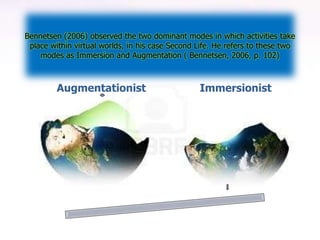
• Bennetsen, H. (2006) augmentation vs immersion. Available AT:
HTTP://SLCREATIVITY.Org/WIKI/INDEX.Php?Title=augmentation_vs_immersion (ACCESSED: 10TH DECEMBER 2011)
• Greenfield, S. (2011) modern technology is changing the way our brains work, says neuroscientist. Available AT:
HTTP://WWW.Dailymail.Co.Uk/SCIENCETECH/ARTICLE-565207/MODERN-TECHNOLOGY-CHANGING-WAY-BRAINS-
WORK-SAYS-NEUROSCIENTIST.Html#ixzz1gfb8ba3y (ACCESSED: 10TH DECEMBER 2011)
• Linden LAB (2011) SECOND LIFE EDUCATION: THE VIRTUAL LEARNING ADVANTAGE. Available AT: HTTP://LECS-
STATIC-SECONDLIFE-COM.S3.Amazonaws.Com/WORK/SL-EDU-BROCHURE-010411.Pdf (ACCESSED: 9TH DECEMBER
2011)
• Prensky, M (2001) ‘DIGITAL NATIVES, DIGITAL IMMIGRANTS’ ON THE HORIZON 9 (5) [ONLINE] AVAILABLE AT:
HTTP://WWW.Marcprensky.Com/WRITING/PRENSKY%20-
%20DIGITAL%20NATIVES,%20DIGITAL%20IMMIGRANTS%20-%20PART1.Pdf (ACCESSED: 9TH DECEMBER 2011)
• Second LIFE (2009) CASE STUDY: THE NEW MEDIA CONSORTIUM. Available AT:
HTTP://WIKI.Secondlife.Com/WIKI/CASE_STUDY:_THE_NEW_MEDIA_CONSORTIUM_(NMC) (ACCESSED: 9TH
DECEMBER 2011)
• SECOND LIFE (2009) CASE STUDY: THE OPEN UNIVERSITY. Availability AT:
HTTP://WIKI.Secondlife.Com/WIKI/CASE_STUDY:_THE_OPEN_UNIVERSITY (ACCESSED: 9TH DECEMBER 2011)
• Second LIFE (2011) CASE STUDY: LOYALIST COLLEGE. Available AT:
HTTP://WIKI.Secondlife.Com/WIKI/CASE_STUDY:_LOYALIST_COLLEGE (ACCESSED: 9TH DECEMBER 2011)
• Second LIFE (2011) SECOND LIFE EDUCATION/ RESOURCES. Available AT:
HTTP://WIKI.Secondlife.Com/WIKI/SECOND_LIFE_EDUCATION/RESOURCES (ACCESSED: 9TH DECEMBER 2011)
• Vine, J (2010) BBC’S PANORAMA- VIDEOGAMES ADDICTION? Available AT:
HTTP://WWW.Youtube.Com/WATCH?V=r83287n6kfg (ACCESSED:10TH DECEMBER 2011)](https://image.slidesharecdn.com/presentation-120111155534-phpapp01/85/CE502-19-320.jpg)


