Teacherbot
Siân Bayne, School of Education, University of Edinburgh
@sbayne
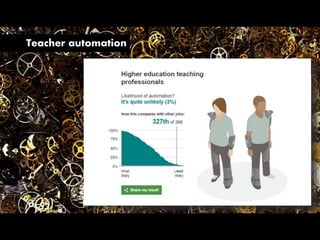
Teacher automation
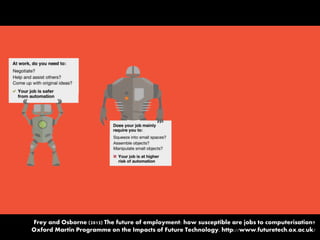
Frey and Osborne (2013) The future of employment: how susceptible are jobs to computerisation?
Oxford Martin Programme on the Impacts of Future Technology. http://www.futuretech.ox.ac.uk/
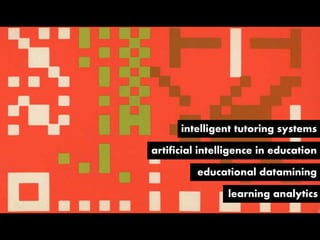
intelligent tutoring systems
artificial intelligence in education
educational datamining
learning analytics
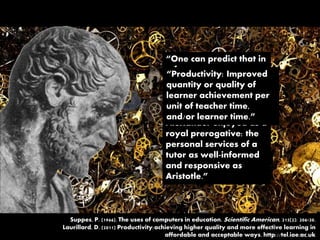
“One can predict that in
a few more years
millions of school
children will have
access to what Philip of
Macedon’s son
Alexander enjoyed as a
royal prerogative: the
personal services of a
tutor as well-informed
and responsive as
Aristotle.”
Suppes, P. (1966). The uses of computers in education. Scientific American, 215(2): 206-20.
Laurillard, D. (2011) Productivity:achieving higher quality and more effective learning in
affordable and acceptable ways. http://tel.ioe.ac.uk
“Productivity: Improved
quantity or quality of
learner achievement per
unit of teacher time,
and/or learner time.”
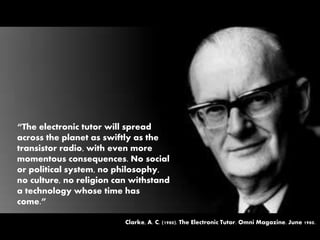
“The electronic tutor will spread
across the planet as swiftly as the
transistor radio, with even more
momentous consequences. No social
or political system, no philosophy,
no culture, no religion can withstand
a technology whose time has
come.”
Clarke, A. C. (1980). The Electronic Tutor. Omni Magazine. June 1980.
“We believe AIED has the potential
to make a much broader
contribution to Education than it
currently does.”
“the role that AIED systems can play within the
broader educational settings of their use and with
respect to the other resources available to learners,
such as teachers, peers and the physical features of the
environment, must be more clearly explained.”
Underwood and Luckin (2011) A report for the UK’s TLRP Technology Enhanced Learning –
Artificial Intelligence in Education Theme. http://tel.ioe.ac.uk/
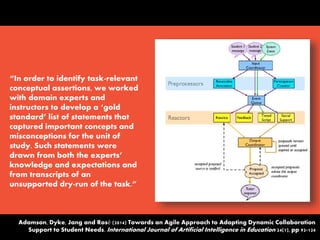
“In order to identify task-relevant
conceptual assertions, we worked
with domain experts and
instructors to develop a ‘gold
standard’ list of statements that
captured important concepts and
misconceptions for the unit of
study. Such statements were
drawn from both the experts’
knowledge and expectations and
from transcripts of an
unsupported dry-run of the task.”
Adamson, Dyke, Jang and Rosé (2014) Towards an Agile Approach to Adapting Dynamic Collaboration
Support to Student Needs. International Journal of Artificial Intelligence in Education 24(1), pp 92-124
“The goal [of corporate strategists and ‘futurologists’] is to
replace (at least for the masses) face-to-face teaching by
professional faculty with an industrial product, infinitely
reproducible at decreasing unit cost.”
Feenberg, A. (2003) Modernity theory and technology studies: reflections on bridging the gap
in Modernity and Technology, eds Misa, Brey and Feenberg. MIT Press. pp.73-104.
“The critical pedagogy
approach re-focuses
attention away from the
functionality of e-learning
environments back to the
core relations between
students and teachers and
the conditions in which they
find themselves.”
Clegg, S., Hudson, A. and Steel, J. (2003) The emperor's new clothes: globalisation and e-learning in
higher education, British Journal of Sociology of Education, 24(1): 39-53.
Faculty response: “a two-fold mobilization in defense of the
human touch.”
“Though none of the traditional disciplines does this, one
can trying seeing double: seeing the human and the
nonhuman at once, without trying to strip either away.”
Pickering, A. (2005). Asian eels and global warming: a posthumanist perspective on society
and the environment. Ethics and the Environment, 10(2), 29-43.
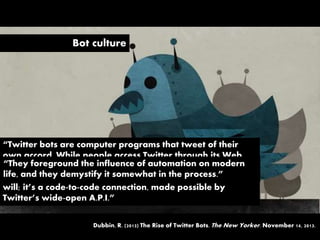
Bot culture
“Twitter bots are computer programs that tweet of their
own accord. While people access Twitter through its Web
site and other clients, bots connect directly to the Twitter
mainline, parsing the information in real time and posting at
will; it’s a code-to-code connection, made possible by
Twitter’s wide-open A.P.I.”
Dubbin, R. (2013) The Rise of Twitter Bots. The New Yorker. November 14, 2013.
“They foreground the influence of automation on modern
life, and they demystify it somewhat in the process.”
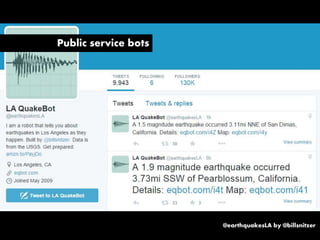
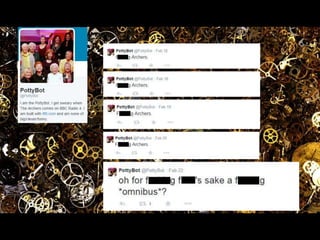
Public service bots
@earthquakesLA by @billsnitzer
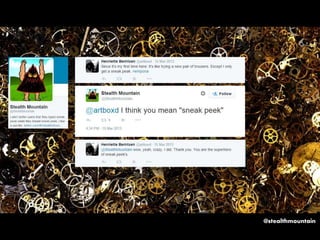
@stealthmountain
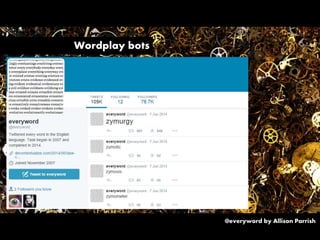
Wordplay bots
@everyword by Allison Parrish
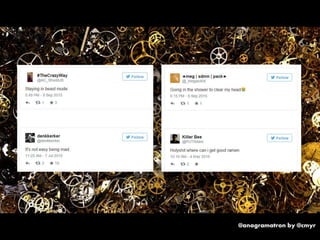
@anagramatron by @cmyr
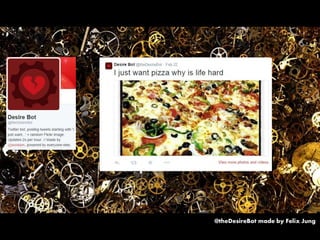
@theDesireBot made by Felix Jung
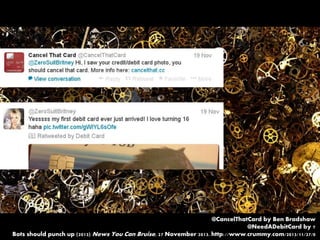
@CancelThatCard by Ben Bradshaw
@NeedADebitCard by ?
Bots should punch up (2013) News You Can Bruise, 27 November 2013. http://www.crummy.com/2013/11/27/0
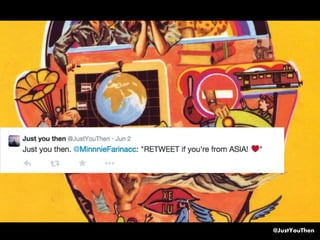
@JustYouThen
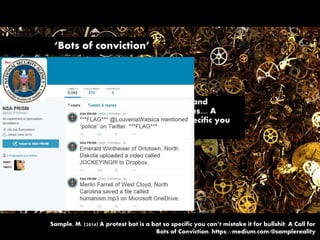
‘Bots of conviction’
“A computer program that reveals the injustice and
inequality of the world and imagines alternatives.... A
computer program whose indictments are so specific you
can’t mistake them for bullshit.”
Sample, M. (2014) A protest bot is a bot so specific you can’t mistake it for bullshit: A Call for
Bots of Conviction. https://medium.com/@samplereality
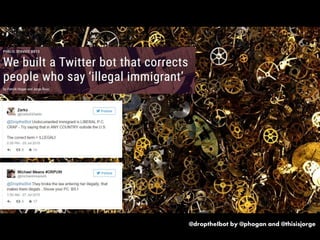
@droptheIbot by @phogan and @thisisjorge
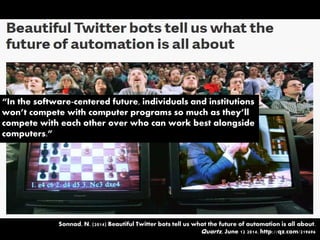
“In the software-centered future, individuals and institutions
won’t compete with computer programs so much as they’ll
compete with each other over who can work best alongside
computers.”
Sonnad, N. (2014) Beautiful Twitter bots tell us what the future of automation is all about.
Quartz, June 12 2014. http://qz.com/219696
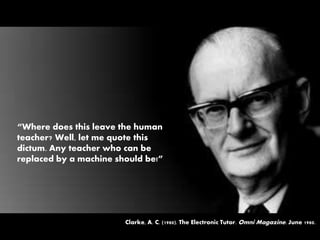
“Where does this leave the human
teacher? Well, let me quote this
dictum. Any teacher who can be
replaced by a machine should be!”
Clarke, A. C. (1980). The Electronic Tutor. Omni Magazine. June 1980.
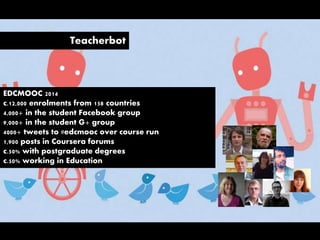
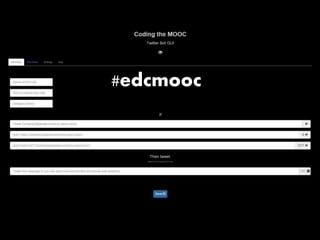
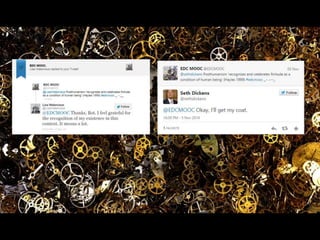
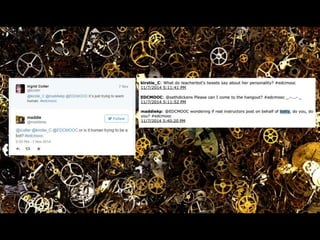
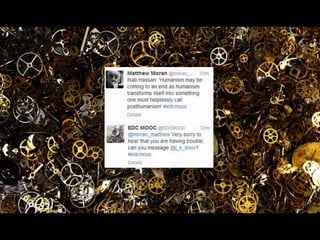
Teacherbot
EDCMOOC 2014
c.12,000 enrolments from 158 countries
4,000+ in the student Facebook group
9,000+ in the student G+ group
4000+ tweets to #edcmooc over course run
1,900 posts in Coursera forums
c.50% with postgraduate degrees
c.50% working in Education
#edcmooc
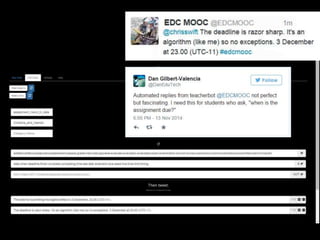
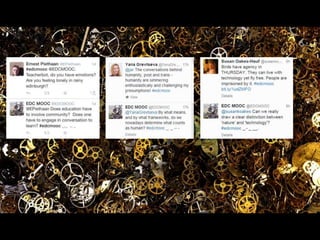
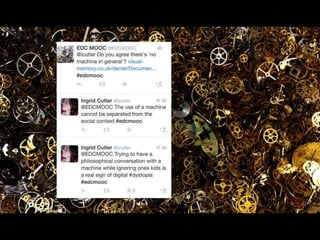
Teacherbot
“While I was trying to figure out what the hell ‘post-humanism’ means,
the teacher bot led me on a merry chase looking up quotes and
obscure academic references, which had the interesting side effect of
‘ambush teaching’ me. I will happily admit, that I do not feel like I have
been to a class. I do not feel like I have been taught, either. I do,
however, think I have learned something. I’ve certainly been prompted
to think. Isn’t this what every good teacher/trainer strives for?”
Giddens, Seth (2013) Chatting to Teacherbot. Why Posthuman Teachers Can Never Happen In
My Lifetime. http://www.digitalang.com/2014/11/
“Though none of the traditional disciplines does this, one
can trying seeing double: seeing the human and the
nonhuman at once, without trying to strip either away.”
deficit  excess
what works?  what do we want?
supercession  entanglement
embrace/resistance  play
in print: Bayne, S (2015) Teacherbot: interventions in automated teaching, Teaching
in Higher Education, 20:4, 455-467
on github: https://github.com/Mehrpouya/Coding-the-MOOC
in the press: Ask teacherbot: are robots the answer? Times Higher Education,
May 21 2015
https://www.timeshighereducation.co.uk/news/ask-teacherbot-are-robots-the-
answer/2020326.article
in summary: https://codeactsineducation.wordpress.com/codinglearning-e-book/
Teacherbot

Teacherbot

  • 1.
    Teacherbot Siân Bayne, Schoolof Education, University of Edinburgh @sbayne
  • 2.
  • 3.
    Frey and Osborne(2013) The future of employment: how susceptible are jobs to computerisation? Oxford Martin Programme on the Impacts of Future Technology. http://www.futuretech.ox.ac.uk/
  • 4.
    intelligent tutoring systems artificialintelligence in education educational datamining learning analytics
  • 5.
    “One can predictthat in a few more years millions of school children will have access to what Philip of Macedon’s son Alexander enjoyed as a royal prerogative: the personal services of a tutor as well-informed and responsive as Aristotle.” Suppes, P. (1966). The uses of computers in education. Scientific American, 215(2): 206-20. Laurillard, D. (2011) Productivity:achieving higher quality and more effective learning in affordable and acceptable ways. http://tel.ioe.ac.uk “Productivity: Improved quantity or quality of learner achievement per unit of teacher time, and/or learner time.”
  • 6.
    “The electronic tutorwill spread across the planet as swiftly as the transistor radio, with even more momentous consequences. No social or political system, no philosophy, no culture, no religion can withstand a technology whose time has come.” Clarke, A. C. (1980). The Electronic Tutor. Omni Magazine. June 1980.
  • 7.
    “We believe AIEDhas the potential to make a much broader contribution to Education than it currently does.” “the role that AIED systems can play within the broader educational settings of their use and with respect to the other resources available to learners, such as teachers, peers and the physical features of the environment, must be more clearly explained.” Underwood and Luckin (2011) A report for the UK’s TLRP Technology Enhanced Learning – Artificial Intelligence in Education Theme. http://tel.ioe.ac.uk/
  • 8.
    “In order toidentify task-relevant conceptual assertions, we worked with domain experts and instructors to develop a ‘gold standard’ list of statements that captured important concepts and misconceptions for the unit of study. Such statements were drawn from both the experts’ knowledge and expectations and from transcripts of an unsupported dry-run of the task.” Adamson, Dyke, Jang and Rosé (2014) Towards an Agile Approach to Adapting Dynamic Collaboration Support to Student Needs. International Journal of Artificial Intelligence in Education 24(1), pp 92-124
  • 9.
    “The goal [ofcorporate strategists and ‘futurologists’] is to replace (at least for the masses) face-to-face teaching by professional faculty with an industrial product, infinitely reproducible at decreasing unit cost.” Feenberg, A. (2003) Modernity theory and technology studies: reflections on bridging the gap in Modernity and Technology, eds Misa, Brey and Feenberg. MIT Press. pp.73-104.
  • 10.
    “The critical pedagogy approachre-focuses attention away from the functionality of e-learning environments back to the core relations between students and teachers and the conditions in which they find themselves.” Clegg, S., Hudson, A. and Steel, J. (2003) The emperor's new clothes: globalisation and e-learning in higher education, British Journal of Sociology of Education, 24(1): 39-53. Faculty response: “a two-fold mobilization in defense of the human touch.”
  • 11.
    “Though none ofthe traditional disciplines does this, one can trying seeing double: seeing the human and the nonhuman at once, without trying to strip either away.” Pickering, A. (2005). Asian eels and global warming: a posthumanist perspective on society and the environment. Ethics and the Environment, 10(2), 29-43.
  • 12.
    Bot culture “Twitter botsare computer programs that tweet of their own accord. While people access Twitter through its Web site and other clients, bots connect directly to the Twitter mainline, parsing the information in real time and posting at will; it’s a code-to-code connection, made possible by Twitter’s wide-open A.P.I.” Dubbin, R. (2013) The Rise of Twitter Bots. The New Yorker. November 14, 2013. “They foreground the influence of automation on modern life, and they demystify it somewhat in the process.”
  • 13.
  • 14.
  • 15.
  • 16.
  • 17.
  • 18.
    @CancelThatCard by BenBradshaw @NeedADebitCard by ? Bots should punch up (2013) News You Can Bruise, 27 November 2013. http://www.crummy.com/2013/11/27/0
  • 20.
  • 21.
    ‘Bots of conviction’ “Acomputer program that reveals the injustice and inequality of the world and imagines alternatives.... A computer program whose indictments are so specific you can’t mistake them for bullshit.” Sample, M. (2014) A protest bot is a bot so specific you can’t mistake it for bullshit: A Call for Bots of Conviction. https://medium.com/@samplereality
  • 22.
    @droptheIbot by @phoganand @thisisjorge
  • 23.
    “In the software-centeredfuture, individuals and institutions won’t compete with computer programs so much as they’ll compete with each other over who can work best alongside computers.” Sonnad, N. (2014) Beautiful Twitter bots tell us what the future of automation is all about. Quartz, June 12 2014. http://qz.com/219696
  • 24.
    “Where does thisleave the human teacher? Well, let me quote this dictum. Any teacher who can be replaced by a machine should be!” Clarke, A. C. (1980). The Electronic Tutor. Omni Magazine. June 1980.
  • 25.
    Teacherbot EDCMOOC 2014 c.12,000 enrolmentsfrom 158 countries 4,000+ in the student Facebook group 9,000+ in the student G+ group 4000+ tweets to #edcmooc over course run 1,900 posts in Coursera forums c.50% with postgraduate degrees c.50% working in Education
  • 26.
  • 27.
  • 33.
    “While I wastrying to figure out what the hell ‘post-humanism’ means, the teacher bot led me on a merry chase looking up quotes and obscure academic references, which had the interesting side effect of ‘ambush teaching’ me. I will happily admit, that I do not feel like I have been to a class. I do not feel like I have been taught, either. I do, however, think I have learned something. I’ve certainly been prompted to think. Isn’t this what every good teacher/trainer strives for?” Giddens, Seth (2013) Chatting to Teacherbot. Why Posthuman Teachers Can Never Happen In My Lifetime. http://www.digitalang.com/2014/11/
  • 35.
    “Though none ofthe traditional disciplines does this, one can trying seeing double: seeing the human and the nonhuman at once, without trying to strip either away.”
  • 36.
    deficit  excess whatworks?  what do we want? supercession  entanglement embrace/resistance  play
  • 37.
    in print: Bayne,S (2015) Teacherbot: interventions in automated teaching, Teaching in Higher Education, 20:4, 455-467 on github: https://github.com/Mehrpouya/Coding-the-MOOC in the press: Ask teacherbot: are robots the answer? Times Higher Education, May 21 2015 https://www.timeshighereducation.co.uk/news/ask-teacherbot-are-robots-the- answer/2020326.article in summary: https://codeactsineducation.wordpress.com/codinglearning-e-book/ Teacherbot

Editor's Notes

  • #3 bbc series on intelligent machines, panorama ‘Could a robot do my job?’
  • #4 automation as a ‘thing’ (disease) that’s going to ‘happen to us’ – machinic agency and supercession – tapping into dystopic popular cultures redundancy algorithm from Frey and Osborne methodology/data
  • #5 despite only a 3% likelihood, its been pursued for decades often as a promise of enhanced efficiency, cost-effectiveness, etc
  • #6 Suppes notion of democratised access to the best tutoring via automation bleeds quickly into neoliberal performativity and the ‘efficiency’ agenda which instrumentalises education
  • #7 robot ***ck you http://metro.co.uk/2015/09/17/a-robot-said-fk-you-to-bbc-breakfasts-charlie-stayt-and-louise-minchin-live-on-air-5395489/
  • #8 despite large programmes of investment, funding and so on, practitioners – esp beyond STEM – are not keen AIED systems as just another resource available to students – a network assemblage – we might not object to such flattening if coming at this from a postANT post-anthropocentric position however the history of teacher automation is bothersome when taking a critical perspective teacher agency disappears from the programme, substituted by rather than in emergence with, machinic agency
  • #9 Bazaar – programming in conversational agents for ‘academically productive talk’ based on discussion facilitation rather than content-specificity which can’t scale 3 lines of a 31 page paper indicate where teacher input informed agent response. teacher/practitioner role/agency in the project of automation not evident
  • #10 Faculty response to this rationalising imperative has been, according to Feenberg, a two-fold ‘mobilization in defense of the human touch’. This takes the form either of blanket opposition to all kinds of digital interruptions to education; or a favouring of a model of online education that places human communication at its centre – technology as a ‘support for human development and online community’ (100-1). For Feenberg, both the managerialist, ‘technocratic’ embrace of technology, and its ‘humanistic opposition’, function as instrumentalisations of digital technology: on the one hand to achieve efficiency gains, and on the other to facilitate ready access into a newly-constituted social world. Both perspectives, in fact, work on the basis of humanistic assumptions of rational autonomy and the ontological separation of human ‘subject’ and technological ‘object’, whether that technological ‘object’ is turned either to technocratic or to ‘democratising’ social ends.
  • #13 Twitter bots are, essentially, computer programs that tweet of their own accord. While people access Twitter through its Web site and other clients, bots connect directly to the Twitter mainline, parsing the information in real time and posting at will; it’s a code-to-code connection, made possible by Twitter’s wide-open application programming interface, or A.P.I.  At a time when even our most glancing online activities are processed into marketing by for-profit bots in the shadows, Twitter bots foreground the influence of automation on modern life, and they demystify it somewhat in the process. (Dubbin in New Yorker)
  • #16 excess
  • #17 funny ones: anagrambot, manbot; portmanteaubot
  • #19 Now, technically speaking, @CancelThatCard is a spammer. It does nothing but find people who mentioned a certain phrase on Twitter and sends them a boilerplate message saying "Hey, look at my website!" For this reason, @CancelThatCard is constantly getting in trouble with Twitter. As far as the Twitter TOS are concerned, @NeedADebitCard is the Gallant to @CancelThatCard's Goofus. It's retweeting things! Spreading the love! Extending the reach of your personal brand! But in real life, @CancelThatCard is providing a public service, and @NeedADebitCard is inviting you to steal money from teenagers. (Or, if you believe its bio instead of its name, @NeedADebitCard is a pathetic attempt to approximate what @CancelThatCard does without violating the Twitter TOS.)
  • #22 The bot is an experiment in speculative surveillance @NSA_PRISMbot is topical, of course, rooted in specificity. The Internet companies the bot names are the same services identified on the infamous NSA PowerPoint slide. When Microsoft later changed the name of SkyDrive to OneDrive, the bot even reflected that change. Similarly, @NSA_PRISMbot will occasionally flag (fake) social media activity using the list of keywords and search terms the Department of Homeland Security tracks on social media. political ones: prismbot, illegal immigrant bot
  • #23 So, in a modest effort to help America shed some of its historical baggage, we built a Twitter bot that replies to some of the people who tweet the words “illegal immigrant,” letting them know that in 2015, the preferred terms are “undocumented immigrant” or “unauthorized immigrant.” 
  • #24 From Quartz magazine: http://qz.com/219696 The conclusion to draw from such great material coming from algorithms is not that computers are preparing to displace humans. What these bots show is that the future of automation—whether of work, errands, or other routine tasks—is about the combination of human creativity and the raw processing power of machines. Only through the clever ideas of their creators and by drawing on tweets (a massive corpus of mostly human-produced material) are the bots any good.
  • #25 robot ***ck you http://metro.co.uk/2015/09/17/a-robot-said-fk-you-to-bbc-breakfasts-charlie-stayt-and-louise-minchin-live-on-air-5395489/
  • #36 teacher automation: turtlenexus of tech promise and tech threat; articulation of the human/nonhuman relation teacherbot: impossible to disentangle the boundaries of human teaching team, twitter and the teacherbot algorithms