C OPERATORS, OPERANDS, EXPRESSION &
STATEMENTS
 Operators are symbols which take one or more operands or expressions
and perform arithmetic or logical computations.
 Operands are variables or expressions which are used in conjunction
with operators to evaluate the expression.
 Combination of operands and operators form an expression.
 Expressions are sequences of operators, operands, and punctuators that
specify a computation.
 Evaluation of expressions is based on the operators that the expressions
contain and the context in which they are used.
 Expression can result in a value and can produce side effects.
 A side effect is a change in the state of the execution environment.
C OPERATORS
 An expression is any valid set of literals, variables,
operators, operands and expressions that evaluates to a
single value.
 This value can be a number, a string or a logical value.
 For instance a = b + c; denotes an expression in which
there are 3 operands a, b, c and two operator + and =.
 A statement, the smallest independent computational
unit, specifies an action to be performed.
 In most cases, statements are executed in sequence.
 The number of operands of an operator is called its arity.
 Based on arity, operators are classified as nullary (no
operands), unary (1 operand), binary (2 operands),
ternary (3 operands).
3/46
www.tenouk.com, ©
OPERATOR PRECEDENCE
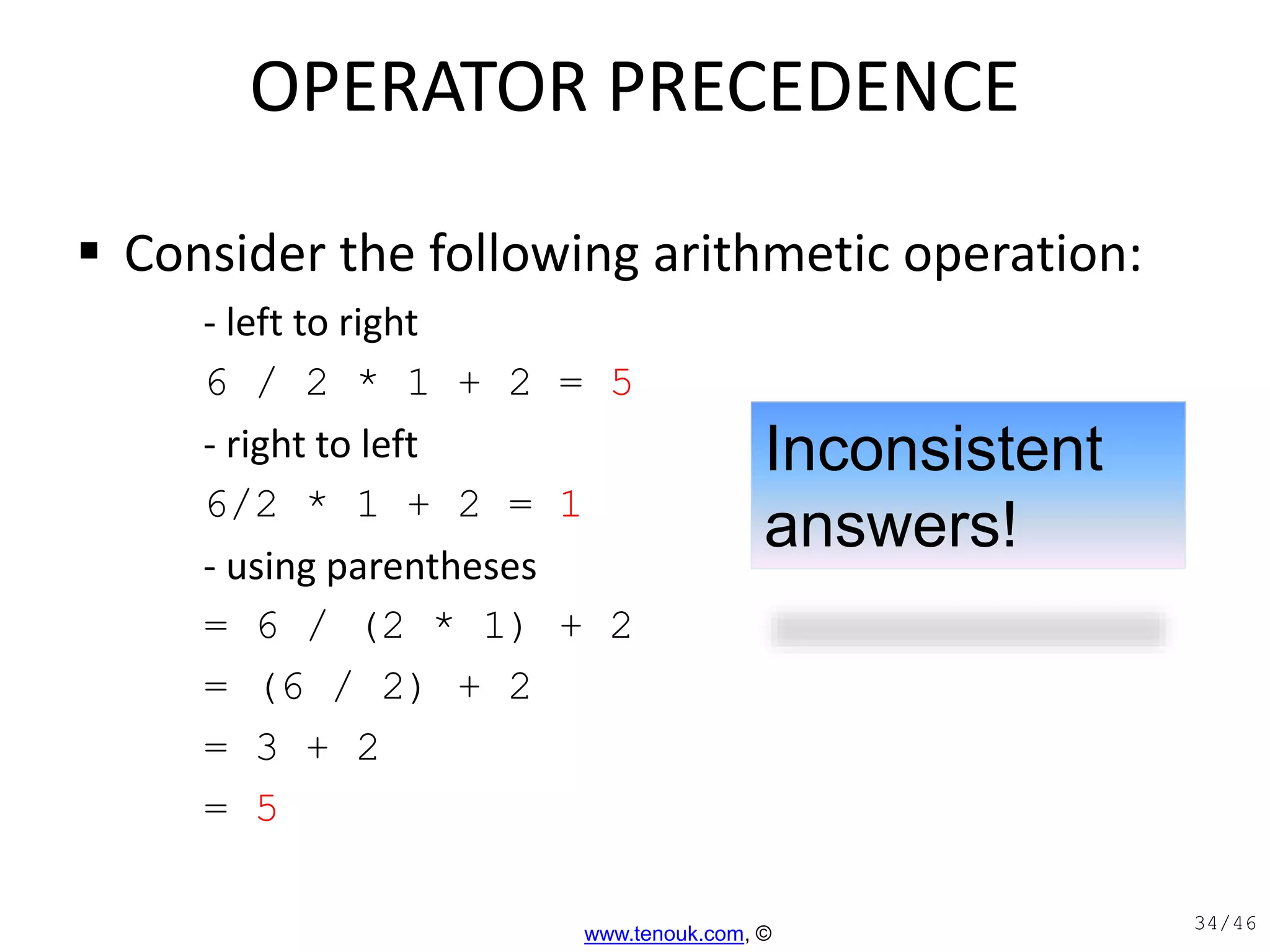
 Consider the following arithmetic operation:
- left to right
6 / 2 * 1 + 2 = 5
- right to left
6/2 * 1 + 2 = 1
- using parentheses
= 6 / (2 * 1) + 2
= (6 / 2) + 2
= 3 + 2
= 5
34/46
Inconsistent
answers!
www.tenouk.com, ©
OPERATOR PRECEDENCE
 Operator precedence: a rule used to clarify
unambiguously which operations (operator
and operands) should be performed first in
the given (mathematical) expression.
 Use precedence levels that conform to the
order commonly used in mathematics.
 However, parentheses take the highest
precedence and operation performed from
the innermost to the outermost parentheses.
35/46
www.tenouk.com, ©
OPERATOR PRECEDENCE
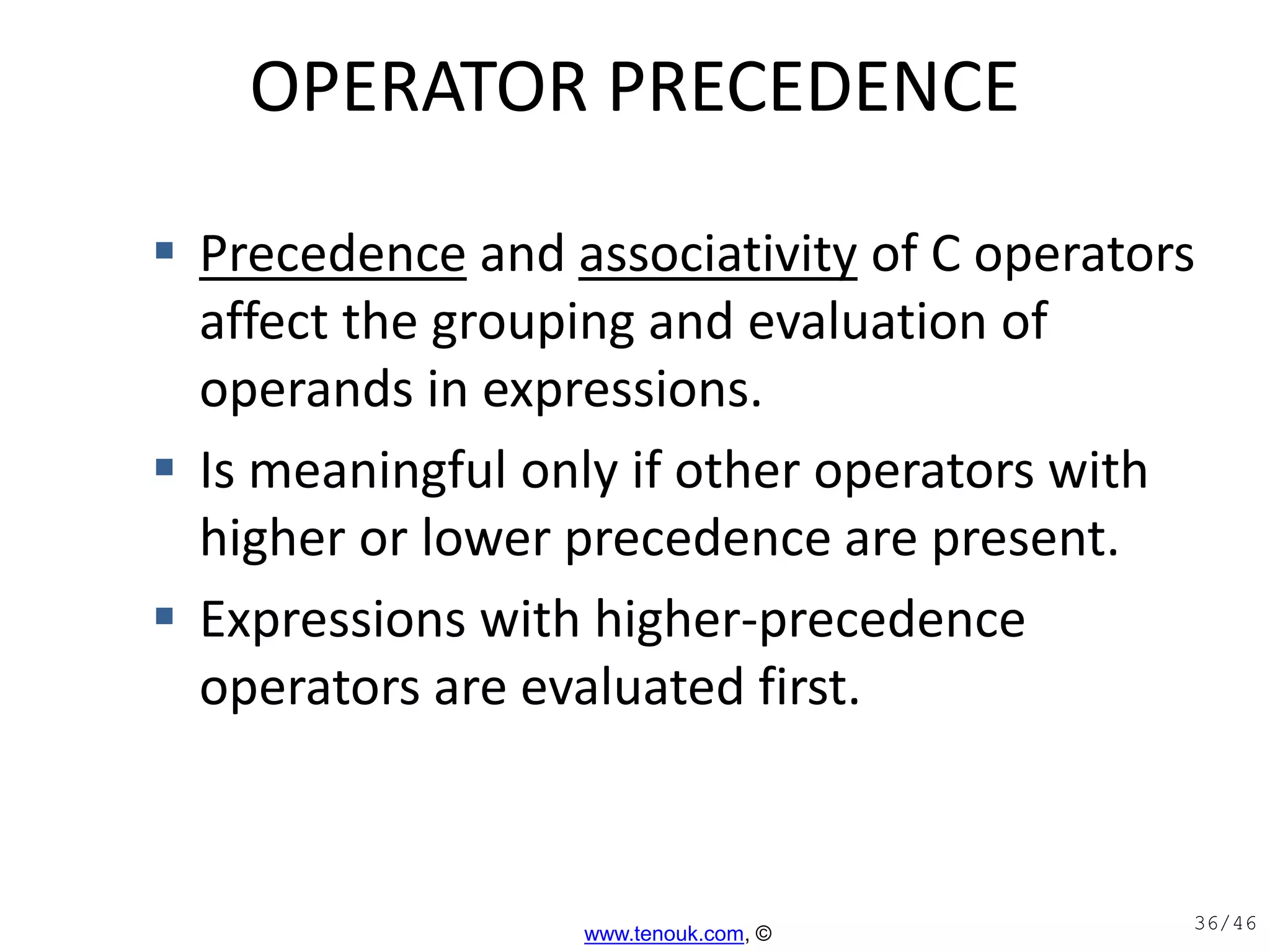
 Precedence and associativity of C operators
affect the grouping and evaluation of
operands in expressions.
 Is meaningful only if other operators with
higher or lower precedence are present.
 Expressions with higher-precedence
operators are evaluated first.
36/46
www.tenouk.com, ©
Precedence and Associativity of C Operators
Symbol Type of Operation Associativity
[ ] ( ) . –> postfix ++ and postfix –– Expression Left to right
prefix ++ and prefix –– sizeof
& * + – ~ !
Unary Right to left
typecasts Unary Right to left
* / % Multiplicative Left to right
+ – Additive Left to right
<< >> Bitwise shift Left to right
< > <= >= Relational Left to right
== != Equality Left to right
& Bitwise-AND Left to right
^ Bitwise-exclusive-OR Left to right
| Bitwise-inclusive-OR Left to right
&& Logical-AND Left to right
|| Logical-OR Left to right
? : Conditional-expression Right to left
= *= /= %=
+= –= <<= >>= &=
^= |=
Simple and compound
assignment
Right to left
, Sequential evaluation Left to right
OPERATOR PRECEDENCE
37/46
www.tenouk.com, ©
OPERATOR PRECEDENCE
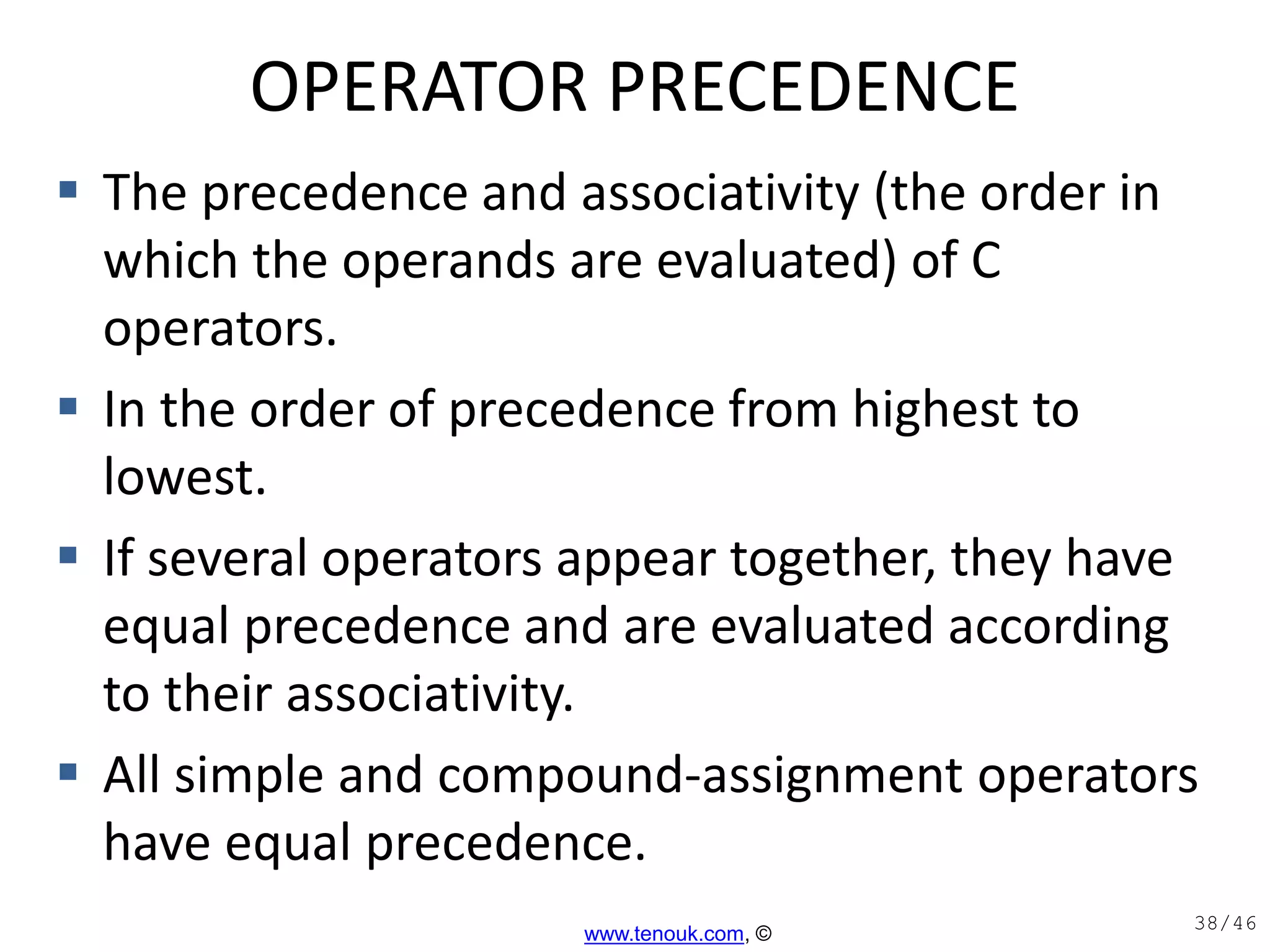
 The precedence and associativity (the order in
which the operands are evaluated) of C
operators.
 In the order of precedence from highest to
lowest.
 If several operators appear together, they have
equal precedence and are evaluated according
to their associativity.
 All simple and compound-assignment operators
have equal precedence.
38/46
www.tenouk.com, ©
OPERATOR PRECEDENCE
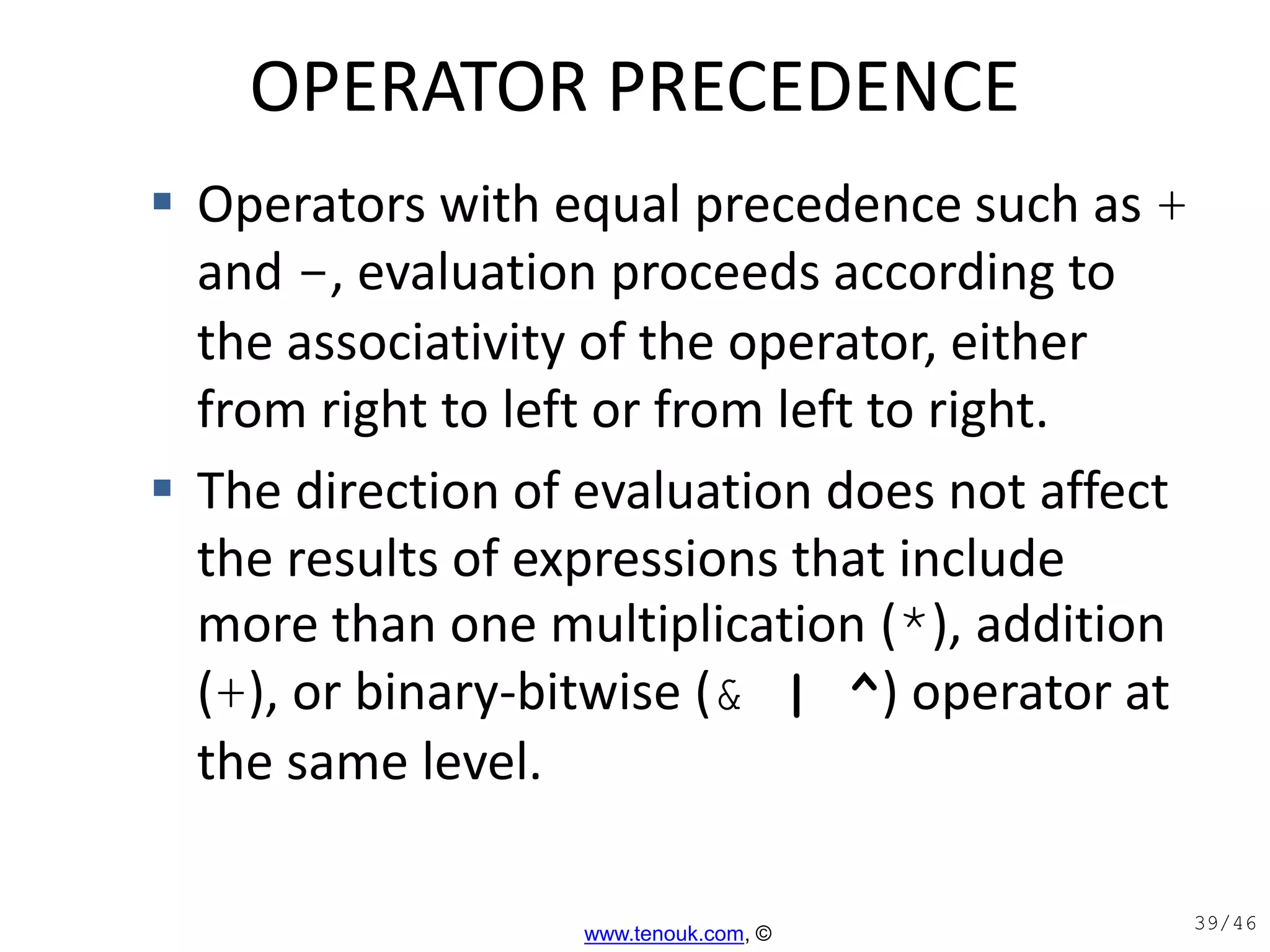
 Operators with equal precedence such as +
and -, evaluation proceeds according to
the associativity of the operator, either
from right to left or from left to right.
 The direction of evaluation does not affect
the results of expressions that include
more than one multiplication (*), addition
(+), or binary-bitwise (& | ^) operator at
the same level.
39/46
www.tenouk.com, ©
OPERATOR PRECEDENCE
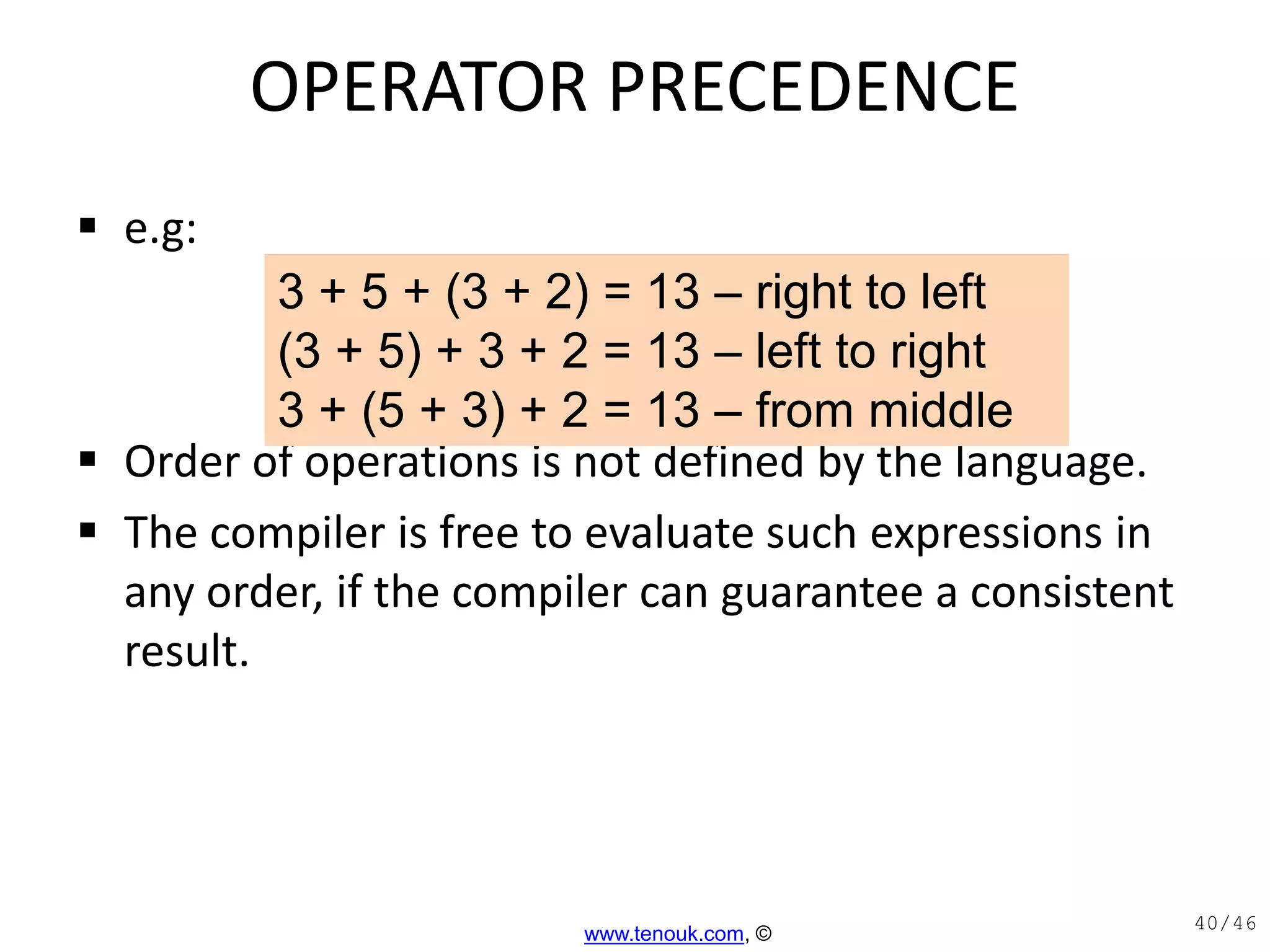
 e.g:
 Order of operations is not defined by the language.
 The compiler is free to evaluate such expressions in
any order, if the compiler can guarantee a consistent
result.
40/46
3 + 5 + (3 + 2) = 13 – right to left
(3 + 5) + 3 + 2 = 13 – left to right
3 + (5 + 3) + 2 = 13 – from middle
www.tenouk.com, ©
OPERATOR PRECEDENCE
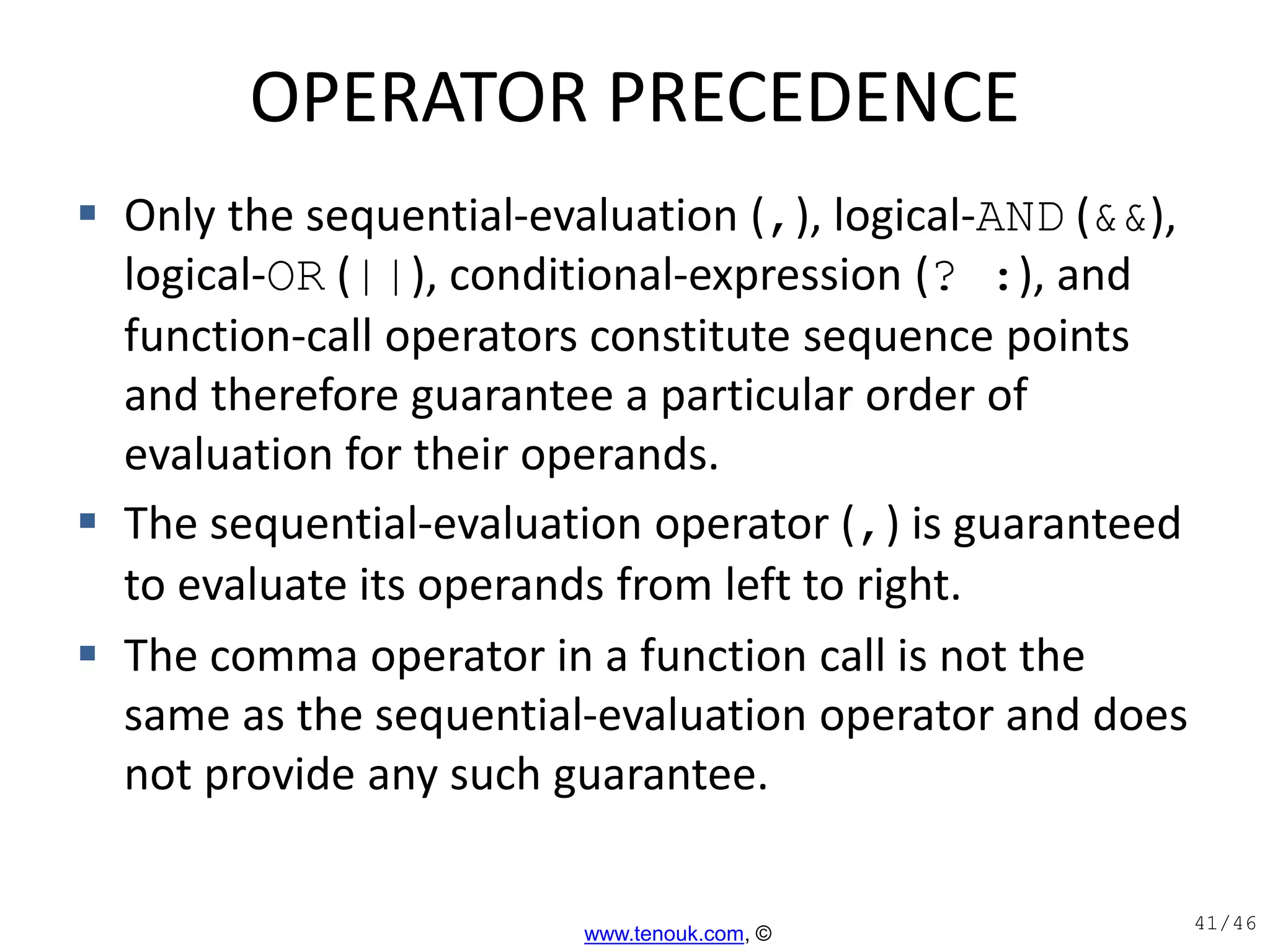
 Only the sequential-evaluation (,), logical-AND (&&),
logical-OR (||), conditional-expression (? :), and
function-call operators constitute sequence points
and therefore guarantee a particular order of
evaluation for their operands.
 The sequential-evaluation operator (,) is guaranteed
to evaluate its operands from left to right.
 The comma operator in a function call is not the
same as the sequential-evaluation operator and does
not provide any such guarantee.
41/46
www.tenouk.com, ©
OPERATOR PRECEDENCE
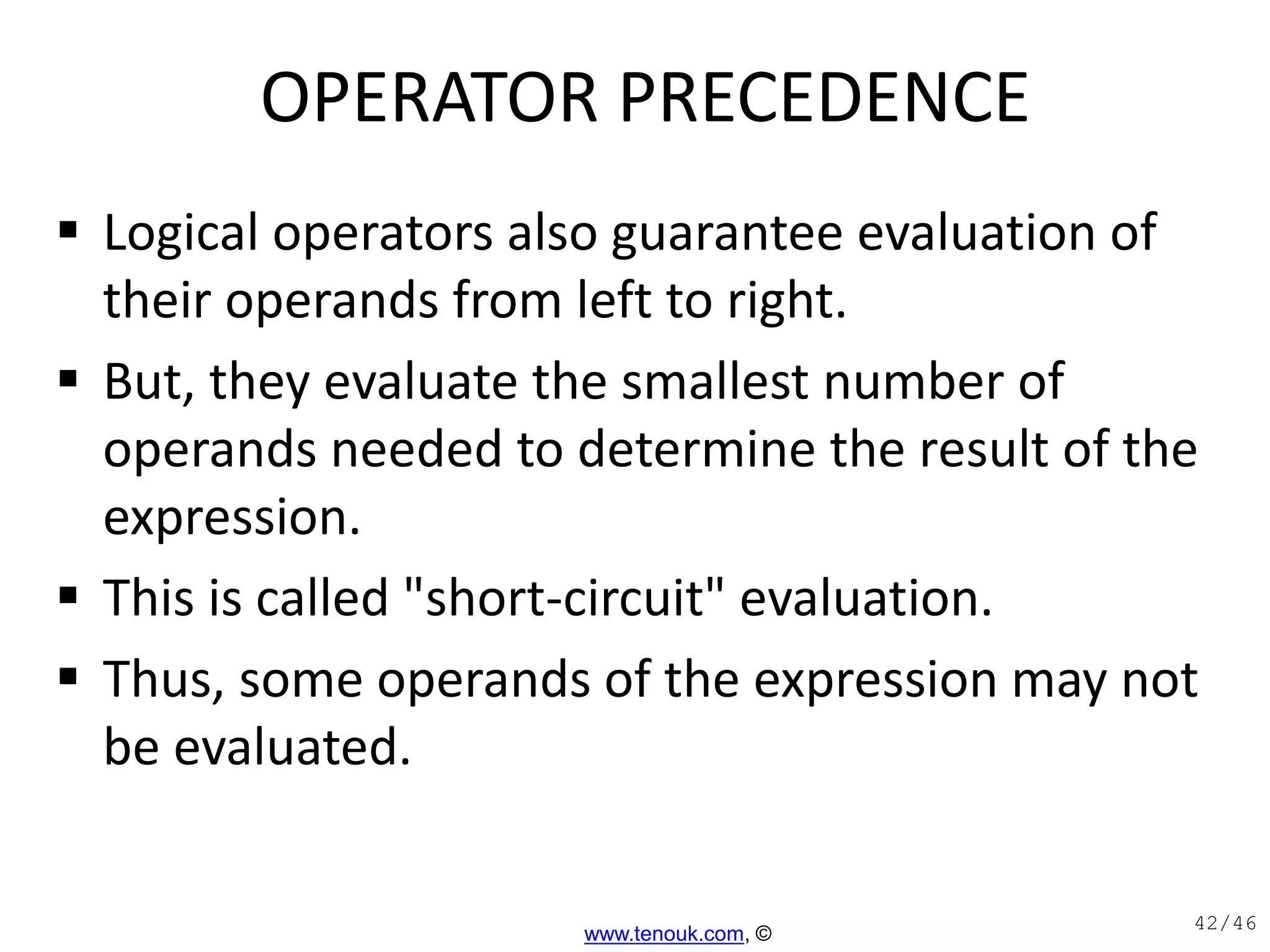
 Logical operators also guarantee evaluation of
their operands from left to right.
 But, they evaluate the smallest number of
operands needed to determine the result of the
expression.
 This is called "short-circuit" evaluation.
 Thus, some operands of the expression may not
be evaluated.
42/46
www.tenouk.com, ©
OPERATOR PRECEDENCE
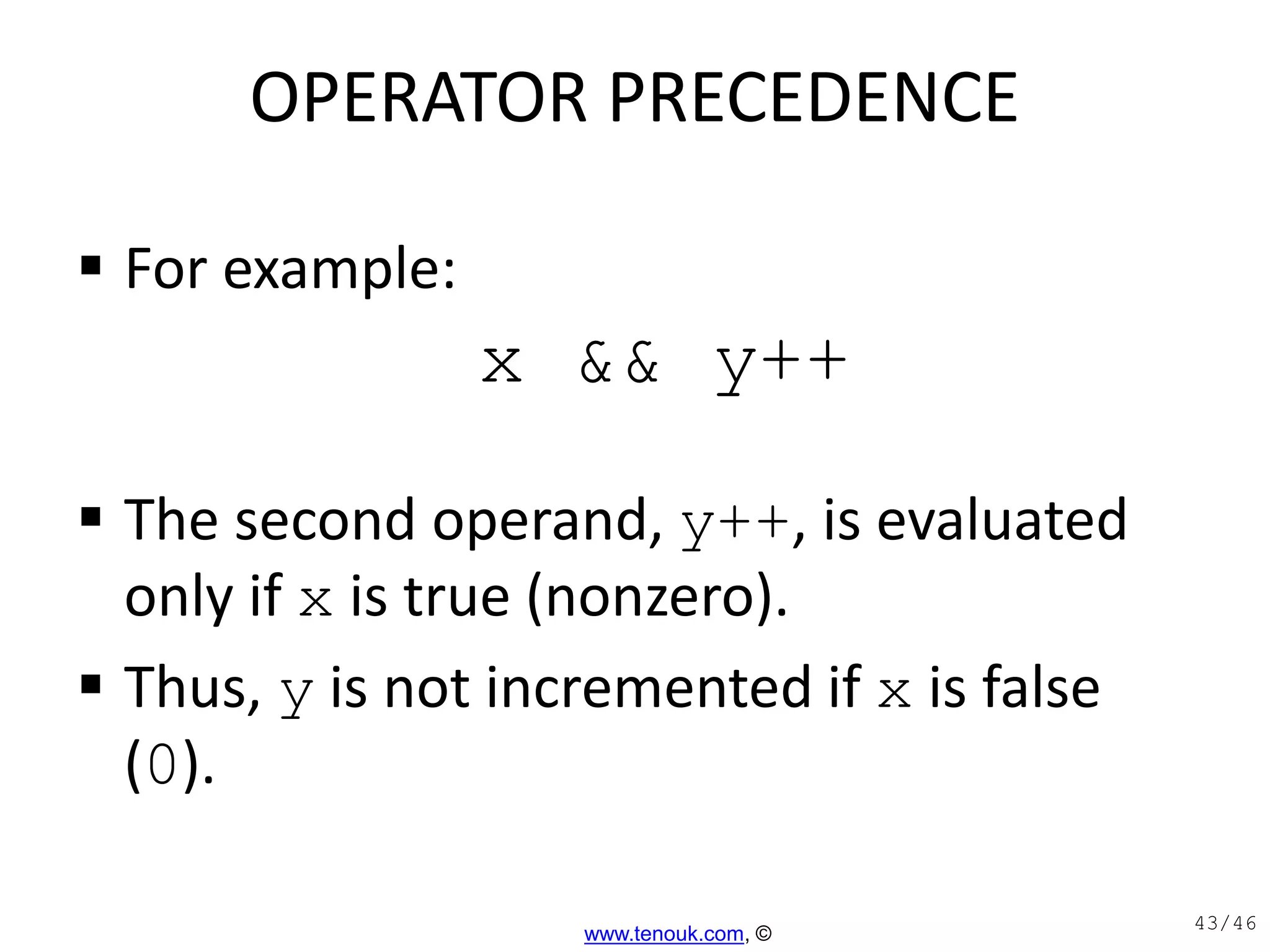
 For example:
 The second operand, y++, is evaluated
only if x is true (nonzero).
 Thus, y is not incremented if x is false
(0).
43/46
x && y++
www.tenouk.com, ©
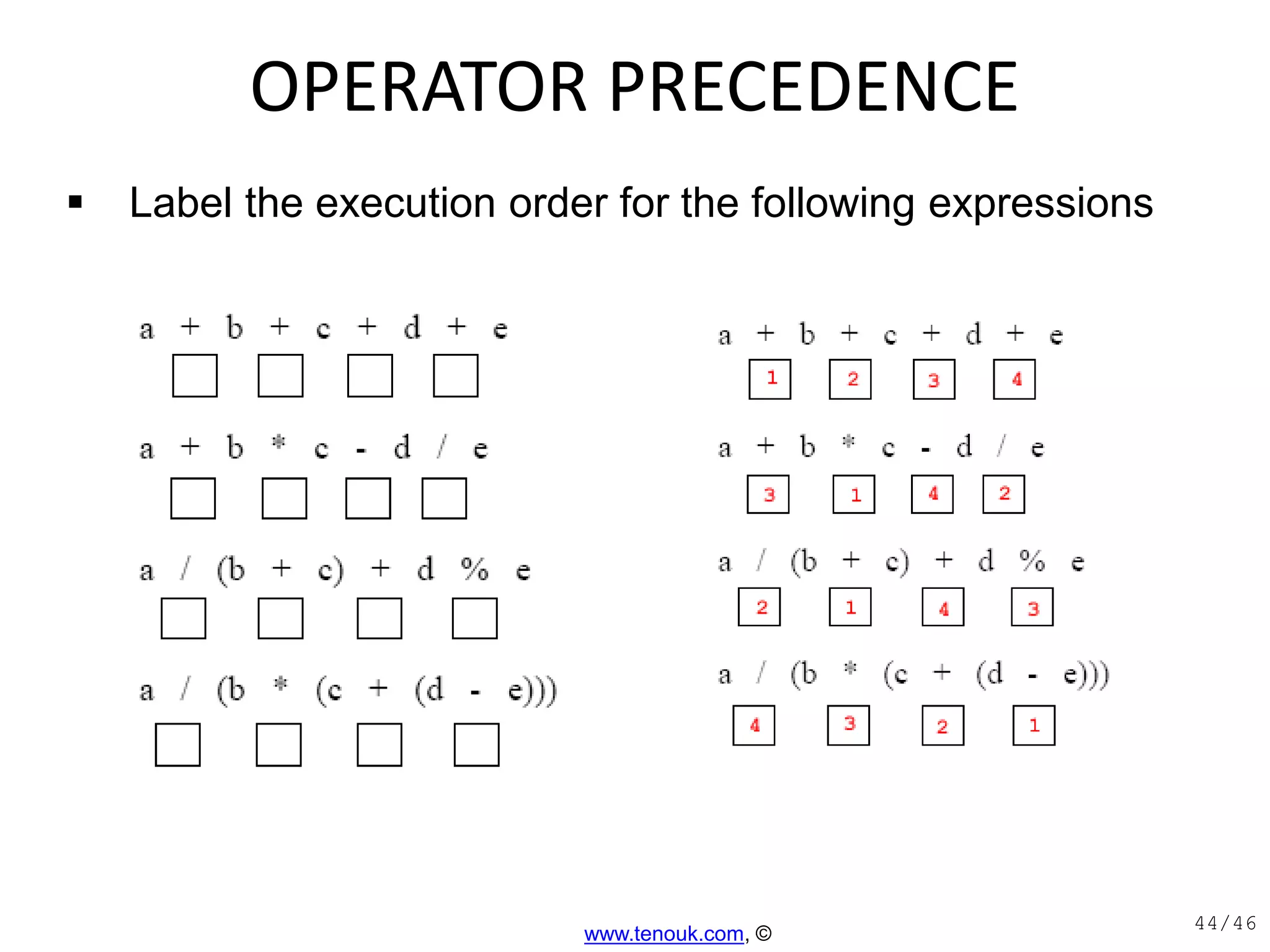
 Label the execution order for the following expressions
OPERATOR PRECEDENCE
44/46
www.tenouk.com, ©
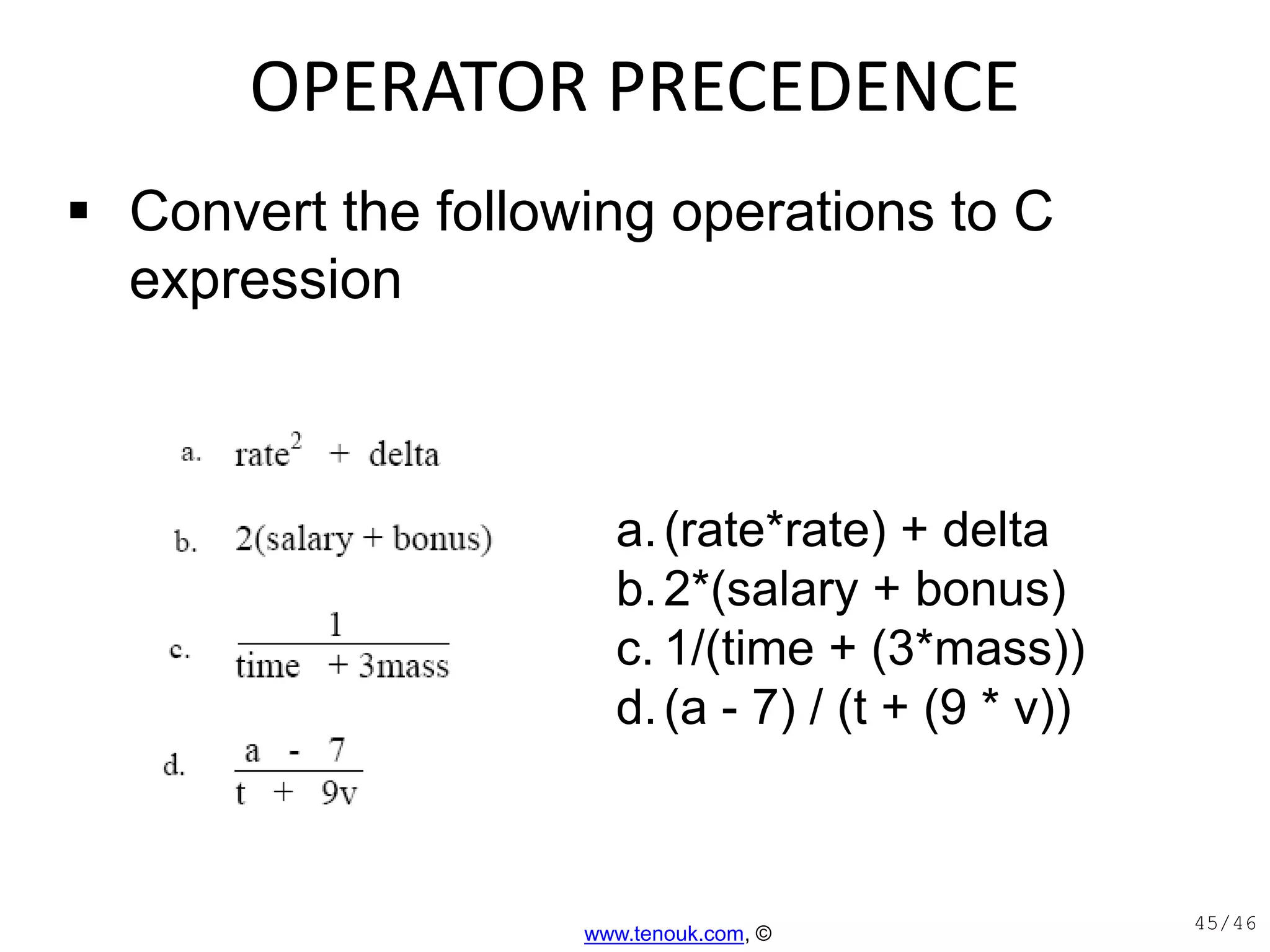
a.(rate*rate) + delta
b.2*(salary + bonus)
c. 1/(time + (3*mass))
d.(a - 7) / (t + (9 * v))
OPERATOR PRECEDENCE
45/46
 Convert the following operations to C
expression
www.tenouk.com, ©

Operator precedence and associativity

  • 1.
    C OPERATORS, OPERANDS,EXPRESSION & STATEMENTS  Operators are symbols which take one or more operands or expressions and perform arithmetic or logical computations.  Operands are variables or expressions which are used in conjunction with operators to evaluate the expression.  Combination of operands and operators form an expression.  Expressions are sequences of operators, operands, and punctuators that specify a computation.  Evaluation of expressions is based on the operators that the expressions contain and the context in which they are used.  Expression can result in a value and can produce side effects.  A side effect is a change in the state of the execution environment.
  • 2.
    C OPERATORS  Anexpression is any valid set of literals, variables, operators, operands and expressions that evaluates to a single value.  This value can be a number, a string or a logical value.  For instance a = b + c; denotes an expression in which there are 3 operands a, b, c and two operator + and =.  A statement, the smallest independent computational unit, specifies an action to be performed.  In most cases, statements are executed in sequence.  The number of operands of an operator is called its arity.  Based on arity, operators are classified as nullary (no operands), unary (1 operand), binary (2 operands), ternary (3 operands). 3/46 www.tenouk.com, ©
  • 3.
    OPERATOR PRECEDENCE  Considerthe following arithmetic operation: - left to right 6 / 2 * 1 + 2 = 5 - right to left 6/2 * 1 + 2 = 1 - using parentheses = 6 / (2 * 1) + 2 = (6 / 2) + 2 = 3 + 2 = 5 34/46 Inconsistent answers! www.tenouk.com, ©
  • 4.
    OPERATOR PRECEDENCE  Operatorprecedence: a rule used to clarify unambiguously which operations (operator and operands) should be performed first in the given (mathematical) expression.  Use precedence levels that conform to the order commonly used in mathematics.  However, parentheses take the highest precedence and operation performed from the innermost to the outermost parentheses. 35/46 www.tenouk.com, ©
  • 5.
    OPERATOR PRECEDENCE  Precedenceand associativity of C operators affect the grouping and evaluation of operands in expressions.  Is meaningful only if other operators with higher or lower precedence are present.  Expressions with higher-precedence operators are evaluated first. 36/46 www.tenouk.com, ©
  • 6.
    Precedence and Associativityof C Operators Symbol Type of Operation Associativity [ ] ( ) . –> postfix ++ and postfix –– Expression Left to right prefix ++ and prefix –– sizeof & * + – ~ ! Unary Right to left typecasts Unary Right to left * / % Multiplicative Left to right + – Additive Left to right << >> Bitwise shift Left to right < > <= >= Relational Left to right == != Equality Left to right & Bitwise-AND Left to right ^ Bitwise-exclusive-OR Left to right | Bitwise-inclusive-OR Left to right && Logical-AND Left to right || Logical-OR Left to right ? : Conditional-expression Right to left = *= /= %= += –= <<= >>= &= ^= |= Simple and compound assignment Right to left , Sequential evaluation Left to right OPERATOR PRECEDENCE 37/46 www.tenouk.com, ©
  • 7.
    OPERATOR PRECEDENCE  Theprecedence and associativity (the order in which the operands are evaluated) of C operators.  In the order of precedence from highest to lowest.  If several operators appear together, they have equal precedence and are evaluated according to their associativity.  All simple and compound-assignment operators have equal precedence. 38/46 www.tenouk.com, ©
  • 8.
    OPERATOR PRECEDENCE  Operatorswith equal precedence such as + and -, evaluation proceeds according to the associativity of the operator, either from right to left or from left to right.  The direction of evaluation does not affect the results of expressions that include more than one multiplication (*), addition (+), or binary-bitwise (& | ^) operator at the same level. 39/46 www.tenouk.com, ©
  • 9.
    OPERATOR PRECEDENCE  e.g: Order of operations is not defined by the language.  The compiler is free to evaluate such expressions in any order, if the compiler can guarantee a consistent result. 40/46 3 + 5 + (3 + 2) = 13 – right to left (3 + 5) + 3 + 2 = 13 – left to right 3 + (5 + 3) + 2 = 13 – from middle www.tenouk.com, ©
  • 10.
    OPERATOR PRECEDENCE  Onlythe sequential-evaluation (,), logical-AND (&&), logical-OR (||), conditional-expression (? :), and function-call operators constitute sequence points and therefore guarantee a particular order of evaluation for their operands.  The sequential-evaluation operator (,) is guaranteed to evaluate its operands from left to right.  The comma operator in a function call is not the same as the sequential-evaluation operator and does not provide any such guarantee. 41/46 www.tenouk.com, ©
  • 11.
    OPERATOR PRECEDENCE  Logicaloperators also guarantee evaluation of their operands from left to right.  But, they evaluate the smallest number of operands needed to determine the result of the expression.  This is called "short-circuit" evaluation.  Thus, some operands of the expression may not be evaluated. 42/46 www.tenouk.com, ©
  • 12.
    OPERATOR PRECEDENCE  Forexample:  The second operand, y++, is evaluated only if x is true (nonzero).  Thus, y is not incremented if x is false (0). 43/46 x && y++ www.tenouk.com, ©
  • 13.
     Label theexecution order for the following expressions OPERATOR PRECEDENCE 44/46 www.tenouk.com, ©
  • 14.
    a.(rate*rate) + delta b.2*(salary+ bonus) c. 1/(time + (3*mass)) d.(a - 7) / (t + (9 * v)) OPERATOR PRECEDENCE 45/46  Convert the following operations to C expression www.tenouk.com, ©