Presentation Merging with Technologies June 2017
Safe Practice in Earthing and Protection
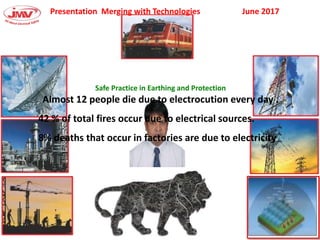
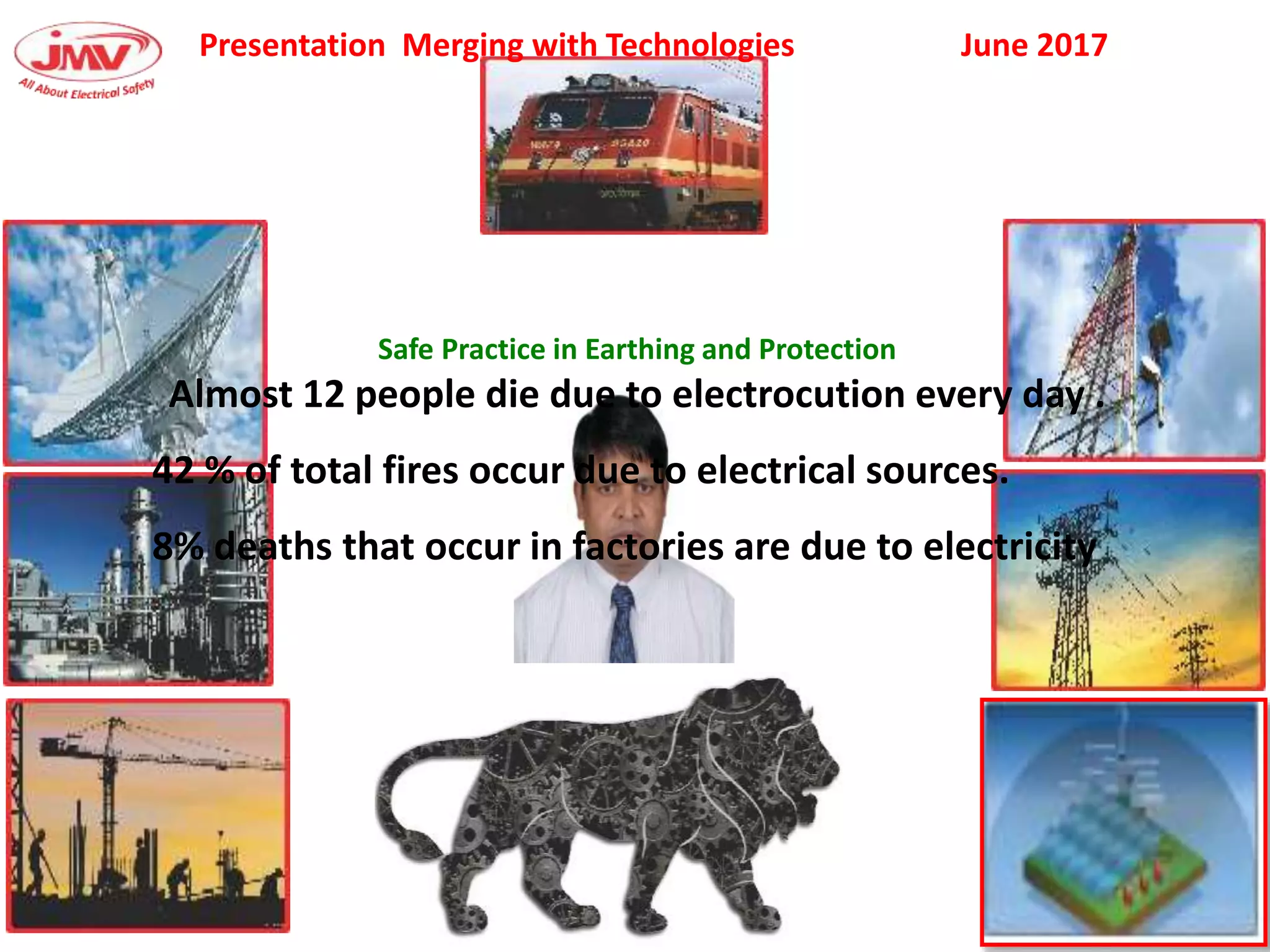
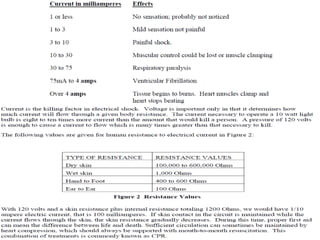
Almost 12 people die due to electrocution every day .
42 % of total fires occur due to electrical sources.
8% deaths that occur in factories are due to electricity
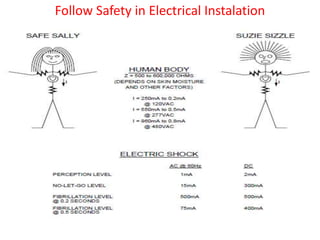
Follow Safety in Electrical Instalation
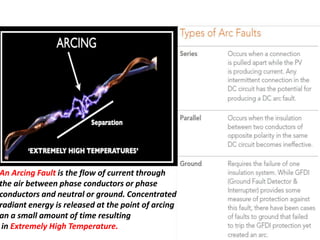
An Arcing Fault is the flow of current through
the air between phase conductors or phase
conductors and neutral or ground. Concentrated
radiant energy is released at the point of arcing
an a small amount of time resulting
in Extremely High Temperature.
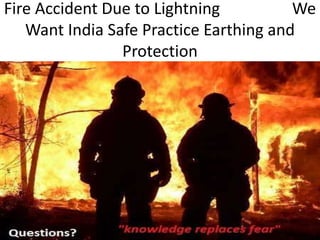
Fire Accident Due to Lightning We
Want India Safe Practice Earthing and
Protection
Why Accidents happen?
Accidents generally happen due to lack of
maintenance, lack of Supervision, lack of knowledge,
over confidence and negligence. Accidents may also
happen due to one or more of the following reasons:
 Using improper tools
 Improper/non usage of protective devices
 Lack of proper instructions and supervision
 Mental/physical condition of the employee
 Poor Judgment
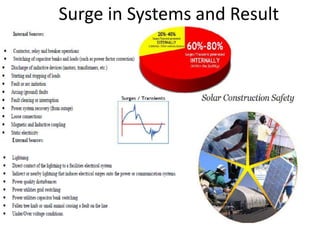
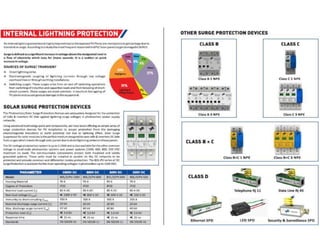
Surge in Systems and Result
11
4. Substations
Planning and design of substations to be based on the following
xii. Power Supply to the sub station auxillaries
a. AC Supply;
2 HT supplies shall be arranged from independent sources.
In addition, a DG set of suitable capacity to be provided
b. DC Supply:
2 sets of 220 V batteries each equipped with own charger
for substations of 220 kV & above. 2 sets of 50 V batteries for
PLCC system.
for substations of 132 kV & below, 1 set of battery each to
be provided
xii. For high current, XLPE cables to be employed. For LV/MV
systems, PVC cables corresponding to IS-1554, can be
employed
12
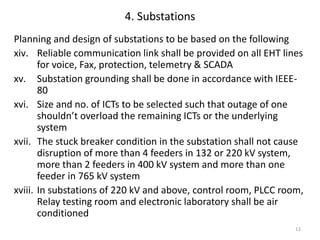
4. Substations
Planning and design of substations to be based on the following
xiv. Reliable communication link shall be provided on all EHT lines
for voice, Fax, protection, telemetry & SCADA
xv. Substation grounding shall be done in accordance with IEEE-
80
xvi. Size and no. of ICTs to be selected such that outage of one
shouldn’t overload the remaining ICTs or the underlying
system
xvii. The stuck breaker condition in the substation shall not cause
disruption of more than 4 feeders in 132 or 220 kV system,
more than 2 feeders in 400 kV system and more than one
feeder in 765 kV system
xviii. In substations of 220 kV and above, control room, PLCC room,
Relay testing room and electronic laboratory shall be air
conditioned
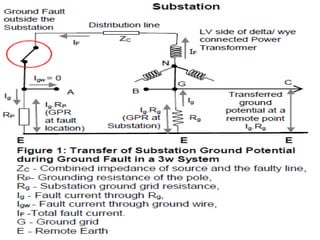
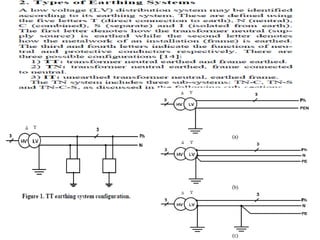
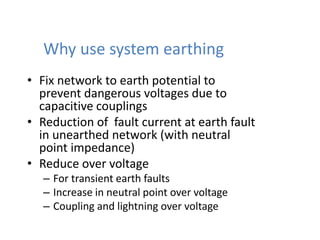
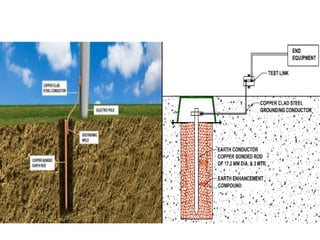
Why use system earthing
• Fix network to earth potential to
prevent dangerous voltages due to
capacitive couplings
• Reduction of fault current at earth fault
in unearthed network (with neutral
point impedance)
• Reduce over voltage
– For transient earth faults
– Increase in neutral point over voltage
– Coupling and lightning over voltage
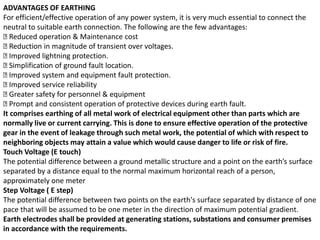
ADVANTAGES OF EARTHING
For efficient/effective operation of any power system, it is very much essential to connect the
neutral to suitable earth connection. The following are the few advantages:
􀂄 Reduced operation & Maintenance cost
􀂄 Reduction in magnitude of transient over voltages.
􀂄 Improved lightning protection.
􀂄 Simplification of ground fault location.
􀂄 Improved system and equipment fault protection.
􀂄 Improved service reliability
􀂄 Greater safety for personnel & equipment
􀂄 Prompt and consistent operation of protective devices during earth fault.
It comprises earthing of all metal work of electrical equipment other than parts which are
normally live or current carrying. This is done to ensure effective operation of the protective
gear in the event of leakage through such metal work, the potential of which with respect to
neighboring objects may attain a value which would cause danger to life or risk of fire.
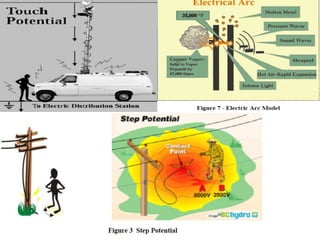
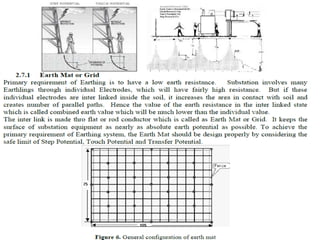
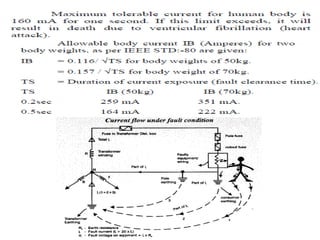
Touch Voltage (E touch)
The potential difference between a ground metallic structure and a point on the earth’s surface
separated by a distance equal to the normal maximum horizontal reach of a person,
approximately one meter
Step Voltage ( E step)
The potential difference between two points on the earth's surface separated by distance of one
pace that will be assumed to be one meter in the direction of maximum potential gradient.
Earth electrodes shall be provided at generating stations, substations and consumer premises
in accordance with the requirements.
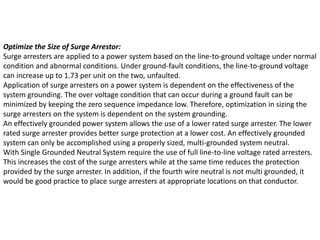
Optimize the Size of Surge Arrestor:
Surge arresters are applied to a power system based on the line-to-ground voltage under normal
condition and abnormal conditions. Under ground-fault conditions, the line-to-ground voltage
can increase up to 1.73 per unit on the two, unfaulted.
Application of surge arresters on a power system is dependent on the effectiveness of the
system grounding. The over voltage condition that can occur during a ground fault can be
minimized by keeping the zero sequence impedance low. Therefore, optimization in sizing the
surge arresters on the system is dependent on the system grounding.
An effectively grounded power system allows the use of a lower rated surge arrester. The lower
rated surge arrester provides better surge protection at a lower cost. An effectively grounded
system can only be accomplished using a properly sized, multi-grounded system neutral.
With Single Grounded Neutral System require the use of full line-to-line voltage rated arresters.
This increases the cost of the surge arresters while at the same time reduces the protection
provided by the surge arrester. In addition, if the fourth wire neutral is not multi grounded, it
would be good practice to place surge arresters at appropriate locations on that conductor.
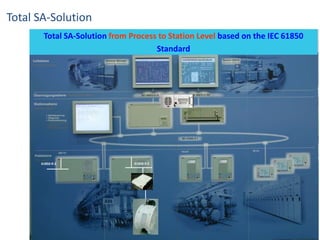
61850-9-261850-9-2
Total SA-Solution from Process to Station Level based on the IEC 61850
Standard
Total SA-Solution
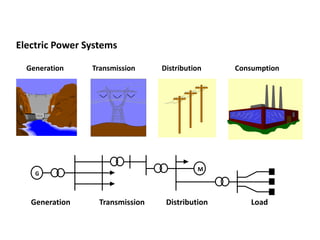
G
M
Generation Transmission Distribution Load
Generation Transmission Distribution Consumption
Electric Power Systems
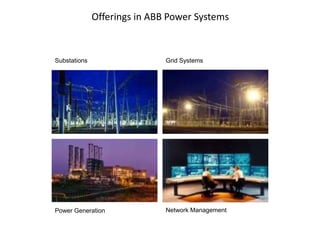
Offerings in ABB Power Systems
Substations
Network Management
Grid Systems
Power Generation
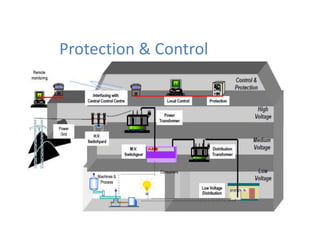
Protection & Control
•
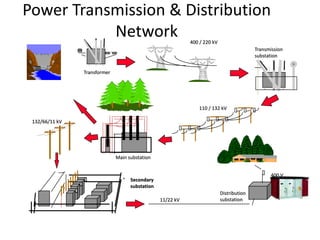
Power Transmission & Distribution
Network
Secondary
substation
Distribution
substation
400 / 220 kV
132/66/11 kV
110 / 132 kV
11/22 kV
Transmission
substation
Main substation
400 V
Transformer
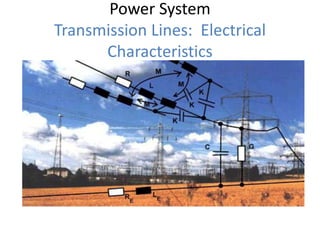
Power System
Transmission Lines: Electrical
Characteristics
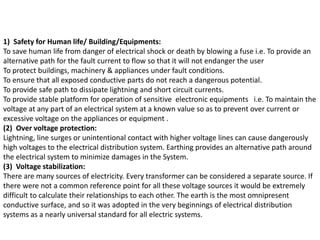
1) Safety for Human life/ Building/Equipments:
To save human life from danger of electrical shock or death by blowing a fuse i.e. To provide an
alternative path for the fault current to flow so that it will not endanger the user
To protect buildings, machinery & appliances under fault conditions.
To ensure that all exposed conductive parts do not reach a dangerous potential.
To provide safe path to dissipate lightning and short circuit currents.
To provide stable platform for operation of sensitive electronic equipments i.e. To maintain the
voltage at any part of an electrical system at a known value so as to prevent over current or
excessive voltage on the appliances or equipment .
(2) Over voltage protection:
Lightning, line surges or unintentional contact with higher voltage lines can cause dangerously
high voltages to the electrical distribution system. Earthing provides an alternative path around
the electrical system to minimize damages in the System.
(3) Voltage stabilization:
There are many sources of electricity. Every transformer can be considered a separate source. If
there were not a common reference point for all these voltage sources it would be extremely
difficult to calculate their relationships to each other. The earth is the most omnipresent
conductive surface, and so it was adopted in the very beginnings of electrical distribution
systems as a nearly universal standard for all electric systems.
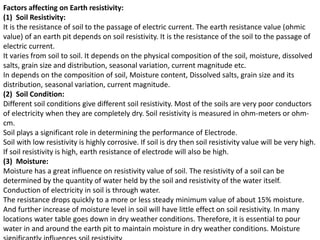
Factors affecting on Earth resistivity:
(1) Soil Resistivity:
It is the resistance of soil to the passage of electric current. The earth resistance value (ohmic
value) of an earth pit depends on soil resistivity. It is the resistance of the soil to the passage of
electric current.
It varies from soil to soil. It depends on the physical composition of the soil, moisture, dissolved
salts, grain size and distribution, seasonal variation, current magnitude etc.
In depends on the composition of soil, Moisture content, Dissolved salts, grain size and its
distribution, seasonal variation, current magnitude.
(2) Soil Condition:
Different soil conditions give different soil resistivity. Most of the soils are very poor conductors
of electricity when they are completely dry. Soil resistivity is measured in ohm-meters or ohm-
cm.
Soil plays a significant role in determining the performance of Electrode.
Soil with low resistivity is highly corrosive. If soil is dry then soil resistivity value will be very high.
If soil resistivity is high, earth resistance of electrode will also be high.
(3) Moisture:
Moisture has a great influence on resistivity value of soil. The resistivity of a soil can be
determined by the quantity of water held by the soil and resistivity of the water itself.
Conduction of electricity in soil is through water.
The resistance drops quickly to a more or less steady minimum value of about 15% moisture.
And further increase of moisture level in soil will have little effect on soil resistivity. In many
locations water table goes down in dry weather conditions. Therefore, it is essential to pour
water in and around the earth pit to maintain moisture in dry weather conditions. Moisture
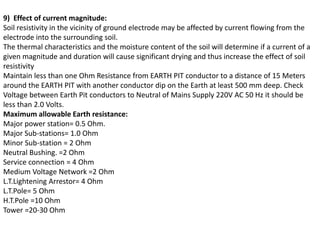
9) Effect of current magnitude:
Soil resistivity in the vicinity of ground electrode may be affected by current flowing from the
electrode into the surrounding soil.
The thermal characteristics and the moisture content of the soil will determine if a current of a
given magnitude and duration will cause significant drying and thus increase the effect of soil
resistivity
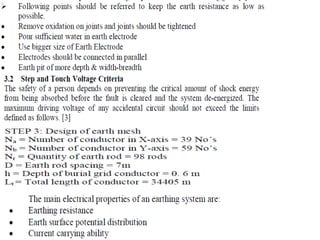
Maintain less than one Ohm Resistance from EARTH PIT conductor to a distance of 15 Meters
around the EARTH PIT with another conductor dip on the Earth at least 500 mm deep. Check
Voltage between Earth Pit conductors to Neutral of Mains Supply 220V AC 50 Hz it should be
less than 2.0 Volts.
Maximum allowable Earth resistance:
Major power station= 0.5 Ohm.
Major Sub-stations= 1.0 Ohm
Minor Sub-station = 2 Ohm
Neutral Bushing. =2 Ohm
Service connection = 4 Ohm
Medium Voltage Network =2 Ohm
L.T.Lightening Arrestor= 4 Ohm
L.T.Pole= 5 Ohm
H.T.Pole =10 Ohm
Tower =20-30 Ohm
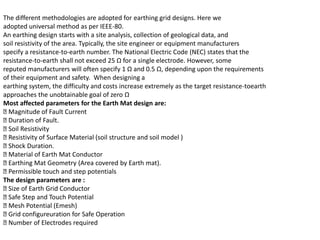
The different methodologies are adopted for earthing grid designs. Here we
adopted universal method as per IEEE-80.
An earthing design starts with a site analysis, collection of geological data, and
soil resistivity of the area. Typically, the site engineer or equipment manufacturers
specify a resistance-to-earth number. The National Electric Code (NEC) states that the
resistance-to-earth shall not exceed 25 Ω for a single electrode. However, some
reputed manufacturers will often specify 1 Ω and 0.5 Ω, depending upon the requirements
of their equipment and safety. When designing a
earthing system, the difficulty and costs increase extremely as the target resistance-toearth
approaches the unobtainable goal of zero Ω
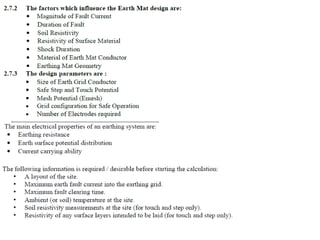
Most affected parameters for the Earth Mat design are:
Magnitude of Fault Current
Duration of Fault.
Soil Resistivity
Resistivity of Surface Material (soil structure and soil model )
Shock Duration.
Material of Earth Mat Conductor
Earthing Mat Geometry (Area covered by Earth mat).
Permissible touch and step potentials
The design parameters are :
Size of Earth Grid Conductor
Safe Step and Touch Potential
Mesh Potential (Emesh)
Grid configureuration for Safe Operation
Number of Electrodes required
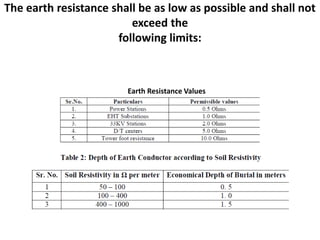
The earth resistance shall be as low as possible and shall not
exceed the
following limits:
Earth Resistance Values
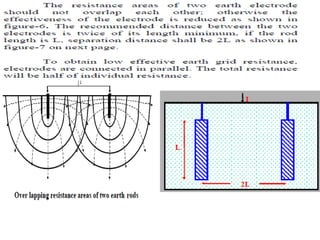
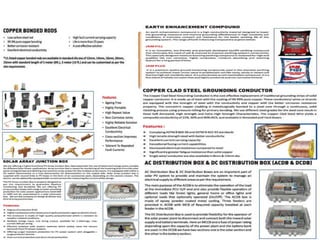
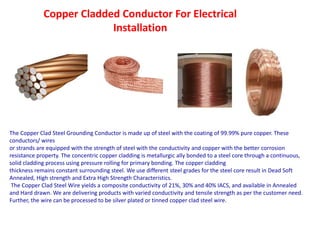
Copper Cladded Conductor For Electrical
Installation
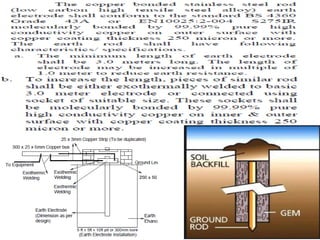
The Copper Clad Steel Grounding Conductor is made up of steel with the coating of 99.99% pure copper. These
conductors/ wires
or strands are equipped with the strength of steel with the conductivity and copper with the better corrosion
resistance property. The concentric copper cladding is metallurgic ally bonded to a steel core through a continuous,
solid cladding process using pressure rolling for primary bonding. The copper cladding
thickness remains constant surrounding steel. We use different steel grades for the steel core result in Dead Soft
Annealed, High strength and Extra High Strength Characteristics.
The Copper Clad Steel Wire yields a composite conductivity of 21%, 30% and 40% IACS, and available in Annealed
and Hard drawn. We are delivering products with varied conductivity and tensile strength as per the customer need.
Further, the wire can be processed to be silver plated or tinned copper clad steel wire.
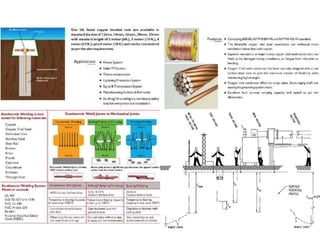
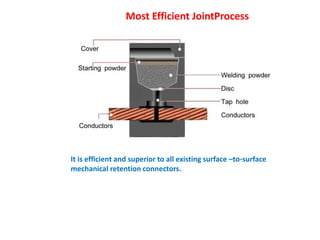
Most Efficient JointProcess
It is efficient and superior to all existing surface –to-surface
mechanical retention connectors.
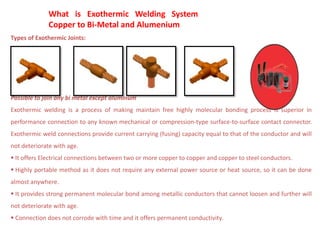
What is Exothermic Welding System?
Copper to Bi-Metal and Alumenium
Types of Exothermic Joints:
Possible to join any bi metal except aluminum
Exothermic welding is a process of making maintain free highly molecular bonding process is superior in
performance connection to any known mechanical or compression-type surface-to-surface contact connector.
Exothermic weld connections provide current carrying (fusing) capacity equal to that of the conductor and will
not deteriorate with age.
 It offers Electrical connections between two or more copper to copper and copper to steel conductors.
 Highly portable method as it does not require any external power source or heat source, so it can be done
almost anywhere.
 It provides strong permanent molecular bond among metallic conductors that cannot loosen and further will
not deteriorate with age.
 Connection does not corrode with time and it offers permanent conductivity.
JMV’s Clients
Neeraj Saini – 9910398538
Rahul Verma – 9910398535
Manav Chandra - 9910398999
manav@jmv.co.in

Presentation jmv internal

  • 1.
    Presentation Merging withTechnologies June 2017 Safe Practice in Earthing and Protection Almost 12 people die due to electrocution every day . 42 % of total fires occur due to electrical sources. 8% deaths that occur in factories are due to electricity
  • 2.
    Follow Safety inElectrical Instalation
  • 3.
    An Arcing Faultis the flow of current through the air between phase conductors or phase conductors and neutral or ground. Concentrated radiant energy is released at the point of arcing an a small amount of time resulting in Extremely High Temperature.
  • 4.
    Fire Accident Dueto Lightning We Want India Safe Practice Earthing and Protection
  • 5.
    Why Accidents happen? Accidentsgenerally happen due to lack of maintenance, lack of Supervision, lack of knowledge, over confidence and negligence. Accidents may also happen due to one or more of the following reasons:  Using improper tools  Improper/non usage of protective devices  Lack of proper instructions and supervision  Mental/physical condition of the employee  Poor Judgment
  • 6.
    Surge in Systemsand Result
  • 11.
    11 4. Substations Planning anddesign of substations to be based on the following xii. Power Supply to the sub station auxillaries a. AC Supply; 2 HT supplies shall be arranged from independent sources. In addition, a DG set of suitable capacity to be provided b. DC Supply: 2 sets of 220 V batteries each equipped with own charger for substations of 220 kV & above. 2 sets of 50 V batteries for PLCC system. for substations of 132 kV & below, 1 set of battery each to be provided xii. For high current, XLPE cables to be employed. For LV/MV systems, PVC cables corresponding to IS-1554, can be employed
  • 12.
    12 4. Substations Planning anddesign of substations to be based on the following xiv. Reliable communication link shall be provided on all EHT lines for voice, Fax, protection, telemetry & SCADA xv. Substation grounding shall be done in accordance with IEEE- 80 xvi. Size and no. of ICTs to be selected such that outage of one shouldn’t overload the remaining ICTs or the underlying system xvii. The stuck breaker condition in the substation shall not cause disruption of more than 4 feeders in 132 or 220 kV system, more than 2 feeders in 400 kV system and more than one feeder in 765 kV system xviii. In substations of 220 kV and above, control room, PLCC room, Relay testing room and electronic laboratory shall be air conditioned
  • 14.
    Why use systemearthing • Fix network to earth potential to prevent dangerous voltages due to capacitive couplings • Reduction of fault current at earth fault in unearthed network (with neutral point impedance) • Reduce over voltage – For transient earth faults – Increase in neutral point over voltage – Coupling and lightning over voltage
  • 15.
    ADVANTAGES OF EARTHING Forefficient/effective operation of any power system, it is very much essential to connect the neutral to suitable earth connection. The following are the few advantages: 􀂄 Reduced operation & Maintenance cost 􀂄 Reduction in magnitude of transient over voltages. 􀂄 Improved lightning protection. 􀂄 Simplification of ground fault location. 􀂄 Improved system and equipment fault protection. 􀂄 Improved service reliability 􀂄 Greater safety for personnel & equipment 􀂄 Prompt and consistent operation of protective devices during earth fault. It comprises earthing of all metal work of electrical equipment other than parts which are normally live or current carrying. This is done to ensure effective operation of the protective gear in the event of leakage through such metal work, the potential of which with respect to neighboring objects may attain a value which would cause danger to life or risk of fire. Touch Voltage (E touch) The potential difference between a ground metallic structure and a point on the earth’s surface separated by a distance equal to the normal maximum horizontal reach of a person, approximately one meter Step Voltage ( E step) The potential difference between two points on the earth's surface separated by distance of one pace that will be assumed to be one meter in the direction of maximum potential gradient. Earth electrodes shall be provided at generating stations, substations and consumer premises in accordance with the requirements.
  • 16.
    Optimize the Sizeof Surge Arrestor: Surge arresters are applied to a power system based on the line-to-ground voltage under normal condition and abnormal conditions. Under ground-fault conditions, the line-to-ground voltage can increase up to 1.73 per unit on the two, unfaulted. Application of surge arresters on a power system is dependent on the effectiveness of the system grounding. The over voltage condition that can occur during a ground fault can be minimized by keeping the zero sequence impedance low. Therefore, optimization in sizing the surge arresters on the system is dependent on the system grounding. An effectively grounded power system allows the use of a lower rated surge arrester. The lower rated surge arrester provides better surge protection at a lower cost. An effectively grounded system can only be accomplished using a properly sized, multi-grounded system neutral. With Single Grounded Neutral System require the use of full line-to-line voltage rated arresters. This increases the cost of the surge arresters while at the same time reduces the protection provided by the surge arrester. In addition, if the fourth wire neutral is not multi grounded, it would be good practice to place surge arresters at appropriate locations on that conductor.
  • 17.
    61850-9-261850-9-2 Total SA-Solution fromProcess to Station Level based on the IEC 61850 Standard Total SA-Solution
  • 18.
    G M Generation Transmission DistributionLoad Generation Transmission Distribution Consumption Electric Power Systems
  • 19.
    Offerings in ABBPower Systems Substations Network Management Grid Systems Power Generation
  • 20.
  • 21.
    Power Transmission &Distribution Network Secondary substation Distribution substation 400 / 220 kV 132/66/11 kV 110 / 132 kV 11/22 kV Transmission substation Main substation 400 V Transformer
  • 22.
    Power System Transmission Lines:Electrical Characteristics
  • 23.
    1) Safety forHuman life/ Building/Equipments: To save human life from danger of electrical shock or death by blowing a fuse i.e. To provide an alternative path for the fault current to flow so that it will not endanger the user To protect buildings, machinery & appliances under fault conditions. To ensure that all exposed conductive parts do not reach a dangerous potential. To provide safe path to dissipate lightning and short circuit currents. To provide stable platform for operation of sensitive electronic equipments i.e. To maintain the voltage at any part of an electrical system at a known value so as to prevent over current or excessive voltage on the appliances or equipment . (2) Over voltage protection: Lightning, line surges or unintentional contact with higher voltage lines can cause dangerously high voltages to the electrical distribution system. Earthing provides an alternative path around the electrical system to minimize damages in the System. (3) Voltage stabilization: There are many sources of electricity. Every transformer can be considered a separate source. If there were not a common reference point for all these voltage sources it would be extremely difficult to calculate their relationships to each other. The earth is the most omnipresent conductive surface, and so it was adopted in the very beginnings of electrical distribution systems as a nearly universal standard for all electric systems.
  • 24.
    Factors affecting onEarth resistivity: (1) Soil Resistivity: It is the resistance of soil to the passage of electric current. The earth resistance value (ohmic value) of an earth pit depends on soil resistivity. It is the resistance of the soil to the passage of electric current. It varies from soil to soil. It depends on the physical composition of the soil, moisture, dissolved salts, grain size and distribution, seasonal variation, current magnitude etc. In depends on the composition of soil, Moisture content, Dissolved salts, grain size and its distribution, seasonal variation, current magnitude. (2) Soil Condition: Different soil conditions give different soil resistivity. Most of the soils are very poor conductors of electricity when they are completely dry. Soil resistivity is measured in ohm-meters or ohm- cm. Soil plays a significant role in determining the performance of Electrode. Soil with low resistivity is highly corrosive. If soil is dry then soil resistivity value will be very high. If soil resistivity is high, earth resistance of electrode will also be high. (3) Moisture: Moisture has a great influence on resistivity value of soil. The resistivity of a soil can be determined by the quantity of water held by the soil and resistivity of the water itself. Conduction of electricity in soil is through water. The resistance drops quickly to a more or less steady minimum value of about 15% moisture. And further increase of moisture level in soil will have little effect on soil resistivity. In many locations water table goes down in dry weather conditions. Therefore, it is essential to pour water in and around the earth pit to maintain moisture in dry weather conditions. Moisture
  • 25.
    9) Effect ofcurrent magnitude: Soil resistivity in the vicinity of ground electrode may be affected by current flowing from the electrode into the surrounding soil. The thermal characteristics and the moisture content of the soil will determine if a current of a given magnitude and duration will cause significant drying and thus increase the effect of soil resistivity Maintain less than one Ohm Resistance from EARTH PIT conductor to a distance of 15 Meters around the EARTH PIT with another conductor dip on the Earth at least 500 mm deep. Check Voltage between Earth Pit conductors to Neutral of Mains Supply 220V AC 50 Hz it should be less than 2.0 Volts. Maximum allowable Earth resistance: Major power station= 0.5 Ohm. Major Sub-stations= 1.0 Ohm Minor Sub-station = 2 Ohm Neutral Bushing. =2 Ohm Service connection = 4 Ohm Medium Voltage Network =2 Ohm L.T.Lightening Arrestor= 4 Ohm L.T.Pole= 5 Ohm H.T.Pole =10 Ohm Tower =20-30 Ohm
  • 30.
    The different methodologiesare adopted for earthing grid designs. Here we adopted universal method as per IEEE-80. An earthing design starts with a site analysis, collection of geological data, and soil resistivity of the area. Typically, the site engineer or equipment manufacturers specify a resistance-to-earth number. The National Electric Code (NEC) states that the resistance-to-earth shall not exceed 25 Ω for a single electrode. However, some reputed manufacturers will often specify 1 Ω and 0.5 Ω, depending upon the requirements of their equipment and safety. When designing a earthing system, the difficulty and costs increase extremely as the target resistance-toearth approaches the unobtainable goal of zero Ω Most affected parameters for the Earth Mat design are: Magnitude of Fault Current Duration of Fault. Soil Resistivity Resistivity of Surface Material (soil structure and soil model ) Shock Duration. Material of Earth Mat Conductor Earthing Mat Geometry (Area covered by Earth mat). Permissible touch and step potentials The design parameters are : Size of Earth Grid Conductor Safe Step and Touch Potential Mesh Potential (Emesh) Grid configureuration for Safe Operation Number of Electrodes required
  • 31.
    The earth resistanceshall be as low as possible and shall not exceed the following limits: Earth Resistance Values
  • 36.
    Copper Cladded ConductorFor Electrical Installation The Copper Clad Steel Grounding Conductor is made up of steel with the coating of 99.99% pure copper. These conductors/ wires or strands are equipped with the strength of steel with the conductivity and copper with the better corrosion resistance property. The concentric copper cladding is metallurgic ally bonded to a steel core through a continuous, solid cladding process using pressure rolling for primary bonding. The copper cladding thickness remains constant surrounding steel. We use different steel grades for the steel core result in Dead Soft Annealed, High strength and Extra High Strength Characteristics. The Copper Clad Steel Wire yields a composite conductivity of 21%, 30% and 40% IACS, and available in Annealed and Hard drawn. We are delivering products with varied conductivity and tensile strength as per the customer need. Further, the wire can be processed to be silver plated or tinned copper clad steel wire.
  • 37.
    Most Efficient JointProcess Itis efficient and superior to all existing surface –to-surface mechanical retention connectors.
  • 38.
    What is ExothermicWelding System? Copper to Bi-Metal and Alumenium Types of Exothermic Joints: Possible to join any bi metal except aluminum Exothermic welding is a process of making maintain free highly molecular bonding process is superior in performance connection to any known mechanical or compression-type surface-to-surface contact connector. Exothermic weld connections provide current carrying (fusing) capacity equal to that of the conductor and will not deteriorate with age.  It offers Electrical connections between two or more copper to copper and copper to steel conductors.  Highly portable method as it does not require any external power source or heat source, so it can be done almost anywhere.  It provides strong permanent molecular bond among metallic conductors that cannot loosen and further will not deteriorate with age.  Connection does not corrode with time and it offers permanent conductivity.
  • 41.
  • 42.
    Neeraj Saini –9910398538 Rahul Verma – 9910398535 Manav Chandra - 9910398999 manav@jmv.co.in