Faculty of foreign languages and area studies


Author: Andrey Kuznetsov
        second year student of 1st English group
Alexander Hamilton - a revolutionary,
     politician, and statesman
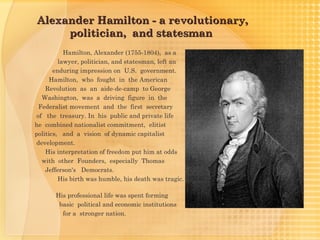
           Hamilton, Alexander (1755-1804), as a
         lawyer, politician, and statesman, left an
       enduring impression on U.S. government.
      Hamilton, who fought in the American
    Revolution as an aide-de-camp to George
  Washington, was a driving figure in the
 Federalist movement and the first secretary
of the treasury. In his public and private life
he combined nationalist commitment, elitist
politics, and a vision of dynamic capitalist
development.
    His interpretation of freedom put him at odds
  with other Founders, especially Thomas
    Jefferson's Democrats.
         His birth was humble, his death was tragic.

       His professional life was spent forming
        basic political and economic institutions
         for a stronger nation.
From naissance to school.
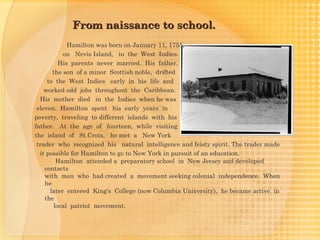
             Hamilton was born on January 11, 1755,
           on Nevis Island, in the West Indies.
          His parents never married. His father,
       the son of a minor Scottish noble, drifted
     to the West Indies early in his life and
    worked odd jobs throughout the Caribbean.
  His mother died in the Indies when he was
 eleven. Hamilton spent his early years in
poverty, traveling to different islands with his
father. At the age of fourteen, while visiting
the island of St.Croix, he met a New York
 trader who recognized his natural intelligence and feisty spirit. The trader made
  it possible for Hamilton to go to New York in pursuit of an education.
         Hamilton attended a preparatory school in New Jersey and developed
    contacts
    with men who had created a movement seeking colonial independence. When
    he
      later entered King's College (now Columbia University), he became active in
    the
        local patriot movement.
Hamilton as a revolutionary
              and a soldier
            By 1774 he was speaking at public meetings and writing
          revolutionary essays and he became active in the local patriot
         movement. The American Revolution had been brewing in the
       background, and Hamilton took a keen interest in the battles that
     flared between the colonists and the British around Boston in 1775.
   Instead of graduating from college, he opted to join a volunteer militia company.

   He reported for orders to General George Washington's chief of artillery, Colonel
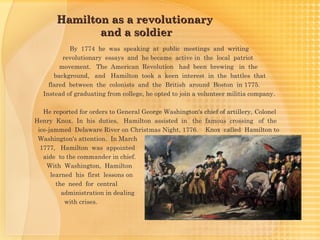
Henry Knox. In his duties, Hamilton assisted in the famous crossing of the
 ice-jammed Delaware River on Christmas Night, 1776. Knox called Hamilton to
 Washington's attention. In March
  1777, Hamilton was appointed
   aide to the commander in chief.
    With Washington, Hamilton
      learned his first lessons on
        the need for central
          administration in dealing
           with crises.
Hamilton as a revolutionary and a soldier
      Hamilton's ability was apparent, and he became one of Washington's most
trusted advisers. Although he played no role in major military decisions,
Hamilton's position was one of great responsibility. He drafted many of
Washington's letters to high-ranking Army officers, the Continental Congress,
and the states. He also was sent on important military missions and drafted
major reports on the reorganization and reform of the Army. Despite the
demands of his position, he found time for reading and reflection and expressed
his ideas on economic policy and governmental debility  in newspaper articles
and in letters to influential public figures.
       In February 1781, in a display of pique at a minor reprimand by Gen.
Washington, Hamilton resigned his position. In July 1781 Hamilton's persistent
search for active military service was rewarded when Washington gave him
command of a battalion of light infantry in the Marquis de Lafayette's corps.
After the Battle of Yorktown, Hamilton returned to New York. In 1782, following
a hasty  apprenticeship, he was admitted to the bar.
        During the Revolution, Hamilton's ideas on government, society, and
economic matured. These were conditioned by his foreign birth, which obviated a
strong attachment to a particular state or locality, and by his presence at
Washington's headquarters, where he could see the war as a whole. Like the
general himself, Hamilton was deeply disturbed that the conduct of the war was
impeded by the weakness of Congress and by state and local jealousies. It was
this experience rather than any theoretical commitment to a particular form of
government that structured Hamilton's later advocacy of a strong central
government.
The beginning of a political career
            In 1780 he married Elizabeth Schuyler, daughter of the
           major general and Hudson Valley landlord Philip Schuyler.
         He was already close to the Livingston family, and the marriage
        cemented his social position and his political, elitist point of view.
      From the end of the Revolution to the inauguration of the first
    government under the Constitution, Hamilton tirelessly opposed what he
   described as the "dangerous prejudices in the particular states opposed to
 those measures which alone can give stability and prosperity to the Union."
Though his extensive law practice won him recognition as one of New York's most
distinguished attorneys, public affairs were his major concern.
    Attending the Continental Congress as a New York delegate from November 1782

through July 1783, he unsuccessfully labored, along with James Madison and other
 nationalists, to invest the Confederation with powers equal to the needs of
  postrevolutionary America. Convinced that the  pervasive  commitment to states'
   rights obviated reform of the Articles of Confederation, Hamilton began to advocate
    a stronger and more efficient central government. As one of the 12 delegates to the
     Annapolis Convention of 1786, he drafted its resolution calling for a
       Constitutional Convention "to devise such further provisions as shall appear …
         necessary to render the Constitution of the Federal Government adequate to
          the exigencies of the Union. … " Similarly, as a member of the New York
           Legislature in 1787, he was the eloquent spokesman for continental
           interests as opposed to state and local ones.
Ratification of Constitution
                  Hamilton was one of the New York delegates to the
            Constitutional Convention, which sat in Philadelphia from May to
          September 1787. Although he served on several important committees,
        his performance was disappointing, particularly when measured against his
      previous (and subsequent) accomplishments.
     His most important speech called for a
   government close to the English model, one so
  high-toned that it was unacceptable to most of
 the delegates.
     Hamilton's contribution to the ratification of
the Constitution was far more important.
     In October 1787 he determined to write a
  series of essays on behalf of the proposed
    Constitution. At the New York ratifying
      convention in 1788, Hamilton led in
        defending the proposed Constitution,
          which, owing measurably to Hamilton's
             labors, New York ratified.
Hamilton as federalist
                                       By 1780 Hamilton had outlined a plan of government with a
                                  strong central authority to replace the weak system of the Articles
                                  of  Confederation, and as delegate (1782-83) to the Continental
                                  Congress he pressed continually for strengthening of the national

                                 government. It was Hamilton who proposed at the successful 
                                 Annapolis convention (1786) that a constitutional convention be
                                 called at Philadelphia in May, 1787, and he was one of New York's
                                 three delegates when it was convened.
                                        Although he believed the Constitution to be deficient in the
                                 powers that it gave the national government, he did much to get it
                                 ratified, particularly by means of his contributions to The Federalist.
     In New York, Hamilton was a powerful constitutional supporter, fighting vigorously against the
opposition of George  Clinton and becoming perhaps the strongest advocate of the new instrument of
government aside from James Madison.
       First published in New York City newspapers under the pseudonym "Publius" and collectively
designated  The Federalist, these essays were designed to persuade the people of New York to ratify the

    Constitution. Though  The Federalist was written in collaboration with John Jay and James Madison,

    Hamilton wrote 51 of the 85 essays. First published in book form in 1788, the Federalist essays have

     been republished in many editions and languages. They constitute one of America's most original
       and important contributions to political philosophy and remain today the authoritative
        contemporary exposition of the meaning of the cryptic clauses of the U.S. Constitution.
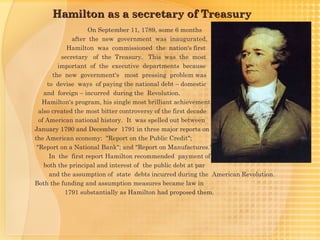
Hamilton as a secretary of Treasury
                    On September 11, 1789, some 6 months
              after the new government was inaugurated,
            Hamilton was commissioned the nation's first
          secretary of the Treasury. This was the most
         important of the executive departments because
       the new government's most pressing problem was
     to devise ways of paying the national debt – domestic
    and foreign – incurred during the Revolution.
   Hamilton's program, his single most brilliant achievement,
  also created the most bitter controversy of the first decade
  of American national history. It was spelled out between
January 1790 and December 1791 in three major reports on
the American economy: "Report on the Public Credit";
 "Report on a National Bank"; and "Report on Manufactures."
      In the first report Hamilton recommended payment of
    both the principal and interest of the public debt at par
      and the assumption of state debts incurred during the American Revolution.
Both the funding and assumption measures became law in
           1791 substantially as Hamilton had proposed them.
Hamilton as a secretary of Treasury
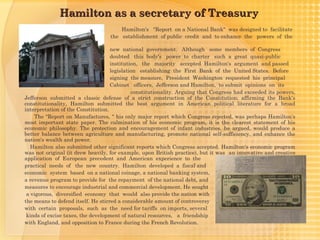
                                      Hamilton's "Report on a National Bank" was designed to facilitate
                                  the establishment of public credit and to enhance the powers of the

                                    new national government. Although some members of Congress
                                    doubted this body's power to charter such a great quasi-public
                                    institution, the majority accepted Hamilton's argument and passed
                                    legislation establishing the First Bank of the United States. Before
                                    signing the measure, President Washington requested his principal
                                    Cabinet officers, Jefferson and Hamilton, to submit opinions on its
                                             constitutionality. Arguing that Congress had exceeded its powers,
Jefferson submitted a classic defense of a strict construction of the Constitution; affirming the Bank's
constitutionality, Hamilton submitted the best argument in American political literature for a broad
interpretation of the Constitution.
    The "Report on Manufactures, " his only major report which Congress rejected, was perhaps Hamilton's
most important state paper. The culmination of his economic program, it is the clearest statement of his
economic philosophy. The protection and encouragement of infant industries, he argued, would produce a
better balance between agriculture and manufacturing, promote national self-sufficiency, and enhance the
nation's wealth and power.
   Hamilton also submitted other significant reports which Congress accepted. Hamilton's economic program
was not original (it drew heavily, for example, upon British practice), but it was an innovative and creative
application of European precedent and American experience to the
practical needs of the new country. Hamilton developed a fiscal and
economic system based on a national coinage, a national banking system,
a revenue program to provide for the repayment of the national debt, and
measures to encourage industrial and commercial development. He sought
 a vigorous, diversified economy that would also provide the nation with
the means to defend itself. He stirred a considerable amount of controversy
with certain proposals, such as the need for tariffs on imports, several
 kinds of excise taxes, the development of natural resources, a friendship
with England, and opposition to France during the French Revolution.
First Political party

           Hamilton's importance during this period was not confined
          to his work as finance minister. As the virtual "prime minister" of
        Washington's administration, he was consulted on a wide range of
      problems, foreign and domestic. He deserves to be ranked, moreover, as
     the leader of the country's first political party, the Federalist party. Hamilton
   himself, like most of his contemporaries, railed against parties and "factions", but
  when the debate over his fiscal policies revealed a deep political division among the
 members of Congress, Hamilton boldly assumed leadership of the proadministration
group, the Federalists, just as Jefferson provided leadership for the Democratic
Republicans.
   Because of Hamilton's decisive stance on some issues, a split occurred between, and
 even within, political parties. Hamilton and John Adams spoke the ideas of the
  Federalists. Madison joined Jefferson in the Democratic-Republican party. Even

  though Hamilton had previously worked alongside Secretary of State Jefferson, the

   two were now, as Washington noted, "daily pitted in the cabinet like two cocks."
     Hamilton stressed the need for a strong central government, while Jefferson
      emphasized individuals' rights. Their rivalry, among the most famous political
       clashes in U.S. history, led to a significant and ongoing level of frustration for
        both sides. Because of the deadlock, Hamilton retired from his secretarial
          position in 1795.
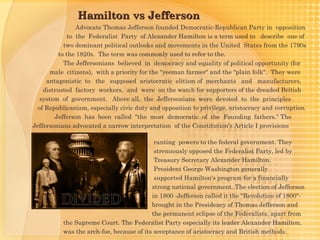
Hamilton vs Jefferson
                Advocate Thomas Jefferson founded Democratic-Republican Party in opposition
             to the  Federalist Party of Alexander Hamilton is a term used to describe one of
           two dominant political outlooks and movements in the United States from the 1790s
         to the 1820s. The term was commonly used to refer to the.
           The Jeffersonians believed in democracy and equality of political opportunity (for
       male citizens), with a priority for the "yeoman farmer" and the "plain folk". They were
     antagonistic to the supposed aristocratic elitism of merchants and manufacturers,
    distrusted factory workers, and were on the watch for supporters of the dreaded British
   system of government. Above all, the Jeffersonians were devoted to the principles
  of Republicanism, especially civic duty and opposition to privilege, aristocracy and corruption.
        Jefferson has been called "the most democratic of the Founding fathers." The
Jeffersonians advocated a narrow interpretation of the Constitution's Article I provisions

                                           ranting powers to the federal government. They
                                           strenuously opposed the Federalist Party, led by
                                           Treasury Secretary Alexander Hamilton.
                                           President George Washington generally
                                           supported Hamilton's program for a financially
                                          strong national government. The election of Jefferson
                                          in 1800 -Jefferson called it the "Revolution of 1800"-
                                          brought in the Presidency of Thomas Jefferson and
                                          the permanent eclipse of the Federalists, apart from
          the Supreme Court. The Federalist Party especially its leader Alexander Hamilton,
          was the arch-foe, because of its acceptance of aristocracy and British methods.
After retirement
                After retirement in 1795, Hamilton went back to practicing law.
Thanks to his service in government and his connections with the Schuyler family,
Hamilton
          became a prominent and prosperous lawyer. His practice extended to
        wealthy clients in New York and in other states, both individuals and
      partnerships. It resembled the practices of modern corporate lawyers, since he
    also represented banks and companies.
         During the presidency of John Adams, however, Hamilton continued to  wield
  considerable national influence, for members of Adams's Cabinet often sought and
  followed his advice. In 1798 they cooperated with George Washington to secure
 Hamilton's appointment - over Adams's strong opposition - as inspector general and
  second in command of the newly augmented U.S. Army, which was preparing for a

  possible war against France. Since Washington declined active command, organizing
   and recruiting the "Provisional Army” fell to Hamilton. His military career abruptly
    came to an end in 1800 after John Adams, in the face of the opposition of his Cabinet
     and other Federalist leaders (Hamilton among them), sent a peace mission to France

       that negotiated a settlement of the major issues.
Tragic final of his career
              Hamilton's role in the presidential campaign of 1800 not
          only was a disservice to his otherwise distinguished career, but
        also seriously wounded the Federalist party. Convinced of John
       Adam's  ineptitude, Hamilton rashly published a long Philippic which
     characterized the President as a man possessed by "vanity without bounds,
   and a jealousy capable of discoloring every object, " with a "disgusting egotism"
  and an "ungovernable discretion of … temper." Instead of discrediting Adams,
 the pamphlet promoted election of the Republican candidates, Jefferson and Aaron
Burr. When the Jefferson-Burr tie went for decision to the House of Representatives,
however, Hamilton regained his balance. Convinced that Jefferson would
not undermine executive authority, Hamilton also believed that Burr was "the
most unfit and dangerous man of the community." He accordingly used his considerable
                                      influence to persuade congressional leaders to select
                                      Jefferson. Burr challenged Hamilton to a duel.
                                      Although Hamilton was reluctant, he believed that
                                      his "ability to be in future useful" demanded his
                                       acceptance. After putting his personal affairs in
                                       order, he met Burr at dawn on July 11, 1804, on the
                                       New Jersey side of the Hudson River. The two
                                       exchanged shots, and Hamilton fell, mortally
                                       wounded. Tradition has it that he deliberately
                                       misdirected his fire, leaving himself an open
                                       target for Burr's bullet. Hamilton was carried
                         back to New York City, where he died the next afternoon.
Glory after death
              As the United States evolved in political,
           legal, and economic dimensions, Hamilton's
        contributions remained part of its basic structure. His legacy went on to
      affect the way the rest of the world interpreted the proper role of government.
     Numerous political experiments took place in the following centuries, but still,
   Hamilton's notions of a strong central government made other systems appear
  weak in comparison. In a letter to the  Washington Post on January 28, 1991,
 biographer Robert A. Hendrickson asserted that Hamilton's doctrine lives up to its
model status as "a beacon of freedom and financial success in the modern world. It has
peacefully discredited agrarianism, communism, and totalitarianism.”
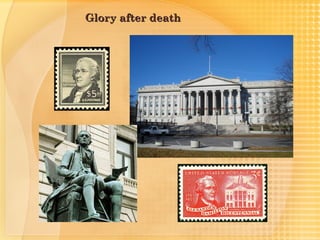
    By the time of the American Civil War, Hamilton's portrait began to appear on US
  currency, including the $2, $5, $10, and $50 notes. His likeness also began to appear on

   US Postage in 1870. His portrait has continued to appear on US postage and currency,

       and most notably appears on the modern $10 bill. Hamilton also appears on the
$500
        Series EE Savings Bond. The source of the face on the $10 bill is John Trumbull's
         1805 portrait of Hamilton, in the portrait collection of New York City Hall. On
            the south side of the Treasury Building in Washington, D.C. is a statue
              of Hamilton.
Glory after death
LINKS AND SOURCES


1. Who2 Profiles. Copyright © 1998-2011 by Who2, LLC. All rights reserved. See the Alexander Hamilton biography from
   Who2.

2. Britannica Concise Encyclopedia. Britannica Concise Encyclopedia. © 1994-2011 Encyclopædia Britannica, Inc. All
   rights reserved.
3. Oxford Companion to US Military History. The Oxford Companion to American Military History. Copyright © 2000
   by Oxford University Press, Inc. All rights reserved.

4. Gale Encyclopedia of Biography. Gale Encyclopedia of Biography. © 2006 by The Gale Group, Inc. All rights reserved
5. Oxford Dictionary of Politics. The Concise Oxford Dictionary of Politics. Copyright © 1996, 2003 by Oxford University
   Press. All rights reserved.

6. Columbia Encyclopedia. The Columbia Electronic Encyclopedia, Sixth Edition Copyright © 2011, Columbia University
   Press. Licensed from Columbia University Press. All rights reserved.

7. Dictionary of Cultural Literacy: History. The New Dictionary of Cultural Literacy, Third Edition Edited by E.D. Hirsch,
    Jr., Joseph F. Kett, and James Trefil. Copyright © 2002 by Houghton Mifflin Company. Published by Houghton Mifflin. All
    rights reserved
8. West's Encyclopedia of American Law. West's Encyclopedia of American Law. Copyright © 1998 by The Gale Group,
    Inc. All rights reserved.
9. www.wikipedia.com
10. www.answers.com

Alexander hamilton

  • 1.
    Faculty of foreignlanguages and area studies Author: Andrey Kuznetsov second year student of 1st English group
  • 2.
    Alexander Hamilton -a revolutionary, politician, and statesman Hamilton, Alexander (1755-1804), as a lawyer, politician, and statesman, left an enduring impression on U.S. government. Hamilton, who fought in the American Revolution as an aide-de-camp to George Washington, was a driving figure in the Federalist movement and the first secretary of the treasury. In his public and private life he combined nationalist commitment, elitist politics, and a vision of dynamic capitalist development. His interpretation of freedom put him at odds with other Founders, especially Thomas Jefferson's Democrats. His birth was humble, his death was tragic. His professional life was spent forming basic political and economic institutions for a stronger nation.
  • 3.
    From naissance toschool. Hamilton was born on January 11, 1755, on Nevis Island, in the West Indies. His parents never married. His father, the son of a minor Scottish noble, drifted to the West Indies early in his life and worked odd jobs throughout the Caribbean. His mother died in the Indies when he was eleven. Hamilton spent his early years in poverty, traveling to different islands with his father. At the age of fourteen, while visiting the island of St.Croix, he met a New York trader who recognized his natural intelligence and feisty spirit. The trader made it possible for Hamilton to go to New York in pursuit of an education. Hamilton attended a preparatory school in New Jersey and developed contacts with men who had created a movement seeking colonial independence. When he later entered King's College (now Columbia University), he became active in the local patriot movement.
  • 4.
    Hamilton as arevolutionary and a soldier By 1774 he was speaking at public meetings and writing revolutionary essays and he became active in the local patriot movement. The American Revolution had been brewing in the background, and Hamilton took a keen interest in the battles that flared between the colonists and the British around Boston in 1775. Instead of graduating from college, he opted to join a volunteer militia company. He reported for orders to General George Washington's chief of artillery, Colonel Henry Knox. In his duties, Hamilton assisted in the famous crossing of the ice-jammed Delaware River on Christmas Night, 1776. Knox called Hamilton to Washington's attention. In March 1777, Hamilton was appointed aide to the commander in chief. With Washington, Hamilton learned his first lessons on the need for central administration in dealing with crises.
  • 5.
    Hamilton as arevolutionary and a soldier Hamilton's ability was apparent, and he became one of Washington's most trusted advisers. Although he played no role in major military decisions, Hamilton's position was one of great responsibility. He drafted many of Washington's letters to high-ranking Army officers, the Continental Congress, and the states. He also was sent on important military missions and drafted major reports on the reorganization and reform of the Army. Despite the demands of his position, he found time for reading and reflection and expressed his ideas on economic policy and governmental debility  in newspaper articles and in letters to influential public figures. In February 1781, in a display of pique at a minor reprimand by Gen. Washington, Hamilton resigned his position. In July 1781 Hamilton's persistent search for active military service was rewarded when Washington gave him command of a battalion of light infantry in the Marquis de Lafayette's corps. After the Battle of Yorktown, Hamilton returned to New York. In 1782, following a hasty  apprenticeship, he was admitted to the bar. During the Revolution, Hamilton's ideas on government, society, and economic matured. These were conditioned by his foreign birth, which obviated a strong attachment to a particular state or locality, and by his presence at Washington's headquarters, where he could see the war as a whole. Like the general himself, Hamilton was deeply disturbed that the conduct of the war was impeded by the weakness of Congress and by state and local jealousies. It was this experience rather than any theoretical commitment to a particular form of government that structured Hamilton's later advocacy of a strong central government.
  • 6.
    The beginning ofa political career In 1780 he married Elizabeth Schuyler, daughter of the major general and Hudson Valley landlord Philip Schuyler. He was already close to the Livingston family, and the marriage cemented his social position and his political, elitist point of view. From the end of the Revolution to the inauguration of the first government under the Constitution, Hamilton tirelessly opposed what he described as the "dangerous prejudices in the particular states opposed to those measures which alone can give stability and prosperity to the Union." Though his extensive law practice won him recognition as one of New York's most distinguished attorneys, public affairs were his major concern. Attending the Continental Congress as a New York delegate from November 1782 through July 1783, he unsuccessfully labored, along with James Madison and other nationalists, to invest the Confederation with powers equal to the needs of postrevolutionary America. Convinced that the  pervasive  commitment to states' rights obviated reform of the Articles of Confederation, Hamilton began to advocate a stronger and more efficient central government. As one of the 12 delegates to the Annapolis Convention of 1786, he drafted its resolution calling for a Constitutional Convention "to devise such further provisions as shall appear … necessary to render the Constitution of the Federal Government adequate to the exigencies of the Union. … " Similarly, as a member of the New York Legislature in 1787, he was the eloquent spokesman for continental interests as opposed to state and local ones.
  • 7.
    Ratification of Constitution Hamilton was one of the New York delegates to the Constitutional Convention, which sat in Philadelphia from May to September 1787. Although he served on several important committees, his performance was disappointing, particularly when measured against his previous (and subsequent) accomplishments. His most important speech called for a government close to the English model, one so high-toned that it was unacceptable to most of the delegates. Hamilton's contribution to the ratification of the Constitution was far more important. In October 1787 he determined to write a series of essays on behalf of the proposed Constitution. At the New York ratifying convention in 1788, Hamilton led in defending the proposed Constitution, which, owing measurably to Hamilton's labors, New York ratified.
  • 8.
    Hamilton as federalist By 1780 Hamilton had outlined a plan of government with a strong central authority to replace the weak system of the Articles of  Confederation, and as delegate (1782-83) to the Continental Congress he pressed continually for strengthening of the national government. It was Hamilton who proposed at the successful  Annapolis convention (1786) that a constitutional convention be called at Philadelphia in May, 1787, and he was one of New York's three delegates when it was convened. Although he believed the Constitution to be deficient in the powers that it gave the national government, he did much to get it ratified, particularly by means of his contributions to The Federalist. In New York, Hamilton was a powerful constitutional supporter, fighting vigorously against the opposition of George  Clinton and becoming perhaps the strongest advocate of the new instrument of government aside from James Madison. First published in New York City newspapers under the pseudonym "Publius" and collectively designated  The Federalist, these essays were designed to persuade the people of New York to ratify the Constitution. Though  The Federalist was written in collaboration with John Jay and James Madison, Hamilton wrote 51 of the 85 essays. First published in book form in 1788, the Federalist essays have been republished in many editions and languages. They constitute one of America's most original and important contributions to political philosophy and remain today the authoritative   contemporary exposition of the meaning of the cryptic clauses of the U.S. Constitution.
  • 9.
    Hamilton as asecretary of Treasury On September 11, 1789, some 6 months after the new government was inaugurated, Hamilton was commissioned the nation's first secretary of the Treasury. This was the most important of the executive departments because the new government's most pressing problem was to devise ways of paying the national debt – domestic and foreign – incurred during the Revolution. Hamilton's program, his single most brilliant achievement, also created the most bitter controversy of the first decade of American national history. It was spelled out between January 1790 and December 1791 in three major reports on the American economy: "Report on the Public Credit"; "Report on a National Bank"; and "Report on Manufactures." In the first report Hamilton recommended payment of both the principal and interest of the public debt at par and the assumption of state debts incurred during the American Revolution. Both the funding and assumption measures became law in 1791 substantially as Hamilton had proposed them.
  • 10.
    Hamilton as asecretary of Treasury Hamilton's "Report on a National Bank" was designed to facilitate the establishment of public credit and to enhance the powers of the new national government. Although some members of Congress doubted this body's power to charter such a great quasi-public institution, the majority accepted Hamilton's argument and passed legislation establishing the First Bank of the United States. Before signing the measure, President Washington requested his principal Cabinet officers, Jefferson and Hamilton, to submit opinions on its constitutionality. Arguing that Congress had exceeded its powers, Jefferson submitted a classic defense of a strict construction of the Constitution; affirming the Bank's constitutionality, Hamilton submitted the best argument in American political literature for a broad interpretation of the Constitution. The "Report on Manufactures, " his only major report which Congress rejected, was perhaps Hamilton's most important state paper. The culmination of his economic program, it is the clearest statement of his economic philosophy. The protection and encouragement of infant industries, he argued, would produce a better balance between agriculture and manufacturing, promote national self-sufficiency, and enhance the nation's wealth and power. Hamilton also submitted other significant reports which Congress accepted. Hamilton's economic program was not original (it drew heavily, for example, upon British practice), but it was an innovative and creative application of European precedent and American experience to the practical needs of the new country. Hamilton developed a fiscal and economic system based on a national coinage, a national banking system, a revenue program to provide for the repayment of the national debt, and measures to encourage industrial and commercial development. He sought a vigorous, diversified economy that would also provide the nation with the means to defend itself. He stirred a considerable amount of controversy with certain proposals, such as the need for tariffs on imports, several kinds of excise taxes, the development of natural resources, a friendship with England, and opposition to France during the French Revolution.
  • 11.
    First Political party Hamilton's importance during this period was not confined to his work as finance minister. As the virtual "prime minister" of Washington's administration, he was consulted on a wide range of problems, foreign and domestic. He deserves to be ranked, moreover, as the leader of the country's first political party, the Federalist party. Hamilton himself, like most of his contemporaries, railed against parties and "factions", but when the debate over his fiscal policies revealed a deep political division among the members of Congress, Hamilton boldly assumed leadership of the proadministration group, the Federalists, just as Jefferson provided leadership for the Democratic Republicans. Because of Hamilton's decisive stance on some issues, a split occurred between, and even within, political parties. Hamilton and John Adams spoke the ideas of the Federalists. Madison joined Jefferson in the Democratic-Republican party. Even though Hamilton had previously worked alongside Secretary of State Jefferson, the two were now, as Washington noted, "daily pitted in the cabinet like two cocks." Hamilton stressed the need for a strong central government, while Jefferson emphasized individuals' rights. Their rivalry, among the most famous political clashes in U.S. history, led to a significant and ongoing level of frustration for both sides. Because of the deadlock, Hamilton retired from his secretarial position in 1795.
  • 12.
    Hamilton vs Jefferson Advocate Thomas Jefferson founded Democratic-Republican Party in opposition to the  Federalist Party of Alexander Hamilton is a term used to describe one of two dominant political outlooks and movements in the United States from the 1790s to the 1820s. The term was commonly used to refer to the. The Jeffersonians believed in democracy and equality of political opportunity (for male citizens), with a priority for the "yeoman farmer" and the "plain folk". They were antagonistic to the supposed aristocratic elitism of merchants and manufacturers, distrusted factory workers, and were on the watch for supporters of the dreaded British system of government. Above all, the Jeffersonians were devoted to the principles of Republicanism, especially civic duty and opposition to privilege, aristocracy and corruption. Jefferson has been called "the most democratic of the Founding fathers." The Jeffersonians advocated a narrow interpretation of the Constitution's Article I provisions ranting powers to the federal government. They strenuously opposed the Federalist Party, led by Treasury Secretary Alexander Hamilton. President George Washington generally supported Hamilton's program for a financially strong national government. The election of Jefferson in 1800 -Jefferson called it the "Revolution of 1800"- brought in the Presidency of Thomas Jefferson and the permanent eclipse of the Federalists, apart from the Supreme Court. The Federalist Party especially its leader Alexander Hamilton, was the arch-foe, because of its acceptance of aristocracy and British methods.
  • 13.
    After retirement After retirement in 1795, Hamilton went back to practicing law. Thanks to his service in government and his connections with the Schuyler family, Hamilton became a prominent and prosperous lawyer. His practice extended to wealthy clients in New York and in other states, both individuals and partnerships. It resembled the practices of modern corporate lawyers, since he also represented banks and companies. During the presidency of John Adams, however, Hamilton continued to  wield   considerable national influence, for members of Adams's Cabinet often sought and followed his advice. In 1798 they cooperated with George Washington to secure Hamilton's appointment - over Adams's strong opposition - as inspector general and second in command of the newly augmented U.S. Army, which was preparing for a possible war against France. Since Washington declined active command, organizing and recruiting the "Provisional Army” fell to Hamilton. His military career abruptly came to an end in 1800 after John Adams, in the face of the opposition of his Cabinet and other Federalist leaders (Hamilton among them), sent a peace mission to France that negotiated a settlement of the major issues.
  • 14.
    Tragic final ofhis career Hamilton's role in the presidential campaign of 1800 not only was a disservice to his otherwise distinguished career, but also seriously wounded the Federalist party. Convinced of John Adam's  ineptitude, Hamilton rashly published a long Philippic which characterized the President as a man possessed by "vanity without bounds, and a jealousy capable of discoloring every object, " with a "disgusting egotism" and an "ungovernable discretion of … temper." Instead of discrediting Adams, the pamphlet promoted election of the Republican candidates, Jefferson and Aaron Burr. When the Jefferson-Burr tie went for decision to the House of Representatives, however, Hamilton regained his balance. Convinced that Jefferson would not undermine executive authority, Hamilton also believed that Burr was "the most unfit and dangerous man of the community." He accordingly used his considerable influence to persuade congressional leaders to select Jefferson. Burr challenged Hamilton to a duel. Although Hamilton was reluctant, he believed that his "ability to be in future useful" demanded his acceptance. After putting his personal affairs in order, he met Burr at dawn on July 11, 1804, on the New Jersey side of the Hudson River. The two exchanged shots, and Hamilton fell, mortally wounded. Tradition has it that he deliberately misdirected his fire, leaving himself an open target for Burr's bullet. Hamilton was carried back to New York City, where he died the next afternoon.
  • 15.
    Glory after death As the United States evolved in political, legal, and economic dimensions, Hamilton's contributions remained part of its basic structure. His legacy went on to affect the way the rest of the world interpreted the proper role of government. Numerous political experiments took place in the following centuries, but still, Hamilton's notions of a strong central government made other systems appear weak in comparison. In a letter to the  Washington Post on January 28, 1991, biographer Robert A. Hendrickson asserted that Hamilton's doctrine lives up to its model status as "a beacon of freedom and financial success in the modern world. It has peacefully discredited agrarianism, communism, and totalitarianism.” By the time of the American Civil War, Hamilton's portrait began to appear on US currency, including the $2, $5, $10, and $50 notes. His likeness also began to appear on US Postage in 1870. His portrait has continued to appear on US postage and currency, and most notably appears on the modern $10 bill. Hamilton also appears on the $500 Series EE Savings Bond. The source of the face on the $10 bill is John Trumbull's 1805 portrait of Hamilton, in the portrait collection of New York City Hall. On the south side of the Treasury Building in Washington, D.C. is a statue of Hamilton.
  • 16.
  • 17.
    LINKS AND SOURCES 1.Who2 Profiles. Copyright © 1998-2011 by Who2, LLC. All rights reserved. See the Alexander Hamilton biography from Who2. 2. Britannica Concise Encyclopedia. Britannica Concise Encyclopedia. © 1994-2011 Encyclopædia Britannica, Inc. All rights reserved. 3. Oxford Companion to US Military History. The Oxford Companion to American Military History. Copyright © 2000 by Oxford University Press, Inc. All rights reserved. 4. Gale Encyclopedia of Biography. Gale Encyclopedia of Biography. © 2006 by The Gale Group, Inc. All rights reserved 5. Oxford Dictionary of Politics. The Concise Oxford Dictionary of Politics. Copyright © 1996, 2003 by Oxford University Press. All rights reserved. 6. Columbia Encyclopedia. The Columbia Electronic Encyclopedia, Sixth Edition Copyright © 2011, Columbia University Press. Licensed from Columbia University Press. All rights reserved. 7. Dictionary of Cultural Literacy: History. The New Dictionary of Cultural Literacy, Third Edition Edited by E.D. Hirsch, Jr., Joseph F. Kett, and James Trefil. Copyright © 2002 by Houghton Mifflin Company. Published by Houghton Mifflin. All rights reserved 8. West's Encyclopedia of American Law. West's Encyclopedia of American Law. Copyright © 1998 by The Gale Group, Inc. All rights reserved. 9. www.wikipedia.com 10. www.answers.com