Cross-platform
learning model of EFL
Post-graduate student of LMSU
Kuznetsov Andrey
Content
1. Definition of cross-platform learning model;
2. Basic elements of cross-platform learning model;
3. Additional elements of cross-platform learning model;
4. Didactic principles of the Langteach platform;
5. Didactic functions of the Langteach platform;
Introduction
Today, there are a huge number of software
products allow you to completely automate the
entire learning process. In order to match the
required level of development of e-learning
process, it must meet a number of
characteristics.
Most important didactic principles of online
courses
1. Functionality
2. Reliability
3. Stability
4. Cost
5. Availability of funds
6. Content development
7. SCORM
8. Control system of
knowledge evaluation
9. Ease of use
10.Modularity
11.Multimedia
12.Access
13.Scalability and extensibility
14.Prospects for the
development of the platform
15.Cross-platform at the level
of MDE
16.Quality of technical support
17.Cross-platform on the level
of online services
18.Autonomy of the elements
of the distance learning
course (AEDC)
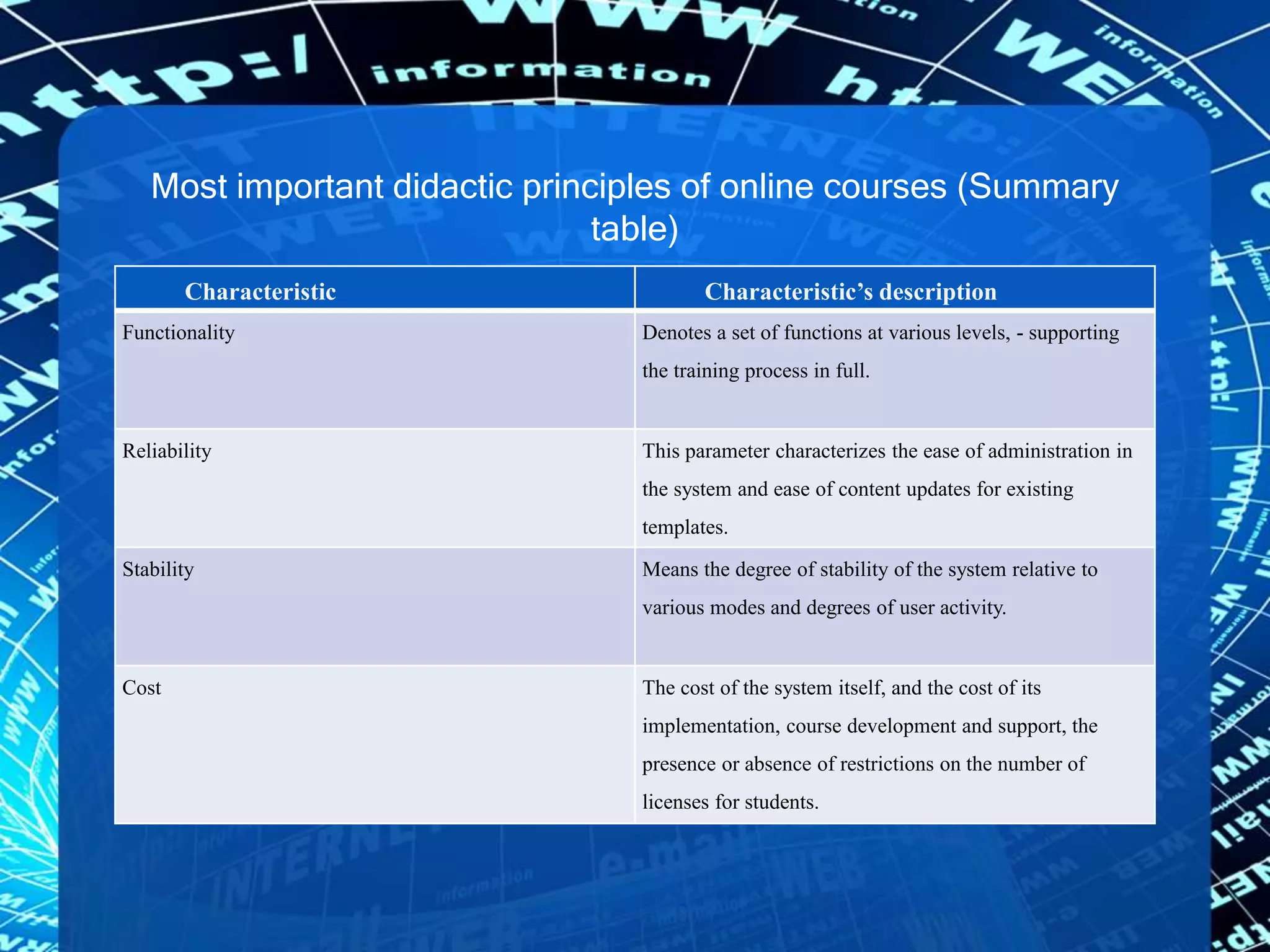
Most important didactic principles of online courses (Summary
table)
Characteristic Characteristic’s description
Functionality Denotes a set of functions at various levels, - supporting
the training process in full.
Reliability This parameter characterizes the ease of administration in
the system and ease of content updates for existing
templates.
Stability Means the degree of stability of the system relative to
various modes and degrees of user activity.
Cost The cost of the system itself, and the cost of its
implementation, course development and support, the
presence or absence of restrictions on the number of
licenses for students.
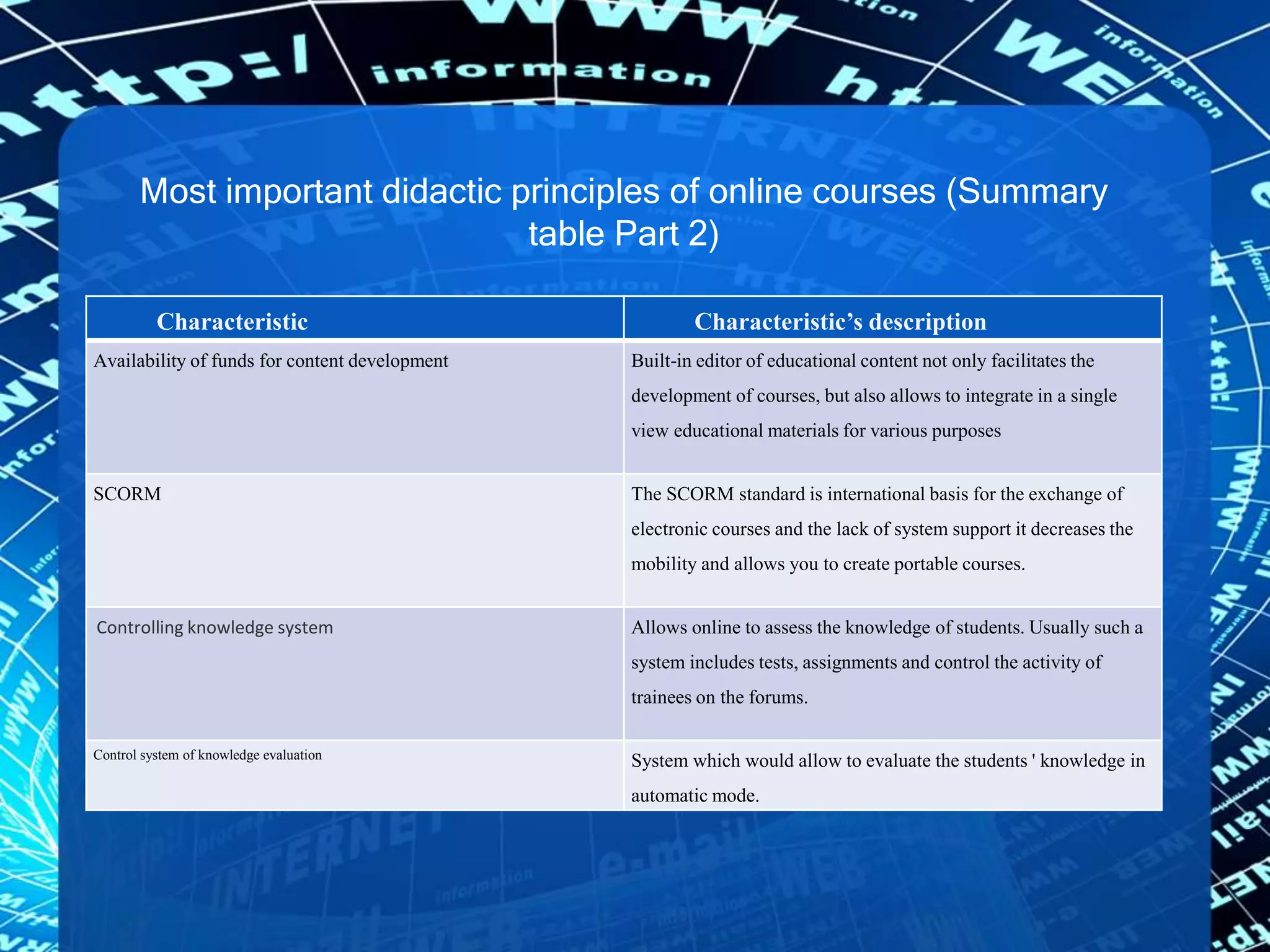
Most important didactic principles of online courses (Summary
table Part 2)
Characteristic Characteristic’s description
Availability of funds for content development Built-in editor of educational content not only facilitates the
development of courses, but also allows to integrate in a single
view educational materials for various purposes
SCORM The SCORM standard is international basis for the exchange of
electronic courses and the lack of system support it decreases the
mobility and allows you to create portable courses.
Controlling knowledge system Allows online to assess the knowledge of students. Usually such a
system includes tests, assignments and control the activity of
trainees on the forums.
Control system of knowledge evaluation
System which would allow to evaluate the students ' knowledge in
automatic mode.
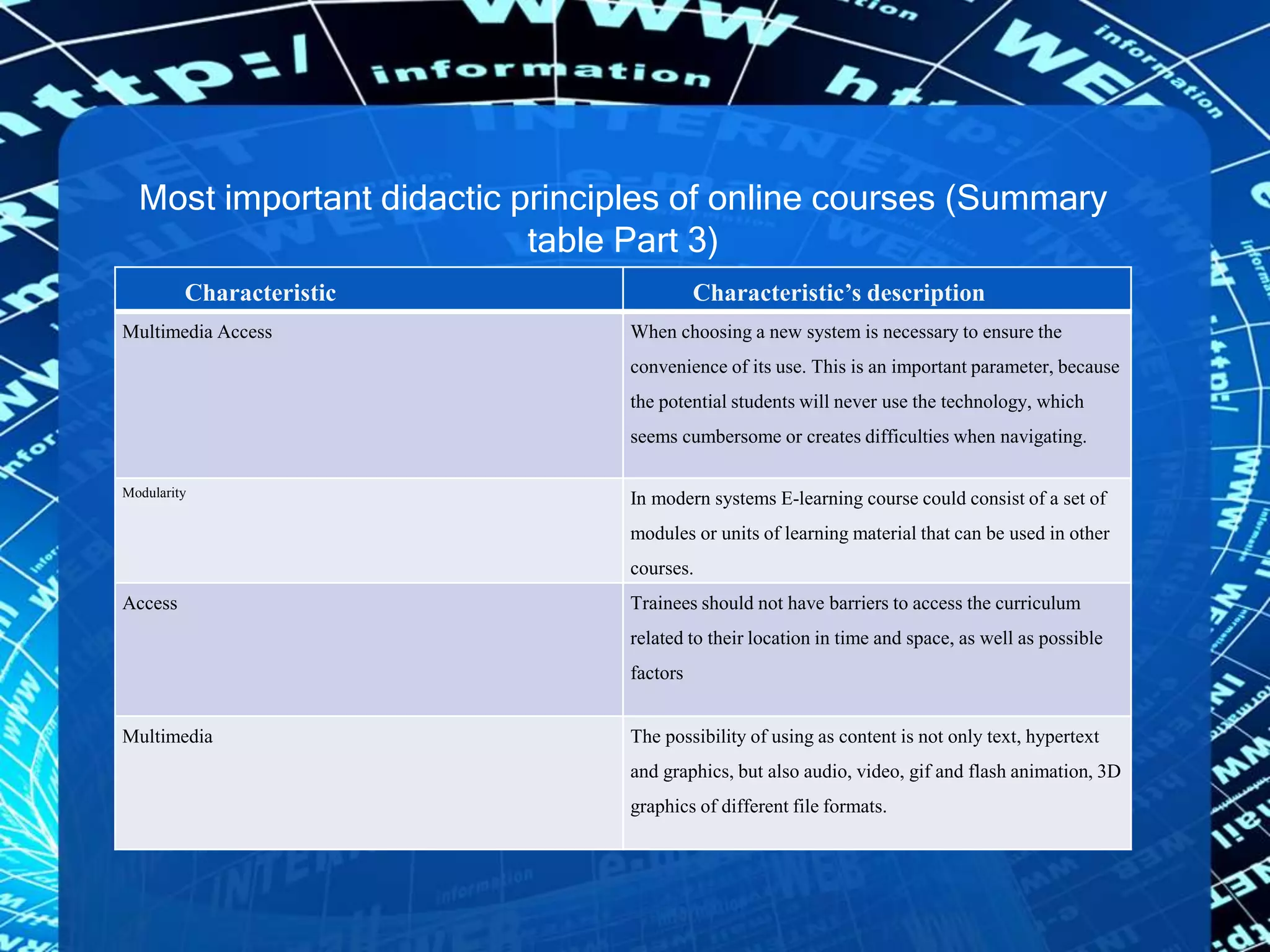
Most important didactic principles of online courses (Summary
table Part 3)
Characteristic Characteristic’s description
Multimedia Access When choosing a new system is necessary to ensure the
convenience of its use. This is an important parameter, because
the potential students will never use the technology, which
seems cumbersome or creates difficulties when navigating.
Modularity
In modern systems E-learning course could consist of a set of
modules or units of learning material that can be used in other
courses.
Access Trainees should not have barriers to access the curriculum
related to their location in time and space, as well as possible
factors
Multimedia The possibility of using as content is not only text, hypertext
and graphics, but also audio, video, gif and flash animation, 3D
graphics of different file formats.
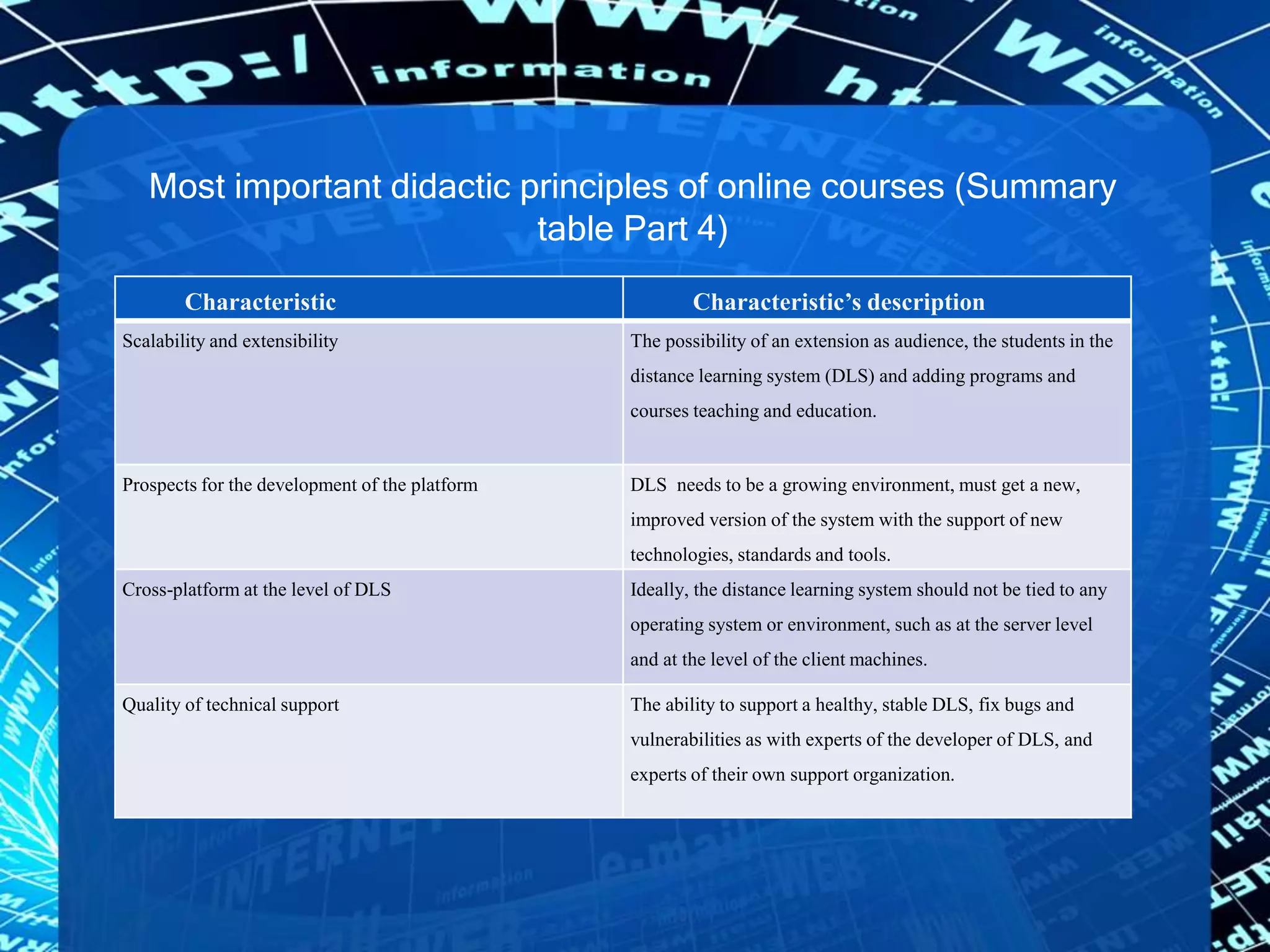
Most important didactic principles of online courses (Summary
table Part 4)
Characteristic Characteristic’s description
Scalability and extensibility The possibility of an extension as audience, the students in the
distance learning system (DLS) and adding programs and
courses teaching and education.
Prospects for the development of the platform DLS needs to be a growing environment, must get a new,
improved version of the system with the support of new
technologies, standards and tools.
Cross-platform at the level of DLS Ideally, the distance learning system should not be tied to any
operating system or environment, such as at the server level
and at the level of the client machines.
Quality of technical support The ability to support a healthy, stable DLS, fix bugs and
vulnerabilities as with experts of the developer of DLS, and
experts of their own support organization.
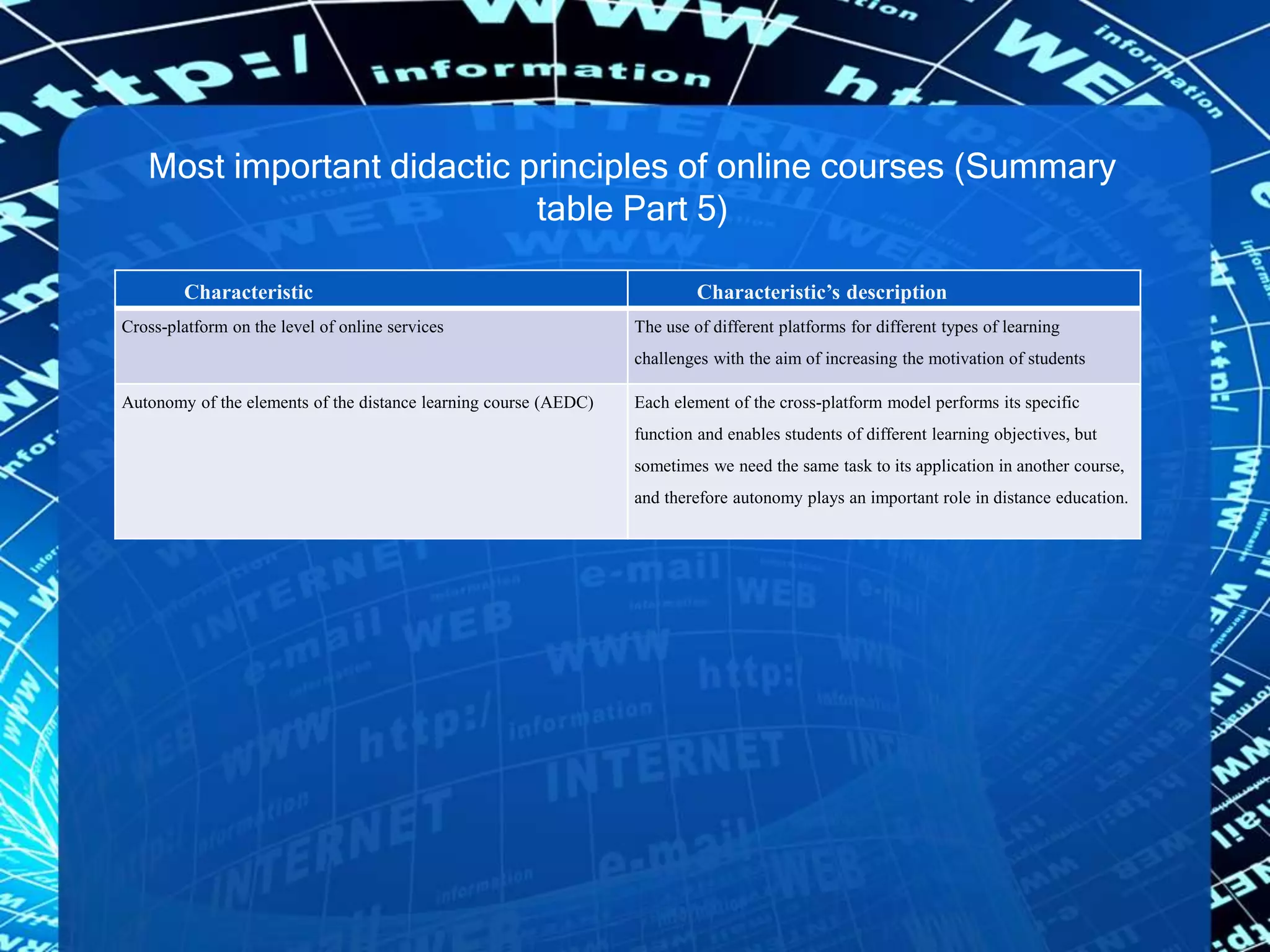
Most important didactic principles of online courses (Summary
table Part 5)
Characteristic Characteristic’s description
Cross-platform on the level of online services The use of different platforms for different types of learning
challenges with the aim of increasing the motivation of students
Autonomy of the elements of the distance learning course (AEDC) Each element of the cross-platform model performs its specific
function and enables students of different learning objectives, but
sometimes we need the same task to its application in another course,
and therefore autonomy plays an important role in distance education.
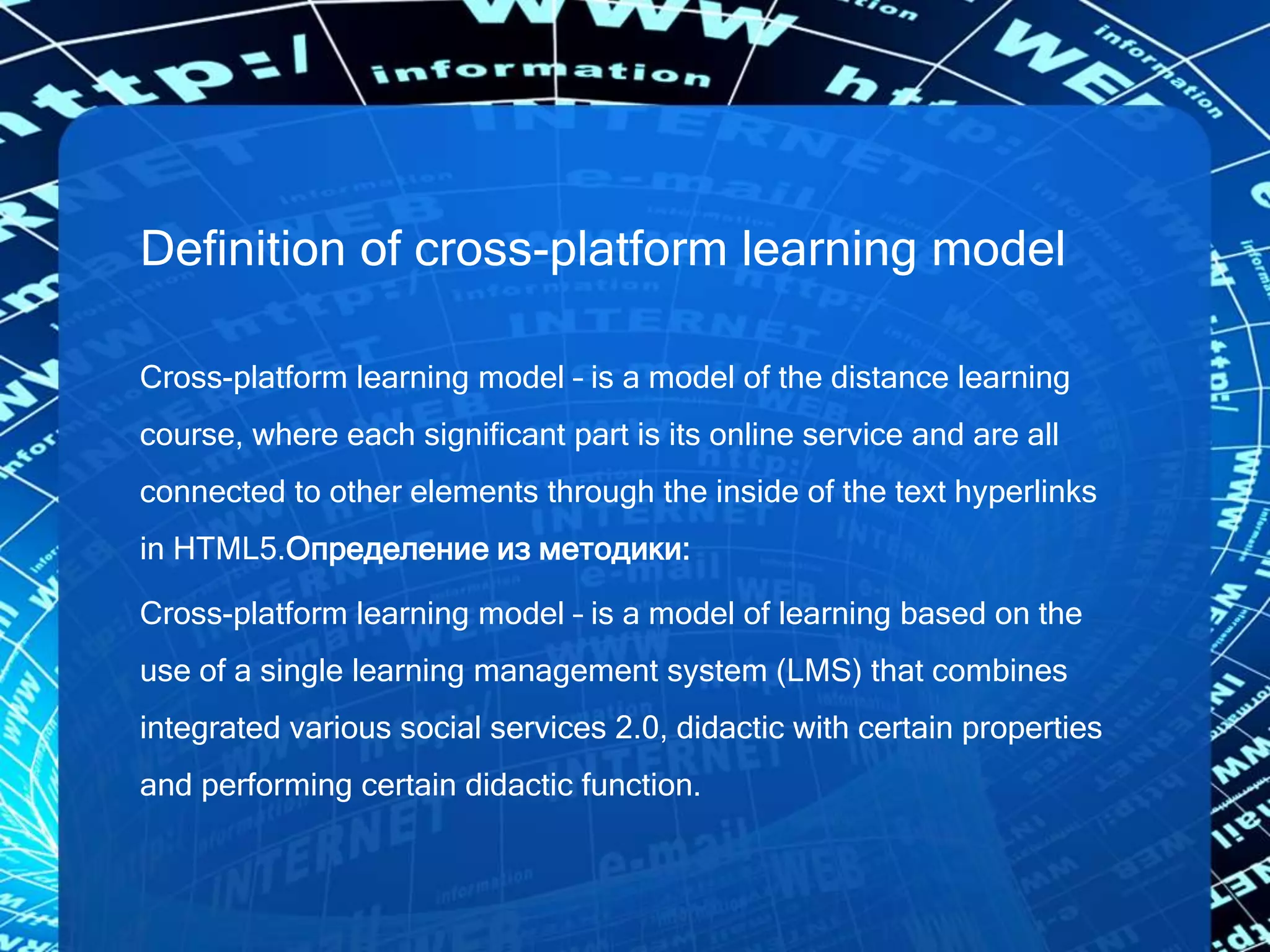
Definition of cross-platform learning model
Cross-platform learning model – is a model of the distance learning
course, where each significant part is its online service and are all
connected to other elements through the inside of the text hyperlinks
in HTML5.Определение из методики:
Cross-platform learning model – is a model of learning based on the
use of a single learning management system (LMS) that combines
integrated various social services 2.0, didactic with certain properties
and performing certain didactic function.
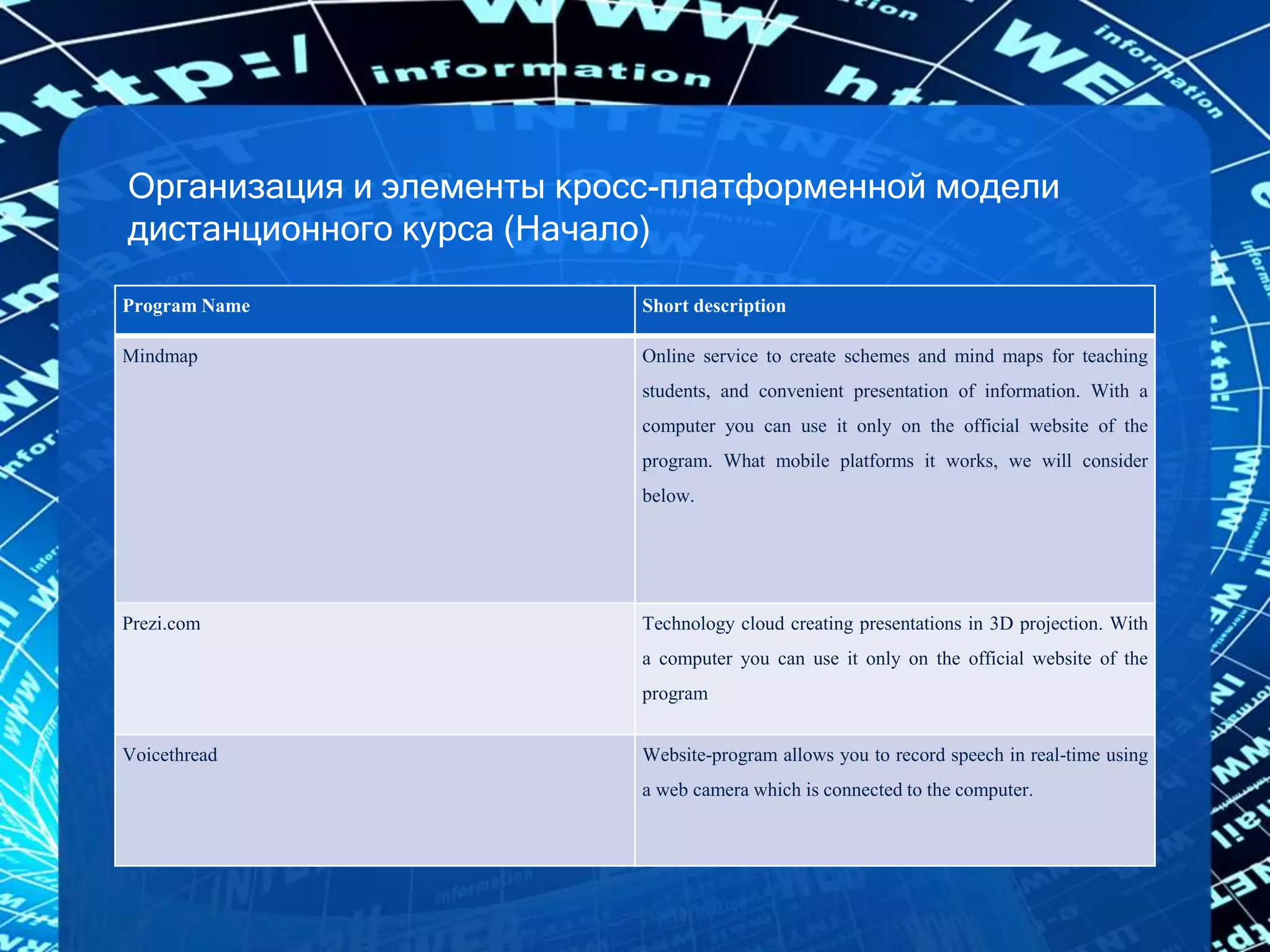
Организация и элементы кросс-платформенной модели
дистанционного курса (Начало)
Program Name Short description
Mindmap Online service to create schemes and mind maps for teaching
students, and convenient presentation of information. With a
computer you can use it only on the official website of the
program. What mobile platforms it works, we will consider
below.
Prezi.com Technology cloud creating presentations in 3D projection. With
a computer you can use it only on the official website of the
program
Voicethread Website-program allows you to record speech in real-time using
a web camera which is connected to the computer.
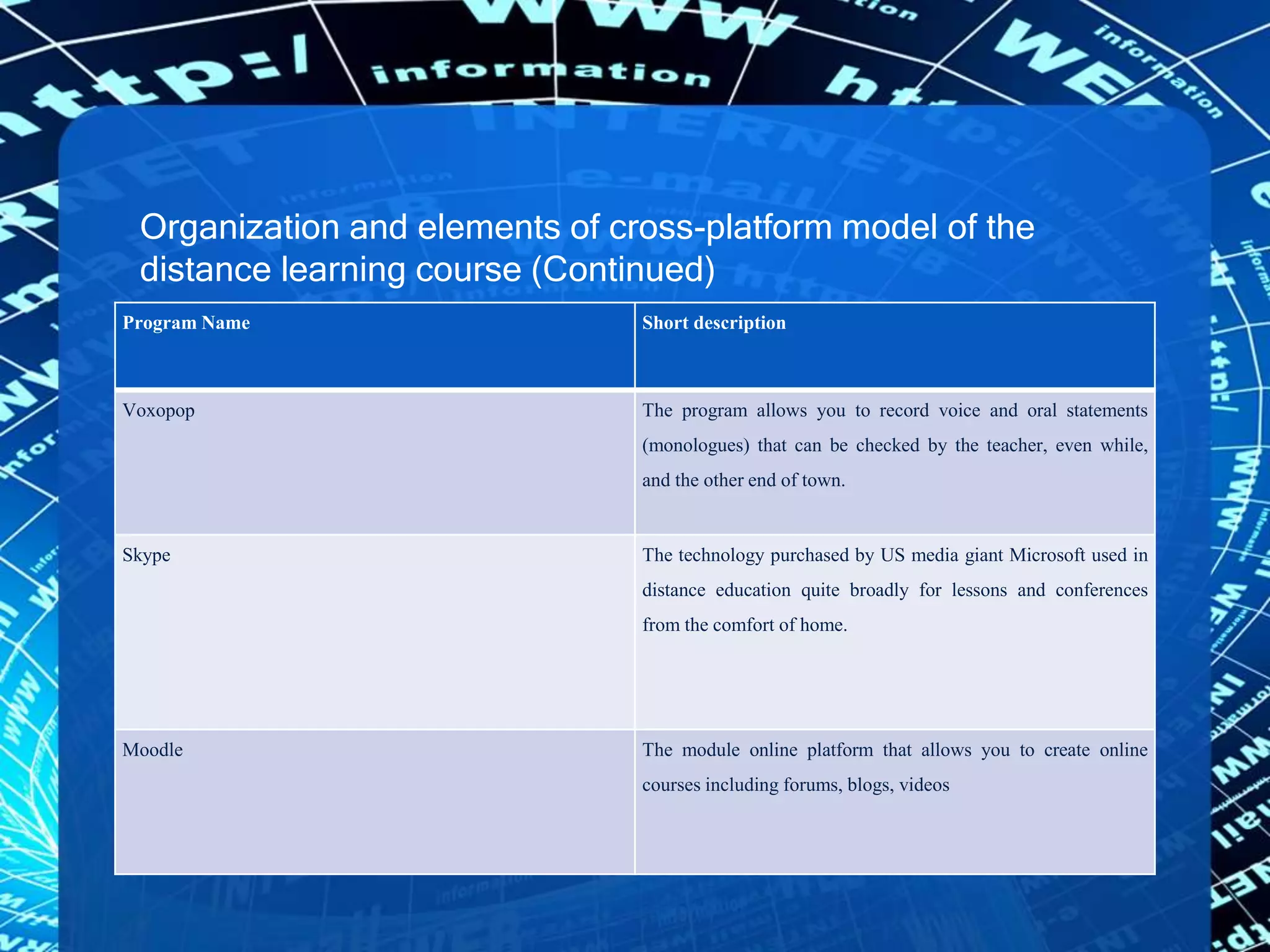
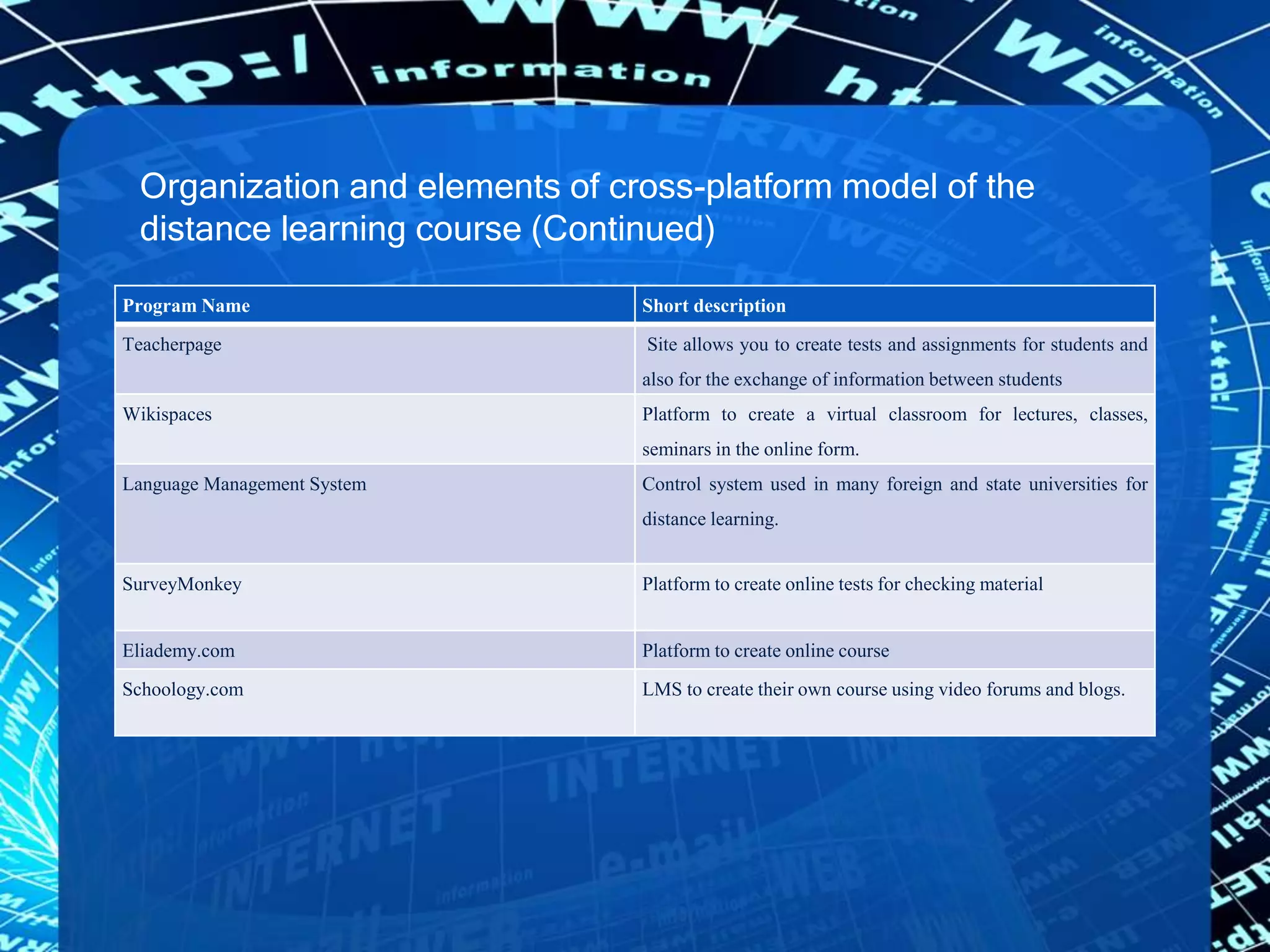
Organization and elements of cross-platform model of the
distance learning course (Continued)
Program Name Short description
Voxopop The program allows you to record voice and oral statements
(monologues) that can be checked by the teacher, even while,
and the other end of town.
Skype The technology purchased by US media giant Microsoft used in
distance education quite broadly for lessons and conferences
from the comfort of home.
Moodle The module online platform that allows you to create online
courses including forums, blogs, videos
Organization and elements of cross-platform model of the
distance learning course (Continued)
Program Name Short description
Teacherpage Site allows you to create tests and assignments for students and
also for the exchange of information between students
Wikispaces Platform to create a virtual classroom for lectures, classes,
seminars in the online form.
Language Management System Control system used in many foreign and state universities for
distance learning.
SurveyMonkey Platform to create online tests for checking material
Eliademy.com Platform to create online course
Schoology.com LMS to create their own course using video forums and blogs.
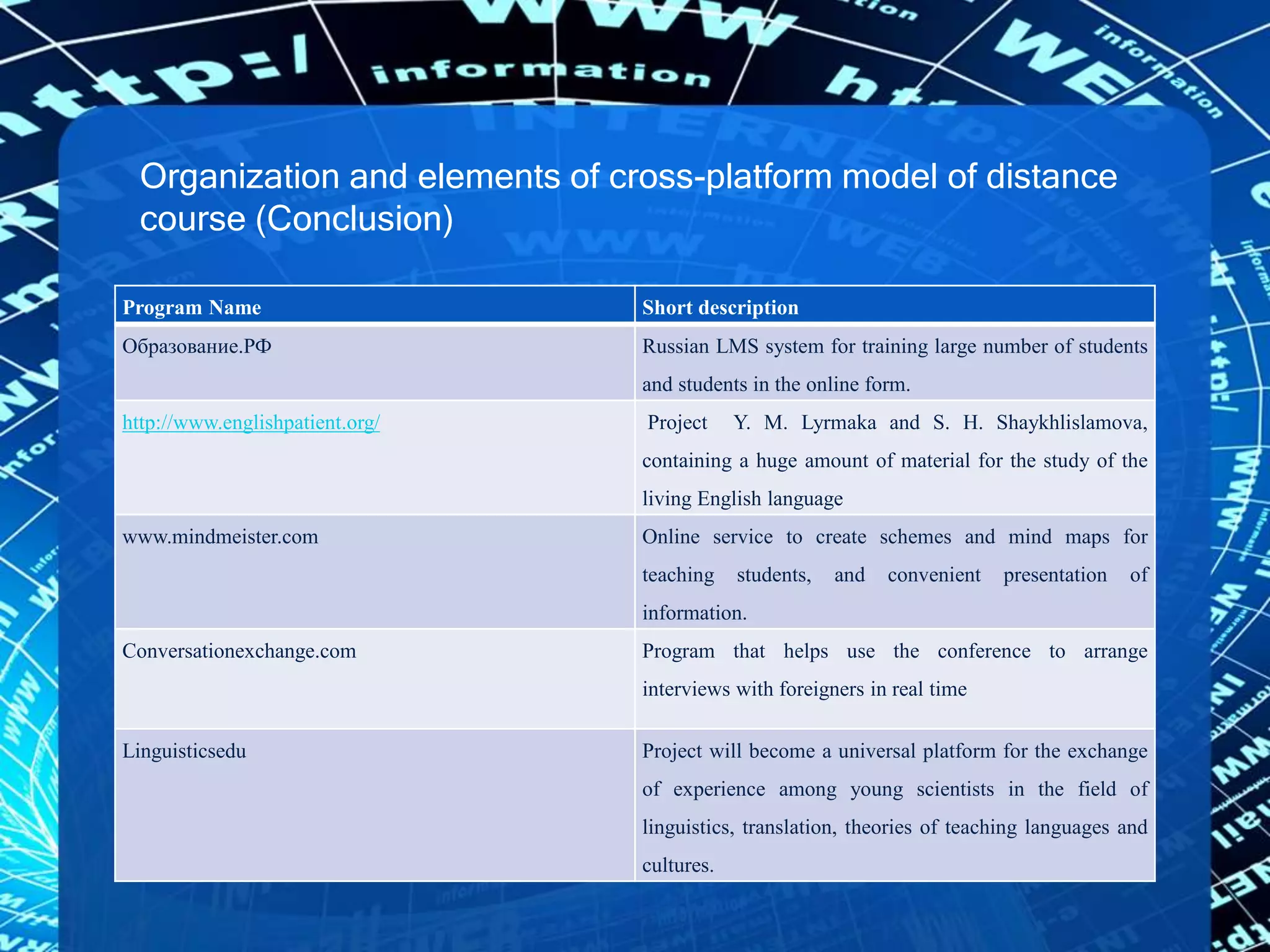
Organization and elements of cross-platform model of distance
course (Conclusion)
Program Name Short description
Образование.РФ Russian LMS system for training large number of students
and students in the online form.
http://www.englishpatient.org/ Project Y. M. Lyrmaka and S. H. Shaykhlislamova,
containing a huge amount of material for the study of the
living English language
www.mindmeister.com Online service to create schemes and mind maps for
teaching students, and convenient presentation of
information.
Conversationexchange.com Program that helps use the conference to arrange
interviews with foreigners in real time
Linguisticsedu Project will become a universal platform for the exchange
of experience among young scientists in the field of
linguistics, translation, theories of teaching languages and
cultures.
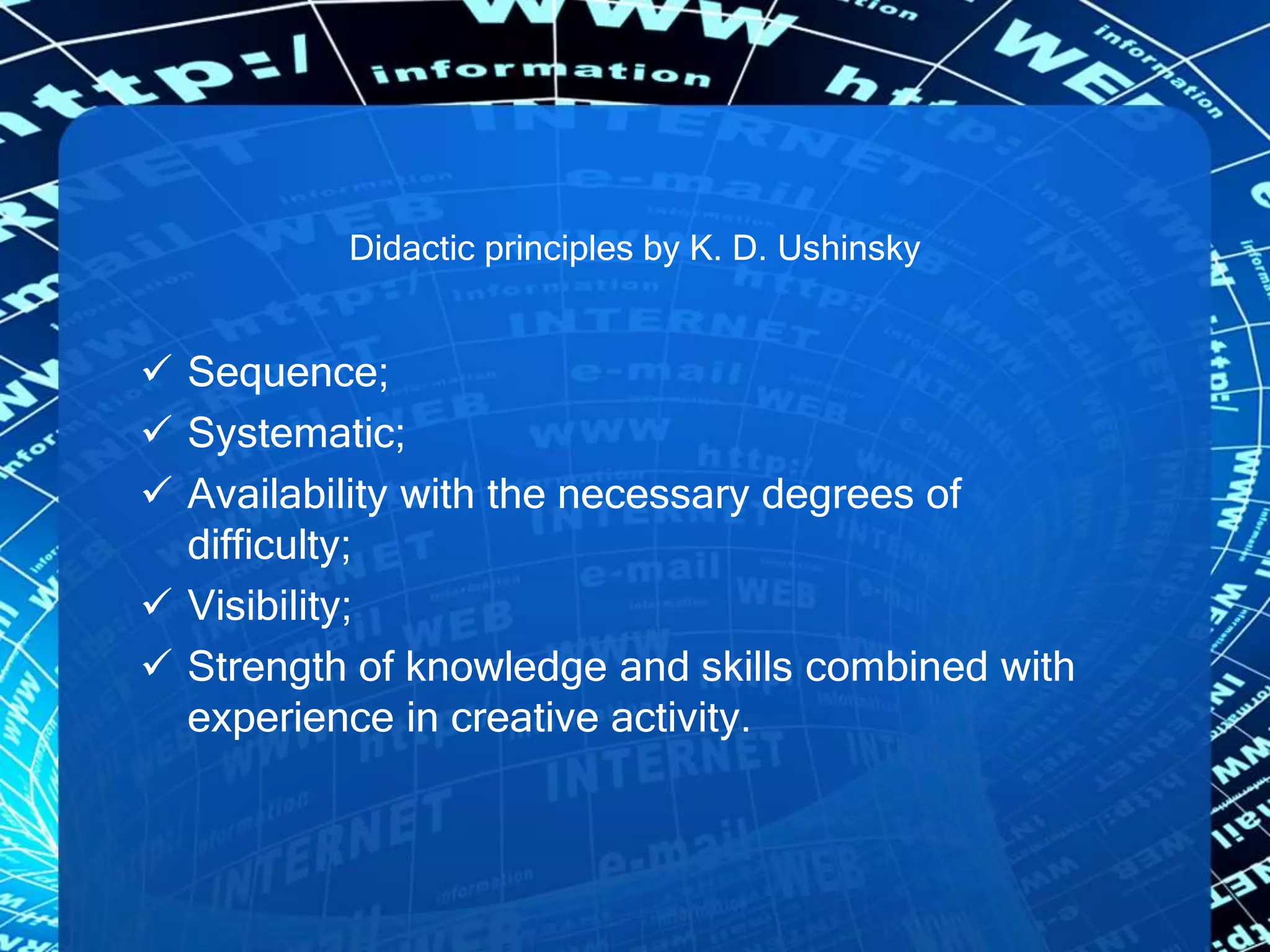
Didactic principles by K. D. Ushinsky
 Sequence;
 Systematic;
 Availability with the necessary degrees of
difficulty;
 Visibility;
 Strength of knowledge and skills combined with
experience in creative activity.
Benefits of the chosen
online platforms
Part 2
Benefits: Mindmap
 Visibility
 Ability to work;
 A huge number of different forms and
options for creating mind maps;
 Support pictures that you can download
from the cloud;
 The possibility of using the profile from
different computers (only need to know
the username and password of an
account);
 Ease of use to present their ideas on the
diploma or project.
Benefits: Mindmeister
 Visibility;
 Ability to work;
 Huge number of different forms and
options for creating mind maps;
 Support pictures that you can download
from the cloud;
 Possibility of using the profile from
different computers (only need to know
the username and password of an
account);
 Ease of use to present their ideas on the
diploma or project.
Benefits: Prezi
 Availability of the mobile version
(PlayMarket and AppStore);
 Possibility of adding a third-party
photo and video;
 Ability to work offline without an
Internet connection (a Windows
Application);
 Large number of tools to create
unique, memorable presentations;
Benefits: Voicethread
 Availability of the mobile
version (PlayMarket and
AppStore);
 Ability to view or listen to the
recording online;
 Add comments and
description to videos and
audio recordings;
Benefits: Skype
 Availability of the mobile
version (PlayMarket and
AppStore);
 Video from any place on the
planet;
 Audio;
 Transfer files of any format
and volume;
 Presence of TAB version;
Benefits: Moodle
 Availability of the mobile
version (PlayMarket and
AppStore);
 Ease of administration;
 Ability to add different types
of tasks;
 Conducting online tests;
 Keeping the scorecard;
 Russian interface;
Benefits: Teacherpage
 Supplement homework;
 Maintenance scorecard (for each student);
 Maintaining statements of students;
 Opportunity to chat with students;
 Possibility of conducting tests and surveys;
Benefits: Wikispaces
 Records of the users of the
course;
 Separate module for
homework;
 Ability to create discussions.
 Ability to comment tasks;
Benefits: SurveyMonkey
 Large number of different
versions of the tests;
 Possibility of mass
distribution of the generated
tests;
 Analysis of the received
information;
Benefits: LMS Schoology
 Availability of the mobile
version (PlayMarket and
AppStore);
 Ease of administration;
 Ability to add different types
of tasks;
 Conducting online tests;
 Maintaining the scorecard;
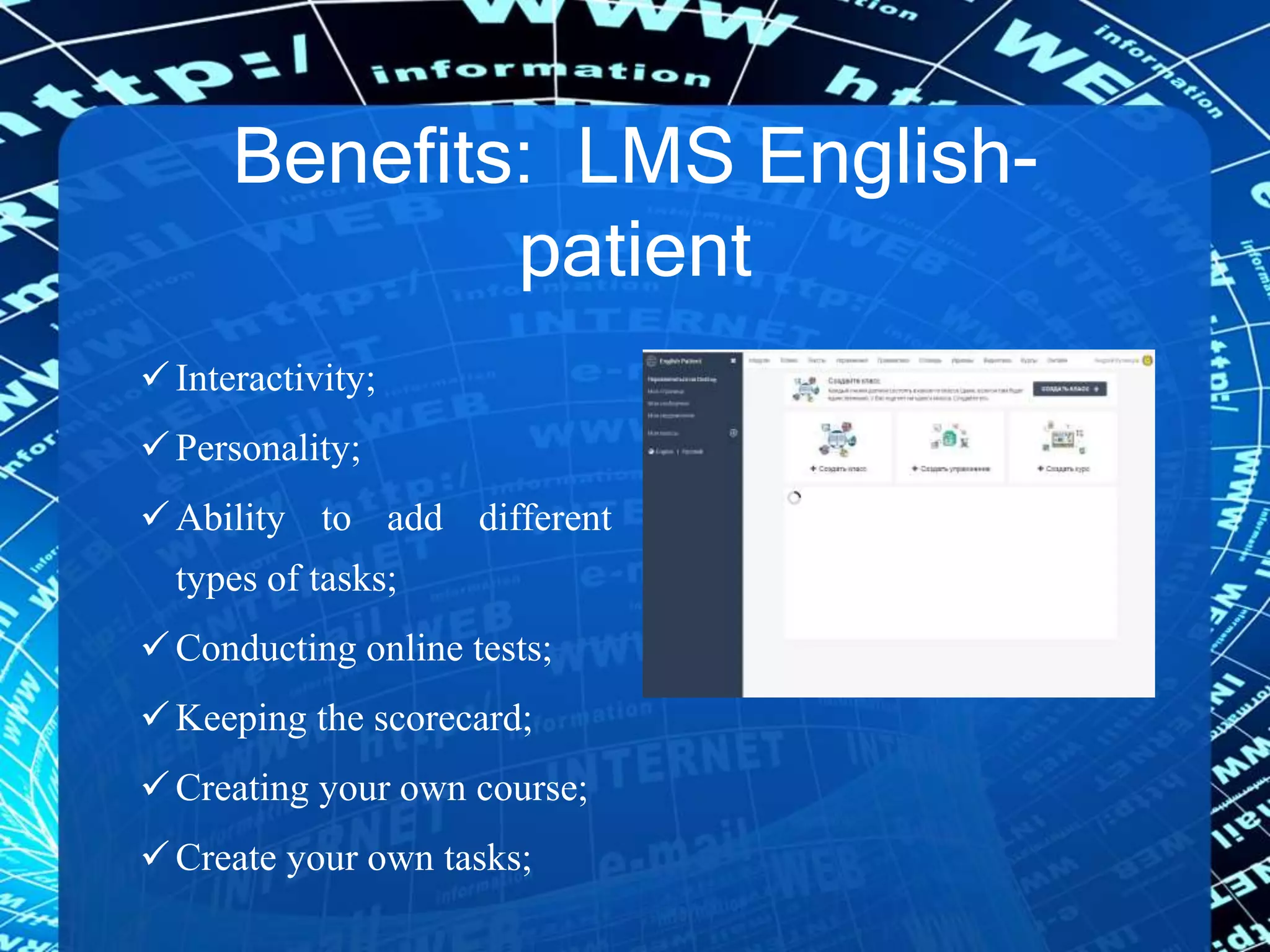
Benefits: LMS English-
patient
Interactivity;
Personality;
Ability to add different
types of tasks;
Conducting online tests;
Keeping the scorecard;
Creating your own course;
Create your own tasks;
Benefits:
Conversationexchange
 Ability to communicate with
people in foreign languages;
 Different forms of
communication: Skype, chat, ICQ
and others;
 File sharing;
 Block unwanted users;
 Adding photos and videos to your
recordings on your personal page;
Benefits: Langteach
 Availability of
mobile version;
 Cross-platform;
 Interactivity and
multimedia;
 Visibility;
 Ease of
administration;
 Large
information
base;
 Multirelational;
 Online tests;
 Vocabulary lists;
 Online courses;
 Set of lesson
plans;
 Systematic;
 Sequence;
Benefits: Google Sites
 Availability of mobile version;
 Cross-platform;
 Interactivity and multimedia;
 Visibility;
 Ease of administration;
Benefits: Slideshare
 Support for large number of formats;
 Possibility of commenting;
 Preview the files before downloading on
the computer's hard drive;
 Limited amount of downloadable file to
100 MB (the free version), 300 MB per
pay;
 Automatic test script of the presentation
and the breaking of his slides which
greatly facilitates the user to search for
necessary information;
 Record number of hits;
Benefits: Quizlet
 Large number of different versions of
the tests;
 Mobile version of the app (AppStore)
 Possibility of mass distribution of the
generated tests
 Analysis of the received information;
 Snapshot of getting the correct answer
after the test;
 Ability to create tests in listening
comprehension;
Benefits: Let's test
 Large number of different versions of
the tests;
 Possibility of mass distribution of the
generated tests;
 Analysis of the received information;
 Snapshot of getting the correct answer
after the test;
Disadvantages of cross-platform model of distant course
Teachers Students
Separate an account for each of the services
(some of them registered through social
networks).
Separate an account for each of the services
(some of them registered through social
networks).
Speed of material load Speed of material load
Some platforms do not possess the function
of evaluation of the obtained results
Very long wait for the results of the
assignment
No unified assessment system Don't see the result.
Absence of certain platforms and services
feedback system.
Inability to ask necessary questions without
the help of third-party services.
Conclusions
1. Cross-platform course model is a model of the distance learning course,
where each significant part is its online service and are all connected to
other elements through the inside of the text hyperlinks in HTML5.
2. Considered the main didactic principles of online courses.
3. Identified the main components of cross-platform model of distance
course.
4. Made a list of online services for cross-platform models of course.
5. Describe the key features and benefits of each of the online services.
6. Revealed the shortcomings of using cross-platform model of organization
of distance online course.
Bibliography
1. Ahan A., V. Robinson. Russian-American telecommunication educational project "Conti Walker", as
an example of distance learning activities Virtual training University // Electronic periodical "Letters in
the Emissia.Offline: electronic scientific and pedagogical journal", SPb, Spbio, 2000, ART 799. State.
reg. No. 0320100088.
2. Traypelnikov A. V. Integration of information and pedagogical technologies in education RFL
(methodological aspect). – M., 2014. – 80 p.: ill. Str. 5
3. Kuznetsov A. A., Simulation and implementation of multi-platform online course // Modern
information technologies and it education. — Vol. 12. — Moscow: Moscow, 2016. — S. 75-81.A.
4. Kuznetsov A A Online platforms in teaching and translation [online] // library for the project
Linguisticsedu. - Linguisticsedu Internet Project 2016 - 2016 07 16 p.
http://linguisticsedu.ucoz.com/index/sravnitelnyj_analiz_vozmozhnostej_realizacii_didakticheskikh_p
rincipov_platform/0-79
5. Mind42 [Online]. - https://mind42.com.
6. Prezi [Online]. - 23 03 2016. - https://prezi.com
7. Voicethread Home [Online] // Voicethread. - 12 03 2014.. - http://voicethread.com.
Bibliography
1. Skype [Online] // Skype. - 04 03,
2014.. - https://www.skype.com/ru/
2.Moodle [Online] // Moodle. - Moodle
build. - 04 12 2013.
https://www.moodle.org
Thank you for your attention
Langteach-online
http://www.langteach-online.ru

Cross-platform learning model of EFL

  • 1.
    Cross-platform learning model ofEFL Post-graduate student of LMSU Kuznetsov Andrey
  • 2.
    Content 1. Definition ofcross-platform learning model; 2. Basic elements of cross-platform learning model; 3. Additional elements of cross-platform learning model; 4. Didactic principles of the Langteach platform; 5. Didactic functions of the Langteach platform;
  • 3.
    Introduction Today, there area huge number of software products allow you to completely automate the entire learning process. In order to match the required level of development of e-learning process, it must meet a number of characteristics.
  • 4.
    Most important didacticprinciples of online courses 1. Functionality 2. Reliability 3. Stability 4. Cost 5. Availability of funds 6. Content development 7. SCORM 8. Control system of knowledge evaluation 9. Ease of use 10.Modularity 11.Multimedia 12.Access 13.Scalability and extensibility 14.Prospects for the development of the platform 15.Cross-platform at the level of MDE 16.Quality of technical support 17.Cross-platform on the level of online services 18.Autonomy of the elements of the distance learning course (AEDC)
  • 5.
    Most important didacticprinciples of online courses (Summary table) Characteristic Characteristic’s description Functionality Denotes a set of functions at various levels, - supporting the training process in full. Reliability This parameter characterizes the ease of administration in the system and ease of content updates for existing templates. Stability Means the degree of stability of the system relative to various modes and degrees of user activity. Cost The cost of the system itself, and the cost of its implementation, course development and support, the presence or absence of restrictions on the number of licenses for students.
  • 6.
    Most important didacticprinciples of online courses (Summary table Part 2) Characteristic Characteristic’s description Availability of funds for content development Built-in editor of educational content not only facilitates the development of courses, but also allows to integrate in a single view educational materials for various purposes SCORM The SCORM standard is international basis for the exchange of electronic courses and the lack of system support it decreases the mobility and allows you to create portable courses. Controlling knowledge system Allows online to assess the knowledge of students. Usually such a system includes tests, assignments and control the activity of trainees on the forums. Control system of knowledge evaluation System which would allow to evaluate the students ' knowledge in automatic mode.
  • 7.
    Most important didacticprinciples of online courses (Summary table Part 3) Characteristic Characteristic’s description Multimedia Access When choosing a new system is necessary to ensure the convenience of its use. This is an important parameter, because the potential students will never use the technology, which seems cumbersome or creates difficulties when navigating. Modularity In modern systems E-learning course could consist of a set of modules or units of learning material that can be used in other courses. Access Trainees should not have barriers to access the curriculum related to their location in time and space, as well as possible factors Multimedia The possibility of using as content is not only text, hypertext and graphics, but also audio, video, gif and flash animation, 3D graphics of different file formats.
  • 8.
    Most important didacticprinciples of online courses (Summary table Part 4) Characteristic Characteristic’s description Scalability and extensibility The possibility of an extension as audience, the students in the distance learning system (DLS) and adding programs and courses teaching and education. Prospects for the development of the platform DLS needs to be a growing environment, must get a new, improved version of the system with the support of new technologies, standards and tools. Cross-platform at the level of DLS Ideally, the distance learning system should not be tied to any operating system or environment, such as at the server level and at the level of the client machines. Quality of technical support The ability to support a healthy, stable DLS, fix bugs and vulnerabilities as with experts of the developer of DLS, and experts of their own support organization.
  • 9.
    Most important didacticprinciples of online courses (Summary table Part 5) Characteristic Characteristic’s description Cross-platform on the level of online services The use of different platforms for different types of learning challenges with the aim of increasing the motivation of students Autonomy of the elements of the distance learning course (AEDC) Each element of the cross-platform model performs its specific function and enables students of different learning objectives, but sometimes we need the same task to its application in another course, and therefore autonomy plays an important role in distance education.
  • 10.
    Definition of cross-platformlearning model Cross-platform learning model – is a model of the distance learning course, where each significant part is its online service and are all connected to other elements through the inside of the text hyperlinks in HTML5.Определение из методики: Cross-platform learning model – is a model of learning based on the use of a single learning management system (LMS) that combines integrated various social services 2.0, didactic with certain properties and performing certain didactic function.
  • 11.
    Организация и элементыкросс-платформенной модели дистанционного курса (Начало) Program Name Short description Mindmap Online service to create schemes and mind maps for teaching students, and convenient presentation of information. With a computer you can use it only on the official website of the program. What mobile platforms it works, we will consider below. Prezi.com Technology cloud creating presentations in 3D projection. With a computer you can use it only on the official website of the program Voicethread Website-program allows you to record speech in real-time using a web camera which is connected to the computer.
  • 12.
    Organization and elementsof cross-platform model of the distance learning course (Continued) Program Name Short description Voxopop The program allows you to record voice and oral statements (monologues) that can be checked by the teacher, even while, and the other end of town. Skype The technology purchased by US media giant Microsoft used in distance education quite broadly for lessons and conferences from the comfort of home. Moodle The module online platform that allows you to create online courses including forums, blogs, videos
  • 13.
    Organization and elementsof cross-platform model of the distance learning course (Continued) Program Name Short description Teacherpage Site allows you to create tests and assignments for students and also for the exchange of information between students Wikispaces Platform to create a virtual classroom for lectures, classes, seminars in the online form. Language Management System Control system used in many foreign and state universities for distance learning. SurveyMonkey Platform to create online tests for checking material Eliademy.com Platform to create online course Schoology.com LMS to create their own course using video forums and blogs.
  • 14.
    Organization and elementsof cross-platform model of distance course (Conclusion) Program Name Short description Образование.РФ Russian LMS system for training large number of students and students in the online form. http://www.englishpatient.org/ Project Y. M. Lyrmaka and S. H. Shaykhlislamova, containing a huge amount of material for the study of the living English language www.mindmeister.com Online service to create schemes and mind maps for teaching students, and convenient presentation of information. Conversationexchange.com Program that helps use the conference to arrange interviews with foreigners in real time Linguisticsedu Project will become a universal platform for the exchange of experience among young scientists in the field of linguistics, translation, theories of teaching languages and cultures.
  • 15.
    Didactic principles byK. D. Ushinsky  Sequence;  Systematic;  Availability with the necessary degrees of difficulty;  Visibility;  Strength of knowledge and skills combined with experience in creative activity.
  • 16.
    Benefits of thechosen online platforms Part 2
  • 17.
    Benefits: Mindmap  Visibility Ability to work;  A huge number of different forms and options for creating mind maps;  Support pictures that you can download from the cloud;  The possibility of using the profile from different computers (only need to know the username and password of an account);  Ease of use to present their ideas on the diploma or project.
  • 18.
    Benefits: Mindmeister  Visibility; Ability to work;  Huge number of different forms and options for creating mind maps;  Support pictures that you can download from the cloud;  Possibility of using the profile from different computers (only need to know the username and password of an account);  Ease of use to present their ideas on the diploma or project.
  • 19.
    Benefits: Prezi  Availabilityof the mobile version (PlayMarket and AppStore);  Possibility of adding a third-party photo and video;  Ability to work offline without an Internet connection (a Windows Application);  Large number of tools to create unique, memorable presentations;
  • 20.
    Benefits: Voicethread  Availabilityof the mobile version (PlayMarket and AppStore);  Ability to view or listen to the recording online;  Add comments and description to videos and audio recordings;
  • 21.
    Benefits: Skype  Availabilityof the mobile version (PlayMarket and AppStore);  Video from any place on the planet;  Audio;  Transfer files of any format and volume;  Presence of TAB version;
  • 22.
    Benefits: Moodle  Availabilityof the mobile version (PlayMarket and AppStore);  Ease of administration;  Ability to add different types of tasks;  Conducting online tests;  Keeping the scorecard;  Russian interface;
  • 23.
    Benefits: Teacherpage  Supplementhomework;  Maintenance scorecard (for each student);  Maintaining statements of students;  Opportunity to chat with students;  Possibility of conducting tests and surveys;
  • 24.
    Benefits: Wikispaces  Recordsof the users of the course;  Separate module for homework;  Ability to create discussions.  Ability to comment tasks;
  • 25.
    Benefits: SurveyMonkey  Largenumber of different versions of the tests;  Possibility of mass distribution of the generated tests;  Analysis of the received information;
  • 26.
    Benefits: LMS Schoology Availability of the mobile version (PlayMarket and AppStore);  Ease of administration;  Ability to add different types of tasks;  Conducting online tests;  Maintaining the scorecard;
  • 27.
    Benefits: LMS English- patient Interactivity; Personality; Abilityto add different types of tasks; Conducting online tests; Keeping the scorecard; Creating your own course; Create your own tasks;
  • 28.
    Benefits: Conversationexchange  Ability tocommunicate with people in foreign languages;  Different forms of communication: Skype, chat, ICQ and others;  File sharing;  Block unwanted users;  Adding photos and videos to your recordings on your personal page;
  • 29.
    Benefits: Langteach  Availabilityof mobile version;  Cross-platform;  Interactivity and multimedia;  Visibility;  Ease of administration;  Large information base;  Multirelational;  Online tests;  Vocabulary lists;  Online courses;  Set of lesson plans;  Systematic;  Sequence;
  • 30.
    Benefits: Google Sites Availability of mobile version;  Cross-platform;  Interactivity and multimedia;  Visibility;  Ease of administration;
  • 31.
    Benefits: Slideshare  Supportfor large number of formats;  Possibility of commenting;  Preview the files before downloading on the computer's hard drive;  Limited amount of downloadable file to 100 MB (the free version), 300 MB per pay;  Automatic test script of the presentation and the breaking of his slides which greatly facilitates the user to search for necessary information;  Record number of hits;
  • 32.
    Benefits: Quizlet  Largenumber of different versions of the tests;  Mobile version of the app (AppStore)  Possibility of mass distribution of the generated tests  Analysis of the received information;  Snapshot of getting the correct answer after the test;  Ability to create tests in listening comprehension;
  • 33.
    Benefits: Let's test Large number of different versions of the tests;  Possibility of mass distribution of the generated tests;  Analysis of the received information;  Snapshot of getting the correct answer after the test;
  • 34.
    Disadvantages of cross-platformmodel of distant course Teachers Students Separate an account for each of the services (some of them registered through social networks). Separate an account for each of the services (some of them registered through social networks). Speed of material load Speed of material load Some platforms do not possess the function of evaluation of the obtained results Very long wait for the results of the assignment No unified assessment system Don't see the result. Absence of certain platforms and services feedback system. Inability to ask necessary questions without the help of third-party services.
  • 35.
    Conclusions 1. Cross-platform coursemodel is a model of the distance learning course, where each significant part is its online service and are all connected to other elements through the inside of the text hyperlinks in HTML5. 2. Considered the main didactic principles of online courses. 3. Identified the main components of cross-platform model of distance course. 4. Made a list of online services for cross-platform models of course. 5. Describe the key features and benefits of each of the online services. 6. Revealed the shortcomings of using cross-platform model of organization of distance online course.
  • 36.
    Bibliography 1. Ahan A.,V. Robinson. Russian-American telecommunication educational project "Conti Walker", as an example of distance learning activities Virtual training University // Electronic periodical "Letters in the Emissia.Offline: electronic scientific and pedagogical journal", SPb, Spbio, 2000, ART 799. State. reg. No. 0320100088. 2. Traypelnikov A. V. Integration of information and pedagogical technologies in education RFL (methodological aspect). – M., 2014. – 80 p.: ill. Str. 5 3. Kuznetsov A. A., Simulation and implementation of multi-platform online course // Modern information technologies and it education. — Vol. 12. — Moscow: Moscow, 2016. — S. 75-81.A. 4. Kuznetsov A A Online platforms in teaching and translation [online] // library for the project Linguisticsedu. - Linguisticsedu Internet Project 2016 - 2016 07 16 p. http://linguisticsedu.ucoz.com/index/sravnitelnyj_analiz_vozmozhnostej_realizacii_didakticheskikh_p rincipov_platform/0-79 5. Mind42 [Online]. - https://mind42.com. 6. Prezi [Online]. - 23 03 2016. - https://prezi.com 7. Voicethread Home [Online] // Voicethread. - 12 03 2014.. - http://voicethread.com.
  • 37.
    Bibliography 1. Skype [Online]// Skype. - 04 03, 2014.. - https://www.skype.com/ru/ 2.Moodle [Online] // Moodle. - Moodle build. - 04 12 2013. https://www.moodle.org
  • 38.
    Thank you foryour attention Langteach-online http://www.langteach-online.ru