International Journal of Modern Engineering Research (IJMER)
               www.ijmer.com                 Vol.2, Issue.4, July-Aug. 2012 pp-1880-1882       ISSN: 2249-6645

        Tribological Investigation of Detonation Sprayed Ni-Cr And Al2O3
       13Tio2 Coatings On Grey Cast Iron To Enhance Its Wear Resistance
                             1
                              Harjot Singh Gill, 2 J. P. Singla           3
                                                                              Dr. N.K. Grover
                                        1
                                            HOD, Mechanical Department DTC, Ferozepur
                                 2
                                   Assistant Professor, Mechanical Department SBSCET, Ferozepur
                                         3
                                           HOD, Mechanical Department SBSCET, Ferozepur

                                                                              II.    Experimental Procedure
Abstract: This paper is concerned with the investigation of                Two types of gray irons were studied: one Grade 250
the capability of Detonation sprayed Ni-Cr And Al2O3 13TiO2       (GI250), one high-carbon (GIHC), whose chemical
coatings to improve the tribological and mechanical properties    compositions and basic mechanical properties are shown in
of grey cast iron. The present study describes and compares       Table 1.
the mechanical and tribological properties of NiCr and Al 2O3
13TiO2 D-Sprayed coatings deposited on two different                                      Table 1
substrates (GI250 and GIHC)             Experiments using a        Chemical composition (wt.%) and mechanical properties of
tribometer (pin on disc) is performed in order to evaluate the                              irons
wear properties. The coating microstructures were                                             GI250        GIHC
characterised by SEM and EDAX. Cumulative weight                      C                       3.54         3.73
analysis is done to compare the wear loss in weight and its           Si                      2.15         2.07
concluded Al2O3 13TiO2 form a good bond with GI250 using              Mn                      0.51         0.78
Detonation spray process.
                                                                      P                       0.054        0.058
                                                                      S                       0.1          0.085
Keywords: Al2O3 13TiO2, Detonation, EDAX , Ni-Cr, SEM.
                                                                      Ti                      0.012        0.014
                   I.     Introduction                                Cu                      0.69         0.56
          Surface engineering is an economic method for the           Cr                      0.034        0.27
production of materials, tools and machine parts with required        Sn                      0.061        0.039
surface properties, such as wear and corrosion resistance [1].
                                                                      Hardness(HB)            195 ± 5      180 ± 5
Since many types of attack such as corrosion, friction, wear,
heat, radiation occur on the surface of a component, or
transferred via the surface into the component, surface                    Samples of cylindrical shape, with diameter 8mm
protection is of a considerable significance as regards modern    and length 30mm were casted with the components of GI250
materials technology.                                             and GIHC. The casted samples were marked accordingly with
          The purpose of surface technology including thermal     sample numbers and The grinding of end faces (to be coated )
spraying is to produce functionally effective surfaces [2]. The   of the pins is done using emery papers of five different
wear resistance in the case of brake disc rotors, wire drawing    grades 220, 400, 600, 800, 1000 in the same order . Grinding
pulleys etc. can be improved by a wide range of coatings.         was followed by polishing with 1/0, 2/0, 3/0 and 4/0 grades
          Thermal spray is a technique that produces a wide       polishing papers. Two types of coating powders namely
range of coatings for diverse applications. The principle of      (1)Ni-Cr (2) Al2O3-13TiO2 are selected for Detonation Spray
thermal spray is to melt material feedstock (wire or powder),     Coating Process after the literature survey. Powder Ni-Cr and
to accelerate the melt to impact on a substrate where rapid       Al2O3-13TiO2 form hard dense and excellent bonded coatings
solidification and deposit build-up occurs[3].                    on the samples. The wear tests were performed in a machine
          To reduce the wear problem, wear resistant coatings     (Wear and Friction Monitor Tester TR-201) conforming to
are deposited on the grey irons. Standard test methods for        ASTM G 99 standard. The wear tests for coated as well as
wear testing with pin-on disc apparatus are employed to study     uncoated specimens were conducted under three normal loads
the wear behavior of the uncoated and coated grey irons as        of 30 N, 40 N and 50 N and a fixed sliding velocity of 1 m/s.
well. Thermal spray processes that have been considered to        A track diameter of D=40 mm, sliding speed v=1 m/s is kept.
deposit the coatings are enlisted as: (1) Flame spraying with a   Wear tests have been carried out for a total sliding distance of
powder or wire, (2) Electric arc wire spraying, (3) Plasma        5400 m ( 6 cycles of 5min, 5min, 10min, 10min, 20min,
spraying, (4) Spray and fuse, (5) High Velocity Oxyfuel           40min duration),so that only top coated surface was exposed
(HVOF) spraying, (6) Detonation Gun.                              for each detonation sprayed sample. Weight losses for pins
                                                                  were measured after each cycle to determine the wear loss.
         Among the commercially available thermal spray                    The weight was measured by a micro balance to an
coating techniques, detonation spray (DS) is chosen to get        accuracy of 0.0001 gm. The coefficient of friction has been
hard, dense and consequently wear resistant coatings              determined from the friction force and the normal loads in all
                                                       www.ijmer.com                                              1880 | P a g e
International Journal of Modern Engineering Research (IJMER)
                  www.ijmer.com              Vol.2, Issue.4, July-Aug. 2012 pp-1880-1882             ISSN: 2249-6645
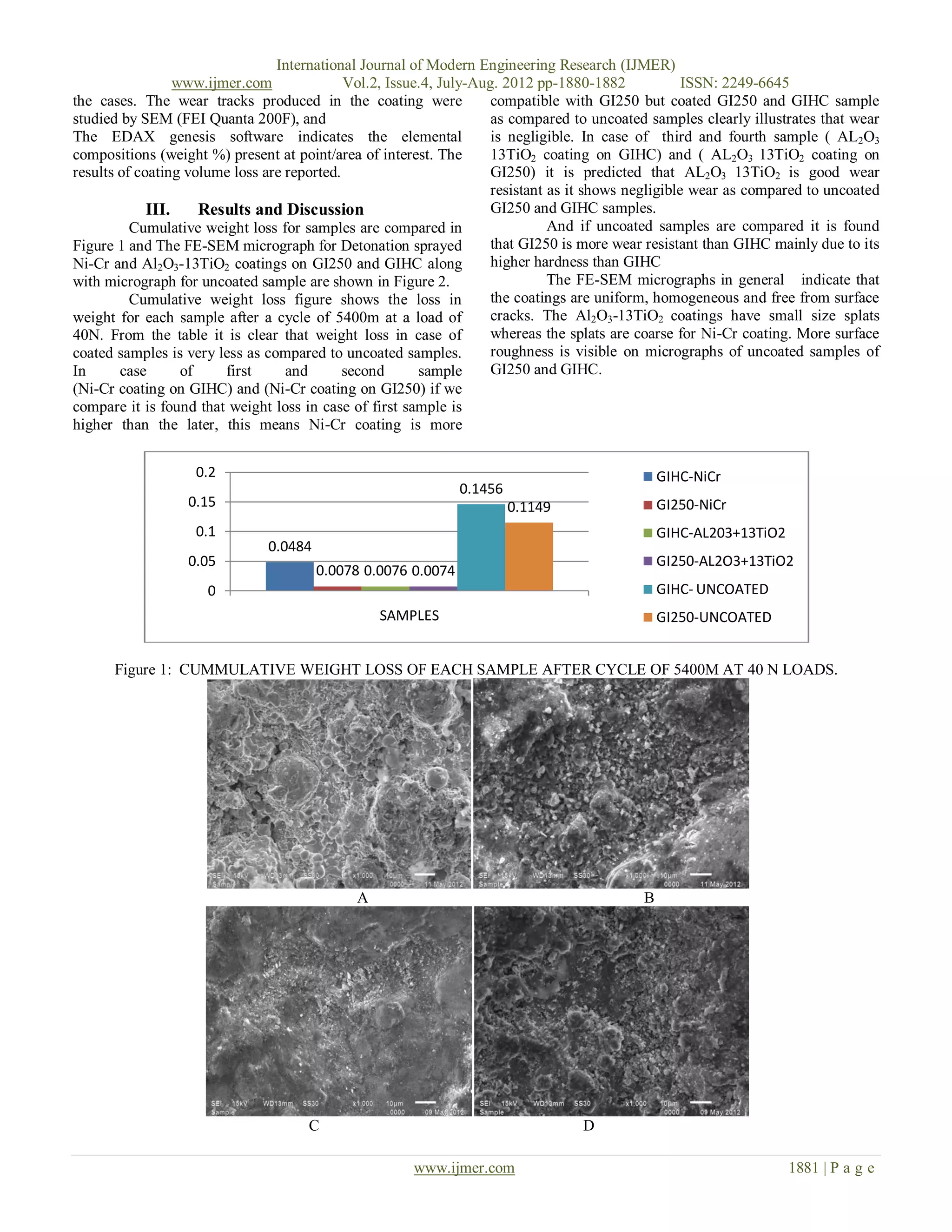
the cases. The wear tracks produced in the coating were              compatible with GI250 but coated GI250 and GIHC sample
studied by SEM (FEI Quanta 200F), and                                as compared to uncoated samples clearly illustrates that wear
The EDAX genesis software indicates the elemental                    is negligible. In case of third and fourth sample ( AL2O3
compositions (weight %) present at point/area of interest. The       13TiO2 coating on GIHC) and ( AL2O3 13TiO2 coating on
results of coating volume loss are reported.                         GI250) it is predicted that AL2O3 13TiO2 is good wear
                                                                     resistant as it shows negligible wear as compared to uncoated
             III.     Results and Discussion                         GI250 and GIHC samples.
          Cumulative weight loss for samples are compared in                   And if uncoated samples are compared it is found
Figure 1 and The FE-SEM micrograph for Detonation sprayed            that GI250 is more wear resistant than GIHC mainly due to its
Ni-Cr and Al2O3-13TiO2 coatings on GI250 and GIHC along              higher hardness than GIHC
with micrograph for uncoated sample are shown in Figure 2.                     The FE-SEM micrographs in general indicate that
          Cumulative weight loss figure shows the loss in            the coatings are uniform, homogeneous and free from surface
weight for each sample after a cycle of 5400m at a load of           cracks. The Al2O3-13TiO2 coatings have small size splats
40N. From the table it is clear that weight loss in case of          whereas the splats are coarse for Ni-Cr coating. More surface
coated samples is very less as compared to uncoated samples.         roughness is visible on micrographs of uncoated samples of
In      case       of    first     and       second      sample      GI250 and GIHC.
(Ni-Cr coating on GIHC) and (Ni-Cr coating on GI250) if we
compare it is found that weight loss in case of first sample is
higher than the later, this means Ni-Cr coating is more


                   0.2                                                                          GIHC-NiCr
                                                               0.1456
                  0.15                                                  0.1149                  GI250-NiCr
                   0.1                                                                          GIHC-AL203+13TiO2
                               0.0484
                  0.05                                                                          GI250-AL2O3+13TiO2
                                        0.0078 0.0076 0.0074
                     0                                                                          GIHC- UNCOATED
                                                 SAMPLES                                        GI250-UNCOATED


      Figure 1: CUMMULATIVE WEIGHT LOSS OF EACH SAMPLE AFTER CYCLE OF 5400M AT 40 N LOADS.


                                             A                                              B


                                      C                                           D

                                                      www.ijmer.com                                                 1881 | P a g e
International Journal of Modern Engineering Research (IJMER)
                www.ijmer.com               Vol.2, Issue.4, July-Aug. 2012 pp-1880-1882       ISSN: 2249-6645


                                         E                                 F
Fig. 2.: SEM Micrographs Of Worn Out Samples Of (A) Ni-Cr Coating On GIHC (B) Al2O3+13tio2 Coating On GIHC (C) Ni-Cr
Coating On GI250 (D) Al2O3+13tio2 Coating On GI250 (E) Uncoated GIHC Sample (F) Uncoated GI250 Sample At 40N Load

          As reported by Astakhov, (2008) [4] that it is               40N ) is Al2O3 13TiO2-GI250 > Al2O3 13TiO2-GIHC
possible to deposit almost any material on any substrate               > NiCr-GI250 >NiCr - GIHC > Uncoated GI250 >
without change in the properties of base material by D-gun             Uncoated GIHC
spray process to considerably extend the life of parts, it is
observed in the present study that the NiCr, Al 2O3-13TiO2                                  References
coatings powders have been successfully deposited on              [1] Iordanova I, Surtchev M, Forcey KS. Metallographic and
GI250 and GIHC substrates by the detonation spray                      SEM investigation of the thermally sprayed coatings on steel
process. It was further confirmed by characterization of               substrate. Surf Coat Technol 2001;139:118 –126.
                                                                  [2] Kahraman, N, Gulenc¸ , B, Investigation of the coating
coatings using EDAX analysis of as coated specimens.                   thickness effect on the surface roughness and hardness of
obtained in the study have been supported by the findings              powder flame spraying coated specimens, Powder Metallurgy
of Mohanty et al., (1996)[5]; Sahraoui et al., (2003)[6] and           Science and Technology, Second International Conference on
Bolelli et al.,(2006). [7]                                             Powder Metallurgy, Ro PM 2000, Technical University of
          The detonation sprayed NiCr, Al2O3-13TiO2                    Cluj, 2000, Romania.
coated GI250 and GIHC specimens showed significantly              [3] Herman H, Sampath S. In: Stern KH, editor. Thermal spray
lower cumulative weight loss (Figure 1) as compared to                 coatings, metallurgical and ceramic protective coatings.
bare GI250 and GIHC materials under the normal load of                 London, UK: Chapman & Hall; 1996. p. 261–89
40N. It was investigated with the help of Pin-on-Disk Wear        [4] 325-347, 2008. Astakhov . Editorial: Tribology at the
                                                                       forefront of study and research on metal cutting, International
Test Rig according to ASTM G99-03 Standard. There are
                                                                       Journal of Machining and Machinability of materials.
many studies ; Murthy & Venkataraman (2006)[8],                   [5] Mohanty M, R W Smith, M De Bonte, LP Celis, E
Sundarajan et al.(2005)[9] which support the above finding             Lugscheider (1996), “Sliding wear behavior of thermally
that Detonation sprayed coatings reduces the wear loss.                prayed 75/25 Cr3C2/NiCr wear resistant coatings” Wear, vol
                                                                       198, pp 251-266.
                  IV.     Conclusion                              [6] Murthy J K N, Venkataraman B (2006), “Abrasive wear
                                                                       behaviour of WC–CoCr and Cr3C2–20NiCr deposited by
   Detonation Sprayed NiCr, Al2O3-13TiO2 coatings have                HVOF and detonation spray processes” Surface & Coatings
    successfully been deposited on GI250 and GIHC                      Technology, vol 200 , pp 2642– 2652
    grades of grey cast iron.                                     [7] Bolelli G, Cannillo V, Lusvarghi L, Manfredini T (2006),”
                                                                       Wear behaviour of thermally sprayed ceramic oxide
   The detonation sprayed NiCr, Al2O3-13TiO2 coated                   coatings” Wear, vol 261, pp 1298–1315
    GI250 and GIHC specimens showed significantly                 [8] Murthy J K N, Venkataraman B (2006), “Abrasive wear
    lower cumulative weight loss as compared to uncoated               behaviour of WC–CoCr and Cr3C2–20NiCr deposited by
    GI250 and GIHC materials.                                          HVOF and detonation spray processes” Surface & Coatings
                                                                       Technology, vol 200 , pp 2642– 2652
   Cumulative weight loss for detonation sprayed NiCr,            [9] Sundararajan G, Sen D, G Sivakumar (2005), “The
    Al2O3-13TiO2 coated as well as bare GI250 and GIHC                 tribological behaviour of detonation sprayed coatings: the
    specimens increases with increase in load.                         importance of coating process parameters” Wear, vol 258, pp
                                                                       377–391
   The Cumulative weight loss for Al2O3-13TiO2 coating
    was observed to be minimum in the present study.
   The Al2O313TiO2 GI250 coating substrate combination
    has shown minimum Cumulative weight loss among all
    the combinations. The wear resistance for coating–
    substrate combinations in their decreasing order (at

                                                       www.ijmer.com                                                 1882 | P a g e

Al2418801882

  • 1.
    International Journal ofModern Engineering Research (IJMER) www.ijmer.com Vol.2, Issue.4, July-Aug. 2012 pp-1880-1882 ISSN: 2249-6645 Tribological Investigation of Detonation Sprayed Ni-Cr And Al2O3 13Tio2 Coatings On Grey Cast Iron To Enhance Its Wear Resistance 1 Harjot Singh Gill, 2 J. P. Singla 3 Dr. N.K. Grover 1 HOD, Mechanical Department DTC, Ferozepur 2 Assistant Professor, Mechanical Department SBSCET, Ferozepur 3 HOD, Mechanical Department SBSCET, Ferozepur II. Experimental Procedure Abstract: This paper is concerned with the investigation of Two types of gray irons were studied: one Grade 250 the capability of Detonation sprayed Ni-Cr And Al2O3 13TiO2 (GI250), one high-carbon (GIHC), whose chemical coatings to improve the tribological and mechanical properties compositions and basic mechanical properties are shown in of grey cast iron. The present study describes and compares Table 1. the mechanical and tribological properties of NiCr and Al 2O3 13TiO2 D-Sprayed coatings deposited on two different Table 1 substrates (GI250 and GIHC) Experiments using a Chemical composition (wt.%) and mechanical properties of tribometer (pin on disc) is performed in order to evaluate the irons wear properties. The coating microstructures were GI250 GIHC characterised by SEM and EDAX. Cumulative weight C 3.54 3.73 analysis is done to compare the wear loss in weight and its Si 2.15 2.07 concluded Al2O3 13TiO2 form a good bond with GI250 using Mn 0.51 0.78 Detonation spray process. P 0.054 0.058 S 0.1 0.085 Keywords: Al2O3 13TiO2, Detonation, EDAX , Ni-Cr, SEM. Ti 0.012 0.014 I. Introduction Cu 0.69 0.56 Surface engineering is an economic method for the Cr 0.034 0.27 production of materials, tools and machine parts with required Sn 0.061 0.039 surface properties, such as wear and corrosion resistance [1]. Hardness(HB) 195 ± 5 180 ± 5 Since many types of attack such as corrosion, friction, wear, heat, radiation occur on the surface of a component, or transferred via the surface into the component, surface Samples of cylindrical shape, with diameter 8mm protection is of a considerable significance as regards modern and length 30mm were casted with the components of GI250 materials technology. and GIHC. The casted samples were marked accordingly with The purpose of surface technology including thermal sample numbers and The grinding of end faces (to be coated ) spraying is to produce functionally effective surfaces [2]. The of the pins is done using emery papers of five different wear resistance in the case of brake disc rotors, wire drawing grades 220, 400, 600, 800, 1000 in the same order . Grinding pulleys etc. can be improved by a wide range of coatings. was followed by polishing with 1/0, 2/0, 3/0 and 4/0 grades Thermal spray is a technique that produces a wide polishing papers. Two types of coating powders namely range of coatings for diverse applications. The principle of (1)Ni-Cr (2) Al2O3-13TiO2 are selected for Detonation Spray thermal spray is to melt material feedstock (wire or powder), Coating Process after the literature survey. Powder Ni-Cr and to accelerate the melt to impact on a substrate where rapid Al2O3-13TiO2 form hard dense and excellent bonded coatings solidification and deposit build-up occurs[3]. on the samples. The wear tests were performed in a machine To reduce the wear problem, wear resistant coatings (Wear and Friction Monitor Tester TR-201) conforming to are deposited on the grey irons. Standard test methods for ASTM G 99 standard. The wear tests for coated as well as wear testing with pin-on disc apparatus are employed to study uncoated specimens were conducted under three normal loads the wear behavior of the uncoated and coated grey irons as of 30 N, 40 N and 50 N and a fixed sliding velocity of 1 m/s. well. Thermal spray processes that have been considered to A track diameter of D=40 mm, sliding speed v=1 m/s is kept. deposit the coatings are enlisted as: (1) Flame spraying with a Wear tests have been carried out for a total sliding distance of powder or wire, (2) Electric arc wire spraying, (3) Plasma 5400 m ( 6 cycles of 5min, 5min, 10min, 10min, 20min, spraying, (4) Spray and fuse, (5) High Velocity Oxyfuel 40min duration),so that only top coated surface was exposed (HVOF) spraying, (6) Detonation Gun. for each detonation sprayed sample. Weight losses for pins were measured after each cycle to determine the wear loss. Among the commercially available thermal spray The weight was measured by a micro balance to an coating techniques, detonation spray (DS) is chosen to get accuracy of 0.0001 gm. The coefficient of friction has been hard, dense and consequently wear resistant coatings determined from the friction force and the normal loads in all www.ijmer.com 1880 | P a g e
  • 2.
    International Journal ofModern Engineering Research (IJMER) www.ijmer.com Vol.2, Issue.4, July-Aug. 2012 pp-1880-1882 ISSN: 2249-6645 the cases. The wear tracks produced in the coating were compatible with GI250 but coated GI250 and GIHC sample studied by SEM (FEI Quanta 200F), and as compared to uncoated samples clearly illustrates that wear The EDAX genesis software indicates the elemental is negligible. In case of third and fourth sample ( AL2O3 compositions (weight %) present at point/area of interest. The 13TiO2 coating on GIHC) and ( AL2O3 13TiO2 coating on results of coating volume loss are reported. GI250) it is predicted that AL2O3 13TiO2 is good wear resistant as it shows negligible wear as compared to uncoated III. Results and Discussion GI250 and GIHC samples. Cumulative weight loss for samples are compared in And if uncoated samples are compared it is found Figure 1 and The FE-SEM micrograph for Detonation sprayed that GI250 is more wear resistant than GIHC mainly due to its Ni-Cr and Al2O3-13TiO2 coatings on GI250 and GIHC along higher hardness than GIHC with micrograph for uncoated sample are shown in Figure 2. The FE-SEM micrographs in general indicate that Cumulative weight loss figure shows the loss in the coatings are uniform, homogeneous and free from surface weight for each sample after a cycle of 5400m at a load of cracks. The Al2O3-13TiO2 coatings have small size splats 40N. From the table it is clear that weight loss in case of whereas the splats are coarse for Ni-Cr coating. More surface coated samples is very less as compared to uncoated samples. roughness is visible on micrographs of uncoated samples of In case of first and second sample GI250 and GIHC. (Ni-Cr coating on GIHC) and (Ni-Cr coating on GI250) if we compare it is found that weight loss in case of first sample is higher than the later, this means Ni-Cr coating is more 0.2 GIHC-NiCr 0.1456 0.15 0.1149 GI250-NiCr 0.1 GIHC-AL203+13TiO2 0.0484 0.05 GI250-AL2O3+13TiO2 0.0078 0.0076 0.0074 0 GIHC- UNCOATED SAMPLES GI250-UNCOATED Figure 1: CUMMULATIVE WEIGHT LOSS OF EACH SAMPLE AFTER CYCLE OF 5400M AT 40 N LOADS. A B C D www.ijmer.com 1881 | P a g e
  • 3.
    International Journal ofModern Engineering Research (IJMER) www.ijmer.com Vol.2, Issue.4, July-Aug. 2012 pp-1880-1882 ISSN: 2249-6645 E F Fig. 2.: SEM Micrographs Of Worn Out Samples Of (A) Ni-Cr Coating On GIHC (B) Al2O3+13tio2 Coating On GIHC (C) Ni-Cr Coating On GI250 (D) Al2O3+13tio2 Coating On GI250 (E) Uncoated GIHC Sample (F) Uncoated GI250 Sample At 40N Load As reported by Astakhov, (2008) [4] that it is 40N ) is Al2O3 13TiO2-GI250 > Al2O3 13TiO2-GIHC possible to deposit almost any material on any substrate > NiCr-GI250 >NiCr - GIHC > Uncoated GI250 > without change in the properties of base material by D-gun Uncoated GIHC spray process to considerably extend the life of parts, it is observed in the present study that the NiCr, Al 2O3-13TiO2 References coatings powders have been successfully deposited on [1] Iordanova I, Surtchev M, Forcey KS. Metallographic and GI250 and GIHC substrates by the detonation spray SEM investigation of the thermally sprayed coatings on steel process. It was further confirmed by characterization of substrate. Surf Coat Technol 2001;139:118 –126. [2] Kahraman, N, Gulenc¸ , B, Investigation of the coating coatings using EDAX analysis of as coated specimens. thickness effect on the surface roughness and hardness of obtained in the study have been supported by the findings powder flame spraying coated specimens, Powder Metallurgy of Mohanty et al., (1996)[5]; Sahraoui et al., (2003)[6] and Science and Technology, Second International Conference on Bolelli et al.,(2006). [7] Powder Metallurgy, Ro PM 2000, Technical University of The detonation sprayed NiCr, Al2O3-13TiO2 Cluj, 2000, Romania. coated GI250 and GIHC specimens showed significantly [3] Herman H, Sampath S. In: Stern KH, editor. Thermal spray lower cumulative weight loss (Figure 1) as compared to coatings, metallurgical and ceramic protective coatings. bare GI250 and GIHC materials under the normal load of London, UK: Chapman & Hall; 1996. p. 261–89 40N. It was investigated with the help of Pin-on-Disk Wear [4] 325-347, 2008. Astakhov . Editorial: Tribology at the forefront of study and research on metal cutting, International Test Rig according to ASTM G99-03 Standard. There are Journal of Machining and Machinability of materials. many studies ; Murthy & Venkataraman (2006)[8], [5] Mohanty M, R W Smith, M De Bonte, LP Celis, E Sundarajan et al.(2005)[9] which support the above finding Lugscheider (1996), “Sliding wear behavior of thermally that Detonation sprayed coatings reduces the wear loss. prayed 75/25 Cr3C2/NiCr wear resistant coatings” Wear, vol 198, pp 251-266. IV. Conclusion [6] Murthy J K N, Venkataraman B (2006), “Abrasive wear behaviour of WC–CoCr and Cr3C2–20NiCr deposited by  Detonation Sprayed NiCr, Al2O3-13TiO2 coatings have HVOF and detonation spray processes” Surface & Coatings successfully been deposited on GI250 and GIHC Technology, vol 200 , pp 2642– 2652 grades of grey cast iron. [7] Bolelli G, Cannillo V, Lusvarghi L, Manfredini T (2006),” Wear behaviour of thermally sprayed ceramic oxide  The detonation sprayed NiCr, Al2O3-13TiO2 coated coatings” Wear, vol 261, pp 1298–1315 GI250 and GIHC specimens showed significantly [8] Murthy J K N, Venkataraman B (2006), “Abrasive wear lower cumulative weight loss as compared to uncoated behaviour of WC–CoCr and Cr3C2–20NiCr deposited by GI250 and GIHC materials. HVOF and detonation spray processes” Surface & Coatings Technology, vol 200 , pp 2642– 2652  Cumulative weight loss for detonation sprayed NiCr, [9] Sundararajan G, Sen D, G Sivakumar (2005), “The Al2O3-13TiO2 coated as well as bare GI250 and GIHC tribological behaviour of detonation sprayed coatings: the specimens increases with increase in load. importance of coating process parameters” Wear, vol 258, pp 377–391  The Cumulative weight loss for Al2O3-13TiO2 coating was observed to be minimum in the present study.  The Al2O313TiO2 GI250 coating substrate combination has shown minimum Cumulative weight loss among all the combinations. The wear resistance for coating– substrate combinations in their decreasing order (at www.ijmer.com 1882 | P a g e