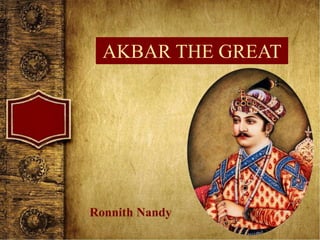
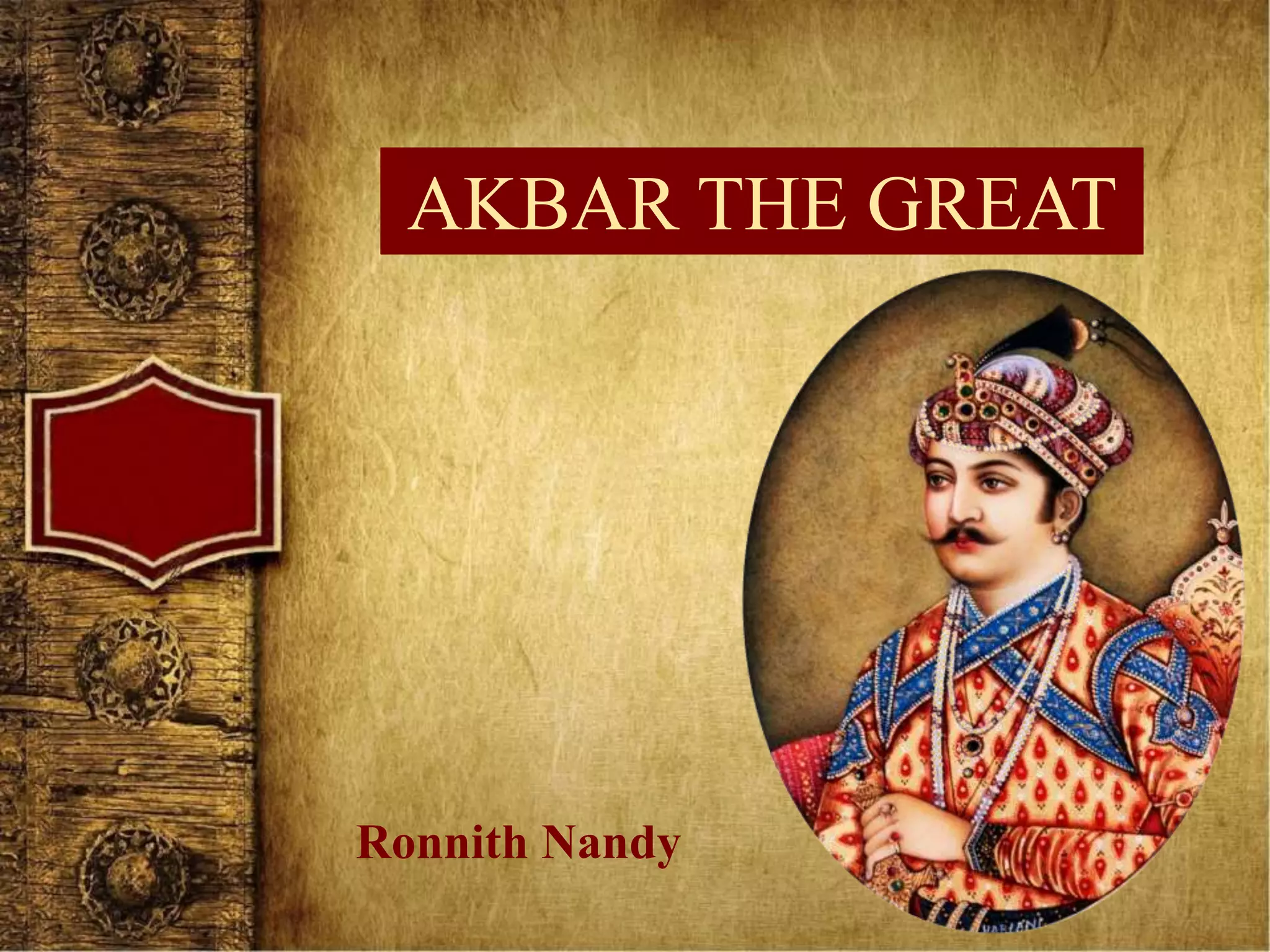
AKBAR THE GREAT
Ronnith Nandy
Introduction
Akbar
the Great
Shortly after Humayun’s return to Delhi after 15 years and re-establishing Mughal rule
in India, he died in an accidental fall from his library.
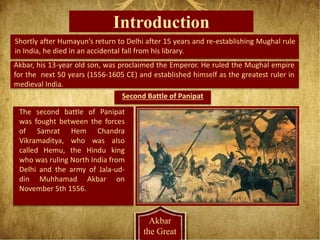
Second Battle of Panipat
The second battle of Panipat
was fought between the forces
of Samrat Hem Chandra
Vikramaditya, who was also
called Hemu, the Hindu king
who was ruling North India from
Delhi and the army of Jala-ud-
din Muhhamad Akbar on
November 5th 1556.
Akbar, his 13-year old son, was proclaimed the Emperor. He ruled the Mughal empire
for the next 50 years (1556-1605 CE) and established himself as the greatest ruler in
medieval India.
Conquest of Akbar
Akbar
the Great
Conquest of Akbar was largely successful and his empire extended from Kabul in the
west to the Bengal in the east and from Kashmir in the north to the Vindhyas in the
south.
Akbar engaged himself in wars of conquest all through his life. He initiated his
conquest of southern India and partially succeeded before he died.
Akbar was an imperialist. He frankly declared
and desired to pursue the policy of the
extension of the empire.
He conquered the entire north India and
consolidated it, under his administration.
Bairam Khan’s
Regency
Akbar
the Great
Bairam Khan became the guardian of Akbar when Akbar was just 13 year old.
Bairam Khan was the Chief Military commander in the Mughal Army.
The next problem awaiting solution was the setting up of a provisional
administration in the territory that had passed into Mughal possession after
the second battle of Panipat.
Bairam Khan was born in Badakhshan and joined
the service of Mughal Emperor Babur at the age
of 16. Later on Bairam Khan contributed towards
the establishment of Mughal Empire in India
under Humayun and Akbar.
The outstanding achievements of Bairam Khan
as a regent were the defeat of Hemu and the
elimination of Akbar’s Sur rivals.
Conflict with Rana Udai
Singh
Akbar
the Great
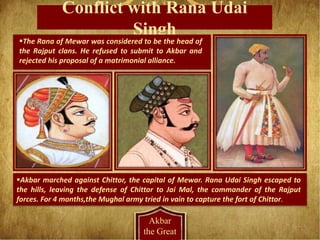
The Rana of Mewar was considered to be the head of
the Rajput clans. He refused to submit to Akbar and
rejected his proposal of a matrimonial alliance.
Akbar marched against Chittor, the capital of Mewar. Rana Udai Singh escaped to
the hills, leaving the defense of Chittor to Jai Mal, the commander of the Rajput
forces. For 4 months,the Mughal army tried in vain to capture the fort of Chittor.
Conflict with Rana Pratap
Singh
Akbar
the Great
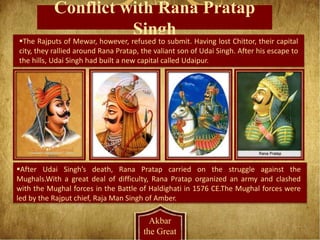
The Rajputs of Mewar, however, refused to submit. Having lost Chittor, their capital
city, they rallied around Rana Pratap, the valiant son of Udai Singh. After his escape to
the hills, Udai Singh had built a new capital called Udaipur.
After Udai Singh’s death, Rana Pratap carried on the struggle against the
Mughals.With a great deal of difficulty, Rana Pratap organized an army and clashed
with the Mughal forces in the Battle of Haldighati in 1576 CE.The Mughal forces were
led by the Rajput chief, Raja Man Singh of Amber.
Administration of
Akbar
Akbar
the Great
1
Wazir/Diwan
Revenue
Department
2
Mir Bakshi
Military and
Head of
Mansabdars
3
Qazi
Chief judge
4
Chief Sadr
Supervisor of
Royal
Household
Council Of Ministers were :-
Akbar was a successful administrator as the principle of
administrative policy was acceptable by everyone.
Central Administration
 It was a mixture of Indian and Persian traditions.
 It consisted of commander-in chief of armed forces and a
Supreme judge on all matters of justice.
Provincial
Administration
Akbar
the Great
[Provincial admin was a miniature of the central admin.]
Subdas
Sarkars
Paranas
VillagesSubhedar
and Diwan
Panchayats
Mansabdari System:
The Mansab is an Arabic word meaning rank or position or status. Thus Mansabdari
was a system in which the rank of a government official was determined.
Every civil and military official was given a Mansab and was called a Mansabdar.
There were two methods of making payments to the nobles. One was giving them
Jagirs (land) wherefrom they got their salaries. The second was making cash
payment.
In the Mansabdari system no Jagirs were granted for the purpose of paying salaries.
A Mansabdar got his salary from the royal treasury.
Revenue System
Akbar
the Great
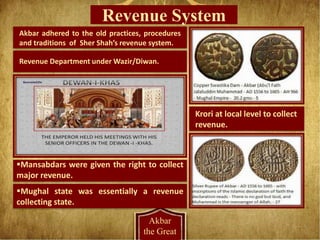
Revenue Department under Wazir/Diwan.
Krori at local level to collect
revenue.
Mansabdars were given the right to collect
major revenue.
Akbar adhered to the old practices, procedures
and traditions of Sher Shah’s revenue system.
Mughal state was essentially a revenue
collecting state.
Akbar’s Religious
Policy
Akbar
the Great
Ibadat Khana –hall of prayer 1575 -built at
Fathepur Sikri
Akbar was interested in learning about
different religion. He invited leaders of
different faiths to discuss their religion.
Issues declaration called the mazar , which
gave him the power to chose different
interpratation of islamic law.
Akbar’s Religion
Akbar
the Great
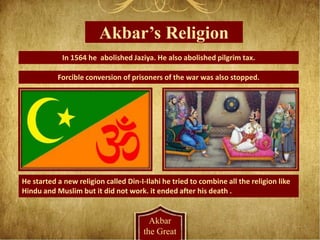
He started a new religion called Din-I-Ilahi he tried to combine all the religion like
Hindu and Muslim but it did not work. it ended after his death .
In 1564 he abolished Jaziya. He also abolished pilgrim tax.
Forcible conversion of prisoners of the war was also stopped.
Akbar’s Rajput
Policies
Akbar
the Great
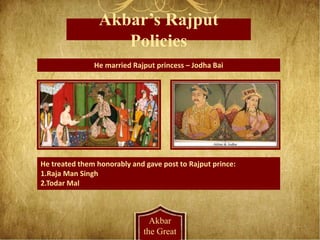
He treated them honorably and gave post to Rajput prince:
1.Raja Man Singh
2.Todar Mal
He married Rajput princess – Jodha Bai
Social & Cultural Achievement
Akbar
the Great
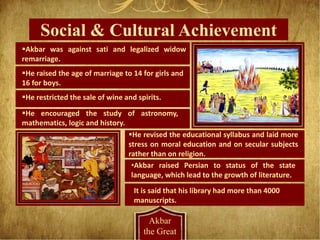
Akbar was against sati and legalized widow
remarriage.
He encouraged the study of astronomy,
mathematics, logic and history.
•Akbar raised Persian to status of the state
language, which lead to the growth of literature.
It is said that his library had more than 4000
manuscripts.
He raised the age of marriage to 14 for girls and
16 for boys.
He restricted the sale of wine and spirits.
He revised the educational syllabus and laid more
stress on moral education and on secular subjects
rather than on religion.
Social & Cultural Achievement
Akbar
the Great
Akbari architecture was known for its
extensive use of red sandstone as a building
material.
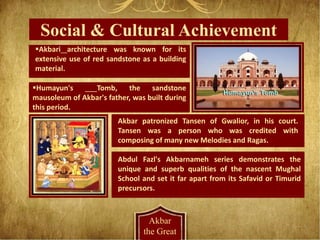
Humayun's Tomb, the sandstone
mausoleum of Akbar's father, was built during
this period.
Akbar patronized Tansen of Gwalior, in his court.
Tansen was a person who was credited with
composing of many new Melodies and Ragas.
Abdul Fazl's Akbarnameh series demonstrates the
unique and superb qualities of the nascent Mughal
School and set it far apart from its Safavid or Timurid
precursors.
Akbar
the Great
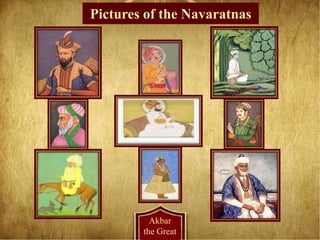
Akbar’s court was adorned by a galaxy of illustrious men known as the nine
gems or navaratnas .
The Nine Gems of Akbar’s court are:
[1] Abul Fazl : He was a scholar, historian and author of Akbarnama and Ain-i-
Akbari.
[2] Faizi: He was a Persian poet laureate and philosopher.
[3] Abdul Rahim Khan –i-khanan: He was a hindi poet and composer of dohas.
[4] Tansen: He was a singer and a musician of a extraordinary talent.
The Nine Gems of Akbar’s
Court
The Nine Gems of Akbar’s
Court
Akbar
the Great
[5] Todar Mal: He was Akbar’s brilliant revenue minister .
[6] Birbal: Akbar’s constant companion, renowned for his intelligent
mind and sharp wit
[7] Raja Maan Singh: He was a great military commander and trusted
advisor of the emperor
[8] Fakir Aziao-Din: He was a mystic and a great advisor for Akbar
[9] Mullah do Piaza: He was a great scholar known for his ready wit
Pictures of the Navaratnas
Akbar
the Great
Thank You

Akbar the Great

  • 1.
  • 2.
    Introduction Akbar the Great Shortly afterHumayun’s return to Delhi after 15 years and re-establishing Mughal rule in India, he died in an accidental fall from his library. Second Battle of Panipat The second battle of Panipat was fought between the forces of Samrat Hem Chandra Vikramaditya, who was also called Hemu, the Hindu king who was ruling North India from Delhi and the army of Jala-ud- din Muhhamad Akbar on November 5th 1556. Akbar, his 13-year old son, was proclaimed the Emperor. He ruled the Mughal empire for the next 50 years (1556-1605 CE) and established himself as the greatest ruler in medieval India.
  • 3.
    Conquest of Akbar Akbar theGreat Conquest of Akbar was largely successful and his empire extended from Kabul in the west to the Bengal in the east and from Kashmir in the north to the Vindhyas in the south. Akbar engaged himself in wars of conquest all through his life. He initiated his conquest of southern India and partially succeeded before he died. Akbar was an imperialist. He frankly declared and desired to pursue the policy of the extension of the empire. He conquered the entire north India and consolidated it, under his administration.
  • 4.
    Bairam Khan’s Regency Akbar the Great BairamKhan became the guardian of Akbar when Akbar was just 13 year old. Bairam Khan was the Chief Military commander in the Mughal Army. The next problem awaiting solution was the setting up of a provisional administration in the territory that had passed into Mughal possession after the second battle of Panipat. Bairam Khan was born in Badakhshan and joined the service of Mughal Emperor Babur at the age of 16. Later on Bairam Khan contributed towards the establishment of Mughal Empire in India under Humayun and Akbar. The outstanding achievements of Bairam Khan as a regent were the defeat of Hemu and the elimination of Akbar’s Sur rivals.
  • 5.
    Conflict with RanaUdai Singh Akbar the Great The Rana of Mewar was considered to be the head of the Rajput clans. He refused to submit to Akbar and rejected his proposal of a matrimonial alliance. Akbar marched against Chittor, the capital of Mewar. Rana Udai Singh escaped to the hills, leaving the defense of Chittor to Jai Mal, the commander of the Rajput forces. For 4 months,the Mughal army tried in vain to capture the fort of Chittor.
  • 6.
    Conflict with RanaPratap Singh Akbar the Great The Rajputs of Mewar, however, refused to submit. Having lost Chittor, their capital city, they rallied around Rana Pratap, the valiant son of Udai Singh. After his escape to the hills, Udai Singh had built a new capital called Udaipur. After Udai Singh’s death, Rana Pratap carried on the struggle against the Mughals.With a great deal of difficulty, Rana Pratap organized an army and clashed with the Mughal forces in the Battle of Haldighati in 1576 CE.The Mughal forces were led by the Rajput chief, Raja Man Singh of Amber.
  • 7.
    Administration of Akbar Akbar the Great 1 Wazir/Diwan Revenue Department 2 MirBakshi Military and Head of Mansabdars 3 Qazi Chief judge 4 Chief Sadr Supervisor of Royal Household Council Of Ministers were :- Akbar was a successful administrator as the principle of administrative policy was acceptable by everyone. Central Administration  It was a mixture of Indian and Persian traditions.  It consisted of commander-in chief of armed forces and a Supreme judge on all matters of justice.
  • 8.
    Provincial Administration Akbar the Great [Provincial adminwas a miniature of the central admin.] Subdas Sarkars Paranas VillagesSubhedar and Diwan Panchayats Mansabdari System: The Mansab is an Arabic word meaning rank or position or status. Thus Mansabdari was a system in which the rank of a government official was determined. Every civil and military official was given a Mansab and was called a Mansabdar. There were two methods of making payments to the nobles. One was giving them Jagirs (land) wherefrom they got their salaries. The second was making cash payment. In the Mansabdari system no Jagirs were granted for the purpose of paying salaries. A Mansabdar got his salary from the royal treasury.
  • 9.
    Revenue System Akbar the Great RevenueDepartment under Wazir/Diwan. Krori at local level to collect revenue. Mansabdars were given the right to collect major revenue. Akbar adhered to the old practices, procedures and traditions of Sher Shah’s revenue system. Mughal state was essentially a revenue collecting state.
  • 10.
    Akbar’s Religious Policy Akbar the Great IbadatKhana –hall of prayer 1575 -built at Fathepur Sikri Akbar was interested in learning about different religion. He invited leaders of different faiths to discuss their religion. Issues declaration called the mazar , which gave him the power to chose different interpratation of islamic law.
  • 11.
    Akbar’s Religion Akbar the Great Hestarted a new religion called Din-I-Ilahi he tried to combine all the religion like Hindu and Muslim but it did not work. it ended after his death . In 1564 he abolished Jaziya. He also abolished pilgrim tax. Forcible conversion of prisoners of the war was also stopped.
  • 12.
    Akbar’s Rajput Policies Akbar the Great Hetreated them honorably and gave post to Rajput prince: 1.Raja Man Singh 2.Todar Mal He married Rajput princess – Jodha Bai
  • 13.
    Social & CulturalAchievement Akbar the Great Akbar was against sati and legalized widow remarriage. He encouraged the study of astronomy, mathematics, logic and history. •Akbar raised Persian to status of the state language, which lead to the growth of literature. It is said that his library had more than 4000 manuscripts. He raised the age of marriage to 14 for girls and 16 for boys. He restricted the sale of wine and spirits. He revised the educational syllabus and laid more stress on moral education and on secular subjects rather than on religion.
  • 14.
    Social & CulturalAchievement Akbar the Great Akbari architecture was known for its extensive use of red sandstone as a building material. Humayun's Tomb, the sandstone mausoleum of Akbar's father, was built during this period. Akbar patronized Tansen of Gwalior, in his court. Tansen was a person who was credited with composing of many new Melodies and Ragas. Abdul Fazl's Akbarnameh series demonstrates the unique and superb qualities of the nascent Mughal School and set it far apart from its Safavid or Timurid precursors.
  • 15.
    Akbar the Great Akbar’s courtwas adorned by a galaxy of illustrious men known as the nine gems or navaratnas . The Nine Gems of Akbar’s court are: [1] Abul Fazl : He was a scholar, historian and author of Akbarnama and Ain-i- Akbari. [2] Faizi: He was a Persian poet laureate and philosopher. [3] Abdul Rahim Khan –i-khanan: He was a hindi poet and composer of dohas. [4] Tansen: He was a singer and a musician of a extraordinary talent. The Nine Gems of Akbar’s Court
  • 16.
    The Nine Gemsof Akbar’s Court Akbar the Great [5] Todar Mal: He was Akbar’s brilliant revenue minister . [6] Birbal: Akbar’s constant companion, renowned for his intelligent mind and sharp wit [7] Raja Maan Singh: He was a great military commander and trusted advisor of the emperor [8] Fakir Aziao-Din: He was a mystic and a great advisor for Akbar [9] Mullah do Piaza: He was a great scholar known for his ready wit
  • 17.
    Pictures of theNavaratnas Akbar the Great
  • 18.