AKBAR’S RAJPUT
POLICY
PRESENTEDBY,
JULIYASAJI
ROLLNO:39
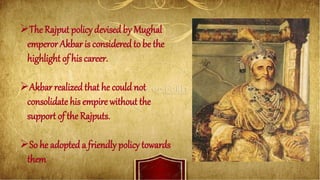
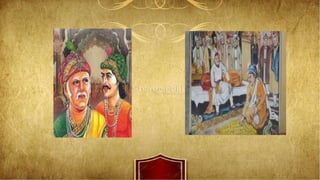
The Rajput policy devisedby Mughal
emperor Akbar is consideredto be the
highlight of his career.
Akbar realizedthat he couldnot
consolidate his empire without the
support of the Rajputs.
So he adopteda friendly policy towards
them
Features of Akbar’s Rajput policy
1.Matrimonial alliances
He made matrimonial alliances withthe Rajputs
In 1562, Akbar married the daughter of Raja Bihari Mai of Amber (modern Jaipur).
Akbar’s son Salimwho came to be known as Jahangir was born fromthis queen.
He also married two other princesses, one of Jodhpur and other of Jaisalmer. He married
his son Jahangir to the daughter of Raja Bhagwan Dass, son of Raja Bihari Mai. Khusrau,
another son of Jahangir, was born to this princess
.
 The marriageof Akbar in thefamilyof Jaipur is consideredas of great
significance.
 It symbolized the dawn of a new era in Indian politics, it gave the countrya line
of remarkable sovereigns, it secured to the four generations of Mughal emperors
the services of some of the greatest captains and diplomats that medieval India
produced.
2. Appointment to high posts
 He appointed Rajputs at high positions in the administration likeRaja Bihari
Mai and his son ,Raja Man Singh,Birbal etc.
3. Equal Treatment
Akbar accordedequal status to the Rajput.
4.Religious Independence
Akbar grantedfull religious independence to the Rajput’s in respect of their
religion. They could buildtemples, worship in themand celebratetheir festivals.
Rajput queens were free in the observance of their faith.
5. All those Rajput rulers who submitted to Akbar after fighting against himwere
given full respect and honours .
 But Akbar, being an imperialist, never toleratedopposition. He launchedmilitary campaigns
against all those Rajput rulers who did not surrender. He conquered Ranthambhor and
Kalinjar – two important Rajput states. However, Akbar’s campaign against Mewar was not
quitesuccessful.
 6.Employment of Rajput’s in the army
 It is said that Rajput’s were holding more than 20 per cent posts in the army.
7. Internal freedomto Rajput kingdoms

 Akbar did not interfere in the internal administration of Rajput kingdoms
8. Personal relations:
 Akbarestablishedmany personal relations withthe Rajput rulers.ItIs said that whenthe son in law of Rai
Singh of Bikaner dieddue to the fall fromthe palanquin, Akbar himself went their to console the family an
share their grief.
9.Reforms in Rajput society
 Akbarattempted to remove some of the evils likethe ‘Sati’ and child marriage fromthe RajputSociety. He
also gave royal sanction to widowremarriage.
10. Abolition of Jizya
 Akbarremoved‘Jizyaatax whichwas levied by the Muslimrulers uponthe Non-Muslims.
11. Respect for cow
 He forbade the cow slaughter.
Significance Of Rajput policy
1. Expansion of Akbar’s influence:
The policy of friendship contributedto the extensionof the Mughal Empire. The Rajput’s had become the
‘Swordand Shield’ of Akbar.
2. Military help:
The Rajput rulers providedstrong military help to Akbar in waging wars and conquering several
territories.
3. Strengthening of administration:
Akbarwas able to secure the services of Rajput’s in the efficient running of the administration. Some of the
Rajput Governors of Mughal provinces proved very helpful.
4. Advantages to Rajputs:
The Rajput rulers got honour, high offices, big jagirs and confidential posts in the royal service.
They were also free to devote their resources on welfare pursuits in place of war adventures.
5. Cultural integration:
According to Dr. lshwari Prasad, “Anew culture – Indo-Muslimculture” was born. Akbar gave
encouragement to Sanskrit, Hindi and other regional languages. There is no doubt that the
Rajput’s made great contribution in the field of Akbar’s expansion of empire, statecraft,
administration, cultural, economic and social progress.
Akbar's Rajput Policy -by Juliya

Akbar's Rajput Policy -by Juliya

  • 1.
  • 2.
    The Rajput policydevisedby Mughal emperor Akbar is consideredto be the highlight of his career. Akbar realizedthat he couldnot consolidate his empire without the support of the Rajputs. So he adopteda friendly policy towards them
  • 3.
    Features of Akbar’sRajput policy 1.Matrimonial alliances He made matrimonial alliances withthe Rajputs In 1562, Akbar married the daughter of Raja Bihari Mai of Amber (modern Jaipur). Akbar’s son Salimwho came to be known as Jahangir was born fromthis queen. He also married two other princesses, one of Jodhpur and other of Jaisalmer. He married his son Jahangir to the daughter of Raja Bhagwan Dass, son of Raja Bihari Mai. Khusrau, another son of Jahangir, was born to this princess
  • 4.
  • 5.
     The marriageofAkbar in thefamilyof Jaipur is consideredas of great significance.  It symbolized the dawn of a new era in Indian politics, it gave the countrya line of remarkable sovereigns, it secured to the four generations of Mughal emperors the services of some of the greatest captains and diplomats that medieval India produced. 2. Appointment to high posts  He appointed Rajputs at high positions in the administration likeRaja Bihari Mai and his son ,Raja Man Singh,Birbal etc.
  • 7.
    3. Equal Treatment Akbaraccordedequal status to the Rajput. 4.Religious Independence Akbar grantedfull religious independence to the Rajput’s in respect of their religion. They could buildtemples, worship in themand celebratetheir festivals. Rajput queens were free in the observance of their faith. 5. All those Rajput rulers who submitted to Akbar after fighting against himwere given full respect and honours .
  • 8.
     But Akbar,being an imperialist, never toleratedopposition. He launchedmilitary campaigns against all those Rajput rulers who did not surrender. He conquered Ranthambhor and Kalinjar – two important Rajput states. However, Akbar’s campaign against Mewar was not quitesuccessful.  6.Employment of Rajput’s in the army  It is said that Rajput’s were holding more than 20 per cent posts in the army. 7. Internal freedomto Rajput kingdoms   Akbar did not interfere in the internal administration of Rajput kingdoms
  • 9.
    8. Personal relations: Akbarestablishedmany personal relations withthe Rajput rulers.ItIs said that whenthe son in law of Rai Singh of Bikaner dieddue to the fall fromthe palanquin, Akbar himself went their to console the family an share their grief. 9.Reforms in Rajput society  Akbarattempted to remove some of the evils likethe ‘Sati’ and child marriage fromthe RajputSociety. He also gave royal sanction to widowremarriage. 10. Abolition of Jizya  Akbarremoved‘Jizyaatax whichwas levied by the Muslimrulers uponthe Non-Muslims. 11. Respect for cow  He forbade the cow slaughter.
  • 10.
    Significance Of Rajputpolicy 1. Expansion of Akbar’s influence: The policy of friendship contributedto the extensionof the Mughal Empire. The Rajput’s had become the ‘Swordand Shield’ of Akbar. 2. Military help: The Rajput rulers providedstrong military help to Akbar in waging wars and conquering several territories. 3. Strengthening of administration: Akbarwas able to secure the services of Rajput’s in the efficient running of the administration. Some of the Rajput Governors of Mughal provinces proved very helpful.
  • 11.
    4. Advantages toRajputs: The Rajput rulers got honour, high offices, big jagirs and confidential posts in the royal service. They were also free to devote their resources on welfare pursuits in place of war adventures. 5. Cultural integration: According to Dr. lshwari Prasad, “Anew culture – Indo-Muslimculture” was born. Akbar gave encouragement to Sanskrit, Hindi and other regional languages. There is no doubt that the Rajput’s made great contribution in the field of Akbar’s expansion of empire, statecraft, administration, cultural, economic and social progress.