www.oeclib.in
Submitted By:
Odisha Electronics Control Library
Seminar
On
AJAX
 INTRODUCTION
 WHAT IS AJAX?
 TECHNOLOGIES
 AJAX WORKS
 AJAX - SERVER RESPONSE
 ADVANTAGES
 DISADVANTAGES
 CONCLUSIONS
 REFERENCES
Ajax stands for asynchronous JavaScript and XML.
It is a group of interrelated web development techniques used on
the client-side to create interactive web applications .
AJAX is about updating parts of a web page, without reloading
the whole page.
Ajax uses a combination of HTML and CSS to mark up and style
information .
 Asynchronous JavaScript and XML (AJAX).
 Not a stand-alone language or technology.
 Combines a set of known technologies in order to create faster
andmore user friendly web pages.
 Client side technology.
 Makes web pages more responsive by exchanging small amounts
ofdata.
 Allows the web page to change its content without refreshing
thewhole page.
 Web browser technology independent of web server software.
• HTML or XHTML and CSS for presentation
• The Document Object Model for dynamic display of and
interaction with data
• XML for the interchange of data, and XSLT for its
manipulation
• The XMLHttpRequest object for asynchronous
communication
• JavaScript to bring these technologies together
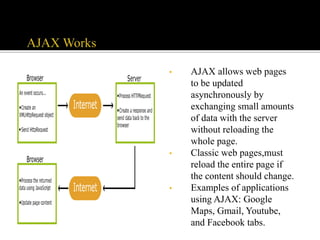
• AJAX allows web pages
to be updated
asynchronously by
exchanging small amounts
of data with the server
without reloading the
whole page.
• Classic web pages,must
reload the entire page if
the content should change.
• Examples of applications
using AJAX: Google
Maps, Gmail, Youtube,
and Facebook tabs.
• The AJAX application contains one div section and one
button.
• The div section will be used to display information returned
from a server.
• The button specify and hold function.
• The script section contains the function.
• The XMLHttpRequest object is used to exchange data with a
server behind the scenes(i,e) possible to update parts of a web
page, without reloading the whole page.
• Syntax for creating an XMLHttpRequest object:
xmlhttp=new XMLHttpRequest();
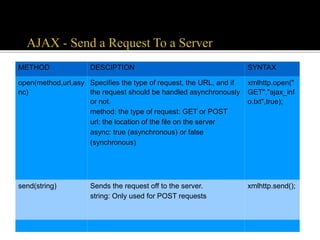
METHOD DESCIPTION SYNTAX
open(method,url,asy
nc)
Specifies the type of request, the URL, and if
the request should be handled asynchronously
or not.
method: the type of request: GET or POST
url: the location of the file on the server
async: true (asynchronous) or false
(synchronous)
xmlhttp.open("
GET","ajax_inf
o.txt",true);
send(string) Sends the request off to the server.
string: Only used for POST requests
xmlhttp.send();
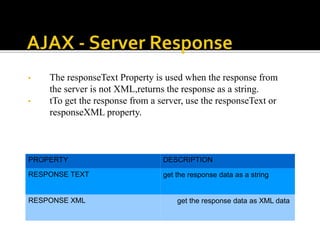
• The responseText Property is used when the response from
the server is not XML,returns the response as a string.
• tTo get the response from a server, use the responseText or
responseXML property.
PROPERTY DESCRIPTION
RESPONSE TEXT get the response data as a string
RESPONSE XML get the response data as XML data
• When a request is sent to server, we need to perform some
actions based on the response.
• Three important properties of the XMLHttpRequest object:
I. The onreadystatechange event is triggered every time the
readyState changes.
II. The readyState property holds the status of the
XMLHttpRequest.
III. status 200: "OK"
 Using a Callback Function
• A callback function is a function passed as a parameter to
another function.
• If you have more than one AJAX task on your website, you
should create ONE standard function for creating the
XMLHttpRequest object, and call this for each AJAX task.
• The function call should contain the URL and what to do on
onreadystatechange.
• page can be refreshed dynamically
• response of the interface to user is faster
• load much faster because the payload is much smaller
• reduces the demand for bandwidth
• allows the web applications to be much more efficient
• operate more like an application rather than a standalone
program
• integration of browsers
• hard for the user to bookmark the state of the web page
 Ajax provides functionality to create a robust web application.
 If an Ajax web application is coded properly it will run faster than
and as secure as a non-Ajax program.
 Ajax also allows websites to reduce their overall bandwidth usage
and server load by reducing the amount of full page loads.
 www.google.com
 www.wikipedia.com
 www.oeclib.in
THANKS

Ajax ppt

  • 1.
    www.oeclib.in Submitted By: Odisha ElectronicsControl Library Seminar On AJAX
  • 2.
     INTRODUCTION  WHATIS AJAX?  TECHNOLOGIES  AJAX WORKS  AJAX - SERVER RESPONSE  ADVANTAGES  DISADVANTAGES  CONCLUSIONS  REFERENCES
  • 3.
    Ajax stands forasynchronous JavaScript and XML. It is a group of interrelated web development techniques used on the client-side to create interactive web applications . AJAX is about updating parts of a web page, without reloading the whole page. Ajax uses a combination of HTML and CSS to mark up and style information .
  • 4.
     Asynchronous JavaScriptand XML (AJAX).  Not a stand-alone language or technology.  Combines a set of known technologies in order to create faster andmore user friendly web pages.  Client side technology.  Makes web pages more responsive by exchanging small amounts ofdata.  Allows the web page to change its content without refreshing thewhole page.  Web browser technology independent of web server software.
  • 5.
    • HTML orXHTML and CSS for presentation • The Document Object Model for dynamic display of and interaction with data • XML for the interchange of data, and XSLT for its manipulation • The XMLHttpRequest object for asynchronous communication • JavaScript to bring these technologies together
  • 6.
    • AJAX allowsweb pages to be updated asynchronously by exchanging small amounts of data with the server without reloading the whole page. • Classic web pages,must reload the entire page if the content should change. • Examples of applications using AJAX: Google Maps, Gmail, Youtube, and Facebook tabs.
  • 7.
    • The AJAXapplication contains one div section and one button. • The div section will be used to display information returned from a server. • The button specify and hold function. • The script section contains the function.
  • 8.
    • The XMLHttpRequestobject is used to exchange data with a server behind the scenes(i,e) possible to update parts of a web page, without reloading the whole page. • Syntax for creating an XMLHttpRequest object: xmlhttp=new XMLHttpRequest();
  • 9.
    METHOD DESCIPTION SYNTAX open(method,url,asy nc) Specifiesthe type of request, the URL, and if the request should be handled asynchronously or not. method: the type of request: GET or POST url: the location of the file on the server async: true (asynchronous) or false (synchronous) xmlhttp.open(" GET","ajax_inf o.txt",true); send(string) Sends the request off to the server. string: Only used for POST requests xmlhttp.send();
  • 10.
    • The responseTextProperty is used when the response from the server is not XML,returns the response as a string. • tTo get the response from a server, use the responseText or responseXML property. PROPERTY DESCRIPTION RESPONSE TEXT get the response data as a string RESPONSE XML get the response data as XML data
  • 11.
    • When arequest is sent to server, we need to perform some actions based on the response. • Three important properties of the XMLHttpRequest object: I. The onreadystatechange event is triggered every time the readyState changes. II. The readyState property holds the status of the XMLHttpRequest. III. status 200: "OK"
  • 12.
     Using aCallback Function • A callback function is a function passed as a parameter to another function. • If you have more than one AJAX task on your website, you should create ONE standard function for creating the XMLHttpRequest object, and call this for each AJAX task. • The function call should contain the URL and what to do on onreadystatechange.
  • 13.
    • page canbe refreshed dynamically • response of the interface to user is faster • load much faster because the payload is much smaller • reduces the demand for bandwidth • allows the web applications to be much more efficient • operate more like an application rather than a standalone program
  • 14.
    • integration ofbrowsers • hard for the user to bookmark the state of the web page
  • 15.
     Ajax providesfunctionality to create a robust web application.  If an Ajax web application is coded properly it will run faster than and as secure as a non-Ajax program.  Ajax also allows websites to reduce their overall bandwidth usage and server load by reducing the amount of full page loads.
  • 16.
  • 17.

Editor's Notes