Deep Virtual Stereo Odometry:
Leveraging Deep Depth Prediction for Monocular
Direct Sparse Odometry [ECCV2018(oral)]
The University of Tokyo
Aizawa Lab M1 Masaya Kaneko
論文読み会 @ AIST
1
Introduction
• Monocular Visual Odometry
– Camera’s trajectory estimation and 3D reconstruction from
image sequences obtained by monocular camera
Direct Sparse Odometry [Engel+, PAMI’18]
2
Introduction
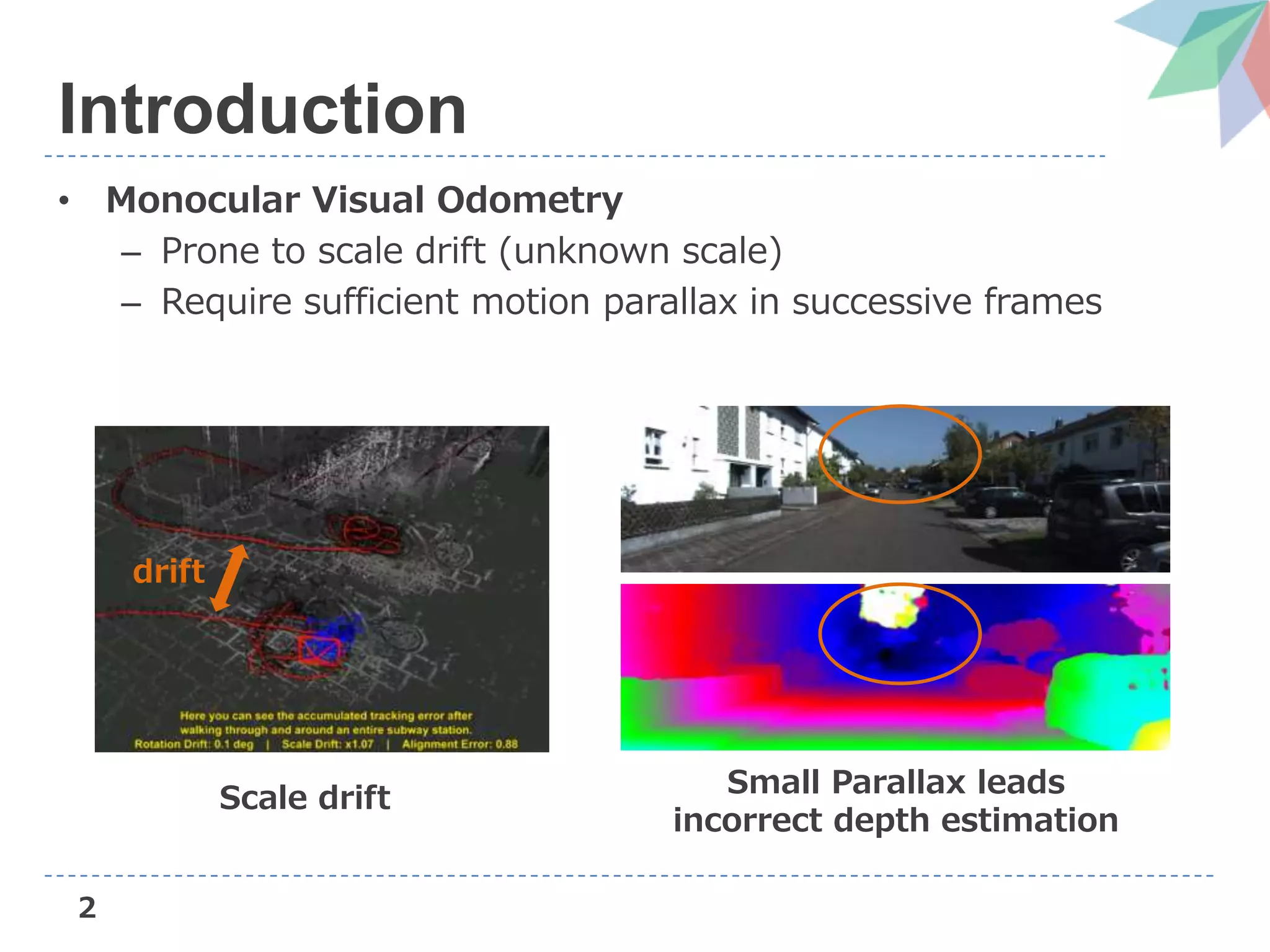
• Monocular Visual Odometry
– Prone to scale drift (unknown scale)
– Require sufficient motion parallax in successive frames
Scale drift Small Parallax leads
incorrect depth estimation
drift
3
Introduction
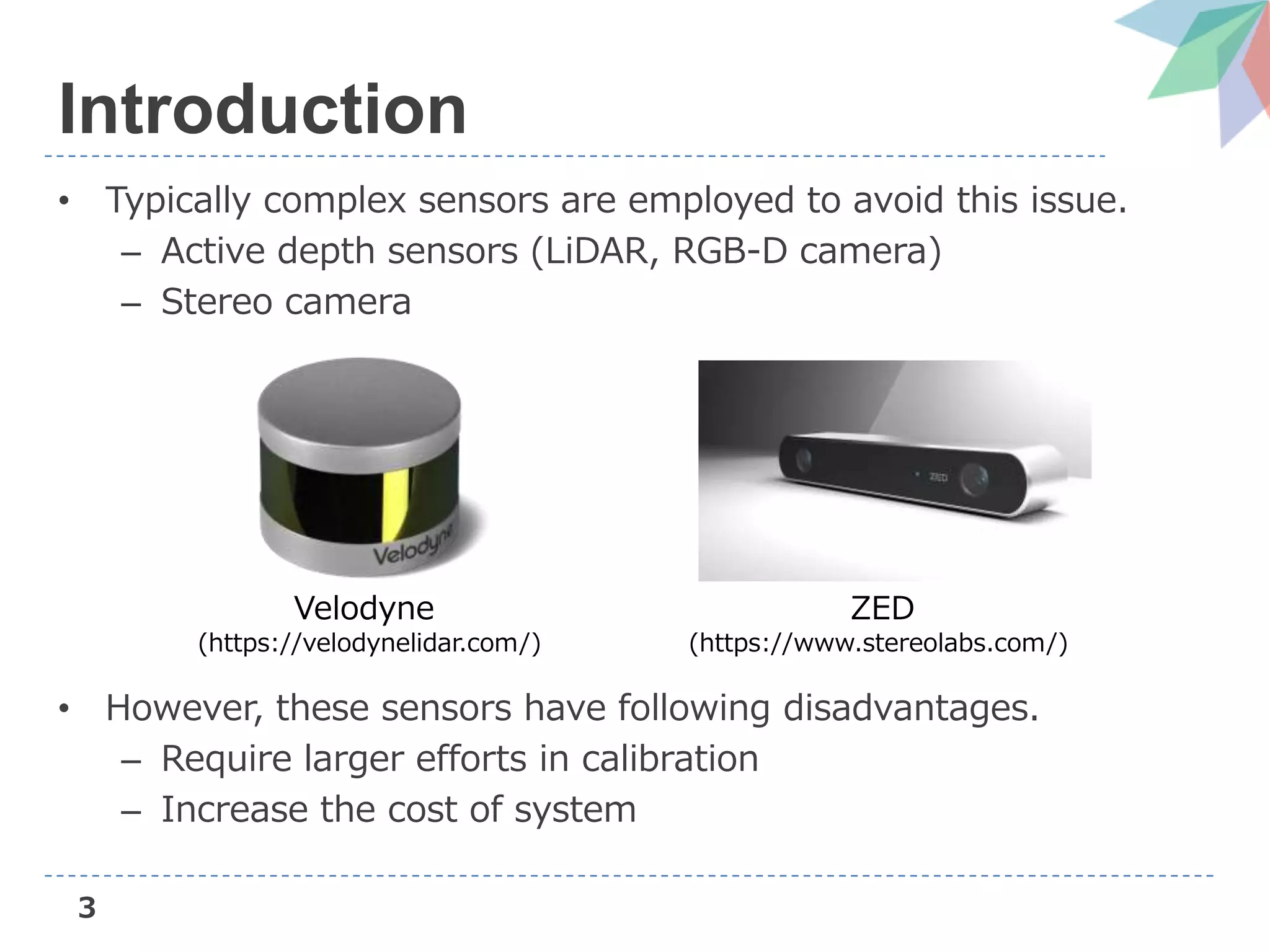
• Typically complex sensors are employed to avoid this issue.
– Active depth sensors (LiDAR, RGB-D camera)
– Stereo camera
• However, these sensors have following disadvantages.
– Require larger efforts in calibration
– Increase the cost of system
Velodyne
(https://velodynelidar.com/)
ZED
(https://www.stereolabs.com/)
4
Introduction
• If a priori knowledge about environment is used, this issue
can be solved without complex sensors.
– Deep based approach like CNN-SLAM [Tateno+, CVPR’18]
– Now they propose a method to adapt this approach into
state-of-the-art VO, DSO (Direct Sparse Odometry).
https://drive.google.com/file/d/108CttbYiBqaI3b1jIJFTS26SzNfQqQNG/view
5
Problem setting
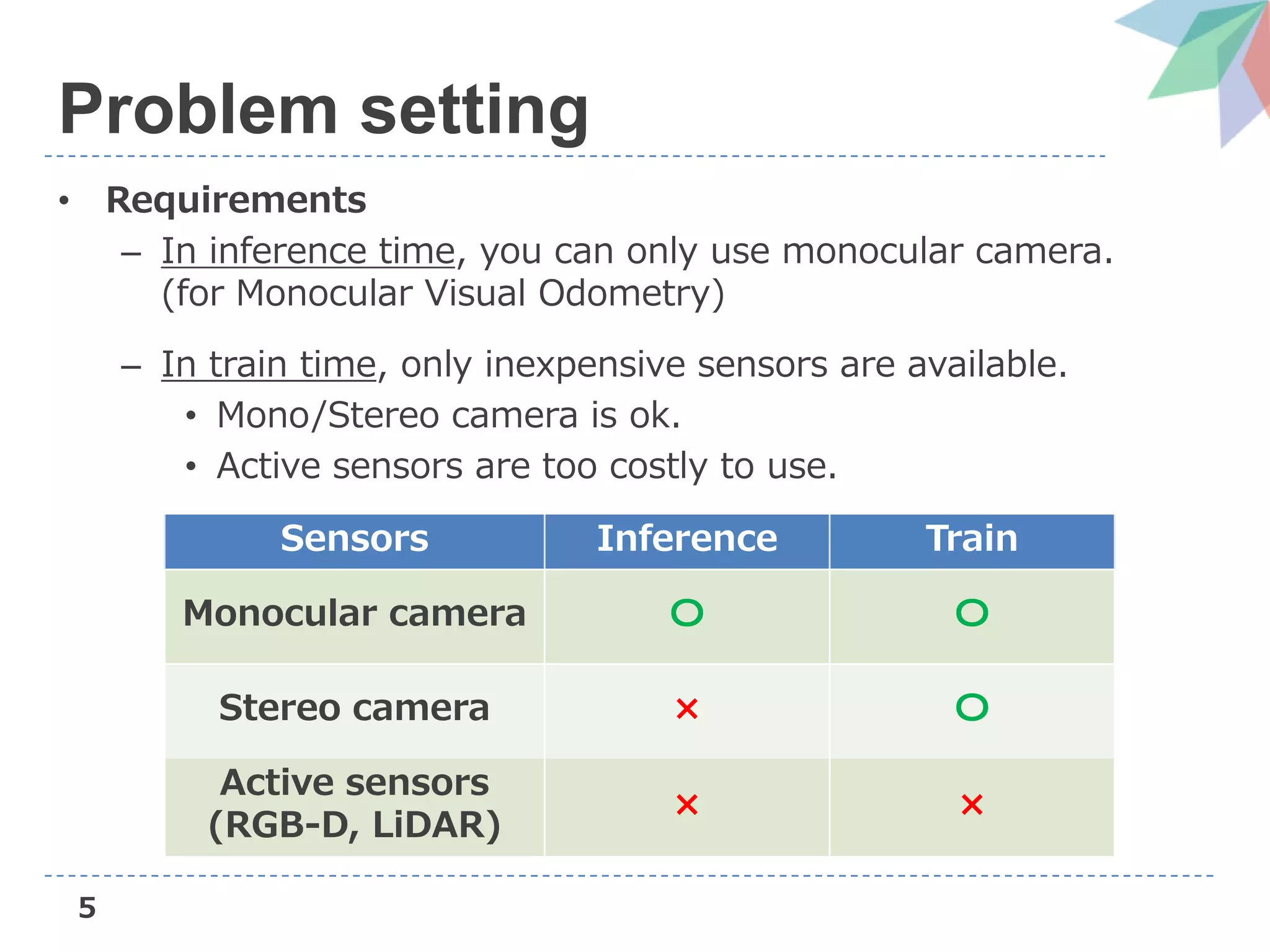
• Requirements
– In inference time, you can only use monocular camera.
(for Monocular Visual Odometry)
– In train time, only inexpensive sensors are available.
• Mono/Stereo camera is ok.
• Active sensors are too costly to use.
Sensors Inference Train
Monocular camera 〇 〇
Stereo camera × 〇
Active sensors
(RGB-D, LiDAR)
× ×
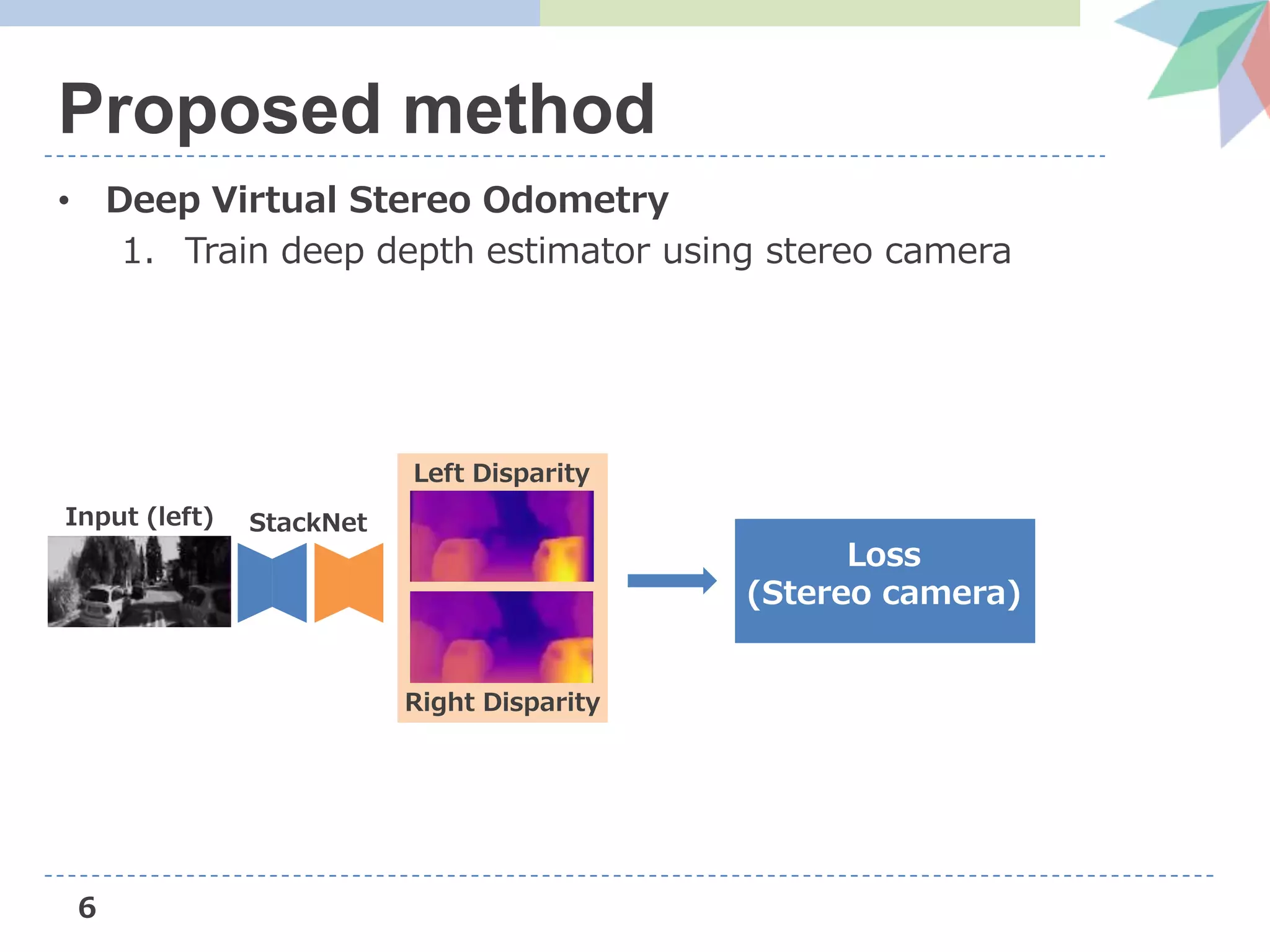
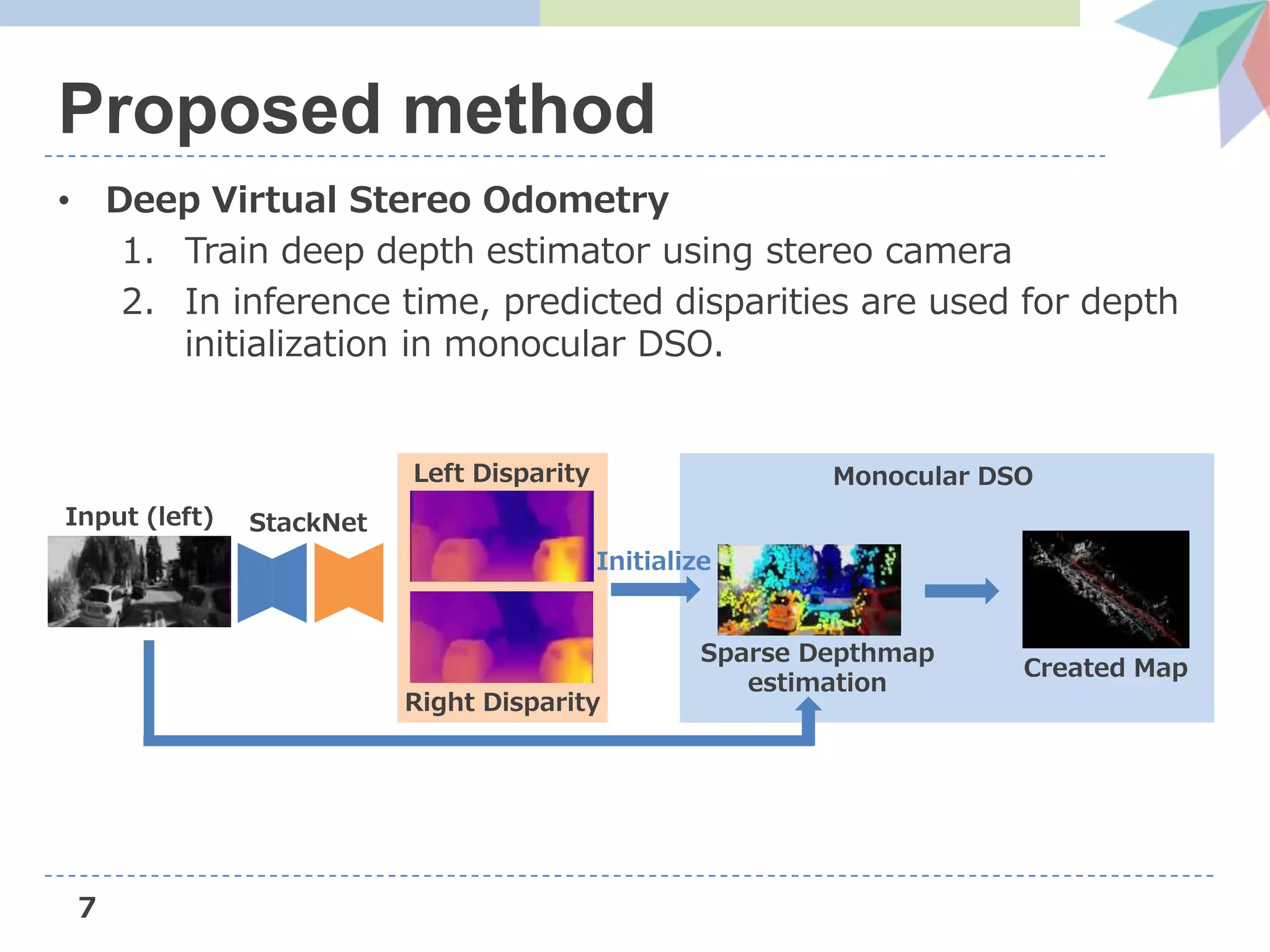
• Deep Virtual Stereo Odometry
1. Train deep depth estimator using stereo camera
6
Proposed method
Loss
(Stereo camera)
Input (left)
Left Disparity
Right Disparity
StackNet
• Deep Virtual Stereo Odometry
1. Train deep depth estimator using stereo camera
2. In inference time, predicted disparities are used for depth
initialization in monocular DSO.
7
Proposed method
Monocular DSO
Sparse Depthmap
estimation
Created Map
Input (left)
Left Disparity
Right Disparity
Initialize
StackNet
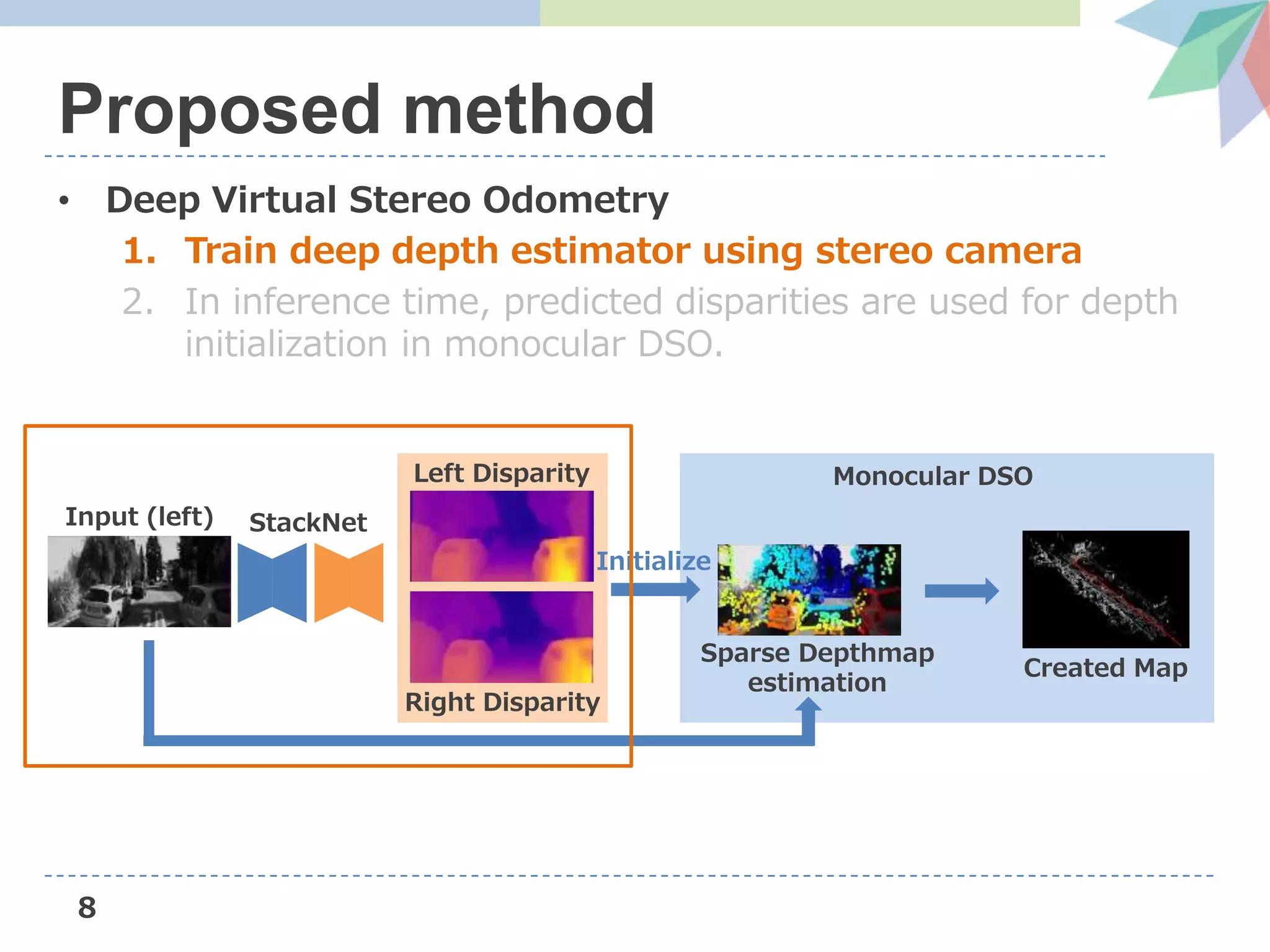
• Deep Virtual Stereo Odometry
1. Train deep depth estimator using stereo camera
2. In inference time, predicted disparities are used for depth
initialization in monocular DSO.
8
Proposed method
Monocular DSO
Sparse Depthmap
estimation
Created Map
Input (left)
Left Disparity
Right Disparity
Initialize
StackNet
9
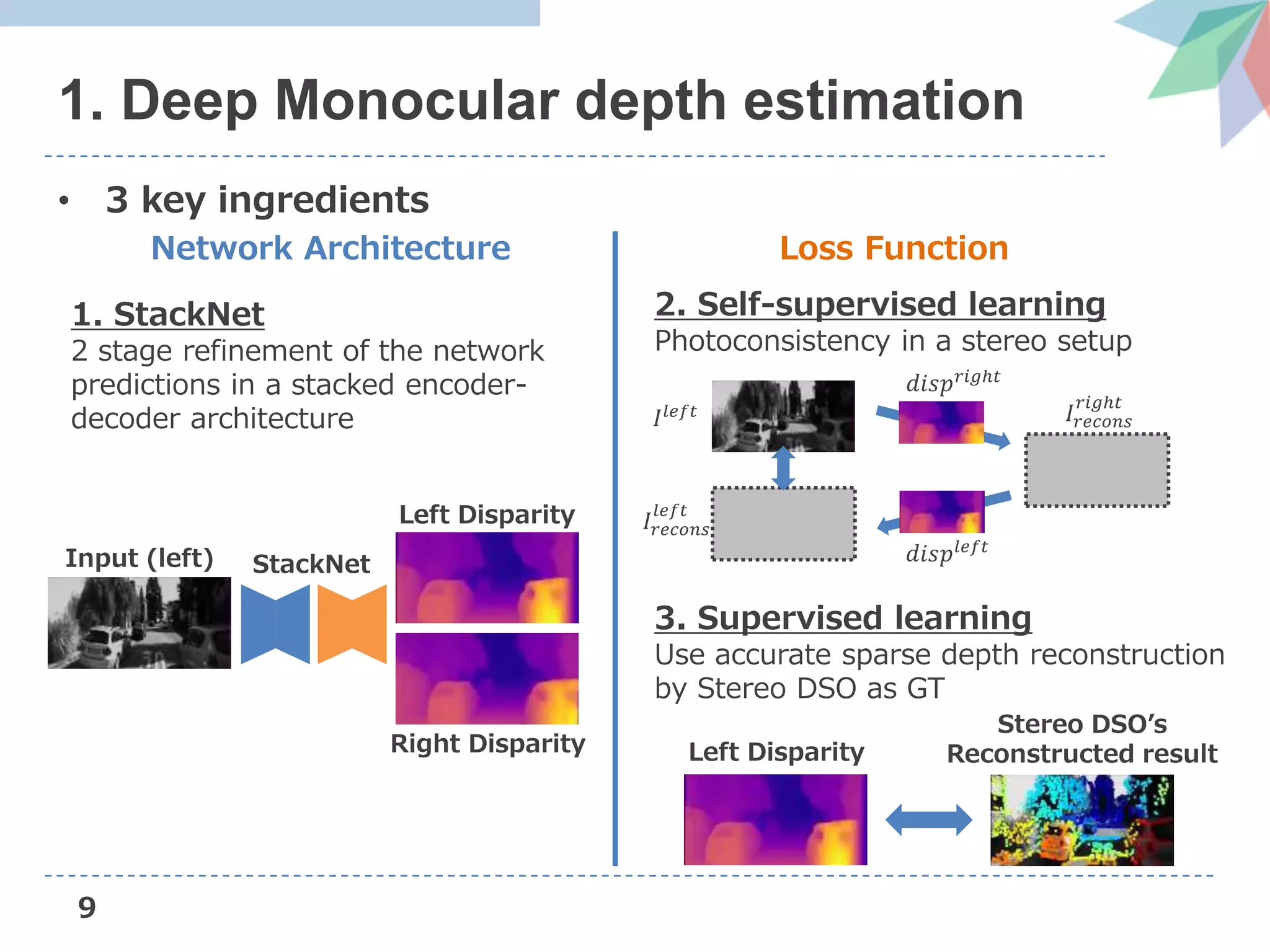
1. Deep Monocular depth estimation
• 3 key ingredients
Network Architecture Loss Function
1. StackNet
2 stage refinement of the network
predictions in a stacked encoder-
decoder architecture
Input (left)
Left Disparity
Right Disparity
StackNet
3. Supervised learning
Use accurate sparse depth reconstruction
by Stereo DSO as GT
Left Disparity
Stereo DSO’s
Reconstructed result
2. Self-supervised learning
Photoconsistency in a stereo setup
𝐼𝑙𝑒𝑓𝑡
𝑑𝑖𝑠𝑝 𝑟𝑖𝑔ℎ𝑡
𝐼𝑟𝑒𝑐𝑜𝑛𝑠
𝑟𝑖𝑔ℎ𝑡
𝐼𝑟𝑒𝑐𝑜𝑛𝑠
𝑙𝑒𝑓𝑡
𝑑𝑖𝑠𝑝𝑙𝑒𝑓𝑡
10
1. Deep Monocular depth estimation
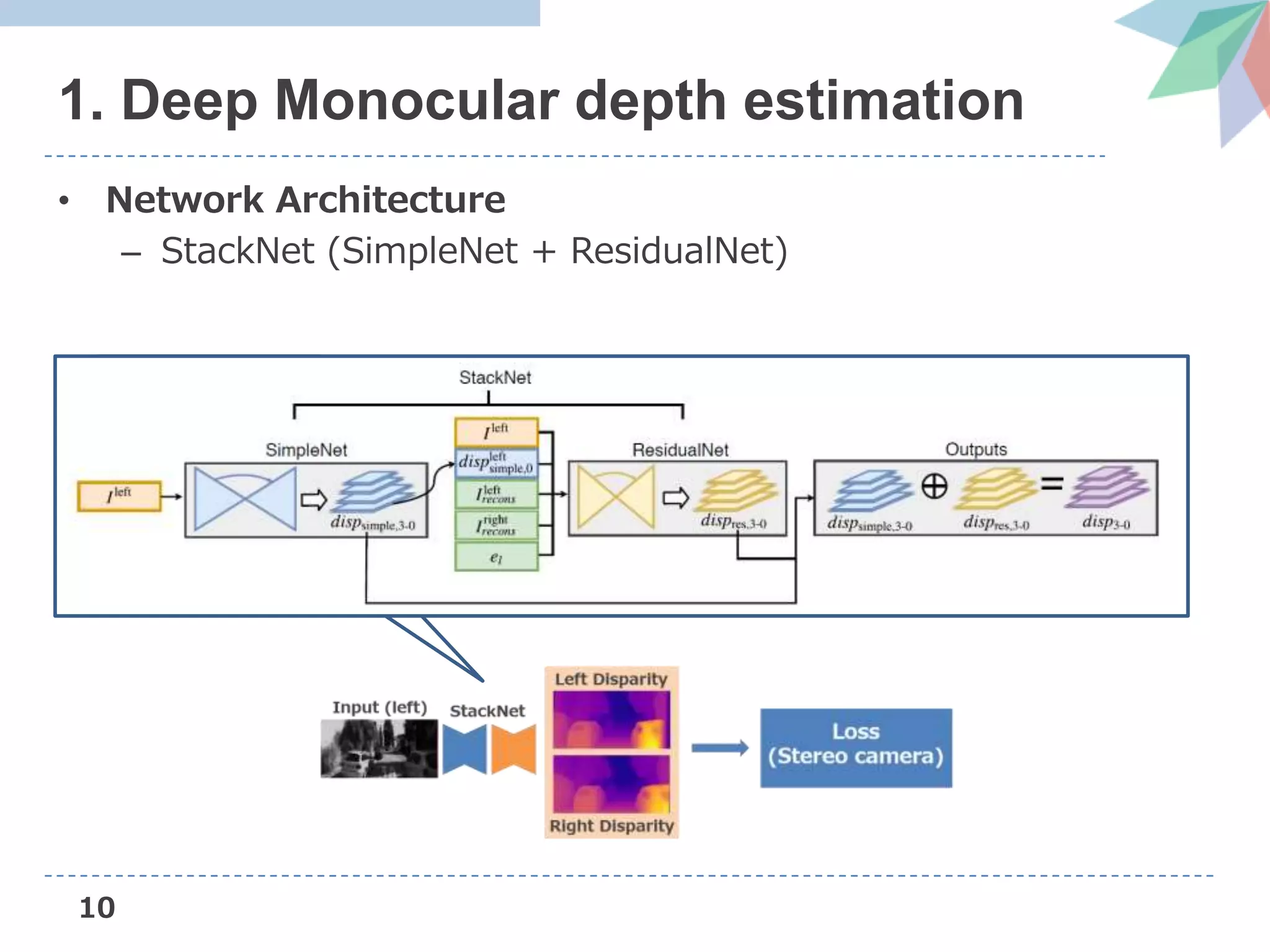
• Network Architecture
– StackNet (SimpleNet + ResidualNet)
11
1. Deep Monocular depth estimation
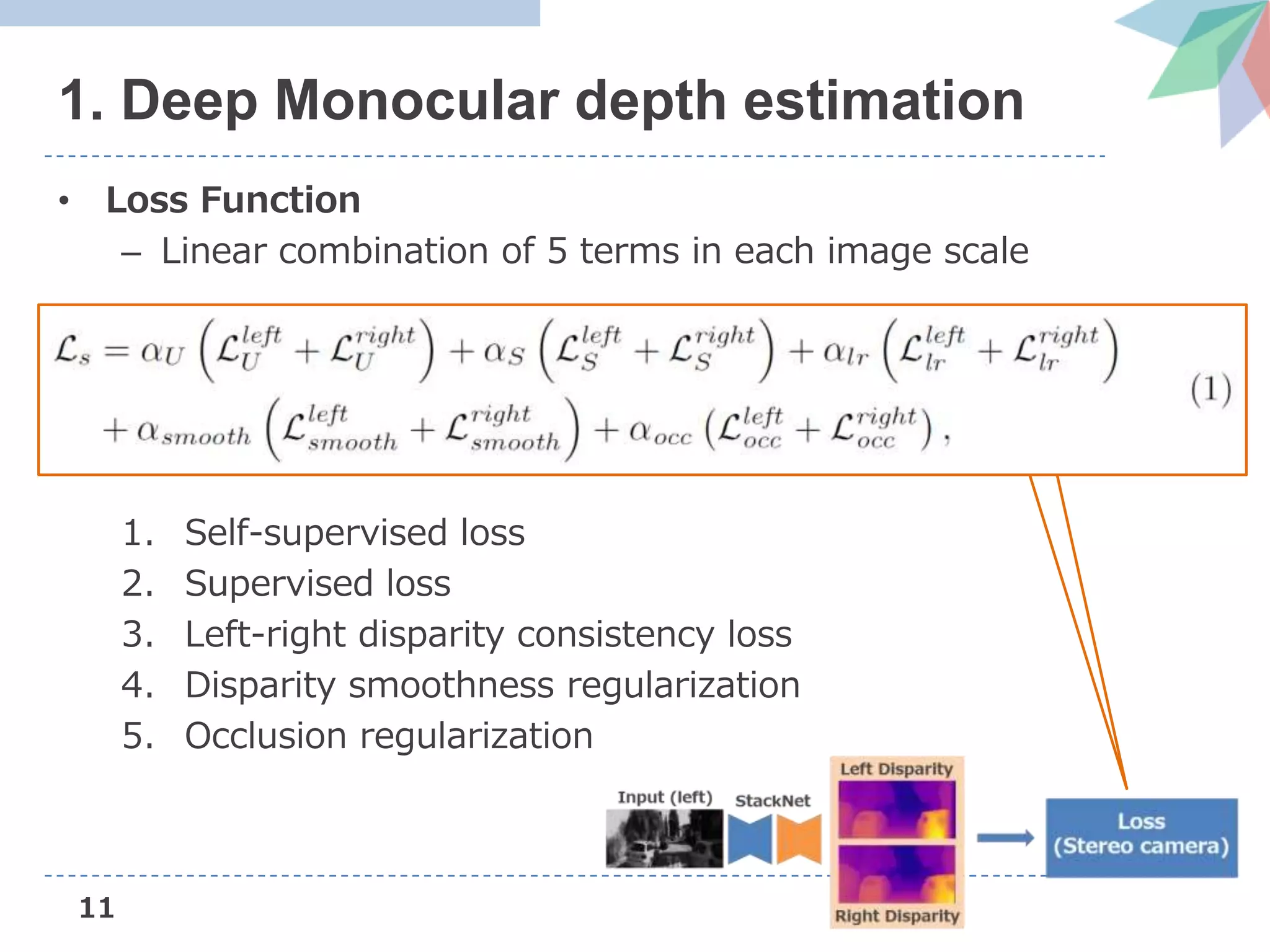
• Loss Function
– Linear combination of 5 terms in each image scale
1. Self-supervised loss
2. Supervised loss
3. Left-right disparity consistency loss
4. Disparity smoothness regularization
5. Occlusion regularization
12
1. Deep Monocular depth estimation
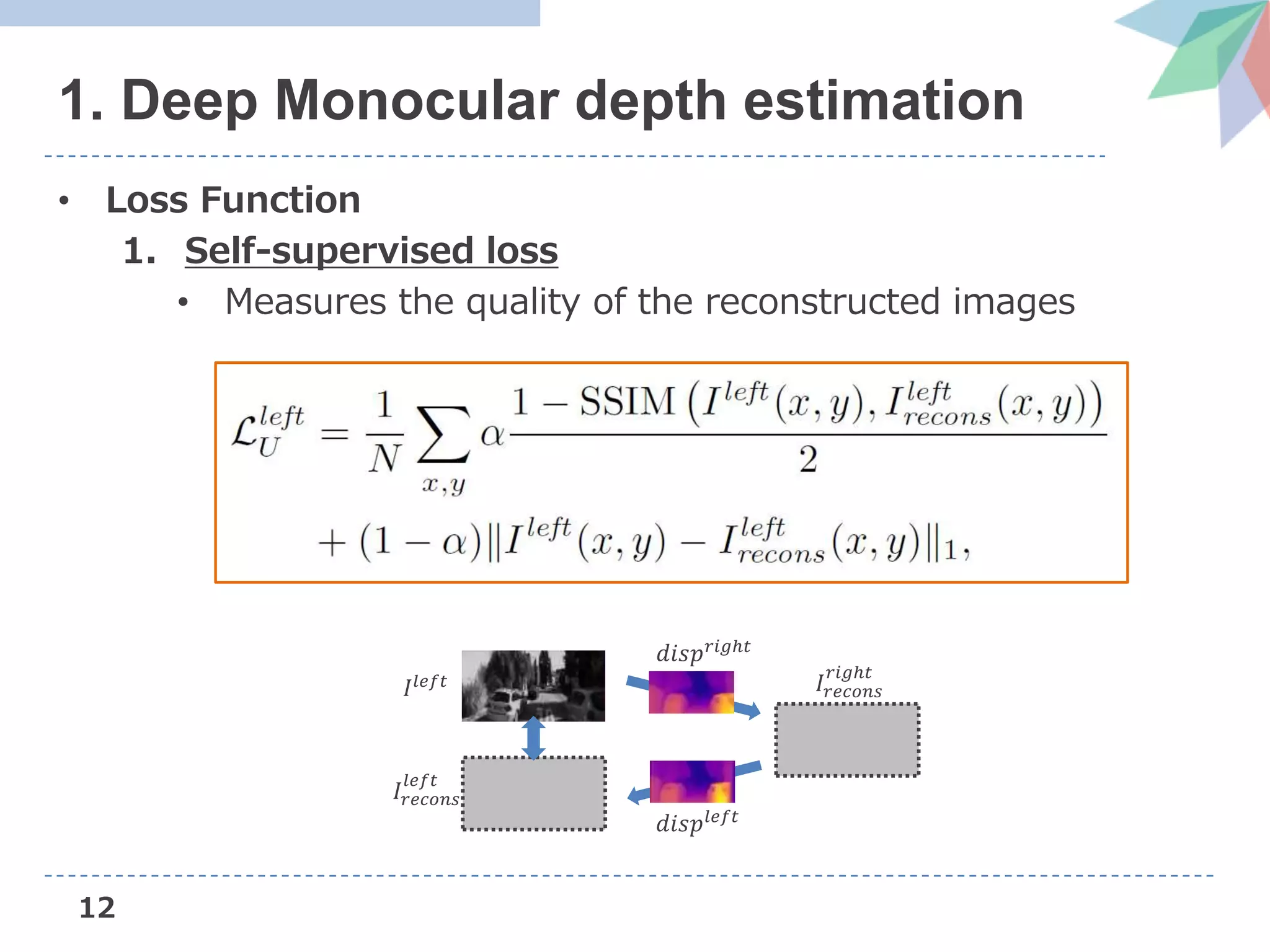
• Loss Function
1. Self-supervised loss
• Measures the quality of the reconstructed images
𝐼𝑙𝑒𝑓𝑡
𝑑𝑖𝑠𝑝 𝑟𝑖𝑔ℎ𝑡
𝐼𝑟𝑒𝑐𝑜𝑛𝑠
𝑟𝑖𝑔ℎ𝑡
𝐼𝑟𝑒𝑐𝑜𝑛𝑠
𝑙𝑒𝑓𝑡
𝑑𝑖𝑠𝑝𝑙𝑒𝑓𝑡
13
1. Deep Monocular depth estimation
• Loss Function
2. Supervised loss
• Measures the deviation of the predicted disparity from
disparities estimated by Stereo DSO [Wang+, ICCV’17]
Left Disparity
Stereo DSO’s
Reconstructed result
Stereo DSO
(using Stereo camera)
14
1. Deep Monocular depth estimation
• Loss Function
3. Left-right disparity consistency loss
• Consistency loss proposed in MonoDepth [Godard+, CVPR’17]
𝐼𝑙𝑒𝑓𝑡
𝑑𝑖𝑠𝑝𝑙𝑒𝑓𝑡 𝑑𝑖𝑠𝑝 𝑟𝑖𝑔ℎ𝑡
𝐼 𝑟𝑖𝑔ℎ𝑡
𝑑𝑖𝑠𝑝𝑙𝑒𝑓𝑡
15
1. Deep Monocular depth estimation
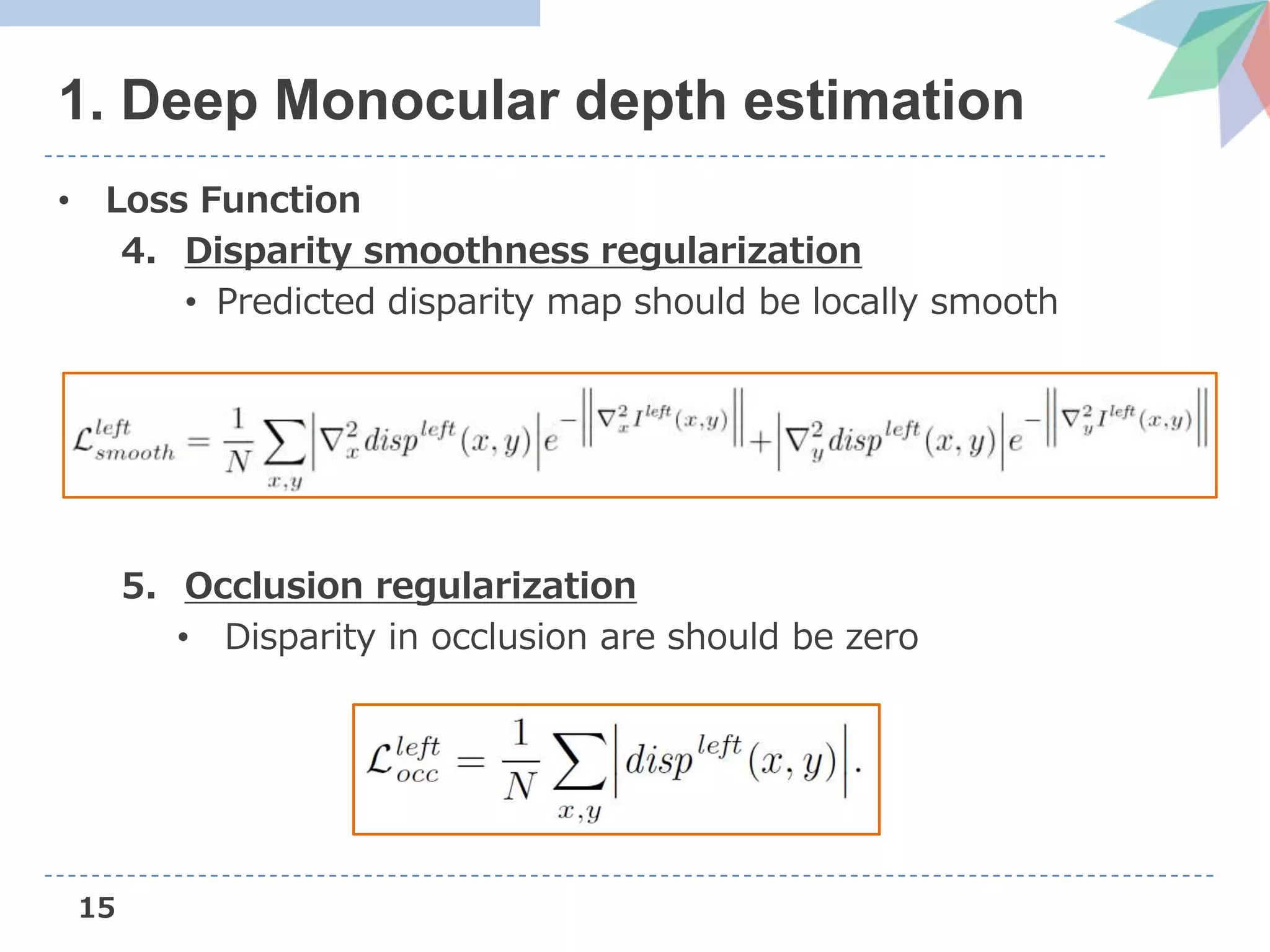
• Loss Function
4. Disparity smoothness regularization
• Predicted disparity map should be locally smooth
5. Occlusion regularization
• Disparity in occlusion are should be zero
16
1. Deep Monocular depth estimation
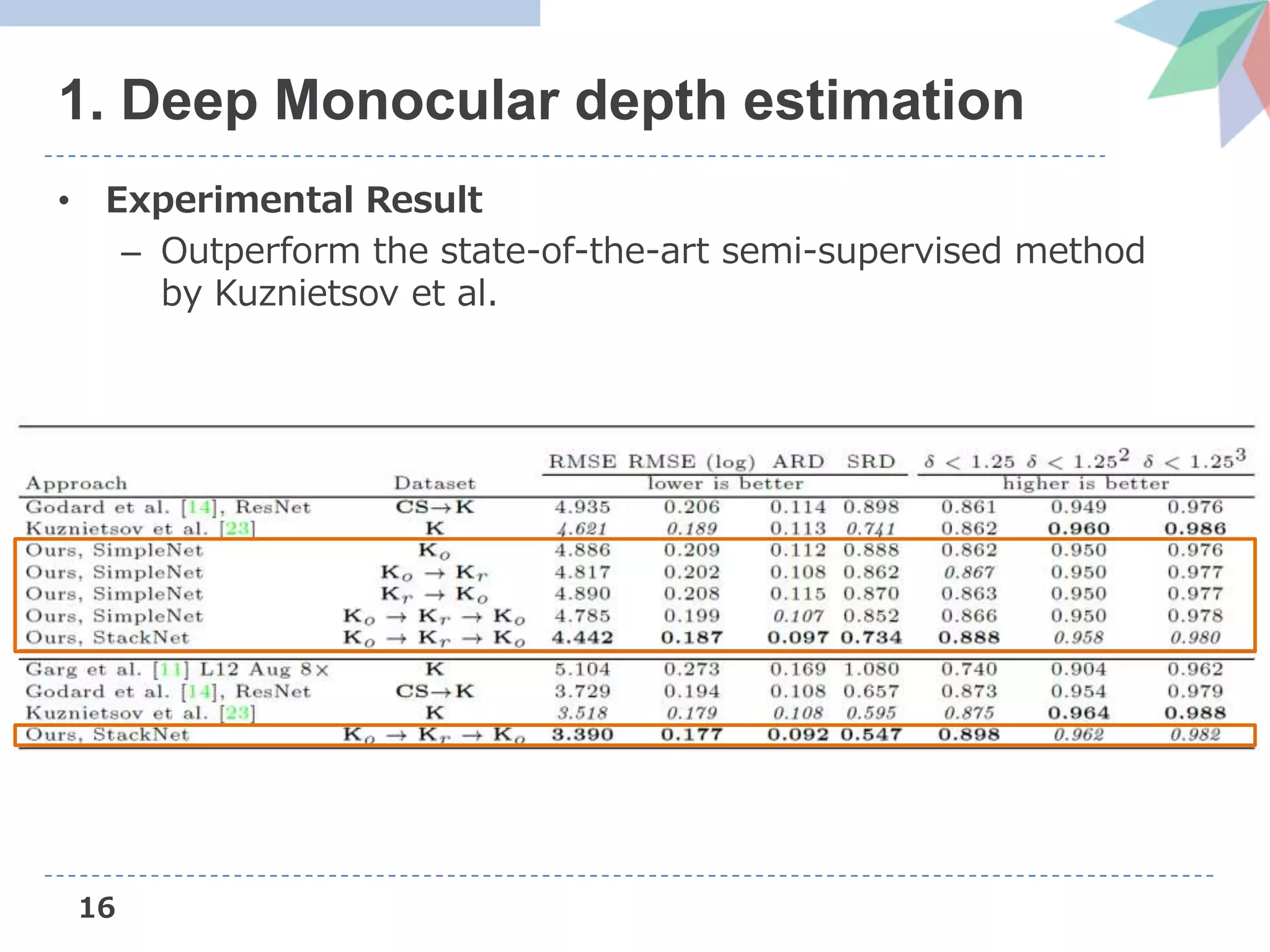
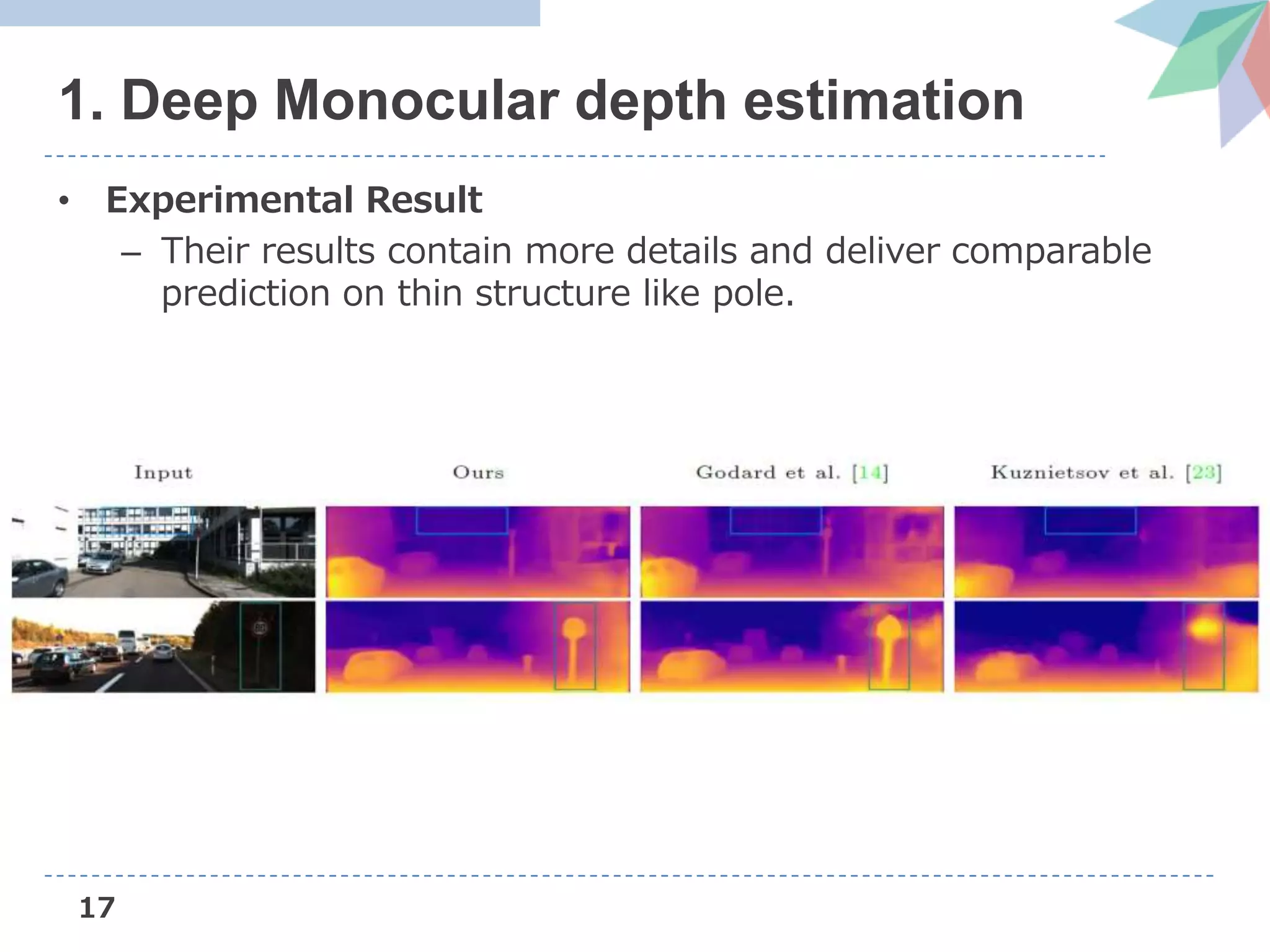
• Experimental Result
– Outperform the state-of-the-art semi-supervised method
by Kuznietsov et al.
17
1. Deep Monocular depth estimation
• Experimental Result
– Their results contain more details and deliver comparable
prediction on thin structure like pole.
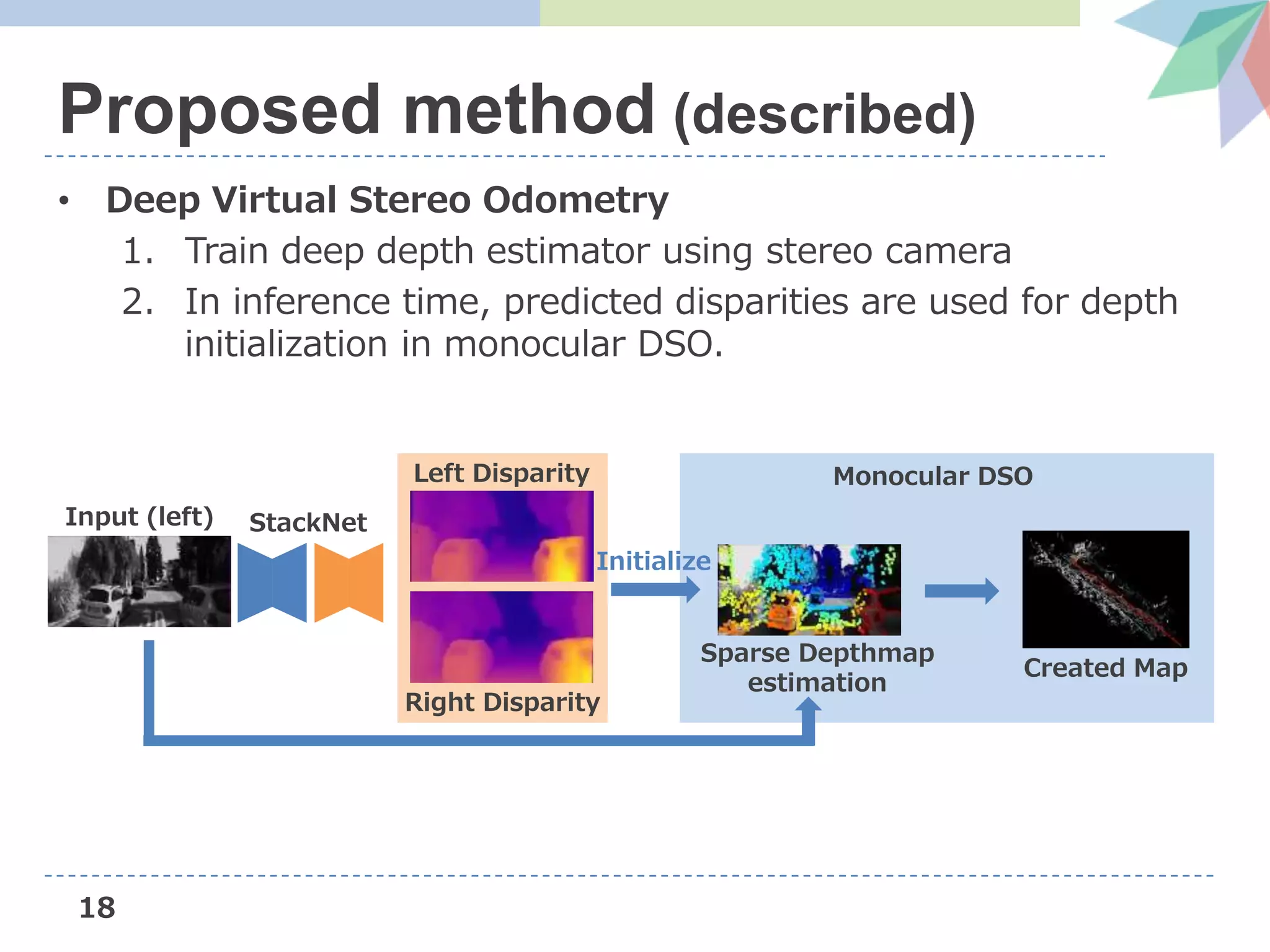
• Deep Virtual Stereo Odometry
1. Train deep depth estimator using stereo camera
2. In inference time, predicted disparities are used for depth
initialization in monocular DSO.
18
Proposed method (described)
Monocular DSO
Sparse Depthmap
estimation
Created Map
Input (left)
Left Disparity
Right Disparity
Initialize
StackNet
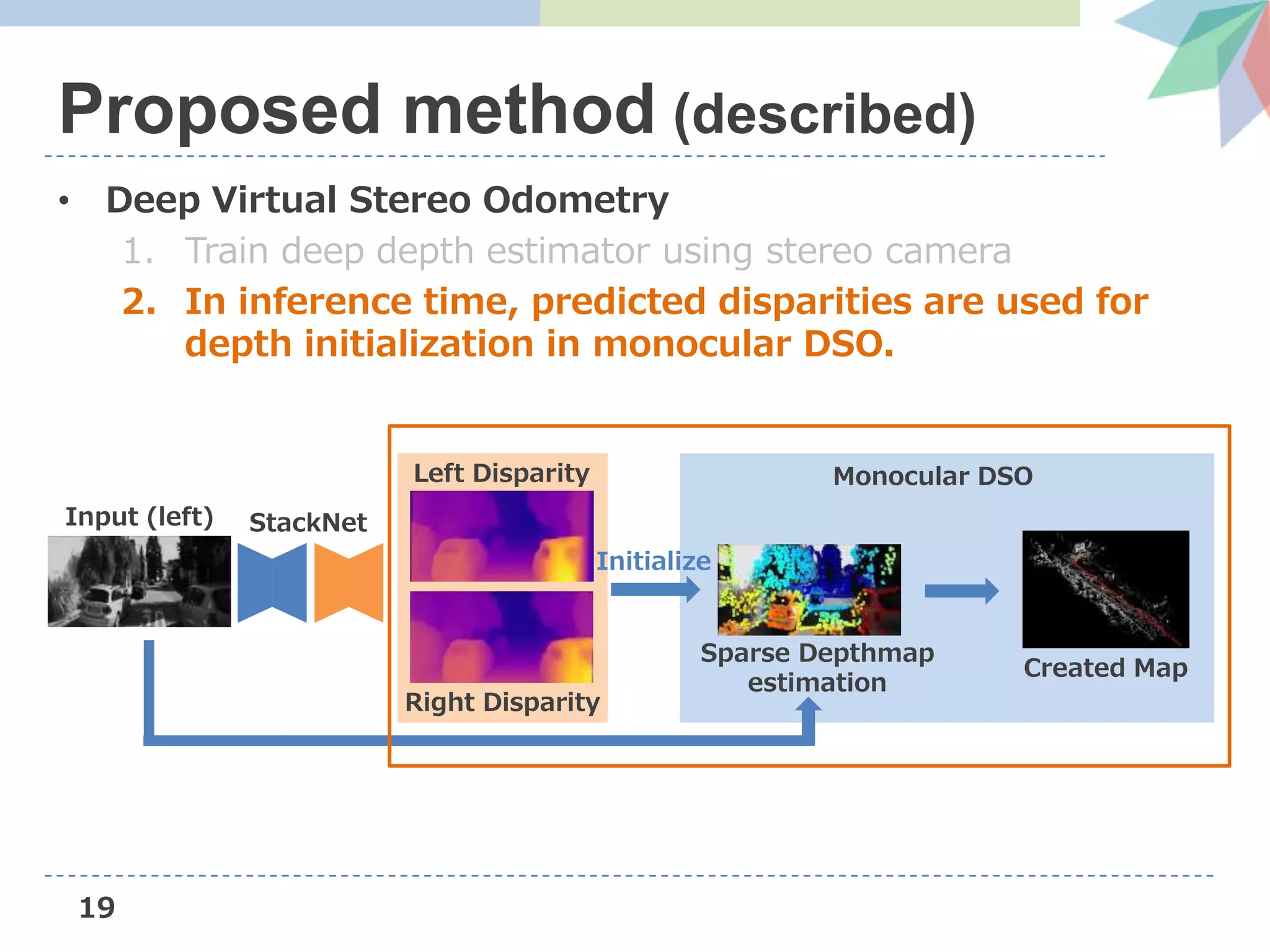
• Deep Virtual Stereo Odometry
1. Train deep depth estimator using stereo camera
2. In inference time, predicted disparities are used for
depth initialization in monocular DSO.
19
Proposed method (described)
Monocular DSO
Sparse Depthmap
estimation
Created Map
Input (left)
Left Disparity
Right Disparity
Initialize
StackNet
20
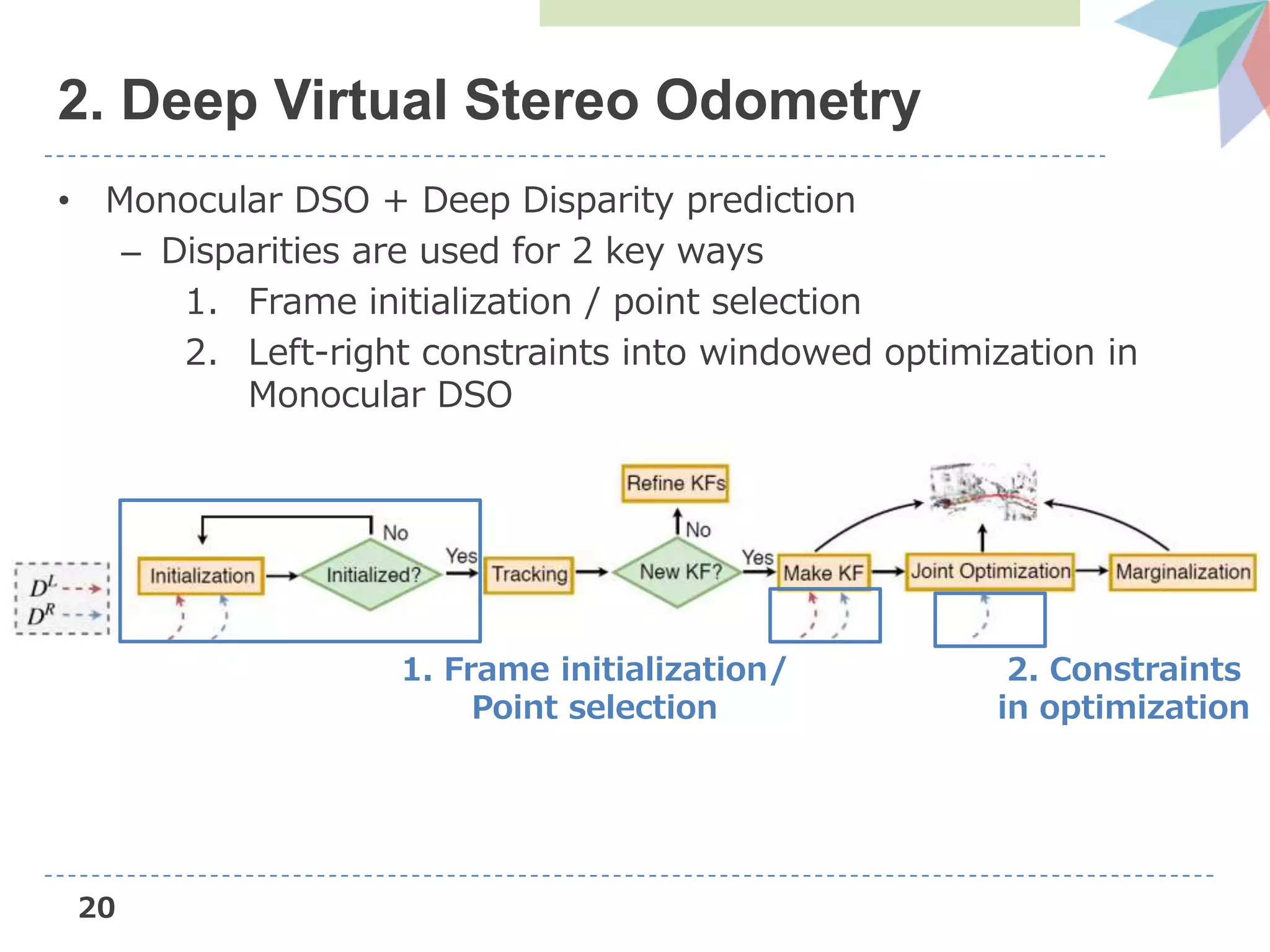
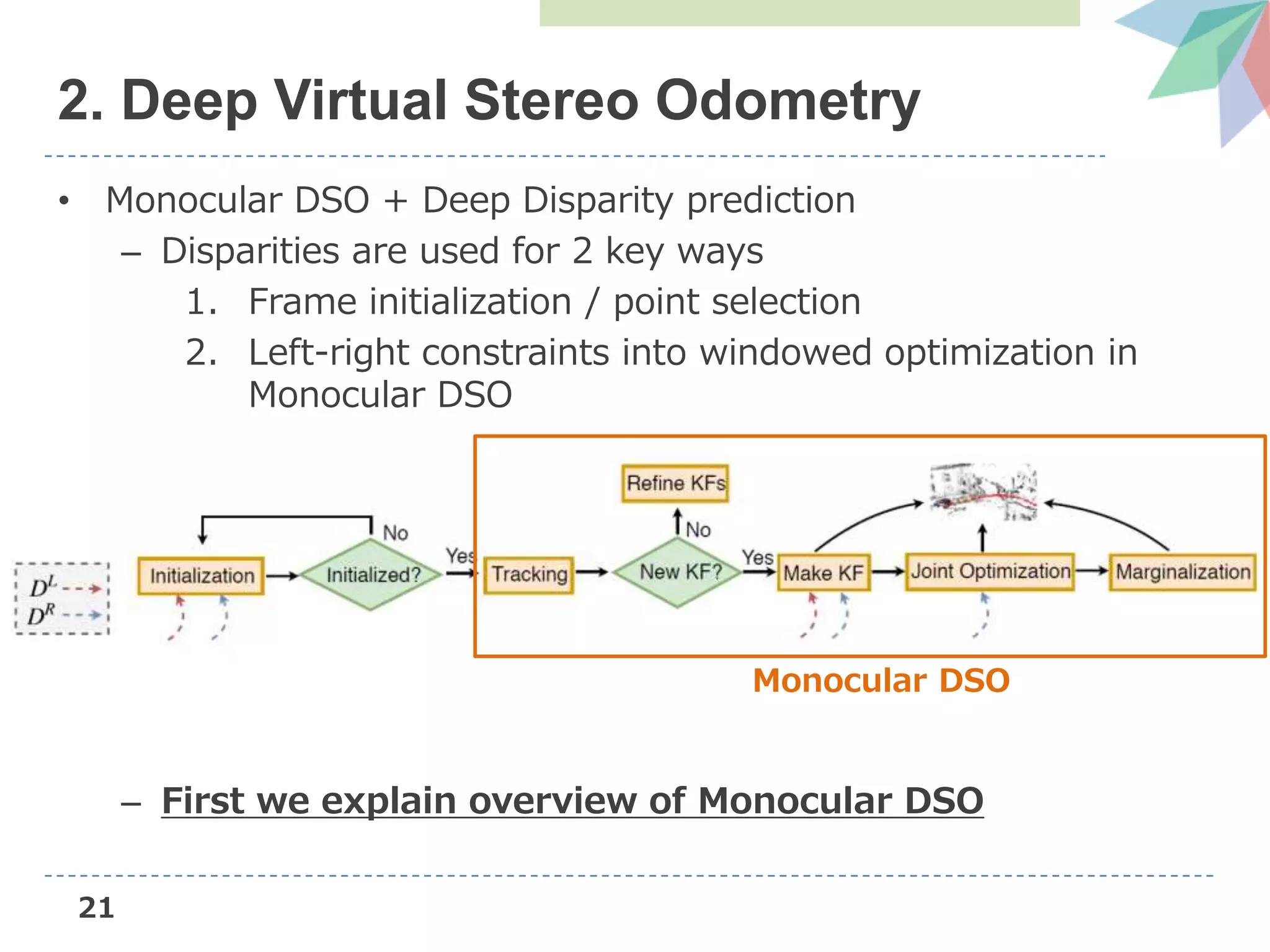
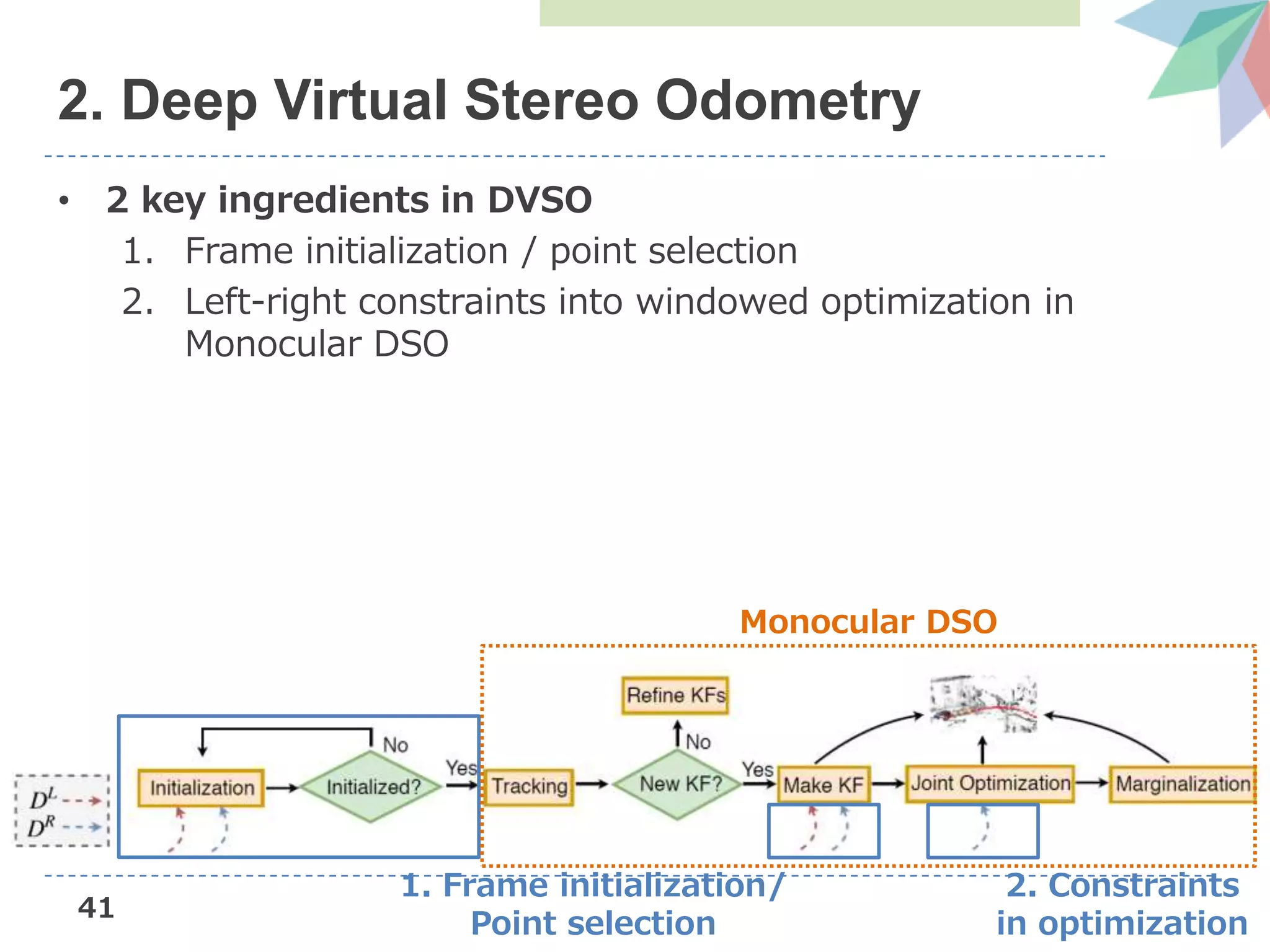
2. Deep Virtual Stereo Odometry
• Monocular DSO + Deep Disparity prediction
– Disparities are used for 2 key ways
1. Frame initialization / point selection
2. Left-right constraints into windowed optimization in
Monocular DSO
1. Frame initialization/
Point selection
2. Constraints
in optimization
21
2. Deep Virtual Stereo Odometry
• Monocular DSO + Deep Disparity prediction
– Disparities are used for 2 key ways
1. Frame initialization / point selection
2. Left-right constraints into windowed optimization in
Monocular DSO
– First we explain overview of Monocular DSO
Monocular DSO
22
DSO (Direct Sparse Odometry)
• Novel direct sparse Visual Odometry method
– Direct: seamless ability to use & reconstruct all points
instead of only corners
– Sparse: efficient, joint optimization of all parameters
Feature-based,
Sparse
Direct,
Semi-dense
Taking both approach’s benefits
[1] https://drive.google.com/file/d/108CttbYiBqaI3b1jIJFTS26SzNfQqQNG/view
LSD-SLAM [Engel+, ICCV’14] ORB-SLAM [Mur-Artal+, MVIGRO’14]
23
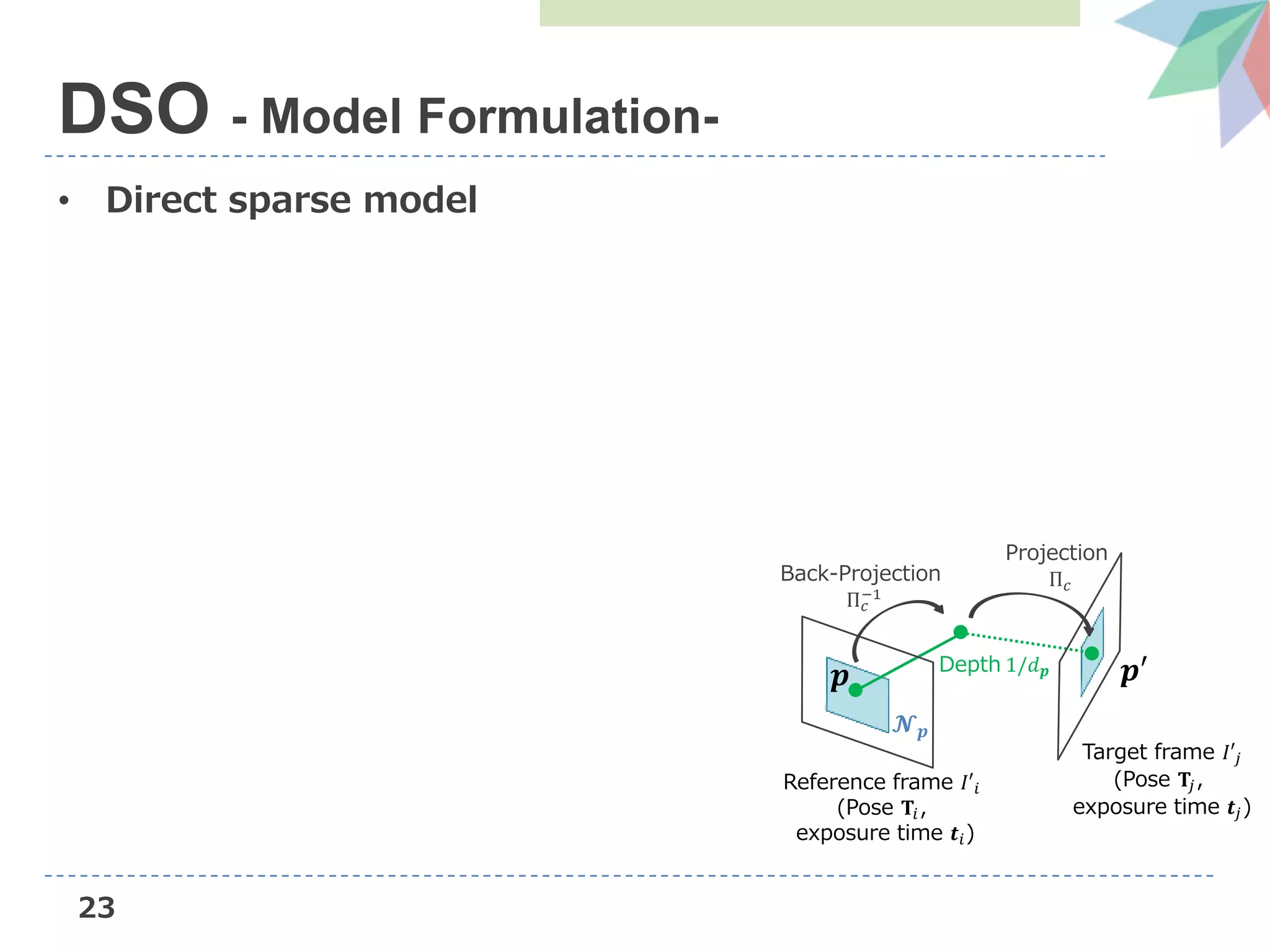
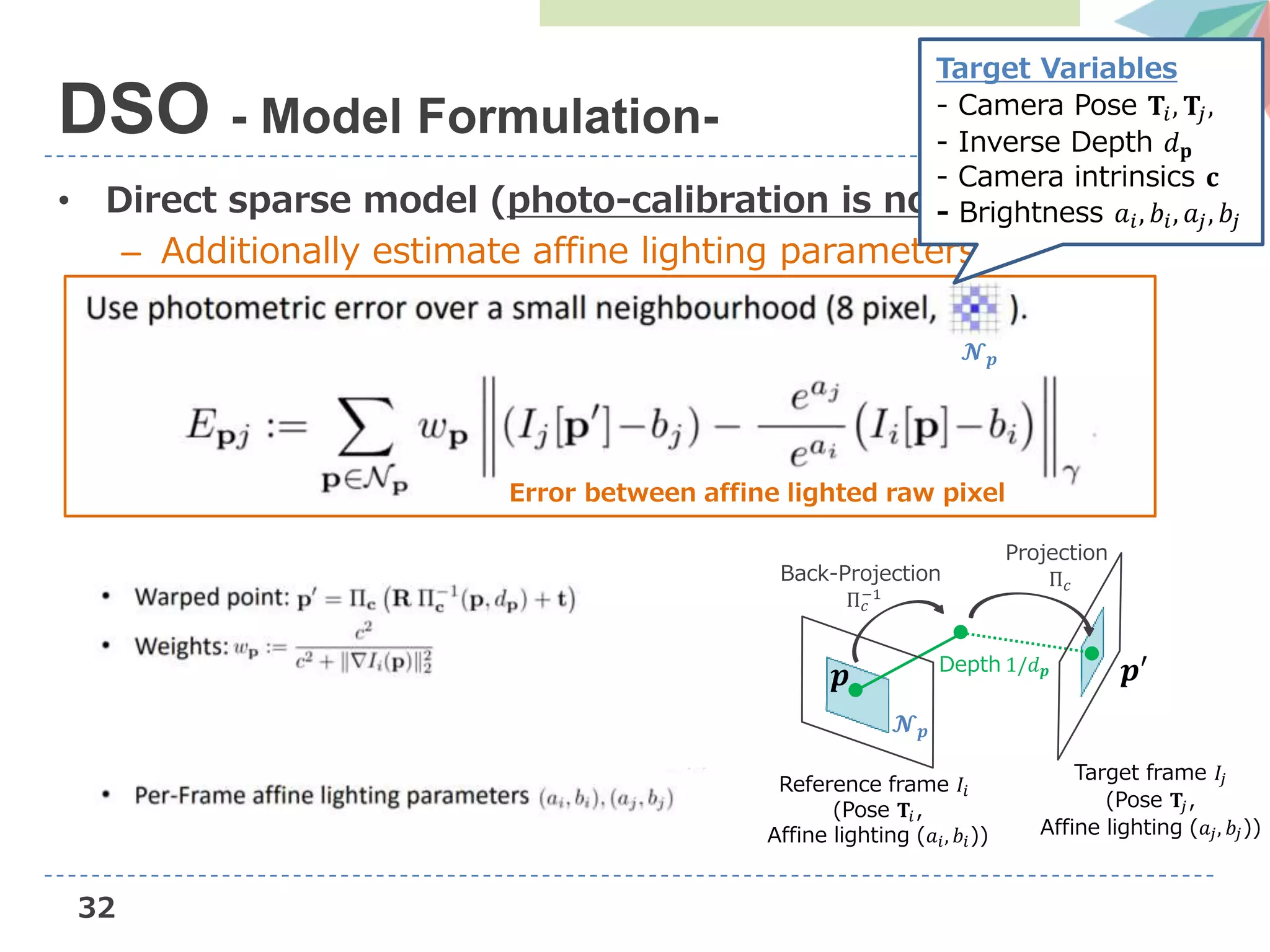
• Direct sparse model
DSO - Model Formulation-
Target frame 𝐼′𝑗
(Pose 𝐓𝑗,
exposure time 𝒕𝑗)
𝒑
𝓝 𝒑
𝒑′Depth 1/𝑑 𝒑
Back-Projection
Π 𝑐
−1
Projection
Π 𝑐
Reference frame 𝐼′𝑖
(Pose 𝐓𝑖,
exposure time 𝒕𝑖)
24
• Direct sparse model
DSO - Model Formulation-
Target frame 𝐼′𝑗
(Pose 𝐓𝑗,
exposure time 𝒕𝑗)
𝒑
𝓝 𝒑
𝒑′Depth 1/𝑑 𝒑
Back-Projection
Π 𝑐
−1
Projection
Π 𝑐
Reference frame 𝐼′𝑖
(Pose 𝐓𝑖,
exposure time 𝒕𝑖)
𝓝 𝒑
[1] https://people.eecs.berkeley.edu/~chaene/cvpr17tut/SLAM.pdf
25
• Direct sparse model
DSO - Model Formulation-
Target frame 𝐼′𝑗
(Pose 𝐓𝑗,
exposure time 𝒕𝑗)
𝒑
𝓝 𝒑
𝒑′Depth 1/𝑑 𝒑
Back-Projection
Π 𝑐
−1
Projection
Π 𝑐
Reference frame 𝐼′𝑖
(Pose 𝐓𝑖,
exposure time 𝒕𝑖)
𝓝 𝒑
Target Variables
- Camera Pose 𝐓𝑖, 𝐓𝑗,
- Inverse Depth 𝑑 𝐩
- Camera intrinsics 𝐜
[1] https://people.eecs.berkeley.edu/~chaene/cvpr17tut/SLAM.pdf
26
• Direct sparse model
DSO - Model Formulation-
Target frame 𝐼′𝑗
(Pose 𝐓𝑗,
exposure time 𝒕𝑗)
𝒑
𝓝 𝒑
𝒑′Depth 1/𝑑 𝒑
Back-Projection
Π 𝑐
−1
Projection
Π 𝑐
Reference frame 𝐼′𝑖
(Pose 𝐓𝑖,
exposure time 𝒕𝑖)
𝓝 𝒑
Target Variables
- Camera Pose 𝐓𝑖, 𝐓𝑗,
- Inverse Depth 𝑑 𝐩
- Camera intrinsics 𝐜
Error between irradiance 𝑩 = 𝑰/𝒕
[1] https://people.eecs.berkeley.edu/~chaene/cvpr17tut/SLAM.pdf
27
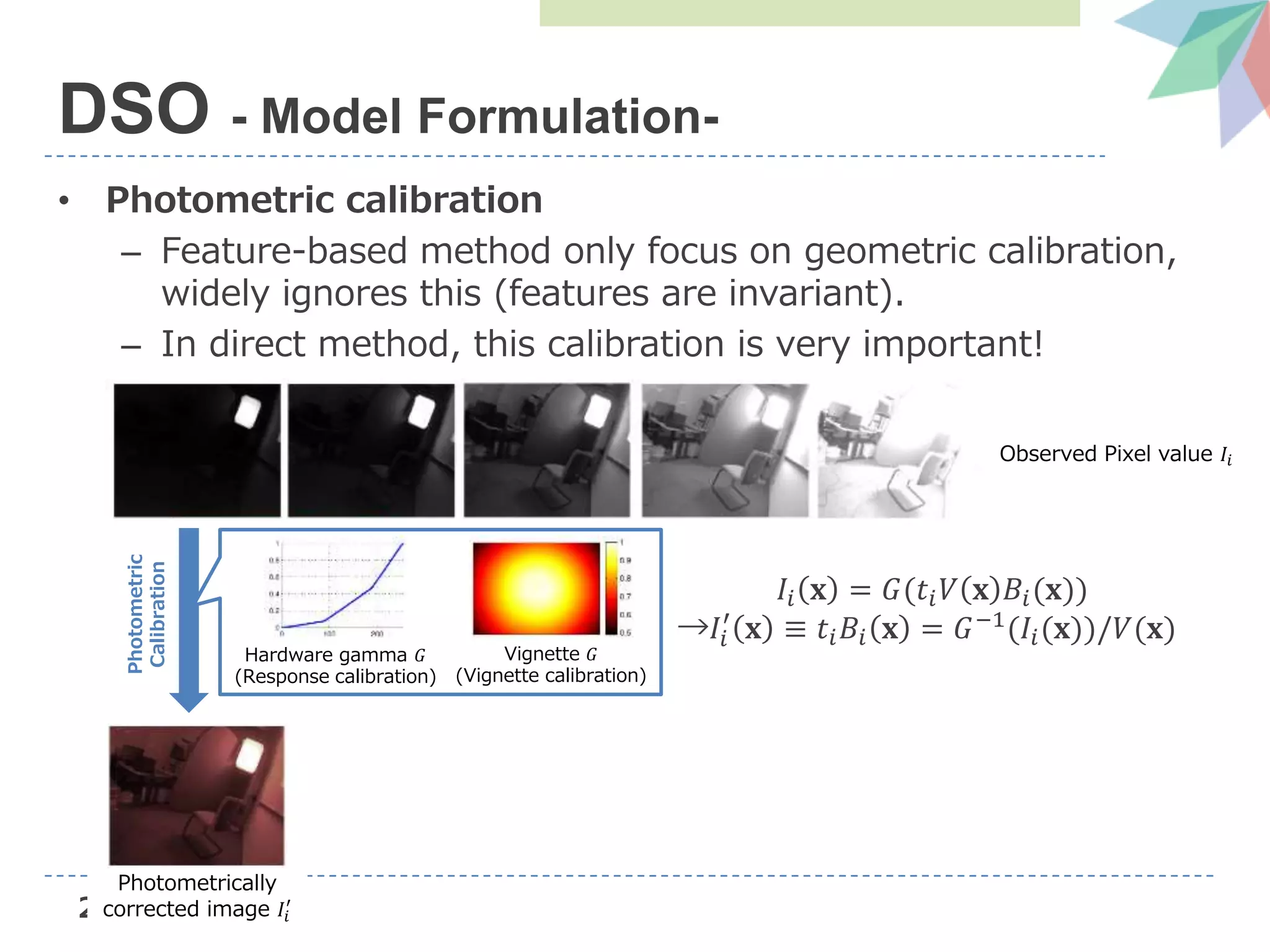
• Photometric calibration
– Feature-based method only focus on geometric calibration,
widely ignores this (features are invariant).
– In direct method, this calibration is very important!
DSO - Model Formulation-
Observed Pixel value 𝐼𝑖
[1] https://people.eecs.berkeley.edu/~chaene/cvpr17tut/SLAM.pdf
28
• Photometric calibration
– Feature-based method only focus on geometric calibration,
widely ignores this (features are invariant).
– In direct method, this calibration is very important!
DSO - Model Formulation-
Observed Pixel value 𝐼𝑖
Photometric
Calibration
Hardware gamma 𝐺
(Response calibration)
Vignette 𝐺
(Vignette calibration)
Photometrically
corrected image 𝐼𝑖
′
𝐼𝑖 𝐱 = 𝐺(𝑡𝑖 𝑉 𝐱 𝐵𝑖(𝐱))
→𝐼𝑖
′
𝐱 ≡ 𝑡𝑖 𝐵𝑖 𝐱 = 𝐺−1
(𝐼𝑖(𝐱))/𝑉(𝐱)
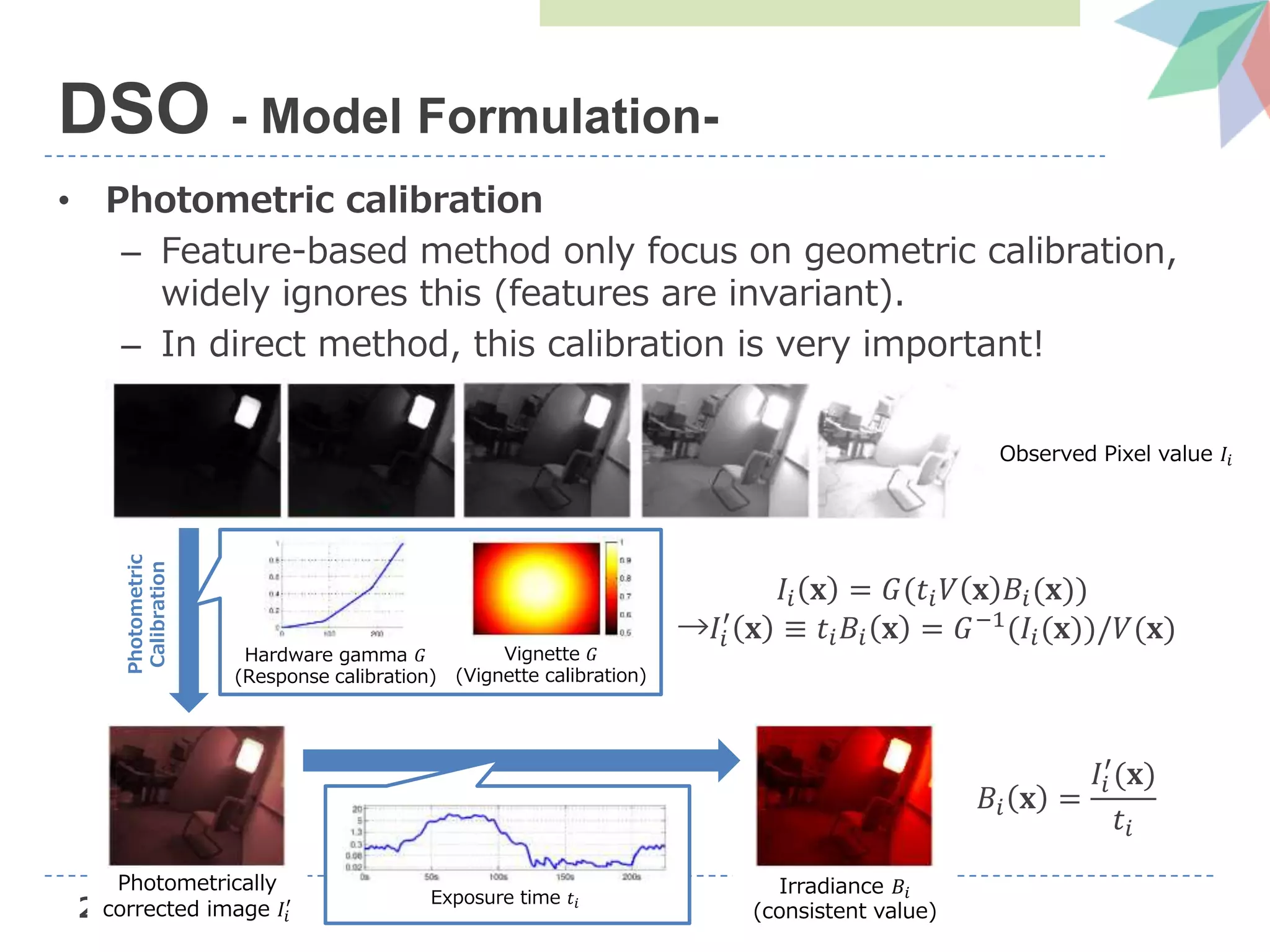
29
• Photometric calibration
– Feature-based method only focus on geometric calibration,
widely ignores this (features are invariant).
– In direct method, this calibration is very important!
DSO - Model Formulation-
Observed Pixel value 𝐼𝑖
Photometric
Calibration
Hardware gamma 𝐺
(Response calibration)
Vignette 𝐺
(Vignette calibration)
Irradiance 𝐵𝑖
(consistent value)
𝐼𝑖 𝐱 = 𝐺(𝑡𝑖 𝑉 𝐱 𝐵𝑖(𝐱))
→𝐼𝑖
′
𝐱 ≡ 𝑡𝑖 𝐵𝑖 𝐱 = 𝐺−1
(𝐼𝑖(𝐱))/𝑉(𝐱)
Photometrically
corrected image 𝐼𝑖
′ Exposure time 𝑡𝑖
𝐵𝑖 𝐱 =
𝐼𝑖
′
(𝐱)
𝑡𝑖
30
• Direct sparse model
DSO - Model Formulation-
Target frame 𝐼′𝑗
(Pose 𝐓𝑗,
exposure time 𝒕𝑗)
𝒑
𝓝 𝒑
𝒑′Depth 1/𝑑 𝒑
Back-Projection
Π 𝑐
−1
Projection
Π 𝑐
Reference frame 𝐼′𝑖
(Pose 𝐓𝑖,
exposure time 𝒕𝑖)
𝓝 𝒑
Error between irradiance 𝑩 = 𝑰/𝒕
[1] https://people.eecs.berkeley.edu/~chaene/cvpr17tut/SLAM.pdf
31
• Direct sparse model (photo-calibration is not available)
– Additionally estimate affine lighting parameters
DSO - Model Formulation-
Reference frame 𝐼𝑖
(Pose 𝐓𝑖,
Affine lighting (𝑎𝑖, 𝑏𝑖))
Target frame 𝐼𝑗
(Pose 𝐓𝑗,
Affine lighting (𝑎𝑗, 𝑏𝑗))
𝒑
𝓝 𝒑
𝒑′Depth 1/𝑑 𝒑
Back-Projection
Π 𝑐
−1
Projection
Π 𝑐
𝓝 𝒑
Error between affine lighted raw pixel
[1] https://people.eecs.berkeley.edu/~chaene/cvpr17tut/SLAM.pdf
32
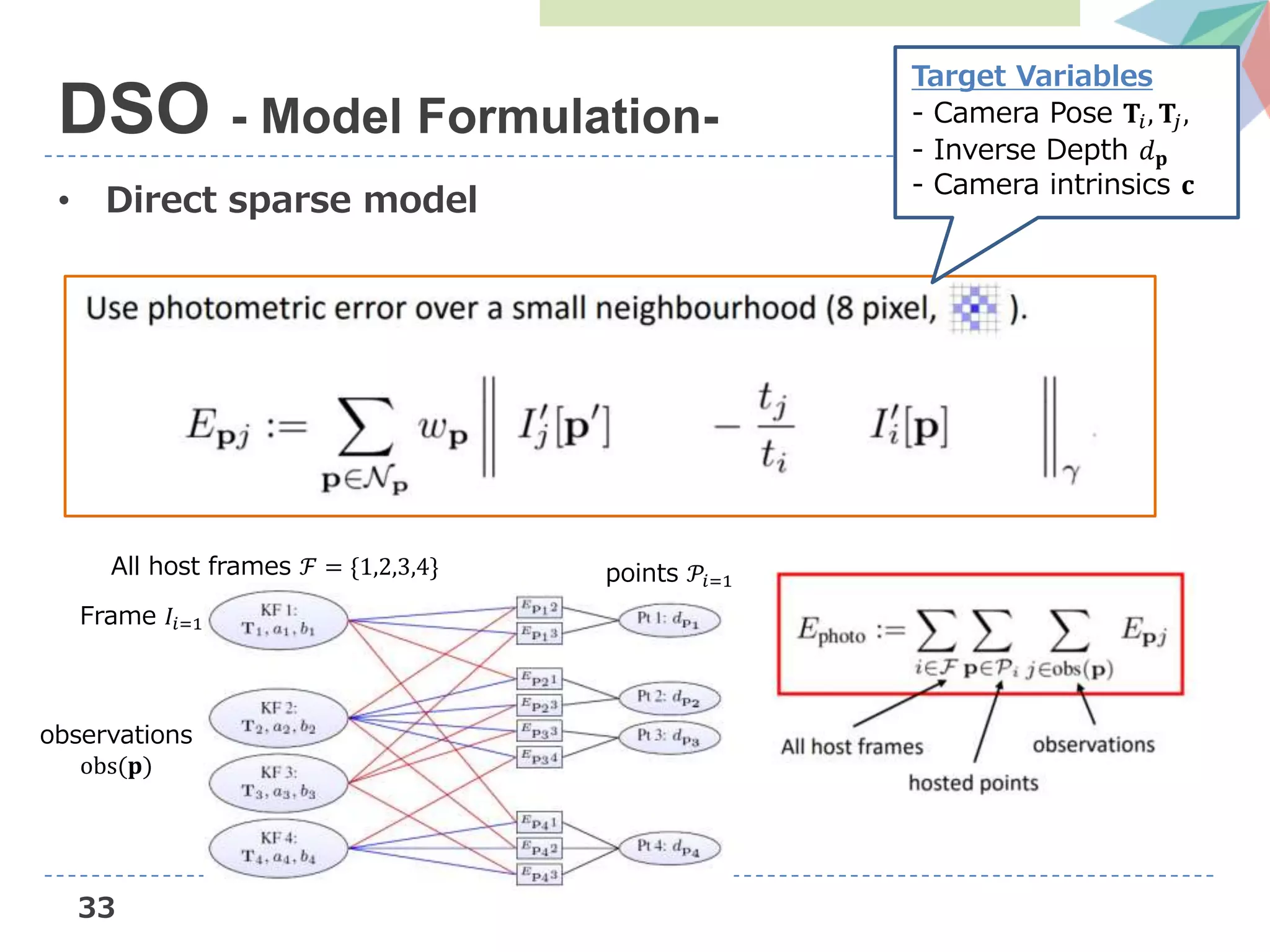
• Direct sparse model (photo-calibration is not available)
– Additionally estimate affine lighting parameters
DSO - Model Formulation-
Reference frame 𝐼𝑖
(Pose 𝐓𝑖,
Affine lighting (𝑎𝑖, 𝑏𝑖))
Target frame 𝐼𝑗
(Pose 𝐓𝑗,
Affine lighting (𝑎𝑗, 𝑏𝑗))
𝒑
𝓝 𝒑
𝒑′Depth 1/𝑑 𝒑
Back-Projection
Π 𝑐
−1
Projection
Π 𝑐
𝓝 𝒑
Error between affine lighted raw pixel
Target Variables
- Camera Pose 𝐓𝑖, 𝐓𝑗,
- Inverse Depth 𝑑 𝐩
- Camera intrinsics 𝐜
- Brightness 𝑎𝑖, 𝑏𝑖, 𝑎𝑗, 𝑏𝑗
33
• Direct sparse model
DSO - Model Formulation-
All host frames ℱ = {1,2,3,4}
Frame 𝐼𝑖=1
points 𝒫𝑖=1
observations
obs(𝐩)
Target Variables
- Camera Pose 𝐓𝑖, 𝐓𝑗,
- Inverse Depth 𝑑 𝐩
- Camera intrinsics 𝐜
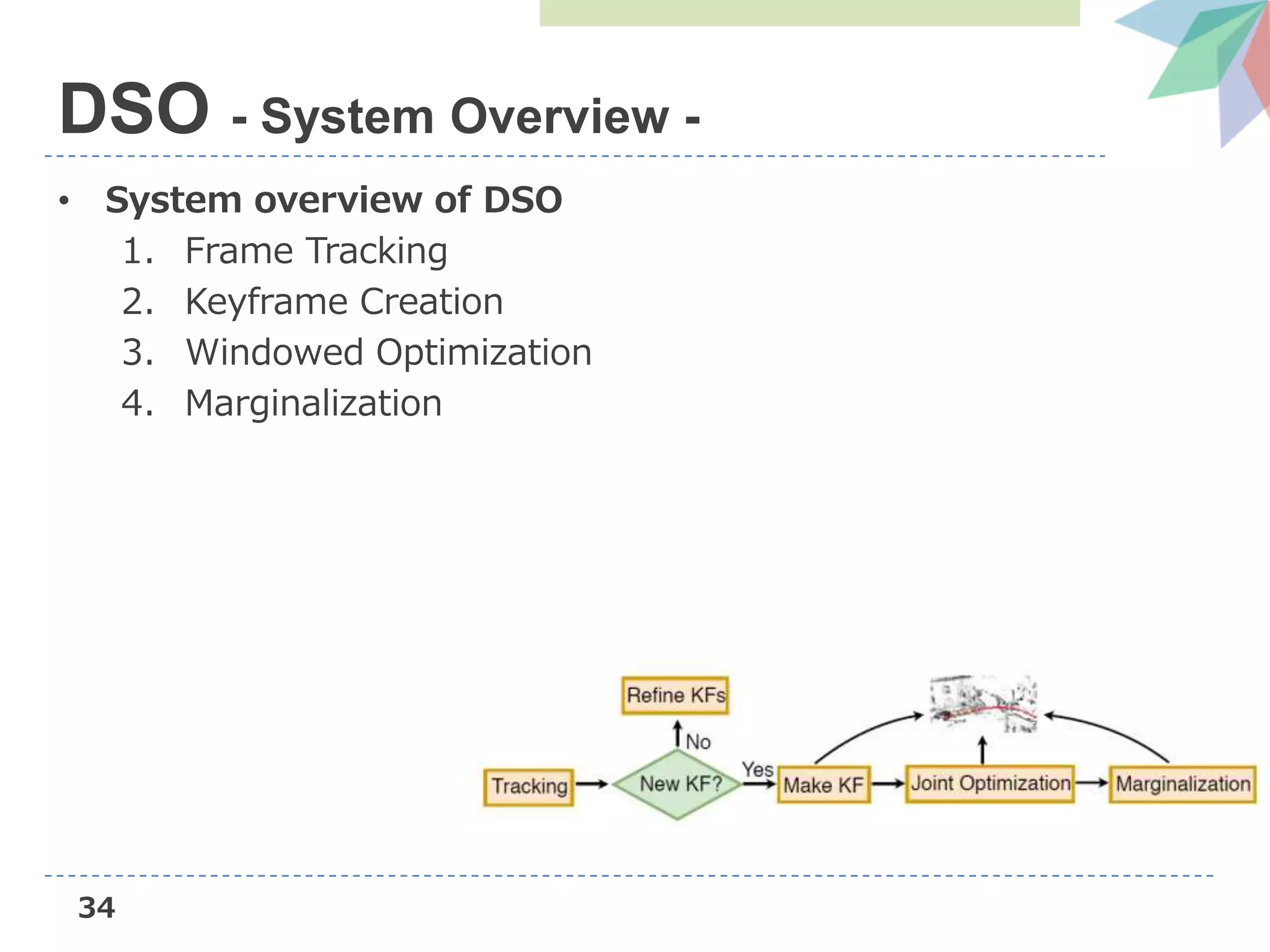
34
• System overview of DSO
1. Frame Tracking
2. Keyframe Creation
3. Windowed Optimization
4. Marginalization
DSO - System Overview -
35
• System overview of DSO
1. Frame Tracking
2. Keyframe Creation
3. Windowed Optimization
4. Marginalization
DSO - System Overview -
Tracking + Depth estimation
- From active 𝑁𝑓(= 7) Keyframes
Multi-scale Image Pyramid
+ constant motion model
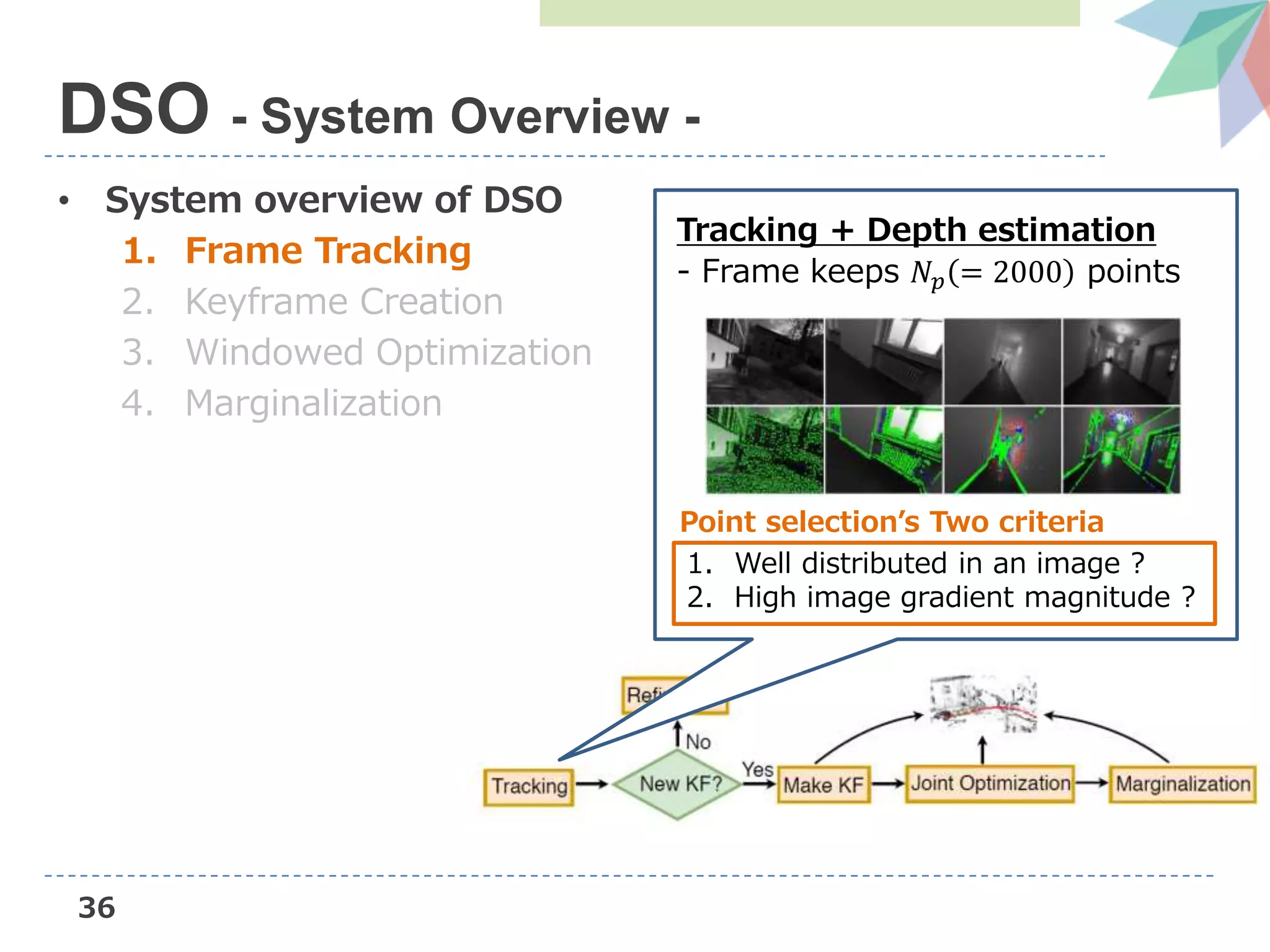
36
• System overview of DSO
1. Frame Tracking
2. Keyframe Creation
3. Windowed Optimization
4. Marginalization
DSO - System Overview -
Tracking + Depth estimation
- Frame keeps 𝑁 𝑝 = 2000 points
1. Well distributed in an image ?
2. High image gradient magnitude ?
Point selection’s Two criteria
37
• System overview of DSO
1. Frame Tracking
2. Keyframe Creation
3. Windowed Optimization
4. Marginalization
DSO - System Overview -
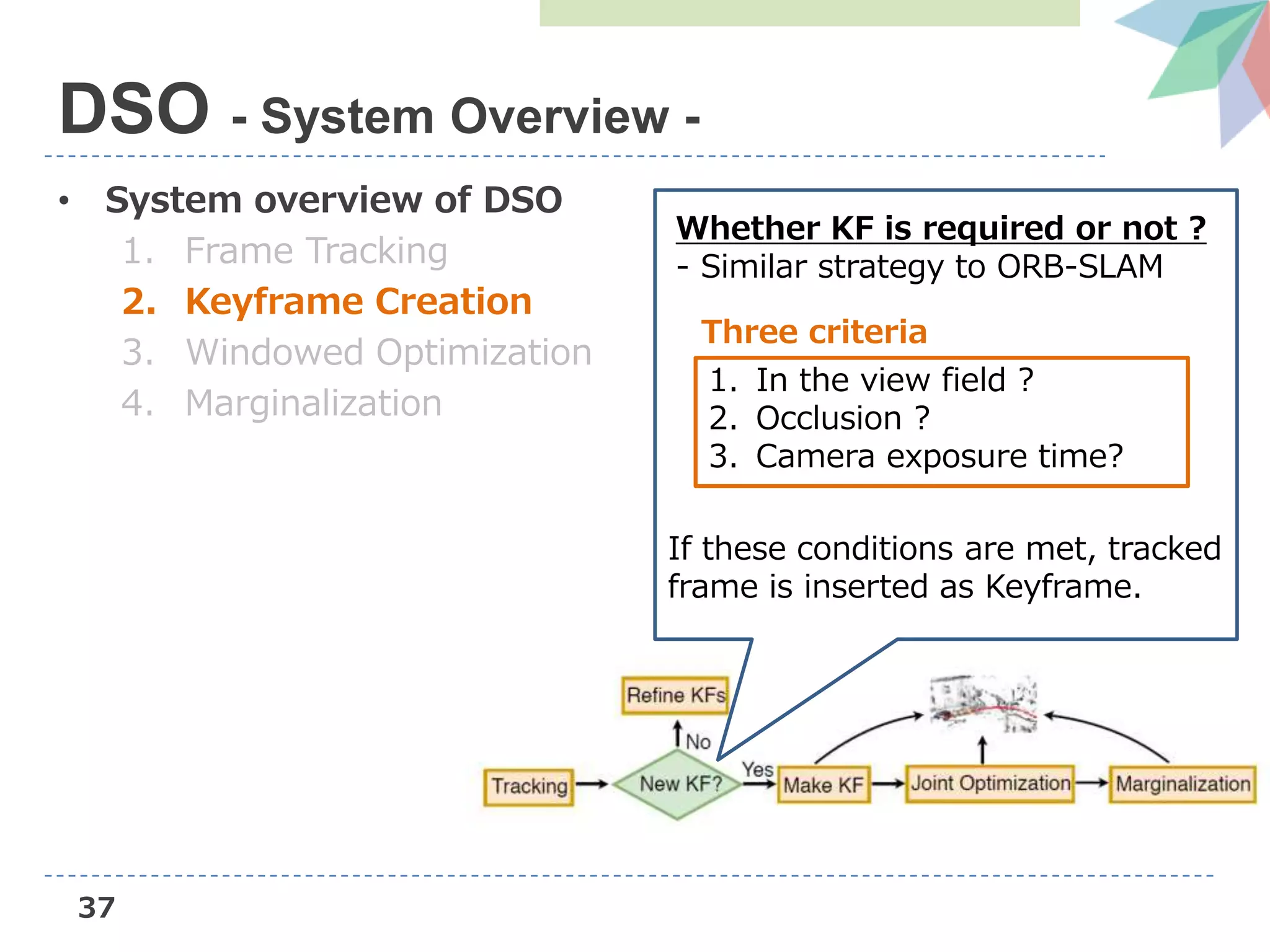
Whether KF is required or not ?
- Similar strategy to ORB-SLAM
1. In the view field ?
2. Occlusion ?
3. Camera exposure time?
Three criteria
If these conditions are met, tracked
frame is inserted as Keyframe.
• System overview of DSO
1. Frame Tracking
2. Keyframe Creation
3. Windowed Optimization
4. Marginalization
38
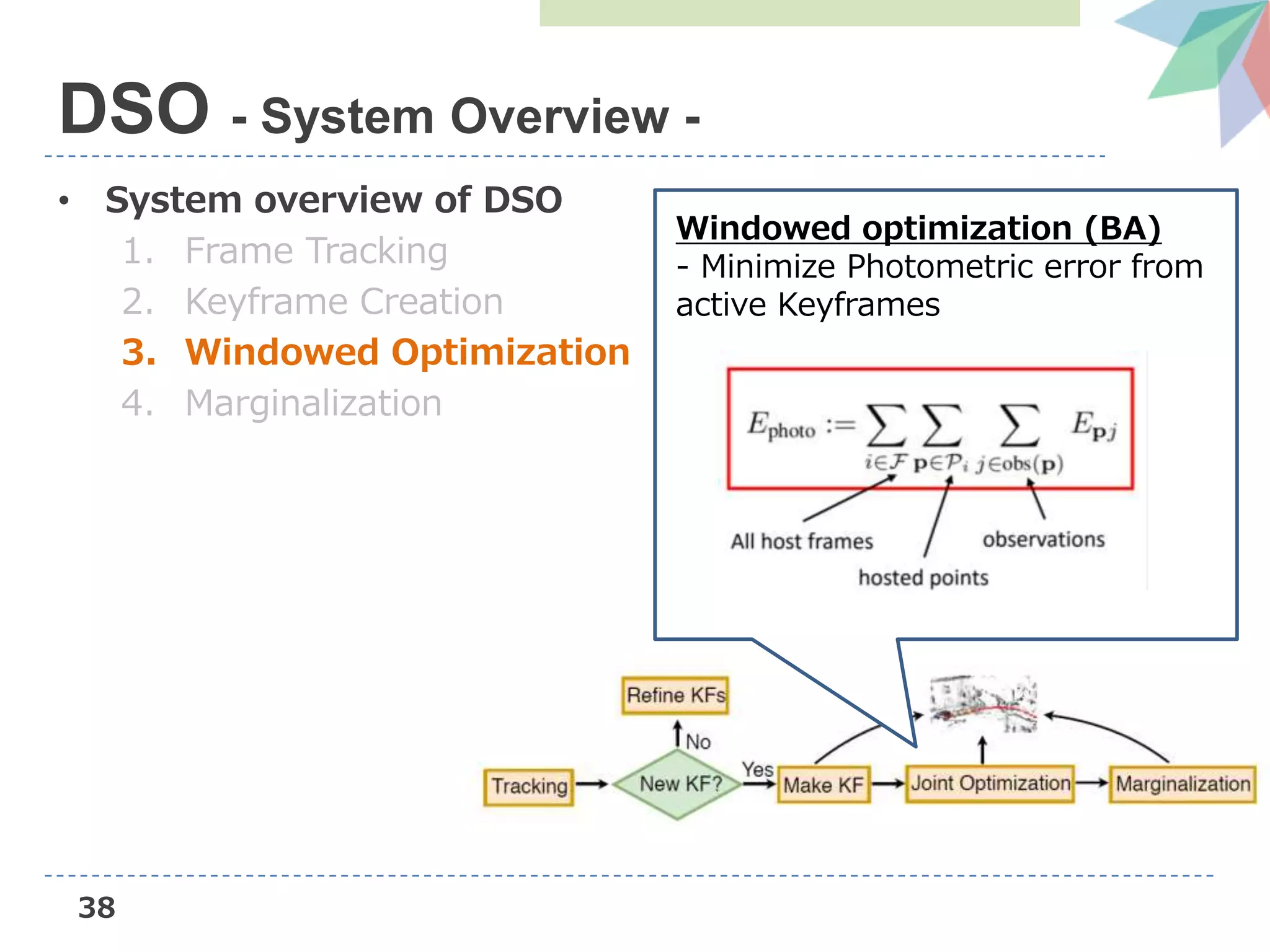
DSO - System Overview -
Windowed optimization (BA)
- Minimize Photometric error from
active Keyframes
• System overview of DSO
1. Frame Tracking
2. Keyframe Creation
3. Windowed Optimization
4. Marginalization
39
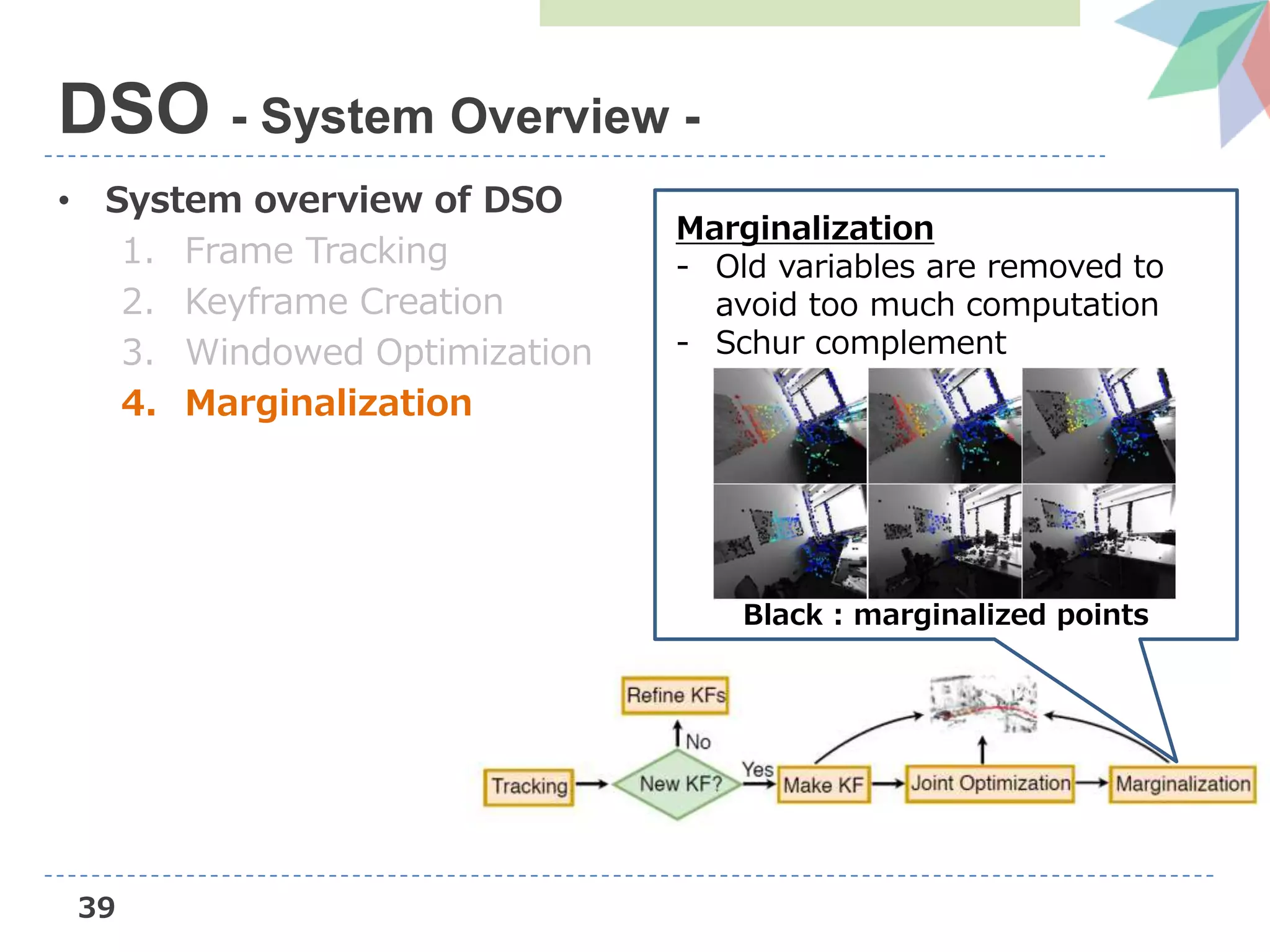
DSO - System Overview -
Marginalization
- Old variables are removed to
avoid too much computation
- Schur complement
Black : marginalized points
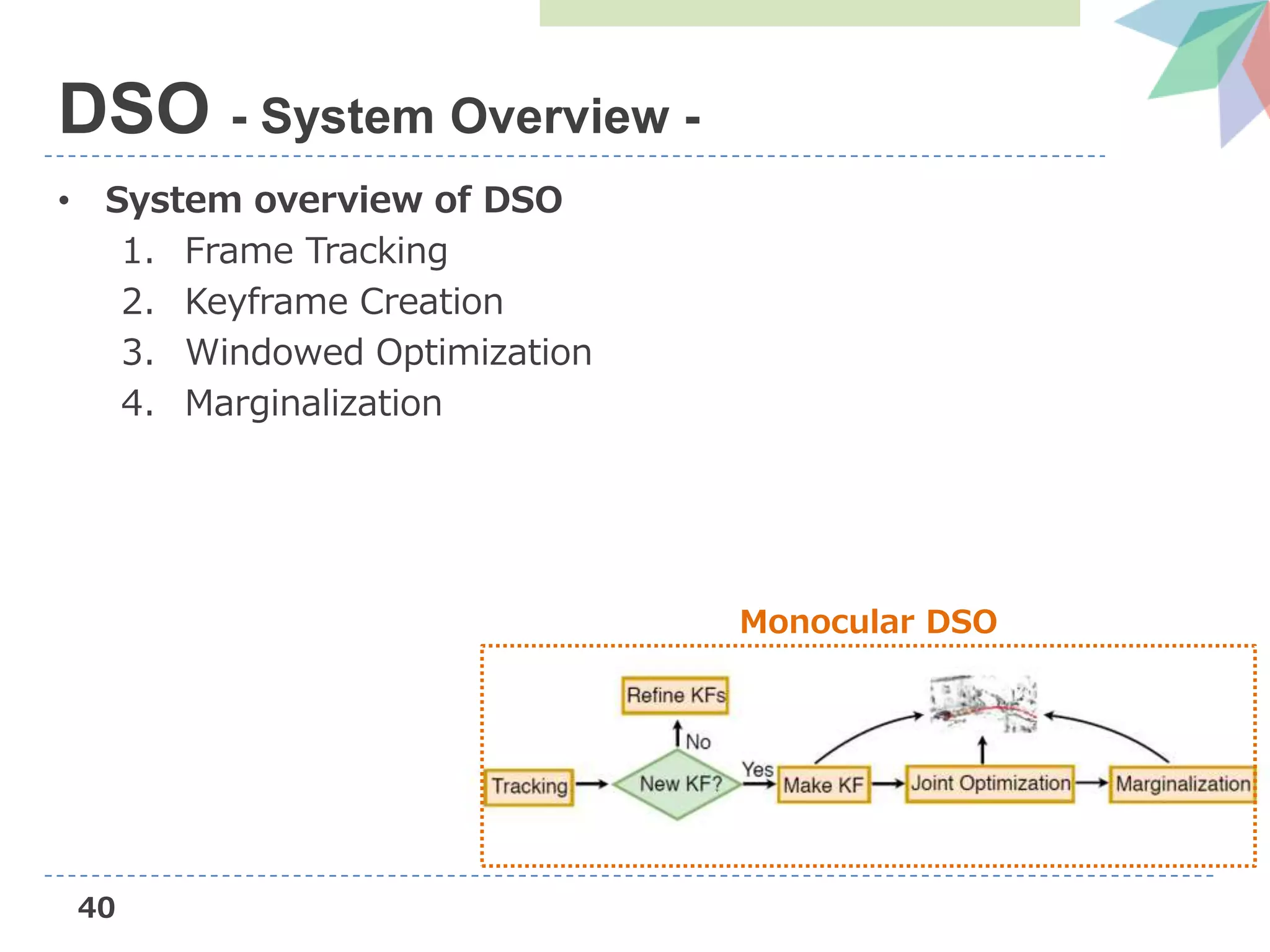
40
• System overview of DSO
1. Frame Tracking
2. Keyframe Creation
3. Windowed Optimization
4. Marginalization
DSO - System Overview -
Monocular DSO
41
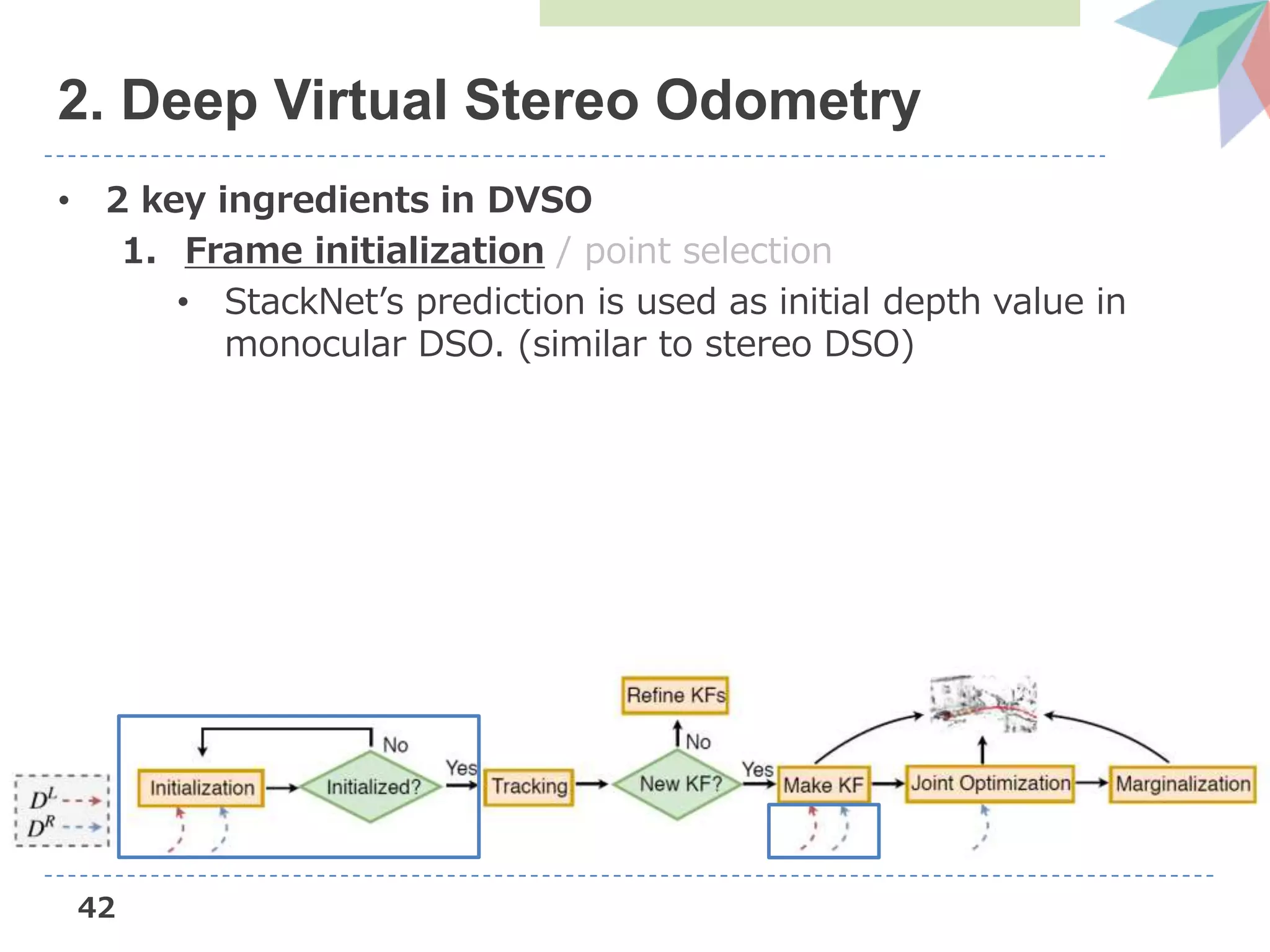
• 2 key ingredients in DVSO
1. Frame initialization / point selection
2. Left-right constraints into windowed optimization in
Monocular DSO
2. Deep Virtual Stereo Odometry
1. Frame initialization/
Point selection
2. Constraints
in optimization
Monocular DSO
42
• 2 key ingredients in DVSO
1. Frame initialization / point selection
• StackNet’s prediction is used as initial depth value in
monocular DSO. (similar to stereo DSO)
2. Deep Virtual Stereo Odometry
43
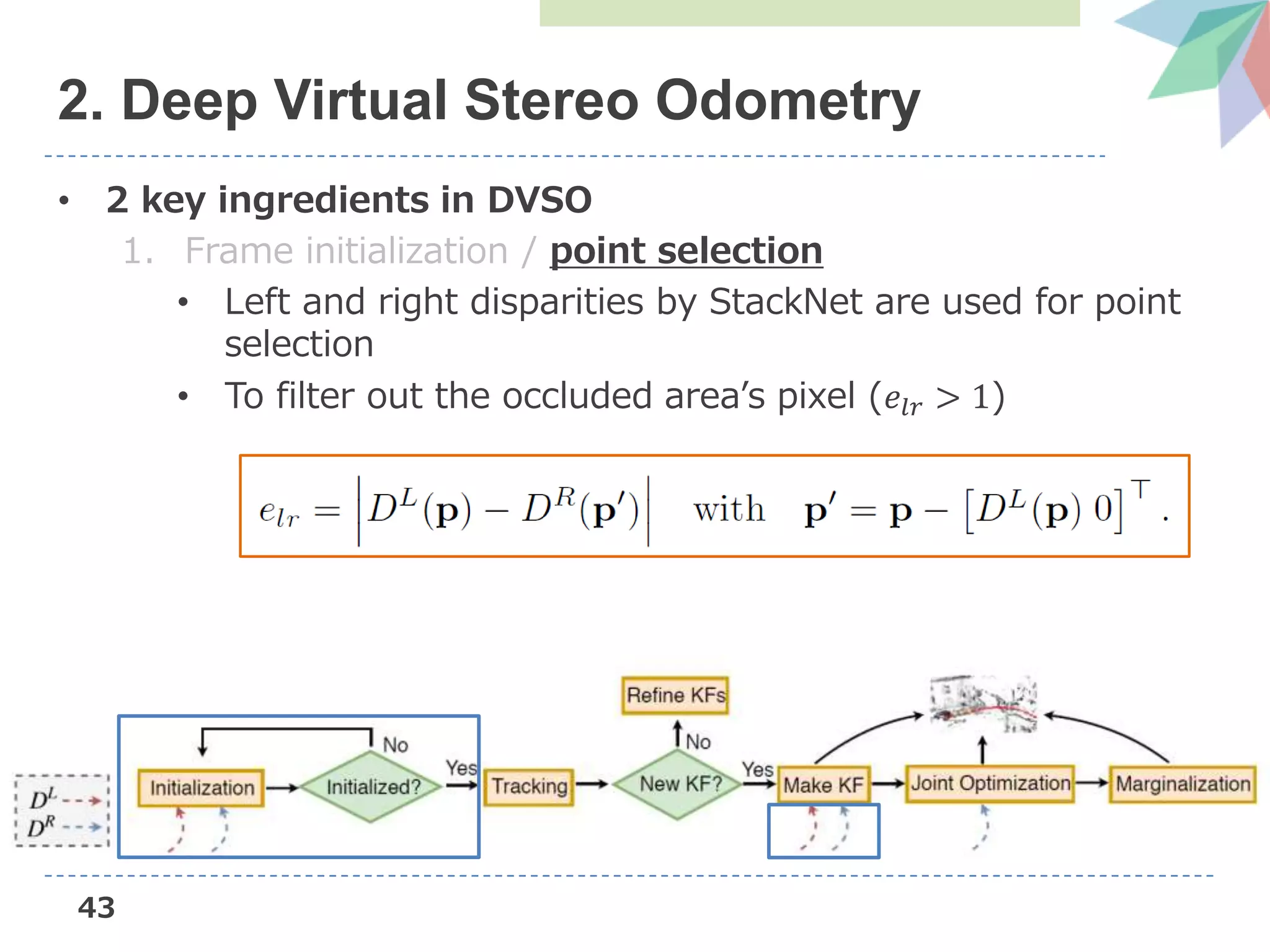
• 2 key ingredients in DVSO
1. Frame initialization / point selection
• Left and right disparities by StackNet are used for point
selection
• To filter out the occluded area’s pixel (𝑒𝑙𝑟 > 1)
2. Deep Virtual Stereo Odometry
44
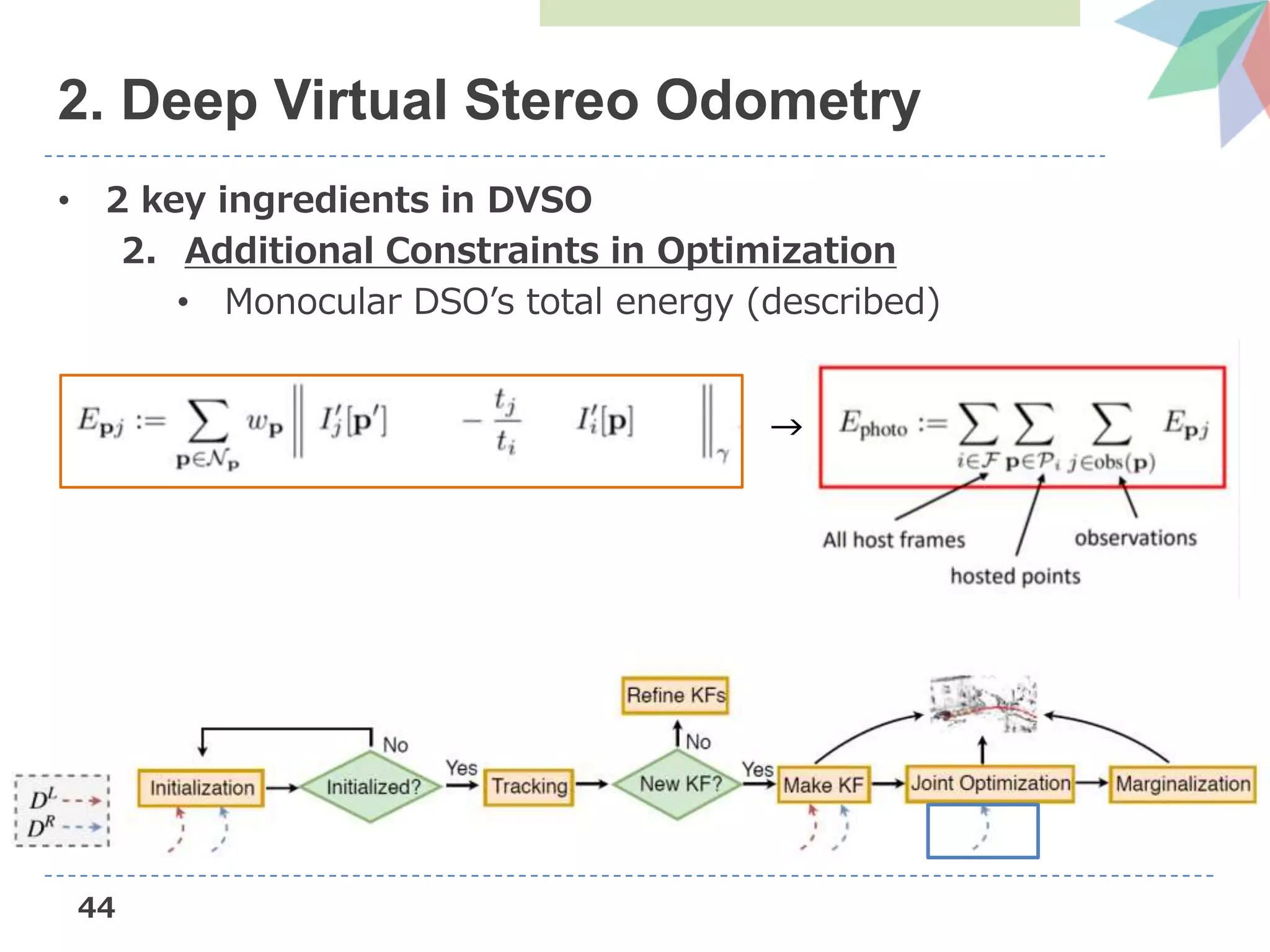
• 2 key ingredients in DVSO
2. Additional Constraints in Optimization
• Monocular DSO’s total energy (described)
2. Deep Virtual Stereo Odometry
→
45
• 2 key ingredients in DVSO
2. Additional Constraints in Optimization
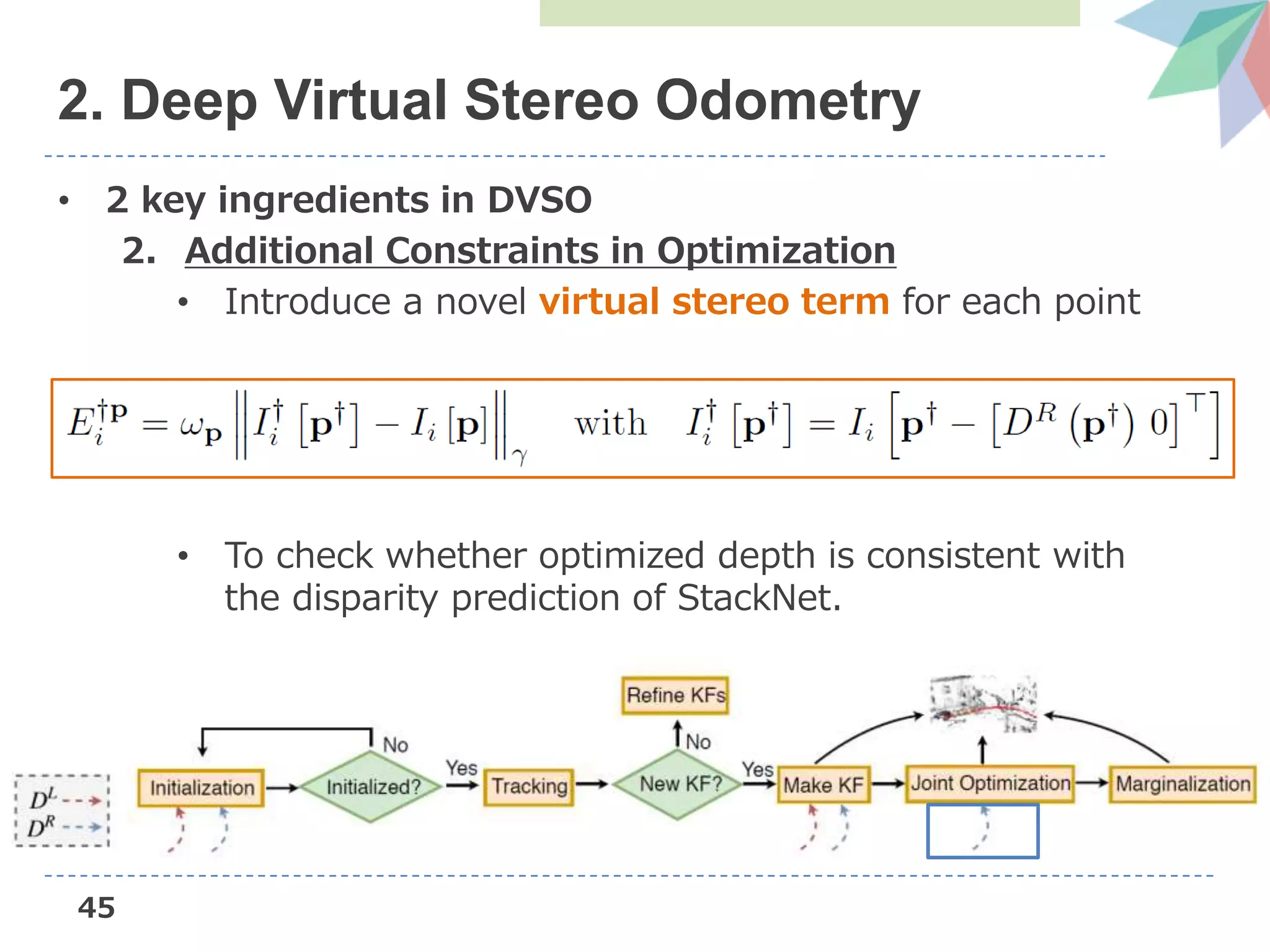
• Introduce a novel virtual stereo term for each point
• To check whether optimized depth is consistent with
the disparity prediction of StackNet.
2. Deep Virtual Stereo Odometry
46
• 2 key ingredients in DVSO
2. Additional Constraints in Optimization
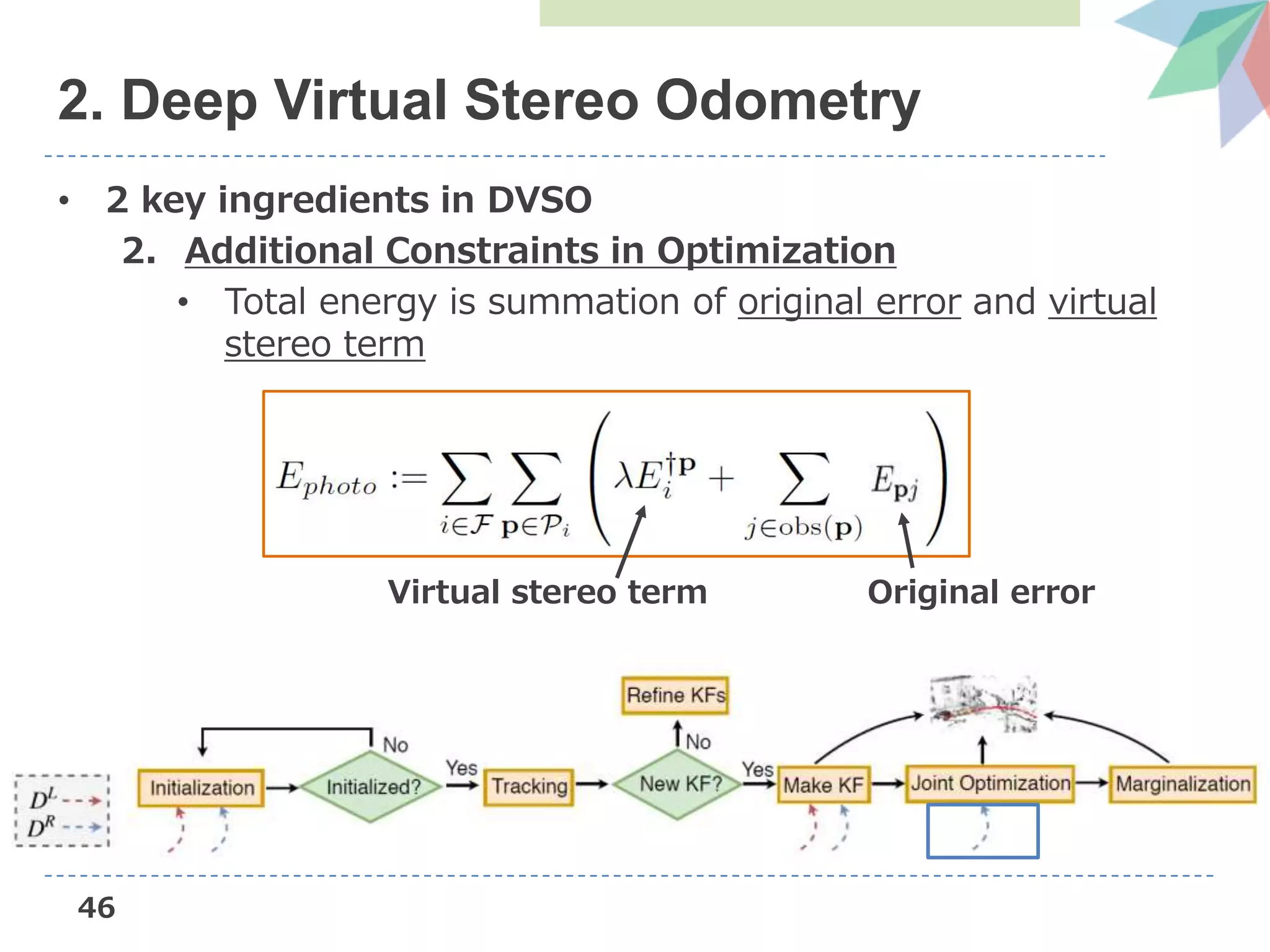
• Total energy is summation of original error and virtual
stereo term
2. Deep Virtual Stereo Odometry
Original errorVirtual stereo term
47
Experimental result
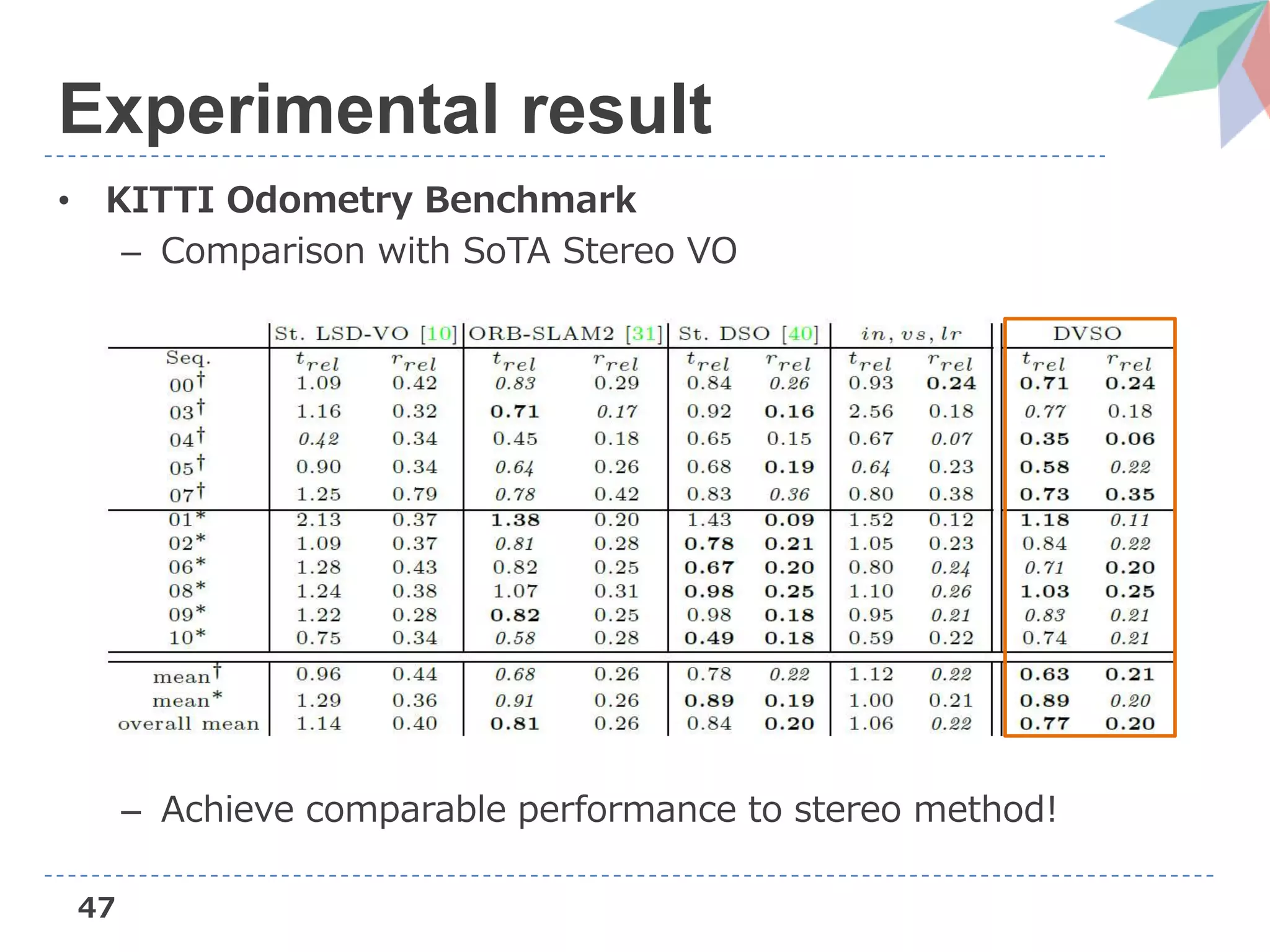
• KITTI Odometry Benchmark
– Comparison with SoTA Stereo VO
– Achieve comparable performance to stereo method!
48
Experimental result
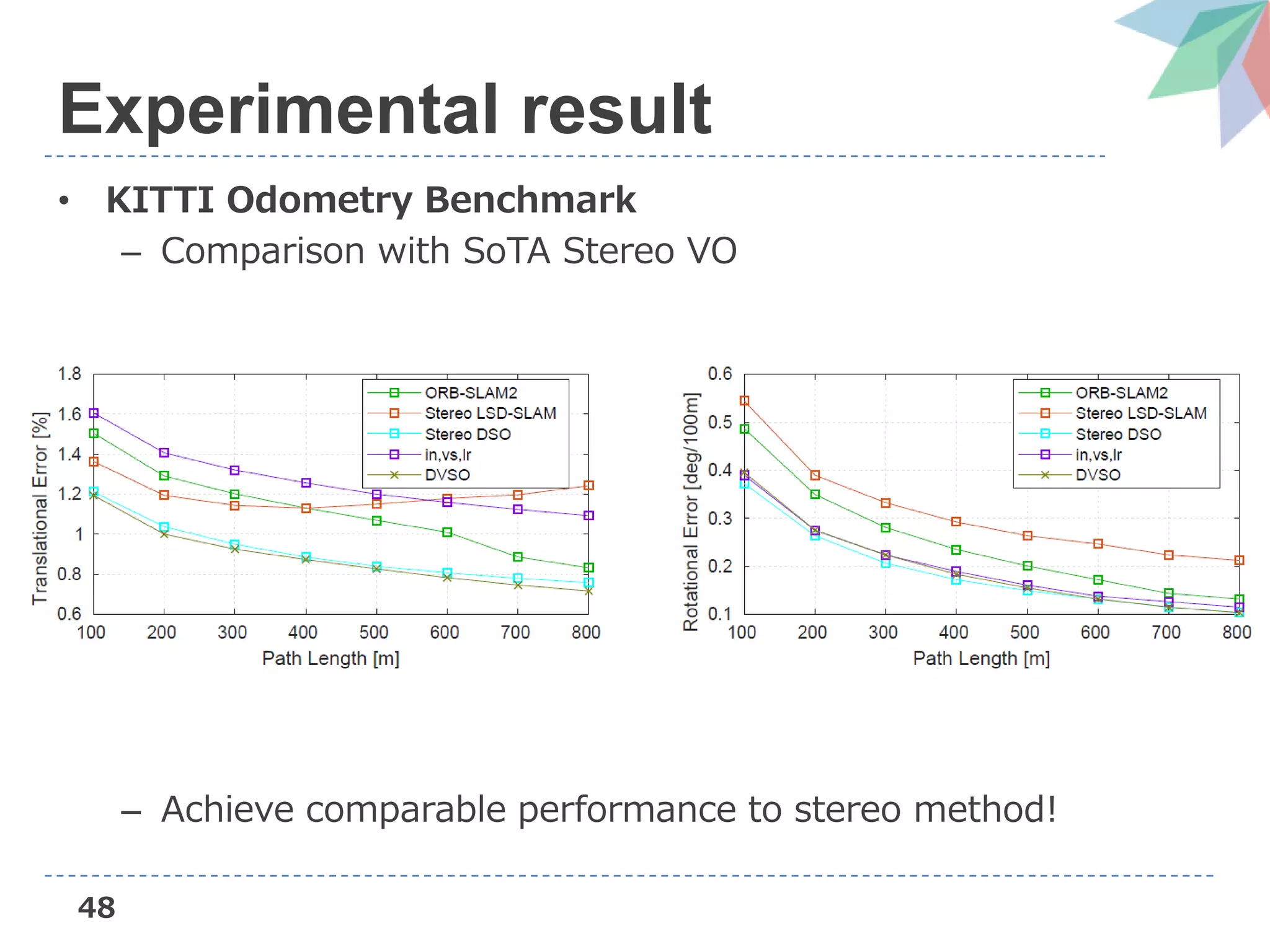
• KITTI Odometry Benchmark
– Comparison with SoTA Stereo VO
– Achieve comparable performance to stereo method!
49
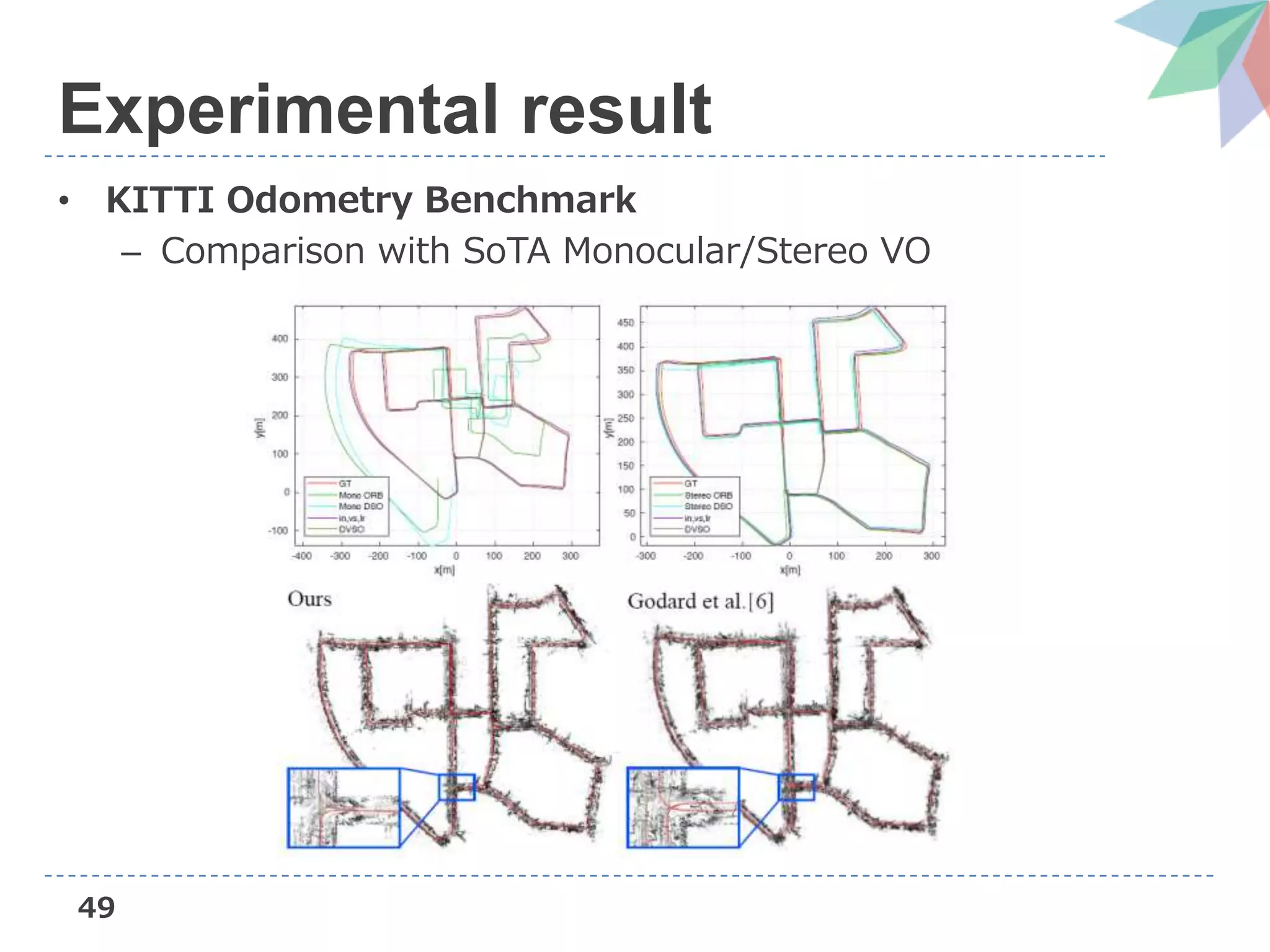
Experimental result
• KITTI Odometry Benchmark
– Comparison with SoTA Monocular/Stereo VO
50
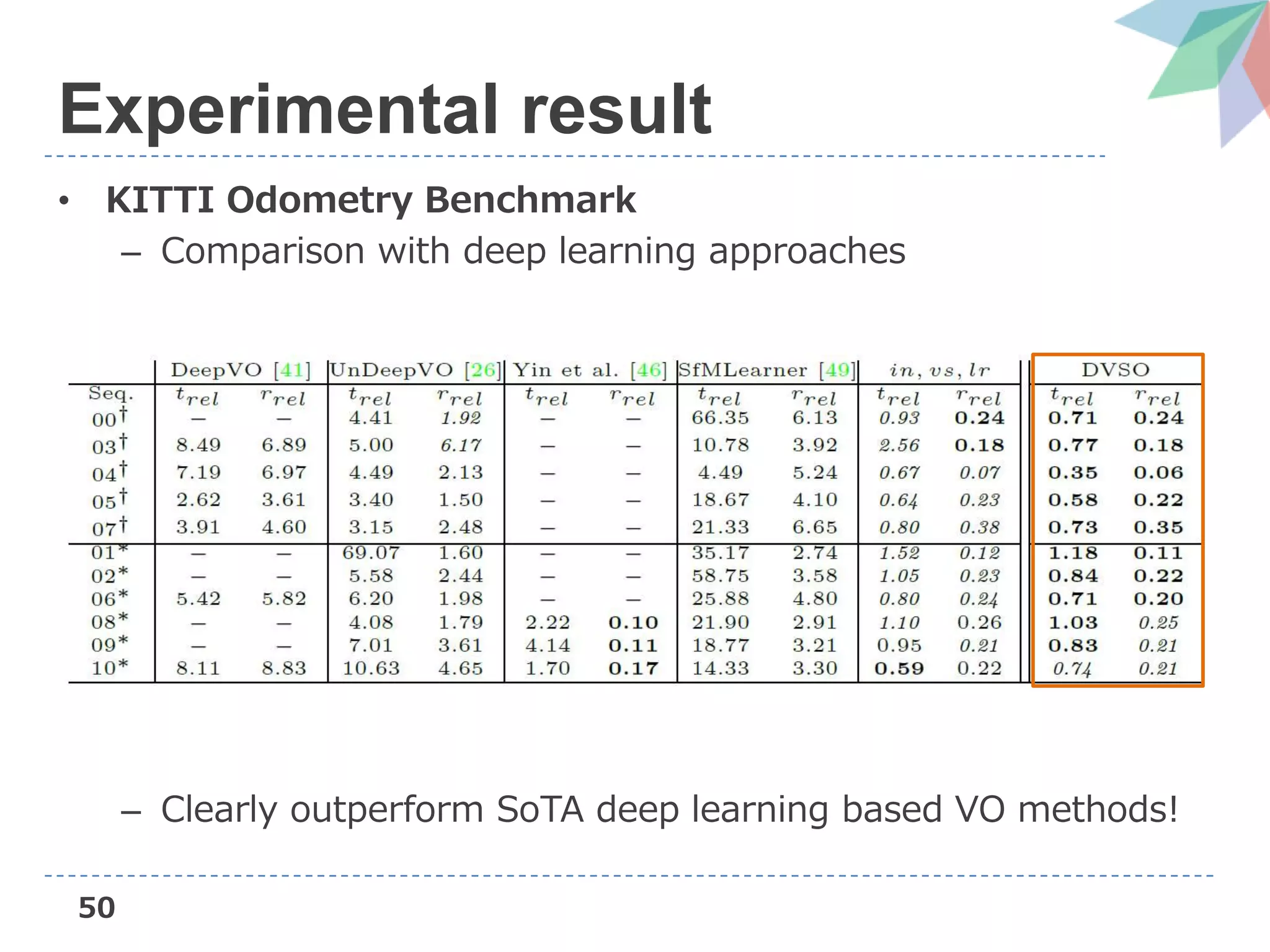
Experimental result
• KITTI Odometry Benchmark
– Comparison with deep learning approaches
– Clearly outperform SoTA deep learning based VO methods!
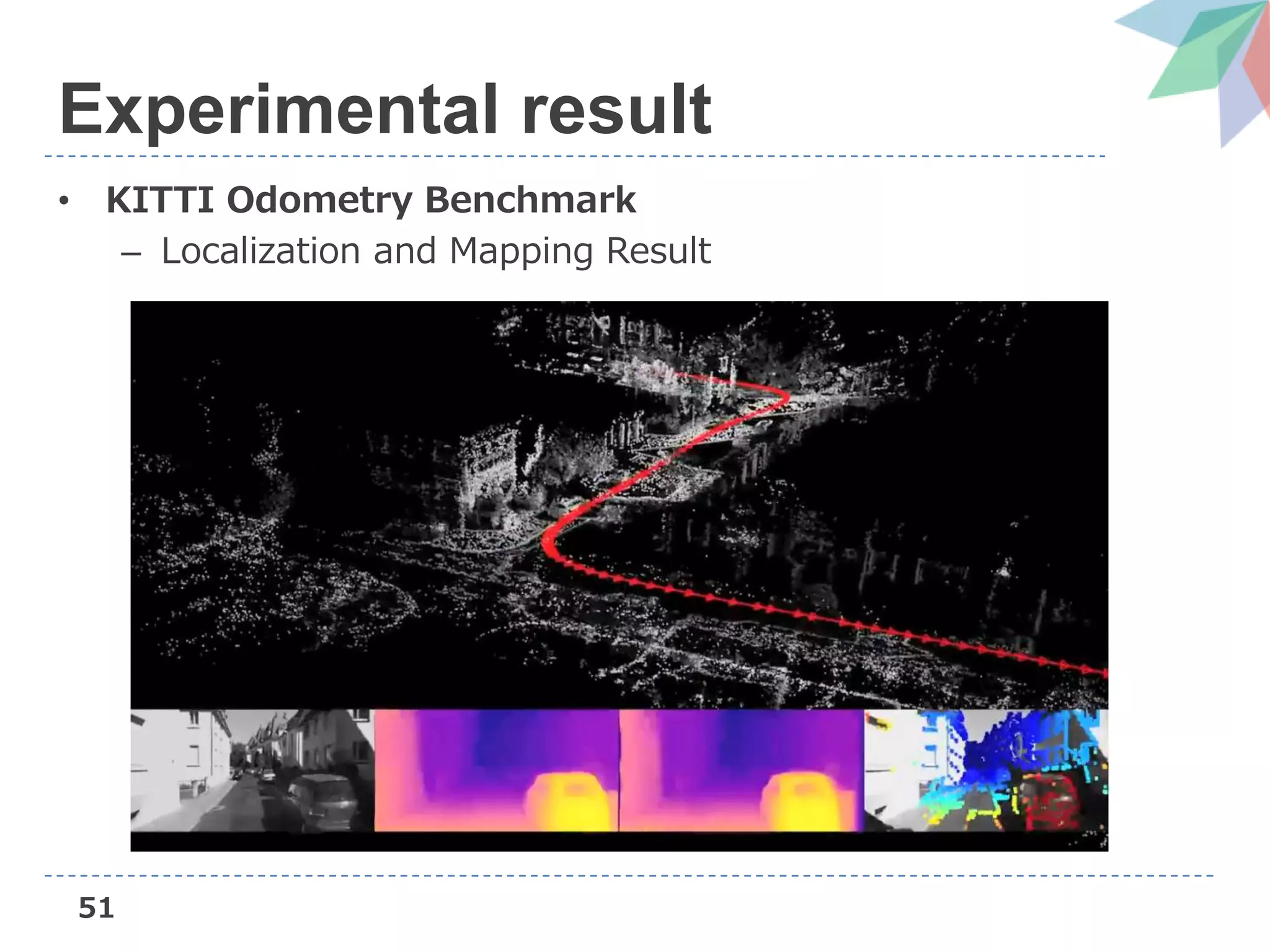
51
Experimental result
• KITTI Odometry Benchmark
– Localization and Mapping Result
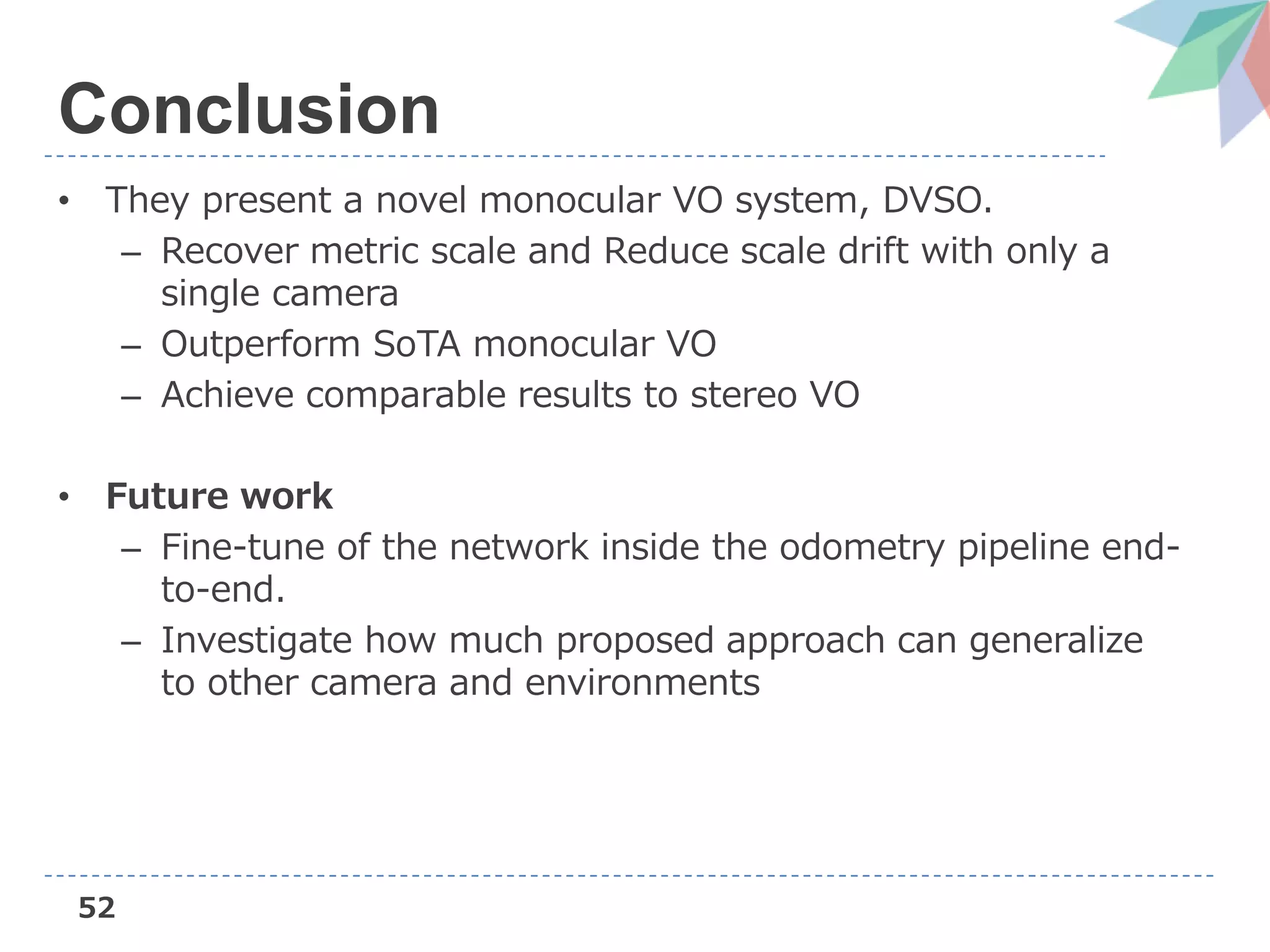
52
Conclusion
• They present a novel monocular VO system, DVSO.
– Recover metric scale and Reduce scale drift with only a
single camera
– Outperform SoTA monocular VO
– Achieve comparable results to stereo VO
• Future work
– Fine-tune of the network inside the odometry pipeline end-
to-end.
– Investigate how much proposed approach can generalize
to other camera and environments

論文読み会@AIST (Deep Virtual Stereo Odometry [ECCV2018])

  • 1.
    Deep Virtual StereoOdometry: Leveraging Deep Depth Prediction for Monocular Direct Sparse Odometry [ECCV2018(oral)] The University of Tokyo Aizawa Lab M1 Masaya Kaneko 論文読み会 @ AIST
  • 2.
    1 Introduction • Monocular VisualOdometry – Camera’s trajectory estimation and 3D reconstruction from image sequences obtained by monocular camera Direct Sparse Odometry [Engel+, PAMI’18]
  • 3.
    2 Introduction • Monocular VisualOdometry – Prone to scale drift (unknown scale) – Require sufficient motion parallax in successive frames Scale drift Small Parallax leads incorrect depth estimation drift
  • 4.
    3 Introduction • Typically complexsensors are employed to avoid this issue. – Active depth sensors (LiDAR, RGB-D camera) – Stereo camera • However, these sensors have following disadvantages. – Require larger efforts in calibration – Increase the cost of system Velodyne (https://velodynelidar.com/) ZED (https://www.stereolabs.com/)
  • 5.
    4 Introduction • If apriori knowledge about environment is used, this issue can be solved without complex sensors. – Deep based approach like CNN-SLAM [Tateno+, CVPR’18] – Now they propose a method to adapt this approach into state-of-the-art VO, DSO (Direct Sparse Odometry). https://drive.google.com/file/d/108CttbYiBqaI3b1jIJFTS26SzNfQqQNG/view
  • 6.
    5 Problem setting • Requirements –In inference time, you can only use monocular camera. (for Monocular Visual Odometry) – In train time, only inexpensive sensors are available. • Mono/Stereo camera is ok. • Active sensors are too costly to use. Sensors Inference Train Monocular camera 〇 〇 Stereo camera × 〇 Active sensors (RGB-D, LiDAR) × ×
  • 7.
    • Deep VirtualStereo Odometry 1. Train deep depth estimator using stereo camera 6 Proposed method Loss (Stereo camera) Input (left) Left Disparity Right Disparity StackNet
  • 8.
    • Deep VirtualStereo Odometry 1. Train deep depth estimator using stereo camera 2. In inference time, predicted disparities are used for depth initialization in monocular DSO. 7 Proposed method Monocular DSO Sparse Depthmap estimation Created Map Input (left) Left Disparity Right Disparity Initialize StackNet
  • 9.
    • Deep VirtualStereo Odometry 1. Train deep depth estimator using stereo camera 2. In inference time, predicted disparities are used for depth initialization in monocular DSO. 8 Proposed method Monocular DSO Sparse Depthmap estimation Created Map Input (left) Left Disparity Right Disparity Initialize StackNet
  • 10.
    9 1. Deep Monoculardepth estimation • 3 key ingredients Network Architecture Loss Function 1. StackNet 2 stage refinement of the network predictions in a stacked encoder- decoder architecture Input (left) Left Disparity Right Disparity StackNet 3. Supervised learning Use accurate sparse depth reconstruction by Stereo DSO as GT Left Disparity Stereo DSO’s Reconstructed result 2. Self-supervised learning Photoconsistency in a stereo setup 𝐼𝑙𝑒𝑓𝑡 𝑑𝑖𝑠𝑝 𝑟𝑖𝑔ℎ𝑡 𝐼𝑟𝑒𝑐𝑜𝑛𝑠 𝑟𝑖𝑔ℎ𝑡 𝐼𝑟𝑒𝑐𝑜𝑛𝑠 𝑙𝑒𝑓𝑡 𝑑𝑖𝑠𝑝𝑙𝑒𝑓𝑡
  • 11.
    10 1. Deep Monoculardepth estimation • Network Architecture – StackNet (SimpleNet + ResidualNet)
  • 12.
    11 1. Deep Monoculardepth estimation • Loss Function – Linear combination of 5 terms in each image scale 1. Self-supervised loss 2. Supervised loss 3. Left-right disparity consistency loss 4. Disparity smoothness regularization 5. Occlusion regularization
  • 13.
    12 1. Deep Monoculardepth estimation • Loss Function 1. Self-supervised loss • Measures the quality of the reconstructed images 𝐼𝑙𝑒𝑓𝑡 𝑑𝑖𝑠𝑝 𝑟𝑖𝑔ℎ𝑡 𝐼𝑟𝑒𝑐𝑜𝑛𝑠 𝑟𝑖𝑔ℎ𝑡 𝐼𝑟𝑒𝑐𝑜𝑛𝑠 𝑙𝑒𝑓𝑡 𝑑𝑖𝑠𝑝𝑙𝑒𝑓𝑡
  • 14.
    13 1. Deep Monoculardepth estimation • Loss Function 2. Supervised loss • Measures the deviation of the predicted disparity from disparities estimated by Stereo DSO [Wang+, ICCV’17] Left Disparity Stereo DSO’s Reconstructed result Stereo DSO (using Stereo camera)
  • 15.
    14 1. Deep Monoculardepth estimation • Loss Function 3. Left-right disparity consistency loss • Consistency loss proposed in MonoDepth [Godard+, CVPR’17] 𝐼𝑙𝑒𝑓𝑡 𝑑𝑖𝑠𝑝𝑙𝑒𝑓𝑡 𝑑𝑖𝑠𝑝 𝑟𝑖𝑔ℎ𝑡 𝐼 𝑟𝑖𝑔ℎ𝑡 𝑑𝑖𝑠𝑝𝑙𝑒𝑓𝑡
  • 16.
    15 1. Deep Monoculardepth estimation • Loss Function 4. Disparity smoothness regularization • Predicted disparity map should be locally smooth 5. Occlusion regularization • Disparity in occlusion are should be zero
  • 17.
    16 1. Deep Monoculardepth estimation • Experimental Result – Outperform the state-of-the-art semi-supervised method by Kuznietsov et al.
  • 18.
    17 1. Deep Monoculardepth estimation • Experimental Result – Their results contain more details and deliver comparable prediction on thin structure like pole.
  • 19.
    • Deep VirtualStereo Odometry 1. Train deep depth estimator using stereo camera 2. In inference time, predicted disparities are used for depth initialization in monocular DSO. 18 Proposed method (described) Monocular DSO Sparse Depthmap estimation Created Map Input (left) Left Disparity Right Disparity Initialize StackNet
  • 20.
    • Deep VirtualStereo Odometry 1. Train deep depth estimator using stereo camera 2. In inference time, predicted disparities are used for depth initialization in monocular DSO. 19 Proposed method (described) Monocular DSO Sparse Depthmap estimation Created Map Input (left) Left Disparity Right Disparity Initialize StackNet
  • 21.
    20 2. Deep VirtualStereo Odometry • Monocular DSO + Deep Disparity prediction – Disparities are used for 2 key ways 1. Frame initialization / point selection 2. Left-right constraints into windowed optimization in Monocular DSO 1. Frame initialization/ Point selection 2. Constraints in optimization
  • 22.
    21 2. Deep VirtualStereo Odometry • Monocular DSO + Deep Disparity prediction – Disparities are used for 2 key ways 1. Frame initialization / point selection 2. Left-right constraints into windowed optimization in Monocular DSO – First we explain overview of Monocular DSO Monocular DSO
  • 23.
    22 DSO (Direct SparseOdometry) • Novel direct sparse Visual Odometry method – Direct: seamless ability to use & reconstruct all points instead of only corners – Sparse: efficient, joint optimization of all parameters Feature-based, Sparse Direct, Semi-dense Taking both approach’s benefits [1] https://drive.google.com/file/d/108CttbYiBqaI3b1jIJFTS26SzNfQqQNG/view LSD-SLAM [Engel+, ICCV’14] ORB-SLAM [Mur-Artal+, MVIGRO’14]
  • 24.
    23 • Direct sparsemodel DSO - Model Formulation- Target frame 𝐼′𝑗 (Pose 𝐓𝑗, exposure time 𝒕𝑗) 𝒑 𝓝 𝒑 𝒑′Depth 1/𝑑 𝒑 Back-Projection Π 𝑐 −1 Projection Π 𝑐 Reference frame 𝐼′𝑖 (Pose 𝐓𝑖, exposure time 𝒕𝑖)
  • 25.
    24 • Direct sparsemodel DSO - Model Formulation- Target frame 𝐼′𝑗 (Pose 𝐓𝑗, exposure time 𝒕𝑗) 𝒑 𝓝 𝒑 𝒑′Depth 1/𝑑 𝒑 Back-Projection Π 𝑐 −1 Projection Π 𝑐 Reference frame 𝐼′𝑖 (Pose 𝐓𝑖, exposure time 𝒕𝑖) 𝓝 𝒑 [1] https://people.eecs.berkeley.edu/~chaene/cvpr17tut/SLAM.pdf
  • 26.
    25 • Direct sparsemodel DSO - Model Formulation- Target frame 𝐼′𝑗 (Pose 𝐓𝑗, exposure time 𝒕𝑗) 𝒑 𝓝 𝒑 𝒑′Depth 1/𝑑 𝒑 Back-Projection Π 𝑐 −1 Projection Π 𝑐 Reference frame 𝐼′𝑖 (Pose 𝐓𝑖, exposure time 𝒕𝑖) 𝓝 𝒑 Target Variables - Camera Pose 𝐓𝑖, 𝐓𝑗, - Inverse Depth 𝑑 𝐩 - Camera intrinsics 𝐜 [1] https://people.eecs.berkeley.edu/~chaene/cvpr17tut/SLAM.pdf
  • 27.
    26 • Direct sparsemodel DSO - Model Formulation- Target frame 𝐼′𝑗 (Pose 𝐓𝑗, exposure time 𝒕𝑗) 𝒑 𝓝 𝒑 𝒑′Depth 1/𝑑 𝒑 Back-Projection Π 𝑐 −1 Projection Π 𝑐 Reference frame 𝐼′𝑖 (Pose 𝐓𝑖, exposure time 𝒕𝑖) 𝓝 𝒑 Target Variables - Camera Pose 𝐓𝑖, 𝐓𝑗, - Inverse Depth 𝑑 𝐩 - Camera intrinsics 𝐜 Error between irradiance 𝑩 = 𝑰/𝒕 [1] https://people.eecs.berkeley.edu/~chaene/cvpr17tut/SLAM.pdf
  • 28.
    27 • Photometric calibration –Feature-based method only focus on geometric calibration, widely ignores this (features are invariant). – In direct method, this calibration is very important! DSO - Model Formulation- Observed Pixel value 𝐼𝑖 [1] https://people.eecs.berkeley.edu/~chaene/cvpr17tut/SLAM.pdf
  • 29.
    28 • Photometric calibration –Feature-based method only focus on geometric calibration, widely ignores this (features are invariant). – In direct method, this calibration is very important! DSO - Model Formulation- Observed Pixel value 𝐼𝑖 Photometric Calibration Hardware gamma 𝐺 (Response calibration) Vignette 𝐺 (Vignette calibration) Photometrically corrected image 𝐼𝑖 ′ 𝐼𝑖 𝐱 = 𝐺(𝑡𝑖 𝑉 𝐱 𝐵𝑖(𝐱)) →𝐼𝑖 ′ 𝐱 ≡ 𝑡𝑖 𝐵𝑖 𝐱 = 𝐺−1 (𝐼𝑖(𝐱))/𝑉(𝐱)
  • 30.
    29 • Photometric calibration –Feature-based method only focus on geometric calibration, widely ignores this (features are invariant). – In direct method, this calibration is very important! DSO - Model Formulation- Observed Pixel value 𝐼𝑖 Photometric Calibration Hardware gamma 𝐺 (Response calibration) Vignette 𝐺 (Vignette calibration) Irradiance 𝐵𝑖 (consistent value) 𝐼𝑖 𝐱 = 𝐺(𝑡𝑖 𝑉 𝐱 𝐵𝑖(𝐱)) →𝐼𝑖 ′ 𝐱 ≡ 𝑡𝑖 𝐵𝑖 𝐱 = 𝐺−1 (𝐼𝑖(𝐱))/𝑉(𝐱) Photometrically corrected image 𝐼𝑖 ′ Exposure time 𝑡𝑖 𝐵𝑖 𝐱 = 𝐼𝑖 ′ (𝐱) 𝑡𝑖
  • 31.
    30 • Direct sparsemodel DSO - Model Formulation- Target frame 𝐼′𝑗 (Pose 𝐓𝑗, exposure time 𝒕𝑗) 𝒑 𝓝 𝒑 𝒑′Depth 1/𝑑 𝒑 Back-Projection Π 𝑐 −1 Projection Π 𝑐 Reference frame 𝐼′𝑖 (Pose 𝐓𝑖, exposure time 𝒕𝑖) 𝓝 𝒑 Error between irradiance 𝑩 = 𝑰/𝒕 [1] https://people.eecs.berkeley.edu/~chaene/cvpr17tut/SLAM.pdf
  • 32.
    31 • Direct sparsemodel (photo-calibration is not available) – Additionally estimate affine lighting parameters DSO - Model Formulation- Reference frame 𝐼𝑖 (Pose 𝐓𝑖, Affine lighting (𝑎𝑖, 𝑏𝑖)) Target frame 𝐼𝑗 (Pose 𝐓𝑗, Affine lighting (𝑎𝑗, 𝑏𝑗)) 𝒑 𝓝 𝒑 𝒑′Depth 1/𝑑 𝒑 Back-Projection Π 𝑐 −1 Projection Π 𝑐 𝓝 𝒑 Error between affine lighted raw pixel [1] https://people.eecs.berkeley.edu/~chaene/cvpr17tut/SLAM.pdf
  • 33.
    32 • Direct sparsemodel (photo-calibration is not available) – Additionally estimate affine lighting parameters DSO - Model Formulation- Reference frame 𝐼𝑖 (Pose 𝐓𝑖, Affine lighting (𝑎𝑖, 𝑏𝑖)) Target frame 𝐼𝑗 (Pose 𝐓𝑗, Affine lighting (𝑎𝑗, 𝑏𝑗)) 𝒑 𝓝 𝒑 𝒑′Depth 1/𝑑 𝒑 Back-Projection Π 𝑐 −1 Projection Π 𝑐 𝓝 𝒑 Error between affine lighted raw pixel Target Variables - Camera Pose 𝐓𝑖, 𝐓𝑗, - Inverse Depth 𝑑 𝐩 - Camera intrinsics 𝐜 - Brightness 𝑎𝑖, 𝑏𝑖, 𝑎𝑗, 𝑏𝑗
  • 34.
    33 • Direct sparsemodel DSO - Model Formulation- All host frames ℱ = {1,2,3,4} Frame 𝐼𝑖=1 points 𝒫𝑖=1 observations obs(𝐩) Target Variables - Camera Pose 𝐓𝑖, 𝐓𝑗, - Inverse Depth 𝑑 𝐩 - Camera intrinsics 𝐜
  • 35.
    34 • System overviewof DSO 1. Frame Tracking 2. Keyframe Creation 3. Windowed Optimization 4. Marginalization DSO - System Overview -
  • 36.
    35 • System overviewof DSO 1. Frame Tracking 2. Keyframe Creation 3. Windowed Optimization 4. Marginalization DSO - System Overview - Tracking + Depth estimation - From active 𝑁𝑓(= 7) Keyframes Multi-scale Image Pyramid + constant motion model
  • 37.
    36 • System overviewof DSO 1. Frame Tracking 2. Keyframe Creation 3. Windowed Optimization 4. Marginalization DSO - System Overview - Tracking + Depth estimation - Frame keeps 𝑁 𝑝 = 2000 points 1. Well distributed in an image ? 2. High image gradient magnitude ? Point selection’s Two criteria
  • 38.
    37 • System overviewof DSO 1. Frame Tracking 2. Keyframe Creation 3. Windowed Optimization 4. Marginalization DSO - System Overview - Whether KF is required or not ? - Similar strategy to ORB-SLAM 1. In the view field ? 2. Occlusion ? 3. Camera exposure time? Three criteria If these conditions are met, tracked frame is inserted as Keyframe.
  • 39.
    • System overviewof DSO 1. Frame Tracking 2. Keyframe Creation 3. Windowed Optimization 4. Marginalization 38 DSO - System Overview - Windowed optimization (BA) - Minimize Photometric error from active Keyframes
  • 40.
    • System overviewof DSO 1. Frame Tracking 2. Keyframe Creation 3. Windowed Optimization 4. Marginalization 39 DSO - System Overview - Marginalization - Old variables are removed to avoid too much computation - Schur complement Black : marginalized points
  • 41.
    40 • System overviewof DSO 1. Frame Tracking 2. Keyframe Creation 3. Windowed Optimization 4. Marginalization DSO - System Overview - Monocular DSO
  • 42.
    41 • 2 keyingredients in DVSO 1. Frame initialization / point selection 2. Left-right constraints into windowed optimization in Monocular DSO 2. Deep Virtual Stereo Odometry 1. Frame initialization/ Point selection 2. Constraints in optimization Monocular DSO
  • 43.
    42 • 2 keyingredients in DVSO 1. Frame initialization / point selection • StackNet’s prediction is used as initial depth value in monocular DSO. (similar to stereo DSO) 2. Deep Virtual Stereo Odometry
  • 44.
    43 • 2 keyingredients in DVSO 1. Frame initialization / point selection • Left and right disparities by StackNet are used for point selection • To filter out the occluded area’s pixel (𝑒𝑙𝑟 > 1) 2. Deep Virtual Stereo Odometry
  • 45.
    44 • 2 keyingredients in DVSO 2. Additional Constraints in Optimization • Monocular DSO’s total energy (described) 2. Deep Virtual Stereo Odometry →
  • 46.
    45 • 2 keyingredients in DVSO 2. Additional Constraints in Optimization • Introduce a novel virtual stereo term for each point • To check whether optimized depth is consistent with the disparity prediction of StackNet. 2. Deep Virtual Stereo Odometry
  • 47.
    46 • 2 keyingredients in DVSO 2. Additional Constraints in Optimization • Total energy is summation of original error and virtual stereo term 2. Deep Virtual Stereo Odometry Original errorVirtual stereo term
  • 48.
    47 Experimental result • KITTIOdometry Benchmark – Comparison with SoTA Stereo VO – Achieve comparable performance to stereo method!
  • 49.
    48 Experimental result • KITTIOdometry Benchmark – Comparison with SoTA Stereo VO – Achieve comparable performance to stereo method!
  • 50.
    49 Experimental result • KITTIOdometry Benchmark – Comparison with SoTA Monocular/Stereo VO
  • 51.
    50 Experimental result • KITTIOdometry Benchmark – Comparison with deep learning approaches – Clearly outperform SoTA deep learning based VO methods!
  • 52.
    51 Experimental result • KITTIOdometry Benchmark – Localization and Mapping Result
  • 53.
    52 Conclusion • They presenta novel monocular VO system, DVSO. – Recover metric scale and Reduce scale drift with only a single camera – Outperform SoTA monocular VO – Achieve comparable results to stereo VO • Future work – Fine-tune of the network inside the odometry pipeline end- to-end. – Investigate how much proposed approach can generalize to other camera and environments