Airline Deregulation and the
Evolution of Airline Market
Power in the United States
Severin Borenstein
Professor, Economic Analysis and Policy Group
Haas School of Business
University of California, Berkeley
1OECD Competition Committee, 19 June 2014
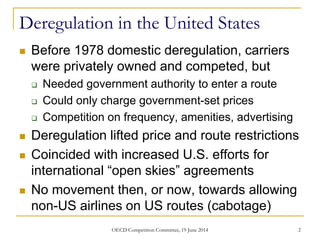
Deregulation in the United States
 Before 1978 domestic deregulation, carriers
were privately owned and competed, but
 Needed government authority to enter a route
 Could only charge government-set prices
 Competition on frequency, amenities, advertising
 Deregulation lifted price and route restrictions
 Coincided with increased U.S. efforts for
international “open skies” agreements
 No movement then, or now, towards allowing
non-US airlines on US routes (cabotage)
OECD Competition Committee, 19 June 2014 2
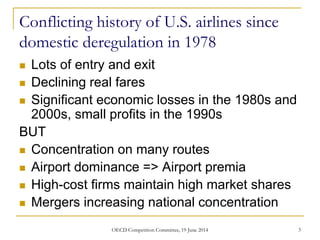
Conflicting history of U.S. airlines since
domestic deregulation in 1978
 Lots of entry and exit
 Declining real fares
 Significant economic losses in the 1980s and
2000s, small profits in the 1990s
BUT
 Concentration on many routes
 Airport dominance => Airport premia
 High-cost firms maintain high market shares
 Mergers increasing national concentration
3OECD Competition Committee, 19 June 2014
Early research found market power
from route and airport concentration
 Supported by Levine (1987) after he had
been CEO of a startup airline
 Contestable airline markets rejected by
numerous studies
 Market power associated with airport
dominant position above and beyond route
concentration or share
 Some finding of density economies
 not finding of network scope economies
4OECD Competition Committee, 19 June 2014
Three trends since the 1980s
 Expansion and contraction of hub-and-spoke
networks
 Steadily increasing load factors
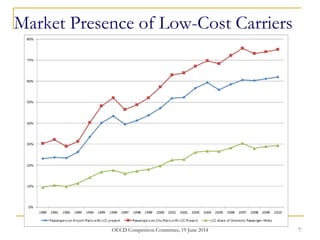
 Expansion of low-cost carriers (LCCs)
 What explains the large decline in real price?
 What’s the role of changes in market power?
 What does that suggest post-consolidation?
 I focus mostly on 1990-2010
5OECD Competition Committee, 19 June 2014
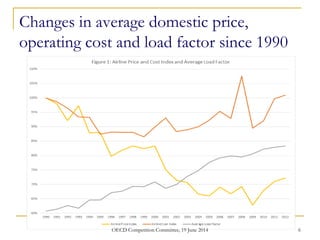
Changes in average domestic price,
operating cost and load factor since 1990
6OECD Competition Committee, 19 June 2014
Market Presence of Low-Cost Carriers
7OECD Competition Committee, 19 June 2014
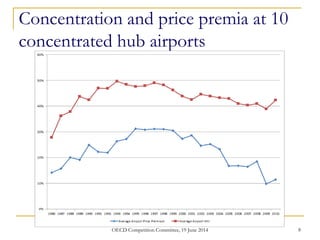
Concentration and price premia at 10
concentrated hub airports
8OECD Competition Committee, 19 June 2014
“Share Gap”
 Example from Dallas/Ft.Worth (DFW)–
Charlotte (CLT) route. US Airways (US) is
dominant at CLT, America (AA) at DFW
 In 2010, on DFW-CLT, US got 65% of
passengers whose trip originated at CLT,
38% of passengers who originated at DFW
 American got 22% at CLT, 49% at DFW
 Share gap is seen in the industry as measure
of regional advantage: advertising, marketing,
loyalty programs
 Frequent flyer and corporate discount programs
9OECD Competition Committee, 19 June 2014
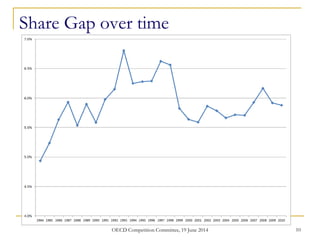
Share Gap over time
10OECD Competition Committee, 19 June 2014
Share Gap is strongly associated with
airport dominance and business travel
 First analysis in 1991, using 1986 data
(Borenstein, Quarterly Journal of Economics, Nov 1991)
 Differential share by point of ticket origination
 as function of differential endpoint airport dominance
and the business orientation of route
 Same analysis for 1984-2010 shows
 Share gap a bit more associated with airport
dominance and biz travel now than in 1990s
 Airline loyalty as strong as ever
11OECD Competition Committee, 19 June 2014
So why have airline prices and hub
airport premia fallen?
 Declining impact of Airport Dominance
 In 1990s, effect is larger than effect of route share
 By 2006-2010 effect is essentially zero
 Steady effect of Share Gap
 Routes with large share gap have higher prices
after controlling for route share and concentration
 Interpretation: Airport access/amenities
advantages have declined (AIR21
regulation), but loyalty impact remains strong
12OECD Competition Committee, 19 June 2014
Airline Prices 1990-2010
 Airline cost reductions, including increased
load factors, offset fuel cost increases, but
prices fell 37% by 2009
 About 10% recovery by 2012
 Fares at dominated airports and on business
routes declined relative to other routes,
combined up to 20% drop by 2009
 But airline loyalty/marketing advantages
remain very strong and strongly associated
with business travel and dominated airports
13OECD Competition Committee, 19 June 2014
Airline prices in the next decade
 Already rising before most recent mergers
took effect, continuing since then
 Much of that likely just rationalization from very low
prices of the 2000s
 Share gap analysis suggests airlines have
maintained strength from loyalty programs
 Leveraging loyalty programs seems likely to
be more important with 4 major players left
 Raising barriers to new entrants
 Dividing markets, possibly softening competition
14OECD Competition Committee, 19 June 2014

Airline Deregulation and the Evolution of Airline Market Power in the United States - Severin Borenstein – June 2014 OECD discussion on airline competition

  • 1.
    Airline Deregulation andthe Evolution of Airline Market Power in the United States Severin Borenstein Professor, Economic Analysis and Policy Group Haas School of Business University of California, Berkeley 1OECD Competition Committee, 19 June 2014
  • 2.
    Deregulation in theUnited States  Before 1978 domestic deregulation, carriers were privately owned and competed, but  Needed government authority to enter a route  Could only charge government-set prices  Competition on frequency, amenities, advertising  Deregulation lifted price and route restrictions  Coincided with increased U.S. efforts for international “open skies” agreements  No movement then, or now, towards allowing non-US airlines on US routes (cabotage) OECD Competition Committee, 19 June 2014 2
  • 3.
    Conflicting history ofU.S. airlines since domestic deregulation in 1978  Lots of entry and exit  Declining real fares  Significant economic losses in the 1980s and 2000s, small profits in the 1990s BUT  Concentration on many routes  Airport dominance => Airport premia  High-cost firms maintain high market shares  Mergers increasing national concentration 3OECD Competition Committee, 19 June 2014
  • 4.
    Early research foundmarket power from route and airport concentration  Supported by Levine (1987) after he had been CEO of a startup airline  Contestable airline markets rejected by numerous studies  Market power associated with airport dominant position above and beyond route concentration or share  Some finding of density economies  not finding of network scope economies 4OECD Competition Committee, 19 June 2014
  • 5.
    Three trends sincethe 1980s  Expansion and contraction of hub-and-spoke networks  Steadily increasing load factors  Expansion of low-cost carriers (LCCs)  What explains the large decline in real price?  What’s the role of changes in market power?  What does that suggest post-consolidation?  I focus mostly on 1990-2010 5OECD Competition Committee, 19 June 2014
  • 6.
    Changes in averagedomestic price, operating cost and load factor since 1990 6OECD Competition Committee, 19 June 2014
  • 7.
    Market Presence ofLow-Cost Carriers 7OECD Competition Committee, 19 June 2014
  • 8.
    Concentration and pricepremia at 10 concentrated hub airports 8OECD Competition Committee, 19 June 2014
  • 9.
    “Share Gap”  Examplefrom Dallas/Ft.Worth (DFW)– Charlotte (CLT) route. US Airways (US) is dominant at CLT, America (AA) at DFW  In 2010, on DFW-CLT, US got 65% of passengers whose trip originated at CLT, 38% of passengers who originated at DFW  American got 22% at CLT, 49% at DFW  Share gap is seen in the industry as measure of regional advantage: advertising, marketing, loyalty programs  Frequent flyer and corporate discount programs 9OECD Competition Committee, 19 June 2014
  • 10.
    Share Gap overtime 10OECD Competition Committee, 19 June 2014
  • 11.
    Share Gap isstrongly associated with airport dominance and business travel  First analysis in 1991, using 1986 data (Borenstein, Quarterly Journal of Economics, Nov 1991)  Differential share by point of ticket origination  as function of differential endpoint airport dominance and the business orientation of route  Same analysis for 1984-2010 shows  Share gap a bit more associated with airport dominance and biz travel now than in 1990s  Airline loyalty as strong as ever 11OECD Competition Committee, 19 June 2014
  • 12.
    So why haveairline prices and hub airport premia fallen?  Declining impact of Airport Dominance  In 1990s, effect is larger than effect of route share  By 2006-2010 effect is essentially zero  Steady effect of Share Gap  Routes with large share gap have higher prices after controlling for route share and concentration  Interpretation: Airport access/amenities advantages have declined (AIR21 regulation), but loyalty impact remains strong 12OECD Competition Committee, 19 June 2014
  • 13.
    Airline Prices 1990-2010 Airline cost reductions, including increased load factors, offset fuel cost increases, but prices fell 37% by 2009  About 10% recovery by 2012  Fares at dominated airports and on business routes declined relative to other routes, combined up to 20% drop by 2009  But airline loyalty/marketing advantages remain very strong and strongly associated with business travel and dominated airports 13OECD Competition Committee, 19 June 2014
  • 14.
    Airline prices inthe next decade  Already rising before most recent mergers took effect, continuing since then  Much of that likely just rationalization from very low prices of the 2000s  Share gap analysis suggests airlines have maintained strength from loyalty programs  Leveraging loyalty programs seems likely to be more important with 4 major players left  Raising barriers to new entrants  Dividing markets, possibly softening competition 14OECD Competition Committee, 19 June 2014