*
    STRATEGY 390 – Section 005

    Ali Khalil
    HaeJun Jeon
    Michael Kondoleon
    Joanna Lu
    Will Wang
    Jason Zhang
*
•   Business: Transport passengers and cargo regionally,
    domestically, and internationally
•   Focus: Domestic passenger airline industry


•   Five major players with majority market share:
*

Pre-flight Operations    Pre-flight Logistics    Flight Service                  Post-flight Services
   -Acquiring aircraft     -Scheduling staff    -Client transportation            -Shuttles/Car rentals
      -Hiring staff         -Setting routes      -On-flight services                -Partnership deals
 -Purchasing materials       -Setting fares      -Baggage handling             -Points/membership system


                                                             Post-flight logistics
                                                                   -Connections
                                                               -Missed flight support
                                                              -Lost baggage support
*
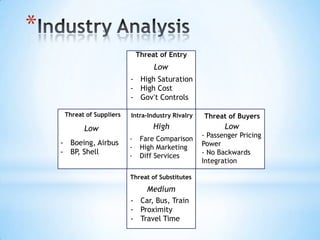
                               Threat of Entry
                                    Low
                           - High Saturation
                           - High Cost
                           - Gov’t Controls

     Threat of Suppliers   Intra-Industry Rivalry   Threat of Buyers
           Low                      High                   Low
                           -    Fare Comparison     - Passenger Pricing
    - Boeing, Airbus                                Power
                           -    High Marketing
    - BP Shell
        ,                                           - No Backwards
                           -    Diff Services
                                                    Integration

                           Threat of Substitutes

                                  Medium
                           - Car, Bus, Train
                           - Proximity
                           - Travel Time
*
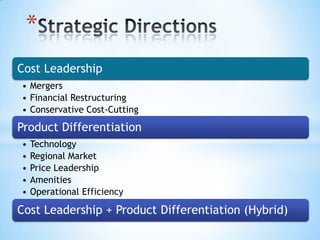
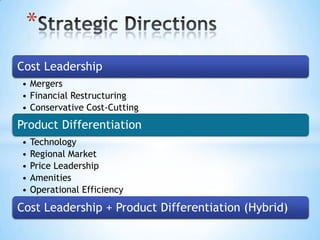
Cost Leadership
• Mergers
• Financial Restructuring
• Conservative Cost-Cutting
Product Differentiation
•   Technology
•   Regional Market
•   Price Leadership
•   Amenities
•   Operational Efficiency

Cost Leadership + Product Differentiation (Hybrid)
*
 • Reduce costs primarily through M & A
    • Renegotiate labor contracts, pensions, etc.

 • Maintain traditional model while cutting costs
   • Continue offering routes to all destinations
   • Maintain frequent flier, lounges, perks


                      Product
Cost Leadership                     Hybrid   Analysis   Conclusion
                  Differentiation
*
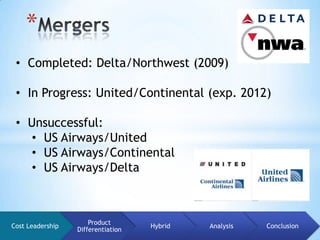
 • Completed: Delta/Northwest (2009)

 • In Progress: United/Continental (exp. 2012)

 • Unsuccessful:
   • US Airways/United
   • US Airways/Continental
   • US Airways/Delta


                      Product
Cost Leadership                     Hybrid   Analysis   Conclusion
                  Differentiation
*
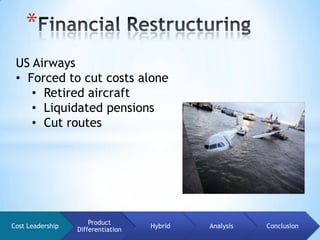
 US Airways
 • Forced to cut costs alone
    • Retired aircraft
    • Liquidated pensions
    • Cut routes


                      Product
Cost Leadership                     Hybrid   Analysis   Conclusion
                  Differentiation
*
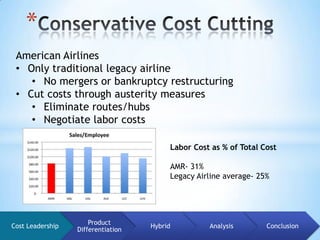
 American Airlines
 • Only traditional legacy airline
    • No mergers or bankruptcy restructuring
 • Cut costs through austerity measures
    • Eliminate routes/hubs
    • Negotiate labor costs

                                         Labor Cost as % of Total Cost

                                         AMR- 31%
                                         Legacy Airline average- 25%


                      Product
Cost Leadership                     Hybrid         Analysis        Conclusion
                  Differentiation
*
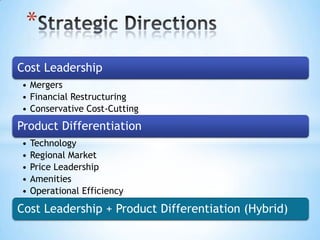
Cost Leadership
• Mergers
• Financial Restructuring
• Conservative Cost-Cutting
Product Differentiation
•   Technology
•   Regional Market
•   Price Leadership
•   Amenities
•   Operational Efficiency

Cost Leadership + Product Differentiation (Hybrid)
*
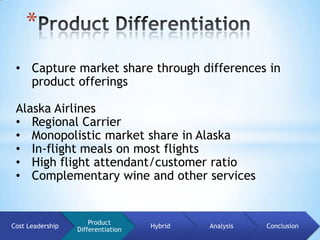
 • Capture market share through differences in
   product offerings

 Alaska Airlines
 • Regional Carrier
 • Monopolistic market share in Alaska
 • In-flight meals on most flights
 • High flight attendant/customer ratio
 • Complementary wine and other services


                      Product
Cost Leadership                     Hybrid   Analysis   Conclusion
                  Differentiation
*
Cost Leadership
• Mergers
• Financial Restructuring
• Conservative Cost-Cutting
Product Differentiation
•   Technology
•   Regional Market
•   Price Leadership
•   Amenities
•   Operational Efficiency

Cost Leadership + Product Differentiation (Hybrid)
*
 Southwest Airlines
 • Cost Leadership
      • Focus on low unit costs
      • Short aircraft turnaround time
      • Mitigation of fuel price risk
 • Product Differentiation
      • “Point-to-Point” network model
      • Secondary markets (BWI, MDW, LGA)
      • No baggage fees


                      Product
Cost Leadership                     Hybrid   Analysis   Conclusion
                  Differentiation
In millions   Delta        US Airways   United     AMR           Alaska     LUV
 Revenue            $ 31,755      $ 11,908    $ 23,229    $ 22,170      $ 3,832    $ 12,104
 Domestic profits   $ 332         $ 291       $ 147       $ (283)       $ 226      $ 459
 Profit margin        1.05%         2.45%       0.63%        (1.27%)      5.90%      3.79%
 Market cap         $ 6,290       $ 692       $ 5,490     $ 543         $ 2,260    $ 6,130


                            Product
Cost Leadership                               Hybrid             Analysis         Conclusion
                        Differentiation
*
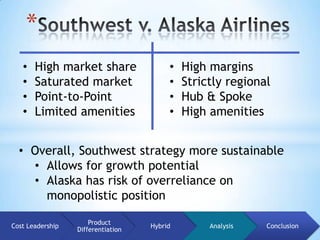
   •   High market share                 •   High margins
   •   Saturated market                  •   Strictly regional
   •   Point-to-Point                    •   Hub & Spoke
   •   Limited amenities                 •   High amenities


  • Overall, Southwest strategy more sustainable
    • Allows for growth potential
    • Alaska has risk of overreliance on
      monopolistic position

                      Product
Cost Leadership                     Hybrid        Analysis   Conclusion
                  Differentiation
*
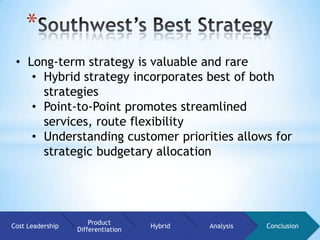
 • Long-term strategy is valuable and rare
    • Hybrid strategy incorporates best of both
      strategies
    • Point-to-Point promotes streamlined
      services, route flexibility
    • Understanding customer priorities allows for
      strategic budgetary allocation


                      Product
Cost Leadership                     Hybrid   Analysis   Conclusion
                  Differentiation
*
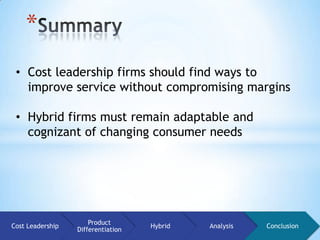
 • Cost leadership firms should find ways to
   improve service without compromising margins

 • Hybrid firms must remain adaptable and
   cognizant of changing consumer needs


                      Product
Cost Leadership                     Hybrid   Analysis   Conclusion
                  Differentiation
*