1
PHILIPPINE AIRLINES


          Vincent Raymond A. Adriano
                     Edwina M. Arceo
                        Vivian T. Dabu
               Maria Farrah Feliciano
                     Irish G. Sanchez
                                    2
COMPANY PROFILE
  PAL   Holdings (PSE: PAL) – holding company,
   part of a group of companies owned by
   business tycoon Lucio C. Tan.
  13th largest corporation in the Philippines in
   terms of revenue and 21st largest in terms of
   assets in 2005 Philippines’ Top 500 Largest
   Corporations.
  61st largest airline in the world in terms of
   revenue passenger kilometers flown.

Mission: to serve as a partner in nation-building
                                                    3
COMPANY PROFILE
 February 26, 1941 – established by a group of
  businessmen led by Andres Soriano and former
  Senator Ramon Fernandez, who served as its
  Chairman and President.
 March 15, 1941 – airline’s first flight with a single
  (twin-engine, 5-seater) Beechcraft Model 18 NPC-
  54 between Manila and Baguio.
 September 1941 – Philippine government invested
  in PAL, paving the way for its nationalization.
 February 14, 1946 – resumed operations after
  WWII interruption servicing 15 domestic points with
  5 Douglas DC-3s.


                                                          4
COMPANY PROFILE
 July  31, 1946 – first Asian airline to cross the
  Pacific Ocean with a chartered Douglas DC-4
  ferrying 40 American servicemen to Oakland,
  California from Neilson Airport (Makati) with
  fuelling stops in Guam, Wake Island,
  Johnston Atoll and Honolulu.
 December 1946 – regular service between
  Manila and San Francisco. Designated as
  the country’s flag carrier.


                                                      5
COMPANY PROFILE
 1950s   – founding of the country’s own national
  airline.
 1960s – first privatization with then PAL
  Chairman, Benigno Toda, Jr. acquiring a
  majority stake in the airline.
 1970s – one airline policy under Marcos
  government; comprehensive modernization
  program implemented.
 1980s – massive modernization of domestic
  fleet.
                                                     6
COMPANY PROFILE
 1990s– re-privatization and second
 expansion
  January 1995 – Lucio C. Tan became the new
   Chairman and CEO.
  1996 – US$4 billion modernization and re-fleeting
   program aimed at making PAL one of Asia’s best
   airlines in 3 years.
  1997 – rebranded itself as “Asia’s sunniest airline”;
   commenced unprofitable routes (eg. Manila to New
   York via Vancouver)


                                                           7
COMPANY PROFILE
   1998 – full impact of Asian financial crisis,
    aggravated by industrial action by its union.
     September 23, 1998 – complete shutdown of PAL
      operations, the first Asian airline to do so and one of
      the largest corporate failures in Philippine history.
     October 7, 1998 – resumed operations with services to
      15 domestic points out of Manila.
     December 7, 1998 – submitted a “standalone”
      rehabilitation plan to SEC.
     June 4, 1999 – SEC approved the rehabilitation plan
      after Lucio C. Tan and his associates infused another
      US$200M capital.

                                                                8
COMPANY PROFILE
 2000s– returned to profitability with
 Php44.2M in its first year of rehabilitation after
 6 years of heavy losses.
  Continued with restructuring (outsourcing of
   maintenance and engineering division to LTP);
   aggressive marketing strategies (rewards
   programs and online booking); re-fleeting and
   modernization; and opening/restoring of domestic
   and international destinations.
  October 4, 2007 – released from receivership.


                                                      9
COMPANY PROFILE
   IATA Operational Safety Audit
     February 2007 – accredited by International Air Transport
      Association.
   Airline Turnaround of the Year 2007
     November 2007 – granted by Centre for Asia Pacific
      Aviation for its "strategic contribution to the aviation industry
      through a significant transformation by successfully
      restructuring its operations through innovative cost-cutting
      measures resulting in operating profits.”
   Most trusted airline brand for Filipino consumers
     May 2010 – granted by respected international publication
      Reader’s Digest in its annual, Asia-wide survey.


                                                                          10
COMPANY PROFILE
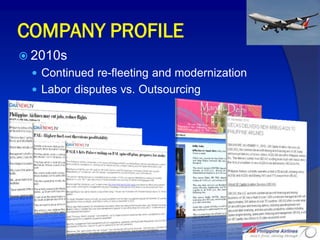
 2010s
  Continued re-fleeting and modernization
  Labor disputes vs. Outsourcing


                                             11
PROBLEM IDENTIFICATION
 The   approaches that PAL has used to stay
  competitive in the global airline industry.
 How service differentiation enables an
  airline such as PAL to stay ahead in the
  fight for market share?
 Does being first always translate into a
  successful marketing strategy?


                                                12
A. PAL APPROACHES
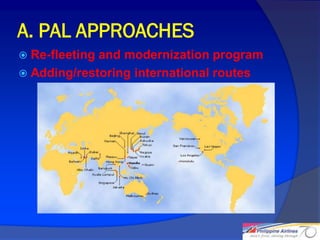
 Re-fleeting and modernization program
 Adding/restoring international routes


                                          13
A. PAL APPROACHES
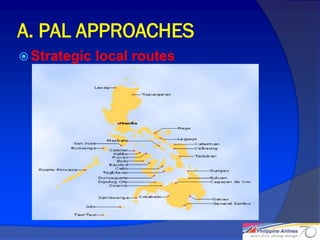
 Strategic   local routes


                             14
A. PAL APPROACHES
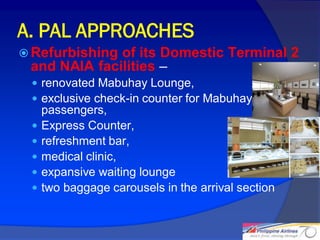
 Refurbishingof its Domestic Terminal 2
 and NAIA facilities –
  renovated Mabuhay Lounge,
  exclusive check-in counter for Mabuhay Class
     passengers,
    Express Counter,
    refreshment bar,
    medical clinic,
    expansive waiting lounge
    two baggage carousels in the arrival section


                                                    15
A. PAL APPROACHES
 Codeshare    agreements as of February
 2011
  Cathay Pacific
  Emirates
  Etihad Airways
  Qatar Airways
  Gulf Air
  Malaysian Airlines
  Airphil Express
  Garuda Indonesia

                                           16
A. PAL APPROACHES
   SLOGANS AND ADVERTISING
       Mabuhay
       Asia's First Airline
       Welcome Aboard the Philippines
       Shining Through - concurrent with the slogan The
        beauty of the Philippines that heavily promoted
        Philippines as a tourist destination. The TV
        advertisement clip won a finalist in Clio Awards.
       Pilipino, Para sa Pilipino (Filipino, for the Filipino)
       On the Wings of Change
       Asia's Sunniest
       With You All the Way

                                                                  17
A. PAL APPROACHES
   SLOGANS AND ADVERTISING
     It's About Experience - introduced after its 60th Anniversary. It
      attempts to highlight the fact that PAL is the first and longest-
      serving airline in Asia under its original name. The slogan was
      also used in the airline's ad spot featuring Kevyn Lettau, which
      incidentally featured her song, "Sunlight."
     Love at Thirty Thousand Feet is the de facto theme song of
      the airline. It was composed by Jose Mari Chan and is still
      being used today. The song has many variations, including a
      version for the PAL's Swingaround tour package
      advertisement.
     Clearly no. 1
     With us, You're always no. 1
     Asia's First, Shining Through - introduced for PAL's 70th
      anniversary, it combines two previous PAL slogans: Asia's
      First Airline and Shining Through.


                                                                          18
B. SERVICE DIFFERENTIATION
   Legacy airline - being the known flag carrier in the
    past, having carried past Presidents of the country, it
    augurs well to Filipinos abroad who are coming home
    for a visit or for good, after long absence.
   Availability and accessibility - with codeshare
    partners as well as presence in 31 international and 29
    domestic destinations
   Comfort and style - Filipinos are very particular with
    “status symbol,” “comfort” and the perks that comes to
    with the “status.”
     Mabuhay club members perks and benefits
     2 classes: Mabuhay (business) and Fiesta
      (economy)


                                                              19
B. SERVICE DIFFERENTIATION
 TRAVELERS’     AMENITIES
  Mabuhay lounges
  Seating comfort – more leg room and space to
   recline.
  Meals and beverages
  LCD television screen showing actual time,
   altitude, temperature, estimated time of arrival
   and others.
  State-of-the-art inflight entertainment systems


                                                      20
C. BEING FIRST = SUCCESSFUL
MARKETING STRATEGY?
 “The  re-fleeting program enabled PAL to be
  dubbed as the first airline in the world to
  operate the full range of new-generation
  Airbus aircraft.”
 PAL is an example of a company that have
  tried to be first in service and product
  innovation but failed due to many factors.
   One factor is acquiring too many aircrafts
    while matching them with unprofitable routes.
   Union activism and employees discontent
    aggravated this.

                                                    21
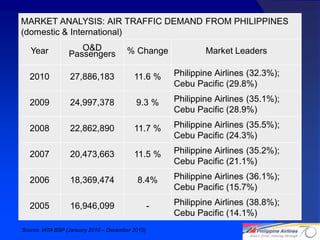
MARKET ANALYSIS: AIR TRAFFIC DEMAND FROM PHILIPPINES
(domestic & International)

   Year             O&D                % Change               Market Leaders
                 Passengers

  2010            27,886,183              11.6 %      Philippine Airlines (32.3%);
                                                      Cebu Pacific (29.8%)

  2009            24,997,378               9.3 %      Philippine Airlines (35.1%);
                                                      Cebu Pacific (28.9%)

  2008            22,862,890              11.7 %      Philippine Airlines (35.5%);
                                                      Cebu Pacific (24.3%)

  2007            20,473,663              11.5 %      Philippine Airlines (35.2%);
                                                      Cebu Pacific (21.1%)

  2006            18,369,474               8.4%       Philippine Airlines (36.1%);
                                                      Cebu Pacific (15.7%)

  2005            16,946,099                      -   Philippine Airlines (38.8%);
                                                      Cebu Pacific (14.1%)
Source: IATA BSP (January 2010 – December 2010)
                                                                                     22
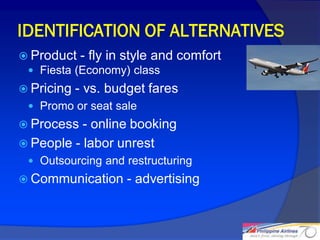
IDENTIFICATION OF ALTERNATIVES
 Product - fly in style and   comfort
  Fiesta (Economy) class
 Pricing   - vs. budget fares
  Promo or seat sale
 Process  - online booking
 People - labor unrest
  Outsourcing and restructuring
 Communication      - advertising


                                         23
CRITICAL ISSUES
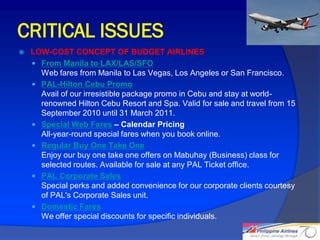
   LOW-COST CONCEPT OF BUDGET AIRLINES
     From Manila to LAX/LAS/SFO
      Web fares from Manila to Las Vegas, Los Angeles or San Francisco.
     PAL-Hilton Cebu Promo
      Avail of our irresistible package promo in Cebu and stay at world-
      renowned Hilton Cebu Resort and Spa. Valid for sale and travel from 15
      September 2010 until 31 March 2011.
     Special Web Fares – Calendar Pricing
      All-year-round special fares when you book online.
     Regular Buy One Take One
      Enjoy our buy one take one offers on Mabuhay (Business) class for
      selected routes. Available for sale at any PAL Ticket office.
     PAL Corporate Sales
      Special perks and added convenience for our corporate clients courtesy
      of PAL's Corporate Sales unit.
     Domestic Fares
      We offer special discounts for specific individuals.

                                                                               24
CRITICAL ISSUES
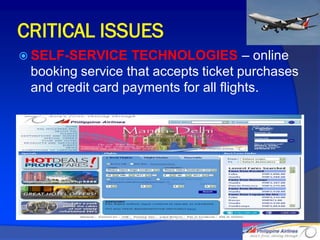
 SELF-SERVICE    TECHNOLOGIES – online
 booking service that accepts ticket purchases
 and credit card payments for all flights.


                                                 25
CRITICAL ISSUES
 OUTSOURCING        AND RESTRUCTURING
  in-flight catering to SkyKitchen Philippines
  airport (cargo handling) services to Sky
   Logistics
  call center reservation operations to ePLDT
   Ventus
  downsize medical, IT and HR units

  Results: Savings and improved employee-
  per-aircraft ratio

                                                  26
CRITICAL ISSUES
 OUTSOURCING      AND RESTRUCTURING
  Effects:
   ○ retrenchment of some 2,600 employees
   ○ help reduce its accumulated net losses
    and deficit
     brought about by surging fuel prices;
     the ban of its entry into 27 European
      Union member-states; and
     the suspension of its remittance facilities
      by the International Transport
      Association.
                                                    27
ANALYSIS
 Asidefrom the news briefings, PAL has no
 aggressive marketing strategy to combat
 the negative issues besetting it:
   labor unrest and its effects on its flight schedules,
      performance, and commitment;
     affordability and accessibility of its flights;
     on time arrivals and safe travel;
     positive image of its Chairman and CEO; and
     corporate social responsibility.


                                                            28
RECOMMENDATIONS
 LEGACY AIRLINE
  FSC and not LCC
  Improve on this distinction
  Be involved in promoting the Philippines as a
   tourist destination
  Be involved in the efforts of the government to
   assist distressed OFWs and calamity-stricken
   countries
 Continueits CALL FOR EXCELLENCE
  campaign to serve its market better.
  Operational efficiency

                                                     29
REFERENCES
   1. Philippine Airlines
   http://en.wikipedia.org/wiki/Philippine_Airlines
   http://en.wikipedia.org/wiki/Airline
   www.philippineairlines.com
   http://tourism-philippines.com/philippines-airlines-review/
   http://www.skyscrapercity.com/showthread.php?t=859722
   http://www.centreforaviation.com/news/2010/09/03/philippine-
    airlines-struggling-as-cebu-pacific-becomes-largest-carrier-in-the-
    philippines/page1
   2. Marketing Management- An Asian Perspective
   http://www.pearsoned-asia.com/marketingmanagement asia
    /2/home.html
   3. Differentiation Strategies, Differentiate Your Product,
    Differentiate Yourself
   http://www.1000ventures.com/business_guide/differentiation_
    strategy.html
                                                                          30
MABUHAY!
         Atty. Vivian T. Dabu
     Marketing for Managers
  Ateneo-Regis, AGSB Clark
      ian8dabu@yahoo.com

                                31

Philippine airlines

  • 1.
  • 2.
    PHILIPPINE AIRLINES Vincent Raymond A. Adriano Edwina M. Arceo Vivian T. Dabu Maria Farrah Feliciano Irish G. Sanchez 2
  • 3.
    COMPANY PROFILE PAL Holdings (PSE: PAL) – holding company, part of a group of companies owned by business tycoon Lucio C. Tan.  13th largest corporation in the Philippines in terms of revenue and 21st largest in terms of assets in 2005 Philippines’ Top 500 Largest Corporations.  61st largest airline in the world in terms of revenue passenger kilometers flown. Mission: to serve as a partner in nation-building 3
  • 4.
    COMPANY PROFILE  February26, 1941 – established by a group of businessmen led by Andres Soriano and former Senator Ramon Fernandez, who served as its Chairman and President.  March 15, 1941 – airline’s first flight with a single (twin-engine, 5-seater) Beechcraft Model 18 NPC- 54 between Manila and Baguio.  September 1941 – Philippine government invested in PAL, paving the way for its nationalization.  February 14, 1946 – resumed operations after WWII interruption servicing 15 domestic points with 5 Douglas DC-3s. 4
  • 5.
    COMPANY PROFILE  July 31, 1946 – first Asian airline to cross the Pacific Ocean with a chartered Douglas DC-4 ferrying 40 American servicemen to Oakland, California from Neilson Airport (Makati) with fuelling stops in Guam, Wake Island, Johnston Atoll and Honolulu.  December 1946 – regular service between Manila and San Francisco. Designated as the country’s flag carrier. 5
  • 6.
    COMPANY PROFILE  1950s – founding of the country’s own national airline.  1960s – first privatization with then PAL Chairman, Benigno Toda, Jr. acquiring a majority stake in the airline.  1970s – one airline policy under Marcos government; comprehensive modernization program implemented.  1980s – massive modernization of domestic fleet. 6
  • 7.
    COMPANY PROFILE  1990s–re-privatization and second expansion  January 1995 – Lucio C. Tan became the new Chairman and CEO.  1996 – US$4 billion modernization and re-fleeting program aimed at making PAL one of Asia’s best airlines in 3 years.  1997 – rebranded itself as “Asia’s sunniest airline”; commenced unprofitable routes (eg. Manila to New York via Vancouver) 7
  • 8.
    COMPANY PROFILE  1998 – full impact of Asian financial crisis, aggravated by industrial action by its union.  September 23, 1998 – complete shutdown of PAL operations, the first Asian airline to do so and one of the largest corporate failures in Philippine history.  October 7, 1998 – resumed operations with services to 15 domestic points out of Manila.  December 7, 1998 – submitted a “standalone” rehabilitation plan to SEC.  June 4, 1999 – SEC approved the rehabilitation plan after Lucio C. Tan and his associates infused another US$200M capital. 8
  • 9.
    COMPANY PROFILE  2000s–returned to profitability with Php44.2M in its first year of rehabilitation after 6 years of heavy losses.  Continued with restructuring (outsourcing of maintenance and engineering division to LTP); aggressive marketing strategies (rewards programs and online booking); re-fleeting and modernization; and opening/restoring of domestic and international destinations.  October 4, 2007 – released from receivership. 9
  • 10.
    COMPANY PROFILE  IATA Operational Safety Audit  February 2007 – accredited by International Air Transport Association.  Airline Turnaround of the Year 2007  November 2007 – granted by Centre for Asia Pacific Aviation for its "strategic contribution to the aviation industry through a significant transformation by successfully restructuring its operations through innovative cost-cutting measures resulting in operating profits.”  Most trusted airline brand for Filipino consumers  May 2010 – granted by respected international publication Reader’s Digest in its annual, Asia-wide survey. 10
  • 11.
    COMPANY PROFILE  2010s  Continued re-fleeting and modernization  Labor disputes vs. Outsourcing 11
  • 12.
    PROBLEM IDENTIFICATION  The approaches that PAL has used to stay competitive in the global airline industry.  How service differentiation enables an airline such as PAL to stay ahead in the fight for market share?  Does being first always translate into a successful marketing strategy? 12
  • 13.
    A. PAL APPROACHES Re-fleeting and modernization program  Adding/restoring international routes 13
  • 14.
    A. PAL APPROACHES Strategic local routes 14
  • 15.
    A. PAL APPROACHES Refurbishingof its Domestic Terminal 2 and NAIA facilities –  renovated Mabuhay Lounge,  exclusive check-in counter for Mabuhay Class passengers,  Express Counter,  refreshment bar,  medical clinic,  expansive waiting lounge  two baggage carousels in the arrival section 15
  • 16.
    A. PAL APPROACHES Codeshare agreements as of February 2011  Cathay Pacific  Emirates  Etihad Airways  Qatar Airways  Gulf Air  Malaysian Airlines  Airphil Express  Garuda Indonesia 16
  • 17.
    A. PAL APPROACHES  SLOGANS AND ADVERTISING  Mabuhay  Asia's First Airline  Welcome Aboard the Philippines  Shining Through - concurrent with the slogan The beauty of the Philippines that heavily promoted Philippines as a tourist destination. The TV advertisement clip won a finalist in Clio Awards.  Pilipino, Para sa Pilipino (Filipino, for the Filipino)  On the Wings of Change  Asia's Sunniest  With You All the Way 17
  • 18.
    A. PAL APPROACHES  SLOGANS AND ADVERTISING  It's About Experience - introduced after its 60th Anniversary. It attempts to highlight the fact that PAL is the first and longest- serving airline in Asia under its original name. The slogan was also used in the airline's ad spot featuring Kevyn Lettau, which incidentally featured her song, "Sunlight."  Love at Thirty Thousand Feet is the de facto theme song of the airline. It was composed by Jose Mari Chan and is still being used today. The song has many variations, including a version for the PAL's Swingaround tour package advertisement.  Clearly no. 1  With us, You're always no. 1  Asia's First, Shining Through - introduced for PAL's 70th anniversary, it combines two previous PAL slogans: Asia's First Airline and Shining Through. 18
  • 19.
    B. SERVICE DIFFERENTIATION  Legacy airline - being the known flag carrier in the past, having carried past Presidents of the country, it augurs well to Filipinos abroad who are coming home for a visit or for good, after long absence.  Availability and accessibility - with codeshare partners as well as presence in 31 international and 29 domestic destinations  Comfort and style - Filipinos are very particular with “status symbol,” “comfort” and the perks that comes to with the “status.”  Mabuhay club members perks and benefits  2 classes: Mabuhay (business) and Fiesta (economy) 19
  • 20.
    B. SERVICE DIFFERENTIATION TRAVELERS’ AMENITIES  Mabuhay lounges  Seating comfort – more leg room and space to recline.  Meals and beverages  LCD television screen showing actual time, altitude, temperature, estimated time of arrival and others.  State-of-the-art inflight entertainment systems 20
  • 21.
    C. BEING FIRST= SUCCESSFUL MARKETING STRATEGY?  “The re-fleeting program enabled PAL to be dubbed as the first airline in the world to operate the full range of new-generation Airbus aircraft.”  PAL is an example of a company that have tried to be first in service and product innovation but failed due to many factors.  One factor is acquiring too many aircrafts while matching them with unprofitable routes.  Union activism and employees discontent aggravated this. 21
  • 22.
    MARKET ANALYSIS: AIRTRAFFIC DEMAND FROM PHILIPPINES (domestic & International) Year O&D % Change Market Leaders Passengers 2010 27,886,183 11.6 % Philippine Airlines (32.3%); Cebu Pacific (29.8%) 2009 24,997,378 9.3 % Philippine Airlines (35.1%); Cebu Pacific (28.9%) 2008 22,862,890 11.7 % Philippine Airlines (35.5%); Cebu Pacific (24.3%) 2007 20,473,663 11.5 % Philippine Airlines (35.2%); Cebu Pacific (21.1%) 2006 18,369,474 8.4% Philippine Airlines (36.1%); Cebu Pacific (15.7%) 2005 16,946,099 - Philippine Airlines (38.8%); Cebu Pacific (14.1%) Source: IATA BSP (January 2010 – December 2010) 22
  • 23.
    IDENTIFICATION OF ALTERNATIVES Product - fly in style and comfort  Fiesta (Economy) class  Pricing - vs. budget fares  Promo or seat sale  Process - online booking  People - labor unrest  Outsourcing and restructuring  Communication - advertising 23
  • 24.
    CRITICAL ISSUES  LOW-COST CONCEPT OF BUDGET AIRLINES  From Manila to LAX/LAS/SFO Web fares from Manila to Las Vegas, Los Angeles or San Francisco.  PAL-Hilton Cebu Promo Avail of our irresistible package promo in Cebu and stay at world- renowned Hilton Cebu Resort and Spa. Valid for sale and travel from 15 September 2010 until 31 March 2011.  Special Web Fares – Calendar Pricing All-year-round special fares when you book online.  Regular Buy One Take One Enjoy our buy one take one offers on Mabuhay (Business) class for selected routes. Available for sale at any PAL Ticket office.  PAL Corporate Sales Special perks and added convenience for our corporate clients courtesy of PAL's Corporate Sales unit.  Domestic Fares We offer special discounts for specific individuals. 24
  • 25.
    CRITICAL ISSUES  SELF-SERVICE TECHNOLOGIES – online booking service that accepts ticket purchases and credit card payments for all flights. 25
  • 26.
    CRITICAL ISSUES  OUTSOURCING AND RESTRUCTURING  in-flight catering to SkyKitchen Philippines  airport (cargo handling) services to Sky Logistics  call center reservation operations to ePLDT Ventus  downsize medical, IT and HR units  Results: Savings and improved employee- per-aircraft ratio 26
  • 27.
    CRITICAL ISSUES  OUTSOURCING AND RESTRUCTURING  Effects: ○ retrenchment of some 2,600 employees ○ help reduce its accumulated net losses and deficit  brought about by surging fuel prices;  the ban of its entry into 27 European Union member-states; and  the suspension of its remittance facilities by the International Transport Association. 27
  • 28.
    ANALYSIS  Asidefrom thenews briefings, PAL has no aggressive marketing strategy to combat the negative issues besetting it:  labor unrest and its effects on its flight schedules, performance, and commitment;  affordability and accessibility of its flights;  on time arrivals and safe travel;  positive image of its Chairman and CEO; and  corporate social responsibility. 28
  • 29.
    RECOMMENDATIONS  LEGACY AIRLINE  FSC and not LCC  Improve on this distinction  Be involved in promoting the Philippines as a tourist destination  Be involved in the efforts of the government to assist distressed OFWs and calamity-stricken countries  Continueits CALL FOR EXCELLENCE campaign to serve its market better.  Operational efficiency 29
  • 30.
    REFERENCES  1. Philippine Airlines  http://en.wikipedia.org/wiki/Philippine_Airlines  http://en.wikipedia.org/wiki/Airline  www.philippineairlines.com  http://tourism-philippines.com/philippines-airlines-review/  http://www.skyscrapercity.com/showthread.php?t=859722  http://www.centreforaviation.com/news/2010/09/03/philippine- airlines-struggling-as-cebu-pacific-becomes-largest-carrier-in-the- philippines/page1  2. Marketing Management- An Asian Perspective  http://www.pearsoned-asia.com/marketingmanagement asia /2/home.html  3. Differentiation Strategies, Differentiate Your Product, Differentiate Yourself  http://www.1000ventures.com/business_guide/differentiation_ strategy.html 30
  • 31.
    MABUHAY! Atty. Vivian T. Dabu Marketing for Managers Ateneo-Regis, AGSB Clark ian8dabu@yahoo.com 31