V3.4 • OCTOBER/NOVEMBER 2014 
PAPERLESS 
AND MOBILE 
MAINTENANCE 
SPECIAL INTEGRATION 
CASE STUDIES 
Columbia Helicopters Paperless MRO 
China Airlines M&E IT Upgrade 
Mobile MRO as part of the ERP 
White Paper: IFS, AeroSoft Systems Case Study: China Airlines, Columbia Helicopters with IDMR Solutions 
PLUS… How I see IT, News, Upcoming and Past Webinars, past Webinar focus, MRO Software Directory
V3.4 • OCTOBER/NOVEMBER 2014 Welcome… 
Digital capability and mobile technology have 
transformed the value of IT by putting what you need, 
where you can access it. 
It was only a few decades ago when IT first entered the business world. Then, it was seen 
as a tool with which simple but repetitive and lengthy processes could be automated and 
large tables or charts printed to put records where they were needed. Well, up to a point. 
The printed reports were often massive structures whose weight and size meant that they 
could only be viewed on a sturdy surface. 
Things moved on to where IT became the infrastructure of the business — the means 
by which users could access all of the records they needed but one departmental silo at 
a time through a heavy CRT screen on their desk. The PCs continued to get smaller but 
the process hardly progressed until digital technology, big data and mobile capability 
converged with IT to change everything. 
Today, we don’t so much access records as view solutions drawing on information 
generated in all parts of the business and presented to us wherever we are on whatever device we are holding, 
in the form most useful to us and in real time. It has transformed the ways people work and generated fantastic 
opportunities to add value to the processes that have to be completed. 
In this issue we’ll be looking at how a major airline, when upgrading its MRO IT, took the opportunity to leverage 
new capabilities and create a more cost-effective and leaner process with long-term value. There’s also an article 
about implementing a paperless regime in an MRO environment that has to reach out into the field as well as 
operate a busy engineering hangar. Last issue’s paper on systems integration is concluded with considerations of 
how the kind of integration that users would find useful can be achieved. And we look at how mobility can be much 
more valuable when integrated into a wider ERP. 
Quite enough for one issue, you might think; but there’s also how Michael Denis sees IT, as thought provoking as 
ever, and our usual overview of news and information affecting your sector as well as some of the deals that have 
been concluded. Aircraft IT live demonstration webinars are previewed and the recorded archive reviewed to help 
readers research the software market from the convenience of their own desk and to find a package that could meet 
their needs by accessing past webinars with more focus than ever and booking their place on future webinars. It’s a 
valuable resource for which readers simply need to register. 
It’s Aircraft IT MRO: information that you can use. 
Ed Haskey 
04 NEWS & TECHNOLOGY 
Nothing stands still in the world of the MRO IT 
professional. Reading Aircraft IT MRO News at 
www.aircraftit.com/MRO and here in the Aircraft IT 
MRO e-journal is a great way for busy professionals to 
keep up to date with the latest developments. 
18 CASE STUDY: SAFER, FASTER, BETTER 
Houng Wang, Vice President, Engineering 
Division – China Airlines 
When upgrading its MRO IT to the latest standards, 
China Airlines took a business-like approach 
that has already paid dividends in cost savings 
and lean processes. 
22 UPCOMING LIVE MRO SOFTWARE 
DEMONSTRATION WEBINAR 
A preview of the live MRO software demonstration 
webinars featuring Commsoft on 16th October 2014 
and Flatirons Solutions on 13th November 2014. 
23 COLUMN: HOW MICHAEL DENIS SEES IT 
Autonomics and the Network of Everything (NoE) 
The Internet of things is becoming a ‘must use’ in any 
talk about technology: the simple term relates 
to concepts that are anything but simple; but they 
are useful. 
24 WHITE PAPER: CMS AND MRO SYSTEMS 
INTEGRATION, PART 2 
Thanos Kaponeridis, CEO & President, 
AeroSoft Systems Inc. 
This second article considers how the systems 
integration that would be so useful to MRO 
businesses might be achieved and what hurdles 
would need to be overcome. 
28 PAST WEBINARS: KNOWLEDGE 
TRANSFER AND ACCESS FOR 
INDUSTRY EXPERTS 
View Video Recordings of our Past Live MRO 
Software Demonstration Webinars. See full 
information and view video recordings of past Live 
MRO Software Demos, including: Mxi Technologies, 
Hexaware and TRAX. 
30 CASE STUDY: PAPERLESS END-TO-END 
AIRCRAFT MAINTENANCE 
Israel Revivo, President & CEO, IDMR Solutions 
Paul Myrand, Project Manager, Columbia 
Helicopters 
When Columbia Helicopters Inc. (CHI) wanted 
to move towards a paperless environment for 
their MRO system, it posed a challenge for their 
solution providers. 
34 PAST WEBINAR FOCUS: IPAD AND 
MOBILE MRO SOLUTIONS 
Finding the right iPad and Mobile MRO solution to 
match your requirements is so much easier if you 
search the library of recordings of Aircraft IT Past 
Webinars by category. 
36 WHITE PAPER: MEETING THE NEW 
MRO ORDER 
Espen Olsen, European Director for 
Aerospace & Defense at IFS 
Given how MRO and demands on engineers are 
changing, a mobile solution is attractive; but 
integrated into a larger ERP system, mobile can do so 
much more. 
41 MRO SOFTWARE DIRECTORY 
A detailed look at the world’s leading 
MRO IT systems. 
CLICK HERE: Send your feedback and suggestions to AircraftIT MRO 
CLICK HERE: Subscribe for free 
AircraftIT MRO 
Publisher/Editor: Ed Haskey 
E-mail: ed.haskey@aircraftit.com 
Telephone: +44 1273 454 235 
Website: www.aircraftIT.com 
Copy Editor/Contributor: John Hancock 
E-mail: john@aircraftit.com 
Magazine Production: Dean Cook 
E-mail: deancook@magazineproduction.com 
AircraftIT MRO is published bi-monthly and is an affiliate of Aircraft Commerce and part of the AviationNextGen Ltd group. The entire contents within this 
publication © Copyright 2014 AviationNextGen Ltd an independent publication and not affiliated with any of the IT vendors or suppliers. Content may not 
be reproduced without the strict written agreement of the publisher. The views and opinions expressed in this publication are the views of the authors and 
do not necessarily reflect the views or policies of their companies or of the publisher. The publisher does not guarantee the source, originality, accuracy, 
completeness or reliability of any statement, information, data, finding, interpretation, advice, opinion, or view presented.
OCTOBER/NOVEMBER 2014 | AIRCRAFT IT MRO | TECHNOLOGY & NEWS | 5 
INTERACTIVE Click here for a demonstration 
Flatirons grows the business and 
opens new flagship office 
HONEYWELL AEROSPACE SELECTS 
FLATIRONS FOR TRAINING DEVELOPMENT 
SERVICES TO ACHIEVE SIGNIFICANT COST 
SAVINGS BY REUSING CONTENT ACROSS 
TECHNICAL PUBLICATIONS AND TRAINING 
FLATIRONS Solutions announced in late September 2014 
that Honeywell Aerospace, a provider of products and services 
to commercial, defense, and space aircraft worldwide, has 
selected the Flatirons’ Training Services group to serve as its 
primary developer for training content. The contract includes 
developing new training materials, updating existing source 
materials, and making modifications to training content used 
by Honeywell’s employees and customers for servicing and 
maintaining Honeywell products. The selection of Flatirons, 
which also serves as Honeywell Aerospace’s single global 
supplier for technical publications services, allows Honeywell 
Aerospace to achieve significant cost savings by reusing 
technical publications content in its training materials. 
In 2009, Honeywell Aerospace selected Flatirons as its global 
supplier for technical publications services, covering more than 
four million pages and 40,000 documents annually. “When 
seeking a partner for the development of training content, our 
objective was to reduce the overall costs by reusing technical 
publications content in the development of training materials,” 
said Lewis Mallory, Director Flight Sim Support, Technical 
Publications & Customer Product Training for Honeywell 
Aerospace. 
In collaboration with Flatirons, 75% of Honeywell’s illustration 
content in training materials is reused directly from existing 
technical documentation. This amounts to a 32% cost 
savings for the overall project when compared to the costs 
of recreating and duplicating illustrations for each training 
project. 
“Re-use of technical content across documents or between 
technical publications and work instructions is a highly desired 
practice in many industries,” said Geoffrey Godet, president and 
CEO of Flatirons. “Because Flatirons provides both technical 
publications and training content development services, 
customers like Honeywell can reuse content to achieve accurate, 
high-quality technical information at reduced costs.” 
Flatirons’ Training Services group is ISO 9001:2008 certified. 
Its technical writers, illustrators, and multi-media developers 
use the Six Sigma process to ensure accurate, high-quality 
information throughout the content lifecycle. 
ACCELERATED GROWTH TRIGGERS 
FLATIRONS EXPANSION IN NORTH AMERICA: 
NEW CUSTOMER DEMAND TO BE SERVED 
FROM FLAGSHIP OFFICE IN BOULDER, 
COLORADO 
AT the beginning of October 2014, Flatirons Solutions 
announced that accelerated growth has spurred expansion 
of its North American operations and the opening of its new 
flagship office in Boulder, Colorado. 
Flatirons has forecasted a 37% growth rate for 2014, 
following revenue increases of 33 percent and 13 percent 
in 2013 and 2012, respectively. Year-on-year growth comes 
from greater demand for Flatirons’ comprehensive set of CLM 
solutions and services that help customers across multiple 
industries deliver the right information, at the right time, to 
the right people while controlling costs and meeting often 
complex information requirements. 
“Organizations today are faced with some of the most 
pressing content lifecycle management challenges they have 
seen in decades,” said Geoffrey Godet, Flatirons’ CEO. “Whether 
adapting to information requirements driven by the most 
modern aircraft being introduced, the need to organize and 
use rich media to produce graphically rich, multi-media driven, 
and personalized products for consumers, or the basic need 
to retire out-dated and expensive business applications that 
maintain regulated data, organizations of all types must do 
so efficiently and in the most cost-effective way possible. 
Flatirons, together with its network of partners, is uniquely 
positioned to help customers meet these challenges head on.” 
“Such a strong response to our CLM solutions from 
customers like General Electric, BMO Harris Bank, the LATAM 
Airlines Group, Whirlpool, McGraw Hill Education, and others 
has driven rapid expansion,” said Greg Beserra, Flatirons’ chief 
operations officer. “The bulk of this demand will be addressed 
from our larger, modern office in Boulder, Colorado.” 
“Flatirons’ choice of Boulder and its new 37,000 square foot 
office reflects the company’s strong history and continued 
commitment to both the local community and our top-notch 
staff,” said Godet. “Boulder is a thriving technology community 
with many of the best and brightest people. We designed 
an office that gives our team the ability to brainstorm the 
next innovation in a huddle room, tackle customer issues by 
drawing on the whiteboard walls, or just take a break with a 
bike ride on Boulder’s extensive trail system right outside our 
back door.” 
180mm Trim 
Whatever’s in your fleet, 
it’s now in our toolbox. 
Your fleet’s growing. Your fleet’s changing. And the Boeing Maintenance Performance Toolbox 
is changing with you, providing new tools designed for the digital airline to meet your evolving 
needs. Tools for your entire fleet, no matter the OEM. Tools accessible anywhere—from web 
to tablet—with or without connectivity. New tools to keep your maintenance at the forefront of 
innovation and efficiency, and your airplanes in the air where they belong. 
www.boeing.com/boeingedge/informationservices
18 | CASE STUDY: CHINA AIRLINES | AIRCRAFT IT MRO | OCTOBER/NOVEMBER 2014 
China Airlines is Taiwan’s largest airline. Over 
the years, the passenger and cargo carrier has 
developed an international reputation for 
delivering superior customer service, having recently 
been voted airline with the top mind-share, according to 
a leading business management magazine. 
A SkyTeam airline alliance member since 2011, 
China Airlines is committed to promoting innovative, 
high-quality passenger experience and caring services, 
including the retrofitting of Boeing 747-400 aircraft 
with brand new seats and entertainment systems, in-flight 
meals that combine the best of Chinese, Western 
and Taiwanese cuisine, as well as mobile phone and 
online services that satisfy passengers’ demand for 
convenient access. 
CHINA AIRLINES — AT A GLANCE 
• Founded in 1959 
• The largest airline in Taiwan 
• SkyTeam airline alliance member since September 
2011 
• Fleet: 80 
• A330-300, A340-300 
• 737-800, 747-400, 747-400F (cargo) 
• 27 on order (including777-300ER) 
• Hub: Taipei 
• Destinations: 120 domestic and international 
destinations in 29 countries 
• Employees: 11,000 worldwide 
• Subsidiaries: Mandarin Airlines, Tigerair Taiwan 
• 2013 Revenues: TWD131.753 million 
This case study details how its commitment to 
standardized Maintenance, Repair and Overhaul 
(MRO) practices — supported by Mxi Technologies’ 
Maintenix system — is enabling a ‘best in class’ 
maintenance unit that is helping drive significant 
business performance returns. 
A COMMITMENT TO PASSENGER SAFETY 
It should come as no surprise that the primary goal of 
any commercial aircraft operator is to deliver the best 
service possible for its customers. While this entails 
a number of factors to support customer loyalty — 
reliable departures and arrivals; friendly and helpful 
staff; in-flight comfort and entertainment; innovative 
rewards packages and trip promotions — the most 
fundamental of all is the promise of passenger safety. 
As Taiwan’s largest air carrier, operating in a highly 
dynamic and competitive market in the Asia- 
Pacific region, we have no choice but to continue to 
consolidate our reputation as an industry leader in this 
area. Over the years, we have implemented a number 
of key in-house flight safety programs, designed to 
foster an open and highly-collaborative environment 
dedicated to preventing safety incidents both in the air 
and on the ground. Of note, for instance, are… 
• China Airline’s Safety Management System (SMS) 
systematically manages all forms of aviation risks in 
areas such as flight operations, in-flight services, and 
ground handling. We have a safety report policy that 
encourages employees to quickly and honestly report 
all identified incidents and hazards, in the spirit of 
reducing the probability of unsafe incidences. 
• An Aviation Quality Database, built within the SMS, 
was introduced in 2013 to more efficiently collect 
work process issues, conduct risk assessment, take 
appropriate risk control measures, and monitor the 
subsequent status. 
• A Line Operations Safety Audit (LOSA) was also 
established to enable experts and trained observers 
to collect and assess data on flight crew behavior 
and strategies for managing threats and correcting 
errors. By identifying the strengths and weaknesses 
of an airline, LOSA is a means for China Airlines to 
self-assess its safety margins in flight operations 
Aviation safety is China Airlines’ utmost mission — 
each and every employee is fully committed to it by 
integrating safety consciousness into our operations, 
system design, and organization. 
EFFECTIVE MAINTENANCE OPERATIONS: 
A PREREQUISITE FOR SAFETY 
The Engineering & Maintenance Organization (EMO) 
is no exception to this rule. In fact, we consider the 
quality assurance of maintenance work as the best 
foundation for flight safety. Since the formation of our 
maintenance unit in 1959, China Airlines has worked 
hard to certify staff and operations according to latest 
safety regulations and practices. Today, we are the 
largest and most modern aircraft body maintenance 
center in the region. We count on more than 1,200 
professionals working out of five hangars to deliver a 
complete range of internationally certified line, heavy 
and shop maintenance work on various types of aircraft 
and engines, both for our own passenger and cargo 
fleets, and for over 40 other domestic and international 
airlines. 
We never rest on our laurels in our dedication to 
safety but continue to evaluate and monitor the 
training and certification of all maintenance personnel, 
to ensure ongoing compliance with new and evolving 
CAA certification requirements. This commitment 
inevitably found its way into the EMO back office — 
specifically, how we function on a day-to-day basis and 
what systems are used to support our maintenance 
operations. 
Our network of legacy mainframe systems often 
could not deliver the data insights we felt were critical 
if we wanted to evolve the business and introduce 
new efficiencies. For the most part, these systems 
worked in siloes, each isolated from the others, and 
Safer, faster, better 
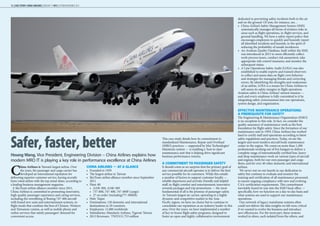
Houng Wang, Vice President, Engineering Division – China Airlines explains how 
modern MRO IT is playing a key role in performance excellence at China Airlines
OCTOBER/NOVEMBER 2014 | AIRCRAFT IT MRO | CASE STUDY: CHINA AIRLINES | 19 
each operated by its own set of processes for capturing 
and storing data. This made it very difficult to access 
and share timely maintenance information across the 
organization. 
In our highly competitive marketplace, we understood 
that success would hinge solely on factors that could 
be controlled, namely driving greater operational 
efficiencies. With the need to fulfil aggressive 
corporate expansion plans, coupled with the need to 
accommodate an evolving fleet, we soon recognized 
“…we consider the quality assurance of maintenance work as the best foundation 
for flight safety. Since the formation of our maintenance unit in 1959, China 
Airlines has worked hard to certify staff and operations according to latest safety 
regulations and practices.” 
that it was no longer viable to continue with the status 
quo. Subsequently, China Airlines committed to 
investing in more modern IT systems to support the 
business, including EMO. 
EVOLVING THE EMO DEPARTMENT 
The search for an MRO IT solution extended beyond 
simply selecting a system that could do a better job of 
storing maintenance transactional activity or executing 
existing maintenance processes. This initiative was 
based on three key objectives: 
• Integrate the entire EMO department using a single, 
seamless approach; 
• Strengthen configuration control and record 
keeping, for more agile compliance reporting; 
• Minimize in-house system customizations. 
In addition to generating substantial cost savings, we 
were motivated by the possibility of driving stronger 
visibility into our operations, both ‘day of’ and 
historical. Doing so would not only simplify ongoing 
compliance with regulatory standards, it would also 
help us better understand why things happen and 
how, through preventative maintenance, we could 
best minimize the risk of it happening again in the 
future. Such proven practices would typically lead to 
better performance and greater productivity during all 
maintenance visits, both scheduled and unscheduled. 
Based on these goals, we engaged in an active market 
assessment of vendor solutions. We eventually turned 
to Mxi Technologies and its Maintenix software as 
the best option capable of supporting the increasing 
sophistication of our fleet, and our demand for 
operational efficiencies in line with corporate strategy. 
We envisioned Maintenix to be our system of record 
for maintenance and engineering needs across our 
entire fleet of Boeing and Airbus airplanes, as well as 
those aircraft handled by our burgeoning third-party 
maintenance services practice. It offered the promise 
INTERACTIVE Click here for a demonstration 
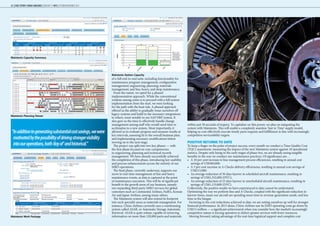
MAINTENANCE OPERATIONS CONTROL MAINTENANCE PLANNING MAINTENANCE SUPPLY CHAIN 
DELIVERING 
ON THE FLIGHT OPERATIONS PROMISE 
Watch the new video series from Mxi Technologies and discover 
how Maintenix® delivers information insights across maintenance 
operations control, maintenance planning, and maintenance supply chain. 
Watch them all today at www.mxi.com.
“In addition to generating substantial cost savings, we were 
motivated by the possibility of driving stronger visibility 
into our operations, both ‘day of’ and historical.” 
of a full end-to-end suite, including functionality for 
maintenance program management; configuration 
management; engineering; planning; materials 
management; and line, heavy, and shop maintenance. 
From the outset, we opted for a phased 
implementation approach. While the conventional 
wisdom among some is to proceed with a full system 
implementation from the start, we were looking 
for the path with the least risk. A phased approach 
offered us the ability to gradually wean ourselves off 
legacy systems and build in the necessary integrations 
to others, most notably to our SAP ERP system. It 
also gave us the time to effectively handle change 
management among staff who would need time to 
acclimatize to a new system. Most importantly, it 
allowed us to evaluate progress and measure results at 
key intervals, assessing fit to the overall business plan, 
and implementing necessary modifications before 
moving on to the next stage. 
The project was split into two key phases — with 
the first phase focused on core competencies 
in engineering, planning and technical records 
management. We have already successfully achieved 
the completion of this phase, introducing key usability 
and process enhancements across the entirety of our 
MRO operations. 
The final phase, currently underway, supports our 
move to real-time management of line and heavy 
maintenance events, as data is captured at the point 
of maintenance execution. This will be of significant 
benefit to the growth areas of our business, namely 
our expanding third-party MRO services for global 
customers such as Continental Airlines, FedEx, Korean 
Air and Japan Airlines, among many others. 
The Maintenix system will also extend its footprint 
into such specialty areas as materials management. For 
instance, China Airlines currently uses a warehousing 
system called ASAR, or Automatic Storage Automatic 
Retrieval. ASAR is quite robust, capable of retrieving 
information on more than 120,000 parts and materials 
20 | CASE STUDY: CHINA AIRLINES | AIRCRAFT IT MRO | OCTOBER/NOVEMBER 2014 
within just 50 seconds of inquiry. To capitalize on this power, we plan on integrating the 
system with Maintenix. This will enable a completely seamless ‘Just in Time’ supply model, 
helping us cost-effectively execute timely parts requests and fulfillment in line with increasingly 
competitive serviceability targets. 
POSITIVE RETURNS TO DATE 
To keep a finger on the pulse of project success, every month we conduct a Time Quality Cost 
(TQC) assessment, measuring the impact of the new Maintenix system against 18 operational 
metrics. Despite only being in the early stages of phase two, we are already seeing tangible 
benefits in the way we conduct our maintenance practices. Of significance are… 
• A 10 per cent increase in line management process efficiencies, resulting in annual cost 
savings of US$560,000; 
• A 3 per cent increase in A Checks delivery efficiencies, resulting in annual cost savings of 
US$213,000; 
• An average reduction of 30 days layover in scheduled aircraft maintenance, resulting in 
savings of US$1,352,000 (DVC); 
• An average reduction of 25 days layover in unscheduled aircraft maintenance, resulting in 
savings of US$1,133,000 (DVC). 
Collectively, the positive results we have experienced to date cannot be understated. 
Optimizing the way we perform line and A Checks, coupled with the significant reduction in 
layover times, mean our aircraft are spending more time in revenue-generation mode, and less 
time in the hangar. 
Factoring in the cost reductions achieved to date, we are setting ourselves up well for stronger 
financial performance. In 2013 alone, China Airlines saw its EMO operating costs go down by 
US$3.5 million — a significant achievement when you consider how the market’s increasingly 
competitive nature is forcing operators to deliver greater services with fewer resources. 
Moving forward, taking advantage of the real-time logistical support and complete cost 
Maintenix Capacity Summary 
Maintenix Planning Viewer 
Maintenix Work Package 
Maintenix Station Capacity
analysis afforded by the Maintenix system, we expect to further 
increase our maintenance cost control and drive continuing 
improvements in repair quality and efficiency. 
PROVEN PRACTICES 
The success of any MRO project is naturally rooted first and 
foremost in having a modern, comprehensive system that is 
backed by a committed team of professionals. We have been very 
fortunate to work with a knowledgeable and helpful team from 
Mxi throughout the project. However, other key factors go a long 
way to ensuring a smooth transition and faster time to returns. 
Over the course of the project to date, we have recognized a few 
proven practices that have contributed greatly to making this a 
positive experience. 
Naturally, every MRO IT project will come with its own 
unique challenges and needs. Fundamentally, though, there 
are three paramount practices that would serve to help any 
operator of any size tackle the task of evolving maintenance IT 
and operations: 
• Maintain executive buy-in — no matter the size or scope of the 
project, it all starts with the top level of the airline. Unless they 
are wholly committed, the project will not meet its objectives. 
From the start, China Airlines’ MRO IT modernization project 
has received strong support from the Executive Steering 
Author 
HOUNG WANG 
VICE PRESIDENT, ENGINEERING 
DIVISION – CHINA AIRLINES 
Mr. Houng Wang 
is responsible for 
all Engineering 
activities at China 
Airlines, including 
system engineering, 
engineering planning, 
supply, technical information 
planning and accounting. He 
joined China Airlines in 1982 as 
a mechanic. Since then, he has 
filled different functions and has 
held various senior positions 
within the airline’s Engineering and 
Maintenance Organization. Prior 
to his current post, he was Vice 
President of Quality Assurance. 
About… 
MXI TECHNOLOGIES 
Mxi Technologies 
is a provider 
of integrated 
and intelligent 
maintenance 
management software, support 
and services catering to the 
global aviation industry, including 
commercial and defense operators, 
third-party MROs, and OEM 
aftermarket service providers. 
Maintenix® software is designed 
to help aviation organizations 
maximize the revenue potential 
of their aviation assets through 
standard, lean, and predictable 
maintenance. Featuring a modern, 
web-based and mobile-enabled 
architecture, Maintenix delivers 
advanced capabilities such as 
controlled workflow, automated 
maintenance and materials 
planning, point-of-maintenance 
access to real-time information, and 
paperless execution and compliance. 
Mxi’s customers range from small 
organizations to the largest global 
enterprises, with single to multi-site 
deployments. 
INTERACTIVE Give us your opinion 
Click here to have your say 
INTERACTIVE Subscribe here 
Click here to read all future editions 
OCTOBER/NOVEMBER 2014 | AIRCRAFT IT MRO | CASE STUDY: CHINA AIRLINES | 21 
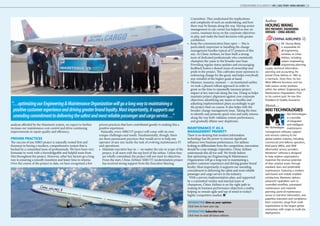
“…optimizing our Engineering & Maintenance Organization will go a long way to maintaining a 
positive customer experience and driving greater brand loyalty. Most importantly, it supports our 
unending commitment to delivering the safest and most reliable passenger and cargo service…” 
Committee. They understand the implications 
and complexity of such an undertaking, and how 
there may be bumps along the way. Having senior 
management in our corner has helped us stay on 
course, maintain focus on the corporate objectives 
in play, and make the hard decisions with greater 
confidence. 
• Keep the communication lines open — this is 
particularly important in handling the change 
management hurdles typical of IT projects of this 
size. At China Airlines, we have built a strong 
team of dedicated professionals who consistently 
champion the cause to the broader user base. 
Providing regular status updates and encouraging 
feedback fosters a shared sense of ownership and 
pride in the project. This cultivates more openness to 
embracing change for the good, and helps everybody 
stay mindful of the higher goals at hand. 
• Measure, measure, measure — as mentioned earlier, 
we took a phased rollout approach in order to 
grant us the time to repeatedly measure project 
impact at key intervals along the way. Doing so helps 
maintain project alignment against core corporate 
objectives, identifying any issues or hurdles and 
adjusting implementation plans accordingly to get 
the project back on course. It also helps with the 
broader change management issue. Taking the time 
to identify and promote quick wins and early returns 
along the way both validates system performance, 
and gradually dilutes user skepticism. 
MAINTENANCE IT AS A 
MANAGEMENT PRIORITY 
There is no denying that modern information 
technology has the power to exercise significant 
influence over business performance. For airlines 
looking to differentiate from the competition, innovation 
should be a top strategic imperative. China Airlines 
understands this all too well. We firmly believe 
that optimizing our Engineering & Maintenance 
Organization will go a long way to maintaining a 
positive customer experience and driving greater brand 
loyalty. Most importantly, it supports our unending 
commitment to delivering the safest and most reliable 
passenger and cargo service in the industry. 
With a proven implementation plan, and supported 
by a committed vendor and internal team of 
champions, China Airlines is on the right path to 
making its business performance objectives a reality, 
helping us remain agile and top of mind in today’s 
highly-competitive market. n
22 | WEBINARS | AIRCRAFT IT MRO | OCTOBER/NOVEMBER 2014 
Upcoming Live Software Demonstration Webinars at www.aircraftit.com/MRO/Webinars.aspx this October and November. 
This October and November will bring a great opportunity for readers to attend a program covering one the digital future for M&E/MRO software solutions. To find out more about the digital 
future, what it will mean for M&E/MRO, what changes it will bring and how to prepare for it, you’ll save a great deal of time and gain a lot of what you’ll need to know to inform a good decision 
by simply attending this informative webinar with a leading software solution provider. 
Sign up to free live online software demonstrations for a perfect introduction to the world’s leading MRO Software vendors and to learn how they can assist and add value to your operations 
LIVE M&E / MRO SOFTWARE DEMONSTRATION OF OASES 
WEBINAR [ETECHLOG & TECH RECORDS; RELIABILITY 
REPORTS; REPETITIVE DEFECT INVESTIGATIONS] 
n WEBINAR OVERVIEW 
Register to attend this Webinar and for an excellent chance 
to view a live online demonstration of one of the industry’s 
leading and most cost effective end-to-end aircraft M&E/ 
MRO IT Solutions: OASES from Commsoft. During the 
Webinar you will see some cutting-edge new developments 
in M&E/MRO Software including: Electronic Tech Log 
(eTechlog) and Technical Records Management; Repetitive 
Defect Investigations and Reliability Reporting. 
The Webinar will begin with a high level tour of OASES 
and the rich functionality the software provides including: 
Continuing Airworthiness, Planning, Production, Line 
Maintenance Control, Material Management, Commercial 
Management, Warranty. You will see how the different 
modules seamlessly integrate with each other and with 
other IT solutions, such as an eTechLog, creating significant 
company-wide increases in efficiency via the sharing of data. 
Then the Commsoft experts will provide a detailed live 
demonstration of some of the OASES system highlights and 
latest cutting-edge M&E / MRO software developments 
n HOW TO SIGN UP FOR THE WEBINAR 
Click on the ‘Register for Webinar’ link, select your preferred 
Webinar Session and enter your details. Full instructions on 
how to access the Webinar will be emailed to you. 
If you can’t attend the live Webinar Sessions, sign up 
anyway and you will receive immediate access to the 
Webinar recording as soon as it is loaded to the Aircraft IT 
Website. 
n SESSION 1: 16th October 2014 
06:30 GMT/UTC 
n SESSION 2: 16th October 2014 
14:30 GMT/UTC 
n DURATION: 1 hour plus Q&A. 
INTERACTIVE Join the free webinar 
Click here to view full details and sign up for this webinar 
n WEBINAR OVERVIEW 
Are your mechanics suffering from tablet envy? Does it seem 
like all other departments apart from engineering get all the 
cool tools whilst the benefits in maintenance are actually 
greater? 
Did you know that the average wide body aircraft 
generates around 8000 sheets of paper from maintenance 
activity each year? The cost of paper, distributing it, faxing 
it, archiving it, shipping it, storing it and so on amounts 
upwards of up $5000 per aircraft per year after year. 
Not to mention the headache for engineers filling out 
known data on paper forms, labor productivity, aircraft 
cycle time and utilization, inefficiencies of interpreting dirty-finger- 
print copies and the duplication of effort between 
paper and IT systems. It is time that we moved to a 
paperless industry! 
Register to attend this webinar and you will learn how 
Flatirons’ CORENA Knowledge Center and CORENA Pinpoint 
Mobile are delivering real paperless solutions to real line and 
base maintenance mechanics delivering real efficiencies and 
real cost savings. Learn how our mobile solutions deliver 
knowledge to mechanics at the point of performance where 
OEM technical publications are put onto tablets in the 
hands of the people who matter and how mobile electronic 
task cards are set to revolutionize the way we carry out 
maintenance. 
n HOW TO SIGN UP FOR THE WEBINAR 
Click on the ‘Register for Webinar’ link, select your preferred 
Webinar Session and enter your details. Full instructions on 
how to access the Webinar will be emailed to you. 
If you can’t attend the live Webinar Sessions, sign up 
anyway and you will receive immediate access to the 
Webinar recording as soon as it is loaded to the Aircraft IT 
Website. 
ENABLING THE MOBILE WORKFORCE TO 
INCREASE AIRCRAFT UTILIZATION 
n SESSION 1: 13th November 2014 
07:00 GMT/UTC 
n SESSION 2: 13th November 2014 
15:00 GMT/UTC 
n DURATION: 1 hour plus Q&A. 
INTERACTIVE Join the free webinar 
Click here to view full details and sign up for this webinar
Autonomics and the 
Network of Everything (NoE) 
to optimize asset utilization, labor productivity and supply effectiveness. 
Networked autonomics are alive and well in aviation. But these initial 
capabilities have been stove piped along OEM specific closed proprietary 
networks. 
MRO business networks need open universally interoperable MRO 
technology networks in order to optimize planes, parts, people and plants 
across the industry. 
The last elements of an open modern set of data and content standards 
are being put in place by the Aerospace and Defence Industries Association 
of Europe (ASD) via the SX000i specifications. The open autonomic 
MRO Network of Everything is about to become a reality. At least that’s 
how I see IT. n 
Michael Denis: How I see IT 
“It’s Official: The Internet Of Things Takes Over As The Most 
Hyped Technology,” wrote Gil Press on Forbes.com announcing 
Gartner’s annual Hype Cycle report on Emerging Technologies. 
So what is “The Internet of Things” (IoT) and what does it have to do with 
aviation MRO? 
IoT isn’t about the Internet nor about Things, rather, it’s about machines 
connected across networks of autonomous agents automatically processing 
events, without human intervention, to create value by adaptively analyzing 
big data to diagnose and prognosticate granular knowledge in order to 
provide value to human consumers of one. 
Wow – that’s a mouth full of consultantese! 
Like many innovations, the capabilities of IoT originated in military 
research and development. Network Centric Warfare and Network 
Centric Operations (NCO) were strategic capabilities undertaken by the 
US DOD, UK MoD and NATO in parallel with Sweden’s Network Based 
Defense (NBD). NCO and NBD leverage previous capability developments 
commonplace in A&D (Aerospace and Defense) such as Reliability 
Centered Maintenance, Condition Based Maintenance, and the Machinery 
Information Management Open Systems Alliance (MIMOSA). 
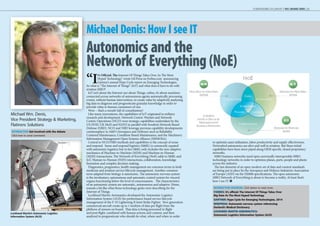
Central to NCO/NBD methods and capabilities is the concept of sense 
and respond. Sense and respond logistics (S&RL) is commonly equated 
with autonomic logistics; but in fact S&RL only includes the non-adaptive 
mechanics of Machine-to-Machine (M2M) and Machine-to-Human 
(M2H) transactions. The Network of Everything (NoE) adds to S&RL and 
IoT, Human-to-Human (H2H) interactions, collaboration, knowledge 
formation and complex decision making. 
Diagnostics, prognostics, health management are common terms in both 
medicine and aviation service lifecycle management. Another common 
term adapted from biology is autonomic. The autonomic nervous system 
is the involuntary, autonomous and automatic control system for visceral 
organs functioning below the level of consciousness. The characteristics 
of an autonomic system are automatic, autonomous and adaptive. Hmm, 
sounds a bit like what those technology geeks were describing for the 
Internet of Things. 
Lockheed Martin Aeronautics developed the Autonomic Logistics 
Information System (ALIS) for performance based service lifecycle 
management of the F-35 Lightening II Joint Strike Fighter. New generation 
commercial aircraft create up to 1 terabyte of data per flight from the 
plethora of sensors on board. That data is being processed in flight 
and post flight, combined with human actions and content, and then 
analyzed to prognosticate who should do what, where and when in order 
OCTOBER/NOVEMBER 2014 | AIRCRAFT IT MRO | MICHAEL DENIS | 23 
Michael Wm. Denis, 
Vice President Strategy & Marketing, 
Flatirons Solutions 
INTERACTIVE Get involved with the debate 
Click here to send comments 
INTERACTIVE SOURCES: Click below to read more. 
FORBES: It’s official: The Internet Of Things Takes Over 
Big Data As The Most Hyped Technology 
GARTNER: Hype Cycle for Emerging Technologies, 2014 
WIKIPEDIA: Autonomic nervous system referencing 
Dorland’s Medical Dictionary 
LOCKHEED MARTIN AERONAUTICS: 
Lockheed Martin’s Autonomic Logistics Autonomic Logistics Information System (ALIS) 
Information System (ALIS)
24 | WHITE PAPER: AEROSOFT | AIRCRAFT IT MRO | OCTOBER/NOVEMBER 2014 
CMS and MRO systems 
integration – Part 2 
In an industry full of standards, Thanos Kaponeridis, CEO & President, 
AeroSoft Systems Inc. considers the challenges of electronic data interchange
OCTOBER/NOVEMBER 2014 | AIRCRAFT IT MRO | WHITE PAPER: AEROSOFT | 25 
“…to begin with, we have to say, the process is 
complicated which is both a challenge and a block to 
true standards-based CMS and MRO systems evolution.” 
In the previous issue we considered some of the underlying causes of 
a seeming inability to integrate the various M&E and CMS systems 
that we use. In this issue we’ll consider some specific matters and some 
thought processes that might just take us forward to the more integrated 
environment that people have been seeking for decades. However, to begin 
with, we have to say, the process is complicated which is both a challenge 
and a block to true standards-based CMS and MRO systems evolution. Let’s 
consider a couple of examples to illustrate what I mean. 
TOOLBOX VS PURE ISPEC2200 OR S1000D 
Say you start making your COCs in Toolbox, then extract the collection (for 
a Boeing 777 it would be iSPEC2200, in the case of a Boeing 787 it would 
be edits to the data modules in S1000D). If you extract them in SGML or 
XML, such content does not parse against the iSPEC2200 DTDs or S1000D 
Rev 3.0. So, when you’re looking in Toolbox and considering what content 
you can extract directly from it, you will have to do work to actually make 
it comply with the open standards established by ATA. Take the Service 
Bulletin, for example: we had a case in the last few months. It’s now at about 
revision 9 of the DTD and, accidentally, one of our customers inserted a 
revision 4 service bulletin in SGML. Unfortunately, there’s a slight difference 
between the two: in rev4, effectivity was quoted as text in a para; in rev9 it’s 
quoted as table data. The result is that we have an application build looking 
for a new table that isn’t going to find it inside a para. 
Consider the MTCM: Boeing has an MTCM and so does Bombardier but 
they’re not the same structure and MTCM per se is not part of iSPEC2200. 
An Airbus customer would say, ‘what’s an MTCM?’ because they have an 
MPD/AMM and have to create Task Cards. FIM and FRM are separate 
documents in Boeing but go as a single TSM in Airbus. Why do we need 
an MTCM if an MPD contains the AMM references for each MID? In 
a perfect world, an MTCM is really a document that comes together by 
the intelligent combination of the MPD/record data with the AMM/ 
detailed instructions, contained in AMM tasks. And, just to compound 
the confusion, the XML delivery of MPD from Boeing (for B767/757) 
is missing key sections which are included in their .PDF version? Ditto 
the Excel/XSL version: but, if you don’t catch that and deal with the data 
individually, you don’t have a fully compliant environment established. 
And these are just references to the situation with the large OEMs who are 
very versed with the standards and processes. How about the 16,000 or so 
CMMs — the lower tier manufacturers in the manufacturing supply chain 
— how many of them have adopted or use any of the above standards? 
How many have moved beyond MSWord and .PDF, the lowest common 
denominator in this world of small suppliers. 
TYPICAL CHALLENGES TO MRO/CMS INTEGRATION 
Here’s a challenge: you have an older MRO system — sort of middle of 
the road because it even allows you to author and edit job cards in SGML.
26 | WHITE PAPER: AEROSOFT | AIRCRAFT IT MRO | OCTOBER/NOVEMBER 2014 
However, you’ve decided you’ve got to replace it and you’ve shopped 
around and sourced a state-of-the-art current MRO solution, one of the 
market leaders today. You had (in the legacy system) the top part of the 
task card (mostly MPD and visit specific data) and the bottom (detailed 
instructions and data capture during the visit) and now you want to 
migrate to a CMS integrated with your state of the art MRO. 
What you’ll find is that you’re purchasing iSPEC2200 digital data 
subscriptions from the OEM’s, but you also want to keep the task cards 
that you’ve authored, especially your in-house task cards from your initial 
MRO system, and you only want to introduce the MTCM for the standard 
scheduled interval tasks. A heck of a lot of data conversion is involved with 
this situation where we’re talking about state-of-the-art MRO and CMS 
systems as well as original data that, in parts, was in SGML and in others 
as records in a relational database. And yet, you’ve been let to believe that 
it might be more straightforward since, after all, the legacy MRO, the ‘new’ 
MRO and the CMS all have Oracle underneath! 
OLD MENTALITY AND OUTDATED PROCESSES 
In reality, low cost MRO shops expect to receive paper printed task cards 
(or .PDF which they print in their facility). They execute them then sign 
them off on paper and return them in boxes of paper: so there needs to be 
a capability to scan them and do indexing and OCR or ICR conversions as 
the only remaining alternative to link them to transaction oriented MRO 
or CMS systems, modern systems that would otherwise accept true open 
digital data. 
The same goes for the old 8130/EASA Form 1: most are printed and 
filled and signed by hand — then scanned for linking with or attaching to 
transaction oriented systems. Everybody is hung up on where do we put 
their logo and signature column or box on job cards (totally locked on the 
page/print paradigm) without understanding the concept of linking the 
approval event and its audit trail to the information unit. They need to ask, 
how do you do conditional intelligent branching in a job card where you 
read, observe a condition on the aircraft or component and then execute 
this path versus the other when undertaking the maintenance? And how 
do you capture all that information and feed it back to the MRO system 
or have it directly authored into the MRO system; or architect job cards 
that truly capture ‘part off/part on’ information during the visit but also 
inspection data in a comprehensive manner and relate it back to the MRO 
system so that the data can flow among the different systems at the airline 
vs their 3rd party MRO supplier? 
DATA CONVERSION — CLAIMS VERSUS REALITY 
In aviation we have had an incredible array of standards for many years 
so you can pick any, many or all of them and yet you cannot, at the push 
of a button, move electronic data, for example, from one MRO system 
to another, even though they’re almost all on Oracle! You cannot move 
a complete Maintenance program or job card work-package with its 
associated scheduling (the emphasis again is at the push of a button) from 
one airline to a 3rd party MRO facility, complete the work, capture the 
findings and accomplishment authorizations and return the package to the 
originating airline. And if you want to move all of the parts information, 
what if the old system used 25 digits to capture part numbers while the 
new one uses 20? Get XML to solve that one and then bring in 20 years of 
history and then you’ll be able to say to yourself that you’re ready to take 
compliance on the new system. 
Even in the CMS industry, where we take absolute pride in abiding by 
standards, have you ever tried to migrate Jouve (ex-ITG/Flatirons+Corena 
now) to Enigma? Have you tried moving data from Corena S1000D to 
TechSight? Or maybe IDMR to TerraView? What do you think it would 
take to move a mature fleet database with five to 10 years history (as 
some of these systems are older than that) with substantial local content 
and associated ‘audit history/workflow meta-data’ to move across these 
systems? 
In every system implementation the biggest challenge by far is the data 
conversion — and proving that you in fact have all the data correctly 
migrated after the process. Various workarounds are often used such as 
converting minimalist amounts of current data and keeping the history in 
a dormant version of the legacy system — this is often required for SOX 
compliance. 
Building bridges between different systems is a complex endeavor; so here 
are some hypothesizes that might be presented to you. 
Hypothesis 1: You can move an electronic/intelligent set of Job Cards 
from one MRO system to another (at the push of a button), process them 
and return them to the original MRO. We’re talking about a round trip in 
which the airline sends it to the MRO; the MRO accomplishes the work 
and sends them back, with all the customization that the airline wanted in 
the first place. 
Hypothesis 2: You can (at the push of a button) move complete 
maintenance data records from one MRO system to another, process them 
and return them to the original MRO. 
Hypothesis 3: XML makes data interchange easy, transparent and 
pushbutton plus you can edit XML data like MSWord. 
All of the above are at best ‘marketecture statements’! 
Hopefully I’ve convinced you that there are some difficult questions to ask 
in assuming the above and that serious due diligence needs to take place 
to validate these claims… which are absolutely not true. In saying that, I’ve 
just spread FUD, an acronym from the bad old days (fear, uncertainty and 
doubt). Typically, vendors that don’t have solutions usually do that; spread 
fear, uncertainty and doubt. But let’s look at what the regulators are saying; 
this (figure 4) shows some results from an FAA study carried out in 2012 
and it’s worth considering. The bottom line is what’s important, that there 
is technology and software and processes but that they’re under-utilized 
across the industry. 
What are the Regulators saying… 
• 60% of aviation incidents were procedure related or involved 
technical documentation. 
• The "two top errors" on the maintenance floor are : 
• "information not used" 
• "procedures not followed". 
• 36% of all regulatory actions against aircraft maintenance 
technicians are for "not using proper technical documentation" 
• 64% of all incidents registered in the Aviation Safety Reporting 
System (ASRS) are related to technical documentation or 
procedural challenges or both. 
• The data is extremely complex in all its interrelations. 
• There is available software technology and know-how that it 
is not being fully exploited to solve the issues. 
Figure 4 
“Everybody is hung up on where do we put their 
logo and signature column or box on job cards 
(totally locked on the page/print paradigm) without 
understanding the concept of linking the approval 
event and its audit trail to the information unit.” 
Figure 5 
The next chart (figure 5 above) provides a snapshot of what the study 
concluded about the distribution of the root causes of technical 
documentation issues based on a statistical sample. The most important 
recommendation of the workshop that produced these statistics was that 
“the industry has to make more use of the available software technology 
and know-how that already exists which is not [currently] being fully 
exploited to solve the issues.” 
THE PARADOX OF OUR INDUSTRY 
We take too long to build Standards — even though we’re copying them 
from others (iSPEC2200 came out of CALS, S1000D from AECMA). We 
also take too long to develop them to our own versions and then we take 
too long to adopt them and adapt them. We keep changing them and we 
watch the world go by while other industries bring forth revolutionary 
standards and technologies which do amazing things that we wished 
we could do. And we are stuck. We have a lot, yes, there is SPEC2000, 
iSPEC2200, S1000D, SPEC2300 to potentially make the electronic data 
interchange between OEM’s and airlines and MRO’s and amongst end-users 
of the data, transparent and easy. We have Electronic Signature and we even 
have nose-to-tail communications on aircraft and communications from 
aircraft to the ground with ACARS/ARINC CMC protocols for data capture 
and transmission from aircraft to ground. Yet the encoded values for such 
protocol data streams for various errors and fault conditions on the aircraft 
are totally different across aircraft types even from the same OEM. So you 
require different intelligence to analyze the codes from a 737 and a 757 and 
a 767. Yet we fiercely defend our standards.
OCTOBER/NOVEMBER 2014 | AIRCRAFT IT MRO | WHITE PAPER: AEROSOFT | 27 
INTERACTIVE Click here for a demonstration 
Author 
THANOS 
KAPONERIDIS 
PRESIDENT AND CEO AEROSOFT 
SYSTEMS INC. 
Thanos Kaponeridis 
is the founder of 
AeroSoft Systems Inc. 
established in Toronto 
Canada in 1997. 
He has brought AeroSoft from 
a start-up through organic and 
inorganic growth to become a 
unique niche player in the M&E 
Systems marketplace with their 
two MRO products of DigiMAINT 
and WebPMI plus DigiDOC (CMS). 
Thanos has built up his aerospace 
and aviation experience since 
engaging at Bombardier Regional 
aircraft in 1992 where he managed 
the development of the iSPEC2200 
compliant digital document systems 
for the CRJ and Q400. He was 
a long-standing member of the 
ATA/EMMC/TICC eText and FOWG 
since 1994 in the development of 
digital document standards. Prior 
to Bombardier, Thanos was an 
accomplished IT/IS senior consultant 
with his own practice and prior to 
that with the Canadian subsidiary 
of Gartner Group, offering strategic 
and tactical planning of IT/IS to 
multi-national corporations. Mr. 
Kaponeridis holds a Bachelor of 
Applied Science from the University 
of Toronto in Industrial Engineering 
and a Master of Science from 
the University of London (UK) in 
Ergonomics / Human Factors. 
About… 
AEROSOFT SYSTEMS 
AeroSoft 
Systems 
Inc. was 
established in June 1997 and 
now has 25+ customers with over 
1000 aircraft globally. There are 
three distinct products, two in 
MRO/M&E: DigiMAINT and WebPMI 
plus DigiDOC as an aviation CMS. 
DigiDOC integrates agnostically with 
any MRO/M&E system 
“We take too long to build Standards – even though 
we’re copying them from others (iSPEC2200 came out 
of CALS, S1000D from AECMA). We also take too long 
to develop them to our own versions and then we take 
too long to adopt them and adapt them.” 
INTERACTIVE Give us your opinion 
Click here to have your say 
INTERACTIVE Subscribe here 
Click here to read all future editions 
only supplier of 2 MRO 
‘best of breed’ plus 
Oering DigiPLAN, DigiREPORTS, Analytics and 
B2B for DigiMAINT and WebPMI MRO systems. 
Our DigiDOC CMS is agnostic 
of MRO with proven integration 
with any competitors’ system, 
in addition to our own. 
iSPEC2200, S1000D, DITA, SPEC2000, SPEC2300 
A HEALTHY DATA INTERCHANGE ENVIRONMENT 
Let me digress a little — it is relevant. The company that actually enabled 
XML editing within MSWord in 1994 was i4i and that’s the technology 
whose patents, ultimately today, gives you .docx. After that, i4i specialized 
in the Medical industry and participated in work on the HL7 standards, 
an application level interface; it’s built on the ISO Layer 7 interconnect 
model and its application to application interface. That’s because you can’t 
go to one doctor and then change your doctor or hospital next week and 
not be able to have your data totally move from one place to the other or 
say ‘well, we need a lot of conversion’ or ‘we’re going to lose some of your 
information’. But that’s the kind of answer that we accept in the aviation 
industry. So, you say, ‘so what?’ 
The ‘what’ is that, in aviation, we need an application level interface 
that we haven’t even come close to developing. The existing standards 
that we have, as we use them, do not allow for transparent moves of data 
at the push of a button for the round trip as I described above. Establishing 
such a ‘product independent’ data interchange in our industry will 
make the playing field level and will allow buyers to make their choices 
according to true ‘product features and functions’ and not because 
“I bought a plane from an operator that uses ABC MRO software, so I’ll 
install ABC MRO in my company.” 
GLOSSARY OF TERMS 
AECMA Association Européenne des Constructeurs de Matériel aérospatial/ 
European Association of Aerospace Manufacturers 
AMM Aircraft Maintenance Manual 
CMC Central Maintenance Computer 
CMS Content Management System 
COC Customer Originated Changes 
DTD Document Type Definition 
FIM Fault Isolation Manual 
FRM Fault Reporting Manual 
ICR Intelligent Character Recognition 
MID Maintenance Instruction Document 
MPD Maintenance Planning Document 
MTCM Multidimensional Trellis Coded Modulation 
OCR Optical Character Recognition 
SOX Sarbanes-Oxley Act 
TSM Troubleshooting Manual
Untimely Information and 
Delays Cost the Airline 
Industry $5 Billion Annually! 
Real Time Content at the Point of 
Performance Increases Technical 
Dispatch Rates and Punctuality! 
Struggling to Get Accurate, Real Time Information? 
Get in touch to learn how our Content Lifecycle Management Solutions can 
help you overcome your challenges! 
www.FlatironsSolutions.com  www.Corena.com

AircraftIT MRO Journal Vol 3.4 Autonomics and the Network of Everything (NoE)

  • 1.
    V3.4 • OCTOBER/NOVEMBER2014 PAPERLESS AND MOBILE MAINTENANCE SPECIAL INTEGRATION CASE STUDIES Columbia Helicopters Paperless MRO China Airlines M&E IT Upgrade Mobile MRO as part of the ERP White Paper: IFS, AeroSoft Systems Case Study: China Airlines, Columbia Helicopters with IDMR Solutions PLUS… How I see IT, News, Upcoming and Past Webinars, past Webinar focus, MRO Software Directory
  • 2.
    V3.4 • OCTOBER/NOVEMBER2014 Welcome… Digital capability and mobile technology have transformed the value of IT by putting what you need, where you can access it. It was only a few decades ago when IT first entered the business world. Then, it was seen as a tool with which simple but repetitive and lengthy processes could be automated and large tables or charts printed to put records where they were needed. Well, up to a point. The printed reports were often massive structures whose weight and size meant that they could only be viewed on a sturdy surface. Things moved on to where IT became the infrastructure of the business — the means by which users could access all of the records they needed but one departmental silo at a time through a heavy CRT screen on their desk. The PCs continued to get smaller but the process hardly progressed until digital technology, big data and mobile capability converged with IT to change everything. Today, we don’t so much access records as view solutions drawing on information generated in all parts of the business and presented to us wherever we are on whatever device we are holding, in the form most useful to us and in real time. It has transformed the ways people work and generated fantastic opportunities to add value to the processes that have to be completed. In this issue we’ll be looking at how a major airline, when upgrading its MRO IT, took the opportunity to leverage new capabilities and create a more cost-effective and leaner process with long-term value. There’s also an article about implementing a paperless regime in an MRO environment that has to reach out into the field as well as operate a busy engineering hangar. Last issue’s paper on systems integration is concluded with considerations of how the kind of integration that users would find useful can be achieved. And we look at how mobility can be much more valuable when integrated into a wider ERP. Quite enough for one issue, you might think; but there’s also how Michael Denis sees IT, as thought provoking as ever, and our usual overview of news and information affecting your sector as well as some of the deals that have been concluded. Aircraft IT live demonstration webinars are previewed and the recorded archive reviewed to help readers research the software market from the convenience of their own desk and to find a package that could meet their needs by accessing past webinars with more focus than ever and booking their place on future webinars. It’s a valuable resource for which readers simply need to register. It’s Aircraft IT MRO: information that you can use. Ed Haskey 04 NEWS & TECHNOLOGY Nothing stands still in the world of the MRO IT professional. Reading Aircraft IT MRO News at www.aircraftit.com/MRO and here in the Aircraft IT MRO e-journal is a great way for busy professionals to keep up to date with the latest developments. 18 CASE STUDY: SAFER, FASTER, BETTER Houng Wang, Vice President, Engineering Division – China Airlines When upgrading its MRO IT to the latest standards, China Airlines took a business-like approach that has already paid dividends in cost savings and lean processes. 22 UPCOMING LIVE MRO SOFTWARE DEMONSTRATION WEBINAR A preview of the live MRO software demonstration webinars featuring Commsoft on 16th October 2014 and Flatirons Solutions on 13th November 2014. 23 COLUMN: HOW MICHAEL DENIS SEES IT Autonomics and the Network of Everything (NoE) The Internet of things is becoming a ‘must use’ in any talk about technology: the simple term relates to concepts that are anything but simple; but they are useful. 24 WHITE PAPER: CMS AND MRO SYSTEMS INTEGRATION, PART 2 Thanos Kaponeridis, CEO & President, AeroSoft Systems Inc. This second article considers how the systems integration that would be so useful to MRO businesses might be achieved and what hurdles would need to be overcome. 28 PAST WEBINARS: KNOWLEDGE TRANSFER AND ACCESS FOR INDUSTRY EXPERTS View Video Recordings of our Past Live MRO Software Demonstration Webinars. See full information and view video recordings of past Live MRO Software Demos, including: Mxi Technologies, Hexaware and TRAX. 30 CASE STUDY: PAPERLESS END-TO-END AIRCRAFT MAINTENANCE Israel Revivo, President & CEO, IDMR Solutions Paul Myrand, Project Manager, Columbia Helicopters When Columbia Helicopters Inc. (CHI) wanted to move towards a paperless environment for their MRO system, it posed a challenge for their solution providers. 34 PAST WEBINAR FOCUS: IPAD AND MOBILE MRO SOLUTIONS Finding the right iPad and Mobile MRO solution to match your requirements is so much easier if you search the library of recordings of Aircraft IT Past Webinars by category. 36 WHITE PAPER: MEETING THE NEW MRO ORDER Espen Olsen, European Director for Aerospace & Defense at IFS Given how MRO and demands on engineers are changing, a mobile solution is attractive; but integrated into a larger ERP system, mobile can do so much more. 41 MRO SOFTWARE DIRECTORY A detailed look at the world’s leading MRO IT systems. CLICK HERE: Send your feedback and suggestions to AircraftIT MRO CLICK HERE: Subscribe for free AircraftIT MRO Publisher/Editor: Ed Haskey E-mail: ed.haskey@aircraftit.com Telephone: +44 1273 454 235 Website: www.aircraftIT.com Copy Editor/Contributor: John Hancock E-mail: john@aircraftit.com Magazine Production: Dean Cook E-mail: deancook@magazineproduction.com AircraftIT MRO is published bi-monthly and is an affiliate of Aircraft Commerce and part of the AviationNextGen Ltd group. The entire contents within this publication © Copyright 2014 AviationNextGen Ltd an independent publication and not affiliated with any of the IT vendors or suppliers. Content may not be reproduced without the strict written agreement of the publisher. The views and opinions expressed in this publication are the views of the authors and do not necessarily reflect the views or policies of their companies or of the publisher. The publisher does not guarantee the source, originality, accuracy, completeness or reliability of any statement, information, data, finding, interpretation, advice, opinion, or view presented.
  • 3.
    OCTOBER/NOVEMBER 2014 |AIRCRAFT IT MRO | TECHNOLOGY & NEWS | 5 INTERACTIVE Click here for a demonstration Flatirons grows the business and opens new flagship office HONEYWELL AEROSPACE SELECTS FLATIRONS FOR TRAINING DEVELOPMENT SERVICES TO ACHIEVE SIGNIFICANT COST SAVINGS BY REUSING CONTENT ACROSS TECHNICAL PUBLICATIONS AND TRAINING FLATIRONS Solutions announced in late September 2014 that Honeywell Aerospace, a provider of products and services to commercial, defense, and space aircraft worldwide, has selected the Flatirons’ Training Services group to serve as its primary developer for training content. The contract includes developing new training materials, updating existing source materials, and making modifications to training content used by Honeywell’s employees and customers for servicing and maintaining Honeywell products. The selection of Flatirons, which also serves as Honeywell Aerospace’s single global supplier for technical publications services, allows Honeywell Aerospace to achieve significant cost savings by reusing technical publications content in its training materials. In 2009, Honeywell Aerospace selected Flatirons as its global supplier for technical publications services, covering more than four million pages and 40,000 documents annually. “When seeking a partner for the development of training content, our objective was to reduce the overall costs by reusing technical publications content in the development of training materials,” said Lewis Mallory, Director Flight Sim Support, Technical Publications & Customer Product Training for Honeywell Aerospace. In collaboration with Flatirons, 75% of Honeywell’s illustration content in training materials is reused directly from existing technical documentation. This amounts to a 32% cost savings for the overall project when compared to the costs of recreating and duplicating illustrations for each training project. “Re-use of technical content across documents or between technical publications and work instructions is a highly desired practice in many industries,” said Geoffrey Godet, president and CEO of Flatirons. “Because Flatirons provides both technical publications and training content development services, customers like Honeywell can reuse content to achieve accurate, high-quality technical information at reduced costs.” Flatirons’ Training Services group is ISO 9001:2008 certified. Its technical writers, illustrators, and multi-media developers use the Six Sigma process to ensure accurate, high-quality information throughout the content lifecycle. ACCELERATED GROWTH TRIGGERS FLATIRONS EXPANSION IN NORTH AMERICA: NEW CUSTOMER DEMAND TO BE SERVED FROM FLAGSHIP OFFICE IN BOULDER, COLORADO AT the beginning of October 2014, Flatirons Solutions announced that accelerated growth has spurred expansion of its North American operations and the opening of its new flagship office in Boulder, Colorado. Flatirons has forecasted a 37% growth rate for 2014, following revenue increases of 33 percent and 13 percent in 2013 and 2012, respectively. Year-on-year growth comes from greater demand for Flatirons’ comprehensive set of CLM solutions and services that help customers across multiple industries deliver the right information, at the right time, to the right people while controlling costs and meeting often complex information requirements. “Organizations today are faced with some of the most pressing content lifecycle management challenges they have seen in decades,” said Geoffrey Godet, Flatirons’ CEO. “Whether adapting to information requirements driven by the most modern aircraft being introduced, the need to organize and use rich media to produce graphically rich, multi-media driven, and personalized products for consumers, or the basic need to retire out-dated and expensive business applications that maintain regulated data, organizations of all types must do so efficiently and in the most cost-effective way possible. Flatirons, together with its network of partners, is uniquely positioned to help customers meet these challenges head on.” “Such a strong response to our CLM solutions from customers like General Electric, BMO Harris Bank, the LATAM Airlines Group, Whirlpool, McGraw Hill Education, and others has driven rapid expansion,” said Greg Beserra, Flatirons’ chief operations officer. “The bulk of this demand will be addressed from our larger, modern office in Boulder, Colorado.” “Flatirons’ choice of Boulder and its new 37,000 square foot office reflects the company’s strong history and continued commitment to both the local community and our top-notch staff,” said Godet. “Boulder is a thriving technology community with many of the best and brightest people. We designed an office that gives our team the ability to brainstorm the next innovation in a huddle room, tackle customer issues by drawing on the whiteboard walls, or just take a break with a bike ride on Boulder’s extensive trail system right outside our back door.” 180mm Trim Whatever’s in your fleet, it’s now in our toolbox. Your fleet’s growing. Your fleet’s changing. And the Boeing Maintenance Performance Toolbox is changing with you, providing new tools designed for the digital airline to meet your evolving needs. Tools for your entire fleet, no matter the OEM. Tools accessible anywhere—from web to tablet—with or without connectivity. New tools to keep your maintenance at the forefront of innovation and efficiency, and your airplanes in the air where they belong. www.boeing.com/boeingedge/informationservices
  • 4.
    18 | CASESTUDY: CHINA AIRLINES | AIRCRAFT IT MRO | OCTOBER/NOVEMBER 2014 China Airlines is Taiwan’s largest airline. Over the years, the passenger and cargo carrier has developed an international reputation for delivering superior customer service, having recently been voted airline with the top mind-share, according to a leading business management magazine. A SkyTeam airline alliance member since 2011, China Airlines is committed to promoting innovative, high-quality passenger experience and caring services, including the retrofitting of Boeing 747-400 aircraft with brand new seats and entertainment systems, in-flight meals that combine the best of Chinese, Western and Taiwanese cuisine, as well as mobile phone and online services that satisfy passengers’ demand for convenient access. CHINA AIRLINES — AT A GLANCE • Founded in 1959 • The largest airline in Taiwan • SkyTeam airline alliance member since September 2011 • Fleet: 80 • A330-300, A340-300 • 737-800, 747-400, 747-400F (cargo) • 27 on order (including777-300ER) • Hub: Taipei • Destinations: 120 domestic and international destinations in 29 countries • Employees: 11,000 worldwide • Subsidiaries: Mandarin Airlines, Tigerair Taiwan • 2013 Revenues: TWD131.753 million This case study details how its commitment to standardized Maintenance, Repair and Overhaul (MRO) practices — supported by Mxi Technologies’ Maintenix system — is enabling a ‘best in class’ maintenance unit that is helping drive significant business performance returns. A COMMITMENT TO PASSENGER SAFETY It should come as no surprise that the primary goal of any commercial aircraft operator is to deliver the best service possible for its customers. While this entails a number of factors to support customer loyalty — reliable departures and arrivals; friendly and helpful staff; in-flight comfort and entertainment; innovative rewards packages and trip promotions — the most fundamental of all is the promise of passenger safety. As Taiwan’s largest air carrier, operating in a highly dynamic and competitive market in the Asia- Pacific region, we have no choice but to continue to consolidate our reputation as an industry leader in this area. Over the years, we have implemented a number of key in-house flight safety programs, designed to foster an open and highly-collaborative environment dedicated to preventing safety incidents both in the air and on the ground. Of note, for instance, are… • China Airline’s Safety Management System (SMS) systematically manages all forms of aviation risks in areas such as flight operations, in-flight services, and ground handling. We have a safety report policy that encourages employees to quickly and honestly report all identified incidents and hazards, in the spirit of reducing the probability of unsafe incidences. • An Aviation Quality Database, built within the SMS, was introduced in 2013 to more efficiently collect work process issues, conduct risk assessment, take appropriate risk control measures, and monitor the subsequent status. • A Line Operations Safety Audit (LOSA) was also established to enable experts and trained observers to collect and assess data on flight crew behavior and strategies for managing threats and correcting errors. By identifying the strengths and weaknesses of an airline, LOSA is a means for China Airlines to self-assess its safety margins in flight operations Aviation safety is China Airlines’ utmost mission — each and every employee is fully committed to it by integrating safety consciousness into our operations, system design, and organization. EFFECTIVE MAINTENANCE OPERATIONS: A PREREQUISITE FOR SAFETY The Engineering & Maintenance Organization (EMO) is no exception to this rule. In fact, we consider the quality assurance of maintenance work as the best foundation for flight safety. Since the formation of our maintenance unit in 1959, China Airlines has worked hard to certify staff and operations according to latest safety regulations and practices. Today, we are the largest and most modern aircraft body maintenance center in the region. We count on more than 1,200 professionals working out of five hangars to deliver a complete range of internationally certified line, heavy and shop maintenance work on various types of aircraft and engines, both for our own passenger and cargo fleets, and for over 40 other domestic and international airlines. We never rest on our laurels in our dedication to safety but continue to evaluate and monitor the training and certification of all maintenance personnel, to ensure ongoing compliance with new and evolving CAA certification requirements. This commitment inevitably found its way into the EMO back office — specifically, how we function on a day-to-day basis and what systems are used to support our maintenance operations. Our network of legacy mainframe systems often could not deliver the data insights we felt were critical if we wanted to evolve the business and introduce new efficiencies. For the most part, these systems worked in siloes, each isolated from the others, and Safer, faster, better Houng Wang, Vice President, Engineering Division – China Airlines explains how modern MRO IT is playing a key role in performance excellence at China Airlines
  • 5.
    OCTOBER/NOVEMBER 2014 |AIRCRAFT IT MRO | CASE STUDY: CHINA AIRLINES | 19 each operated by its own set of processes for capturing and storing data. This made it very difficult to access and share timely maintenance information across the organization. In our highly competitive marketplace, we understood that success would hinge solely on factors that could be controlled, namely driving greater operational efficiencies. With the need to fulfil aggressive corporate expansion plans, coupled with the need to accommodate an evolving fleet, we soon recognized “…we consider the quality assurance of maintenance work as the best foundation for flight safety. Since the formation of our maintenance unit in 1959, China Airlines has worked hard to certify staff and operations according to latest safety regulations and practices.” that it was no longer viable to continue with the status quo. Subsequently, China Airlines committed to investing in more modern IT systems to support the business, including EMO. EVOLVING THE EMO DEPARTMENT The search for an MRO IT solution extended beyond simply selecting a system that could do a better job of storing maintenance transactional activity or executing existing maintenance processes. This initiative was based on three key objectives: • Integrate the entire EMO department using a single, seamless approach; • Strengthen configuration control and record keeping, for more agile compliance reporting; • Minimize in-house system customizations. In addition to generating substantial cost savings, we were motivated by the possibility of driving stronger visibility into our operations, both ‘day of’ and historical. Doing so would not only simplify ongoing compliance with regulatory standards, it would also help us better understand why things happen and how, through preventative maintenance, we could best minimize the risk of it happening again in the future. Such proven practices would typically lead to better performance and greater productivity during all maintenance visits, both scheduled and unscheduled. Based on these goals, we engaged in an active market assessment of vendor solutions. We eventually turned to Mxi Technologies and its Maintenix software as the best option capable of supporting the increasing sophistication of our fleet, and our demand for operational efficiencies in line with corporate strategy. We envisioned Maintenix to be our system of record for maintenance and engineering needs across our entire fleet of Boeing and Airbus airplanes, as well as those aircraft handled by our burgeoning third-party maintenance services practice. It offered the promise INTERACTIVE Click here for a demonstration MAINTENANCE OPERATIONS CONTROL MAINTENANCE PLANNING MAINTENANCE SUPPLY CHAIN DELIVERING ON THE FLIGHT OPERATIONS PROMISE Watch the new video series from Mxi Technologies and discover how Maintenix® delivers information insights across maintenance operations control, maintenance planning, and maintenance supply chain. Watch them all today at www.mxi.com.
  • 6.
    “In addition togenerating substantial cost savings, we were motivated by the possibility of driving stronger visibility into our operations, both ‘day of’ and historical.” of a full end-to-end suite, including functionality for maintenance program management; configuration management; engineering; planning; materials management; and line, heavy, and shop maintenance. From the outset, we opted for a phased implementation approach. While the conventional wisdom among some is to proceed with a full system implementation from the start, we were looking for the path with the least risk. A phased approach offered us the ability to gradually wean ourselves off legacy systems and build in the necessary integrations to others, most notably to our SAP ERP system. It also gave us the time to effectively handle change management among staff who would need time to acclimatize to a new system. Most importantly, it allowed us to evaluate progress and measure results at key intervals, assessing fit to the overall business plan, and implementing necessary modifications before moving on to the next stage. The project was split into two key phases — with the first phase focused on core competencies in engineering, planning and technical records management. We have already successfully achieved the completion of this phase, introducing key usability and process enhancements across the entirety of our MRO operations. The final phase, currently underway, supports our move to real-time management of line and heavy maintenance events, as data is captured at the point of maintenance execution. This will be of significant benefit to the growth areas of our business, namely our expanding third-party MRO services for global customers such as Continental Airlines, FedEx, Korean Air and Japan Airlines, among many others. The Maintenix system will also extend its footprint into such specialty areas as materials management. For instance, China Airlines currently uses a warehousing system called ASAR, or Automatic Storage Automatic Retrieval. ASAR is quite robust, capable of retrieving information on more than 120,000 parts and materials 20 | CASE STUDY: CHINA AIRLINES | AIRCRAFT IT MRO | OCTOBER/NOVEMBER 2014 within just 50 seconds of inquiry. To capitalize on this power, we plan on integrating the system with Maintenix. This will enable a completely seamless ‘Just in Time’ supply model, helping us cost-effectively execute timely parts requests and fulfillment in line with increasingly competitive serviceability targets. POSITIVE RETURNS TO DATE To keep a finger on the pulse of project success, every month we conduct a Time Quality Cost (TQC) assessment, measuring the impact of the new Maintenix system against 18 operational metrics. Despite only being in the early stages of phase two, we are already seeing tangible benefits in the way we conduct our maintenance practices. Of significance are… • A 10 per cent increase in line management process efficiencies, resulting in annual cost savings of US$560,000; • A 3 per cent increase in A Checks delivery efficiencies, resulting in annual cost savings of US$213,000; • An average reduction of 30 days layover in scheduled aircraft maintenance, resulting in savings of US$1,352,000 (DVC); • An average reduction of 25 days layover in unscheduled aircraft maintenance, resulting in savings of US$1,133,000 (DVC). Collectively, the positive results we have experienced to date cannot be understated. Optimizing the way we perform line and A Checks, coupled with the significant reduction in layover times, mean our aircraft are spending more time in revenue-generation mode, and less time in the hangar. Factoring in the cost reductions achieved to date, we are setting ourselves up well for stronger financial performance. In 2013 alone, China Airlines saw its EMO operating costs go down by US$3.5 million — a significant achievement when you consider how the market’s increasingly competitive nature is forcing operators to deliver greater services with fewer resources. Moving forward, taking advantage of the real-time logistical support and complete cost Maintenix Capacity Summary Maintenix Planning Viewer Maintenix Work Package Maintenix Station Capacity
  • 7.
    analysis afforded bythe Maintenix system, we expect to further increase our maintenance cost control and drive continuing improvements in repair quality and efficiency. PROVEN PRACTICES The success of any MRO project is naturally rooted first and foremost in having a modern, comprehensive system that is backed by a committed team of professionals. We have been very fortunate to work with a knowledgeable and helpful team from Mxi throughout the project. However, other key factors go a long way to ensuring a smooth transition and faster time to returns. Over the course of the project to date, we have recognized a few proven practices that have contributed greatly to making this a positive experience. Naturally, every MRO IT project will come with its own unique challenges and needs. Fundamentally, though, there are three paramount practices that would serve to help any operator of any size tackle the task of evolving maintenance IT and operations: • Maintain executive buy-in — no matter the size or scope of the project, it all starts with the top level of the airline. Unless they are wholly committed, the project will not meet its objectives. From the start, China Airlines’ MRO IT modernization project has received strong support from the Executive Steering Author HOUNG WANG VICE PRESIDENT, ENGINEERING DIVISION – CHINA AIRLINES Mr. Houng Wang is responsible for all Engineering activities at China Airlines, including system engineering, engineering planning, supply, technical information planning and accounting. He joined China Airlines in 1982 as a mechanic. Since then, he has filled different functions and has held various senior positions within the airline’s Engineering and Maintenance Organization. Prior to his current post, he was Vice President of Quality Assurance. About… MXI TECHNOLOGIES Mxi Technologies is a provider of integrated and intelligent maintenance management software, support and services catering to the global aviation industry, including commercial and defense operators, third-party MROs, and OEM aftermarket service providers. Maintenix® software is designed to help aviation organizations maximize the revenue potential of their aviation assets through standard, lean, and predictable maintenance. Featuring a modern, web-based and mobile-enabled architecture, Maintenix delivers advanced capabilities such as controlled workflow, automated maintenance and materials planning, point-of-maintenance access to real-time information, and paperless execution and compliance. Mxi’s customers range from small organizations to the largest global enterprises, with single to multi-site deployments. INTERACTIVE Give us your opinion Click here to have your say INTERACTIVE Subscribe here Click here to read all future editions OCTOBER/NOVEMBER 2014 | AIRCRAFT IT MRO | CASE STUDY: CHINA AIRLINES | 21 “…optimizing our Engineering & Maintenance Organization will go a long way to maintaining a positive customer experience and driving greater brand loyalty. Most importantly, it supports our unending commitment to delivering the safest and most reliable passenger and cargo service…” Committee. They understand the implications and complexity of such an undertaking, and how there may be bumps along the way. Having senior management in our corner has helped us stay on course, maintain focus on the corporate objectives in play, and make the hard decisions with greater confidence. • Keep the communication lines open — this is particularly important in handling the change management hurdles typical of IT projects of this size. At China Airlines, we have built a strong team of dedicated professionals who consistently champion the cause to the broader user base. Providing regular status updates and encouraging feedback fosters a shared sense of ownership and pride in the project. This cultivates more openness to embracing change for the good, and helps everybody stay mindful of the higher goals at hand. • Measure, measure, measure — as mentioned earlier, we took a phased rollout approach in order to grant us the time to repeatedly measure project impact at key intervals along the way. Doing so helps maintain project alignment against core corporate objectives, identifying any issues or hurdles and adjusting implementation plans accordingly to get the project back on course. It also helps with the broader change management issue. Taking the time to identify and promote quick wins and early returns along the way both validates system performance, and gradually dilutes user skepticism. MAINTENANCE IT AS A MANAGEMENT PRIORITY There is no denying that modern information technology has the power to exercise significant influence over business performance. For airlines looking to differentiate from the competition, innovation should be a top strategic imperative. China Airlines understands this all too well. We firmly believe that optimizing our Engineering & Maintenance Organization will go a long way to maintaining a positive customer experience and driving greater brand loyalty. Most importantly, it supports our unending commitment to delivering the safest and most reliable passenger and cargo service in the industry. With a proven implementation plan, and supported by a committed vendor and internal team of champions, China Airlines is on the right path to making its business performance objectives a reality, helping us remain agile and top of mind in today’s highly-competitive market. n
  • 8.
    22 | WEBINARS| AIRCRAFT IT MRO | OCTOBER/NOVEMBER 2014 Upcoming Live Software Demonstration Webinars at www.aircraftit.com/MRO/Webinars.aspx this October and November. This October and November will bring a great opportunity for readers to attend a program covering one the digital future for M&E/MRO software solutions. To find out more about the digital future, what it will mean for M&E/MRO, what changes it will bring and how to prepare for it, you’ll save a great deal of time and gain a lot of what you’ll need to know to inform a good decision by simply attending this informative webinar with a leading software solution provider. Sign up to free live online software demonstrations for a perfect introduction to the world’s leading MRO Software vendors and to learn how they can assist and add value to your operations LIVE M&E / MRO SOFTWARE DEMONSTRATION OF OASES WEBINAR [ETECHLOG & TECH RECORDS; RELIABILITY REPORTS; REPETITIVE DEFECT INVESTIGATIONS] n WEBINAR OVERVIEW Register to attend this Webinar and for an excellent chance to view a live online demonstration of one of the industry’s leading and most cost effective end-to-end aircraft M&E/ MRO IT Solutions: OASES from Commsoft. During the Webinar you will see some cutting-edge new developments in M&E/MRO Software including: Electronic Tech Log (eTechlog) and Technical Records Management; Repetitive Defect Investigations and Reliability Reporting. The Webinar will begin with a high level tour of OASES and the rich functionality the software provides including: Continuing Airworthiness, Planning, Production, Line Maintenance Control, Material Management, Commercial Management, Warranty. You will see how the different modules seamlessly integrate with each other and with other IT solutions, such as an eTechLog, creating significant company-wide increases in efficiency via the sharing of data. Then the Commsoft experts will provide a detailed live demonstration of some of the OASES system highlights and latest cutting-edge M&E / MRO software developments n HOW TO SIGN UP FOR THE WEBINAR Click on the ‘Register for Webinar’ link, select your preferred Webinar Session and enter your details. Full instructions on how to access the Webinar will be emailed to you. If you can’t attend the live Webinar Sessions, sign up anyway and you will receive immediate access to the Webinar recording as soon as it is loaded to the Aircraft IT Website. n SESSION 1: 16th October 2014 06:30 GMT/UTC n SESSION 2: 16th October 2014 14:30 GMT/UTC n DURATION: 1 hour plus Q&A. INTERACTIVE Join the free webinar Click here to view full details and sign up for this webinar n WEBINAR OVERVIEW Are your mechanics suffering from tablet envy? Does it seem like all other departments apart from engineering get all the cool tools whilst the benefits in maintenance are actually greater? Did you know that the average wide body aircraft generates around 8000 sheets of paper from maintenance activity each year? The cost of paper, distributing it, faxing it, archiving it, shipping it, storing it and so on amounts upwards of up $5000 per aircraft per year after year. Not to mention the headache for engineers filling out known data on paper forms, labor productivity, aircraft cycle time and utilization, inefficiencies of interpreting dirty-finger- print copies and the duplication of effort between paper and IT systems. It is time that we moved to a paperless industry! Register to attend this webinar and you will learn how Flatirons’ CORENA Knowledge Center and CORENA Pinpoint Mobile are delivering real paperless solutions to real line and base maintenance mechanics delivering real efficiencies and real cost savings. Learn how our mobile solutions deliver knowledge to mechanics at the point of performance where OEM technical publications are put onto tablets in the hands of the people who matter and how mobile electronic task cards are set to revolutionize the way we carry out maintenance. n HOW TO SIGN UP FOR THE WEBINAR Click on the ‘Register for Webinar’ link, select your preferred Webinar Session and enter your details. Full instructions on how to access the Webinar will be emailed to you. If you can’t attend the live Webinar Sessions, sign up anyway and you will receive immediate access to the Webinar recording as soon as it is loaded to the Aircraft IT Website. ENABLING THE MOBILE WORKFORCE TO INCREASE AIRCRAFT UTILIZATION n SESSION 1: 13th November 2014 07:00 GMT/UTC n SESSION 2: 13th November 2014 15:00 GMT/UTC n DURATION: 1 hour plus Q&A. INTERACTIVE Join the free webinar Click here to view full details and sign up for this webinar
  • 9.
    Autonomics and the Network of Everything (NoE) to optimize asset utilization, labor productivity and supply effectiveness. Networked autonomics are alive and well in aviation. But these initial capabilities have been stove piped along OEM specific closed proprietary networks. MRO business networks need open universally interoperable MRO technology networks in order to optimize planes, parts, people and plants across the industry. The last elements of an open modern set of data and content standards are being put in place by the Aerospace and Defence Industries Association of Europe (ASD) via the SX000i specifications. The open autonomic MRO Network of Everything is about to become a reality. At least that’s how I see IT. n Michael Denis: How I see IT “It’s Official: The Internet Of Things Takes Over As The Most Hyped Technology,” wrote Gil Press on Forbes.com announcing Gartner’s annual Hype Cycle report on Emerging Technologies. So what is “The Internet of Things” (IoT) and what does it have to do with aviation MRO? IoT isn’t about the Internet nor about Things, rather, it’s about machines connected across networks of autonomous agents automatically processing events, without human intervention, to create value by adaptively analyzing big data to diagnose and prognosticate granular knowledge in order to provide value to human consumers of one. Wow – that’s a mouth full of consultantese! Like many innovations, the capabilities of IoT originated in military research and development. Network Centric Warfare and Network Centric Operations (NCO) were strategic capabilities undertaken by the US DOD, UK MoD and NATO in parallel with Sweden’s Network Based Defense (NBD). NCO and NBD leverage previous capability developments commonplace in A&D (Aerospace and Defense) such as Reliability Centered Maintenance, Condition Based Maintenance, and the Machinery Information Management Open Systems Alliance (MIMOSA). Central to NCO/NBD methods and capabilities is the concept of sense and respond. Sense and respond logistics (S&RL) is commonly equated with autonomic logistics; but in fact S&RL only includes the non-adaptive mechanics of Machine-to-Machine (M2M) and Machine-to-Human (M2H) transactions. The Network of Everything (NoE) adds to S&RL and IoT, Human-to-Human (H2H) interactions, collaboration, knowledge formation and complex decision making. Diagnostics, prognostics, health management are common terms in both medicine and aviation service lifecycle management. Another common term adapted from biology is autonomic. The autonomic nervous system is the involuntary, autonomous and automatic control system for visceral organs functioning below the level of consciousness. The characteristics of an autonomic system are automatic, autonomous and adaptive. Hmm, sounds a bit like what those technology geeks were describing for the Internet of Things. Lockheed Martin Aeronautics developed the Autonomic Logistics Information System (ALIS) for performance based service lifecycle management of the F-35 Lightening II Joint Strike Fighter. New generation commercial aircraft create up to 1 terabyte of data per flight from the plethora of sensors on board. That data is being processed in flight and post flight, combined with human actions and content, and then analyzed to prognosticate who should do what, where and when in order OCTOBER/NOVEMBER 2014 | AIRCRAFT IT MRO | MICHAEL DENIS | 23 Michael Wm. Denis, Vice President Strategy & Marketing, Flatirons Solutions INTERACTIVE Get involved with the debate Click here to send comments INTERACTIVE SOURCES: Click below to read more. FORBES: It’s official: The Internet Of Things Takes Over Big Data As The Most Hyped Technology GARTNER: Hype Cycle for Emerging Technologies, 2014 WIKIPEDIA: Autonomic nervous system referencing Dorland’s Medical Dictionary LOCKHEED MARTIN AERONAUTICS: Lockheed Martin’s Autonomic Logistics Autonomic Logistics Information System (ALIS) Information System (ALIS)
  • 10.
    24 | WHITEPAPER: AEROSOFT | AIRCRAFT IT MRO | OCTOBER/NOVEMBER 2014 CMS and MRO systems integration – Part 2 In an industry full of standards, Thanos Kaponeridis, CEO & President, AeroSoft Systems Inc. considers the challenges of electronic data interchange
  • 11.
    OCTOBER/NOVEMBER 2014 |AIRCRAFT IT MRO | WHITE PAPER: AEROSOFT | 25 “…to begin with, we have to say, the process is complicated which is both a challenge and a block to true standards-based CMS and MRO systems evolution.” In the previous issue we considered some of the underlying causes of a seeming inability to integrate the various M&E and CMS systems that we use. In this issue we’ll consider some specific matters and some thought processes that might just take us forward to the more integrated environment that people have been seeking for decades. However, to begin with, we have to say, the process is complicated which is both a challenge and a block to true standards-based CMS and MRO systems evolution. Let’s consider a couple of examples to illustrate what I mean. TOOLBOX VS PURE ISPEC2200 OR S1000D Say you start making your COCs in Toolbox, then extract the collection (for a Boeing 777 it would be iSPEC2200, in the case of a Boeing 787 it would be edits to the data modules in S1000D). If you extract them in SGML or XML, such content does not parse against the iSPEC2200 DTDs or S1000D Rev 3.0. So, when you’re looking in Toolbox and considering what content you can extract directly from it, you will have to do work to actually make it comply with the open standards established by ATA. Take the Service Bulletin, for example: we had a case in the last few months. It’s now at about revision 9 of the DTD and, accidentally, one of our customers inserted a revision 4 service bulletin in SGML. Unfortunately, there’s a slight difference between the two: in rev4, effectivity was quoted as text in a para; in rev9 it’s quoted as table data. The result is that we have an application build looking for a new table that isn’t going to find it inside a para. Consider the MTCM: Boeing has an MTCM and so does Bombardier but they’re not the same structure and MTCM per se is not part of iSPEC2200. An Airbus customer would say, ‘what’s an MTCM?’ because they have an MPD/AMM and have to create Task Cards. FIM and FRM are separate documents in Boeing but go as a single TSM in Airbus. Why do we need an MTCM if an MPD contains the AMM references for each MID? In a perfect world, an MTCM is really a document that comes together by the intelligent combination of the MPD/record data with the AMM/ detailed instructions, contained in AMM tasks. And, just to compound the confusion, the XML delivery of MPD from Boeing (for B767/757) is missing key sections which are included in their .PDF version? Ditto the Excel/XSL version: but, if you don’t catch that and deal with the data individually, you don’t have a fully compliant environment established. And these are just references to the situation with the large OEMs who are very versed with the standards and processes. How about the 16,000 or so CMMs — the lower tier manufacturers in the manufacturing supply chain — how many of them have adopted or use any of the above standards? How many have moved beyond MSWord and .PDF, the lowest common denominator in this world of small suppliers. TYPICAL CHALLENGES TO MRO/CMS INTEGRATION Here’s a challenge: you have an older MRO system — sort of middle of the road because it even allows you to author and edit job cards in SGML.
  • 12.
    26 | WHITEPAPER: AEROSOFT | AIRCRAFT IT MRO | OCTOBER/NOVEMBER 2014 However, you’ve decided you’ve got to replace it and you’ve shopped around and sourced a state-of-the-art current MRO solution, one of the market leaders today. You had (in the legacy system) the top part of the task card (mostly MPD and visit specific data) and the bottom (detailed instructions and data capture during the visit) and now you want to migrate to a CMS integrated with your state of the art MRO. What you’ll find is that you’re purchasing iSPEC2200 digital data subscriptions from the OEM’s, but you also want to keep the task cards that you’ve authored, especially your in-house task cards from your initial MRO system, and you only want to introduce the MTCM for the standard scheduled interval tasks. A heck of a lot of data conversion is involved with this situation where we’re talking about state-of-the-art MRO and CMS systems as well as original data that, in parts, was in SGML and in others as records in a relational database. And yet, you’ve been let to believe that it might be more straightforward since, after all, the legacy MRO, the ‘new’ MRO and the CMS all have Oracle underneath! OLD MENTALITY AND OUTDATED PROCESSES In reality, low cost MRO shops expect to receive paper printed task cards (or .PDF which they print in their facility). They execute them then sign them off on paper and return them in boxes of paper: so there needs to be a capability to scan them and do indexing and OCR or ICR conversions as the only remaining alternative to link them to transaction oriented MRO or CMS systems, modern systems that would otherwise accept true open digital data. The same goes for the old 8130/EASA Form 1: most are printed and filled and signed by hand — then scanned for linking with or attaching to transaction oriented systems. Everybody is hung up on where do we put their logo and signature column or box on job cards (totally locked on the page/print paradigm) without understanding the concept of linking the approval event and its audit trail to the information unit. They need to ask, how do you do conditional intelligent branching in a job card where you read, observe a condition on the aircraft or component and then execute this path versus the other when undertaking the maintenance? And how do you capture all that information and feed it back to the MRO system or have it directly authored into the MRO system; or architect job cards that truly capture ‘part off/part on’ information during the visit but also inspection data in a comprehensive manner and relate it back to the MRO system so that the data can flow among the different systems at the airline vs their 3rd party MRO supplier? DATA CONVERSION — CLAIMS VERSUS REALITY In aviation we have had an incredible array of standards for many years so you can pick any, many or all of them and yet you cannot, at the push of a button, move electronic data, for example, from one MRO system to another, even though they’re almost all on Oracle! You cannot move a complete Maintenance program or job card work-package with its associated scheduling (the emphasis again is at the push of a button) from one airline to a 3rd party MRO facility, complete the work, capture the findings and accomplishment authorizations and return the package to the originating airline. And if you want to move all of the parts information, what if the old system used 25 digits to capture part numbers while the new one uses 20? Get XML to solve that one and then bring in 20 years of history and then you’ll be able to say to yourself that you’re ready to take compliance on the new system. Even in the CMS industry, where we take absolute pride in abiding by standards, have you ever tried to migrate Jouve (ex-ITG/Flatirons+Corena now) to Enigma? Have you tried moving data from Corena S1000D to TechSight? Or maybe IDMR to TerraView? What do you think it would take to move a mature fleet database with five to 10 years history (as some of these systems are older than that) with substantial local content and associated ‘audit history/workflow meta-data’ to move across these systems? In every system implementation the biggest challenge by far is the data conversion — and proving that you in fact have all the data correctly migrated after the process. Various workarounds are often used such as converting minimalist amounts of current data and keeping the history in a dormant version of the legacy system — this is often required for SOX compliance. Building bridges between different systems is a complex endeavor; so here are some hypothesizes that might be presented to you. Hypothesis 1: You can move an electronic/intelligent set of Job Cards from one MRO system to another (at the push of a button), process them and return them to the original MRO. We’re talking about a round trip in which the airline sends it to the MRO; the MRO accomplishes the work and sends them back, with all the customization that the airline wanted in the first place. Hypothesis 2: You can (at the push of a button) move complete maintenance data records from one MRO system to another, process them and return them to the original MRO. Hypothesis 3: XML makes data interchange easy, transparent and pushbutton plus you can edit XML data like MSWord. All of the above are at best ‘marketecture statements’! Hopefully I’ve convinced you that there are some difficult questions to ask in assuming the above and that serious due diligence needs to take place to validate these claims… which are absolutely not true. In saying that, I’ve just spread FUD, an acronym from the bad old days (fear, uncertainty and doubt). Typically, vendors that don’t have solutions usually do that; spread fear, uncertainty and doubt. But let’s look at what the regulators are saying; this (figure 4) shows some results from an FAA study carried out in 2012 and it’s worth considering. The bottom line is what’s important, that there is technology and software and processes but that they’re under-utilized across the industry. What are the Regulators saying… • 60% of aviation incidents were procedure related or involved technical documentation. • The "two top errors" on the maintenance floor are : • "information not used" • "procedures not followed". • 36% of all regulatory actions against aircraft maintenance technicians are for "not using proper technical documentation" • 64% of all incidents registered in the Aviation Safety Reporting System (ASRS) are related to technical documentation or procedural challenges or both. • The data is extremely complex in all its interrelations. • There is available software technology and know-how that it is not being fully exploited to solve the issues. Figure 4 “Everybody is hung up on where do we put their logo and signature column or box on job cards (totally locked on the page/print paradigm) without understanding the concept of linking the approval event and its audit trail to the information unit.” Figure 5 The next chart (figure 5 above) provides a snapshot of what the study concluded about the distribution of the root causes of technical documentation issues based on a statistical sample. The most important recommendation of the workshop that produced these statistics was that “the industry has to make more use of the available software technology and know-how that already exists which is not [currently] being fully exploited to solve the issues.” THE PARADOX OF OUR INDUSTRY We take too long to build Standards — even though we’re copying them from others (iSPEC2200 came out of CALS, S1000D from AECMA). We also take too long to develop them to our own versions and then we take too long to adopt them and adapt them. We keep changing them and we watch the world go by while other industries bring forth revolutionary standards and technologies which do amazing things that we wished we could do. And we are stuck. We have a lot, yes, there is SPEC2000, iSPEC2200, S1000D, SPEC2300 to potentially make the electronic data interchange between OEM’s and airlines and MRO’s and amongst end-users of the data, transparent and easy. We have Electronic Signature and we even have nose-to-tail communications on aircraft and communications from aircraft to the ground with ACARS/ARINC CMC protocols for data capture and transmission from aircraft to ground. Yet the encoded values for such protocol data streams for various errors and fault conditions on the aircraft are totally different across aircraft types even from the same OEM. So you require different intelligence to analyze the codes from a 737 and a 757 and a 767. Yet we fiercely defend our standards.
  • 13.
    OCTOBER/NOVEMBER 2014 |AIRCRAFT IT MRO | WHITE PAPER: AEROSOFT | 27 INTERACTIVE Click here for a demonstration Author THANOS KAPONERIDIS PRESIDENT AND CEO AEROSOFT SYSTEMS INC. Thanos Kaponeridis is the founder of AeroSoft Systems Inc. established in Toronto Canada in 1997. He has brought AeroSoft from a start-up through organic and inorganic growth to become a unique niche player in the M&E Systems marketplace with their two MRO products of DigiMAINT and WebPMI plus DigiDOC (CMS). Thanos has built up his aerospace and aviation experience since engaging at Bombardier Regional aircraft in 1992 where he managed the development of the iSPEC2200 compliant digital document systems for the CRJ and Q400. He was a long-standing member of the ATA/EMMC/TICC eText and FOWG since 1994 in the development of digital document standards. Prior to Bombardier, Thanos was an accomplished IT/IS senior consultant with his own practice and prior to that with the Canadian subsidiary of Gartner Group, offering strategic and tactical planning of IT/IS to multi-national corporations. Mr. Kaponeridis holds a Bachelor of Applied Science from the University of Toronto in Industrial Engineering and a Master of Science from the University of London (UK) in Ergonomics / Human Factors. About… AEROSOFT SYSTEMS AeroSoft Systems Inc. was established in June 1997 and now has 25+ customers with over 1000 aircraft globally. There are three distinct products, two in MRO/M&E: DigiMAINT and WebPMI plus DigiDOC as an aviation CMS. DigiDOC integrates agnostically with any MRO/M&E system “We take too long to build Standards – even though we’re copying them from others (iSPEC2200 came out of CALS, S1000D from AECMA). We also take too long to develop them to our own versions and then we take too long to adopt them and adapt them.” INTERACTIVE Give us your opinion Click here to have your say INTERACTIVE Subscribe here Click here to read all future editions only supplier of 2 MRO ‘best of breed’ plus Oering DigiPLAN, DigiREPORTS, Analytics and B2B for DigiMAINT and WebPMI MRO systems. Our DigiDOC CMS is agnostic of MRO with proven integration with any competitors’ system, in addition to our own. iSPEC2200, S1000D, DITA, SPEC2000, SPEC2300 A HEALTHY DATA INTERCHANGE ENVIRONMENT Let me digress a little — it is relevant. The company that actually enabled XML editing within MSWord in 1994 was i4i and that’s the technology whose patents, ultimately today, gives you .docx. After that, i4i specialized in the Medical industry and participated in work on the HL7 standards, an application level interface; it’s built on the ISO Layer 7 interconnect model and its application to application interface. That’s because you can’t go to one doctor and then change your doctor or hospital next week and not be able to have your data totally move from one place to the other or say ‘well, we need a lot of conversion’ or ‘we’re going to lose some of your information’. But that’s the kind of answer that we accept in the aviation industry. So, you say, ‘so what?’ The ‘what’ is that, in aviation, we need an application level interface that we haven’t even come close to developing. The existing standards that we have, as we use them, do not allow for transparent moves of data at the push of a button for the round trip as I described above. Establishing such a ‘product independent’ data interchange in our industry will make the playing field level and will allow buyers to make their choices according to true ‘product features and functions’ and not because “I bought a plane from an operator that uses ABC MRO software, so I’ll install ABC MRO in my company.” GLOSSARY OF TERMS AECMA Association Européenne des Constructeurs de Matériel aérospatial/ European Association of Aerospace Manufacturers AMM Aircraft Maintenance Manual CMC Central Maintenance Computer CMS Content Management System COC Customer Originated Changes DTD Document Type Definition FIM Fault Isolation Manual FRM Fault Reporting Manual ICR Intelligent Character Recognition MID Maintenance Instruction Document MPD Maintenance Planning Document MTCM Multidimensional Trellis Coded Modulation OCR Optical Character Recognition SOX Sarbanes-Oxley Act TSM Troubleshooting Manual
  • 14.
    Untimely Information and Delays Cost the Airline Industry $5 Billion Annually! Real Time Content at the Point of Performance Increases Technical Dispatch Rates and Punctuality! Struggling to Get Accurate, Real Time Information? Get in touch to learn how our Content Lifecycle Management Solutions can help you overcome your challenges! www.FlatironsSolutions.com  www.Corena.com