Page 1
Aviation & Aerospace Sector
“Our Ground – Work Takes You Sky High’’
-Abhishek Yelne
Introduction
Aviation is derived from avis, the Latin word for bird. Many cultures
have developed devices which fly in the air from earliest projectiles
like stones and spears to hot air balloons and kites which fly in the air
along with man. There are stories of human flight such as the stories
of Icarus, and Jamshid in Persian myth, and later, somewhat more
credible claims of short-distance human flights appear, such as the
flying automaton of Archytas of Tarentum (428–347 BC), the winged
flights of Abbas Ibn Firnas (810
Century), and the hot-air Paassarola of Bartolomeu Lourenço de Gus
(1685–1724). The modern age of aviation began with the first un
tethered human lighter-
air balloon designed by the Montgolfier brothers. However the balloon
was only able to fly in the low winds which was
was replaced by elastic balloons. Jean
human-powered dirigible in 1784 and he himself crossed the English
Channel in one of them in 1785. While there are many competing claims
for the earliest powere
accepted date is 17th
December 1903 by the Wright brothers.
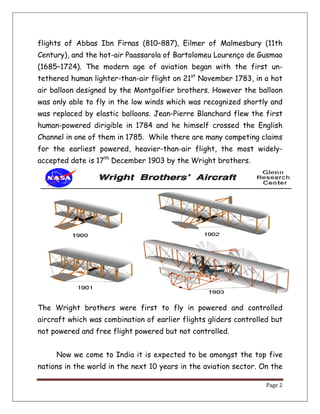
The Wright brothers were first to fly in powered and controlled
aircraft which was combination of earlier flights gliders controlled but
not powered and free flight powered but not controlled.
Now we come to India it is expected to be amongst the top five
nations in the world in the next 10 years in the aviation sector. On the
flights of Abbas Ibn Firnas (810–887), Eilmer of Malmesbury (11th
air Paassarola of Bartolomeu Lourenço de Gus
1724). The modern age of aviation began with the first un
-than-air flight on 21st
November 1783, in a hot
air balloon designed by the Montgolfier brothers. However the balloon
was only able to fly in the low winds which was recognized shortly and
was replaced by elastic balloons. Jean-Pierre Blanchard flew the first
powered dirigible in 1784 and he himself crossed the English
Channel in one of them in 1785. While there are many competing claims
for the earliest powered, heavier-than-air flight, the most widely
December 1903 by the Wright brothers.
The Wright brothers were first to fly in powered and controlled
aircraft which was combination of earlier flights gliders controlled but
and free flight powered but not controlled.
Now we come to India it is expected to be amongst the top five
nations in the world in the next 10 years in the aviation sector. On the
Page 2
Eilmer of Malmesbury (11th
air Paassarola of Bartolomeu Lourenço de Gusmao
1724). The modern age of aviation began with the first un-
November 1783, in a hot
air balloon designed by the Montgolfier brothers. However the balloon
recognized shortly and
Pierre Blanchard flew the first
powered dirigible in 1784 and he himself crossed the English
Channel in one of them in 1785. While there are many competing claims
air flight, the most widely-
December 1903 by the Wright brothers.
The Wright brothers were first to fly in powered and controlled
aircraft which was combination of earlier flights gliders controlled but
Now we come to India it is expected to be amongst the top five
nations in the world in the next 10 years in the aviation sector. On the
Page 3
sidelines of the International Civil Aviation Negotiation (ICAN)
Conference, Ms Pratibha Patel, Ex-President of India, highlighted that
currently, India is the 9th largest civil aviation market in the world.
The Ministry of Civil Aviation, Government of India (GOI), has decided
to allow the Indian Scheduled Carriers including Air India to utilize the
allocated bilateral till the time they reach the maximum permissible
limit under Air Service Agreements (ASAs). Air India's operational
plan will receive due consideration in allocation of the traffic rights
and entitlements.
The Ministry has also supported the approach outlined in the
Inter Ministerial Group (IMG) discussion -paper in this context.
Keeping in view the recent developments in the civil aviation sector and
in order to modernize and update the existing Air Services
Agreements (ASAs) with foreign countries as per the ICAO templates,
the Ministry of Civil Aviation has signed ASAs with Indonesia and
Brazil, besides initializing ASAs with Jamaica, Dominican Republic,
Mozambique, Uganda, Trinidad and Tobago .
After the invention of Airplane the airplane, the safety of
passengers in a flight is of foremost consideration. “One World-One
Sky-One Mission: SAFETY” is the foremost consideration of the
airport authority India. The ICAO (International Civil Aviation
Organization) document 9859 chapter 12 lays down the requirement of
issuing a Safety Policy by the service providers and establishment of
Safety Management System (SMS) based upon the policy. The
guidelines for Safety policy and SMS framework are also issued by the
ICAO document {entitled “ICAO Regional Workshop on SMS and State
Safety Program (SSP) Implementation”}.
Maintenance includes the installation or removal of a component from
an aircraft or aircraft subassembly,
 Elementary work, such as
plates, spark plugs, checking cylinder compression, etc.
 Servicing, such as refueling, washing windows:
 Any work done on an aircraft or aircraft component as part of
the manufacturing process, prior to issue of a ce
airworthiness or other certification document.
Directorate General of Civil Aviation (DGCA) compliances:
India has been found to be fully compliant with the international
safety standards by an audit done by the Federal Aviation
Administration (FAA) of the United States of America. Before
permitting a foreign airline to operate in the USA, the FAA of US,
backed by the US legislation, conducts an audit of the concerned
country’s Civil Aviation Authority (CAA) / DGCA to ensure its capability
Maintenance includes the installation or removal of a component from
an aircraft or aircraft subassembly, but does not include:
Elementary work, such as removing and replacing tires, inspection
plates, spark plugs, checking cylinder compression, etc.
Servicing, such as refueling, washing windows:
Any work done on an aircraft or aircraft component as part of
the manufacturing process, prior to issue of a ce
airworthiness or other certification document.
Directorate General of Civil Aviation (DGCA) compliances:
India has been found to be fully compliant with the international
safety standards by an audit done by the Federal Aviation
ation (FAA) of the United States of America. Before
permitting a foreign airline to operate in the USA, the FAA of US,
backed by the US legislation, conducts an audit of the concerned
country’s Civil Aviation Authority (CAA) / DGCA to ensure its capability
Page 4
Maintenance includes the installation or removal of a component from
but does not include:-
removing and replacing tires, inspection
plates, spark plugs, checking cylinder compression, etc.
Any work done on an aircraft or aircraft component as part of
the manufacturing process, prior to issue of a certificate of
Directorate General of Civil Aviation (DGCA) compliances:
India has been found to be fully compliant with the international
safety standards by an audit done by the Federal Aviation
ation (FAA) of the United States of America. Before
permitting a foreign airline to operate in the USA, the FAA of US,
backed by the US legislation, conducts an audit of the concerned
country’s Civil Aviation Authority (CAA) / DGCA to ensure its capability
Page 5
for providing safety certification and continuing oversight on its
international carriers.
The audit is conducted under an ‘International Aviation Safety
Assessment Program’ (IASA) and focuses on the country's ability to
adhere to standards and recommended practices of International Civil
Aviation Organization (ICAO) for aircraft operations and maintenance.
EXISTING SECURITY MEASURES
Some countries may have an agency that protects all of their
airports (such as Australia, where the Australian Federal Police is
responsible for security at major airports); in other countries like the
United States, the protection is controlled at the state or local level.
The primary personnel will vary and can include:
1. A police force hired and dedicated to the airport
2. A branch of the local police department stationed at the airport
3. Members of the local police department assigned to the airport
as their normal patrol area
4. Members of a country's military
5. Members of a country's airport protection service
6. Police dog services for explosive detection, drug detection and
other purposes.
7. Other resources may include:
a. Security guards
b. Paramilitary forces
c. Military forces
Page 6
Aviation Audit
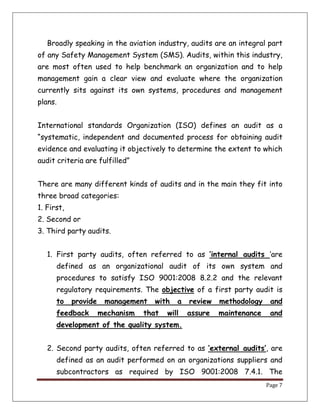
What is an audit?
An audit may be defined in many
different ways and there are a number
of issues to consider too when defining
'What is an audit?' Considerations such
as the type of audit being conducted and
the industry within which an audit is being undertaken need to be taken
into consideration as definitions vary accordingly. However, broadly
speaking, an audit is defined as “a formal and planned event carried out
in accordance with documented procedures by appropriately trained
personnel”.
At Aviation Auditors we can provide and structure our aviation
auditing services according to the needs of each of our client’s. Our
audit procedures can be applied to any part of the aviation industry
such as:
 RPT
 Charter
 Commercial Operations
 Flying Training Schools
 War bird Operators
 Parachute Operators
 Gliding
 Ballooning
 Emergency Medical Services.
Page 7
Broadly speaking in the aviation industry, audits are an integral part
of any Safety Management System (SMS). Audits, within this industry,
are most often used to help benchmark an organization and to help
management gain a clear view and evaluate where the organization
currently sits against its own systems, procedures and management
plans.
International standards Organization (ISO) defines an audit as a
“systematic, independent and documented process for obtaining audit
evidence and evaluating it objectively to determine the extent to which
audit criteria are fulfilled”
There are many different kinds of audits and in the main they fit into
three broad categories:
1. First,
2. Second or
3. Third party audits.
1. First party audits, often referred to as ‘internal audits ‘are
defined as an organizational audit of its own system and
procedures to satisfy ISO 9001:2008 8.2.2 and the relevant
regulatory requirements. The objective of a first party audit is
to provide management with a review methodology and
feedback mechanism that will assure maintenance and
development of the quality system.
2. Second party audits, often referred to as ‘external audits’, are
defined as an audit performed on an organizations suppliers and
subcontractors as required by ISO 9001:2008 7.4.1. The
Page 8
objective of a second party audit is to measure the performance
of suppliers and or sub-contractors.
3. Third party audits often referred to as ‘extrinsic audits’ and are
defined as an assessment, by a body commercially and
contractually independent of the organization, its supplies and
customers. Commonly, this is an assessment by a certification or
regulatory body to a quality or safety system standard. The
objective of a third party audit is to determine the quality or
safety system has been documented and implemented to a
specific standard.
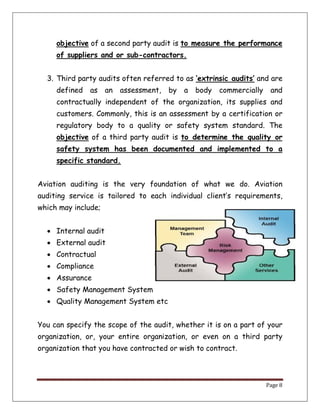
Aviation auditing is the very foundation of what we do. Aviation
auditing service is tailored to each individual client’s requirements,
which may include;
 Internal audit
 External audit
 Contractual
 Compliance
 Assurance
 Safety Management System
 Quality Management System etc
You can specify the scope of the audit, whether it is on a part of your
organization, or, your entire organization, or even on a third party
organization that you have contracted or wish to contract.
Page 9
Corporate Aviation Auditing
Corporate aviation auditing service is tailored to each organization as
required. Service can be as simple as a onetime audit, or, we can
provide a full audit service on a regular basis.
We understand that running a corporate aviation service can be very
demanding which is why we are excited to offer our services.
We can offer you a suite of products and services tailored to your
requirements, such as;
1. Auditing, first, second & third party accident and
2. Incident investigation
 SMS Auditing
 QMS Auditing
 Surveillance auditing
 At Aviation Auditors
we are independent,
professional, and confidential and operate in a timely
manner.
QMS Auditing
 Quality Management Systems (QMS) auditing is a key component
of a functioning QMS. We can conduct an independent audit of
all, or, part of your QMS in a professional, timely and confidential
manner.
 This also allows us to find any problems within your QMS so that
they can be rectified. An independent audit is crucial in assessing
your QMS.
Page 10
 When we conduct an audit we observe conformance to your
systems and processes and find conformance or non-conformance.
When we find non-conformance we work with you to resolve the
issue so that our final report states that conformance has been
achieved. This is largely your responsibility to achieve, but we will
work with you. In some circumstances a non-conformance may be
published in your final report.
 We find that this can occur when it is more responsible to take
time to rectify an issue rather than push through a solution that
may not be in the best interest of all involved.
SMS Auditing
 Aviation Safety Management Systems (SMS) auditing is a
key component of a functioning SMS. We can conduct an
independent audit of all, or, part of your SMS in a
professional, timely and confidential manner.
Professional Opportunities
Industry overview, sectoral snips and Government initiatives
The aviation sector globally, though growing is recently experiencing
turbulent weather with Aviation Turbine Fuel ( ATF) price volatility,
Carbon emission issues, funding challenges and teething market
competition. The industry drivers of aviation sector encompass:
 Price sensitive Service industry
 Seats are perishable inventory
 Yield management
 Labor relations
Page 11
The key success factors for any aviation company to survive, sustain
and scale up are as:
 On time arrivals, departure, flight operations
 Customer service, Food quality, frequent flier programs fewer
customer complaints,
 Denial of service
 Luggage and Cargo handling Fast check-in and booking
 Facilities
 Safety records, compliance with ICAO / DGCA Norms
In India, there has been lot of action in this domain. While Low Cost
Carrier (LCC) Indigo has off late, been granted international route
licenses by Director General of Civil Aviation (DGCA) there is
persistent crisis both in our National Carrier Air India (NACIL) and
Kingfisher Airlines (KFA).
The government has taken proactive measures to help sustain the
aviation sector in its flight to greater heights, these include
 Allowing direct ATF imports by private players, reducing
cost burden (fuel cost accounts for nearly 49% of total
operating costs of airline companies)
 Softening Sales tax for sale of ATF and engine oil
Eliminating Service tax on air-tickets Consideration of 49 %
FDI in Aviation sector (proposed in Finance Bill 2012) AI-IA
merger and consequent Air India restructuring and bailout
package.
Page 12
Consulting opportunities for Chartered Accountants
The success of AI-IA merger and future sustainability, like in Case of
any other airlines, depends not only on a robust restructuring / funding
package but also on operational restructuring and turnaround
techniques. CA s can play a vital role in this domain, broadly as in:
1. Financial consulting – sourcing funds through External Commercial
Borrowings ( ECB), financial restructuring , cost rationalization
2. Structuring funds through PPP model for setting up of Greenfield
airports( e.g. Navi Mumbai), expansion and modernization of
existing airports ( Kolkata Netaji Subhash International
Terminal, T3 of Delhi IGI Airport etc)
3. Assisting in fleet acquisition through outright purchase ( Boeing
787 Dream liner by Air India) or lease of aircrafts
4. Operational structuring – integration and modernization of HR
policies ( as in Case of AI-IA merger), otherwise pilots & ground
personnel strike is inevitable leading to revenue loss , reputational
damage and competition risk Development , analysis and
benchmarking of key performance metrics – e.g.. Cost per
Available Seat Kilometer ( CASK), Revenue per passenger per
Nautical mile, Capacity / fleet utilization
5. Consulting service for corporate / High Net worth individuals
with private jets.
Page 13
6. Commodity hedging: ATF pricing and ensuing forex risk
management.
7. Compliance with ICAO & DGCA standards – Chartered
Accountants are emerging as top professionals in Aviation audit
to ensure ongoing compliance with International Civil Aviation
Organization ( ICAO) norms, DGCA mandates and standards set
up by Airports Authority of India ( AAI)
8. ICAO Operational Safety Audit (IOSA) – providing ongoing
adherence, compliance etc
9. Process improvement consulting like Balanced Score Card, 6
Sigma etc
Consulting and internal audit of aviation and aerospace sector
preferably requires specific domain knowledge, international aviation
audit / QMS certifications, understanding of route navigation, radio
telephony, aviation regulations including ICAO norms, IATA Standards,
Aircraft Act, 1934 etc. The focus of internal and operational audit
addresses –
 Operational Control/Dispatch Flight Operations
 Engineering & Maintenance of aircrafts, ground handling
equipments
 Cabin Operations Ground Operations
 Management & Quality
 Safety, Security and sustainability
 Cost control, reduction and rationalization
Page 14
Conclusion:
With increasing challenges in this sector, there
is a growing trend in consulting practice,
especially by well-equipped Chartered
Accountants. It is expected that in the foreseeable future, with our
value additive service, we CA s shall be able to express to the aviation
sector – ‘’our ground work takes you sky-high.’’
There are many opportunities under this Civil Aviation audits. Financial
consulting, Commodity hedging etc a professional can developed himself
new era of Civil Aviation and can provide and structure our aviation
auditing services according to the needs of each of our client’s.
-Abhishek Yelne
-aayelne@outlook.com
-Maharashtra.
-India

Aviation Audit

  • 1.
    Page 1 Aviation &Aerospace Sector “Our Ground – Work Takes You Sky High’’ -Abhishek Yelne Introduction Aviation is derived from avis, the Latin word for bird. Many cultures have developed devices which fly in the air from earliest projectiles like stones and spears to hot air balloons and kites which fly in the air along with man. There are stories of human flight such as the stories of Icarus, and Jamshid in Persian myth, and later, somewhat more credible claims of short-distance human flights appear, such as the flying automaton of Archytas of Tarentum (428–347 BC), the winged
  • 2.
    flights of AbbasIbn Firnas (810 Century), and the hot-air Paassarola of Bartolomeu Lourenço de Gus (1685–1724). The modern age of aviation began with the first un tethered human lighter- air balloon designed by the Montgolfier brothers. However the balloon was only able to fly in the low winds which was was replaced by elastic balloons. Jean human-powered dirigible in 1784 and he himself crossed the English Channel in one of them in 1785. While there are many competing claims for the earliest powere accepted date is 17th December 1903 by the Wright brothers. The Wright brothers were first to fly in powered and controlled aircraft which was combination of earlier flights gliders controlled but not powered and free flight powered but not controlled. Now we come to India it is expected to be amongst the top five nations in the world in the next 10 years in the aviation sector. On the flights of Abbas Ibn Firnas (810–887), Eilmer of Malmesbury (11th air Paassarola of Bartolomeu Lourenço de Gus 1724). The modern age of aviation began with the first un -than-air flight on 21st November 1783, in a hot air balloon designed by the Montgolfier brothers. However the balloon was only able to fly in the low winds which was recognized shortly and was replaced by elastic balloons. Jean-Pierre Blanchard flew the first powered dirigible in 1784 and he himself crossed the English Channel in one of them in 1785. While there are many competing claims for the earliest powered, heavier-than-air flight, the most widely December 1903 by the Wright brothers. The Wright brothers were first to fly in powered and controlled aircraft which was combination of earlier flights gliders controlled but and free flight powered but not controlled. Now we come to India it is expected to be amongst the top five nations in the world in the next 10 years in the aviation sector. On the Page 2 Eilmer of Malmesbury (11th air Paassarola of Bartolomeu Lourenço de Gusmao 1724). The modern age of aviation began with the first un- November 1783, in a hot air balloon designed by the Montgolfier brothers. However the balloon recognized shortly and Pierre Blanchard flew the first powered dirigible in 1784 and he himself crossed the English Channel in one of them in 1785. While there are many competing claims air flight, the most widely- December 1903 by the Wright brothers. The Wright brothers were first to fly in powered and controlled aircraft which was combination of earlier flights gliders controlled but Now we come to India it is expected to be amongst the top five nations in the world in the next 10 years in the aviation sector. On the
  • 3.
    Page 3 sidelines ofthe International Civil Aviation Negotiation (ICAN) Conference, Ms Pratibha Patel, Ex-President of India, highlighted that currently, India is the 9th largest civil aviation market in the world. The Ministry of Civil Aviation, Government of India (GOI), has decided to allow the Indian Scheduled Carriers including Air India to utilize the allocated bilateral till the time they reach the maximum permissible limit under Air Service Agreements (ASAs). Air India's operational plan will receive due consideration in allocation of the traffic rights and entitlements. The Ministry has also supported the approach outlined in the Inter Ministerial Group (IMG) discussion -paper in this context. Keeping in view the recent developments in the civil aviation sector and in order to modernize and update the existing Air Services Agreements (ASAs) with foreign countries as per the ICAO templates, the Ministry of Civil Aviation has signed ASAs with Indonesia and Brazil, besides initializing ASAs with Jamaica, Dominican Republic, Mozambique, Uganda, Trinidad and Tobago . After the invention of Airplane the airplane, the safety of passengers in a flight is of foremost consideration. “One World-One Sky-One Mission: SAFETY” is the foremost consideration of the airport authority India. The ICAO (International Civil Aviation Organization) document 9859 chapter 12 lays down the requirement of issuing a Safety Policy by the service providers and establishment of Safety Management System (SMS) based upon the policy. The guidelines for Safety policy and SMS framework are also issued by the ICAO document {entitled “ICAO Regional Workshop on SMS and State Safety Program (SSP) Implementation”}.
  • 4.
    Maintenance includes theinstallation or removal of a component from an aircraft or aircraft subassembly,  Elementary work, such as plates, spark plugs, checking cylinder compression, etc.  Servicing, such as refueling, washing windows:  Any work done on an aircraft or aircraft component as part of the manufacturing process, prior to issue of a ce airworthiness or other certification document. Directorate General of Civil Aviation (DGCA) compliances: India has been found to be fully compliant with the international safety standards by an audit done by the Federal Aviation Administration (FAA) of the United States of America. Before permitting a foreign airline to operate in the USA, the FAA of US, backed by the US legislation, conducts an audit of the concerned country’s Civil Aviation Authority (CAA) / DGCA to ensure its capability Maintenance includes the installation or removal of a component from an aircraft or aircraft subassembly, but does not include: Elementary work, such as removing and replacing tires, inspection plates, spark plugs, checking cylinder compression, etc. Servicing, such as refueling, washing windows: Any work done on an aircraft or aircraft component as part of the manufacturing process, prior to issue of a ce airworthiness or other certification document. Directorate General of Civil Aviation (DGCA) compliances: India has been found to be fully compliant with the international safety standards by an audit done by the Federal Aviation ation (FAA) of the United States of America. Before permitting a foreign airline to operate in the USA, the FAA of US, backed by the US legislation, conducts an audit of the concerned country’s Civil Aviation Authority (CAA) / DGCA to ensure its capability Page 4 Maintenance includes the installation or removal of a component from but does not include:- removing and replacing tires, inspection plates, spark plugs, checking cylinder compression, etc. Any work done on an aircraft or aircraft component as part of the manufacturing process, prior to issue of a certificate of Directorate General of Civil Aviation (DGCA) compliances: India has been found to be fully compliant with the international safety standards by an audit done by the Federal Aviation ation (FAA) of the United States of America. Before permitting a foreign airline to operate in the USA, the FAA of US, backed by the US legislation, conducts an audit of the concerned country’s Civil Aviation Authority (CAA) / DGCA to ensure its capability
  • 5.
    Page 5 for providingsafety certification and continuing oversight on its international carriers. The audit is conducted under an ‘International Aviation Safety Assessment Program’ (IASA) and focuses on the country's ability to adhere to standards and recommended practices of International Civil Aviation Organization (ICAO) for aircraft operations and maintenance. EXISTING SECURITY MEASURES Some countries may have an agency that protects all of their airports (such as Australia, where the Australian Federal Police is responsible for security at major airports); in other countries like the United States, the protection is controlled at the state or local level. The primary personnel will vary and can include: 1. A police force hired and dedicated to the airport 2. A branch of the local police department stationed at the airport 3. Members of the local police department assigned to the airport as their normal patrol area 4. Members of a country's military 5. Members of a country's airport protection service 6. Police dog services for explosive detection, drug detection and other purposes. 7. Other resources may include: a. Security guards b. Paramilitary forces c. Military forces
  • 6.
    Page 6 Aviation Audit Whatis an audit? An audit may be defined in many different ways and there are a number of issues to consider too when defining 'What is an audit?' Considerations such as the type of audit being conducted and the industry within which an audit is being undertaken need to be taken into consideration as definitions vary accordingly. However, broadly speaking, an audit is defined as “a formal and planned event carried out in accordance with documented procedures by appropriately trained personnel”. At Aviation Auditors we can provide and structure our aviation auditing services according to the needs of each of our client’s. Our audit procedures can be applied to any part of the aviation industry such as:  RPT  Charter  Commercial Operations  Flying Training Schools  War bird Operators  Parachute Operators  Gliding  Ballooning  Emergency Medical Services.
  • 7.
    Page 7 Broadly speakingin the aviation industry, audits are an integral part of any Safety Management System (SMS). Audits, within this industry, are most often used to help benchmark an organization and to help management gain a clear view and evaluate where the organization currently sits against its own systems, procedures and management plans. International standards Organization (ISO) defines an audit as a “systematic, independent and documented process for obtaining audit evidence and evaluating it objectively to determine the extent to which audit criteria are fulfilled” There are many different kinds of audits and in the main they fit into three broad categories: 1. First, 2. Second or 3. Third party audits. 1. First party audits, often referred to as ‘internal audits ‘are defined as an organizational audit of its own system and procedures to satisfy ISO 9001:2008 8.2.2 and the relevant regulatory requirements. The objective of a first party audit is to provide management with a review methodology and feedback mechanism that will assure maintenance and development of the quality system. 2. Second party audits, often referred to as ‘external audits’, are defined as an audit performed on an organizations suppliers and subcontractors as required by ISO 9001:2008 7.4.1. The
  • 8.
    Page 8 objective ofa second party audit is to measure the performance of suppliers and or sub-contractors. 3. Third party audits often referred to as ‘extrinsic audits’ and are defined as an assessment, by a body commercially and contractually independent of the organization, its supplies and customers. Commonly, this is an assessment by a certification or regulatory body to a quality or safety system standard. The objective of a third party audit is to determine the quality or safety system has been documented and implemented to a specific standard. Aviation auditing is the very foundation of what we do. Aviation auditing service is tailored to each individual client’s requirements, which may include;  Internal audit  External audit  Contractual  Compliance  Assurance  Safety Management System  Quality Management System etc You can specify the scope of the audit, whether it is on a part of your organization, or, your entire organization, or even on a third party organization that you have contracted or wish to contract.
  • 9.
    Page 9 Corporate AviationAuditing Corporate aviation auditing service is tailored to each organization as required. Service can be as simple as a onetime audit, or, we can provide a full audit service on a regular basis. We understand that running a corporate aviation service can be very demanding which is why we are excited to offer our services. We can offer you a suite of products and services tailored to your requirements, such as; 1. Auditing, first, second & third party accident and 2. Incident investigation  SMS Auditing  QMS Auditing  Surveillance auditing  At Aviation Auditors we are independent, professional, and confidential and operate in a timely manner. QMS Auditing  Quality Management Systems (QMS) auditing is a key component of a functioning QMS. We can conduct an independent audit of all, or, part of your QMS in a professional, timely and confidential manner.  This also allows us to find any problems within your QMS so that they can be rectified. An independent audit is crucial in assessing your QMS.
  • 10.
    Page 10  Whenwe conduct an audit we observe conformance to your systems and processes and find conformance or non-conformance. When we find non-conformance we work with you to resolve the issue so that our final report states that conformance has been achieved. This is largely your responsibility to achieve, but we will work with you. In some circumstances a non-conformance may be published in your final report.  We find that this can occur when it is more responsible to take time to rectify an issue rather than push through a solution that may not be in the best interest of all involved. SMS Auditing  Aviation Safety Management Systems (SMS) auditing is a key component of a functioning SMS. We can conduct an independent audit of all, or, part of your SMS in a professional, timely and confidential manner. Professional Opportunities Industry overview, sectoral snips and Government initiatives The aviation sector globally, though growing is recently experiencing turbulent weather with Aviation Turbine Fuel ( ATF) price volatility, Carbon emission issues, funding challenges and teething market competition. The industry drivers of aviation sector encompass:  Price sensitive Service industry  Seats are perishable inventory  Yield management  Labor relations
  • 11.
    Page 11 The keysuccess factors for any aviation company to survive, sustain and scale up are as:  On time arrivals, departure, flight operations  Customer service, Food quality, frequent flier programs fewer customer complaints,  Denial of service  Luggage and Cargo handling Fast check-in and booking  Facilities  Safety records, compliance with ICAO / DGCA Norms In India, there has been lot of action in this domain. While Low Cost Carrier (LCC) Indigo has off late, been granted international route licenses by Director General of Civil Aviation (DGCA) there is persistent crisis both in our National Carrier Air India (NACIL) and Kingfisher Airlines (KFA). The government has taken proactive measures to help sustain the aviation sector in its flight to greater heights, these include  Allowing direct ATF imports by private players, reducing cost burden (fuel cost accounts for nearly 49% of total operating costs of airline companies)  Softening Sales tax for sale of ATF and engine oil Eliminating Service tax on air-tickets Consideration of 49 % FDI in Aviation sector (proposed in Finance Bill 2012) AI-IA merger and consequent Air India restructuring and bailout package.
  • 12.
    Page 12 Consulting opportunitiesfor Chartered Accountants The success of AI-IA merger and future sustainability, like in Case of any other airlines, depends not only on a robust restructuring / funding package but also on operational restructuring and turnaround techniques. CA s can play a vital role in this domain, broadly as in: 1. Financial consulting – sourcing funds through External Commercial Borrowings ( ECB), financial restructuring , cost rationalization 2. Structuring funds through PPP model for setting up of Greenfield airports( e.g. Navi Mumbai), expansion and modernization of existing airports ( Kolkata Netaji Subhash International Terminal, T3 of Delhi IGI Airport etc) 3. Assisting in fleet acquisition through outright purchase ( Boeing 787 Dream liner by Air India) or lease of aircrafts 4. Operational structuring – integration and modernization of HR policies ( as in Case of AI-IA merger), otherwise pilots & ground personnel strike is inevitable leading to revenue loss , reputational damage and competition risk Development , analysis and benchmarking of key performance metrics – e.g.. Cost per Available Seat Kilometer ( CASK), Revenue per passenger per Nautical mile, Capacity / fleet utilization 5. Consulting service for corporate / High Net worth individuals with private jets.
  • 13.
    Page 13 6. Commodityhedging: ATF pricing and ensuing forex risk management. 7. Compliance with ICAO & DGCA standards – Chartered Accountants are emerging as top professionals in Aviation audit to ensure ongoing compliance with International Civil Aviation Organization ( ICAO) norms, DGCA mandates and standards set up by Airports Authority of India ( AAI) 8. ICAO Operational Safety Audit (IOSA) – providing ongoing adherence, compliance etc 9. Process improvement consulting like Balanced Score Card, 6 Sigma etc Consulting and internal audit of aviation and aerospace sector preferably requires specific domain knowledge, international aviation audit / QMS certifications, understanding of route navigation, radio telephony, aviation regulations including ICAO norms, IATA Standards, Aircraft Act, 1934 etc. The focus of internal and operational audit addresses –  Operational Control/Dispatch Flight Operations  Engineering & Maintenance of aircrafts, ground handling equipments  Cabin Operations Ground Operations  Management & Quality  Safety, Security and sustainability  Cost control, reduction and rationalization
  • 14.
    Page 14 Conclusion: With increasingchallenges in this sector, there is a growing trend in consulting practice, especially by well-equipped Chartered Accountants. It is expected that in the foreseeable future, with our value additive service, we CA s shall be able to express to the aviation sector – ‘’our ground work takes you sky-high.’’ There are many opportunities under this Civil Aviation audits. Financial consulting, Commodity hedging etc a professional can developed himself new era of Civil Aviation and can provide and structure our aviation auditing services according to the needs of each of our client’s. -Abhishek Yelne -aayelne@outlook.com -Maharashtra. -India