Read Anytime Anywhere Easy Ebook Downloads at ebookmeta.com
Industry X 0 Realizing Digital Value in Industrial
Sectors 1st Edition Eric Schaeffer
https://ebookmeta.com/product/industry-x-0-realizing-
digital-value-in-industrial-sectors-1st-edition-eric-
schaeffer/
OR CLICK HERE
DOWLOAD EBOOK
Visit and Get More Ebook Downloads Instantly at https://ebookmeta.com
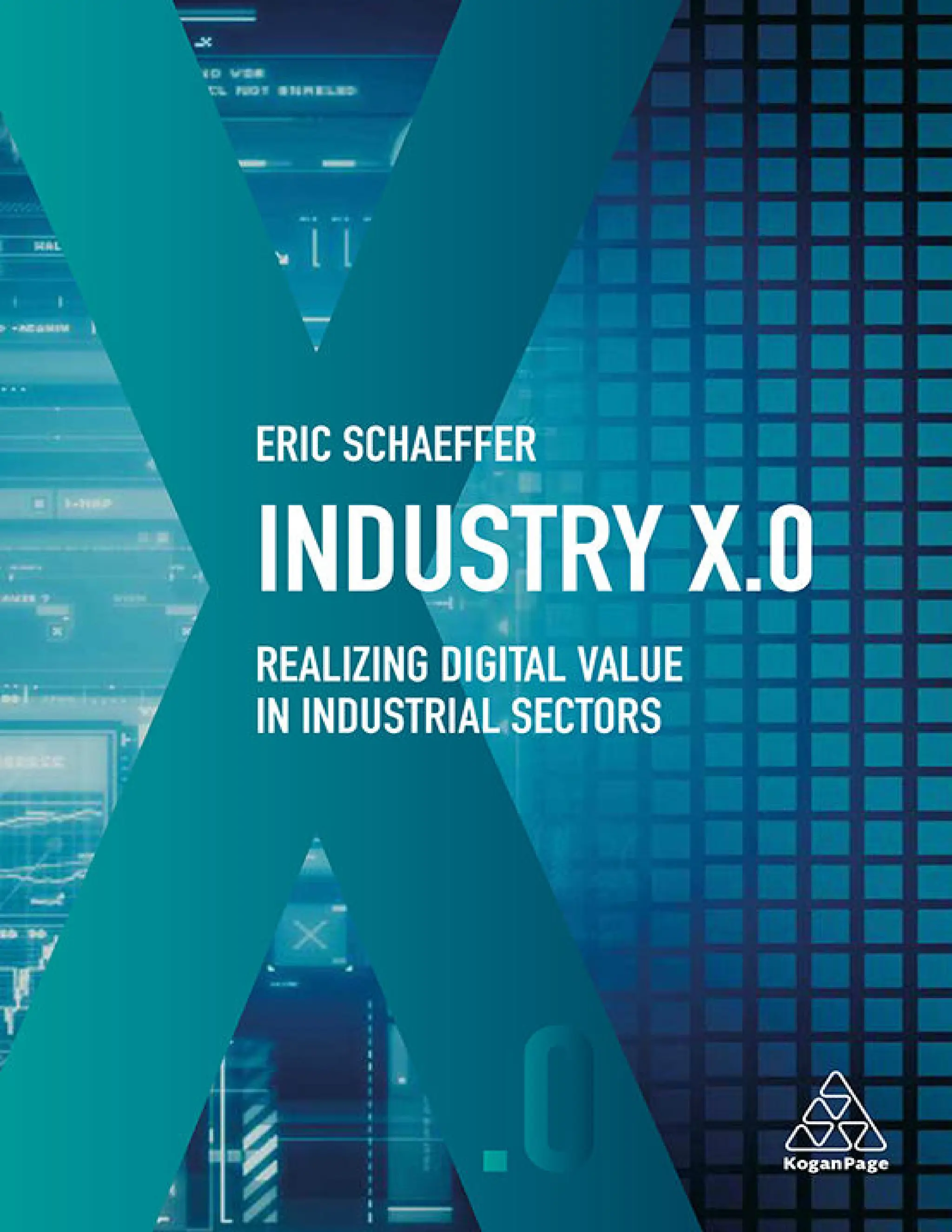
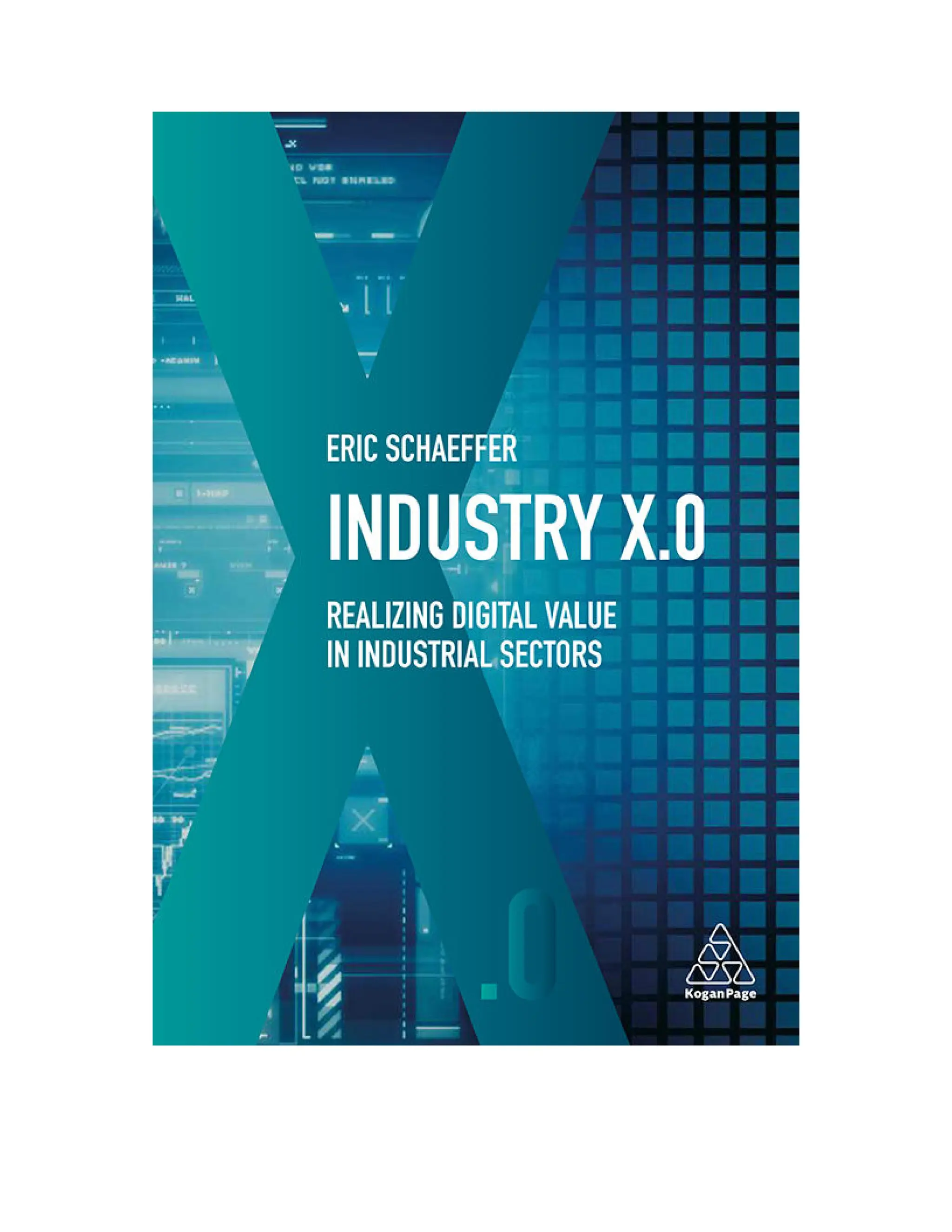
Industry X.0
Realizing Digital Value in Industrial
Sectors
Eric Schaeffer
Tabel of Contents
Cover
Title Page
Contents
Preface
Acknowledgments
Introduction
PART I The Industrial Internet of Things – Transforming
Manufacturing Beyond Recognition
01 Industry’s Ongoing and Accelerating Digital Transformation
The Drivers of Change in the Industrial Sphere
Technology Becomes Affordable and Puts Speed Behind
the IIoT
The Value of the IIoT is Still to be Unlocked
Ecosystems Form Powerful Wells of Innovation
The Product of Me vs. Mass Manufacturing
Liquid Fulfillment Networks Will Supplant Old-Style
Factories
The Critical Importance of Preparing the Digital
Workforce
The Surprisingly Slow Embrace of the IIoT by Business
Takeaways
02 How the IIoT Leads to the Outcome Economy
New Tech Creates New Business Models
Living Products or the Reinvention of the Product
Outcome Orientation Spurs Innovation in Products and
Services
Outcomes are Appearing Across Sectors
The Why Behind the Buy
From Rigid Business Silos to Agile Ecosystems
New Risks and Rewards
The Four Future Stages of Industry
Takeaways
03 Digital Super Value – A Guiding Light for Digital Strategy
Two Speeds Create Massive Value Deposits
The Societal Benefits
What’s in it for Business?
Automotive – the Vanguard Efficiency Seekers
How to Find the Right Pivots
Takeaways
PART II How to Make the Most of the Digital Industrial
Transformation
04 Six “No-Regret” Capabilities – the Journey Towards Digital,
Mapped out Simply
From Old World to New World on Many Different Paths
Be Adaptive and Relaxed but Curious and Visionary –
and Get Going
Design Thinking Speeds up Service Development
Processes
The Six Fundamental Capabilities that Can Get your
Digitization Started
Your IIoT Business – How to Succeed
To Take Services to Market, Think Big, Start Small, Scale
Fast
Takeaways
05 Zoom in: How to Make Data Analytics Work Your Way
Raw Data Has no Value and Needs Enrichment
Which Data Strategy to Pursue – More Return from
Inside or Outside?
The Five Sources of Value that Can be Tapped with a
Data Strategy
IoT Lead Generation – Anticipate your Customers’
Demand
From Mere Monitoring to a Real Predictive
Maintenance Practice
Data Analytics Strategy – the New Industrial Must-Have
Gains to Make Now in a Changing Landscape
How Utility Businesses Harness Big Data Analytics
Keep Pilots Incremental and Focused
Flexible Data Analytics as a Service and Edge
Computing
Practically Connecting the Digital Factory
Wherever you Start, Work Along a Roadmap for More
Takeaways
06 Zoom in: How to Handle Digital Product Development
From Connected Products to Digitized Product
Development
Digitizing PLM End-to-End – the Main Challenge
The Stepped Road to Future-Proofed DPLM
Digital PLM already Generates Value for Real
Businesses
Choose the Right Speed for Changing Processes and
People
Electronics and High-Tech Pointing the Way for Industry
Mobile Phone Functionality Gives Manufacturers a
Major Steer
The Problem of Beating the Clock – How and Which
One of the Many?
Takeaways
07 Zoom in: How to Create a Connected Industrial Workforce
Mutuality Between Humans and Machines Across the
Whole Enterprise
Low-Supervision Shop-Floor Machine-Centricity – It’s
Nearly Here
The Path to Collaborative Robots Running Enterprises
A Fully Connected Workforce Needs New
Organizational Structures
Connected Workers Must Iterate, Adapt, and be
Flexible
Managerial Trust Issues Around Machines
Managers Must do More Strategic Judgment Work
Under-Appreciated Intelligent Machines
Corporate HR’s Need for a Strategic Stance
Takeaways
08 Zoom in: How to Master Innovation in the New
Old-Style Innovators See Only the Market’s Supply Side
“Build it and They Will Come” vs . “Let Them Come and
We Will Build it”
The First Boosts From Innovation in the New
Four Innovator Types, One Long-Term Winner
Brilliant Innovators Lead the Way in the Industrial
Sector
Digitally-Driven Innovation Makes all the Difference
Four Recommendations for Becoming a Reinventor
Incubator Mentalities and Capabilities Round off Future
Innovation
Takeaways
09 Zoom in: How to Make the Most of Platforms and
Ecosystems
What is an Ecosystem and Why Build One?
Leveraging Start-ups
Building an Ecosystem – How to Do it
The Emerging Power of Platforms
From Transaction Hubs to Innovation Machines
Platforms as “Tissue”
Three Stages of Maturity
Gently Disassembling to Make Way for New Business
Models
Asset-Heavy vs . Asset-Light
Five Things to Watch out for When Building Platforms
Takeaways
PART III The Future is Now and Tomorrow
10 A Visionary Outlook – The Digital Industrial Enterprise
In the Pull Economy, Meet the Production Crowd
Technology Makes Making More Flexible
Nothing as Usual Becomes Business as Usual
Chapter Takeaways at a Glance
Glossary of Terms
Endnotes
Index
About the Author
Copyright
Preface
The world has become digitally connected to the point of no return.
Each day around five million devices become linked up with either
each other, the Internet or both. There are around 6.4bn data-
communicating objects in the world and by 2020 this number is
forecast to explode to around 20bn.1 Our digital universe is in
healthy expansion mode.
From this perspective, today’s device boom – the wristband pulse
monitors, smart watches, satnavs and intelligent thermostats – are
just the overture to a long and eventful journey towards lives
digitally augmented, supported and enabled in ways unlike anything
humans have ever experienced before.
The advance is propelled by our craving for technical innovation
and our tendency to adapt promptly to new ways of interacting and
engaging with machines and devices as soon as they exist. We as
consumers will keep asking why this or that gap in the market has
not yet been filled by some device or software solution. Businesses –
the focus of this book, hence the title “Industry X.0” – and their
increasingly digitally native workforce, used to a highly digitized
private lifestyle, will put the same kinds of questions to their
industrial vendors, displaying a new form of “industrial
consumerism.”
At the core of this seismic upheaval sit Living Products, physical
products reinvented as software-intelligent devices that act, think,
and are closely and constantly aligned with their users and
ecosystems.
Clearly, then, the industrial sphere, the sphere of technologically
produced physical objects, will play a major part in the seminal trip
towards the planet’s digitization. Digital technologies will create a
stage on which we as public, businesses and industry experts will
pull off spectacular things in the coming years.
Consider the following: the first pharmacy staffed only by robots,
is expected to open its doors in 2021;2 sensorized medical pills that
report back to the makers when patients have swallowed them are
currently in development; Siemens is already successfully running
prototypes of completely unmanned, self-organizing and hyper-
productive industrial plants;3
and raw materials giant Rio Tinto has
huge mining operations based on automated trucks and drill systems
provided by heavy equipment makers Caterpillar and Komatsu.4
Cars, industrial machinery and tooling, pumps, circuit breakers –
they can all be rendered Living Products by adding software
intelligence.
The ship has clearly sailed for digital sceptics, both as citizens and
business leaders. The industrial enterprise world, comprising two
thirds of the world’s gross domestic product, will be changed beyond
recognition by digital technology, disrupting decades-old business
habits, conventions and operating models. The ways in which labor
works, machine-based processes are organized and information is
shared will be turned on their heads. Strategic corporate thinking will
be forced to incorporate completely new data-driven business
models to secure a future for any enterprise. No wonder the US,
Germany, China and Japan – all strongholds of successful industrial
enterprises – have, with varying focus, put industrial digital
transformation high on the agenda.
There is no turning back. What matters now is to make the most
of the digital transformation. We have the opportunity to shape it.
There is not one standard way to make it happen, the journey must
be tailored to each enterprise individually.
That is why this book, unlike other publications, not only
addresses the “why” of the industrial sphere’s wholesale digitization
but also, primarily, the “how”, examining in detail the steps industrial
businesses need to take to get the greatest positive effect and value
from digital.
Packed with easily accessible actionable insights and suggestions,
it should be a vital resource for industrial business leaders at all
levels, C-suite and below as well as across all functions. It should
help them discover, think through, adopt and implement the
roadmap necessary for their enterprises to head out for the new
territory, and act as an aide-memoire as the journey progresses.
Acknowledgements
In this book I have managed to gather and shape forward-looking
advice around a complex subject: the emergence of the Industrial
Internet of Things (IIoT) and its transformation of the industrial
sectors. I visited and revisited the topic in detail and assessed its
ramifications for the enterprises affected. And I developed a good
deal of thought leadership in the process.
All this would have been impossible without the input of a large
number of knowledgeable people from beyond our core book team. I
was fortunate to be able to tap a wide intellectual catchment area:
corporate thinkers, co-consultants, and clients, based in the US, UK,
Germany, France, Italy, Korea, Europe, Japan, and China,
contributing either broad ideas that helped shape the general
themes and scope of the book or practical industry experience,
focused sector insights, and firm opinion to test our own thinking.
Their input has been invaluable in shaping the book’s observations,
analyses and hypotheses.
To all of them I would like to express a sincere “Thank you.” The
support of every one of you individually was a conditio sine qua non
for pulling this off and collectively represents a piece of vanguard
consultancy thinking on what is currently one of the most pressing
subjects in the business world.
At Accenture I wish to thank David Abood, Fabian Bohn,
Christophe Brasselet, Jean Cabanes, Brian Doyle, Dan Elron, Andreas
Gissler, AJ Gupta, Francis Hintermann, Richard Holman, Venkatesh
Iyer, Lisa-Cheng Jackson, Jitendra A. Kavathekar, Shinichiro Kohno,
Bodo Körber, Guiseppe La Commare, JC Ledoux, Sebastien Lepicard,
Mahesh Mahajan, Sarat Maitin, Brian May, Bruno le Moal, Eric
Mokrenski, Massimo Pagella, Mark H. Pearson, Bruno Pfeiffer,
Philippe Pruvost, Kevin Prendeville, Kausar Qazilbash, Wu Qi, Aidan
Quilligan, Ganesan Ramachandran, Shugo Sohma, Ben Salama,
Marcello Tamietti, Maxence Tilliette, Cedric Vatier, Patrick Vollmer,
Ben Wang, and Will Zhang.
Special thanks must go to Sander van ‘t Noordende, Omar
Abbosh, and Frank Riemensperger for their support, inspiration and
thought leadership around the transformation of industries.
Within Accenture thanks are also owed to Georg Berger, Gemma
Catchpole, Andreas Egetenmeyer, Sonja Fink, Ulf Henning, Fiona
Morris and Matthias Wahrendorff, the closer team steering the
publication, as well as to Jens Schadendorf, Titus Kroder, and John
Moseley, who brought valuable experience and exceptional
knowledge with regard to the writing and publishing of a book.
A big thank you also goes to Helen Kogan and Jenny Volich from
Kogan Page, and Michael Wurster from Redline, as the publishers of
this book, for their enduring commitment to and trust in this project.
Finally, and above all, I thank my wife Pascale for her patience,
relentless support and love and my children William, Meryl and
Edouard for the many and passionate discussions on the new digital
economy. May this book help them navigate successfully through the
change.
Introduction
Coinciding with the wholesale digital interlinking of society, the
digital disruption and transformation of the industrial sphere is one
of the world’s current megatrends, affecting companies representing
two thirds of global GDP.1 Makers of cars, planes, trains, domestic
appliances, heavy equipment and engineering technology,
pharmaceuticals, and utility and raw materials businesses are all
undergoing waves of technological upheaval as we speak.
Smartened, tightly connected, data-driven industrial products and
processes are going to go mainstream in all advanced and many
emerging countries very soon. Embedded in the wider trend towards
the Internet of Things (IoT), its sub-segment, the Industrial Internet
of Things (IIoT), will digitally orchestrate factory floors, physical
products, workers and all enterprise functions and processes,
unleashing enormous value potential.
Beyond the Product: Outcomes and
Value
In only a few years time we will look back and call the two decades
since the turn of the century the period of “the end of the product.”
Ever more advanced digital technology will help to establish a new
world in which customers will ask businesses for complex
“outcomes” delivered by digital services around physical products
instead of delivery of mere hardware.
The software “tissue” and data analytics that will eventually
permeate the industrial sector will create a very distinctive new
stage of economy. Enterprises will have departed from a
conventional focus on manufacturing “dumb” low-margin products
made for anonymous markets to forming very personalized
relationships with their customers, driven by the latter’s
instantaneous demand for “switched-on, software-connected, and
eventually even Living Products and Living Services with huge value
potential. Digital technology will also enable providers of outcomes
to monitor the shape of outcomes and usage patterns in the field.
In the churn of this megatrend, the terms B2B and B2C will start
to blur. In fact it will be one of the defining fascinations of the
industrial sector’s digitization that enterprises used to dealing with
business clients will suddenly be forced to think like consumer-facing
businesses as part of the trend known as “industrial consumerism.”
This means, that, for not only consumer goods companies but B2B
industrial companies too, final outcome experience and service
quality will now be the top criteria for success or failure – and
eventually the only significant source of corporate value in this
sector.
This is driven by a shift in customer attitudes and, as such, is a
clear rebuke to the common assumption in government that it is
businesses that will drive the broad-based trend towards digitization.
What we currently see is the opposite: the urge for change clearly
stems from the demand not the supply side.
It is the phenomenon of industrial consumerism and the
emergence of Living Products that are driving the change. In that
regard many governments are too focused on creating the right
environment for digitizing the shop floor, not realizing that this is not
the right starting point for enterprises to arrive at the necessary new
business models.
In only a short while we will be accustomed to markets in which
tried-and-tested industrial hardware products will become
permanently reconfigurable software containers, eclipsed in
profitability by their own new service qualities.
This will have dramatic effects for businesses and how they go
about managing their products. This will be when companies
immerse themselves in ecosystems and alliances with what today
would seem unlikely partners – another seismic shift for most of
today’s industrial organizations.
It will therefore be paramount for industrial companies to master
this radical transition successfully, opening themselves to a journey
that will change their operating models, ways of working and
organization beyond recognition – the alternative being a
catastrophic loss of market clout and profitability.
This is why this book’s aim is to familiarize business leaders from
the industrial sectors with the key competencies necessary to tackle
all this – competencies such as creating unified Product Lifecycle
Management (PLM), embedding software and connectivity in
products and services, using analytics to drive value and growth,
creating closed-loop agility in development and manufacturing,
selling “as a service” and orchestrating the digital and industrial
ecosystem, to name but a few.
Two Battlegrounds, Trapped Value and
Six “No-Regrets”
From the perspective of industrial enterprises, digital disruption will
have two major battlegrounds. On the one hand, it will be about
leveraging new digital technologies to bolster internal efficiency
throughout all functions, as only this will fund expansion into current
and future markets around Living Products. Buried value can be
found plentifully, especially in legacy industrial businesses, and
digital technology can typically bring it to light for investment into
the future.
On the other hand, digitization will challenge businesses to work out
how Living Products with a smart software lifeblood can make a
market, how an advanced, technology-driven and value-creating
digital customer relationship could look, and how it can be
embedded into new and unaccustomed outcome models.
Both fields currently probably appear to many business leaders like
giant construction sites with no horizon, with works in constant
progress because the technologies deployed are incessantly
evolving. Which one should one pick, when and along which
roadmap? This sort of disorientation might even repel enterprises
and their executives to the point of postponing work or even giving
up completely on attempting a future-proof digital strategy.
Certainly at the moment, the progress of IIoT adoption is
sluggish. Research conducted for the World Economic Forum showed
72 percent of the C-level executives interviewed were convinced that
the IIoT would fundamentally change their industry, but just 20
percent had a thought-through strategy for harnessing it.2
The dizzying vortex is not just because of digital technology’s swift
advances. It is also the ever-complicating mix of numerous
underlying technologies such as sensors, cloud computing,
processing power, business intelligence algorithms, robots, artificial
intelligence, cognitive computing and big data.
The decision to give this book the title “Industry X.0” was born not
least from the awareness that technology now is in such dynamic
flux that its staging posts can no longer be pinned down for longer
than a moment. Industry 4.0 will turn swiftly to 5.0, to 6.0, and
counting.
Still, in the middle of this raging tech storm there exists a bedrock
foundation of digital models, mantras and measures that will create
immediate value in any industrial enterprise. A company that adopts
them and makes them work adequately will be steering the right
digital course regardless of what the future holds and which
trajectories digital technology takes.
This is the upside of the current technology frenzy, the opportunity
for “unconventional” growth, the chance for industrial businesses
that execute their digital strategy right to reap unheard-of speeds of
profitable expansion. I think there is every reason to believe the
landslide successes of digitally driven businesses such as Amazon or
Facebook can be replicated in the industrial sphere.
Those software-only platforms can be a role model for many
industrial products. Not all products can be transformed into
platforms, but certainly sooner or later every industrial product will
be integrated into another product that operates as a platform.
To be as helpful as possible to industrial practitioners, this book is
therefore built around a set of fundamental digital “no-regret”
capabilities every company should implement and use as a launch
pad for digitization. They form the basis for a detailed, strategic tour
d’horizon showing what the industrial sector will face over the
coming years and how to harness it.
Fluidity and Data Pervasiveness Across
the Enterprise
Often referred to as the “fourth industrial revolution,” and better
framed as “Industry X.0,” the digital transformation of industrial
companies has profound ramifications for businesses’ cost structure,
their work process design, the involvement of human labor and,
crucially, the shaping of products and services.
Digitization is not – by far – only just about the progressive
automation of existing manufacturing facilities and shop floors.
Casting the net much wider, it entails completely new digital set-ups
across all business functions and the creation of holistic new
operating models around software-enabled connected products.
Thus, internally, enterprise digitization covers any process or
operation that does not involve direct consumer interaction – areas
such as idea generation, testing and prototyping, or R&D, with the
management of customer, supplier and partner relationships also
crucially defined by the new digital ways of steering industrial
production.
Externally, business digitization means hunting for propositions
that customers find attractive because they offer excellent software-
induced efficiency or convenience, fulfill an outcome or create good
value for their own business.
Creating agility and acceleration of processes is hence among the
top three commandments for a solid digital strategy. Industrial
businesses’ product and service development units must be enabled
to react in real-time to changes in the market. And in a demand-
driven economy, they must be able to hyperpersonalize a product or
service in a short timeframe, down to a lot of just one.
This radical shift is only achievable when, among other measures,
siloed units within the enterprise are broken up and unhindered
information loops are established to connect designers with
engineers with marketers with customers with suppliers with
boardrooms. An absolute maximum of data pervasiveness but also
much more decentralized decision-making processes based on local
data analysis will define the well digitized organizations of the future.
Innovation in the New and in the Core –
Finding the Right Pivot
Importantly, a dual innovation approach will usually be needed.
Most industrial companies still run very profitable legacy product or
service lines that need to be maintained while applying gradual
innovation steps. In a completely separate strand, a second
innovation engine for thinking “outside the box” must be kick-started
to come up with new and visionary data-based customer
propositions unrelated to the old world. This is going to require
some extra human and financial resources.
What this implies – applying ingenuity at different speeds and
looking at different technological horizons within one business – is
certainly not easy to achieve, but it is a necessity for success in a
hyper-connected corporate future. Eventually and over time both
innovation streams will need to be led to new and future-proofed
business models.
What customers want and expect, are no longer just bigger,
better, faster or smaller products and services. Rather it is ideally up
to industrial businesses to anticipate through their intimate digital
customer relationships what their customers and the customers of
their customers require. The “why behind the buy” has to be
understood and this requires a new, demand-driven approach to
innovation, one open to external input from extended ecosystems
and banking heavily on digital feedback loops with the end-user
market.
The trends described will also have a massive impact on the way
the whole product value chain and product engineers, factory staff
and field agents work. From their perspective, incorporating and
blending with intelligent machinery and software tools will be the
birth of the connected industrial workforce.
Digital technology will augment employees in all functions across a
business. Shop-floor employees will eventually cooperate with semi-
autonomous machines at very close distance in a state of mutual
understanding. They will wear data-collecting devices such as smart
glasses or helmets, augmenting their skills to achieve much better
productivity. Product engineers will be supported by artificial
intelligence (AI) driven software and generative designs. AI will even
take a seat in the boardroom, supporting strategic management
decisions.
This new work style and work environment will require new
training and re-skilling. This holds true for blue- and white-collar
workers, managers and executives. Overall, enterprises will have to
prepare by adopting a more active role in training, developing and
preparing existing staff for the digital age or else suffer a significant
skills shortage.
Tying Together Products, Ecosystems
and Platform Products
Finally, the IIoT requires that input from customers,
subcontractors, partners and suppliers be channelled to continually
influence strategy throughout a product’s lifecycle. Leveraging allied
ecosystem parties is therefore becoming critical to arrive at
satisfactory time-to-capability, agility-to-assemble and speed-to-
market. And on top of that it will also blur traditional industry
boundaries.
Building an ecosystem is a skilful task, requiring business leaders
to think laterally, factoring in wide horizons of possible allies and
unusual business cases and opportunities. This is a drastic departure
from old-style product-focused manufacturing, but is still rewarding
and will create enormous value.
Against this ecosystem backdrop, many industrial products will be
shaped to become platforms. The trailblazers here are the likes of
Apple and Google. Both businesses created an ecosystem-style
developer community around their smartphone operating systems as
platforms. External app creators are the ones imbuing otherwise
“dumb” smartphones with value – to the mutual benefit of all: the
developer, the platform owner and the customer. Again, there is no
reason to assume that industrial companies cannot replicate a
similarly stellar success around mining trucks, jet engines or home
technology such as lighting, security or heating systems – though
surely not all industrial products can turn into platform products.
How to Use This Book
As is probably already clear, the huge changes digitization is set to
bring about in manufacturing can be as bewildering as they are
fascinating. This book has been written to be your guide to this new
territory. The landscape is wildly complex, but, if you know how to
read them, its multitude of features provide compelling pointers for
the future.
Think of this, then, as something to be used – a usage manual, if
you like, for the Industrial Internet of Things (IIoT). While it may
serve as a general-interest primer, it is aimed mainly at those who
will be actively implementing the change. It provides a clear
delineation of the challenges and opportunities, and invaluable
guidelines on drawing up the right digitization roadmap for your
organization. Not all routes will be the same.
And just as there is no fixed path towards the digitized industrial
future, there is no one route through this book. Read it in order, or
zero in on particular areas as you require. In this, you can be guided
by this section.
Be aware that each chapter can be read independently and that
what is discussed in them is illustrated by company cases and with
the key takeaways.
Part I, comprising Chapters 1-3, is your introductory overview of
the IIoT transformation, designed to help you orient yourself in the
new world. Chapter 1 gives the current big picture. I look at the
flurry of massively disruptive new technologies converging to create
the IIoT and explain how the result will be an entirely
unprecedented paradigm of manufacturing in which businesses will
operate in highly unfamiliar ways. Chapter 2 shows where we’re
headed, explaining how the IIoT will inevitably lead to a new kind of
economy, the Outcome Economy. Chapter 3 discusses the enormous
value to be gained from digitization of industry.
Part II, comprising Chapters 4-9, is a series of detailed looks at
the key areas a digitization strategy will need to encompass. Chapter
4 gets you started on your path towards digitization. It introduces six
“no-regret” capabilities – digitally-based changes you can make now
that are certain to deliver results. Chapter 5 looks at big (and ever-
increasing) data, probably the single most powerful value driver in
the Industry X.0 – as long as you get your data analytics right.
Chapter 6 takes you through digital product development, discussing
the importance of strengthening software capabilities, synchronizing
software and hardware clocks, and of having a robust Digital Product
Lifecycle Management (DPLM). Chapter 7 highlights the challenges
of managing the human workforce in the era of roboticization and
artificial intelligence. Chapter 8 is your guide to innovation in the
radical new world of the IIoT, describing the four main innovator
types and explaining why only one can really thrive in the Outcome
Economy. Chapter 9 explains how in the IIoT’s porous,
interconnected world, you will need to become part of an ecosystem
and may well benefit from building a platform.
Part III, Chapter 10 is a look further into the future, to 2030 and
beyond, at a magical, ultra-fluid world in which products can change
shape and the Outcome Economy gives way to the Pull Economy.
At the end of the book you will find all the chapter takeaways –
that provide a quick and easy access to the actions needed to be
taken to digitize your business –, a glossary of terms and an index.
Too Much Will be Lost by Sitting on the
Fence
Arguing the case for digitization in the face of scepticism from staff,
investors and business partners may take ingenuity, courage,
stamina and lots of skills in change management on the part of
executives and business leaders. It is all worth it and there is no
alternative.
The ground is shifting, but the industrial world’s rapid digital
transformation should not to be seen as a threat. It is a major
opportunity for value creation, not to mention for an incredibly
dynamic and stimulating work environment. Industrial companies
should seize it rather than wait and see – or risk becoming a digital
laggard, resulting in low margins, weak innovation power, slow
profits and even disappearance from the market.
There is, contrastingly, little to fear from making a start at
digitization if you take the right approach. You can and in fact should
start small, scaling swiftly only if your initiative proves successful.
That is the beauty of the digital era.
PART I
The Industrial Internet of Things –
Transforming Manufacturing
Beyond Recognition
01
Industry’s Ongoing and
Accelerating Digital
Transformation
Smartened-up and tightly connected industrial manufacturing
processes are going to go mainstream in just a few years in all
advanced markets and many emerging ones. A sub-segment of the
Internet of Things, the Industrial Internet of Things (IIoT), will
digitally orchestrate factory floors, physical products, workers and
more, unleashing enormous value. However, critical to the success of
this new world will be deployment of the right technology,
orchestration of it in the right way, the embedding of enterprises in
the right ecosystems of business partners, and last but not least,
finding adequately skilled people.
As is already fairly common knowledge, the Internet of Things (IoT)
put very simply refers to appliances networked via digitization. Most
readers will have at least a nodding acquaintance with some
common examples, whether by reputation or direct experience: cars,
toasters, fridges and central heating systems that can be monitored
and controlled from household computers and smartphones.
The Industrial Internet of Things is a key subset within the IoT,
less visible than our common household objects, but with arguably
far greater power to revolutionize the way the world works. It
creates, via connected technologies and various platforms, highly
efficient relationships between products, machines, services, and
sites, but also between customers, workers, managers, suppliers and
partners.
It is, in short, the main bridge between the physical and digital
enterprise applications enabled by the so called “fourth industrial
revolution” – that is, the revolution in industry brought about by
digital technology. This is really many revolutions in one, comprising
various advances such as artificial intelligence, robots, big data
analytics and, in the pipeline, quantum computing.
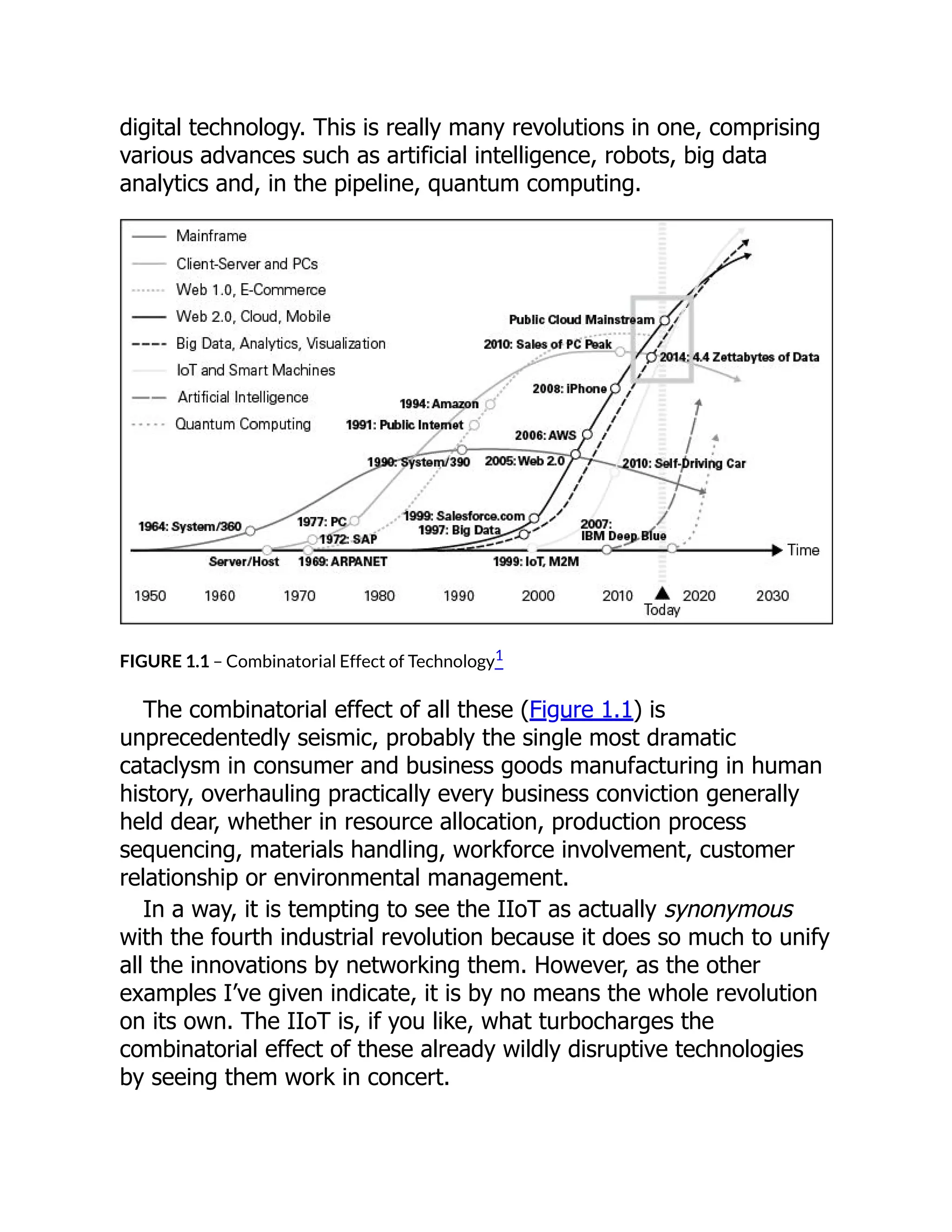
FIGURE 1.1 – Combinatorial Effect of Technology1
The combinatorial effect of all these (Figure 1.1) is
unprecedentedly seismic, probably the single most dramatic
cataclysm in consumer and business goods manufacturing in human
history, overhauling practically every business conviction generally
held dear, whether in resource allocation, production process
sequencing, materials handling, workforce involvement, customer
relationship or environmental management.
In a way, it is tempting to see the IIoT as actually synonymous
with the fourth industrial revolution because it does so much to unify
all the innovations by networking them. However, as the other
examples I’ve given indicate, it is by no means the whole revolution
on its own. The IIoT is, if you like, what turbocharges the
combinatorial effect of these already wildly disruptive technologies
by seeing them work in concert.
This book is not a comprehensive guide to the entire fourth
industrial revolution – to every node of technological change that
comprises it. Its focus is very much the IIoT. However, precisely
because the IIoT connects the other factors, it offers a key route
into understanding how to capitalize upon the whole and avoid being
left behind.
In particular, I will look at the innovations in connectivity and data
collection that enable the IIoT alone: tech such as sensors, portable
devices, the cloud, application programme interfaces (APIs) and
apps. These are exploding.
All this is set to shake up research and development,
manufacturing, aftersales, and product and service configurations. In
numerous industrial settings, the drift, albeit often tentative, has
already begun towards digitally run shop floors, management
processes, platforms and ecosystems.
This opens up space to establish new income streams for
enterprises and allows companies to set a strategic course for
entirely new business models focused on delivering quality
“outcomes” for customers rather than just physical products.
Outcomes are another reason why the emergence of the IIoT is
an event of such historical significance. It marks the end of roughly
200 years of modern industrial production habits because it
relegates basic products to insignificance compared to the results
they deliver at any given moment thanks to their digital connectivity.
We are right at the tipping point of this change and there is simply
no better time to be getting to grips with it. The entire purpose of
this book is to help you do this. In this chapter I will further
delineate the significance of the IIoT, giving a sense of the (relatively
early) stage of development it is at now.
Finally, as a sort of summary overview of the other chapters in this
book, I will sketch out some key steps you need to take and
concepts you need to understand to correctly position your company
in the IIoT’s radically new landscape.
The Drivers of Change in the Industrial
Sphere
The connected, smart product is at the core of the change. The
combination of smart products, services and new experiences will
disrupt legacy business models and shake up the entire product
value chain.
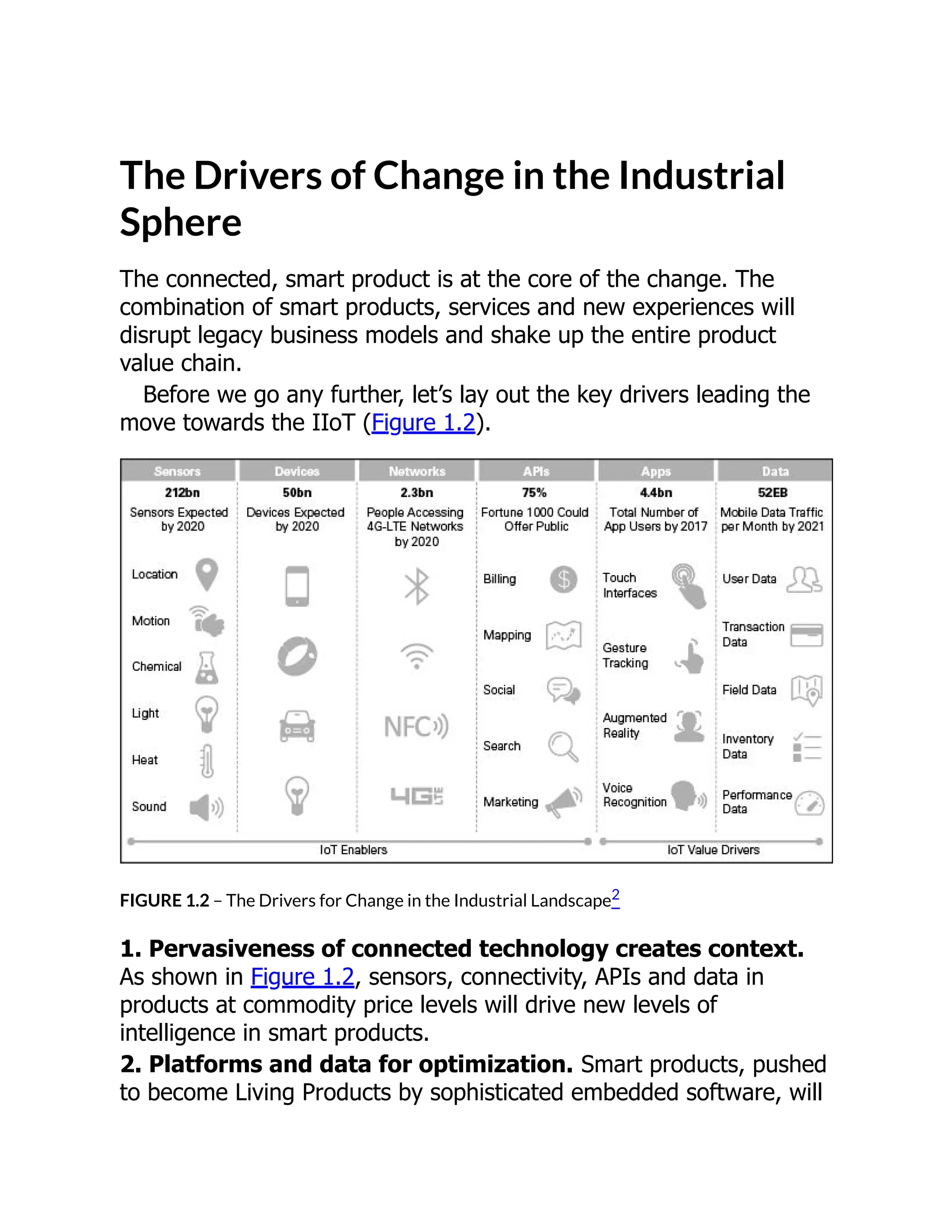
Before we go any further, let’s lay out the key drivers leading the
move towards the IIoT (Figure 1.2).
FIGURE 1.2 – The Drivers for Change in the Industrial Landscape2
1. Pervasiveness of connected technology creates context.
As shown in Figure 1.2, sensors, connectivity, APIs and data in
products at commodity price levels will drive new levels of
intelligence in smart products.
2. Platforms and data for optimization. Smart products, pushed
to become Living Products by sophisticated embedded software, will
be connected to platforms during operations and accompanied with
analytics and data-driven services to optimize their operation.
3. Ecosystems and services drive value. Data and services
provided by smart products and platform ecosystem allow creation
of mutually complementing value-add services and new revenue
streams while the smart product is in operation.
4. Hyperpersonalization and new experiences disrupt. Smart
products have the ability to hyperpersonalize, adapting to the
individual product user in his or her individual context with the
objective of optimizing the business outcome. Hyperpersonalization
creates new experiences for the individual. This leads to a new level
of competition around the combination of smart products, services
and new experiences, potentially disruptive to existing business
models.
5. As-a-service business models emerge. Consumption-based
business models replace traditional “sell-and-maintain” business
models. This involves significant changes to the balance sheet with
CAPEX shifting from customer to the as-a-service provider.
6. New technologies will disrupt further. Robotics, autonomous
systems, artificial intelligence and deep learning, augmented and
virtual reality, 5G networks, 3/4D Printing, blockchain, and other new
technologies will reach industrial strength and radically impact the
way products are engineered, manufactured and operated.
7. Security and data privacy ensure resilience and fairness.
Progress in industrial-strength security, data ownership and sharing,
and data privacy solutions are a prerequisite for the IIoT. Security
solutions will be engineered to provide resilience during cyber
attacks and new principles around data sharing will ensure fairness
between stakeholders.
Technology Becomes Affordable and
Puts Speed Behind the IIoT
Why is the current moment in the development of the IIoT so
crucial? Because of the standard pattern by which innovations often
reach maturity and marketability: IIoT technology has
simultaneously become cheaper and its sophistication has increased,
making it ready to go mainstream.
Production costs and market prices have tumbled to commodity
levels over the last two decades or so for many technologies critical
to the IIoT: cloud computing services, processing power, storage
space, analytics tools, mobile connectivity, and components such as
sensors. Prices have fallen by up to a factor of 50 compared to only
a few years ago (see Figure 1.3). Concurrently, new waves of
innovation have succeeded their predecessors with exceptional and
increasing speed, shortening the window within which to absorb and
adapt to the changes.
FIGURE 1.3 – A Decade of Eroding Cost Fuels the Rise of the Internet of Things3
All this greatly increases both the feasibility and attractiveness of
new investment cases unthinkable only a few years ago. A small
ironmonger operating an assembly line in an urban backyard, for
instance, can now buy software-controlled sensor kits to apply a
basic form of predictive analytics for lathe maintenance or managing
energy consumption.
Such small-scale entrepreneurs will probably soon be using
process engineering equipment that, not long ago, existed only in
research laboratories or would have cost a fortune to integrate into
ordinary factory floors.
The potential for rendering old-style enterprise arrangements
smart from end-to-end, then, is huge. Research anticipates that
around two thirds of today’s companies can easily boost efficiency
and value via a gradual introduction of digitized processes, as many
of their departments have barely been put on a digital footing at all
over the last decades. This will soon streamline and optimize
businesses around the world and pump trillions of dollars of income
into the economy.
In that perspectie the IIoT is probably the greatest compound
value proposition industrial manufacturers have ever been offered.
The Value of the IIoT is Still to be
Unlocked
One can get a sense of the IIoT’s potential for value creation by
looking at where the new smart technology is already embedded in
efficient set-ups. Advantages such as greater visibility of processes,
much more efficient data utilization, and the intertwining of
underlying systems and sub-processes can boost unit cost ratios,
workforce flexibility and product quality by several orders of
magnitude.
Consider the technology known as Predictive Maintenance: data is
collected from machinery and used to predict future maintenance
stops. This helps to save up to 12 percent in repair costs and
reduces overall maintenance cost by up to 30 percent.4
Or take predictive analytics, born of machine-installed sensors and
intelligent diagnostic software, which reduces machine breakdowns
by a whopping 70 percent.5
Hardly any previous technological
advance has been able boast productivity gains of this magnitude.
The big picture estimates are at least equally stunning. By
adopting digitally controlled business and manufacturing processes,
global factories are set to secure $100tn of combined value for
society and industry by 2025.6
This should even make manufacturing sufficiently competitive for
substantial operations to be relocated from the lower-cost emerging
world back to highly industrialized western countries. That should
push new-growth nations to quickly develop their own digital
industrial base in order to remain competitive. More generally, it’s a
clear indication that no one can afford to ignore the onward march
of the IIoT.
The few early-adopters who are significantly realizing IIoT –
aircraft or car manufacturers and mining operators being good
examples – already significantly realizing IIoT enjoy higher
productivity, lower operational costs, better working conditions, and
effective machine occupancy. They are experiencing a significant
profit uplift.7
FIGURE 1.4 – Digital Index and Financial Performance of German Industrial Players8
Ecosystems Form Powerful Wells of
Innovation
While many of my remarks already suggest this, I should emphasize
that deploying smart manufacturing solutions yields a lot more than
just a few insular, one-dimensional efficiency gains reflected in profit
and loss accounts. This is precisely because the IIoT is itself multi-
dimensional, comprising so many innovations in concert.
Compared with individual innovations, the network effect here
means that the value horizon is exponentially larger and vastly more
transformative. Technological transformation is the basis, but it
leads, as inevitably as water flowing downhill, to interconnected
changes in products, services, strategies, processes and, crucially,
relationships between businesses and sectors.
Smart manufacturing will, by definition, not evolve in the form of
isolated beacon projects. It is the nature of these radical new
production set-ups to emerge in sector context – thriving best in
expanding ecosystems within and across industries.
In other words, the innovations that work in concert will be
achieved through and give rise to innovation processes that also
happen in concert. The more adequate and user experience-oriented
IIoT technology you and your partners have in your process chains,
components and products, the more everyone will be able to
introduce new business models based on service offerings that
mutually augment physical products and tap collectively into new
revenue streams.
As you phase in IIoT-enabled processes, you will have no choice
but to open up your existing business model step by step in
thorough and irreversible ways. Your enterprise will eventually be
embedded in a myriad of flexibly evolving digital relationships with
other parties. Your own digitization’s pace will depend on the ebb
and flow of your customers’, partners’, and suppliers’ parallel
processes. You will, in short, have to get used to progress in step
with your various ecosystem partners.
Managing such ecosystems, harnessing Open Innovation flows
among their constituents and breaking down silos, will thus become
critical capabilities for business leaders. Competition to be part of
the best-performing ecosystems will almost certainly be even
stronger than the rivalry around individual product markets.
Following this path, you will eventually build the capacity to morph
from a more traditional product-oriented manufacturer into a
provider of measurable outcomes: complex bundles of services,
hardware, and experience.
Exploring the Variety of Random
Documents with Different Content
*** END OF THE PROJECT GUTENBERG EBOOK BLUE RIDGE
PARKWAY, VIRGINIA AND NORTH CAROLINA (1949) ***
Updated editions will replace the previous one—the old editions will
be renamed.
Creating the works from print editions not protected by U.S.
copyright law means that no one owns a United States copyright in
these works, so the Foundation (and you!) can copy and distribute it
in the United States without permission and without paying
copyright royalties. Special rules, set forth in the General Terms of
Use part of this license, apply to copying and distributing Project
Gutenberg™ electronic works to protect the PROJECT GUTENBERG™
concept and trademark. Project Gutenberg is a registered trademark,
and may not be used if you charge for an eBook, except by following
the terms of the trademark license, including paying royalties for use
of the Project Gutenberg trademark. If you do not charge anything
for copies of this eBook, complying with the trademark license is
very easy. You may use this eBook for nearly any purpose such as
creation of derivative works, reports, performances and research.
Project Gutenberg eBooks may be modified and printed and given
away—you may do practically ANYTHING in the United States with
eBooks not protected by U.S. copyright law. Redistribution is subject
to the trademark license, especially commercial redistribution.
START: FULL LICENSE
THE FULL PROJECT GUTENBERG LICENSE
PLEASE READ THIS BEFORE YOU DISTRIBUTE OR USE THIS WORK
To protect the Project Gutenberg™ mission of promoting the free
distribution of electronic works, by using or distributing this work (or
any other work associated in any way with the phrase “Project
Gutenberg”), you agree to comply with all the terms of the Full
Project Gutenberg™ License available with this file or online at
www.gutenberg.org/license.
Section 1. General Terms of Use and
Redistributing Project Gutenberg™
electronic works
1.A. By reading or using any part of this Project Gutenberg™
electronic work, you indicate that you have read, understand, agree
to and accept all the terms of this license and intellectual property
(trademark/copyright) agreement. If you do not agree to abide by all
the terms of this agreement, you must cease using and return or
destroy all copies of Project Gutenberg™ electronic works in your
possession. If you paid a fee for obtaining a copy of or access to a
Project Gutenberg™ electronic work and you do not agree to be
bound by the terms of this agreement, you may obtain a refund
from the person or entity to whom you paid the fee as set forth in
paragraph 1.E.8.
1.B. “Project Gutenberg” is a registered trademark. It may only be
used on or associated in any way with an electronic work by people
who agree to be bound by the terms of this agreement. There are a
few things that you can do with most Project Gutenberg™ electronic
works even without complying with the full terms of this agreement.
See paragraph 1.C below. There are a lot of things you can do with
Project Gutenberg™ electronic works if you follow the terms of this
agreement and help preserve free future access to Project
Gutenberg™ electronic works. See paragraph 1.E below.
1.C. The Project Gutenberg Literary Archive Foundation (“the
Foundation” or PGLAF), owns a compilation copyright in the
collection of Project Gutenberg™ electronic works. Nearly all the
individual works in the collection are in the public domain in the
United States. If an individual work is unprotected by copyright law
in the United States and you are located in the United States, we do
not claim a right to prevent you from copying, distributing,
performing, displaying or creating derivative works based on the
work as long as all references to Project Gutenberg are removed. Of
course, we hope that you will support the Project Gutenberg™
mission of promoting free access to electronic works by freely
sharing Project Gutenberg™ works in compliance with the terms of
this agreement for keeping the Project Gutenberg™ name associated
with the work. You can easily comply with the terms of this
agreement by keeping this work in the same format with its attached
full Project Gutenberg™ License when you share it without charge
with others.
1.D. The copyright laws of the place where you are located also
govern what you can do with this work. Copyright laws in most
countries are in a constant state of change. If you are outside the
United States, check the laws of your country in addition to the
terms of this agreement before downloading, copying, displaying,
performing, distributing or creating derivative works based on this
work or any other Project Gutenberg™ work. The Foundation makes
no representations concerning the copyright status of any work in
any country other than the United States.
1.E. Unless you have removed all references to Project Gutenberg:
1.E.1. The following sentence, with active links to, or other
immediate access to, the full Project Gutenberg™ License must
appear prominently whenever any copy of a Project Gutenberg™
work (any work on which the phrase “Project Gutenberg” appears,
or with which the phrase “Project Gutenberg” is associated) is
accessed, displayed, performed, viewed, copied or distributed:
This eBook is for the use of anyone anywhere in the United States
and most other parts of the world at no cost and with almost no
restrictions whatsoever. You may copy it, give it away or re-use it
under the terms of the Project Gutenberg License included with
this eBook or online at www.gutenberg.org. If you are not located
in the United States, you will have to check the laws of the
country where you are located before using this eBook.
1.E.2. If an individual Project Gutenberg™ electronic work is derived
from texts not protected by U.S. copyright law (does not contain a
notice indicating that it is posted with permission of the copyright
holder), the work can be copied and distributed to anyone in the
United States without paying any fees or charges. If you are
redistributing or providing access to a work with the phrase “Project
Gutenberg” associated with or appearing on the work, you must
comply either with the requirements of paragraphs 1.E.1 through
1.E.7 or obtain permission for the use of the work and the Project
Gutenberg™ trademark as set forth in paragraphs 1.E.8 or 1.E.9.
1.E.3. If an individual Project Gutenberg™ electronic work is posted
with the permission of the copyright holder, your use and distribution
must comply with both paragraphs 1.E.1 through 1.E.7 and any
additional terms imposed by the copyright holder. Additional terms
will be linked to the Project Gutenberg™ License for all works posted
with the permission of the copyright holder found at the beginning
of this work.
1.E.4. Do not unlink or detach or remove the full Project
Gutenberg™ License terms from this work, or any files containing a
part of this work or any other work associated with Project
Gutenberg™.
1.E.5. Do not copy, display, perform, distribute or redistribute this
electronic work, or any part of this electronic work, without
prominently displaying the sentence set forth in paragraph 1.E.1
with active links or immediate access to the full terms of the Project
Gutenberg™ License.
1.E.6. You may convert to and distribute this work in any binary,
compressed, marked up, nonproprietary or proprietary form,
including any word processing or hypertext form. However, if you
provide access to or distribute copies of a Project Gutenberg™ work
in a format other than “Plain Vanilla ASCII” or other format used in
the official version posted on the official Project Gutenberg™ website
(www.gutenberg.org), you must, at no additional cost, fee or
expense to the user, provide a copy, a means of exporting a copy, or
a means of obtaining a copy upon request, of the work in its original
“Plain Vanilla ASCII” or other form. Any alternate format must
include the full Project Gutenberg™ License as specified in
paragraph 1.E.1.
1.E.7. Do not charge a fee for access to, viewing, displaying,
performing, copying or distributing any Project Gutenberg™ works
unless you comply with paragraph 1.E.8 or 1.E.9.
1.E.8. You may charge a reasonable fee for copies of or providing
access to or distributing Project Gutenberg™ electronic works
provided that:
• You pay a royalty fee of 20% of the gross profits you derive
from the use of Project Gutenberg™ works calculated using the
method you already use to calculate your applicable taxes. The
fee is owed to the owner of the Project Gutenberg™ trademark,
but he has agreed to donate royalties under this paragraph to
the Project Gutenberg Literary Archive Foundation. Royalty
payments must be paid within 60 days following each date on
which you prepare (or are legally required to prepare) your
periodic tax returns. Royalty payments should be clearly marked
as such and sent to the Project Gutenberg Literary Archive
Foundation at the address specified in Section 4, “Information
about donations to the Project Gutenberg Literary Archive
Foundation.”
• You provide a full refund of any money paid by a user who
notifies you in writing (or by e-mail) within 30 days of receipt
that s/he does not agree to the terms of the full Project
Gutenberg™ License. You must require such a user to return or
destroy all copies of the works possessed in a physical medium
and discontinue all use of and all access to other copies of
Project Gutenberg™ works.
• You provide, in accordance with paragraph 1.F.3, a full refund of
any money paid for a work or a replacement copy, if a defect in
the electronic work is discovered and reported to you within 90
days of receipt of the work.
• You comply with all other terms of this agreement for free
distribution of Project Gutenberg™ works.
1.E.9. If you wish to charge a fee or distribute a Project Gutenberg™
electronic work or group of works on different terms than are set
forth in this agreement, you must obtain permission in writing from
the Project Gutenberg Literary Archive Foundation, the manager of
the Project Gutenberg™ trademark. Contact the Foundation as set
forth in Section 3 below.
1.F.
1.F.1. Project Gutenberg volunteers and employees expend
considerable effort to identify, do copyright research on, transcribe
and proofread works not protected by U.S. copyright law in creating
the Project Gutenberg™ collection. Despite these efforts, Project
Gutenberg™ electronic works, and the medium on which they may
be stored, may contain “Defects,” such as, but not limited to,
incomplete, inaccurate or corrupt data, transcription errors, a
copyright or other intellectual property infringement, a defective or
damaged disk or other medium, a computer virus, or computer
codes that damage or cannot be read by your equipment.
1.F.2. LIMITED WARRANTY, DISCLAIMER OF DAMAGES - Except for
the “Right of Replacement or Refund” described in paragraph 1.F.3,
the Project Gutenberg Literary Archive Foundation, the owner of the
Project Gutenberg™ trademark, and any other party distributing a
Project Gutenberg™ electronic work under this agreement, disclaim
all liability to you for damages, costs and expenses, including legal
fees. YOU AGREE THAT YOU HAVE NO REMEDIES FOR
NEGLIGENCE, STRICT LIABILITY, BREACH OF WARRANTY OR
BREACH OF CONTRACT EXCEPT THOSE PROVIDED IN PARAGRAPH
1.F.3. YOU AGREE THAT THE FOUNDATION, THE TRADEMARK
OWNER, AND ANY DISTRIBUTOR UNDER THIS AGREEMENT WILL
NOT BE LIABLE TO YOU FOR ACTUAL, DIRECT, INDIRECT,
CONSEQUENTIAL, PUNITIVE OR INCIDENTAL DAMAGES EVEN IF
YOU GIVE NOTICE OF THE POSSIBILITY OF SUCH DAMAGE.
1.F.3. LIMITED RIGHT OF REPLACEMENT OR REFUND - If you
discover a defect in this electronic work within 90 days of receiving
it, you can receive a refund of the money (if any) you paid for it by
sending a written explanation to the person you received the work
from. If you received the work on a physical medium, you must
return the medium with your written explanation. The person or
entity that provided you with the defective work may elect to provide
a replacement copy in lieu of a refund. If you received the work
electronically, the person or entity providing it to you may choose to
give you a second opportunity to receive the work electronically in
lieu of a refund. If the second copy is also defective, you may
demand a refund in writing without further opportunities to fix the
problem.
1.F.4. Except for the limited right of replacement or refund set forth
in paragraph 1.F.3, this work is provided to you ‘AS-IS’, WITH NO
OTHER WARRANTIES OF ANY KIND, EXPRESS OR IMPLIED,
INCLUDING BUT NOT LIMITED TO WARRANTIES OF
MERCHANTABILITY OR FITNESS FOR ANY PURPOSE.
1.F.5. Some states do not allow disclaimers of certain implied
warranties or the exclusion or limitation of certain types of damages.
If any disclaimer or limitation set forth in this agreement violates the
law of the state applicable to this agreement, the agreement shall be
interpreted to make the maximum disclaimer or limitation permitted
by the applicable state law. The invalidity or unenforceability of any
provision of this agreement shall not void the remaining provisions.
1.F.6. INDEMNITY - You agree to indemnify and hold the Foundation,
the trademark owner, any agent or employee of the Foundation,
anyone providing copies of Project Gutenberg™ electronic works in
accordance with this agreement, and any volunteers associated with
the production, promotion and distribution of Project Gutenberg™
electronic works, harmless from all liability, costs and expenses,
including legal fees, that arise directly or indirectly from any of the
following which you do or cause to occur: (a) distribution of this or
any Project Gutenberg™ work, (b) alteration, modification, or
additions or deletions to any Project Gutenberg™ work, and (c) any
Defect you cause.
Section 2. Information about the Mission
of Project Gutenberg™
Project Gutenberg™ is synonymous with the free distribution of
electronic works in formats readable by the widest variety of
computers including obsolete, old, middle-aged and new computers.
It exists because of the efforts of hundreds of volunteers and
donations from people in all walks of life.
Volunteers and financial support to provide volunteers with the
assistance they need are critical to reaching Project Gutenberg™’s
goals and ensuring that the Project Gutenberg™ collection will
remain freely available for generations to come. In 2001, the Project
Gutenberg Literary Archive Foundation was created to provide a
secure and permanent future for Project Gutenberg™ and future
generations. To learn more about the Project Gutenberg Literary
Archive Foundation and how your efforts and donations can help,
see Sections 3 and 4 and the Foundation information page at
www.gutenberg.org.
Section 3. Information about the Project
Gutenberg Literary Archive Foundation
The Project Gutenberg Literary Archive Foundation is a non-profit
501(c)(3) educational corporation organized under the laws of the
state of Mississippi and granted tax exempt status by the Internal
Revenue Service. The Foundation’s EIN or federal tax identification
number is 64-6221541. Contributions to the Project Gutenberg
Literary Archive Foundation are tax deductible to the full extent
permitted by U.S. federal laws and your state’s laws.
The Foundation’s business office is located at 809 North 1500 West,
Salt Lake City, UT 84116, (801) 596-1887. Email contact links and up
to date contact information can be found at the Foundation’s website
and official page at www.gutenberg.org/contact
Section 4. Information about Donations to
the Project Gutenberg Literary Archive
Foundation
Project Gutenberg™ depends upon and cannot survive without
widespread public support and donations to carry out its mission of
increasing the number of public domain and licensed works that can
be freely distributed in machine-readable form accessible by the
widest array of equipment including outdated equipment. Many
small donations ($1 to $5,000) are particularly important to
maintaining tax exempt status with the IRS.
The Foundation is committed to complying with the laws regulating
charities and charitable donations in all 50 states of the United
States. Compliance requirements are not uniform and it takes a
considerable effort, much paperwork and many fees to meet and
keep up with these requirements. We do not solicit donations in
locations where we have not received written confirmation of
compliance. To SEND DONATIONS or determine the status of
compliance for any particular state visit www.gutenberg.org/donate.
While we cannot and do not solicit contributions from states where
we have not met the solicitation requirements, we know of no
prohibition against accepting unsolicited donations from donors in
such states who approach us with offers to donate.
International donations are gratefully accepted, but we cannot make
any statements concerning tax treatment of donations received from
outside the United States. U.S. laws alone swamp our small staff.
Please check the Project Gutenberg web pages for current donation
methods and addresses. Donations are accepted in a number of
other ways including checks, online payments and credit card
donations. To donate, please visit: www.gutenberg.org/donate.
Section 5. General Information About
Project Gutenberg™ electronic works
Professor Michael S. Hart was the originator of the Project
Gutenberg™ concept of a library of electronic works that could be
freely shared with anyone. For forty years, he produced and
distributed Project Gutenberg™ eBooks with only a loose network of
volunteer support.
Project Gutenberg™ eBooks are often created from several printed
editions, all of which are confirmed as not protected by copyright in
the U.S. unless a copyright notice is included. Thus, we do not
necessarily keep eBooks in compliance with any particular paper
edition.
Most people start at our website which has the main PG search
facility: www.gutenberg.org.
This website includes information about Project Gutenberg™,
including how to make donations to the Project Gutenberg Literary
Archive Foundation, how to help produce our new eBooks, and how
to subscribe to our email newsletter to hear about new eBooks.

Industry X 0 Realizing Digital Value in Industrial Sectors 1st Edition Eric Schaeffer
  • 1.
    Read Anytime AnywhereEasy Ebook Downloads at ebookmeta.com Industry X 0 Realizing Digital Value in Industrial Sectors 1st Edition Eric Schaeffer https://ebookmeta.com/product/industry-x-0-realizing- digital-value-in-industrial-sectors-1st-edition-eric- schaeffer/ OR CLICK HERE DOWLOAD EBOOK Visit and Get More Ebook Downloads Instantly at https://ebookmeta.com
  • 4.
    Industry X.0 Realizing DigitalValue in Industrial Sectors Eric Schaeffer
  • 5.
    Tabel of Contents Cover TitlePage Contents Preface Acknowledgments Introduction PART I The Industrial Internet of Things – Transforming Manufacturing Beyond Recognition 01 Industry’s Ongoing and Accelerating Digital Transformation The Drivers of Change in the Industrial Sphere Technology Becomes Affordable and Puts Speed Behind the IIoT The Value of the IIoT is Still to be Unlocked Ecosystems Form Powerful Wells of Innovation The Product of Me vs. Mass Manufacturing Liquid Fulfillment Networks Will Supplant Old-Style Factories The Critical Importance of Preparing the Digital Workforce The Surprisingly Slow Embrace of the IIoT by Business Takeaways 02 How the IIoT Leads to the Outcome Economy New Tech Creates New Business Models Living Products or the Reinvention of the Product Outcome Orientation Spurs Innovation in Products and Services Outcomes are Appearing Across Sectors
  • 6.
    The Why Behindthe Buy From Rigid Business Silos to Agile Ecosystems New Risks and Rewards The Four Future Stages of Industry Takeaways 03 Digital Super Value – A Guiding Light for Digital Strategy Two Speeds Create Massive Value Deposits The Societal Benefits What’s in it for Business? Automotive – the Vanguard Efficiency Seekers How to Find the Right Pivots Takeaways PART II How to Make the Most of the Digital Industrial Transformation 04 Six “No-Regret” Capabilities – the Journey Towards Digital, Mapped out Simply From Old World to New World on Many Different Paths Be Adaptive and Relaxed but Curious and Visionary – and Get Going Design Thinking Speeds up Service Development Processes The Six Fundamental Capabilities that Can Get your Digitization Started Your IIoT Business – How to Succeed To Take Services to Market, Think Big, Start Small, Scale Fast Takeaways 05 Zoom in: How to Make Data Analytics Work Your Way Raw Data Has no Value and Needs Enrichment Which Data Strategy to Pursue – More Return from Inside or Outside? The Five Sources of Value that Can be Tapped with a
  • 7.
    Data Strategy IoT LeadGeneration – Anticipate your Customers’ Demand From Mere Monitoring to a Real Predictive Maintenance Practice Data Analytics Strategy – the New Industrial Must-Have Gains to Make Now in a Changing Landscape How Utility Businesses Harness Big Data Analytics Keep Pilots Incremental and Focused Flexible Data Analytics as a Service and Edge Computing Practically Connecting the Digital Factory Wherever you Start, Work Along a Roadmap for More Takeaways 06 Zoom in: How to Handle Digital Product Development From Connected Products to Digitized Product Development Digitizing PLM End-to-End – the Main Challenge The Stepped Road to Future-Proofed DPLM Digital PLM already Generates Value for Real Businesses Choose the Right Speed for Changing Processes and People Electronics and High-Tech Pointing the Way for Industry Mobile Phone Functionality Gives Manufacturers a Major Steer The Problem of Beating the Clock – How and Which One of the Many? Takeaways 07 Zoom in: How to Create a Connected Industrial Workforce Mutuality Between Humans and Machines Across the Whole Enterprise Low-Supervision Shop-Floor Machine-Centricity – It’s
  • 8.
    Nearly Here The Pathto Collaborative Robots Running Enterprises A Fully Connected Workforce Needs New Organizational Structures Connected Workers Must Iterate, Adapt, and be Flexible Managerial Trust Issues Around Machines Managers Must do More Strategic Judgment Work Under-Appreciated Intelligent Machines Corporate HR’s Need for a Strategic Stance Takeaways 08 Zoom in: How to Master Innovation in the New Old-Style Innovators See Only the Market’s Supply Side “Build it and They Will Come” vs . “Let Them Come and We Will Build it” The First Boosts From Innovation in the New Four Innovator Types, One Long-Term Winner Brilliant Innovators Lead the Way in the Industrial Sector Digitally-Driven Innovation Makes all the Difference Four Recommendations for Becoming a Reinventor Incubator Mentalities and Capabilities Round off Future Innovation Takeaways 09 Zoom in: How to Make the Most of Platforms and Ecosystems What is an Ecosystem and Why Build One? Leveraging Start-ups Building an Ecosystem – How to Do it The Emerging Power of Platforms From Transaction Hubs to Innovation Machines Platforms as “Tissue” Three Stages of Maturity
  • 9.
    Gently Disassembling toMake Way for New Business Models Asset-Heavy vs . Asset-Light Five Things to Watch out for When Building Platforms Takeaways PART III The Future is Now and Tomorrow 10 A Visionary Outlook – The Digital Industrial Enterprise In the Pull Economy, Meet the Production Crowd Technology Makes Making More Flexible Nothing as Usual Becomes Business as Usual Chapter Takeaways at a Glance Glossary of Terms Endnotes Index About the Author Copyright
  • 12.
    Preface The world hasbecome digitally connected to the point of no return. Each day around five million devices become linked up with either each other, the Internet or both. There are around 6.4bn data- communicating objects in the world and by 2020 this number is forecast to explode to around 20bn.1 Our digital universe is in healthy expansion mode. From this perspective, today’s device boom – the wristband pulse monitors, smart watches, satnavs and intelligent thermostats – are just the overture to a long and eventful journey towards lives digitally augmented, supported and enabled in ways unlike anything humans have ever experienced before. The advance is propelled by our craving for technical innovation and our tendency to adapt promptly to new ways of interacting and engaging with machines and devices as soon as they exist. We as consumers will keep asking why this or that gap in the market has not yet been filled by some device or software solution. Businesses – the focus of this book, hence the title “Industry X.0” – and their increasingly digitally native workforce, used to a highly digitized private lifestyle, will put the same kinds of questions to their industrial vendors, displaying a new form of “industrial consumerism.” At the core of this seismic upheaval sit Living Products, physical products reinvented as software-intelligent devices that act, think, and are closely and constantly aligned with their users and ecosystems. Clearly, then, the industrial sphere, the sphere of technologically produced physical objects, will play a major part in the seminal trip towards the planet’s digitization. Digital technologies will create a stage on which we as public, businesses and industry experts will pull off spectacular things in the coming years.
  • 13.
    Consider the following:the first pharmacy staffed only by robots, is expected to open its doors in 2021;2 sensorized medical pills that report back to the makers when patients have swallowed them are currently in development; Siemens is already successfully running prototypes of completely unmanned, self-organizing and hyper- productive industrial plants;3 and raw materials giant Rio Tinto has huge mining operations based on automated trucks and drill systems provided by heavy equipment makers Caterpillar and Komatsu.4 Cars, industrial machinery and tooling, pumps, circuit breakers – they can all be rendered Living Products by adding software intelligence. The ship has clearly sailed for digital sceptics, both as citizens and business leaders. The industrial enterprise world, comprising two thirds of the world’s gross domestic product, will be changed beyond recognition by digital technology, disrupting decades-old business habits, conventions and operating models. The ways in which labor works, machine-based processes are organized and information is shared will be turned on their heads. Strategic corporate thinking will be forced to incorporate completely new data-driven business models to secure a future for any enterprise. No wonder the US, Germany, China and Japan – all strongholds of successful industrial enterprises – have, with varying focus, put industrial digital transformation high on the agenda. There is no turning back. What matters now is to make the most of the digital transformation. We have the opportunity to shape it. There is not one standard way to make it happen, the journey must be tailored to each enterprise individually. That is why this book, unlike other publications, not only addresses the “why” of the industrial sphere’s wholesale digitization but also, primarily, the “how”, examining in detail the steps industrial businesses need to take to get the greatest positive effect and value from digital. Packed with easily accessible actionable insights and suggestions, it should be a vital resource for industrial business leaders at all levels, C-suite and below as well as across all functions. It should
  • 14.
    help them discover,think through, adopt and implement the roadmap necessary for their enterprises to head out for the new territory, and act as an aide-memoire as the journey progresses.
  • 15.
    Acknowledgements In this bookI have managed to gather and shape forward-looking advice around a complex subject: the emergence of the Industrial Internet of Things (IIoT) and its transformation of the industrial sectors. I visited and revisited the topic in detail and assessed its ramifications for the enterprises affected. And I developed a good deal of thought leadership in the process. All this would have been impossible without the input of a large number of knowledgeable people from beyond our core book team. I was fortunate to be able to tap a wide intellectual catchment area: corporate thinkers, co-consultants, and clients, based in the US, UK, Germany, France, Italy, Korea, Europe, Japan, and China, contributing either broad ideas that helped shape the general themes and scope of the book or practical industry experience, focused sector insights, and firm opinion to test our own thinking. Their input has been invaluable in shaping the book’s observations, analyses and hypotheses. To all of them I would like to express a sincere “Thank you.” The support of every one of you individually was a conditio sine qua non for pulling this off and collectively represents a piece of vanguard consultancy thinking on what is currently one of the most pressing subjects in the business world. At Accenture I wish to thank David Abood, Fabian Bohn, Christophe Brasselet, Jean Cabanes, Brian Doyle, Dan Elron, Andreas Gissler, AJ Gupta, Francis Hintermann, Richard Holman, Venkatesh Iyer, Lisa-Cheng Jackson, Jitendra A. Kavathekar, Shinichiro Kohno, Bodo Körber, Guiseppe La Commare, JC Ledoux, Sebastien Lepicard, Mahesh Mahajan, Sarat Maitin, Brian May, Bruno le Moal, Eric Mokrenski, Massimo Pagella, Mark H. Pearson, Bruno Pfeiffer, Philippe Pruvost, Kevin Prendeville, Kausar Qazilbash, Wu Qi, Aidan Quilligan, Ganesan Ramachandran, Shugo Sohma, Ben Salama,
  • 16.
    Marcello Tamietti, MaxenceTilliette, Cedric Vatier, Patrick Vollmer, Ben Wang, and Will Zhang. Special thanks must go to Sander van ‘t Noordende, Omar Abbosh, and Frank Riemensperger for their support, inspiration and thought leadership around the transformation of industries. Within Accenture thanks are also owed to Georg Berger, Gemma Catchpole, Andreas Egetenmeyer, Sonja Fink, Ulf Henning, Fiona Morris and Matthias Wahrendorff, the closer team steering the publication, as well as to Jens Schadendorf, Titus Kroder, and John Moseley, who brought valuable experience and exceptional knowledge with regard to the writing and publishing of a book. A big thank you also goes to Helen Kogan and Jenny Volich from Kogan Page, and Michael Wurster from Redline, as the publishers of this book, for their enduring commitment to and trust in this project. Finally, and above all, I thank my wife Pascale for her patience, relentless support and love and my children William, Meryl and Edouard for the many and passionate discussions on the new digital economy. May this book help them navigate successfully through the change.
  • 17.
    Introduction Coinciding with thewholesale digital interlinking of society, the digital disruption and transformation of the industrial sphere is one of the world’s current megatrends, affecting companies representing two thirds of global GDP.1 Makers of cars, planes, trains, domestic appliances, heavy equipment and engineering technology, pharmaceuticals, and utility and raw materials businesses are all undergoing waves of technological upheaval as we speak. Smartened, tightly connected, data-driven industrial products and processes are going to go mainstream in all advanced and many emerging countries very soon. Embedded in the wider trend towards the Internet of Things (IoT), its sub-segment, the Industrial Internet of Things (IIoT), will digitally orchestrate factory floors, physical products, workers and all enterprise functions and processes, unleashing enormous value potential.
  • 18.
    Beyond the Product:Outcomes and Value In only a few years time we will look back and call the two decades since the turn of the century the period of “the end of the product.” Ever more advanced digital technology will help to establish a new world in which customers will ask businesses for complex “outcomes” delivered by digital services around physical products instead of delivery of mere hardware. The software “tissue” and data analytics that will eventually permeate the industrial sector will create a very distinctive new stage of economy. Enterprises will have departed from a conventional focus on manufacturing “dumb” low-margin products made for anonymous markets to forming very personalized relationships with their customers, driven by the latter’s instantaneous demand for “switched-on, software-connected, and eventually even Living Products and Living Services with huge value potential. Digital technology will also enable providers of outcomes to monitor the shape of outcomes and usage patterns in the field. In the churn of this megatrend, the terms B2B and B2C will start to blur. In fact it will be one of the defining fascinations of the industrial sector’s digitization that enterprises used to dealing with business clients will suddenly be forced to think like consumer-facing businesses as part of the trend known as “industrial consumerism.” This means, that, for not only consumer goods companies but B2B industrial companies too, final outcome experience and service quality will now be the top criteria for success or failure – and eventually the only significant source of corporate value in this sector. This is driven by a shift in customer attitudes and, as such, is a clear rebuke to the common assumption in government that it is businesses that will drive the broad-based trend towards digitization. What we currently see is the opposite: the urge for change clearly
  • 19.
    stems from thedemand not the supply side. It is the phenomenon of industrial consumerism and the emergence of Living Products that are driving the change. In that regard many governments are too focused on creating the right environment for digitizing the shop floor, not realizing that this is not the right starting point for enterprises to arrive at the necessary new business models. In only a short while we will be accustomed to markets in which tried-and-tested industrial hardware products will become permanently reconfigurable software containers, eclipsed in profitability by their own new service qualities. This will have dramatic effects for businesses and how they go about managing their products. This will be when companies immerse themselves in ecosystems and alliances with what today would seem unlikely partners – another seismic shift for most of today’s industrial organizations. It will therefore be paramount for industrial companies to master this radical transition successfully, opening themselves to a journey that will change their operating models, ways of working and organization beyond recognition – the alternative being a catastrophic loss of market clout and profitability. This is why this book’s aim is to familiarize business leaders from the industrial sectors with the key competencies necessary to tackle all this – competencies such as creating unified Product Lifecycle Management (PLM), embedding software and connectivity in products and services, using analytics to drive value and growth, creating closed-loop agility in development and manufacturing, selling “as a service” and orchestrating the digital and industrial ecosystem, to name but a few.
  • 20.
    Two Battlegrounds, TrappedValue and Six “No-Regrets” From the perspective of industrial enterprises, digital disruption will have two major battlegrounds. On the one hand, it will be about leveraging new digital technologies to bolster internal efficiency throughout all functions, as only this will fund expansion into current and future markets around Living Products. Buried value can be found plentifully, especially in legacy industrial businesses, and digital technology can typically bring it to light for investment into the future. On the other hand, digitization will challenge businesses to work out how Living Products with a smart software lifeblood can make a market, how an advanced, technology-driven and value-creating digital customer relationship could look, and how it can be embedded into new and unaccustomed outcome models. Both fields currently probably appear to many business leaders like giant construction sites with no horizon, with works in constant progress because the technologies deployed are incessantly evolving. Which one should one pick, when and along which roadmap? This sort of disorientation might even repel enterprises and their executives to the point of postponing work or even giving up completely on attempting a future-proof digital strategy. Certainly at the moment, the progress of IIoT adoption is sluggish. Research conducted for the World Economic Forum showed 72 percent of the C-level executives interviewed were convinced that the IIoT would fundamentally change their industry, but just 20 percent had a thought-through strategy for harnessing it.2 The dizzying vortex is not just because of digital technology’s swift advances. It is also the ever-complicating mix of numerous underlying technologies such as sensors, cloud computing, processing power, business intelligence algorithms, robots, artificial
  • 21.
    intelligence, cognitive computingand big data. The decision to give this book the title “Industry X.0” was born not least from the awareness that technology now is in such dynamic flux that its staging posts can no longer be pinned down for longer than a moment. Industry 4.0 will turn swiftly to 5.0, to 6.0, and counting. Still, in the middle of this raging tech storm there exists a bedrock foundation of digital models, mantras and measures that will create immediate value in any industrial enterprise. A company that adopts them and makes them work adequately will be steering the right digital course regardless of what the future holds and which trajectories digital technology takes. This is the upside of the current technology frenzy, the opportunity for “unconventional” growth, the chance for industrial businesses that execute their digital strategy right to reap unheard-of speeds of profitable expansion. I think there is every reason to believe the landslide successes of digitally driven businesses such as Amazon or Facebook can be replicated in the industrial sphere. Those software-only platforms can be a role model for many industrial products. Not all products can be transformed into platforms, but certainly sooner or later every industrial product will be integrated into another product that operates as a platform. To be as helpful as possible to industrial practitioners, this book is therefore built around a set of fundamental digital “no-regret” capabilities every company should implement and use as a launch pad for digitization. They form the basis for a detailed, strategic tour d’horizon showing what the industrial sector will face over the coming years and how to harness it.
  • 22.
    Fluidity and DataPervasiveness Across the Enterprise Often referred to as the “fourth industrial revolution,” and better framed as “Industry X.0,” the digital transformation of industrial companies has profound ramifications for businesses’ cost structure, their work process design, the involvement of human labor and, crucially, the shaping of products and services. Digitization is not – by far – only just about the progressive automation of existing manufacturing facilities and shop floors. Casting the net much wider, it entails completely new digital set-ups across all business functions and the creation of holistic new operating models around software-enabled connected products. Thus, internally, enterprise digitization covers any process or operation that does not involve direct consumer interaction – areas such as idea generation, testing and prototyping, or R&D, with the management of customer, supplier and partner relationships also crucially defined by the new digital ways of steering industrial production. Externally, business digitization means hunting for propositions that customers find attractive because they offer excellent software- induced efficiency or convenience, fulfill an outcome or create good value for their own business. Creating agility and acceleration of processes is hence among the top three commandments for a solid digital strategy. Industrial businesses’ product and service development units must be enabled to react in real-time to changes in the market. And in a demand- driven economy, they must be able to hyperpersonalize a product or service in a short timeframe, down to a lot of just one. This radical shift is only achievable when, among other measures, siloed units within the enterprise are broken up and unhindered information loops are established to connect designers with
  • 23.
    engineers with marketerswith customers with suppliers with boardrooms. An absolute maximum of data pervasiveness but also much more decentralized decision-making processes based on local data analysis will define the well digitized organizations of the future.
  • 24.
    Innovation in theNew and in the Core – Finding the Right Pivot Importantly, a dual innovation approach will usually be needed. Most industrial companies still run very profitable legacy product or service lines that need to be maintained while applying gradual innovation steps. In a completely separate strand, a second innovation engine for thinking “outside the box” must be kick-started to come up with new and visionary data-based customer propositions unrelated to the old world. This is going to require some extra human and financial resources. What this implies – applying ingenuity at different speeds and looking at different technological horizons within one business – is certainly not easy to achieve, but it is a necessity for success in a hyper-connected corporate future. Eventually and over time both innovation streams will need to be led to new and future-proofed business models. What customers want and expect, are no longer just bigger, better, faster or smaller products and services. Rather it is ideally up to industrial businesses to anticipate through their intimate digital customer relationships what their customers and the customers of their customers require. The “why behind the buy” has to be understood and this requires a new, demand-driven approach to innovation, one open to external input from extended ecosystems and banking heavily on digital feedback loops with the end-user market. The trends described will also have a massive impact on the way the whole product value chain and product engineers, factory staff and field agents work. From their perspective, incorporating and blending with intelligent machinery and software tools will be the birth of the connected industrial workforce. Digital technology will augment employees in all functions across a business. Shop-floor employees will eventually cooperate with semi-
  • 25.
    autonomous machines atvery close distance in a state of mutual understanding. They will wear data-collecting devices such as smart glasses or helmets, augmenting their skills to achieve much better productivity. Product engineers will be supported by artificial intelligence (AI) driven software and generative designs. AI will even take a seat in the boardroom, supporting strategic management decisions. This new work style and work environment will require new training and re-skilling. This holds true for blue- and white-collar workers, managers and executives. Overall, enterprises will have to prepare by adopting a more active role in training, developing and preparing existing staff for the digital age or else suffer a significant skills shortage.
  • 26.
    Tying Together Products,Ecosystems and Platform Products Finally, the IIoT requires that input from customers, subcontractors, partners and suppliers be channelled to continually influence strategy throughout a product’s lifecycle. Leveraging allied ecosystem parties is therefore becoming critical to arrive at satisfactory time-to-capability, agility-to-assemble and speed-to- market. And on top of that it will also blur traditional industry boundaries. Building an ecosystem is a skilful task, requiring business leaders to think laterally, factoring in wide horizons of possible allies and unusual business cases and opportunities. This is a drastic departure from old-style product-focused manufacturing, but is still rewarding and will create enormous value. Against this ecosystem backdrop, many industrial products will be shaped to become platforms. The trailblazers here are the likes of Apple and Google. Both businesses created an ecosystem-style developer community around their smartphone operating systems as platforms. External app creators are the ones imbuing otherwise “dumb” smartphones with value – to the mutual benefit of all: the developer, the platform owner and the customer. Again, there is no reason to assume that industrial companies cannot replicate a similarly stellar success around mining trucks, jet engines or home technology such as lighting, security or heating systems – though surely not all industrial products can turn into platform products.
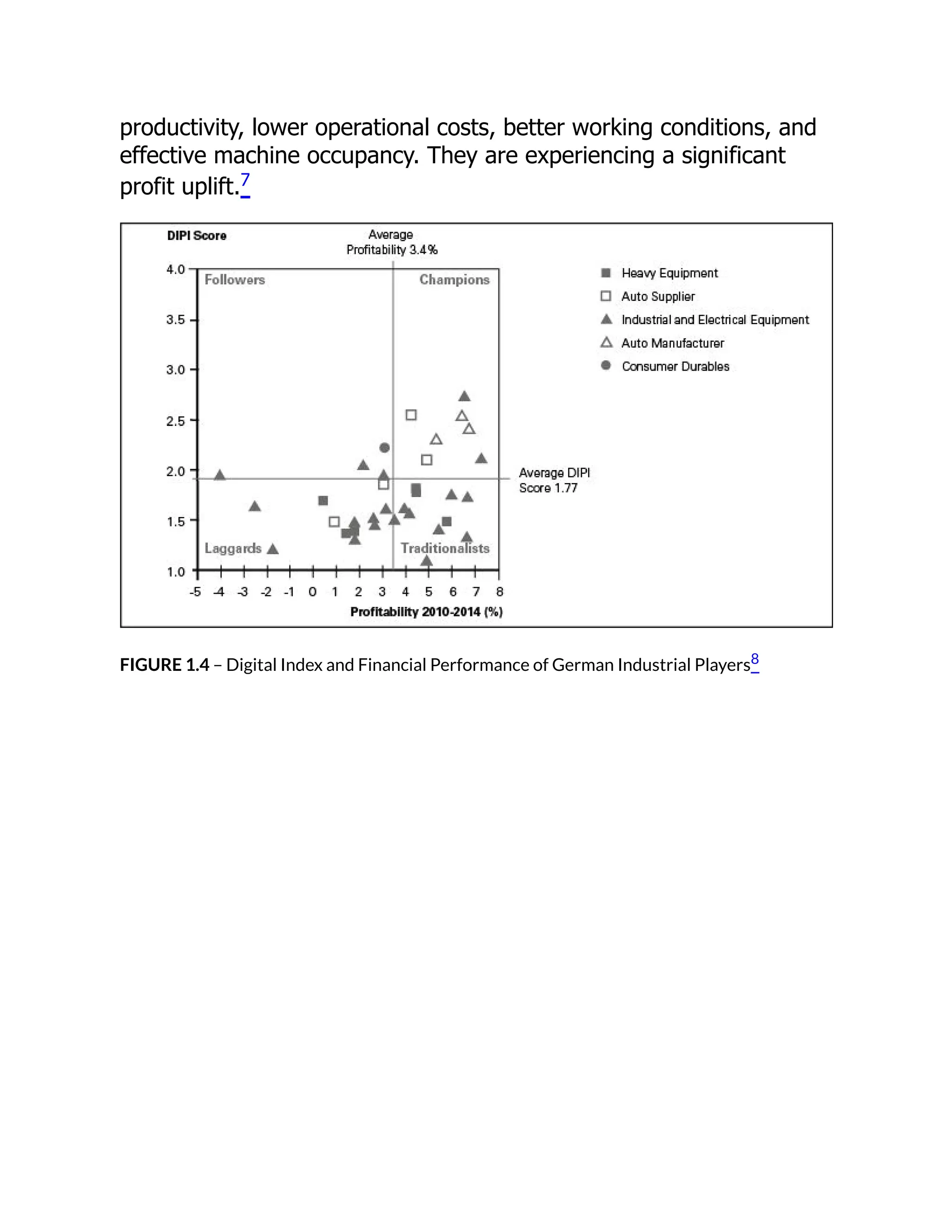
  • 27.
    How to UseThis Book As is probably already clear, the huge changes digitization is set to bring about in manufacturing can be as bewildering as they are fascinating. This book has been written to be your guide to this new territory. The landscape is wildly complex, but, if you know how to read them, its multitude of features provide compelling pointers for the future. Think of this, then, as something to be used – a usage manual, if you like, for the Industrial Internet of Things (IIoT). While it may serve as a general-interest primer, it is aimed mainly at those who will be actively implementing the change. It provides a clear delineation of the challenges and opportunities, and invaluable guidelines on drawing up the right digitization roadmap for your organization. Not all routes will be the same. And just as there is no fixed path towards the digitized industrial future, there is no one route through this book. Read it in order, or zero in on particular areas as you require. In this, you can be guided by this section. Be aware that each chapter can be read independently and that what is discussed in them is illustrated by company cases and with the key takeaways. Part I, comprising Chapters 1-3, is your introductory overview of the IIoT transformation, designed to help you orient yourself in the new world. Chapter 1 gives the current big picture. I look at the flurry of massively disruptive new technologies converging to create the IIoT and explain how the result will be an entirely unprecedented paradigm of manufacturing in which businesses will operate in highly unfamiliar ways. Chapter 2 shows where we’re headed, explaining how the IIoT will inevitably lead to a new kind of economy, the Outcome Economy. Chapter 3 discusses the enormous value to be gained from digitization of industry. Part II, comprising Chapters 4-9, is a series of detailed looks at
  • 28.
    the key areasa digitization strategy will need to encompass. Chapter 4 gets you started on your path towards digitization. It introduces six “no-regret” capabilities – digitally-based changes you can make now that are certain to deliver results. Chapter 5 looks at big (and ever- increasing) data, probably the single most powerful value driver in the Industry X.0 – as long as you get your data analytics right. Chapter 6 takes you through digital product development, discussing the importance of strengthening software capabilities, synchronizing software and hardware clocks, and of having a robust Digital Product Lifecycle Management (DPLM). Chapter 7 highlights the challenges of managing the human workforce in the era of roboticization and artificial intelligence. Chapter 8 is your guide to innovation in the radical new world of the IIoT, describing the four main innovator types and explaining why only one can really thrive in the Outcome Economy. Chapter 9 explains how in the IIoT’s porous, interconnected world, you will need to become part of an ecosystem and may well benefit from building a platform. Part III, Chapter 10 is a look further into the future, to 2030 and beyond, at a magical, ultra-fluid world in which products can change shape and the Outcome Economy gives way to the Pull Economy. At the end of the book you will find all the chapter takeaways – that provide a quick and easy access to the actions needed to be taken to digitize your business –, a glossary of terms and an index.
  • 29.
    Too Much Willbe Lost by Sitting on the Fence Arguing the case for digitization in the face of scepticism from staff, investors and business partners may take ingenuity, courage, stamina and lots of skills in change management on the part of executives and business leaders. It is all worth it and there is no alternative. The ground is shifting, but the industrial world’s rapid digital transformation should not to be seen as a threat. It is a major opportunity for value creation, not to mention for an incredibly dynamic and stimulating work environment. Industrial companies should seize it rather than wait and see – or risk becoming a digital laggard, resulting in low margins, weak innovation power, slow profits and even disappearance from the market. There is, contrastingly, little to fear from making a start at digitization if you take the right approach. You can and in fact should start small, scaling swiftly only if your initiative proves successful. That is the beauty of the digital era.
  • 30.
    PART I The IndustrialInternet of Things – Transforming Manufacturing Beyond Recognition
  • 31.
    01 Industry’s Ongoing and AcceleratingDigital Transformation Smartened-up and tightly connected industrial manufacturing processes are going to go mainstream in just a few years in all advanced markets and many emerging ones. A sub-segment of the Internet of Things, the Industrial Internet of Things (IIoT), will digitally orchestrate factory floors, physical products, workers and more, unleashing enormous value. However, critical to the success of this new world will be deployment of the right technology, orchestration of it in the right way, the embedding of enterprises in the right ecosystems of business partners, and last but not least, finding adequately skilled people. As is already fairly common knowledge, the Internet of Things (IoT) put very simply refers to appliances networked via digitization. Most readers will have at least a nodding acquaintance with some common examples, whether by reputation or direct experience: cars, toasters, fridges and central heating systems that can be monitored and controlled from household computers and smartphones. The Industrial Internet of Things is a key subset within the IoT, less visible than our common household objects, but with arguably far greater power to revolutionize the way the world works. It creates, via connected technologies and various platforms, highly efficient relationships between products, machines, services, and sites, but also between customers, workers, managers, suppliers and partners. It is, in short, the main bridge between the physical and digital enterprise applications enabled by the so called “fourth industrial revolution” – that is, the revolution in industry brought about by
  • 32.
    digital technology. Thisis really many revolutions in one, comprising various advances such as artificial intelligence, robots, big data analytics and, in the pipeline, quantum computing. FIGURE 1.1 – Combinatorial Effect of Technology1 The combinatorial effect of all these (Figure 1.1) is unprecedentedly seismic, probably the single most dramatic cataclysm in consumer and business goods manufacturing in human history, overhauling practically every business conviction generally held dear, whether in resource allocation, production process sequencing, materials handling, workforce involvement, customer relationship or environmental management. In a way, it is tempting to see the IIoT as actually synonymous with the fourth industrial revolution because it does so much to unify all the innovations by networking them. However, as the other examples I’ve given indicate, it is by no means the whole revolution on its own. The IIoT is, if you like, what turbocharges the combinatorial effect of these already wildly disruptive technologies by seeing them work in concert.
  • 33.
    This book isnot a comprehensive guide to the entire fourth industrial revolution – to every node of technological change that comprises it. Its focus is very much the IIoT. However, precisely because the IIoT connects the other factors, it offers a key route into understanding how to capitalize upon the whole and avoid being left behind. In particular, I will look at the innovations in connectivity and data collection that enable the IIoT alone: tech such as sensors, portable devices, the cloud, application programme interfaces (APIs) and apps. These are exploding. All this is set to shake up research and development, manufacturing, aftersales, and product and service configurations. In numerous industrial settings, the drift, albeit often tentative, has already begun towards digitally run shop floors, management processes, platforms and ecosystems. This opens up space to establish new income streams for enterprises and allows companies to set a strategic course for entirely new business models focused on delivering quality “outcomes” for customers rather than just physical products. Outcomes are another reason why the emergence of the IIoT is an event of such historical significance. It marks the end of roughly 200 years of modern industrial production habits because it relegates basic products to insignificance compared to the results they deliver at any given moment thanks to their digital connectivity. We are right at the tipping point of this change and there is simply no better time to be getting to grips with it. The entire purpose of this book is to help you do this. In this chapter I will further delineate the significance of the IIoT, giving a sense of the (relatively early) stage of development it is at now. Finally, as a sort of summary overview of the other chapters in this book, I will sketch out some key steps you need to take and concepts you need to understand to correctly position your company in the IIoT’s radically new landscape.
  • 34.
    The Drivers ofChange in the Industrial Sphere The connected, smart product is at the core of the change. The combination of smart products, services and new experiences will disrupt legacy business models and shake up the entire product value chain. Before we go any further, let’s lay out the key drivers leading the move towards the IIoT (Figure 1.2). FIGURE 1.2 – The Drivers for Change in the Industrial Landscape2 1. Pervasiveness of connected technology creates context. As shown in Figure 1.2, sensors, connectivity, APIs and data in products at commodity price levels will drive new levels of intelligence in smart products. 2. Platforms and data for optimization. Smart products, pushed to become Living Products by sophisticated embedded software, will
  • 35.
    be connected toplatforms during operations and accompanied with analytics and data-driven services to optimize their operation. 3. Ecosystems and services drive value. Data and services provided by smart products and platform ecosystem allow creation of mutually complementing value-add services and new revenue streams while the smart product is in operation. 4. Hyperpersonalization and new experiences disrupt. Smart products have the ability to hyperpersonalize, adapting to the individual product user in his or her individual context with the objective of optimizing the business outcome. Hyperpersonalization creates new experiences for the individual. This leads to a new level of competition around the combination of smart products, services and new experiences, potentially disruptive to existing business models. 5. As-a-service business models emerge. Consumption-based business models replace traditional “sell-and-maintain” business models. This involves significant changes to the balance sheet with CAPEX shifting from customer to the as-a-service provider. 6. New technologies will disrupt further. Robotics, autonomous systems, artificial intelligence and deep learning, augmented and virtual reality, 5G networks, 3/4D Printing, blockchain, and other new technologies will reach industrial strength and radically impact the way products are engineered, manufactured and operated. 7. Security and data privacy ensure resilience and fairness. Progress in industrial-strength security, data ownership and sharing, and data privacy solutions are a prerequisite for the IIoT. Security solutions will be engineered to provide resilience during cyber attacks and new principles around data sharing will ensure fairness between stakeholders.
  • 36.
    Technology Becomes Affordableand Puts Speed Behind the IIoT Why is the current moment in the development of the IIoT so crucial? Because of the standard pattern by which innovations often reach maturity and marketability: IIoT technology has simultaneously become cheaper and its sophistication has increased, making it ready to go mainstream. Production costs and market prices have tumbled to commodity levels over the last two decades or so for many technologies critical to the IIoT: cloud computing services, processing power, storage space, analytics tools, mobile connectivity, and components such as sensors. Prices have fallen by up to a factor of 50 compared to only a few years ago (see Figure 1.3). Concurrently, new waves of innovation have succeeded their predecessors with exceptional and increasing speed, shortening the window within which to absorb and adapt to the changes. FIGURE 1.3 – A Decade of Eroding Cost Fuels the Rise of the Internet of Things3 All this greatly increases both the feasibility and attractiveness of new investment cases unthinkable only a few years ago. A small
  • 37.
    ironmonger operating anassembly line in an urban backyard, for instance, can now buy software-controlled sensor kits to apply a basic form of predictive analytics for lathe maintenance or managing energy consumption. Such small-scale entrepreneurs will probably soon be using process engineering equipment that, not long ago, existed only in research laboratories or would have cost a fortune to integrate into ordinary factory floors. The potential for rendering old-style enterprise arrangements smart from end-to-end, then, is huge. Research anticipates that around two thirds of today’s companies can easily boost efficiency and value via a gradual introduction of digitized processes, as many of their departments have barely been put on a digital footing at all over the last decades. This will soon streamline and optimize businesses around the world and pump trillions of dollars of income into the economy. In that perspectie the IIoT is probably the greatest compound value proposition industrial manufacturers have ever been offered.
  • 38.
    The Value ofthe IIoT is Still to be Unlocked One can get a sense of the IIoT’s potential for value creation by looking at where the new smart technology is already embedded in efficient set-ups. Advantages such as greater visibility of processes, much more efficient data utilization, and the intertwining of underlying systems and sub-processes can boost unit cost ratios, workforce flexibility and product quality by several orders of magnitude. Consider the technology known as Predictive Maintenance: data is collected from machinery and used to predict future maintenance stops. This helps to save up to 12 percent in repair costs and reduces overall maintenance cost by up to 30 percent.4 Or take predictive analytics, born of machine-installed sensors and intelligent diagnostic software, which reduces machine breakdowns by a whopping 70 percent.5 Hardly any previous technological advance has been able boast productivity gains of this magnitude. The big picture estimates are at least equally stunning. By adopting digitally controlled business and manufacturing processes, global factories are set to secure $100tn of combined value for society and industry by 2025.6 This should even make manufacturing sufficiently competitive for substantial operations to be relocated from the lower-cost emerging world back to highly industrialized western countries. That should push new-growth nations to quickly develop their own digital industrial base in order to remain competitive. More generally, it’s a clear indication that no one can afford to ignore the onward march of the IIoT. The few early-adopters who are significantly realizing IIoT – aircraft or car manufacturers and mining operators being good examples – already significantly realizing IIoT enjoy higher
  • 39.
    productivity, lower operationalcosts, better working conditions, and effective machine occupancy. They are experiencing a significant profit uplift.7 FIGURE 1.4 – Digital Index and Financial Performance of German Industrial Players8
  • 40.
    Ecosystems Form PowerfulWells of Innovation While many of my remarks already suggest this, I should emphasize that deploying smart manufacturing solutions yields a lot more than just a few insular, one-dimensional efficiency gains reflected in profit and loss accounts. This is precisely because the IIoT is itself multi- dimensional, comprising so many innovations in concert. Compared with individual innovations, the network effect here means that the value horizon is exponentially larger and vastly more transformative. Technological transformation is the basis, but it leads, as inevitably as water flowing downhill, to interconnected changes in products, services, strategies, processes and, crucially, relationships between businesses and sectors. Smart manufacturing will, by definition, not evolve in the form of isolated beacon projects. It is the nature of these radical new production set-ups to emerge in sector context – thriving best in expanding ecosystems within and across industries. In other words, the innovations that work in concert will be achieved through and give rise to innovation processes that also happen in concert. The more adequate and user experience-oriented IIoT technology you and your partners have in your process chains, components and products, the more everyone will be able to introduce new business models based on service offerings that mutually augment physical products and tap collectively into new revenue streams. As you phase in IIoT-enabled processes, you will have no choice but to open up your existing business model step by step in thorough and irreversible ways. Your enterprise will eventually be embedded in a myriad of flexibly evolving digital relationships with other parties. Your own digitization’s pace will depend on the ebb and flow of your customers’, partners’, and suppliers’ parallel processes. You will, in short, have to get used to progress in step
  • 41.
    with your variousecosystem partners. Managing such ecosystems, harnessing Open Innovation flows among their constituents and breaking down silos, will thus become critical capabilities for business leaders. Competition to be part of the best-performing ecosystems will almost certainly be even stronger than the rivalry around individual product markets. Following this path, you will eventually build the capacity to morph from a more traditional product-oriented manufacturer into a provider of measurable outcomes: complex bundles of services, hardware, and experience.
  • 42.
    Exploring the Varietyof Random Documents with Different Content
  • 43.
    *** END OFTHE PROJECT GUTENBERG EBOOK BLUE RIDGE PARKWAY, VIRGINIA AND NORTH CAROLINA (1949) *** Updated editions will replace the previous one—the old editions will be renamed. Creating the works from print editions not protected by U.S. copyright law means that no one owns a United States copyright in these works, so the Foundation (and you!) can copy and distribute it in the United States without permission and without paying copyright royalties. Special rules, set forth in the General Terms of Use part of this license, apply to copying and distributing Project Gutenberg™ electronic works to protect the PROJECT GUTENBERG™ concept and trademark. Project Gutenberg is a registered trademark, and may not be used if you charge for an eBook, except by following the terms of the trademark license, including paying royalties for use of the Project Gutenberg trademark. If you do not charge anything for copies of this eBook, complying with the trademark license is very easy. You may use this eBook for nearly any purpose such as creation of derivative works, reports, performances and research. Project Gutenberg eBooks may be modified and printed and given away—you may do practically ANYTHING in the United States with eBooks not protected by U.S. copyright law. Redistribution is subject to the trademark license, especially commercial redistribution. START: FULL LICENSE
  • 44.
    THE FULL PROJECTGUTENBERG LICENSE
  • 45.
    PLEASE READ THISBEFORE YOU DISTRIBUTE OR USE THIS WORK To protect the Project Gutenberg™ mission of promoting the free distribution of electronic works, by using or distributing this work (or any other work associated in any way with the phrase “Project Gutenberg”), you agree to comply with all the terms of the Full Project Gutenberg™ License available with this file or online at www.gutenberg.org/license. Section 1. General Terms of Use and Redistributing Project Gutenberg™ electronic works 1.A. By reading or using any part of this Project Gutenberg™ electronic work, you indicate that you have read, understand, agree to and accept all the terms of this license and intellectual property (trademark/copyright) agreement. If you do not agree to abide by all the terms of this agreement, you must cease using and return or destroy all copies of Project Gutenberg™ electronic works in your possession. If you paid a fee for obtaining a copy of or access to a Project Gutenberg™ electronic work and you do not agree to be bound by the terms of this agreement, you may obtain a refund from the person or entity to whom you paid the fee as set forth in paragraph 1.E.8. 1.B. “Project Gutenberg” is a registered trademark. It may only be used on or associated in any way with an electronic work by people who agree to be bound by the terms of this agreement. There are a few things that you can do with most Project Gutenberg™ electronic works even without complying with the full terms of this agreement. See paragraph 1.C below. There are a lot of things you can do with Project Gutenberg™ electronic works if you follow the terms of this agreement and help preserve free future access to Project Gutenberg™ electronic works. See paragraph 1.E below.
  • 46.
    1.C. The ProjectGutenberg Literary Archive Foundation (“the Foundation” or PGLAF), owns a compilation copyright in the collection of Project Gutenberg™ electronic works. Nearly all the individual works in the collection are in the public domain in the United States. If an individual work is unprotected by copyright law in the United States and you are located in the United States, we do not claim a right to prevent you from copying, distributing, performing, displaying or creating derivative works based on the work as long as all references to Project Gutenberg are removed. Of course, we hope that you will support the Project Gutenberg™ mission of promoting free access to electronic works by freely sharing Project Gutenberg™ works in compliance with the terms of this agreement for keeping the Project Gutenberg™ name associated with the work. You can easily comply with the terms of this agreement by keeping this work in the same format with its attached full Project Gutenberg™ License when you share it without charge with others. 1.D. The copyright laws of the place where you are located also govern what you can do with this work. Copyright laws in most countries are in a constant state of change. If you are outside the United States, check the laws of your country in addition to the terms of this agreement before downloading, copying, displaying, performing, distributing or creating derivative works based on this work or any other Project Gutenberg™ work. The Foundation makes no representations concerning the copyright status of any work in any country other than the United States. 1.E. Unless you have removed all references to Project Gutenberg: 1.E.1. The following sentence, with active links to, or other immediate access to, the full Project Gutenberg™ License must appear prominently whenever any copy of a Project Gutenberg™ work (any work on which the phrase “Project Gutenberg” appears, or with which the phrase “Project Gutenberg” is associated) is accessed, displayed, performed, viewed, copied or distributed:
  • 47.
    This eBook isfor the use of anyone anywhere in the United States and most other parts of the world at no cost and with almost no restrictions whatsoever. You may copy it, give it away or re-use it under the terms of the Project Gutenberg License included with this eBook or online at www.gutenberg.org. If you are not located in the United States, you will have to check the laws of the country where you are located before using this eBook. 1.E.2. If an individual Project Gutenberg™ electronic work is derived from texts not protected by U.S. copyright law (does not contain a notice indicating that it is posted with permission of the copyright holder), the work can be copied and distributed to anyone in the United States without paying any fees or charges. If you are redistributing or providing access to a work with the phrase “Project Gutenberg” associated with or appearing on the work, you must comply either with the requirements of paragraphs 1.E.1 through 1.E.7 or obtain permission for the use of the work and the Project Gutenberg™ trademark as set forth in paragraphs 1.E.8 or 1.E.9. 1.E.3. If an individual Project Gutenberg™ electronic work is posted with the permission of the copyright holder, your use and distribution must comply with both paragraphs 1.E.1 through 1.E.7 and any additional terms imposed by the copyright holder. Additional terms will be linked to the Project Gutenberg™ License for all works posted with the permission of the copyright holder found at the beginning of this work. 1.E.4. Do not unlink or detach or remove the full Project Gutenberg™ License terms from this work, or any files containing a part of this work or any other work associated with Project Gutenberg™. 1.E.5. Do not copy, display, perform, distribute or redistribute this electronic work, or any part of this electronic work, without prominently displaying the sentence set forth in paragraph 1.E.1
  • 48.
    with active linksor immediate access to the full terms of the Project Gutenberg™ License. 1.E.6. You may convert to and distribute this work in any binary, compressed, marked up, nonproprietary or proprietary form, including any word processing or hypertext form. However, if you provide access to or distribute copies of a Project Gutenberg™ work in a format other than “Plain Vanilla ASCII” or other format used in the official version posted on the official Project Gutenberg™ website (www.gutenberg.org), you must, at no additional cost, fee or expense to the user, provide a copy, a means of exporting a copy, or a means of obtaining a copy upon request, of the work in its original “Plain Vanilla ASCII” or other form. Any alternate format must include the full Project Gutenberg™ License as specified in paragraph 1.E.1. 1.E.7. Do not charge a fee for access to, viewing, displaying, performing, copying or distributing any Project Gutenberg™ works unless you comply with paragraph 1.E.8 or 1.E.9. 1.E.8. You may charge a reasonable fee for copies of or providing access to or distributing Project Gutenberg™ electronic works provided that: • You pay a royalty fee of 20% of the gross profits you derive from the use of Project Gutenberg™ works calculated using the method you already use to calculate your applicable taxes. The fee is owed to the owner of the Project Gutenberg™ trademark, but he has agreed to donate royalties under this paragraph to the Project Gutenberg Literary Archive Foundation. Royalty payments must be paid within 60 days following each date on which you prepare (or are legally required to prepare) your periodic tax returns. Royalty payments should be clearly marked as such and sent to the Project Gutenberg Literary Archive Foundation at the address specified in Section 4, “Information
  • 49.
    about donations tothe Project Gutenberg Literary Archive Foundation.” • You provide a full refund of any money paid by a user who notifies you in writing (or by e-mail) within 30 days of receipt that s/he does not agree to the terms of the full Project Gutenberg™ License. You must require such a user to return or destroy all copies of the works possessed in a physical medium and discontinue all use of and all access to other copies of Project Gutenberg™ works. • You provide, in accordance with paragraph 1.F.3, a full refund of any money paid for a work or a replacement copy, if a defect in the electronic work is discovered and reported to you within 90 days of receipt of the work. • You comply with all other terms of this agreement for free distribution of Project Gutenberg™ works. 1.E.9. If you wish to charge a fee or distribute a Project Gutenberg™ electronic work or group of works on different terms than are set forth in this agreement, you must obtain permission in writing from the Project Gutenberg Literary Archive Foundation, the manager of the Project Gutenberg™ trademark. Contact the Foundation as set forth in Section 3 below. 1.F. 1.F.1. Project Gutenberg volunteers and employees expend considerable effort to identify, do copyright research on, transcribe and proofread works not protected by U.S. copyright law in creating the Project Gutenberg™ collection. Despite these efforts, Project Gutenberg™ electronic works, and the medium on which they may be stored, may contain “Defects,” such as, but not limited to, incomplete, inaccurate or corrupt data, transcription errors, a copyright or other intellectual property infringement, a defective or
  • 50.
    damaged disk orother medium, a computer virus, or computer codes that damage or cannot be read by your equipment. 1.F.2. LIMITED WARRANTY, DISCLAIMER OF DAMAGES - Except for the “Right of Replacement or Refund” described in paragraph 1.F.3, the Project Gutenberg Literary Archive Foundation, the owner of the Project Gutenberg™ trademark, and any other party distributing a Project Gutenberg™ electronic work under this agreement, disclaim all liability to you for damages, costs and expenses, including legal fees. YOU AGREE THAT YOU HAVE NO REMEDIES FOR NEGLIGENCE, STRICT LIABILITY, BREACH OF WARRANTY OR BREACH OF CONTRACT EXCEPT THOSE PROVIDED IN PARAGRAPH 1.F.3. YOU AGREE THAT THE FOUNDATION, THE TRADEMARK OWNER, AND ANY DISTRIBUTOR UNDER THIS AGREEMENT WILL NOT BE LIABLE TO YOU FOR ACTUAL, DIRECT, INDIRECT, CONSEQUENTIAL, PUNITIVE OR INCIDENTAL DAMAGES EVEN IF YOU GIVE NOTICE OF THE POSSIBILITY OF SUCH DAMAGE. 1.F.3. LIMITED RIGHT OF REPLACEMENT OR REFUND - If you discover a defect in this electronic work within 90 days of receiving it, you can receive a refund of the money (if any) you paid for it by sending a written explanation to the person you received the work from. If you received the work on a physical medium, you must return the medium with your written explanation. The person or entity that provided you with the defective work may elect to provide a replacement copy in lieu of a refund. If you received the work electronically, the person or entity providing it to you may choose to give you a second opportunity to receive the work electronically in lieu of a refund. If the second copy is also defective, you may demand a refund in writing without further opportunities to fix the problem. 1.F.4. Except for the limited right of replacement or refund set forth in paragraph 1.F.3, this work is provided to you ‘AS-IS’, WITH NO OTHER WARRANTIES OF ANY KIND, EXPRESS OR IMPLIED,
  • 51.
    INCLUDING BUT NOTLIMITED TO WARRANTIES OF MERCHANTABILITY OR FITNESS FOR ANY PURPOSE. 1.F.5. Some states do not allow disclaimers of certain implied warranties or the exclusion or limitation of certain types of damages. If any disclaimer or limitation set forth in this agreement violates the law of the state applicable to this agreement, the agreement shall be interpreted to make the maximum disclaimer or limitation permitted by the applicable state law. The invalidity or unenforceability of any provision of this agreement shall not void the remaining provisions. 1.F.6. INDEMNITY - You agree to indemnify and hold the Foundation, the trademark owner, any agent or employee of the Foundation, anyone providing copies of Project Gutenberg™ electronic works in accordance with this agreement, and any volunteers associated with the production, promotion and distribution of Project Gutenberg™ electronic works, harmless from all liability, costs and expenses, including legal fees, that arise directly or indirectly from any of the following which you do or cause to occur: (a) distribution of this or any Project Gutenberg™ work, (b) alteration, modification, or additions or deletions to any Project Gutenberg™ work, and (c) any Defect you cause. Section 2. Information about the Mission of Project Gutenberg™ Project Gutenberg™ is synonymous with the free distribution of electronic works in formats readable by the widest variety of computers including obsolete, old, middle-aged and new computers. It exists because of the efforts of hundreds of volunteers and donations from people in all walks of life. Volunteers and financial support to provide volunteers with the assistance they need are critical to reaching Project Gutenberg™’s goals and ensuring that the Project Gutenberg™ collection will
  • 52.
    remain freely availablefor generations to come. In 2001, the Project Gutenberg Literary Archive Foundation was created to provide a secure and permanent future for Project Gutenberg™ and future generations. To learn more about the Project Gutenberg Literary Archive Foundation and how your efforts and donations can help, see Sections 3 and 4 and the Foundation information page at www.gutenberg.org. Section 3. Information about the Project Gutenberg Literary Archive Foundation The Project Gutenberg Literary Archive Foundation is a non-profit 501(c)(3) educational corporation organized under the laws of the state of Mississippi and granted tax exempt status by the Internal Revenue Service. The Foundation’s EIN or federal tax identification number is 64-6221541. Contributions to the Project Gutenberg Literary Archive Foundation are tax deductible to the full extent permitted by U.S. federal laws and your state’s laws. The Foundation’s business office is located at 809 North 1500 West, Salt Lake City, UT 84116, (801) 596-1887. Email contact links and up to date contact information can be found at the Foundation’s website and official page at www.gutenberg.org/contact Section 4. Information about Donations to the Project Gutenberg Literary Archive Foundation Project Gutenberg™ depends upon and cannot survive without widespread public support and donations to carry out its mission of increasing the number of public domain and licensed works that can be freely distributed in machine-readable form accessible by the widest array of equipment including outdated equipment. Many
  • 53.
    small donations ($1to $5,000) are particularly important to maintaining tax exempt status with the IRS. The Foundation is committed to complying with the laws regulating charities and charitable donations in all 50 states of the United States. Compliance requirements are not uniform and it takes a considerable effort, much paperwork and many fees to meet and keep up with these requirements. We do not solicit donations in locations where we have not received written confirmation of compliance. To SEND DONATIONS or determine the status of compliance for any particular state visit www.gutenberg.org/donate. While we cannot and do not solicit contributions from states where we have not met the solicitation requirements, we know of no prohibition against accepting unsolicited donations from donors in such states who approach us with offers to donate. International donations are gratefully accepted, but we cannot make any statements concerning tax treatment of donations received from outside the United States. U.S. laws alone swamp our small staff. Please check the Project Gutenberg web pages for current donation methods and addresses. Donations are accepted in a number of other ways including checks, online payments and credit card donations. To donate, please visit: www.gutenberg.org/donate. Section 5. General Information About Project Gutenberg™ electronic works Professor Michael S. Hart was the originator of the Project Gutenberg™ concept of a library of electronic works that could be freely shared with anyone. For forty years, he produced and distributed Project Gutenberg™ eBooks with only a loose network of volunteer support.
  • 54.
    Project Gutenberg™ eBooksare often created from several printed editions, all of which are confirmed as not protected by copyright in the U.S. unless a copyright notice is included. Thus, we do not necessarily keep eBooks in compliance with any particular paper edition. Most people start at our website which has the main PG search facility: www.gutenberg.org. This website includes information about Project Gutenberg™, including how to make donations to the Project Gutenberg Literary Archive Foundation, how to help produce our new eBooks, and how to subscribe to our email newsletter to hear about new eBooks.